
mike mulvihill

Why TV viewers had a love affair with the World Cup

Coverage of the 2026 FIFA World Cup on Fox and Telemundo became the ratings smash of the summer.

Fox TV executives knew their telecast of Sunday’s 2026 FIFA World Cup Final would be big.

But bigger than every NFL game outside of the Super Bowl, the perennial ratings blockbuster, was not on their radar.

“I have to admit that I didn’t see it coming, that we and Telemundo would combine for almost 65 million viewers for the final,” Mike Mulvihill, executive vice president and head of strategy and analytics for Fox Sports. “That’s beyond what we could have hoped for.”

Spain’s World Cup victory over Argentina by a 1-0 score attracted the largest audience for any sports telecast outside of the Super Bowl since the 1994 Winter Olympics when Nancy Kerrigan and Tonya Harding competed in the women’s figure skating short program.

The 38.9 million viewers who tuned in on Fox was enough to make the final the most-watched soccer telecast in history. Telemundo’s coverage set the record for a Spanish language soccer telecast with 23.9 million viewers.

It capped a month of massive viewing for the quadrennial tournament. In the United States,128.4 million people watched some portion of the World Cup across Fox’s broadcast network, its cable outlet FS1 and streaming platform Tubi. The 104 matches averaged a record high 7.7 million viewers, a 116% increase over the 2022 World Cup in Qatar.

Spanish language coverage on NBCUniversal’s Telemundo and the Peacock streaming platform combined to average 6.3 million viewers across the 104 matches, up 143% over the 2022 tournament.

Ad revenues for the tournament topped $1.2 billion, according to data from Guideline, which tracks media spending.

Having the tournament in the U.S. with games airing in daytime and prime time helped. Mulvihill noted the tournament came up at a fortunate time on the sports viewing calendar. The NBA Finals were over and Major League Baseball’s post-season and the NFL season are months away.

But even with that soft competition for sports fans’ attention, the World Cup demonstrated an ability to bring in viewers who don’t follow the sport. Fox data showed 53% of viewers who tuned into its coverage had not watched any soccer in the past year. The network’s research found that a majority of U.S. sports fans could name only two stars, Cristiano Ronaldo and Lionel Messi, and their home countries.

What brought the audience in? Mulvihill credits social media, which tends to be an angry place during big sporting events. The lead up to the World Cup was no different, but the doom and gloom went away once the action began.

“There was a lot of negativity around this tournament on social as there always is about everything related to the cost of tickets and related to challenges that foreign visitors might face coming to the U.S.,” Mulvihill noted. “As soon as the ball was kicked, and the matches were in progress, that just completely pivoted to overwhelming positivity.”

Patrick Rishe, director of the sports business program at Washington University in St. Louis, said the global reach of social media made the international stars accessible to U.S. fans and created a “fear of missing out” effect that likely drove them to watch.

“There is a communal aspect of soccer, in particular, where you can be in a room with people wearing 10 different colored jerseys, and they all just kind of get into the camaraderie of it, and the highs and lows of it, and the drama of it,” Rishe said. “So even if you don’t have rooting interests, it’s just fun to be a part of it.”

The appeal of communal viewing showed up in the Nielsen data. Out-of-home viewing accounted for 27% of the audience. For Sunday’s final, the figure was 35%

People were having viewing parties or gatherings at home as well. An average of 1.955 viewers per home watched the World Cup. The figure for last year’s regular season NFL games was 1.685 viewers.

The question going forward is whether the World Cup will spur more interest in soccer in the U.S. Major League Soccer has reportedly seen significant increases in ticket sales. The league, which has most of its matches on Apple TV, launched an ad campaign with the tagline, “Thanks World, We’ll Take It From Here.”

Versant acquired the rights to carry 300 Bundesliga matches. The company’s USA Network will carry at least 30 matches from the German domestic league, with the rest streaming on the company’s free Fandango platform. The league was previously available on ESPN’s streaming service, which required a subscription.

Telemundo acquired the Spanish-language TV rights to the Union of European Football Assns. men’s club competitions, including the Champions League.

Fox paid $485 million for the rights to the 2026 World Cup, while Telemundo shelled out $600 million for the Spanish-language telecasts.

But the real prize is the rights for the 2030 World Cup, which both TV networks and streamers are expected to vigorously pursue, even though the time zones will not be as hospitable to the U.S. (The host countries are Morocco, Portugal, and Spain.)

During a recent appearance at the CNBC Sport x Boardroom Game Plan Summit in New York, ESPN Chairman Jimmy Pitaro made it clear where he stands.

“Of course we’re interested,” Pitaro said. “This has been a juggernaut. We’re not at all surprised by it.”
Source link

Early TV ratings for 2026 World Cup set records for Fox, Telemundo

Argentina’s Lionel Messi isn’t the only one scoring in the 2026 FIFA World Cup.

Fox and Telemundo are off to a blazing start in the TV ratings for the quadrennial soccer tournament, delivering big increases over the 2022 World Cup held in Qatar.

Through the first 16 group stage matches, an average of 6 million viewers have watched on Fox and cable network FS1 cable network, a 128% increase over the 2022 FIFA World Cup according to Nielsen data.

The first 12 group stage matches of the tournament drew an average of 7.5 million viewers on the Comcast-owned Spanish language network Telemundo, a 234% increase from four years ago. The Telemundo telecasts are also streamed on Peacock.

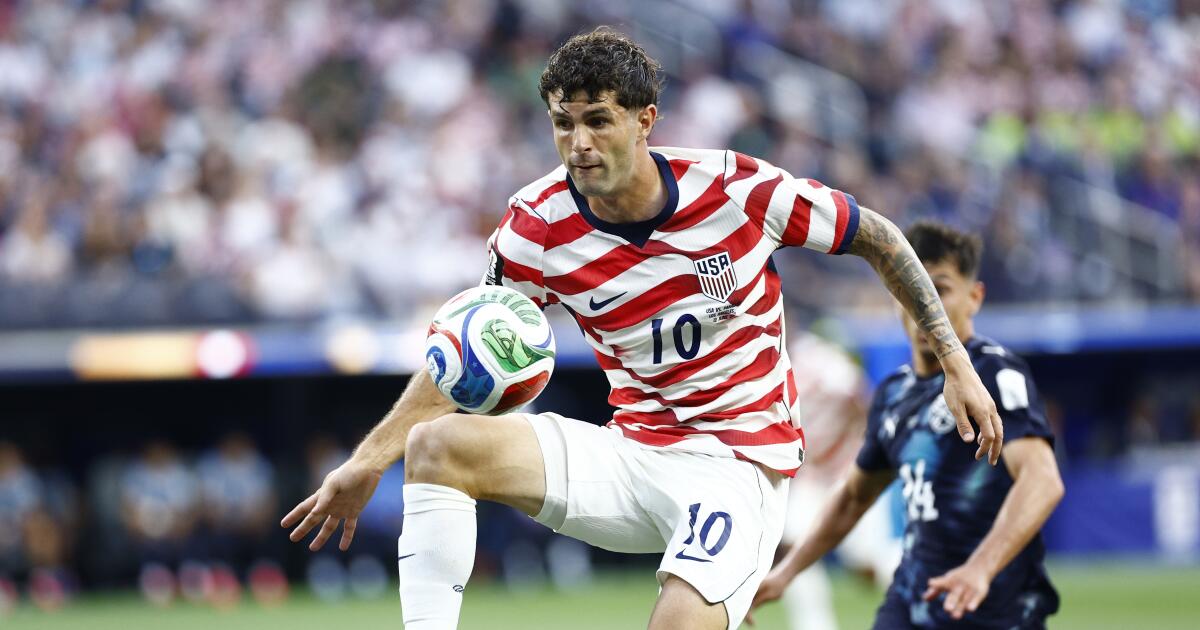
The U.S. Men’s National Soccer Team’s opening match against Paraguay held Friday at SoFi Stadium set a record for the most-watched World Cup game on both and English and Spanish language television. The match scored 18 million viewers on Fox and its streaming platforms, while Telemundo’s telecast averaged 9.5 million.

The early ratings show the enduring power of live sporting events and their ability to draw mass audiences at a time when streaming video has splintered viewership . Scripted hit prime time TV shows need seven days or more of viewing on demand to reach the audience levels the World Cup is attracting in real time.

“Having this World Cup in North America clearly has a huge impact on ratings,” said Patrick Rishe, director of the sports business program at Washington University in St. Louis.

World Cup matches held in the U.S. for the first time since 1994 helps — and a competitive USNMT playing in front of home crowds could turbocharge the ratings to even bigger heights. Fox is expecting another record when the team plays its third group stage match in prime time on June 25.

Some sports media pundits have been citing the addition of out-of-home viewing and internet-connected televisions to Nielsen data as the reason sports ratings have been on the rise. But Mike Mulvihill, president of insights and analytics for Fox Sports, asserts that the viewers have been there all along.

“For many years, the numbers were under-counted and what we’re seeing now is a truer representation of the sports audience,” Mulvihill said in a recent interview. “You just cannot overstate what it means to us to be able to capture all that viewing that’s happening at fan fests, in bars and at smaller watch parties.”

Out-of-home viewing boosted the audience levels for Mexico’s inaugural World Cup match on June 11 by 50%, and contributed several million viewers to the total for the USMNT opener.

Mulvihill projects that by the end of the tournament, 150 million people will have watched some portion of Fox’s 2026 FIFA World Cup coverage. The figure approaches the 170 million people Fox reaches with a slate of regular season NFL games.

“For us, it’s like having two NFL seasons in a single year,” Mulvihill said.

Fox will be able to capitalize on the strong numbers for the early matches. Networks typically hold back some commercial inventory for big events in case audience levels fall short of what advertisers are guaranteed. Fox has surpassed those expectations and can now go back into the marketplace to sell available commercials for the later rounds, most likely for more than what was paid before the tournament.

The 2026 World Cup may also be benefiting from a viewing public that wants a distraction from the ongoing political discord in the U.S. and war in the Middle East.

“Sports still remains the one thing we can all kind of talk about and disagree about without it being divisive,” said Lisa Delpy Neirotti, director of the sports management program at the George Washington University School of Business.

Delphy Neirotti believes the World Cup has some momentum from the NBA Finals, which averaged 20.6 million viewers on ABC for the New York Knicks’ triumph over the San Antonio Spurs, The feel-good story of the Knicks winning their first championship in 53 years delivered the most-watched Finals since 1998 and put fans in the mood for more action.

“Fans were already primed up, meeting with friends, watching sports and now they can continue that camaraderie and that collective experience,” Delphy Neirotti said. “They want to be with community.”

The combined numbers for Fox and Telemundo are highest in Los Angeles, which in addition to a large Latino population has 500,000 Iranians. An average audience of 4.7 million viewers watched the Iranian national team play to a 2-2 tie against New Zealand on Monday, the second most-watched match ever on Fox Sports 1.

But there are plenty of World Cup fans in the heartland. Kansas City had the highest local rating for Fox’s coverage of the USMNT’s match, with more than 9% of the market’s homes tuning in.

Kansas City hosted its first World Cup match Tuesday at Arrowhead Stadium, where Argentina’s Messi set a tournament record with three goals in his team’s 3-0 victory over Algeria. The city has cultivated soccer fans with well-attended watch parties held in its Power and Light District.

“The watch parties that they’ve planned out throughout their cities to give people an opportunity to be part of the event, even though they’re not going to the event,” Rishe said. “Whether you’re watching or just walking by, it’s exciting.”

Source link