Miguel

Miguel Rojas’ homer propels Dodgers to series-opening win over Rays

Miguel Rojas had practiced his dance moves in the Dodgers dugout Monday, long before he hit the go-ahead home run. Before the game, he strutted around, at one point even grabbing Dalton Rushing, decked in full catcher’s gear, to get hyped.

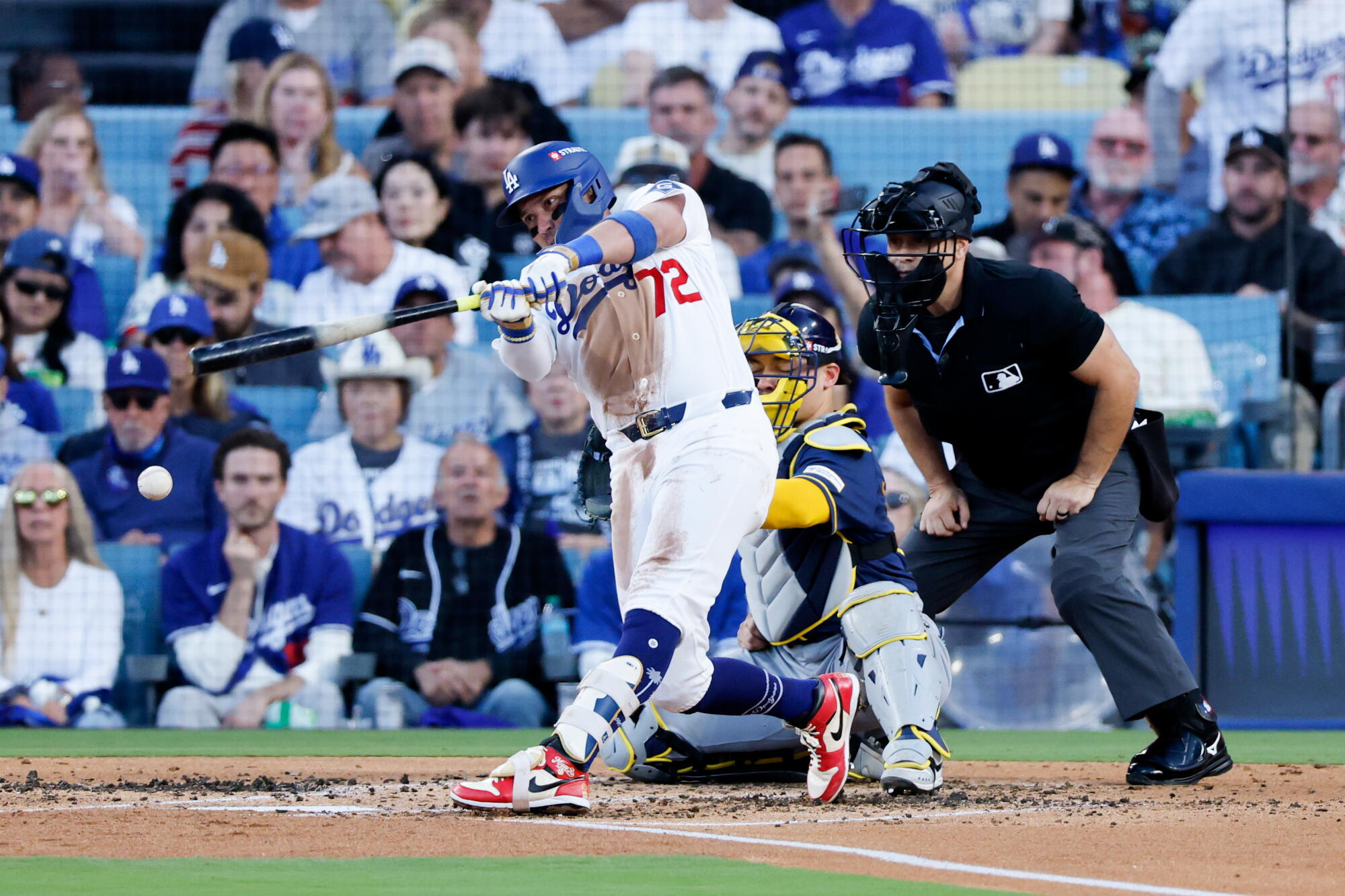
Rojas, who pinch-hit for Alex Freeland in the bottom of the seventh and homered to center, was more measured as he crossed the plate without any antics. His veteran steadiness never indicated that he‘d hit a pinch-hit home run only one other time in his career.

The Dodgers’ 4-3 win over Tampa Bay rid them of their middling road performance. The team split a six-game trip, capped by a Sunday loss to the Chicago White Sox, before returning home.

No one found more immediate success than Kyle Tucker, who temporarily put his .227 batting average on the trip in the rearview mirror. For how long remains a question. Tucker’s season so far has looked more like a teenager testing out their driver’s license: stopping and starting and stopping again. Yet everything seemed to be working when the Dodgers (46-27) beat the Rays (41-28).

Of the five Dodgers who’ve played at least 60 games, Tucker has the lowest batting average (.238). Still, he battled in an eight-pitch duel in the second inning before taking a changeup 384 feet over the wall in right-center. His home run tied the score at three apiece, and Tucker wasn’t finished.

The next inning, the Rays’ Ben Williamson hit a two-out single to Tucker in right field, and Tampa’s Jonathan Aranda darted around third toward home. Tucker lasered a ball to Rushing, who tagged Aranda out on the slide.

Miguel Rojas acknowledges the bullpen after homering in the seventh inning.

Miguel Rojas acknowledges the bullpen after homering in the seventh inning.

(Eric Thayer / Los Angeles Times)

The defensive play helped buoy an otherwise precarious start by pitcher Eric Lauer. The left-hander had been undefeated in three starts with the Dodgers, a large departure from the 1-5 record he had with the Toronto Blue Jays. After starting his year with a 6.69 ERA, Lauer had dropped it to 2.76 with the Dodgers.

But inconsistencies plagued Lauer’s start, ranging from the three earned runs he gave up in the first two innings to a pitch clock violation in the fourth. While Lauer eventually settled, the command of his fastball remained absent. He normally crosses the strike zone with 53.7% accuracy on his fastball, getting batters to chase about 37% of the time. In the series opener, Lauer threw his four-seamer in the zone only 42% of the time, cutting his chase rate to 23%.

In other words, the best pitch in Lauer’s arsenal became one of his worst, and the Rays took advantage. Junior Caminero doubled in the first inning, and Ryan Vilade followed with a home run on a cutter, silencing a sold-out Dodger Stadium before the game could even heat up. The Rays tacked on another run on a safety squeeze, taking the lead until Tucker’s home run. Lauer finished after six innings, giving up the three earned runs on six hits and three walks, striking out four.

Tampa Bay starter Nick Martinez fared about as well. The right-hander lasted 5-1/3 innings of three-run baseball, striking out six and walking one.

While there was movement on the bases for both starters, the game lulled until the seventh. A couple of feet separated Rushing’s foul ball from a home run. Reliever Steven Matz didn’t get so lucky with Rojas, who delivered his first homer since April 20.

Source link

U.S. sanctions Cuban leader Miguel Díaz-Canel, military, Castro kin

Cuban President Miguel Diaz-Canel was slapped with sanctions by the United States on Thursday as Washington continued to ratchet up pressure of the island nation’s communist government. File Photo by Ley Royero/EPA-EFE

June 4 (UPI) — The United States on Thursday leveled sanctions against Cuban Miguel Díaz-Canel, members of former President Raul Castro‘s family, the Cuban military and other organizations as it continued a crackdown on the country’s communist government.

Secretary of State Marco Rubio announced the measures against Diaz-Canel the others in a statement, asserting they are being targeted because they “fund the [Cuban] regime and its efforts to mobilize its radical revolutionary movements in the United States and around the world.”

The Cuban president, Rubio said, poses a threat to U.S. national security, while the Ministry of the Revolutionary Armed Forces of Cuba, with its “many majority holdings and subsidiaries,” is also now “considered blocked.”

Other organizations newly added to the sanctions list are the Cuban Institute of Friendship with the Peoples, or ICAP, Amistur Cuba S.A., Committees for the Defense of the Revolution and Minera La Victoria S.A.

The individuals sanctioned include Alejandro Castro Espin, the former head of the Cuban intelligence services and the son of Raul Castro, and Raul Alejandro Castro Calis, Castro Espin’s son.

“For decades, Cuba has been the world capital for radical left-wing terrorism,” Rubio asserted. “The regime in Havana has recruited, trained and backed violent Marxist and ‘third-worldist’ movements across our hemisphere and beyond.

“Today, we are targeting the network that enables and funds Cuba’s subversive and radical operations.”

In a stated response, Diaz-Canel said the latest sanctions are “illegitimate” and are “aimed at reinforcing the blockade measures and the scenario of conflict between Cuba and the United States.

“This political blindness is added to the coercive measures applied in recent weeks against our country, designed to harm the Cuban people,” he added. “The aggressiveness and perversity of the Yankee government will clash with our determination to confront the worst scenarios and resist the imperialist onslaught.”

The newly issued sanctions are the latest in a series of moves designed to ratchet up pressure on the Cuban government.

The Trump administration has set a Friday deadline for foreign companies to sever ties with GAESA, the business conglomerate run by Cuba’s Armed Forces, sparking a mass exodus of tourism-related businesses from the island nation.

Meanwhile, Cuba is struggling with the effects of a January 2026 executive order issued by U.S. President Donald Trump imposing a fuel blockade against the nation on national security grounds.

The move has resulted in shortages of electricity, fuel, medicine and medical supplies across Cuba, according to the U.N. Office for the Coordination of Humanitarian Affairs and the World Health Organization, which says emergency care, blood banks, laboratories, immunization programs and maternal and child health services have all been “severely disrupted.”

Source link