Prosecutors exit outpace hires, hollowing mid-level ranks

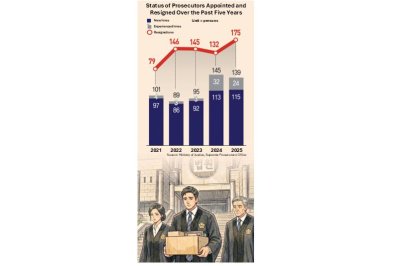
A graphic shows the number of prosecutors hired and those who resigned in South Korea from 2021 to 2025, highlighting a growing gap as resignations outpaced recruitment. Data from Ministry of Justice, Supreme Prosecutors’ Office. Graphic by Asia Today and translated by UPI
April 1 (Asia Today) — More prosecutors have left South Korea’s prosecution service than have been hired over the past five years, deepening a shortage of experienced mid-level staff and slowing investigations, according to data compiled by Asia Today.
From 2021 through 2025, 569 prosecutors were newly appointed, but 677 resigned, resulting in a net loss of 108-roughly equivalent to the full staffing level of the Seoul Southern District Prosecutors’ Office.
Most vacancies have been filled by newly appointed prosecutors rather than experienced hires. During the same period, about 90% of new recruits were first-time appointees, while experienced hires remained limited. Analysts say the gap has left the organization unable to replace departing mid-level prosecutors with personnel who have comparable investigative experience.
As a result, junior prosecutors are increasingly assigned to handle cases without sufficient on-the-job training. Legal officials say this has contributed to delays in investigations and a growing backlog of cases.
A comparison of authorized staffing levels and actual personnel in January 2025 and January 2026 shows that prosecutor positions nationwide were understaffed by about 10%. Over the past two years, all but two of the country’s 60 local prosecutors’ offices reported staffing shortages.
The imbalance has been particularly evident in 2022, 2023 and 2025, when resignations exceeded new appointments. In 2022, 89 prosecutors were appointed while 146 resigned. In 2023, 95 were appointed and 145 resigned. In 2025, 139 were appointed while 175 left the service.
Observers link the exodus to a series of prosecutorial reforms, political transitions and personnel reshuffles that have reduced job stability and increased workload pressure. Concerns over reduced investigative authority also contributed to a surge in resignations in 2022.
The outflow has been compounded by the dispatch of prosecutors to multiple special investigations, further straining frontline resources.
The Ministry of Justice has responded by accelerating recruitment and expanding the number of new appointments. It is also recruiting experienced legal professionals with at least two years of practice, with new appointees expected to begin work in May.
However, officials within the prosecution service say new hiring alone is unlikely to resolve accumulated case delays and staffing shortages, particularly as a broader restructuring-including the planned abolition of the prosecution service in October-approaches.
A Justice Ministry official said new prosecutors will be assigned to priority areas such as trial work, reducing investigative delays, judicial oversight, human rights protection, recovery of criminal proceeds and support for crime victims.
— Reported by Asia Today; translated by UPI
© Asia Today. Unauthorized reproduction or redistribution prohibited.
Original Korean report: https://www.asiatoday.co.kr/kn/view.php?key=20260402010000446