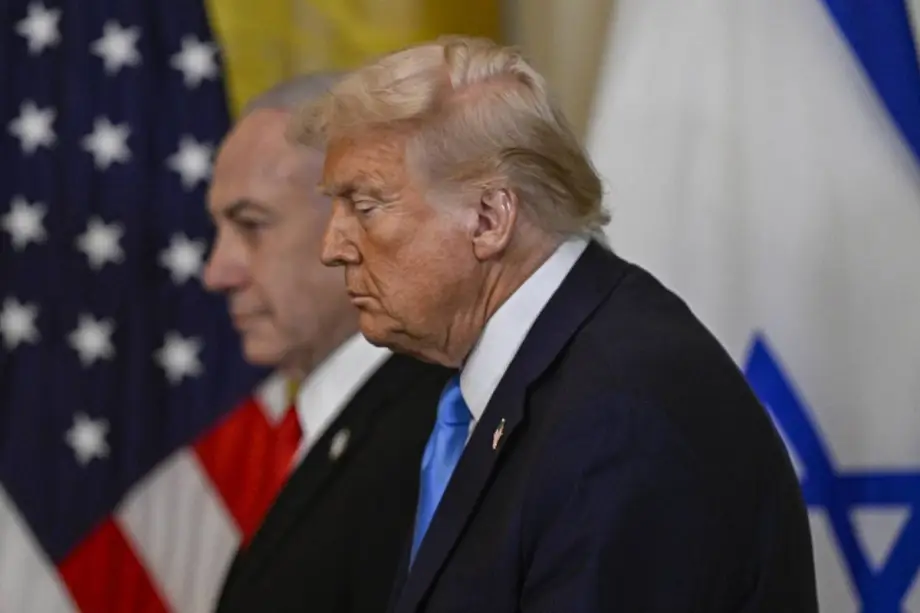
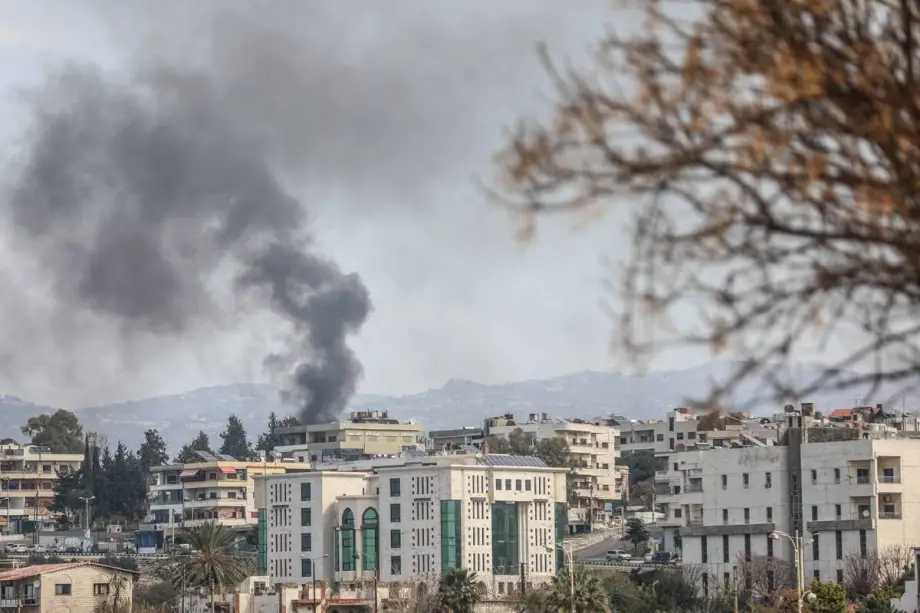
The opening ceremony of the Milano Cortina 2026 Winter Olympics on Friday was marked by audible boos from the crowd as delegations from the US and Israel entered the San Siro stadium, Anadolu reports.
US Vice President JD Vance and Secretary of State Marco Rubio led the American delegation.
As Vance appeared on the stadium’s big screen, waving the US flag, the crowd responded with jeers, according to live coverage of the event.
“There is the Vice President JD Vance and his wife Usha. Oops — those are a lot of boos for him,” an announcer was heard saying during the broadcast.
The reaction followed days of tension surrounding the participation of US Immigration and Customs Enforcement (ICE) agents in Olympic security.
The Department of Homeland Security confirmed the presence of Homeland Security Investigations personnel in Milan, prompting widespread protests and opposition from Italian lawmakers and citizens.
“They’re not welcome in Milan,” said Milan Mayor Giuseppe Sala in a radio interview, calling ICE a “militia that kills.”
Thousands gathered in Piazza 25 Aprile last weekend to demonstrate against the agents’ presence and raise concerns about civil rights violations.
International Olympic Committee President Kirsty Coventry responded to concerns ahead of the ceremony, saying: “I hope that the opening ceremony is seen by everyone as an opportunity to be respectful of each other.”
The Israeli delegation, which included nine Olympians and one Paralympian, also faced a “smattering of boos” as they entered the stadium, though the crowd noise was largely drowned out by music.
Additional protests were reported in Cortina d’Ampezzo and Predazzo, where simultaneous parades were held.
Security remains a top concern for several delegations, with increased attention to political sensitivities throughout the Games.
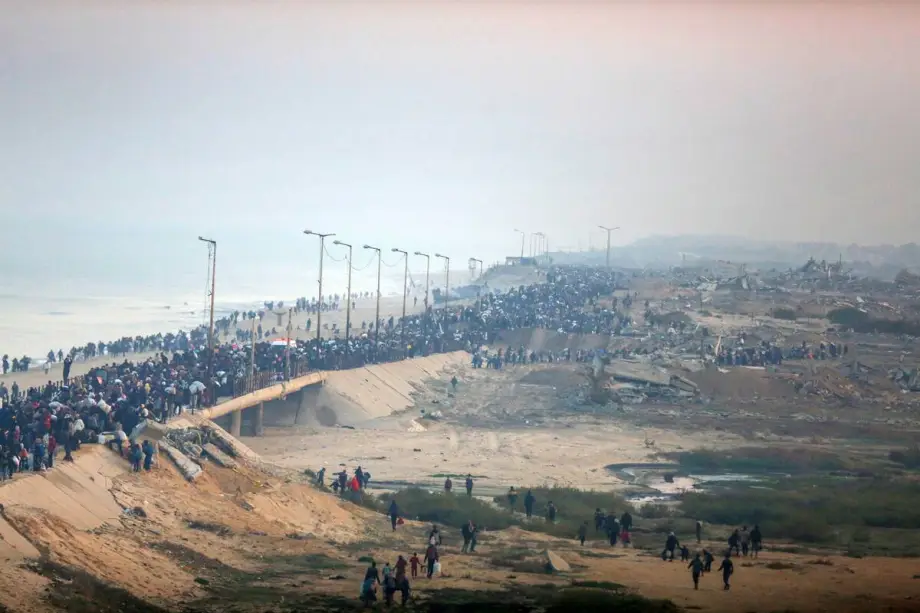
More than 800 athletes have been killed in Gaza since the start of Israel’s offensive on Oct. 7, 2023, as the sports community continues to suffer under bombardment, famine, and the collapse of infrastructure, according to Palestinian officials.
In 1948, as the foundations of the Israeli state were being laid upon the ruins of hundreds of Palestinian villages, Albert Einstein wrote a letter to the American Friends of the Fighters for the Freedom of Israel (AFFFI), condemning the growing Zionist militancy within the settler Jewish community. “When a real and final catastrophe should befall us in Palestine the first responsible for it would be the British and the second responsible for it the terrorist organisations built up from our own ranks. I am not willing to see anybody associated with those misled and criminal people.”
Einstein — perhaps the most celebrated Jewish intellectual of the 20th century — refused to conflate his Jewish identity with the violence of Zionism. He turned down the offer to become Israel’s president, rejecting the notion that Jewish survival and self-determination should come at the cost of another people’s displacement and suffering. And yet, if Einstein were alive today, his words would likely be condemned under the current definitions of anti-Semitism adopted by many Western governments and institutions, including the controversial International Holocaust Remembrance Alliance (IHRA) definition, now endorsed by most Australian universities.
Under the IHRA definition, Einstein’s outspoken criticism of Israel — he called its founding actors “terrorists” and denounced their betrayal of Jewish ethics — would render him suspect. He would be accused not only of delegitimising Israel, but also of anti-Semitism. His moral clarity, once visionary, would today be vilified.
That is why we must untangle the threads of Zionism, colonialism and human rights.
Einstein’s resistance to Zionism was not about denying Jewish belonging or rights; it was about refusing to build those rights on ethno-nationalist violence. He understood what too many people fail to grasp today: that Zionism and Judaism are not synonymous.
Zionism is a political ideology rooted in European colonial logics, one that enforces Jewish supremacy in a land shared historically by Palestinian and other Levantine peoples. To criticise this ideology is not anti-Semitic; it is, rather, a necessary act of justice and a moral act of bearing witness. The religious symbolism that Israel uses is irrelevant in this respect. And yet, in today’s political climate, any critique of Israel — no matter how grounded it might be in international law, historical fact or humanitarian concern — is increasingly branded as anti-Semitism. This conflation shields from accountability a settler-colonial state, and it silences Palestinians and their allies from speaking out on the reality of their oppression. Billions in arms sales, stolen resources and apartheid infrastructure don’t just happen; they’re the reason that legitimate “criticism” gets rebranded as “hate”.
To understand Einstein’s critique, we must confront the truth about Zionism itself. While often framed as a movement for Jewish liberation, Zionism in practice has operated as a colonial project of erasure and domination. The Nakba was not a tragic consequence of war, it was a deliberate blueprint for dispossession and disappearance. Israeli historian Ilan Pappé has detailed how David Ben-Gurion, Israel’s first Prime Minister, approved “Plan Dalet” on 10 March, 1948. This included the mass expulsion and execution of Palestinians to create a Jewish-majority state. As Ben-Gurion himself declared chillingly: “Every attack has to end with occupation, destruction and expulsion.”
This is the basis of the Zionist state that we are told not to critique.
Einstein saw this unfolding and recoiled. In another 1948 open letter to the New York Times, he and other Jewish intellectuals described Israel’s newly formed political parties — like Herut (the precursor to Likud) — as “closely akin in… organisation, methods, political philosophy and social appeal to the Nazi and Fascist parties.”
Einstein’s words were not hyperbole, they were a warning. Having fled Nazi Germany, he had direct experience with the defining traits of Nazi fascism. “From Israel’s past actions,” he wrote, “we can judge what it may be expected to do in the future.”
Einstein warned about what many still refuse to see: a state established on principles of ethnic supremacy and expulsion could never transcend its foundation ethos. Israel’s creation in occupied Palestine is Zionism in practice; it cannot endure without employing repression until resistance is erased entirely. Hence, the Nakba wasn’t a one-off event in 1948; it evolved, funded by Washington, armed by Berlin and enabled by every government that trades Palestinian blood for political favours.
Zionism cannot be separated from the broader history of European settler-colonialism. As Patrick Wolfe explains, the ideology hijacked the rhetoric of Jewish liberation to mask its colonial reality of re-nativism, with the settlers recasting themselves as “indigenous” while painting resistance as terrorism.
The father of political Zionism, Theodor Herzl, stated in his manifesto-novel Altneuland, “To build anew, I must demolish before I construct.” To him, Palestine was not seen as a shared homeland, but as a house to be razed to the ground and rebuilt by and for Jews alone. His ideology was made possible by British imperial interests to divide and dominate post-Ottoman territories. Through ethnic partition and military alliances embellished under the 1917 Balfour Declaration to the ironic Zionist-Nazi 1933 Haavara Agreement, the Zionist project aligned perfectly with the West’s goal, as per the 1916 Sykes-Picot Agreement.
Zionism is a global power structure, not a monolithic ethnic identity.
Many Jews around the world — rabbis, scholars, students and Holocaust survivors and their descendants — continue Einstein’s legacy by saying “Not in our name”. They reject the co-option of Holocaust memory to justify genocide in Gaza. They refuse to be complicit in what the Torah forbids: the theft of land and the murder of innocents. They are not “self-hating Jews”. They are the inheritors of a prophetic tradition of justice. And they are being silenced.
Perhaps the most dangerous development today is, therefore, Israel’s insistence on linking its crimes to Jewish identity. It frames civilian massacres, apartheid policies and violations of international law as acts done in the name of all Jews and Judaism. By tying the Jewish people to the crimes of a state, Israel risks exposing Jews around the world to collective blame and retaliation.
Einstein warned against this. And if Einstein’s vision teaches us anything, it is this: Justice cannot be compromised for comfort and profit. Truth must outlast repression. And freedom must belong to all. In the end, no amount of Israel’s militarisation of terminology, propaganda or geopolitical alliances can suppress a people’s resistance forever or outlast global condemnation. The only question left is: how much more blood will be spilled before justice prevails?
The struggle for clarity today is not just academic, it is existential. Without the ability to distinguish anti-Semitism from anti-Zionism, we cannot build a future where Jews and Palestinians all live in dignity, safety and peace. Reclaiming the term “Semite” in its full meaning, encompassing both Jews and Arabs, is critical. Further isolation of Arabs from their Semitic identity has enabled the dehumanisation of Palestinians and the erasure of shared Jewish-Arab histories, especially the centuries of coexistence, the Jewish-Muslim golden ages in places like Baghdad, Granada/Andalusia, Istanbul, Damascus and Cairo.
Einstein stood up for the future for us to reclaim it.
The way forward must be rooted in truth, justice and accountability. That means unequivocally opposing anti-Semitism in all its forms, but refusing to allow the term to be manipulated as a shield for apartheid, ethnic cleansing and colonial domination. It means affirming that Jewish safety must never come at the price of Palestinian freedom, and that Palestinian resistance is not hatred; it is survival.
And if Einstein would be silenced today, who will speak tomorrow?
Weekly insights and analysis on the latest developments in military technology, strategy, and foreign policy.
Even as the U.S. and Iran are scheduled to hold talks in Oman on Friday in hopes of defusing tensions between the two nations, Washington, Jerusalem and Tehran are all preparing for what could be a very violent future conflict. With the talks widely seen as a last-ditch diplomatic effort to avoid another war, the buildup of U.S. military capabilities in the region is continuing.
“While these negotiations are taking place, I would remind the Iranian regime that the president has many options at his disposal as the commander in chief of the most powerful military in history,” White House Press Secretary Karoline Leavitt told reporters at the White House Thursday afternoon.
➡️ “While these negotiations are taking place, I would remind the Iranian regime that the president has many options at his disposal as the commander in chief of the most powerful military in history,” @PressSec Karoline Leavitt says at White House. pic.twitter.com/bM7WpPq96U
Her comments followed those made Thursday morning by President Donald Trump, who continued his verbal pressure campaign against Iran.
“They’re negotiating,” Trump said during the 74th National Prayer Breakfast. “They don’t want us to hit them. You know, we have a big fleet going over there.”
“U.S. envoys Steve Witkoff and Jared Kushner, currently in Abu Dhabi, are expected to travel to Qatar to consult with Prime Minister Mohammed Abdulrahman Al Thani ahead of the talks in Oman,” according to the Jerusalem Post. At the moment, the U.S. and Iran are scheduled to talk about Tehran’s nuclear programs. Under the proposed framework for an agreement, Iran would commit to zero enrichment of uranium for three years, Al Jazeera reported.
“After that, it would agree to limit enrichment of uranium to below 1.5 percent,” the publication explained. “Its current stock of highly enriched uranium – including about 440kg (970lb) that has been enriched to 60 percent – would be transferred to a third country. The proposed framework goes beyond Iran’s nuclear program with mediators proposing that Iran should agree not to transfer weapons and technologies to its regional, non-state allies.”
BREAKING: Al Jazeera claims to have obtained the US-Iran deal framework proposed by Turkey, Qatar and Egypt:
1. Iran agrees to commit to zero uranium enrichment for 3 years, and then agrees to under 1.5% enrichment after that
2. Its stockpile of Highly Enriched Uranium would be…
A wide gap, however, remains about the ultimate outcome of these talks. While Iran wants to limit them to just its nuclear program, the Trump administration has a more comprehensive range of issues that need to be addressed.
“At the end of the day, the United States is prepared to engage, and has always been prepared to engage with Iran,” U.S. Secretary of State Marco Rubio said on Wednesday. “For talks to actually lead to something meaningful, they will have to include certain things, and that includes the range of their ballistic missiles. That includes their sponsorship of terrorist organizations across the region. That includes the nuclear program. And that includes the treatment of their own people.”
SECRETARY RUBIO on IRAN TALKS: They will have to include certain things, and that includes the range of their ballistic missiles, their sponsorship of terrorist organizations across the region, the nuclear program, the treatment of their own people.pic.twitter.com/i9i97giQSe
Trump’s initial threats against Iran came as information trickled out about the nation’s brutal crackdown on anti-regime protests that have seen upwards of 30,000 killed, according to some estimates. The unrest began in Iran on Dec. 28 over rising prices and a devalued currency that saw the rial crater now to basically nothing, as well as a devastating drought.
Turkish President Tayyip Erdogan said his country is working hard to prevent U.S.-Iran tensions from tipping the Middle East into a new conflict.
“Speaking to reporters on a return flight from a visit to Egypt, Erdogan added that talks at the level of the U.S. and Iranian leadership would be helpful after lower-level nuclear negotiations due in Oman on Friday,” Reuters reported, citing a transcript of Erdogan’s comments shared by his office on Thursday.
Turkish President Recep Tayyip Erdogan said on Thursday that Ankara was doing its utmost to prevent tensions between the United States and Iran from dragging the region into a new conflict.
Speaking to reporters on a return flight from Egypt, Erdogan said diplomacy remained… pic.twitter.com/A63xLbI6QJ
Regardless of diplomacy, the head of the Islamic Revolutionary Guard Corps on Thursday threatened Israel, America and the nations hosting U.S. military bases.
“When Americans threaten to attack us, they should know our first target would be the Zionist entity,” said IRGC General Hossein Daghighi, using the term Iran refers to when discussing Israel. “It is well within the range of our missiles. It is America’s weak spot in the region.”
“The enemy’s return to negotiations – the Americans’ return to negotiations – is a sign that they fear the capabilities of the Iranian people,” Daghighi added. “If attacked, we will immediately target all U.S. bases in the region. The countries and governments of the region are our brothers. We have no problems with them, but we will target the U.S. bases in these countries. If America wants to go to war with us, it should evacuate all its bases in the region and leave the region altogether. This is our objective. Our main goal is to drive America out of all the countries in the region.”
IRGC General Hossein Daghighi:
Our main goal is to drive America out of the region; if the U.S. attacks Iran, we will strike Israel first and target all American bases. Washington returned to negotiations out of fear of the Iranian people’s capabilities. pic.twitter.com/nsog54sw7X
Iran’s Army spokesman said the U.S. bases in the region are easy targets to attack.
“We are ready to defend, and it is the American president who must choose between compromise or war,” said Amir Akraminia. “Our access to US bases is easy, and this issue has increased their vulnerability.”
US military bases are within Iran’s reach, the army spokesman said on Thursday, warning President Donald Trump to choose between compromise and war.
“Our access to US bases is easy, and this has increased their vulnerability,” Amir Akraminia said. “We are ready to defend… pic.twitter.com/vDBoDV8W5O
Perhaps in anticipation of a new attack on its nuclear facilities, satellite images show Iran burying the entrance to the Isfahan site, which was one of three attacked during last year’s Operation Midnight Hammer. Iran did something similar prior that operation when it covered entrances to the Fordow facility with dirt to prevent an Israeli commando raid.
👀👀👀
Iran is burying the entrances to its nuclear facilities once again.
Satellite imagery analyzed by @TheGoodISIS shows dirt is being placed at the entrance to the Esfahan nuclear site that was hit during operation MIDNIGHT HAMMER in June of last year. https://t.co/JlmbrgZsQY
Israel, which has vowed that Iran will never get nuclear weapons, remains a large wildcard in the current situation.
While Jerusalem has been urging Trump to attack Iran, has been told it has to “refrain from any unilateral military action” against its archenemy, Sky News Arabia stated. “Ahead of the talks, which are to be held on Friday in Oman, the Israeli newspaper Yedioth Ahronoth described the coordination between Israel and the United States as ‘very close.’ Senior Israeli officials pointed to the frequent visits by military and intelligence officers between the two countries.”
“The Israeli Broadcasting Authority reported that Prime Minister Benjamin Netanyahu was holding a meeting with the heads of the security services on Thursday to discuss the tensions with Iran,” Sky News Arabia added.
It should be noted, of course, that Israel attacked Iran last June in what became known as the 12-Day War even as Washington was negotiating with Tehran.
Israeli officials said that the US has asked Israel to refrain from any unilateral military action against Iran, coinciding with the scheduled negotiations between Washington and Tehran. https://t.co/ZQMK6octb4
In addition to being concerned about Iran obtaining nuclear weapons, Israel is worried about its ability to produce ballistic missiles, of which Iran already has thousands.
“With help from China…and other countries, IDF Chief of Staff Lt.-Gen. Eyal Zami has warned that it could increase its ballistic missile production to 300 per month, and within a few years, dwarf its prior ballistic missile totals,” the Jerusalem Post reported. “At 6,000, 8,000, and 10,000 missiles in 2027-2028, analysts worry that even Israel’s awesome multi-layer defense shield would find it hard to keep up.”
Amid all the rhetoric, Israel is bracing for war.
“The Air Force, and especially you, must continue to maintain a high level of alertness,” Israeli Air Force commander, General Tomer Bar, said during a visit to an Iron Dome air defense battery on Thursday. “Every day, we are strengthening our readiness and our defensive and offensive capabilities. The reserve forces present at this battery, in the air defense system, and in all units of the Air Force and the Israel Defense Forces, are the central element of our power and of the State of Israel. Your mission and the heavy responsibility you have carried since the beginning of the war and on all fronts, together with the families who support you, are truly inspiring. The professionalism, dedication, and motivation you demonstrate here give me complete confidence that the Air Force is capable of confronting any challenge that lies ahead of us.”
“As we understand the situation, we are on a thin line between preparedness and attack,” an Israeli security official said. “A dramatic weekend awaits the region.”
Visiting a reserve Iron Dome battery in northern Israel, Israeli Air Force chief Maj. Gen. Tomer Bar says the military continues to “strengthen preparedness and capabilities in both defense and offense,” amid the ongoing tensions with Iran.
The stream of U.S. Air Force cargo jets to the region, however, is continuing at a brisk pace. Online flight trackers estimate that well over 100 aircraft have arrived in the Middle East over the past few weeks, bringing additional forces, including additional Patriot and Terminal High Altitude Area Defense (THAAD) systems for increased protection from any Iranian attack.
While that may seem like a large number of flights, remember that last year, when the U.S. wanted to bolster its forces in the Middle East ahead of a potential conflict with Iran, it took 73 C-17 loads to move one Patriot air defense battalion across the globe. That is just one example of how hard-pressed U.S. military transport logistics are in a time of a major conflict that would require massive movements — in the air and at sea — of materiel.
2/5 AM Air Defense Move Update
Flights carrying air defenses have continued to stream into the Middle East overnight with more leaving Texas for Europe.
I have logged 50 flights since 1/23 total with 10 still in progress and no final destination is known yet. For context, last… pic.twitter.com/WlvFep7TEC
As part of the effort to handle all these aircraft movements, the U.S. base at Spangdahlem, Germany, is now operating around the clock, the BBC noted. In addition, it appears another E-11A Battlefield Airborne Communications Node (BACN) jet is now in the region.
“A third US Air Force E-11A aircraft departed from Chania International Airport on the Greek island of Crete yesterday. It touched down about four hours later at Prince Sultan Air Base in Saudi Arabia.”
Separately Spangdahlem Air Base, a large Nato facility in Germany operated…
The U.S. has already deployed additional F-15E Strike Eagles, E/A-18G Growler electronic warfare jets and A-10 Thunderbolt close support aircraft to the region, where some F-15Es and A-10s were already located. The U.S. Navy also has squadrons of F-35C stealth fighters, F/A-18E-F Super Hornets and Growlers embarked aboard the Lincoln. However, as we have frequently pointed out, there still does not appear to be enough tactical jets for the U.S. to maintain a sustained operation, even of limited scope, against Iran.
A flight of Air Force F-35A stealth fighters, used in the raid to capture Maduro, is still stuck in Rota, Spain, according to online flight trackers. The jets, reportedly bound for Jordan, became marooned there after a KC-46 mishap at Moron Air Base, some 50 miles to the northeast, shut the runway for days. While the Moron runway has since been reopened, it remains unclear how many flights have been launched. We have reached out to the U.S. Air Force Air Mobility Command and U.S. Air Forces Europe-Air Force Africa (USAFE) for details.
This KC-46 Pegasus aerial refueling tanker had a mishap on Moron Air Base and remains there. (Pepe Jimenez) Pepe Jimenez
We have not seen any major movement of strategic bombers yet either and there does not appear to be any major increase of assets on Diego Garcia, a U.S. base in the Indian Ocean. Last year, ahead of rising tensions with Iran, the U.S. sent a large force of bombers and other supporting assets to Diego Garcia, which TWZ was first to report on.
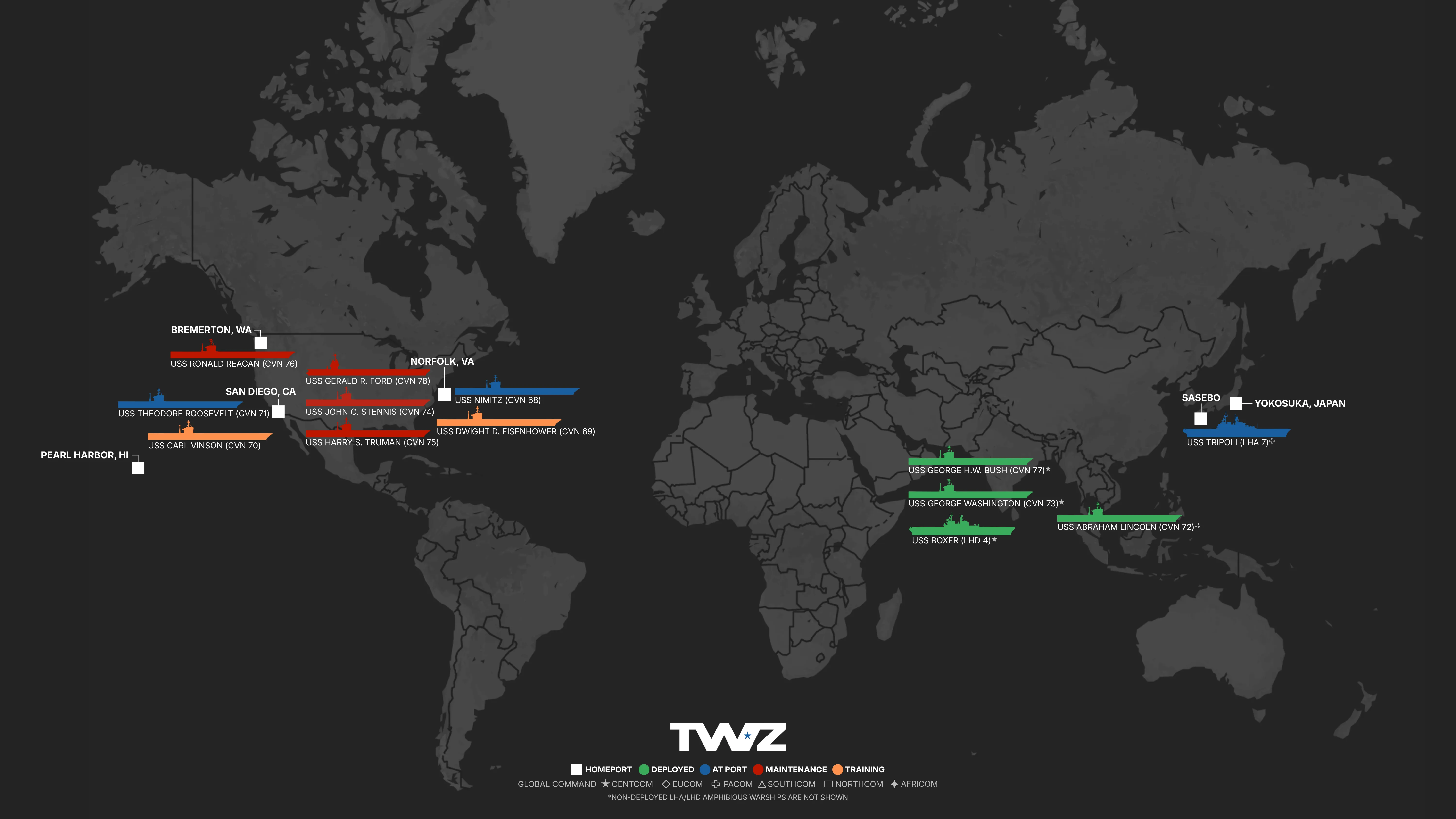
Though Trump on Thursday mentioned that the U.S. has a “big fleet” heading to the Middle East, there have been no ship movements today, a U.S. Navy official told us. There are still 10 ships in the U.S. Central Command region, including the aircraft carrier USS Abraham Lincoln and three of its Arleigh Burke class guided missile destroyer escorts. There are also two Arleigh Burke class ships in the eastern Mediterranean as well, the official added.
In a veiled message to Iran, CENTCOM released a time-lapse video showing the launch and recovery of jets from the Lincoln.
On the flight deck of an aircraft carrier, what looks like a random rush of jets and people is actually a well-orchestrated routine. Sailors aboard the USS Abraham Lincoln are trained to work as a team to launch and recover safely and on time, every time. pic.twitter.com/64ubKaG1wC
Iran is no match for American military forces, the Navy’s highest-ranking active-duty officer said this week.
“Adm. Daryl Caudle, chief of naval operations, told hundreds of sailors at an all-hands call Wednesday that although he doesn’t take Iranian posturing lightly, U.S. forces overmatched Tehran’s threats ‘significantly’ when it comes to capabilities,”Stars and Stripes reported. “We have a very good approach of providing the president of the United States military options. Iran knows this. So, the fact that we have that type of capability is a strong deterrent.”
Adm. Daryl Caudle, chief of naval operations, told hundreds of sailors at an all-hands call that although he doesn’t take Iranian posturing lightly, U.S. forces overmatched Tehran’s threats “significantly” when it comes to capabilities.https://t.co/onC0T1tj5L
As CENTCOM was showing off the Lincoln, the IRGC on Thursday claimed it seized two oil tankers with their foreign crews in Gulf waters for “smuggling fuel,” the official Iranian Tasnim news agency reported.
“More than one million liters of smuggled fuel were discovered on these two violating vessels, and 15 foreign crew members were referred to judicial authorities for legal proceedings,” Tasnim added. It was not immediately clear what flags the tankers were carrying, nor the nationalities of the crews.
BREAKING:
Iranian IRGC terrorists claim they have captured two oil tankers in the Persian Gulf carrying around 1 million liters of diesel fuel.
The seizures, part of an ongoing Iranian effort in the Gulf, came just two days after an F-35C from the Lincoln shot down an Iranian drone. In a separate incident that day, IRGC forces harassed a U.S.-flagged, U.S.-crewed merchant vessel lawfully transiting the Strait of Hormuz. “Two IRGC boats and an Iranian Mohajer drone approached M/V Stena Imperative at high speeds and threatened to board and seize the tanker,” Col. Tim Hawkins, the CENTCOM spokesperson, said in a statement to TWZ. “Guided-missile destroyer USS McFaul (DDG 74) was operating in the area and immediately responded to the scene to escort M/V Stena Imperative with defensive air support from the U.S. Air Force.”
We will keep you up to date with new developments in this fast moving story.
ONE of many Z Hotels in London, the Gloucester Place hotel is fabulously located.
Here is everything you need to know about the hotel.
Sign up for the Travel newsletter
Thank you!
Z Hotels are known for their great locationsThe shared dining lounge even has cheese and wine hours
Where is Z Hotel Gloucester Place?
Split across six converted Georgian townhouses, Z Hotel Gloucester Place is ideally placed between Baker Street and Oxford Street with 114 bedrooms and an onsite 24/7 Z Bar.
What are the rooms like?
Calling the rooms “compact luxury,” each one comes with everything you need for a base to stay such as a hidden underbed drawer to store your suitcase.
This also means huge queen or king beds, Samsung HDTVs and tea and coffee making facilities in the room.
The small bathrooms have large, if not basic showers and come with their own toiletries too.
Saudi Arabia has launched a project to issue passports for camels, in a move seen as a “qualitative step” to regulate the sector and strengthen the kingdom’s credibility in local and international markets, the government said on Wednesday, Anadolu reports.
A statement by the Saudi Ministry of Environment, Water and Agriculture said Deputy Minister Mansour bin Hilal Al-Mushaiti inaugurated the camel passport project Tuesday evening.
The initiative is designed to organize the camel sector, document identity and improve service efficiency while enhancing market trust domestically and internationally, the ministry said.
The project seeks to record camels’ data, ownership and breeds and link them to verified health and regulatory information, making the passport an officially recognized reference that supports more efficient services, the statement added.
The camel passport serves as a comprehensive identification document, containing a microchip number, passport number, the camel’s name, date of birth, breed, sex, color, place of birth, and date and place of issuance, as well as photographs of the animal from both sides to ensure accurate identification, the ministry said.
It also includes a dedicated vaccination table that clearly documents veterinary immunization records, certified by the name, signature and stamp of the veterinarian, according to the statement.
The ministry said the passport will help regulate sales and trading by tightening controls over camel sales, transport and official documentation.
In a census released in June 2025, the ministry said the total number of camels in the kingdom reached 2,235,297 heads.
Saudi Arabia ranks among the world’s top camel-owning countries, with an estimated 80,000 owners, according to unofficial figures.
Last week, a prominent Saudi Sheikh, Mohammed Al-Issa, visited the Auschwitz concentration camp in Poland to commemorate the 75th anniversary of its liberation, which signalled the end of the Nazi Holocaust. Although dozens of Muslim scholars have visited the site, where about one million Jews were killed during World War Two, according to the Auschwitz Memorial Centre’s press office, Al-Issa is the most senior Muslim religious leader to do so.
Visiting Auschwitz is not a problem for a Muslim; Islam orders Muslims to reject unjustified killing of any human being, no matter what their faith is. Al-Issa is a senior ally of Saudi Crown Prince Mohammad bin Salman (MBS), who apparently cares little for the sanctity of human life, though, and the visit to Auschwitz has very definite political connotations beyond any Islamic context.
By sending Al-Issa to the camp, Bin Salman wanted to show his support for Israel, which exploits the Holocaust for geopolitical colonial purposes. “The Israeli government decided that it alone was permitted to mark the 75th anniversary of the Allied liberation of Auschwitz [in modern day Poland] in 1945,” wrote journalist Richard Silverstein recently when he commented on the gathering of world leaders in Jerusalem for Benjamin Netanyahu’s Holocaust event.
Bin Salman uses Al Issa for such purposes, as if to demonstrate his own Zionist credentials. For example, the head of the Makkah-based Muslim World League is leading rapprochement efforts with Evangelical Christians who are, in the US at least, firm Zionists in their backing for the state of Israel. Al-Issa has called for a Muslim-Christian-Jewish interfaith delegation to travel to Jerusalem in what would, in effect, be a Zionist troika.
Zionism is not a religion, and there are many non-Jewish Zionists who desire or support the establishment of a Jewish state in occupied Palestine. The definition of Zionism does not mention the religion of its supporters, and Israeli writer Sheri Oz, is just one author who insists that non-Jews can be Zionists.
Mohammad Bin Salman and Netanyahu – Cartoon [Tasnimnews.com/Wikipedia]
We should not be shocked, therefore, to see a Zionist Muslim leader in these trying times. It is reasonable to say that Bin Salman’s grandfather and father were Zionists, as close friends of Zionist leaders. Logic suggests that Bin Salman comes from a Zionist dynasty.
This has been evident from his close relationship with Zionists and positive approaches to the Israeli occupation and establishment of a Jewish state in Palestine, calling it “[the Jews’] ancestral homeland”. This means that he has no issue with the ethnic cleansing of almost 800,000 Palestinians in 1948, during which thousands were killed and their homes demolished in order to establish the Zionist state of Israel.
“The ‘Jewish state’ claim is how Zionism has tried to mask its intrinsic Apartheid, under the veil of a supposed ‘self-determination of the Jewish people’,” wrote Israeli blogger Jonathan Ofir in Mondoweiss in 2018, “and for the Palestinians it has meant their dispossession.”
As the de facto ruler of Saudi Arabia, Crown Prince Bin Salman has imprisoned dozens of Palestinians, including representatives of Hamas. In doing so he is serving Israel’s interests. Moreover, he has blamed the Palestinians for not making peace with the occupation state. Bin Salman “excoriated the Palestinians for missing key opportunities,” wrote Danial Benjamin in Moment magazine. He pointed out that the prince’s father, King Salman, has played the role of counterweight by saying that Saudi Arabia “permanently stands by Palestine and its people’s right to an independent state with occupied East Jerusalem as its capital.”
Israeli journalist Barak Ravid of Israel’s Channel 13News reported Bin Salman as saying: “In the last several decades the Palestinian leadership has missed one opportunity after the other and rejected all the peace proposals it was given. It is about time the Palestinians take the proposals and agree to come to the negotiations table or shut up and stop complaining.” This is reminiscent of the words of the late Israeli Foreign Minister Abba Eban, one of the Zionist founders of Israel, that the Palestinians “never miss an opportunity to miss an opportunity.”
Bin Salman’s Zionism is also very clear in his bold support for US President Donald Trump’s deal of the century, which achieves Zionist goals in Palestine at the expense of Palestinian rights. He participated in the Bahrain conference, the forum where the economic side of the US deal was announced, where he gave “cover to several other Arab countries to attend the event and infuriated the Palestinians.”
US President Donald Trump looks over at Crown Prince of Saudi Arabia Mohammad bin Salman al-Saud as they line up for the family photo during the opening day of Argentina G20 Leaders’ Summit 2018 at Costa Salguero on 30 November 2018 in Buenos Aires, Argentina [Daniel Jayo/Getty Images]
While discussing the issue of the current Saudi support for Israeli policies and practices in Palestine with a credible Palestinian official last week, he told me that the Palestinians had contacted the Brazilian President Jair Bolsonaro to ask him not to relocate his country’s embassy to Jerusalem. “The Saudis have been putting pressure on us in order to relocate our embassy to Jerusalem,” replied the Brazilian leader. What more evidence of Mohammad Bin Salman’s Zionism do we need?
The founder of Friends of Zion Museum is American Evangelical Christian Mike Evans. He said, after visiting a number of the Gulf States, that, “The leaders [there] are more pro-Israel than a lot of Jews.” This was a specific reference to Saudi Arabia’s Crown Prince, and his counterpart in the UAE, Mohammed Bin Zayed.
“All versions of Zionism lead to the same reactionary end of unbridled expansionism and continued settler colonial genocide of [the] Palestinian people,” Israeli-American writer and photographer Yoav Litvin wrote for Al Jazeera. We may well see an Israeli Embassy opened in Riyadh in the near future, and a Saudi Embassy in Tel Aviv or, more likely, Jerusalem. Is Mohammad Bin Salman a Zionist? There’s no doubt about it.
The views expressed in this article belong to the author and do not necessarily reflect the editorial policy of Middle East Monitor.
Last week, a prominent Saudi Sheikh, Mohammed Al-Issa, visited the Auschwitz concentration camp in Poland to commemorate the 75th anniversary of its liberation, which signalled the end of the Nazi Holocaust. Although dozens of Muslim scholars have visited the site, where about one million Jews were killed during World War Two, according to the Auschwitz Memorial Centre’s press office, Al-Issa is the most senior Muslim religious leader to do so.
Visiting Auschwitz is not a problem for a Muslim; Islam orders Muslims to reject unjustified killing of any human being, no matter what their faith is. Al-Issa is a senior ally of Saudi Crown Prince Mohammad bin Salman (MBS), who apparently cares little for the sanctity of human life, though, and the visit to Auschwitz has very definite political connotations beyond any Islamic context.
By sending Al-Issa to the camp, Bin Salman wanted to show his support for Israel, which exploits the Holocaust for geopolitical colonial purposes. “The Israeli government decided that it alone was permitted to mark the 75th anniversary of the Allied liberation of Auschwitz [in modern day Poland] in 1945,” wrote journalist Richard Silverstein recently when he commented on the gathering of world leaders in Jerusalem for Benjamin Netanyahu’s Holocaust event.
Bin Salman uses Al Issa for such purposes, as if to demonstrate his own Zionist credentials. For example, the head of the Makkah-based Muslim World League is leading rapprochement efforts with Evangelical Christians who are, in the US at least, firm Zionists in their backing for the state of Israel. Al-Issa has called for a Muslim-Christian-Jewish interfaith delegation to travel to Jerusalem in what would, in effect, be a Zionist troika.
Zionism is not a religion, and there are many non-Jewish Zionists who desire or support the establishment of a Jewish state in occupied Palestine. The definition of Zionism does not mention the religion of its supporters, and Israeli writer Sheri Oz, is just one author who insists that non-Jews can be Zionists.
Mohammad Bin Salman and Netanyahu – Cartoon [Tasnimnews.com/Wikipedia]
We should not be shocked, therefore, to see a Zionist Muslim leader in these trying times. It is reasonable to say that Bin Salman’s grandfather and father were Zionists, as close friends of Zionist leaders. Logic suggests that Bin Salman comes from a Zionist dynasty.
This has been evident from his close relationship with Zionists and positive approaches to the Israeli occupation and establishment of a Jewish state in Palestine, calling it “[the Jews’] ancestral homeland”. This means that he has no issue with the ethnic cleansing of almost 800,000 Palestinians in 1948, during which thousands were killed and their homes demolished in order to establish the Zionist state of Israel.
“The ‘Jewish state’ claim is how Zionism has tried to mask its intrinsic Apartheid, under the veil of a supposed ‘self-determination of the Jewish people’,” wrote Israeli blogger Jonathan Ofir in Mondoweiss in 2018, “and for the Palestinians it has meant their dispossession.”
As the de facto ruler of Saudi Arabia, Crown Prince Bin Salman has imprisoned dozens of Palestinians, including representatives of Hamas. In doing so he is serving Israel’s interests. Moreover, he has blamed the Palestinians for not making peace with the occupation state. Bin Salman “excoriated the Palestinians for missing key opportunities,” wrote Danial Benjamin in Moment magazine. He pointed out that the prince’s father, King Salman, has played the role of counterweight by saying that Saudi Arabia “permanently stands by Palestine and its people’s right to an independent state with occupied East Jerusalem as its capital.”
Israeli journalist Barak Ravid of Israel’s Channel 13News reported Bin Salman as saying: “In the last several decades the Palestinian leadership has missed one opportunity after the other and rejected all the peace proposals it was given. It is about time the Palestinians take the proposals and agree to come to the negotiations table or shut up and stop complaining.” This is reminiscent of the words of the late Israeli Foreign Minister Abba Eban, one of the Zionist founders of Israel, that the Palestinians “never miss an opportunity to miss an opportunity.”
Bin Salman’s Zionism is also very clear in his bold support for US President Donald Trump’s deal of the century, which achieves Zionist goals in Palestine at the expense of Palestinian rights. He participated in the Bahrain conference, the forum where the economic side of the US deal was announced, where he gave “cover to several other Arab countries to attend the event and infuriated the Palestinians.”
US President Donald Trump looks over at Crown Prince of Saudi Arabia Mohammad bin Salman al-Saud as they line up for the family photo during the opening day of Argentina G20 Leaders’ Summit 2018 at Costa Salguero on 30 November 2018 in Buenos Aires, Argentina [Daniel Jayo/Getty Images]
While discussing the issue of the current Saudi support for Israeli policies and practices in Palestine with a credible Palestinian official last week, he told me that the Palestinians had contacted the Brazilian President Jair Bolsonaro to ask him not to relocate his country’s embassy to Jerusalem. “The Saudis have been putting pressure on us in order to relocate our embassy to Jerusalem,” replied the Brazilian leader. What more evidence of Mohammad Bin Salman’s Zionism do we need?
The founder of Friends of Zion Museum is American Evangelical Christian Mike Evans. He said, after visiting a number of the Gulf States, that, “The leaders [there] are more pro-Israel than a lot of Jews.” This was a specific reference to Saudi Arabia’s Crown Prince, and his counterpart in the UAE, Mohammed Bin Zayed.
“All versions of Zionism lead to the same reactionary end of unbridled expansionism and continued settler colonial genocide of [the] Palestinian people,” Israeli-American writer and photographer Yoav Litvin wrote for Al Jazeera. We may well see an Israeli Embassy opened in Riyadh in the near future, and a Saudi Embassy in Tel Aviv or, more likely, Jerusalem. Is Mohammad Bin Salman a Zionist? There’s no doubt about it.
The views expressed in this article belong to the author and do not necessarily reflect the editorial policy of Middle East Monitor.
An anonymous pitcher whose entire life changed with four innings is standing in a crowded Dodger Stadium bullpen in the middle of winter when he hears a voice from the stands.
“Will, thank you so much!” shouts a fan, and underneath his thick beard, the pitcher blushes.
“This is something I’ve never had before,” said Will Klein.
And this is ruining baseball?
On a crowded concourse in the middle of a Saturday morning two months before the start of the season, fans are chugging beers, scarfing Dodger dogs, and even doing a line dance.
The queue at the elevator is endless. The screams from the crowd are constant. Blake Snell is walking along one of the barriers giving every nearby fan — every one — a fist bump.
The Dodgers officially opened their doors for the 2026 season Saturday, holding an annual Dodgerfest that has sent a clear message to a landscape of whiners.
This is what winning looks like.
This is why winning is worth it.
The baseball owners will likely lock out the players after this season in hopes of installing a salary cap that will curb the sort of spending that has fueled the Dodgers’ consecutive championships.
They don’t get it. In hoarding their revenue-sharing money, the owners don’t realize the benefits of reinvesting that money in the players and, by extension, the fans.
The Dodgers do that more often, and more effectively, than anyone.
The result Saturday was a mid-winter party that felt different than any of their previous bashes. Some years they spent this day apologizing for their playoff collapses. Last year they spent the afternoon tentatively talking about going back-to-back.
Fans pack into Dodger Stadium for Dodgerfest on Saturday.
(Ronaldo Bolanos/Los Angeles Times)
This year the constraints were off, the party was on, and they all spoke freely of becoming the first time in National League history to win three consecutive World Series titles.
”I don’t mind the ‘three in the air’ as a carrot,” said manager Dave Roberts, adding, “There’s a challenge we’re not going to run from.”
And so the players showed up brandishing hope for this summer while sweetly admitting the emotion that still lingers from last fall.
Klein, who came out of nowhere to rescue the Dodgers with four scoreless innings in the marathon Game 3 of the World Series, was still pinching himself about being recognized in public.
“A guy told me I looked like me,” he said. “I said, ‘Thank you.’”
”The most important part is that everybody continues to say that is the best moment that they have in their life, the best moment of sports they watched,” said Rojas. “That makes me feel really good, because we were part of something bigger than just a home run.”
And Rojas said he hears that a lot.
“I waited 20 years in professional baseball to have that moment … something different happened to my life,” he said. “I’m walking around Rome, I’m seeing Dodger fans saying thank you for that home run. It’s crazy, it’s overwhelming.”
Equally overwhelmed was Freddie Freeman, who grew tearful on the stage when talking about hitting the winning homer in the 18th inning of the World Series Game 3 and the impact of winning two titles in his four years here.
“I’m home playing baseball in front of the best fans day in and day out,” he said. “I couldn’t even wrap my mind around coming back and signing here and being part of this. This has blown me away.”
Even the struggling players seemed thrilled to be here, Tanner Scott acting amazingly relaxed when asked for his 2026 goals.
“Not being as bad as last year,” he said. “I was terrible.”
OK, then.
Bottom line, on a midwinter day when most of this country’s major-league baseball stadiums were empty, Chavez Ravine was full of life and wonder and winning.
“Today we see a lot of fans and that really gets me going,” said Shohei Ohtani.
And this is ruining baseball?
“This organization is never ready to be done … they continue to add players, they continue to add talent, that is a good thing,” said Rojas. “We push ourselves … we believe we can always get better.”
Like he said, a good thing.
“I like winning,” said Klein. “People are always going to be jealous of teams that try to win when they feel like others aren’t. Everybody can go out and do the same thing.”
Spring is here, the haters are out, and the Dodgers are ready.
Seeing players here, seeing their energy, obviously seeing the energy of the fans, its certainly time,” said Roberts.
US Defense Secretary Pete Hegseth said Thursday the US is prepared to use “all options” to prevent Iran from pursuing nuclear weapons, while emphasizing that Washington is still leaving room for a diplomatic deal, Anadolu reports.
“With Iran right now, ensuring that they have all the options to make a deal. They should not pursue nuclear capabilities,” Hegseth said at a Cabinet meeting along with US President Donald Trump.
Trump reiterated Wednesday that a “massive armada” is headed to Iran, expressing hope that Tehran will “come to the table” and negotiate with Washington.
Hegseth stressed that the Pentagon stands ready to carry out any directives issued by Trump, signaling that military options remain firmly on the table if diplomacy fails.
“We will be prepared to deliver whatever this president expects of the War Department, just like we did this month,” he said, referring to the US capture of Venezuelan President Nicolas Maduro on Jan. 3.
Iranian officials, meanwhile, have reacted strongly to the latest threat issued by Trump, as a US military fleet moves toward Iranian waters amid escalating tensions between the longtime adversaries.
Weekly insights and analysis on the latest developments in military technology, strategy, and foreign policy.
As U.S. President Donald Trump is again touting a “massive armada” of ships heading to the Middle East amid growing tensions with Iran, more assets continue to pour into the region, including an electronic intelligence collection plane, which would be critical to addressing a range on contingencies, and another destroyer. Meanwhile, Secretary of State Marco Rubio testified before the Senate that U.S. forces are needed in case of a potential attack from Iran and that the administration does not know what will happen next if the government of Ayatollah Ali Khamenei falls.
You can catch up with our most recent coverage of events in the Middle East here.
“A massive Armada is heading to Iran,” Trump stated Wednesday morning in a post on his Truth Social platform, referring to the USS Abraham Lincoln Carrier Strike Group (CSG). “It is moving quickly, with great power, enthusiasm, and purpose. It is a larger fleet, headed by the great Aircraft Carrier Abraham Lincoln, than that sent to Venezuela. Like with Venezuela, it is ready, willing, and able to rapidly fulfill its mission, with speed and violence, if necessary.”
It remains unclear what Trump meant by a larger fleet. A Navy spokesman confirmed to us Wednesday morning that the Lincoln and three Arleigh Burke class guided missile destroyer escorts are now in the CENTCOM region. That’s the same number of ships the Gerald R. Ford CSG deployed with to the Caribbean ahead of the Maduro capture.
All told, the Navy now has 10 warships in the CENTCOM area of responsibility (AOR). The Arleigh Burke class guided missile destroyer USS Delbert D. Black just joined that force, a Navy official told us.
A destroyer would provide picket defense against missiles and drones, as well as standoff call strike capabilities. This is something especially important in that part of the Middle East right now since the Houthi rebels of Yemen have threatened to attack U.S. and Israeli targets should Iran come under fire.
By comparison, there are 12 warships in the Caribbean, the official explained. That force, along with a number of destroyers and carrier USS Gerald R. Ford, includes the Iwo Jima Amphibious Readiness Group (ARG)/22nd Marine Expeditionary Unit (MEU) made up of three amphibious assault vessels, and a Ticonderoga class guided missile cruiser. In addition, the Ocean Trader, a special operations mothership, was also plying those waters. It’s also worth noting that CSGs deploy with at least one fast attack submarine that isn’t usually disclosed.
When we asked for more details about Trump’s claim, the White House referred us to the Truth Social post, and CENTCOM referred us to the White House.
The Arleigh Burke class guided missile destroyer USS Delbert D. Black joined a growing force of Navy warships in the U.S. Central Command region yesterday. (U.S. Navy photo by Mass Communication Specialist 2nd Class Jacob Mattingly) Petty Officer 2nd Class Jacob Mattingly
While the Navy’s deployments are getting a lot of attention, a U.S. Air Force RC-135V Rivet Joint electronic surveillance plane has flown to Al Udeid Air Base in Qatar, according to online flight trackers. The aircraft, callsign Olive48, arrived at Al Udeid on Wednesday morning Eastern time, according to FlightRadar24.
The U.S. Air Force RC-135V Rivet Joint is now landing at Al Udeid Air Base in Qatar.
I expect both the E-11A BACN and HC-130J Combat King II to leave Chania for Al Udeid later today.
The Rivet Joint departed from Offutt Air Force Base in Nebraska and stopped at RAF Mildenhall before arriving at Al Udeid.
The RC-135 is one of America’s most capable intelligence-gathering assets. Each airliner-sized jet contains a large array of signals intelligence (SIGINT) systems that detect and intercept communications and other electronic emissions. The aircraft can also geolocate and categorize the emitters sending out those signals, from radios to radars. The RC-135s are often used to build a electronic order of battle of an adversary nation, locating their air defenses and command and control nodes, as well as intercepting communications as to how they respond to various stimuli or just during mundane operations. This information is critical to building an effective war plan and it needs to be updated just prior to launching an operation. It is also very important for defensive monitoring and understanding an enemy’s intentions and the status of its military at any given time.
Rivet Joint deployments happen around the globe regularly, including to the Middle East. In November, a U.S. official confirmed to us that one of these jets had been deployed to the U.S. Southern Command region “testing Venezuelan sensors and responses, and it is part of the pressure campaign to show U.S. capabilities in the Caribbean.” This matched our prior analysis as to their presence there. The information gathered would have played a key role in the effective capture of Maduro.
We’ve reached out to CENTCOM and the 55th Wing at Offutt, which operates the Rivet Joints, for comment.
An RC-135V/W Rivet Joint. (U.S. Air Force photo by Staff Sgt. William Rio Rosado) (U.S. Air Force photo by Staff Sgt. William Rio Rosado)
There are also indications that other unique airborne capabilities may be headed to the Middle East.
Flight trackers are showing that an E-11A Battlefield Airborne Communications Node (BACN) jet is heading to Souda Air Base in Crete, a common route for deployments to the Middle East. While we have no confirmation of where this jet might go next, a move to the Middle East ahead of a potential conflict makes sense. E-11As are highly specialized communications gateway nodes designed to create an ‘active net’ over the battlespace and quickly transfer data sent using a variety of distinct waveforms between different aerial platforms and forces on the ground/surface. With these capabilities, the aircraft can also serve as valuable communications relay nodes. You can find out more about BACN and its history in this past War Zone feature. It’s also worth mentioning the BACNs spent many years exclusively deployed to the Middle East during the Global War on Terror.
🇺🇸 Strategic Signal
A U.S. Air Force E 11A BACN aircraft, callsign BLKWF01, was tracked over the western Mediterranean after crossing the Atlantic, reportedly heading toward Souda Air Base in Crete.
In addition, it appears six U.S. Navy E/A-18G Growlers electronic warfare jets have departed from their assignment to the Caribbean and are headed east across the Atlantic, potentially for deployment to the Middle East. Again we have no confirmation of why the jets are making this flight.
The EA-18Gs in the Middle East would be critical force multipliers. Such a deployment could be indicative of what one would see in the lead-up to a kinetic operation centered heavily on strikes on targets in inland areas, such as ones the U.S. and possibly Israel might carry out in Iran in the future. Growlers can provide electronic warfare support for standoff munitions and/or aircraft penetrating into enemy air defenses, among other battlefield effects.
#USAF United States Air Force – Middle East Activity (CORONET) 27 January 2026 – 2000z
Second update for the day. The main focus being CORONET East 037 involving E/A-18G’s, as well as HC-130’s and additional C-17 flights.
There are also signs that HC-130J Combat King II combat search and rescue (CSAR) planes are moving toward the Middle East, another indication that Trump could be considering airstrikes inside Iran. The aircraft would be needed for rapid rescues of any aircrews that are lost during military operations, specifically over contested territory. They can also support special operations aircraft with aerial refueling for non personnel recovery missions.
#USAF United States Air Force – Middle East Activity (CORONET) 27 January 2026 – 2000z
Second update for the day. The main focus being CORONET East 037 involving E/A-18G’s, as well as HC-130’s and additional C-17 flights.
As we have previously reported, at least a dozen additional F-15E Strike Eagle fighters were recently deployed to Muwaffaq Salti Air Base in Jordan. Aerial refueling tankers have also trickled into the Middle East. Other tactical jets remain in the region, including A-10s. But despite the potential presence of the Growlers and the movements of the F-15Es, there has still been no mass influx of USAF tactical airpower into the Middle East. This is something we would likely see if the U.S. intends to execute a sustained campaign, even if limited in scope, against Iran. This points to a more limited operation, unless Israel steps in to provide its tactical fighter force in a joint operation. It’s also very possible that these assets will deploy in the coming days.
#USAF United States Air Force – Middle East Activity 26 January 2026 – 1045z
Traffic is primarily focused on bases housing air defence systems like THAAD from Fort Hood. As the weather conditions don’t appear to have improved, the level of traffic is still fairly low. I’ve… https://t.co/INuCDdgv5spic.twitter.com/PQ9fchMiMf
Amid the U.S. buildup, Rubio offered some insights about why this is happening.
“On the issue of our presence in the region, here’s the baseline I want to set for everybody,” Rubio said during his testimony to the Senate in a hearing on the situation in Venezuela. “The baseline is this: we have 30,000 to 40,000 American troops stationed across eight or nine facilities in that region. All are within the reach…of an array of thousands of Iranian one-way UAVs and Iranian short-range ballistic missiles that threaten our troop presence.”
“We have to have enough force and power in the region just on a baseline to defend against the possibility that at some point, as a result of something, the Iranian regime decides to strike at our troop presence in the region,” he added. “The president always reserves the preemptive defensive option. In essence, if we have indications that, in fact, they’re going to attack our troops in the region, to defend our personnel in the region.”
In addition, Rubio noted that “we also have security agreements, the defense of Israel plan, and others that require a force posture in the region to defend against that. And so I think it’s wise and prudent to have a force posture within the region that could respond and potentially, not necessarily what’s going to happen, but if necessary, preemptively, prevent the attack against thousands of American servicemen and other facilities in the region and our allies.”
Rubio says US forces are amassing in the region to potentially “preemptively prevent” Iran from attacking US forces already in the region. Pristine logic. Especially after Trump just announced he’s sending a “Massive Armada,” and threatened a “far worse” attack than last June pic.twitter.com/dbHMXuUhC9
The U.S. Secretary of State also noted that at least thousands of protesters have been killed by government forces during the unrest that began in Iran on Dec. 28. The uprising occurred due to rising prices and devalued currency that saw the rial crater now to basically nothing, as well as a devastating drought, and ongoing harsh treatment from the regime.
Secretary of State Marco Rubio said “thousands” have died in the Iran protests “for certain,” but couldn’t confirm the numbers.
“The protests may have ebbed, but they will spark up again in the future because this regime, unless they are willing to change and or leave, have no… pic.twitter.com/Tq7RIPm8WA
“That’s an open question,” Rubio responded to a question about who would lead Iran next. “No one knows what would take over. Obviously, their system is divided between the supreme leader and the IRGC that responds directly to him. And then you’ve got these quasi-elected individuals, the ones that wear the suits on television, who are part of their political branches, but ultimately have to run everything they do by the Supreme Leader. So I don’t think anyone can give you a simple answer as to what happens next in Iran if the Supreme Leader and the regime were to fall.”
In his Trump Social post on Wednesday, the president issued one of his most serious threats against Iran to date. The American leader, who began his recent round of warnings to Ayatollah Ali Khamenei in the wake of the regime’s deadly crackdown on anti-government protesters, is also pressuring Iran to end its nuclear weapons program.
“Hopefully Iran will quickly “Come to the Table” and negotiate a fair and equitable deal – NO NUCLEAR WEAPONS – one that is good for all parties,” Trump proclaimed. “Time is running out, it is truly of the essence! As I told Iran once before, MAKE A DEAL! They didn’t, and there was “Operation Midnight Hammer,” a major destruction of Iran. The next attack will be far worse! Don’t make that happen again…”
The American president gave no specifics about the deal he was demanding, “but U.S. and European officials say that in talks, they have put three demands in front of the Iranians: a permanent end to all enrichment of uranium, limits on the range and number of their ballistic missiles, and an end to all support for proxy groups in the Middle East, including Hamas, Hezbollah and the Houthis operating in Yemen,” The New York Times reported on Wednesday.
“Notably absent from those demands — and from Mr. Trump’s post on Truth Social on Wednesday morning — was any reference to protecting the protesters who took to the streets in Iran in December, convulsing the country and creating the latest crisis for its government. Mr. Trump had promised, in past social media posts, to come to their aid, but has barely mentioned them in recent weeks.”
According to U.S. and European officials involved in the ongoing negotiations who spoke to the New York Times, three demands have been given to the Iranians to prevent potential military actions by the United States, these include:
Iran, for its part, said there are no direct negotiations underway.
Iran’s Foreign Minister Abbas Araqchi said he had not been in contact with U.S. special envoy Steve Witkoff in recent days or requested negotiations, Reuters reported on Wednesday, citing Iranian media.
“There was no contact between me and Witkoff in recent days and no request for negotiations was made from us,” Araqchi told state media, adding that various intermediaries were “holding consultations” and “were in contact with Tehran.”
“Our stance is clear, ” he added. “Negotiations don’t go along with threats and talks can only take place when there are no longer menaces and excessive demands.”
“Iraqi Foreign Minister Fuad Hussein says Iran has announced its readiness for dialogue with the United States, but it has yet to receive any response from Washington,” according to IRNA. “Speaking with Rudaw, a Kurdish digital news network based in Iraq’s Kurdistan region, the foreign minister said late on Tuesday that messages are exchanged between Iran and the US, but no meeting has been held yet.”
“The main problem is that there is no direct communication,” Hussein said, adding that messages are exchanged without holding a meeting, which complicates the situation. “If a decision is made to hold a meeting, Iraq would be able to play a role, but the U.S. has yet to decide if it would hold discussions.”
Iraqi Foreign Minister Fuad Hussein (Iranian media)
Wary Israeli officials, who are preparing for an attack on or from Iran, are closely monitoring these unofficial talks, according to the Jerusalem Post.
“Israel is assessing reports that the United States and Iran are holding discreet contacts and that Washington has presented preconditions for possible negotiations on a new nuclear agreement,” the Post reported. “Israeli officials have expressed concern over the possibility of an agreement they view as unfavorable.”
Likely to participate in any strike against Iran, Israel was once again the target of Tehran’s wrath.
Ali Shamkhani, an advisor to Iranian Supreme Leader Ali Khamenei, threatened strikes on Israel if the U.S .attacks Iran.
“The limited strike is an illusion,” he said, according to Israel National News. “Any military action by America, from any source and at any level, will be considered the beginning of war, and the response to it will be immediate, comprehensive, and unprecedented, targeting the aggressor, the heart of Tel Aviv, and everyone who supports the aggressor.”
IRAN THREATENS ISRAEL: Khamenei adviser says US military action will trigger Iranian attack on Tel Aviv (Ynet)
Should a conflict between the U.S. and Iran break out, two key regional allies have said they won’t be involved. Saudi Arabia on Tuesday said it would not allow the U.S. to use its facilities or airspace to attack Iran. That follows a similar statement made by the United Arab Emirates (UAE).
🇸🇦📞🇮🇷 | HRH Crown Prince Mohammed bin Salman spoke by phone with the President of the Islamic Republic of Iran, Dr. Masoud Pezeshkian. pic.twitter.com/sjcDjoHYCv
These public statements could be strictly aimed at internal audiences that might not favor involvement in an attack on another Muslim nation, especially involving Israel. They could also be to deter Iran from barraging their territory in retaliation to an attack. However, if Saudi Arabia and the UAE are serious about their reticence, it would affect U.S. basing in those countries, limiting Trump’s options to attack Iran. There are other bases in the region, like Al Udeid in Qatar, Muwaffaq Salti in Jordan, and Naval Support Activity (NSA) Bahrain, among others. Still, any reduction in facilities to store and launch aircraft makes any strike more challenging and potentially increases the risk to host countries from Iranian missiles and drones. Taking airspace over Saudi Arabia and the UAE out of the picture also reduces the vectors from which the U.S. can launch attacks from the Gulf region, limiting them to a narrower set of funnels. This is also why the carrier strike group is so important.
Prince Sultan Air Base in Saudi Arabia. (Google Earth)
Meanwhile, NATO ally Turkey urged Trump not to attack Iran.
“It’s wrong to attack on Iran, it’s wrong to start the war again. Iran is ready to negotiate on nuclear file again,” said Turkish Foreign Minister Hakan Fidan.”My advice to the American friends: close the files one by one with Iranians. Start with nuclear, close it, and not get it as a package. If you put them as a package, it will be very difficult for our Iranian friends to digest and to go through this. It might seem humiliating for them and difficult to explain to the leadership. If we can make things better tolerated, it would help.”
Turkish Foreign Minister Hakan Fidan:
It’s wrong to attack on Iran, it’s wrong to start the war again. Iran is ready to negotiate on nuclear file again.
My advice to the American friends: close the files one by one with Iranians. Start with nuclear, close it, and not get it as… pic.twitter.com/TtGDV9l9uQ
German Chancellor Friedrich Merz, on the other hand, said the Iranian regime’s days are numbered.
German Chancellor Merz says Iranian regime’s “days are numbered” – “It may be weeks, but this regime has no legitimacy whatsoever to govern the country” pic.twitter.com/sK4M4us73R
Despite the Iranian regime’s crackdown, the protests appear to be ongoing. A new video emerged showing a large demonstration in Tehran, calling for the end of the regime.
BREAKING: Massive protests erupt in Tehran, over 100,000 Iranians flooding the streets, demanding the fall of the Islamic Republic. pic.twitter.com/I8Z60fNab6
As the pressure mounts against Khamenei, a video emerged purporting to show an inside view of his compound, something observers say they’ve never seen before.
This is really something: this new video purportedly shows some of the security protocols leading to the Office of #Iran’s regime’s Supreme Leader. It’s an unprecedented video—never before have I seen something like this surface. A sign of the times. pic.twitter.com/PLSdYGDjw1
So far, there are just harsh words being exchanged in the Middle East, not munitions. However, the warning lights are blinking hot that a conflict could soon break out, something we will continue to monitor closely.
Update: 9:46 PM Eastern –
Trump is now considering options that “include U.S. military airstrikes aimed at Iran’s leaders and the security officials believed to be responsible for the killings, as well as strikes on Iranian nuclear sites and government institutions,” CNN reported, citing sources. “Trump has not made a final decision on how to proceed, sources said, but he believes his military options have been expanded from earlier this month now that a US carrier strike group is in the region.”
“Options he is now considering include US military airstrikes aimed at Iran’s leaders and the security officials…as well as strikes on Iranian nuclear sites and government institutions.”
Most European countries have either turned down their invitations to join United States President Donald Trump’s “Board of Peace” for overseeing the reconstruction of Gaza – or politely suggested they are “considering” it, citing concerns.
From within the European Union, only Hungary and Bulgaria have accepted. That is a better track record of unity than the one displayed in 2003, when then-US President George W Bush called on member states to join his invasion of Iraq.
Recommended Stories
list of 4 itemsend of list
Spain, Britain, Poland, Hungary, Czechia and Slovakia said “yes”.
France turned the invitation down on the grounds that Trump’s board “goes beyond the framework of Gaza and raises serious questions, in particular with respect to the principles and structure of the United Nations, which cannot be called into question”.
Trump pointedly did not invite Denmark, a close US ally, following a diplomatic fracas in which he had threatened to seize Greenland, a Danish territory, by force.
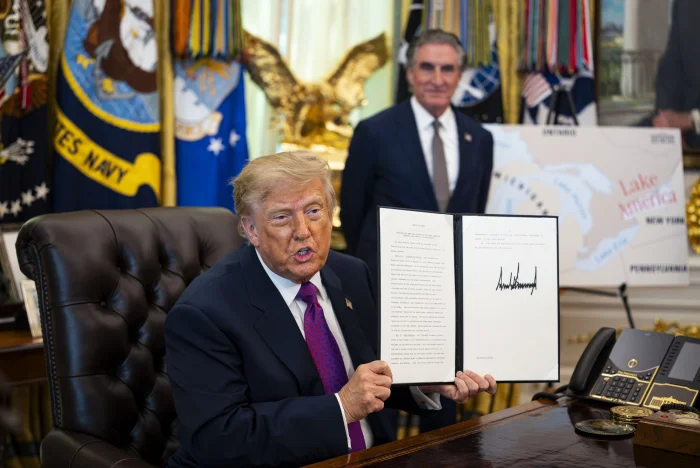
The US leader signed the charter for his Board of Peace on January 22 at the World Economic Forum in Davos, Switzerland, calling it “one of the most consequential bodies ever created”.
It has come across to many of the countries invited to join it as perhaps too consequential – an attempt to supplant the United Nations, whose mandate the board is meant to be fulfilling.
Although Trump said he believed the UN should continue to exist, his recent threats suggest that he would not respect the UN Charter, which forbids the violation of borders.
That impression was strengthened by the fact that he invited Russia to the board, amid its full-scale invasion of Ukraine.
‘Trump needs a big win ahead of midterms’
“Trump is thinking about the interior of the US. Things aren’t going well. He needs a big win ahead of the November midterms,” said Angelos Syrigos, a professor of international law at Panteion University in Athens.
The US president has spent his first year in office looking for foreign policy triumphs he can sell at home, said Syrigos, citing the abduction of Venezuelan President Nicolas Maduro, the bombing of Iran and his efforts to end the Ukraine war.
Trump has invited board members to contribute $1bn each for a lifetime membership, but has not spelled out how the money will be spent.
His son-in-law, Jared Kushner, is a member of the executive board.
“How will this thing function? Will Trump and his son-in-law administer it?” asked Syrigos.
Catherine Fieschi, a political scientist and fellow at the European University Institute, believed there was a more ambitious geopolitical goal as well.
“It’s as though Trump were gathering very deliberately middle powers … to defang the potential that these powers have of working independently and making deals,” she said.
Much like Bush’s 2003 “coalition of the willing” against Iraq, Trump’s initiative has cobbled together an ensemble of countries whose common traits are difficult to discern, ranging from Vietnam and Mongolia to Turkiye and Belarus.
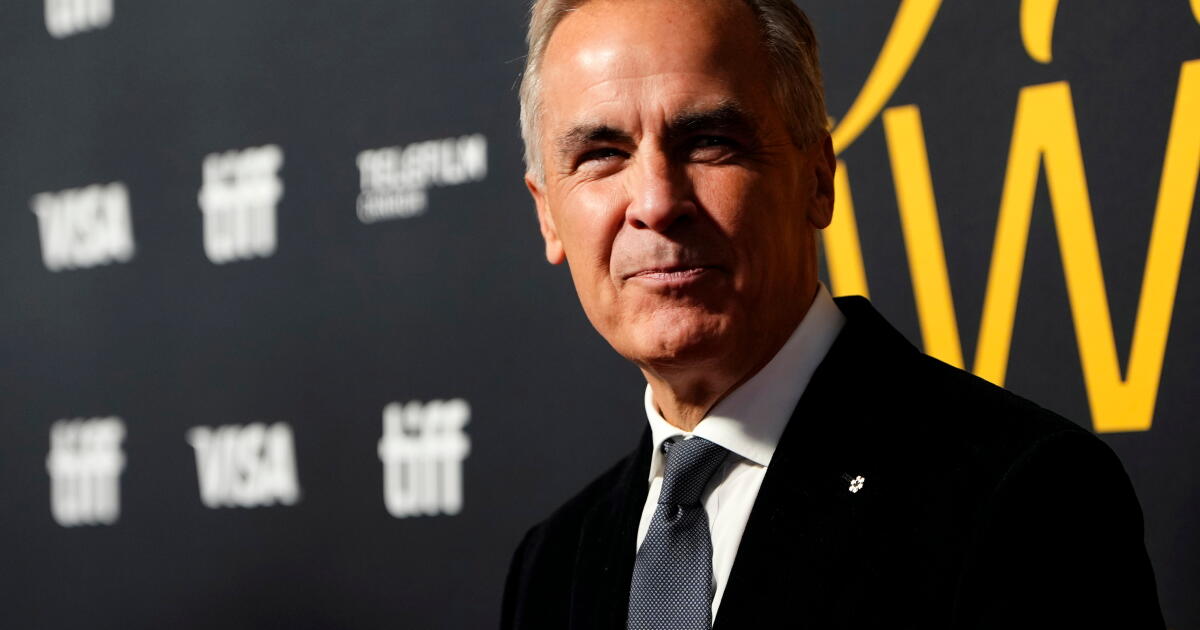
Fieschi believed Trump was trying to corral middle powers in order to forestall other forms of multilateralism, a pathway to power that Canadian Prime Minister Mark Carney outlined in his speech at Davos, which so offended Trump.
“In a world of great power rivalry, the countries in between have a choice: [to] compete with each other for favour, or to combine to create a third path with impact,” Carney had said, encouraging countries to build “different coalitions for different issues” and to draw on “the power of legitimacy, integrity and rules”.
He decried the “rupture in the world order … and the beginning of a brutal reality where geopolitics among the great powers is not subject to any constraints”.
After the speech, Trump soon rescinded Canada’s invitation.
Countering agglomerations of power and legitimacy was Trump’s goal, Fieschi believed.
“Here you bind them into an organisation that in some ways offers a framework with Trump in it and the US in it, and implies constraints,” said Fieschi. “It’s not so much benign multilateralism as stopping the middle powers getting on with their hedging and with their capacity to have any kind of autonomy, strategic and otherwise.”
At the same time, she said, Trump was suggesting that the Board of Peace “might give them more power than they have right now in the UN”.
“Trump thinks this is like a golf club and therefore he’s going to charge a membership fee,” Fieschi said.
“If it was a reconstruction fee [for Gaza], I don’t think people would necessarily baulk at that,” she noted, adding that the fee smacked of “crass oligarchic motivation”.
The Board of Peace is called into existence by last November’s UN Security Council Resolution 2803 to oversee the reconstruction of Gaza.
It is defined as “a transitional administration” meant to exist only “until such time as the Palestinian Authority (PA) has satisfactorily completed its reform program … and [can] effectively take back control of Gaza.”
Trump’s charter for the board makes no mention of Gaza, nor of the board’s limited lifespan. Instead, it broadens the board’s mandate to “areas affected or threatened by conflict”, and says it “shall dissolve at such time as the Chairman considers necessary or appropriate”.
China, which has presented itself as a harbinger of multipolarity and a challenger of the US-led world order, rejected the invitation.
“No matter how the international landscape may evolve, China will stay firmly committed to safeguarding the international system with the UN at its core,” said Chinese Foreign Ministry spokesman Guo Jiakun last week.
The UN itself appears to be offended by Trump’s scheme.
“The UN Security Council stands alone in its Charter-mandated authority to act on behalf of all Member States on matters of peace and security,” wrote UN Secretary-General Antonio Guterres on social media on Monday, January 26.
“No other body or ad-hoc coalition can legally require all Member States to comply with decisions on peace and security,” he wrote.
Guterres was calling for a reform that would strengthen the legitimacy of the UN Security Council by better reflecting the balance of power in the world as it is, 81 years after the body was formed. But his statement can also be read as a veiled criticism of Trump’s version of the Board of Peace.
Transparency and governance are problematic, too.
Trump is appointing himself chairman of the board, with power to overrule all members. He gets to appoint the board’s executive, and makes financial transparency optional, saying the board “may authorise the establishment of accounts as necessary.”
Weekly insights and analysis on the latest developments in military technology, strategy, and foreign policy.
Four decommissioned U.S. Navy Avenger class mine countermeasures ships have left Bahrain on what may be their final voyage aboard a larger heavy lift vessel. Avengers had been forward-deployed to the Middle Eastern nation for years, where critical mine countermeasures duties have now passed to Independence class Littoral Combat Ships (LCS).
The public affairs office for U.S. Naval Forces Central Command (NAVCENT) and U.S. 5th Fleet first released pictures of the M/V Seaway Hawk, a contracted semi-submersible heavy lift vessel, carrying the former Avenger class ships USS Devastator, USS Dextrous, USS Gladiator, and USS Sentry last Friday. The Navy released more images and a brief statement yesterday. The date stamps on the pictures show the Avengers were physically loaded onto the Seaway Hawk in Bahrain on January 9.
The M/V Seaway Hawk is seen here partially submerged as a decommissioned Avenger class mine countermeasures ship is moved into position for loading on January 9, 2025. USNM/V Seaway Hawk seen underway with the four decommissioned Avenger class ships onboard on January 20, 2025. USN
The Navy acquired 14 Avenger class ships between 1987 and 1994. Four of them are still in service, all of which are forward-deployed in Japan, but are also slated for decommissioning in the coming years.
“Decommissioned Avenger class Mine Countermeasures ships were safely moved as part of ongoing U.S. Navy force transition efforts in the region,” per the statement from NAVCENT. “The movement evolution required detailed planning, coordination, and disciplined execution to ensure the safe transport of the decommissioned MCM’s.”
“Mission partners worked together to maintain operational standards, prioritize safety, and ensure accountability throughout each phase of the evolution,” the statement adds. “These efforts support continued fleet readiness and responsible transition of legacy platforms, while sustaining operational momentum and mission effectiveness across the maritime domain.”
Another look at the fully loaded M/V Seaway Hawk as seen from the side. USN
A Navy contracting notice last year said the four decommissioned Avengers would head from Bahrain to Philadelphia, Pennsylvania. Sealift, Inc. subsequently received a contract valued at approximately $7 million for work through February of this year, according to USNI News. In addition, the Navy had said it previously intended to scrap the USS Devastator, USS Dextrous, USS Gladiator, and USS Sentry following their decommissioning. If the ships are due to be broken down, why the decision was made to return them to the United States first is unclear.
A section of the Navy’s Report to Congress on the Annual Long-Range Plan for Construction of Naval Vessels for Fiscal Year 2025, released in 2024, discussing the expected fate of a number of ships post-decommissioning. The four Avengers that had been forward-deployed in Bahrain are all listed as being slated for dismantlement. USN
The USS Devastator was the last of the Avenger class ships in Bahrain to be decommissioned, which was marked by a ceremony last September.
“For more than three decades, USS Devastator, USS Dextrous, USS Gladiator and USS Sentry have been critical to maritime missions around the globe – defending the freedom of navigation, promoting stability and deterring and defeating efforts by adversaries to harm the innocent,” Navy Vice Adm. George Wikoff, then commander of NAVCENT and 5th Fleet, said at that time. “To all, past and present, who have served on [these ships], thank you for standing the watch, being true trailblazers in the fleet and maintaining a constant presence in our area of operations… what a proud legacy you leave in your wake.”
The 224-foot-long and 1,312-ton-displacement Avengers are designed to both hunt for and neutralize moored naval mines, as well as those sitting on the sea floor.
A stock picture of an Avenger class ship during training. USN
Each of the ships is equipped with a mine-hunting sonar and surface search radar. Each Avenger can deploy towed minesweeping gear that can mimic the acoustic and magnetic signatures of warships, causing certain types of mines to detonate prematurely. They also have remotely-operated underwater vehicles capable of cutting mooring lines and otherwise interacting with underwater objects to help with rendering mines safe, as well as finding and categorizing them in the first place.
The crew of the Avenger class mine countermeasures ship USS Chief deploy a remotely operated vehicle during an exercise in the Pacific. USN
The ships themselves have fiberglass-coated wooden hulls to reduce their own vulnerability, particularly to mines that detect targets by their magnetic signature.
Airborne Laser Mine Detection System (ALMDS) Video
The Navy only fielded its first two operational mine countermeasures modules, installed on the Independence class LCSs USS Santa Barbara and USS Canberra, last year. Canberraarrived in Bahrain in May 2025. At that time, Santa Barbara, as well as the Independence class USS Tulsa and another ship to be named, were slated to comprise the inaugural rotational deployment of mine countermeasures-configured LCSs in the region. The USS Canberra notably sailed together with the M/V Seaway Hawk for a time after it departed Bahrain with the decommissioned Avengers.
The Independence class LCS USS Canberra, in front, sails together with the M/V Seaway Hawk on January 20, 2025. USN
Questions and criticism about the suitability of metal-hulled LCSs to take on the mine countermeasures mission have come up in the past. Both subclasses of LCS are also much larger than the Avenger class design, which could impose limits on how close they can get to mined or potentially mined areas. LCSs are better able to defend themselves against other threats than the Avengers, but they still have relatively limited firepower, which has been a separate source of criticism for years now. There would still be a significant need for tertiary support to protect LCSs during mine-clearing operations, which are slow and complex, and carry significant risks, even in benign environments.
The continued critical importance of naval mine-clearing capacity in the Middle East is underscored now by a new surge in geopolitical friction between the United States and Iran. The regime in Iran regularly threatens to blockade the highly strategic Strait of Hormuz in response to foreign attacks, especially ones that could present an existential danger to the regime in Tehran. The Strait of Hormuz links the Persian Gulf and the Arabian Sea, and is a huge chokepoint for oil and natural gas exports from the Middle East to other countries globally. Naval mining would be central to any blockade, but Iran’s capacity and willingness to launch such an operation, which would have worldwide ramifications, is an open question. TWZ previously explored this issue in depth following the start of the 12 Day War between Iran and Israel last year.
If the Navy has to launch its own mine-clearing operations in and around the Persian Gulf for any reason going forward, LCSs will be front and center now that the Avenger class ships have left the region.