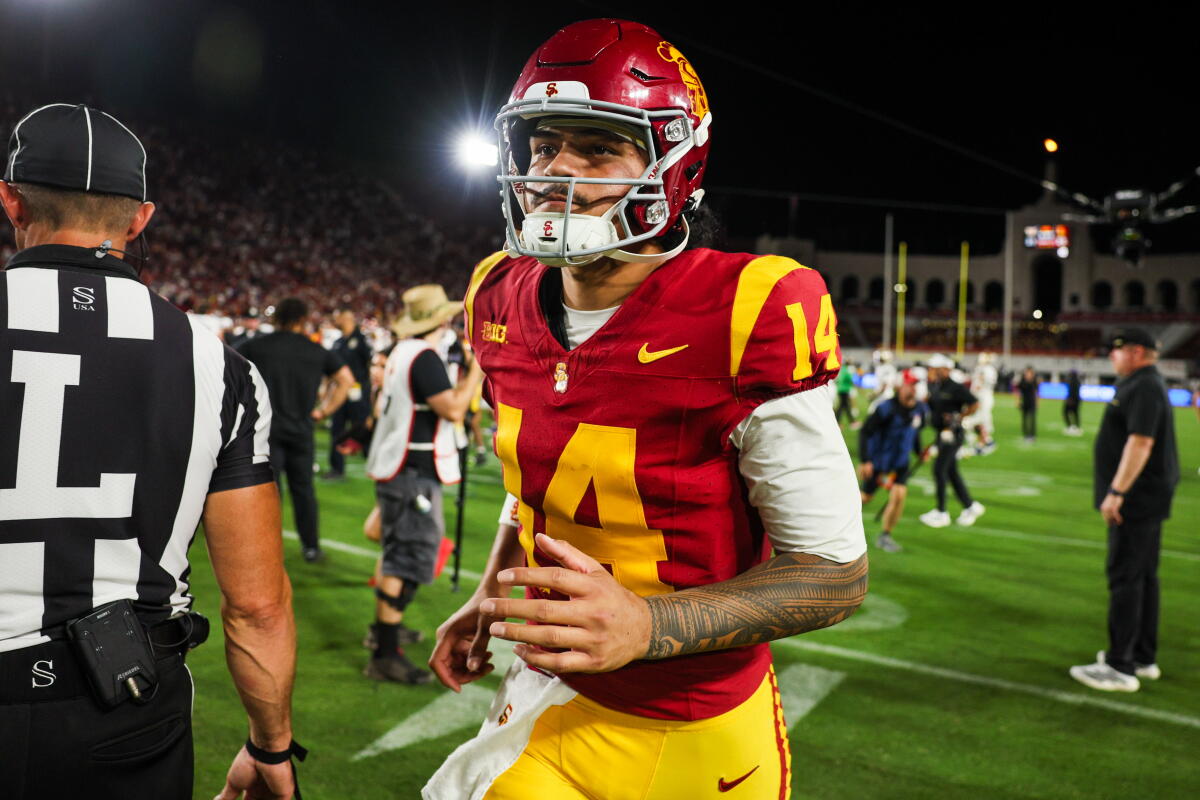
No. 9 UCLA was hosting a Michigan State team with one of the least productive offenses in the country led by freshman quarterback Kayd Coffman, who was taking his first college snaps after the Spartans’ top two quarterbacks were injured.
After forcing three turnovers and four sacks, UCLA trounced Michigan State 28-10 Saturday afternoon at the Rose Bowl. The Bruins improved to 7-0 for the first time since 2005 after winning just three games last season.
UCLA’s defense carried it after the offense was flat in the first half, dropping two passes, drawing drive-killing penalties and fumbling twice in Michigan State territory. Both fumbles were forced by Spartans safety Devin Vaught and returned 50-plus yards to the red zone.
While UCLA conceded a touchdown after the first giveaway, allowing Michigan State (2-6, 0-5) to score in two plays, the Bruins avenged the second fumble with an interception from linebacker Donavyn Pellot.
Pellot returned his first career interception 67 yards. Wayne Knight scored on a one-yard run five plays later for his 13th touchdown of the season. The score gave UCLA a lead it would never relinquish.
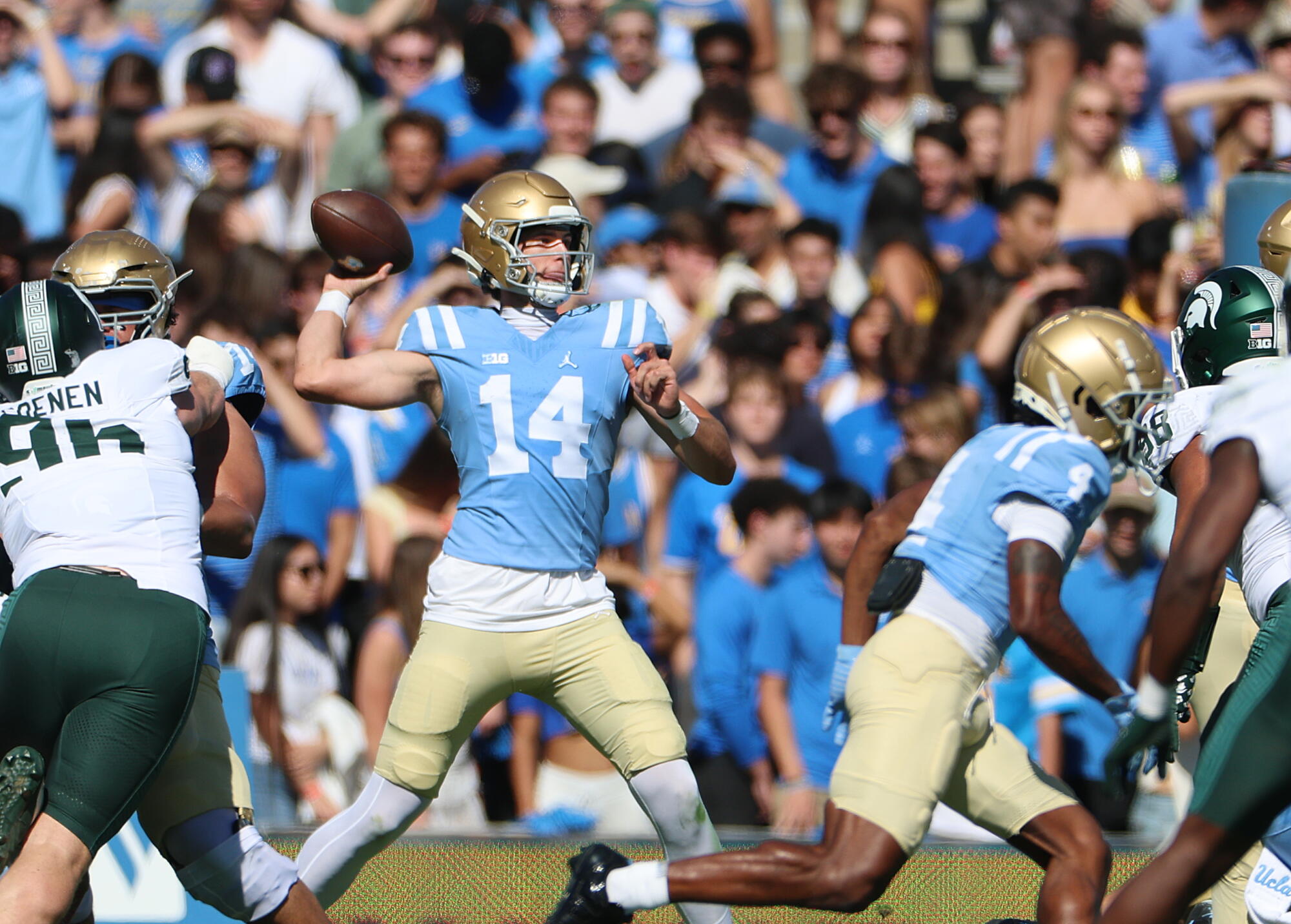
UCLA quarterback Ty Dieffenbach passes in the first quarter against Michigan State at the Rose Bowl on Saturday.
(Allen J. Schaben / Los Angeles Times)
“Second half [was] much, much better than the first half,” UCLA coach Bob Chesney told CBS immediately after the game. “Mistakes in there and uncharacteristic things that we cannot allow to happen at this point in the year.
“So a little bit disappointed in moments, but at the same point in time we did what we had to do.”
Once the offense found its footing, it did not step off the gas.
The Bruins leaned heavily on their running game as they returned to its usual form after being limited to 3.5 yards per carry and failing to surpass 150 yards the past two weeks. All three starting running backs reached the end zone for the third time this season, as UCLA finished with 245 rushing yards at 5.1 yards per carry. Anthony Woods led the UCLA rushing attack with 112 yards and a touchdown in 14 carries.
The running game loosened up the Michigan State defense, and UCLA quarterback Ty Dieffenbach took advantage of an already depleted secondary on the first drive of the second half, unloading a 63-yard pass to sophomore wide receiver Brian Rowe Jr. for his first touchdown of the season.
Dieffenbach made the big play after sustaining an apparent leg injury on a hard hit late in the first half.
With the defense holding the Spartans to just 156 total yards of offense — 73 of which came in the fourth quarter with UCLA in control — Dieffenbach didn’t have to be perfect to secure the win. He completed 18 of 31 passes for 198 yards and a touchdown.
Defensively, UCLA refused to allow a forward push at the line of scrimmage, flying into the backfield and holding Michigan State to 1.6 yards per carry.
UCLA running back Wayne Knight scores a touchdown in the second quarter against Michigan State on Saturday.
(Allen J. Schaben / Los Angeles Times)
And when the Spartans tried to pass, the Bruins dug deeper, making it a nightmare for Coffman until Michigan State coach Pat Fitzgerald turned to fourth-string quarterback Leo Hannan. UCLA finished with four sacks, six tackles for a loss and five quarterback hurries, essentially living in the Spartans’ backfield.
The Bruins sealed their seventh consecutive victory with an interception from safety Malik Hartford, his second forced turnover of the game.
The UCLA defense was one of the team’s biggest liabilities during the past decade, stretching from the Chip Kelly era to last season’s three-win effort.
This season, UCLA hasn’t allowed an opponent to score more than 15 points since Sept. 19.
Less than two weeks before the midterm elections, some Michigan voters are still deciding between Republican Mike Rogers and Democrat Abdul El-Sayed in the race for a US Senate seat. At an event in Detroit this week, one voter questioned why El-Sayed won’t say his ‘real name.’
Welcome back to the Times of Troy newsletter, where I am thrilled to be writing to you today after a harrowing couple of weeks at the Kartje household. But after a bout with stomach ulcers — don’t recommend it! — and a brief hospital stay, I’m now back and ready for the home stretch of USC’s football season, which has gotten a lot more intriguing since we last spoke.
Not only did Lincoln Riley secure a critical road win at Penn State, but the rest of college football’s top tier also collapsed in the week since. The teams ranked Nos. 1, 2, 5, 6 and 7 all lost on Saturday. At 3-1 in the Big Ten, USC is now tied for second place, while the three other teams at the top of the conference — UCLA, Indiana and Ohio State — are all still on the Trojans’ schedule. Two of those teams will face USC with a backup quarterback.
The Playoff picture certainly looks brighter for USC than it did before that trip to State College. But it’s still up to Riley to prove his team can actually deliver on that promise for more than one night.
Fight on! Are you a true Trojans fan?
Get our Times of Troy newsletter for USC insights, news and much more — exclusive to L.A. Times subscribers. Free Members receive a partial preview of each edition.
By continuing, you agree to our Terms of Service, which include arbitration and a class action waiver. You agree that we and our third-party vendors may collect and use your information, including through cookies, pixels and similar technologies, for the purposes set forth in our Privacy Policy such as personalizing your experience and ads.
That starts Saturday, in Madison, Wis., for my money, one of the best college towns in America. But since we’re roughly at the midway point of the football season, let’s look back at the first half for USC, with an eye on where the team could be headed in the second.
Quarterbacks: B
Jayden Maiava is coming off one of his better games as USC’s starting quarterback, having guided the Trojans to victory in State College. And maybe that performance was what Maiava needed to snap out of whatever funk he seemed to be in. Because for a few weeks, his timing and mechanics were a bit out of whack.
He’s still been putting up numbers — seventh in passing yards per game, in spite of my nitpicking. But if he is back to slinging it like he was against Penn State for the rest of the season, USC can keep up with anyone, including Indiana and Ohio State. But through the first half, I would say Maiava was good, not great.
Running backs: B-
King Miller has been a workhorse for USC this season.
(Adam Hunger / Associated Press)
I had high hopes for Waymond Jordan this season, but since his ankle surgeries, he simply hasn’t been the same player through the first half that he was a year ago. Fortunately for USC, that hasn’t been a huge problem. King Miller’s added muscle has given him some added durability, and in turn, USC has used him like a workhorse, with more carries per game so far than basically any other back in the Riley era. But he hasn’t been quite as explosive as he was last season, and that absence of explosion has been noticeable in USC’s offense. The Trojans have just five runs of 20-plus yards in seven games.
Wide receivers/tight ends: A
It’s pretty rare that a team entrusts its entire passing attack to a fleet of freshmen right from the jump. And it’s even more extraordinary to see that trust pay immediate dividends. But that’s been the case for USC so far this season. Trent Mosley has been the most dynamic freshman pass-catcher in the country when healthy. Kayden Dixon-Wyatt leads all Power Four freshmen wideouts in receiving yards (400). And Mark Bowman’s absence has been felt since he’s been out of the lineup. I’ve been blown away by what we’ve seen out of this group, given all it had lost. The last two weeks, we’ve also seen Tanook Hines return to the level on which he left off last year.
Offensive line: A
It’s a credit to what offensive line coach Zach Hanson has been able to accomplish with his group’s development that true freshman Vlad Dyakonov could step in to start at left tackle in the most brutal of circumstances at Penn State and more than hold his own. USC has been able to navigate injuries up front with ease so far this season, after actually losing its starting center before the season even started. The unit has only given up seven sacks in seven games, and their run blocking has been mostly strong as well.
Defensive line: B
USC’s defense looks entirely different when it can effectively pressure opposing quarterbacks. Over the last two weeks, it has managed to rack up seven sacks, one fewer than USC had over its previous five games. That’s a major step forward, and it starts with Luke Wafle and Kameryn Crawford getting more pressure off the edges. If Jide Abasiri and Jahkeem Stewart can use the bye week to get healthier, then suddenly this group looks very dangerous ahead of the second half.
Linebackers: C
I like what I saw out of Ta’Mere Robinson and Elijah Newby in recent weeks, and it’s certainly possible that the linebacker room looks decidedly different coming out of the bye week, with either stepping into a bigger role. It feels like a fork-in-the-road moment for Desman Stephens, given what happened with Oregon and how he’s played outside of that one bad decision. It’s Year 3, and he’s not always in the right place. There’s a lot to work out here still.
Secondary: D+
Through seven games, USC ranks 128th in the nation in pass yards allowed per attempt. Which means I’m probably being kind giving this group the benefit of the doubt inherent to a D-plus. In some sense, this group is what it is. The personnel at safety has not appeared to fit whatever Gary Patterson wants at the position. But the healthy return of Alex Graham at slot corner has helped matters, and Jontez Williams has been solid, albeit unspectacular. Otherwise, well … yeesh. Best-case scenario is Patterson figures out something in the bye week to get the best out of this group.
Injuries shape start of men’s basketball season
We already knew that 7-footer Eric Reibe will miss at least all of USC’s non-conference slate after foot surgery. But according to a person familiar with USC’s roster situation but not authorized to speak publicly told The Times that the Trojans may also be without five-star freshman Christian Collins when they open the season on Nov. 2 against Milwaukee. Collins has been out for several weeks of the preseason with an undisclosed injury, but he’s expected to return sometime in early November. Assuming he continues to progress, he won’t miss much more time.
The earliest Reibe could return, I’m told, is the first week of January, when USC opens conference play. But even that would be an optimistic outlook, considering when Reibe had his surgery. He’d sat out for almost two months, hoping to let the foot heal on its own, before opting for the operation.
A note on House of Troy, Chapter 5
Given my recent health situation, we’ll be taking a one-week break from “House of Troy.” But we’ll be back the following Tuesday, Oct. 27, when Chapter 5 will ready for you wherever you get your podcasts!
Notable quotable
“We have one loss. We just had a terrific win on the road at Penn State. And we’re gonna continue to get things done for the rest of the season. Then, we’ll see what happens.”
—USC president Beong-Soo Kim, when asked about the potential of moving on from Lincoln Riley
Olympic sports spotlight
It’s been a tough season for USC women’s soccer. Entering the weekend, the Trojans had just one win in 14 matches this season … and that lone win came in late August.
But that changed at Northwestern, as USC scored in the first minute of the game and never looked back, delivering a 3-0 win over the Wildcats.
The win won’t change what’s frankly been an unacceptable campaign for a program that was 18-1-4 just two seasons ago. USC is now 2-8-5, with three matches remaining. The time to save this subpar season is already past.
What I’m watching this week
Samantha Sloyan and Summer H. Howell in “Carrie.”
(Liane Hentscher / Prime)
While I was doubled over on the couch for the better part of two weeks, I did happen to stumble onto one of my favorite shows of the year to date. I have a deep respect and love for Stephen King, so I was wary of Amazon’s new adaptation of “Carrie.” But it honestly shattered my expectations.
Adapted by writer and director Mike Flanagan, this modernized version of the classic King story is born out of social media and an Instagram account, “CarrieRed,” which starts terrorizing other students and teachers alike. Meanwhile, Carrie White, the titular character, is thrust into this brutal world of modern high school having spent her life to that point shut in with her strict mother and father. It could’ve been a caricature of high school today, but I thought it was really well done. And it kept me guessing throughout.
That concludes today’s newsletter. If you have any feedback, ideas for improvement or things you’d like to see, email Ryan at ryan.kartje@latimes.com, and follow me on X at @Ryan_Kartje. To get this newsletter in your inbox, click here.
Times of Troy writer Ryan Kartje is out sick this week, but we didn’t want USC fans to miss extended coverage of the Trojans’ win at Penn State. Times sports editor Iliana Limón Romero is filling until Kartje returns.
USC coach Lincoln Riley lingered at Beaver Stadium on Saturday night, soaking up a hard-fought moment of vindication.
Riley celebrated out-coaching Penn State’s Matt Campbell like he won a national championship, offered gleeful remarks to NBC and reporters at his postgame news conference and shook the hands of USC fans who ventured to Happy Valley to catch the Trojans’ first road win over Penn State.
“It’s one of my favorite wins as a head coach no question, for so many reasons,” Riley said after the Trojans’ 31-23 victory. “Obviously phenomenal atmosphere, as good as it gets there in college football, so give credit to Penn State, their fans, but really proud of our team, man.”
Fight on! Are you a true Trojans fan?
Get our Times of Troy newsletter for USC insights, news and much more — exclusive to L.A. Times subscribers. Free Members receive a partial preview of each edition.
By continuing, you agree to our Terms of Service, which include arbitration and a class action waiver. You agree that we and our third-party vendors may collect and use your information, including through cookies, pixels and similar technologies, for the purposes set forth in our Privacy Policy such as personalizing your experience and ads.
And even Riley’s harshest critics had trouble arguing this wasn’t a meaningful win. A serious test his team passed. The kind of beast Riley and the Trojans have struggled to slay.
Yes, the Nittany Lions now sit 3-3 overall and 0-3 in Big Ten play, but White Out games are their super power. When an announced crowd of 114,419 fans commits to wearing white and roaring in unison, it’s hard for any visiting team to pull off a victory. USC had never won in State College, Pa., and Riley noted seemingly no one outside of his team believed the streak would end Saturday.
How did USC do it?
The Trojans figured out how to overachieve in every area that was considered a weakness entering the matchup.
Maiava lights up Nittany Lions
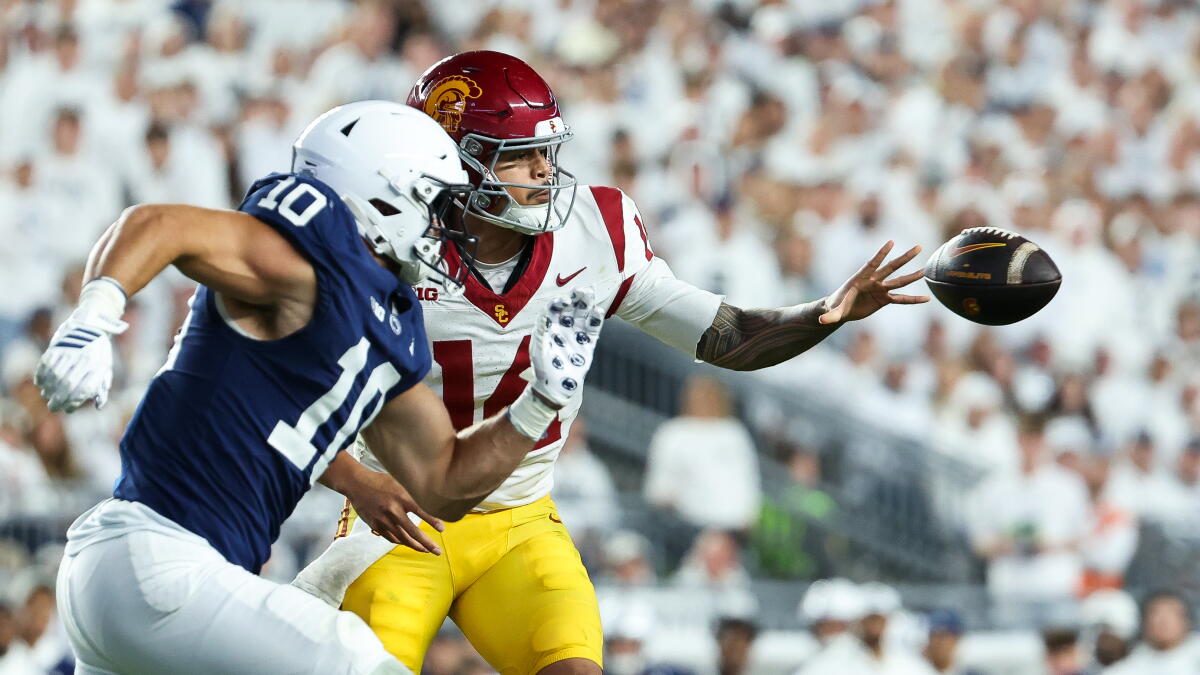
USC quarterback Jayden Maiava delivers an option pitch under pressure from Penn State’s Caleb Bacon on a play that scored a touchdown Saturday at Beaver Stadium.
With big-play threats Mosley and Tanook Hines on the field, Maiava looked like an elite Big Ten quarterback dealing the ball in locations only his two ace receivers could catch.
Maiava completed 21 of 33 passes for 301 yards, three touchdowns and no turnovers.
Mosley had nine catches for 111 yards and one touchdown. Hines had four catches for 82 yards and another score. The passing attack opened up enough space for King Miller to earn 102 yards and a touchdown in 19 carries.
Of course fans have come to expect big highlight plays from a Riley offense, but Maiava was unquestionably tentative the past few weeks and the offense wasn’t clicking. It hit top gear at Penn State.
USC’s Christian Pierce punches the ball out of the hands of Penn State’s Brett Eskildsen, forcing a fumble in the fourth quarter at Beaver Stadium on Saturday.
(Isaiah Vazquez / Getty Images)
While Riley has caught considerable heat this season, the USC defense directed by Gary Patterson wasn’t far behind.
The Trojans have shown marked improvement with Patterson shifting from the sideline to the press box the last two games.
Patterson had always worked from the sideline, but he also was always surrounded by staff members who knew his system well. Riley said the goal of the move was to speed up communication.
Desman Stephens II returned from his one-game suspension and led USC in tackles with nine. Luke Wafle and Kennedy Urlacher earned sacks. Jahkeem Stewart played after being listed as a game-time decision on the injury report and recorded a quarterback hurry.
Jontez Williams, Prophet Brown and Elijah Newby were credited with breaking up one pass apiece.
Riley can deliver in crunch time
USc coach Lincoln Riley talks with quarterback Jayden Maiava during the Trojans’ win over Penn State Saturday at Beaver Stadium.
And he was well aware few expected USC to win at Penn State, with betting odds favoring a rebuilding Nittany Lions squad by 1 1/2 points.
Riley’s clock management and use of timeouts, along with his play-calling, unquestionably got the best of Penn State’s Campbell and helped seal the USC win.
Opening the second half with an onside kick set the tone that everything was on the table for USC.
When Riley kept his offense on the field on fourth and four at the USC 13 late in the fourth quarter. Campbell said he called timeout with 4:15 remaining to be sure he put his team position to go get the ball.
Riley was delighted Campbell burned his final timeout and sent on his punt team.
After his defense forced a turnover, Riley’s offense burned time off the clock and lined up for fourth down when Penn State jumped offside.
For once, the Trojans didn’t flinch when it mattered most. USC finished with three penalties for a loss of 25 yards, a remarkable improvement for a team that has racked up a lot of ill-timed penalties during Riley’s tenure.
USC was awarded the first down and took a knee to run out the clock on a victory.
USC’s Kameryn Crawford and Luke Wafle celebrate with fans after their win over Penn State Saturday at Beaver Stadium.
(Barry Reeger / Associated Press)
The Trojans celebrated in the rain before starting a bye week.
“I was not surprised at all that we played well,” Riley said. “I felt like we really had one of the best weeks of prep that we’ve had since I’ve been here. I thought team had a great mindset coming in.
”… I’ve only been a head coach at two schools. They’ve both been blue bloods. … Blue bloods are unbelievable. The advantages far, far outweigh the disadvantages, but the disadvantages at blue bloods are the outside noise is always going to be way over the top, no matter what’s happening. And your ability to deal with that as a coach and then your team is critical if you want to have success in these jobs.
“And I thought our team blocked out everything. Our team knows how good of a team we have in that locker room and didn’t flinch.”
House of Troy ‘Chapter 4: Higher Power’ episode drops this week
Lane Kiffin was stunned when he was fired on the tarmac at Los Angeles International Airport at about 3 a.m. on Sept. 29, 2013.
He called his wife, who was equally surprised by the abrupt end to his tenure leading the Trojans.
“And I remember saying, I do not want to wake up tomorrow,” Kiffin recounts in the latest episode. “My life’s over.”
Kiffin helps provide an inside look back at the highs and lows of his USC era during Episode 4 of “House of Troy” available Tuesday morning at latimes.com/sports and everywhere you get your podcasts.
Olympic sports spotlight
The USC women’s volleyball team has been through some big changes, with coach Brad Keller missing matches Oct. 2 and Oct 4 because of an illness. USC announced on Oct. 5 Keller is taking personal leave and assistant Megan Moenoa is the Trojans’ interim head coach.
The Trojans (8-8, 2-4 Big Ten) earned a 26-24, 25-19, 25-22 road win over No. 15 Indiana (10-5, 3-3) in Bloomington on Sunday. It was Moenoa’s first win since stepping in for Keller.
Sophomore Abigail Mullen led USC with 11 kills, four blocks and nine digs. Freshman Milly McGee earned 31 assists, six digs and one kill.
Polling the people
Please note the following poll included voting before USC’s win over Penn State. The results do help illustrate the stress level Riley faced entering the game.
We asked “Will Lincoln Riley be USC’s coach in 2027?”
That concludes today’s newsletter. If you have any feedback, ideas for improvement or things you’d like to see, email Ryan at ryan.kartje@latimes.com, and follow me on X at @Ryan_Kartje. To get this newsletter in your inbox, click here.
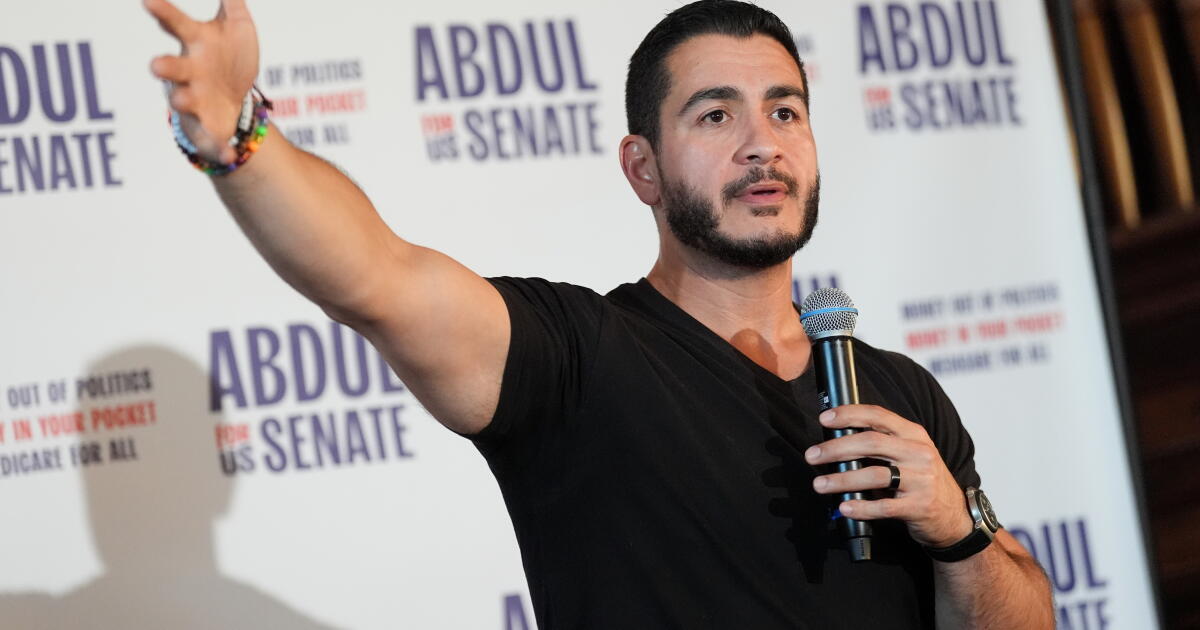
PORT HURON, Mich. — Abdul El-Sayed, holding a microphone and wearing his signature V-neck black T-shirt, slowly shook his head as a woman at his town hall described how she burned through her savings after undergoing emergency brain surgery.
“I’m really sorry for your experience, and I hope that you’re on the mend,” said El-Sayed, the Democratic nominee for U.S. Senate in Michigan, after outlining proposals for guaranteed healthcare and paid leave.
Later that night, while talking to reporters in the basement below the theater, his tone was far different. El-Sayed called his Republican opponent, Mike Rogers, a “coward” and said President Trump was “afraid” to visit the state, and he dismissed as “dumb” a question about whether Iran or Israel posed a greater threat to the United States.
The exchanges captured two sides of a candidate who is the central figure in one of the nation’s most consequential Senate races. El-Sayed would be the country’s first Muslim senator, and he’s crisscrossing the state to counter a Republican effort, fueled by tens of millions of dollars, to portray him as a dangerous radical. But he has also embraced his confrontational side by mocking and taunting Trump and Rogers.
“If they want to make me the main character in the midterms, I’m not shying away from it,” El-Sayed said in an interview. “Run against me. See how well that works out for you.”
El-Sayed’s resolute confidence rubbed some Democrats the wrong way during a divisive primary against Rep. Haley Stevens. The former public health official has shown little interest in toning it down, defending his progressive agenda and adversarial approach toward Republicans, emboldening supporters who believe he’s the right candidate for an angry electorate that has lost faith in the political establishment.
But his doubters fear he’ll cost Democrats control of the Senate by failing to unite his party’s disparate factions ahead of November.
“If you want their votes, you have to make nice with those people, and he’s not really doing that,” said Michigan political strategist Adrian Hemond, who supported Stevens. “Maybe he doesn’t have to. The entire theory of this candidacy has been he can remake what the electorate looks like.”
A Republican target
Even though Michigan backed Trump twice in his three presidential campaigns, no Republican has won a Senate race in the state since 1994.
The political landscape is no friendlier this year. Trump started an unpopular war with Iran, leading to higher gas prices and related inflation. Rogers has opted for a low-key campaign with fewer public events than El-Sayed as he tries to make the race all about his Democratic opponent.
As of Saturday, Republicans had outspent Democrats by $78 million to $63 million in the Michigan Senate race, according to AdImpact, which tracks political advertising. Around $40 million in Republican spending has gone toward negative advertisements, compared with around $20 million from Democrats.
The ads portray El-Sayed as “dangerously radical” and “too extreme,” highlighting his past calls to defund the police and relax immigration enforcement. Others tie him to Hasan Piker, a popular online streamer with whom El-Sayed has appeared and who has drawn criticism for past comments, including saying that “America deserved 9/11.”
On Friday, Rogers appeared alongside Louisiana Sen. John Kennedy, who told reporters that El-Sayed “sleeps in a Bin Laden jersey.” Rogers laughed.
Vice President JD Vance has called El-Sayed “evil.” In one social media post, Trump shared a photo of himself with First Lady Melania Trump alongside a photo of El-Sayed and his wife, who wears a hijab, with the caption: “Two VERY DIFFERENT America’s.”
Late Wednesday, Trump referred to El-Sayed as “Mohammed” and said he “goes back to the days of the Jihad.”
El-Sayed has hardly backed down. At the campaign stop in Port Huron, he taunted Trump and invited him to visit Michigan, suggesting Rogers and other Republicans were afraid the president would hurt their chances.
“Donald, if you’re watching, don’t wuss out, man,” El-Sayed said.
And he responded to Kennedy’s attack by suggesting the Republican is in the Ku Klux Klan.
“That’s rich coming from someone who wears his bed sheets out at night,” El-Sayed posted on social media.
A personal touch with voters
Before the Port Huron town hall, El-Sayed worked his way down a line of people who couldn’t fit inside the theater, shaking hands, taking photos and stopping for conversations.
Jeff Petrucella and his wife, Alice, traveled from Macomb County to see El-Sayed. They described themselves as politically “middle of the road” and said they had voted Republican in the past.
“I’m pretty done with the Republicans right now,” Jeff said.
Alice said she was “looking for a change that is better for my granddaughters,” pointing to El-Sayed’s support for Medicare for All. Nor was she put off by his more confrontational appearances on Fox News.
“I think he expresses himself well. You can tell he’s a well-spoken, educated man,” she said.
Pat Kreiner was among those who waited nearly an hour to see El-Sayed. Her children had persuaded her to support him in the Democratic primary.
“My son said to me, ‘I have been living with this trickle-down economy since the day I was born,’” Kreiner said. “‘It doesn’t work for me.’”
Kreiner also expressed anger about Trump’s trade war with Canada, just across the river from Port Huron.
“We are heartsick about our neighbors,” she said. “They used to come over a lot. We don’t see them now.”
Visiting smaller towns such as Port Huron has become central to El-Sayed’s campaign, with his team recently saying he’s held more than 500 events in over 100 cities across the state.
“Go everywhere. Talk to everyone. That’s what we do,” El-Sayed said in an interview.
The personal approach has not erased all the skepticism surrounding El-Sayed, including within his party.
His criticism of Israel and association with Piker have raised concerns among some Jewish Democrats. El-Sayed has held a series of private gatherings with undecided Jewish voters as he works to win their support.
He has also sought to strengthen his standing with Black voters. In the Democratic primary, Stevens drew more support in Wayne County, home to Detroit and its large Black population.
Ahead of Thursday’s debate, El-Sayed attended two events with Black leaders before stopping at a Black barbershop, where he moved from chair to chair talking with customers. He stopped at one point to speak with a pregnant woman, congratulating her and asking when her baby was due.
“November 8th? Make sure you vote early, huh?” the candidate joked.
A race about more than just Michigan
While El-Sayed has spent much of his campaign trying to win over Michigan voters, his candidacy has taken on significance far beyond the state. Republicans have made him a symbol of what they say is an increasingly radical Democratic Party, while progressives see his campaign as a chance to prove their politics can win in a closely divided state.
At a New York City fundraiser on Oct. 5, Rep. Alexandria Ocasio-Cortez cast his campaign as a test for progressives nationwide.
“If Abdul can win in Michigan, anybody can win anywhere,” said the New York Democrat, a potential presidential candidate.
Ocasio-Cortez plans to campaign with El-Sayed in Michigan this week, followed by former President Obama on Oct. 24.
The national stakes have also drawn renewed opposition. United Democracy Project, a super PAC affiliated with the pro-Israel group AIPAC, disclosed an initial $94,000 expenditure against El-Sayed on Friday, after spending nearly $30 million to oppose him in the Democratic primary.
And El-Sayed, while maintaining that the election should focus on Michigan voters and their economic struggles, has also embraced the larger implications of his candidacy.
“I am grateful for your support,” he told the audience at the New York fundraiser, according to remarks obtained by the Associated Press. He said he had two goals: “pick up a U.S. Senate seat” and “change the nature of our politics for the better.”
WASHINGTON — With the midterm elections just over three weeks away, the fight for control of the U.S. Senate is intensifying in battleground states, as Democrats push into red regions and Republicans pour money into key contests.
Campaigns are entering a crucial stretch for persuading the independent voters who will probably determine outcomes in swing races. Nearly all of the most competitive Senate races are in states with significant swaths of people unaffiliated with either major party — the “kingmakers” in these high-stakes midterms, said Jeremy Gruber, an independent-voting expert.
“Independent voters are going to be deciding this election in every respect,” said Gruber, senior vice president of Open Primaries, an organization that advocates for states to open primary elections to unaffiliated voters.
The urgency around courting nonaligned voters has been on display at recent debates, in ads flooding the airwaves and in the campaign money pouring into key states. For Republicans, it has become an effort to put distance between themselves and President Trump; for Democrats, it’s often a rhetorical shift toward the center and away from the far left.
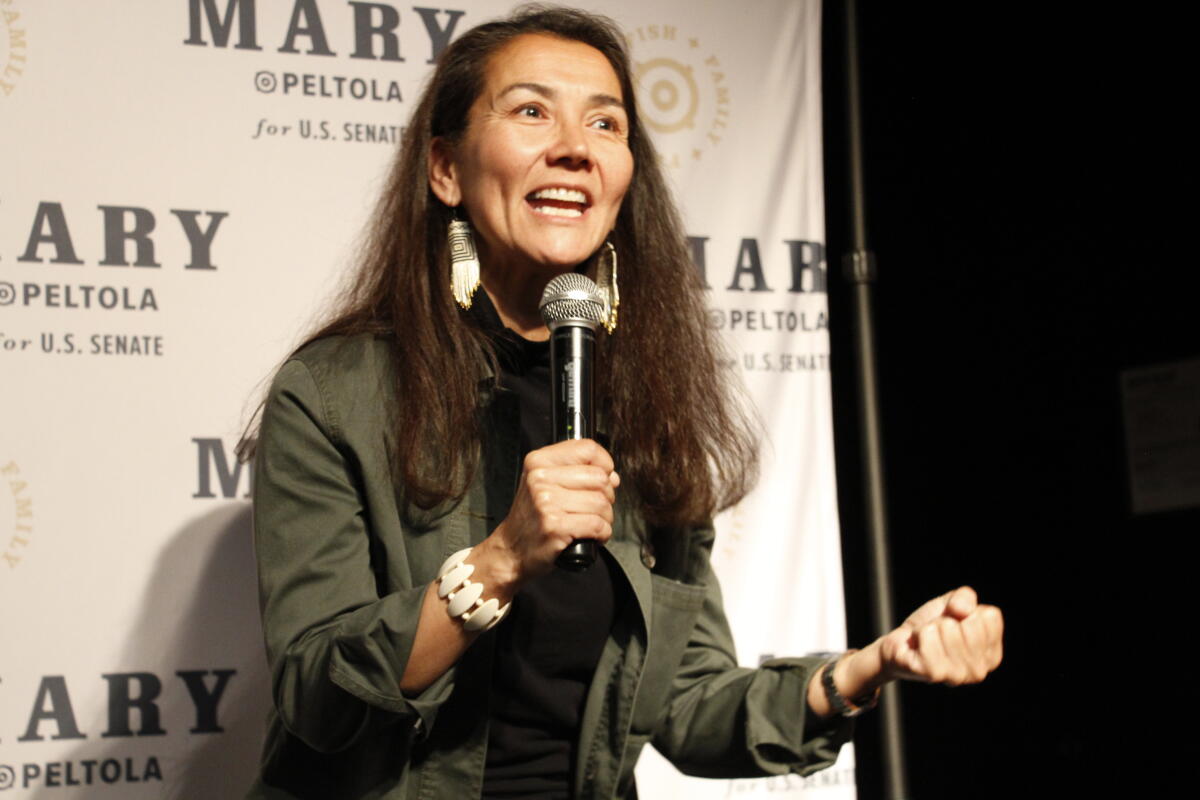
In Iowa, Republican Ashley Hinson used a Wednesday night debate to emphasize her willingness to break with Trump. In Kansas, Democrat Adam Hamilton is circulating a video in which he describes himself as both liberal and conservative. In Alaska, a GOP-backed ad blitz launched last week aims to persuade voters that Democrat Mary Peltola isn’t independent-minded.
Mary Peltola, a Democrat running for the U.S. Senate seat in Alaska, addresses supporters at an election watch party on Aug. 18 in Anchorage.
(Mark Thiessen / Associated Press)
Though many unaffiliated voters have made up their minds, those who remain undecided will begin making decisions soon, as mail ballots go out and early voting begins in some states.
“For Republicans who are running behind and are looking at a potentially devastating midterm election performance, what they really need to do is target the independents who lean Republican,” said Karen Kedrowski, an Iowa State University political scientist. “For Democrats in some place like Iowa … what they need to do is make it seem safe [to independents] to vote for a Democratic candidate.”
Unaffiliated constituents have long been key to victory in swing states, particularly where races are traditionally decided by small margins. They have been viewed as particularly persuadable this year, as public dissatisfaction with Trump’s economic policies puts the votes of swing voters who backed him in 2024 up for grabs.
Forecasters predict that Democrats are on track for the House majority and could hold a majority of gubernatorial seats for the first time since 2010. Though Senate control remains a toss-up, Democrats’ chances are viewed by forecasters to have significantly improved since the summer.
A set of New York Times/Siena polls reported last week showed Democratic candidates for the Senate ahead in Texas, Michigan, Alaska and Ohio and neck-and-neck in Kansas and Iowa — all states Trump carried in 2024. Republicans, meanwhile, are feeling increasingly bullish about their chances in Maine, New Hampshire and Minnesota, all states that went blue in the last presidential election.
Republicans hold a significant fundraising advantage, however, and party donors are pouring money into key races, hoping the spending can cut into the Democrats’ edge. By September’s end, GOP advertisers had more than doubled their spending compared with August, outstripping Democrats, according to tracker AdImpact. Among the nine Senate races considered the tightest by forecasters, Republicans have outspent Democrats in all, AdImpact reported.
But on Friday, the Cook Political Report, a leading election forecaster, moved 18 House races in Democrats’ direction, saying that heavy ad spending by Republicans has not begun to move the needle in their favor.
Democrats view themselves as in their “strongest position yet” to win the majority, Sen. Kirsten Gillibrand (D-N.Y.), who chairs the Democratic Senatorial Campaign Committee, said in a statement last week.
“In this final stretch of the election, Democrats will continue to vigorously campaign and fight for every vote across the expanded map,” Gillibrand said.
Republicans are confident about their ability to persuade voters in key states, said Bernadette Breslin, a spokesperson for the National Republican Senatorial Committee.
“Republicans will defend the Senate majority across key battlegrounds that have trended reliably red,” Breslin said, “with candidates like Mike Rogers [in Michigan] and Roger Marshall [in Kansas] winning over independents by exposing their Democratic opponents’ radical, unaffordable agendas.”
Along with the decisions of independent and swing voters, the midterm outcomes could also hinge on the level of turnout within each party, analysts say. If a portion of the party faithful stay home in a given place — for instance, disillusioned conservatives in Kansas or frustrated Black Democrats in Michigan — that could swing individual races, analysts said.
The number of independent voters reached a record high this year, with 45% of American adults identifying as political independents in Gallup polling. Equal shares identified as Republicans and Democrats, 27% for each party. The trend is partly driven by majorities of millennial and Gen Z voters choosing to be unaffiliated with either party, according to Gallup research.
Such voters make up a majority in Alaska and between 30% and 40% of all registered voters in Maine, Iowa, New Hampshire, North Carolina and Ohio. They account for about 29% in Kansas and about 16% in Texas and Michigan, according to state data compiled by the Independent Voter Project.
Across recent polls, independent voters have favored Democrats and expressed dissatisfaction with Trump. In a late September poll from Emerson College Polling, 66% of independents said Trump has done worse than expected during his second term in office.
State Rep. James Talarico, Democratic U.S. Senate candidate, listens at a food drive at the Frederick Douglass Human Services and Justice Center on Sept. 9 in Dallas.
(Julia Demaree Nikhinson / Associated Press)
In Texas, Democrat James Talarico led Republican Ken Paxton among independents by 32 points in a September poll by Texas Public Opinion Research. The Democratic candidate in Ohio, Sherrod Brown, led Republican Sen. Jon Husted by 27 points among independents in a CNN poll released Thursday.
In Kansas, where the Senate race has become unexpectedly close amid economic-driven anger with Trump, disapproval of the president’s performance among independents appears to be rubbing off on incumbent Sen. Roger Marshall, the Republican seeking reelection.
Fifty-two percent felt unfavorably toward Marshall and 62% disapproved of Trump’s performance, according to a recent Emerson College/Nexstar poll.
In those battleground red states, that creates a tough fight for both parties, analysts said. With control of the Senate hanging in the balance, candidates are duking it out in fundraising and on the campaign trail to win every last vote.
“Both campaigns are raking in ridiculous amounts of money … and they’re spending every penny because [they] have to,” said Wichita State University political science professor Alexandra Middlewood, referring to the Kansas Senate race. “We see that they’re really going to have to fight it out all the way to the end.”
Debates are another tool for candidates to reach independent voters, said Corwin Smidt, a political science professor at Michigan State University.
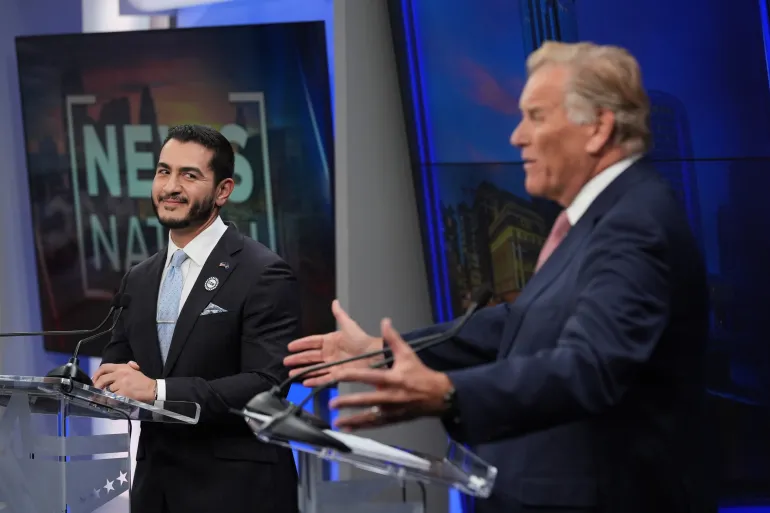
Democrat Abdul El-Sayed, left, and Republican Mike Rogers meet in a Michigan Senate debate Thursday night in Grand Rapids.
(Paul Sancya / Pool Photo)
In Michigan, where the Senate candidates sparred in their first debate Thursday evening, Rep. Mike Rogers, the Republican Senate nominee, has distanced himself from Trump twice in recent weeks, first calling for an end to the war in Iran and then releasing an ad last week denouncing the tariffs against Canada. Democrat Abdul El-Sayed, meanwhile, announced a rally with former President Obama, an appeal to mainstream voters.
“They’ve got to try to both win over people who have been paying attention, but also introduce themselves to the ones who haven’t been paying attention,” Smidt said.
Winning unaffiliated voters can require a tightrope walk for candidates who are faced with the dual tasks of appealing to their party base while persuading independent constituents.
In the final stretch of the campaign, candidates seeking independent votes should telegraph a willingness to admit their party’s flaws and an understanding that voters are turned off by partisan rhetoric, said Chad Peace, legal strategist at the Independent Voter Project, which advocates for open primaries.
“They have to communicate to those folks and try to meet them where they’re at,” Peace said. “[Independents] want the campaigns of persuasion, they don’t want to hear you tell me how bad the other candidate is.”
And, Gruber said, they want to be engaged with, not ignored.
“Independent voters,” he said, “are going to be responding to those candidates and parties that actually talk to them.”
The leading candidates in Michigan’s heated Senate race have faced off in their first televised debate, with less than a month remaining before the United States midterm elections.
Thursday’s hour-long debate was a microcosm of how tense the toss-up race has become.
Recommended Stories
list of 3 itemsend of list
Democratic nominee Abdul El-Sayed, formerly the health director for Wayne County, repeatedly sought to paint his Republican adversary Mike Rogers as a yacht-owning millionaire out of touch with ordinary voters.
For his part, Rogers, a former member of the US House of Representatives, lobbed accusations at El-Sayed that he was soft on “terrorism” and had foreign sympathies.
The Michigan-born El-Sayed has repeatedly faced Islamophobic attacks while on the campaign trail, with Republican President Donald Trump labelling him an “extremist, terrorist sympathizer” whose history “goes back to the days of the Jihad”. If elected, El-Sayed would be the first Muslim member of the US Senate.
The two candidates spent much of their hour onstage together speaking over one another, as they exchanged pointed barbs.
“He can’t condemn a terrorist act that happened on our soil in the state of Michigan. He can’t bring himself to condemn –,” Rogers began, referencing a March attack on a synagogue.
“I did condemn it,” El-Sayed said, jumping in. “No, you did not,” Rogers replied, with El-Sayed quickly responding, “You make stuff up. You make stuff up.”
The Senate race in Michigan is considered key to the battle for control of the US Senate. Democrats are seeking to flip both chambers of Congress, but shifting control of the Senate will be a tougher prospect, given that only a third of its 100 seats are on the November 3 ballot.
Host Rick Albin at times struggled to keep the debate on track, as tensions rose.
“We’ve got dozens of questions we want to get to. You can’t litigate all of these with 14 different rebuttals, so please work with me,” Albin told the two candidates at one point.
Here are the key takeaways from the evening’s debate.
Republican nominee Mike Rogers, right, speaks during a televised debate with Democratic nominee Abdul El-Sayed [Paul Sancya/Pool via AP Photo]
Rogers insinuates El-Sayed family ties to ‘terrorism watch list’
The ferocity of the debate was underscored by the high volume of ad hominem attacks the candidates deployed against each other.
But Rogers repeatedly pushed a series of attacks that seemed to centre on El-Sayed’s identity as a Muslim.
In response to a question about healthcare, Rogers said that El-Sayed has “taken money from individuals on his campaign who openly support Hamas, Hezbollah, al-Qaeda”.
Later, when asked about his position on surveillance by Flock cameras, Rogers argued that such technology has helped catch people suspected of terrorism. He then implied that El-Sayed’s concerns about the cameras were suggestive.
“Why would that bother you?” Rogers asked El-Sayed. “Well, if you have somebody in your family that might be on the terrorism watch list …”
El-Sayed interjected, seeming to dare Rogers to continue his thought.
“Are you going to go ahead and say that I’m a – go ahead and say it,” El-Sayed said. “You’ve been tiptoeing about it the whole time. Just say it. Just say it. Go ahead and say it.”
Muslim and Arab candidates in the US have frequently been subjected to Islamophobic attacks on the campaign trail, accusing them of support for “terrorism” and Islamic fundamentalism.
Republican Mike Rogers insinuated El-Sayed may have family on the ‘terrorism watch list’ [Paul Sancya/Pool via AP Photo]
Both sides agree on ending the Iran war
There were issues, however, on which both candidates found a measure of common ground.
Both Rogers and El-Sayed agreed the US-Israeli war against Iran should end, but they had opposite views on Washington’s relationship with Israel and its role in the conflict.
High gasoline prices and inflation, El-Sayed said, were directly caused by the Iran war, and he blamed the Trump administration for Iran’s decision to shut down the Strait of Hormuz, a critical trade route.
“This is what happens when you start wars you never should be fighting,” El-Sayed said. “We literally taught the Iranian regime that they have a choke on the Strait of Hormuz, and now we’re living in that reality.”
Rogers agreed that “we need [the war] to come to an end”, but he also justified the conflict, saying that Iran’s uranium enrichment programme had been “set back twenty years”, echoing a frequent White House talking point.
The Trump administration has argued that the war was necessary to prevent Iran from creating a nuclear weapon, a goal Tehran has long denied.
Rogers’s position led El-Sayed to accuse him of “cheerleading” for the war and the Trump administration.
Democratic nominee Abdul El-Sayed pushed for an end to unconditional support for Israel [Paul Sancya/Pool via AP Photo]
Rogers backs continued Israel aid, El-Sayed calls for end
As part of the debate about US foreign policy, the candidates were also pressed on their positions about the US alliance with Israel.
The country is considered the largest overall recipient of US aid since World War II. From the start of Israel’s genocidal war on Gaza in October 2023 through September 2025, experts estimate that Israel received nearly $21.7bn in military aid.
El-Sayed has openly called for ending aid to Israel, and he has repeatedly denounced the conflict in Gaza as a genocide, in line with evaluations from United Nations experts and human rights watchdogs.
During the debate, he indicated he preferred US taxpayer dollars to be spent on domestic concerns like education and healthcare, rather than Israeli aid.
“He wants unconditional support for a foreign government,” El-Sayed said of Rogers. “I want unconditional support for kids in our schools, unconditional support for our healthcare, childcare.”
He also blamed Israel for the US military action in Iran. “I don’t want to be pushed into war by Israel, and I don’t want to be in war with Iran,” El-Sayed said.
Rogers, meanwhile, has joined most of his fellow Republicans in continuing to support aid for Israel. He argued that the country had “the right to defend itself in a very difficult neighbourhood”.
“Is there anything Israel could do that would lose your support?” the debate host asked.
“Listen, if they’re talking about using nuclear weapons, they would definitely lose my support,” Rogers replied.
Abdul El-Sayed, right, and Mike Rogers shake hands prior to their debate [Paul Sancya/Pool via AP Photo]
Another hot-button issue during the debate was Trump’s crackdown on immigration.
The Republican leader has pledged to carry out the largest mass deportation effort in US history, and his campaign has spurred human rights concerns.
When asked how they would approach the crackdown, both Rogers and El-Sayed agreed on tempering the militarised nature of the campaign.
In several cities, including Minneapolis, Minnesota, immigration authorities have been accused of racial profiling and using excessive force against immigrants and protesters, as well as violating their rights to due process.
Multiple fatal shootings have occurred during immigration enforcement operations, including the deaths of Renee Good and Alex Pretti in January.
Rogers indicated he would not have supported such confrontational operations, but he repeated a Trump claim that the raids were taking dangerous criminals off the streets.
“I think the public efforts in Minnesota were probably not appropriate,” Rogers said. “You always want to go in quiet, get the bad guy, get out of the neighbourhood for less problems. So that, to me, was something that they could have done differently.”
He later claimed that, under Trump, the country had seen “the largest decrease in murders ever recorded”.
El-Sayed, meanwhile, has previously voiced support for abolishing Immigration and Customs Enforcement (ICE), a key agency in Trump’s deportation campaign. He defended that stance on the debate stage.
“ICE right now is not about immigration enforcement. ICE is about terrorising our streets,” he said.
Mike Rogers speaks to reporters in the spin room after the debate on October 8, 2026 [Jim Vondruska/Reuters]
Candidates debate Canada trade war and tariffs
Donald Trump’s trade war with Canada, felt acutely in neighbouring Michigan, was another key topic of conversation.
El-Sayed depicted Rogers as an uncritical backer of Trump and his tariffs and tied him to past free trade deals such as the North American Free Trade Agreement (NAFTA), which paved the way for companies to shift manufacturing facilities out of the US – though Rogers did not enter Congress until 2001, eight years after NAFTA passed.
“You did that, man. That was your policy. NAFTA, that was your policy,” said El-Sayed.
Rogers sought to distance himself from the current trade war but expressed support for a deal with Canada that would loosen some of Ottawa’s tariffs on US goods.
“I would like to see the deal made,” said Rogers, adding that high Canadian tariffs for US goods “should be eliminated”.
Both candidates tried to strike a balance between criticism of the economic fallout of the trade war and qualifying their support for more selective tariffs, favoured by some industries and labour unions as a means of protecting domestic jobs.
It never has been about the glory for Semaj Morgan.
Not the touchdowns. Not the name, image and license deals. And not even the 2024 national championship he won with Michigan.
For the UCLA wide receiver, all of that plays second fiddle to giving back to his community in Detroit and touching the lives of the people around him through the Semaj J. Morgan Foundation — an initiative he started when he was 17 years old.
“My foundation is definitely the best thing that I do. It’s great being a football player, but being able to give back and show people that I really care for others and not just about football and money, I want to be able to pour back into the people that support me and show me love,” Morgan said. “A lot of people don’t get to wake up every day and know that there’s going to be food around. A lot of people in the city of Detroit don’t even know if they’re going to eat at all.”
UCLA receiver Semaj Morgan is surrounded by children he has helped through his foundation.
(Courtesy of the Morgan family)
Morgan decided he wanted to start the foundation when he handed out toys with the Dream Team Male Mentoring group, telling his dad, Semaj T. Morgan, that community service was his calling. But at 17, he was too young to have his name on the paperwork, so his parents opened the foundation for him.
Since the foundation’s launch in February 2023, Morgan has hosted turkey drives, during which he gives away 2,000 turkeys, 2,000 food bags and 1,000 hot meals along with hats, coats, scarves and gloves, in an effort to tackle the health and food gaps in his community.
Morgan also has spearheaded back-to-school giveaways, handing out backpacks and supplies to children.
“We don’t do it just to do it. We do it because we’re trying to close the educational gap that our kids in Detroit suffer from,” Morgan’s father said.
“When you have a kid that’s going to school with the same notebooks and pens and highlighters and erasers that their counterparts have, now they have more confidence when they go to school.”
Morgan received a grant from the Ballmer Group, founded by Clippers owner Steve Ballmer and his wife, for the foundation’s DiscoverWorks Summer program. The initiative serves 250 families, giving students the opportunity to get their test scores up in the morning and go on field trips in the afternoon, alongside other enrichment activities such as robotics and mentoring.
UCLA quarterback Nico Iamaleava celebrates with Semaj Morgan after scoring a touchdown against Purdue at the Rose Bowl on Sept. 19.
(Ronaldo Bolanos/Los Angeles Times)
But the endeavor closest to Morgan’s heart is the foundation’s Mother’s Day and Father’s Day events.
“These are mothers and fathers who lost their sons to gun violence. Semaj is their son, and he takes his NIL money, and he takes them to dinner, buys them gifts as if their son was here,” Morgan’s father said. “These are parents that a lot of these children’s murders have not been solved, so this is a way for us to bless these parents, let them know that they’re not forgotten. There’s never a dry eye in the room.”
The events — which started out with 10 moms and five dads and are up to 35 moms and 20 dads — are particularly special to Morgan, who was friends with some of the sons of the parents involved. Morgan said that seeing the parents and hearing their testimonies puts everything in his life into perspective.
While Morgan is humble about the effect his foundation has had on the people around him, others are taking notice.
UCLA receiver Semaj Morgan holds up a Michigan state Senate certificate recognizing his foundation’s work to support people in Detroit.
(Courtesy of Morgan familiy)
Morgan was recognized on the Michigan House floor by state Sens. John DaMoose and Rosemary Bayer for the community service that he’s led in Detroit.
And during the 2024-25 academic year, Morgan was nominated for the inaugural Big Ten Jackie Robinson Community & Impact Award by his previous school, Michigan, for his philanthropic work.
“He understands his mission and call in life, and that’s to bless other people. He’s not about him; he’s about other people, and it’s very rare that you see individuals at such a young age understand their mission and cause in life,” Morgan’s father said.
“Football is one thing, but when he’s giving out turkeys, food bags, hats and coats, he has a bigger smile than getting in the end zone because he understands these people need help.”
Morgan’s desire to help others was inspired by Curtis Blackwell — Morgan’s travel football coach and president of Sound Mind Sound Body Sports Academy. Morgan’s father said Blackwell always urged players to give back to others.
Blackwell, who coached Arizona Cardinals cornerback Will Johnson, Buffalo Bills cornerback Maxwell Hairston and former Michigan safety Makari Paige alongside Morgan, stresses education before football and places an equal emphasis on academics, athletics and life skills.
And because Michigan does not get the same high school football exposure as Texas, Florida or California, Blackwell was keen on getting his players on college visits, leading to Morgan receiving more than 25 offers — a direct result of the travel the team made to raise players’ exposure.
“Growing up in a single-parent home, I was fortunate to get a scholarship to college, and it was because of my coaches. And had it not been for my coaches, I don’t know where I would be,” Blackwell said. “If we as coaches are the best people to really influence young people, they will listen to their coach more than their mom, their teacher. And so if we can get the coaches to be the teachers off the field, we could really change their attitude.”
Blackwell was astounded that Morgan was the pupil who took the program’s mission the furthest, surpassing the efforts of NFL players and affecting people well before he’s turned 21.
“You don’t have to wait till you get to the NFL to make an impact. You don’t have to wait till you retire to give back. You can do something every step along the way, and that’s what we teach to our kids — lift as you climb,” Blackwell said. “Semaj took that and ran with it. He has a really big heart and he’s a person that is a giver, not a taker. He’s going to give you the shirt off his back.”
UCLA receiver Semaj Morgan catches a touchdown pass against Purdue at the Rose Bowl Stadium on Sept. 19.
(Kevin Terrell / Getty Images)
Morgan earned his bachelor’s degree at Michigan and is working on his master’s degree at UCLA while playing football and running his foundation from the West Coast. But he may miss his first foundation event when UCLA travels to Ann Arbor to play his former school in November, although coach Bob Chesney already gave him permission to stay in Michigan after the team leaves.
Morgan’s greatest achievement that weekend may not involve the scoreboard at the Big House.
“I might not have done the best on the field last year, but being able to come home knowing that I’m touching people’s lives, that’s the biggest thing for me,” Morgan said. “To do this at such a young age, and grow so rapidly and touch so many lives, it’s great for me. After football, I want to continue to give back to people. I eventually want to be able to start football programs.”
Welcome back to the Times of Troy newsletter, where I, like many of you, can’t help but wonder: What’s going on with Jayden Maiava?
As USC’s quarterback kneeled out the final seconds of an unsatisfying win over Washington on Saturday, he didn’t waste any time celebrating on the field. Maiava spotted an NBC camera trained on him, turned toward the Coliseum tunnel and took off.
The camera followed Maiava and caught USC sports information director Katie Ryan sprinting to reach him. But even after Ryan caught up to the quarterback, Maiava barely broke his stride. He just kept running, the first one up the tunnel, while his Trojan teammates remained on the field.
Fight on! Are you a true Trojans fan?
Get our Times of Troy newsletter for USC insights, news and much more — exclusive to L.A. Times subscribers. Free Members receive a partial preview of each edition.
By continuing, you agree to our Terms of Service, which include arbitration and a class action waiver. You agree that we and our third-party vendors may collect and use your information, including through cookies, pixels and similar technologies, for the purposes set forth in our Privacy Policy such as personalizing your experience and ads.
It was a strange moment, after a game of strange moments for Maiava. And it certainly was not the sort of body language you want to see from your starting quarterback and team leader. Let alone after a win.
It didn’t get much better afterward, when USC trotted him out for the team’s postgame news conference. Maiava was asked about not being able to get into a rhythm. And he proceeded to answer a question that seemingly wasn’t asked.
“Just being able to trust it, fall back on routine plays,” Maiava said.
That’s not new for Maiava, who has often avoided any questions that he doesn’t want to answer by using a non sequitur football cliche. That’s his right. He’s not obligated to play ball with reporters.
USC quarterback Jayden Maiava jogs off the field without pausing for an NBC interview after the Trojans’ win over Washington at the Coliseum on Saturday.
(Ronaldo Bolanos/Los Angeles Times)
But USC has trumpeted Maiava’s progress as a vocal leader for more than a year now. And as the quarterback, he is naturally a representation of the program’s leadership and its larger culture. Which is what makes the body language of the past two weeks, as USC’s season feels on the brink, particularly concerning. Especially in context with what we’ve seen on the field.
The truth is Maiava hasn’t really looked the same since the shutout of Fresno State on Sept. 4, when he appeared to hurt his right shoulder. Maiava was asked about it the following weeks, but he said that he was “great.”
“It’s a physical game,” Maiava said. “It’s what happens.”
No one has mentioned the injury since, but Maiava has been markedly less accurate in the ensuing four games. He’s completing 60% of his passes over that time, after the first two games had him closer to 90%. Maiava’s mechanics have looked far less consistent over that stretch. And then there were the moments Saturday in which Maiava appeared tentative, like he might actually be shying away from running the ball.
During USC’s opening drive, Maiava scrambled away from pressure and had a chance to take off upfield and potentially pick up the first down with his legs. But instead he sprinted wider toward the sideline, in search of receivers who weren’t there in the corner of the end zone. He ended up getting sacked.
A couple possessions later, Maiava launched a prayer down the field off his back foot. It was intercepted and the quarterback threw his hands, fully aware the turnover was his fault.
USC’s problems certainly can’t be laid at Maiava’s feet. The quarterback has been pretty good this season by normal statistical standards. He’s ninth in the nation in passing yards per game (290) and third in total passing touchdowns (15)
But our eyes also don’t deceive us. Maybe he is hurt. Regardless, in order to actually save their season, the Trojans need Maiava to be more than just a passable Big Ten quarterback. They need him to put the team on his back.
Riley said earlier this season that Maiava has come further than any other passer he’s mentored as a college coach. But midway through his third season at USC, it’s this last step in his development that seems to be most troubling Maiava.
Patterson in the press box
USC defensive coordinator Gary Patterson walked onto the field before the Trojans played Oregon at the Coliseum on Sept. 26.
The results at least seemed palpable on Saturday. The defense was much more dialed in on third down, holding the Huskies to just a single conversion on 12 attempts. And the secondary seemed to iron out most of its communication problems.
Whether that can be attributed to Patterson being the one in the booth is impossible for me to say. The bigger question, as I see it, is why there was such a disconnect between Patterson, his scheme and the rest of the staff. Riley seemed to suggest that the way Patterson wanted to do things wasn’t clicking with the rest of the operation.
“Going through some of these first few games, seeing the makeup of the staff, it was a conversation that he and I had on Sunday,” Riley said after USC’s win over Washington. “We thought there were some reasons just kind of in our operation that made sense. He knows this defense obviously better than anyone. He was used to having, I think, a staff at TCU — if you look at his staff there, for years and years, they had little to no turnover, right? So when you had guys who had been coaching with you for 15-20 years, like he had in a lot of ways, you might handle that different. He had a heck of a defensive staff, and it’s kind of like players, right? You’re trying to just move the chess pieces to get everyone in the right position to get the best out of them.”
House of Troy ‘Chapter 3: A New Era’ episode drops this week
Ask most people from within the Trojan family when things started to unravel for USC’s football program, and they’ll inevitably point to the Reggie Bush-related NCAA sanctions as an obvious starting place.
Well, what if I told you that the mess that USC would find itself wrapped up in could’ve been so easily avoided?
At least, that’s the opinion of the key former members of New Era Sports & Entertainment, the failed sports agency that said it paid Bush and his family. Bush continues to deny allegations he violated NCAA rules. What could’ve presumably ended with one calm conversation in 2006 ended up snowballing into a yearslong saga that didn’t just upend USC football, it derailed the lives of everyone involved.
— USC’s pass rush finally played to its potential. The Trojans tallied 25 (!) pressures against Washington and sacked Demond Williams Jr. five times, which was more than its previous three games combined. The most important of those sacks came on the final drive, as Kameryn Crawford dropped Williams on a critical third down, deep in USC’s own territory. Freshman Luke Wafle also got his first college sack, after being close basically 10 other times, and he seemed relieved by that. He wasn’t the only one relieved by the pass rush production. The Trojans’ maligned secondary, in particular, was a major beneficiary.
— Rampant penalties may just be a part of this team’s identity. USC committed nine penalties against Washington and lost 94 yards, but the numbers alone didn’t tell the whole story. Half of those penalties were pretty consequential. An illegal formation call brought back a USC passing touchdown, then a face mask from Wafle kept the ensuing Washington drive moving. The Huskies ended up scoring a go-ahead touchdown. USC has at least eight penalties in three of its past four games.
— Should Desman Stephens II keep his starting job when he returns? Not because of what happened against Oregon, but because of what happened against Washington. I thought his replacement, Ta’Mere Robinson, played the best game of any linebacker at USC this season. Robinson had six defensive stops, twice as many as any other Trojan defender on Saturday. He added a sack and graded quite well in coverage by Pro Football Focus. It’s not like Stephens was playing all that well before his suspension. USC also got a strong showing from reserve linebacker Elijah Newby.
— Alex Graham is clearly essential to USC’s secondary. The Trojans’ Swiss Army knife defensive back returned from injury Saturday and made a marked difference for the whole unit. Graham had four pressures as a blitzer and has looked absolutely lethal in that role. And he played a huge part in taking away Washington’s short-area passing game, which can be dangerous if Williams is able to get loose. There’s no player more valuable on the back end of USC’s defense.
This week … in 2006
USC’s Brian Cushing blocks Sean Douglas’ punt during the Trojans’ win over Washington on Oct. 7, 2006.
(Matt Sayles / Associated Press)
For the second straight week, USC’s defense was backed up deep into its own territory in the final seconds, in danger of losing to a lesser Pac-10 team.
Washington had gotten the ball back with 1:34 remaining, trailing the Trojans, 26-20, when Husky quarterback Isaiah Stanback proceeded to march down the field on USC’s defense. Stanback scrambled to convert a fourth down with 18 seconds remaining, then completed a 19-yard pass to the USC 15.
But with two seconds left, Washington couldn’t get set in time to spike the ball. The clock ran out on their comeback attempt.
The whole experience gave linebacker Brian Cushing flashbacks of USC’s loss to Texas at the Rose Bowl.
“That last minute just got a little nerve-racking,” Cushing said.
Olympic sports spotlight
USC’s men’s water polo team was down 12-11 to California when the Trojans collected the ball with five seconds remaining in their Mountain Pacific Sports Federation opener. Somehow, they managed to win the game from there.
It started with an exclusion. Then a goal with a single tick left on the clock, sending the game to overtime.
It went to a second overtime and USC eventually put away the game 15-14 with a golden goal from Strahinja Krstic. A scintillating start to conference play.
Polling the people
Newsletter editor and poll manager Houston Mitchell is out this week, so we’re extending our poll one more week. If you have not voted, feel free to weigh in now.
Sienna Miller and Dominic West star in the new HBO series “War.”
(Justin Downing/ Sky / HBO)
I’ve been yearning for a slow-burn HBO drama since the end of “Industry’s” most recent season, and I’m optimistic that the network appears to have delivered.
“War” has that potential, at least. The first season of what is apparently an anthology series follows a high-stakes divorce case between a tech mogul played by Dominic West and a movie star played by Sienna Miller. And while it doesn’t seem to be breaking any new ground as a legal drama, the writing and acting appears to be on point — as usual with an HBO show of this magnitude.
That concludes today’s newsletter. If you have any feedback, ideas for improvement or things you’d like to see, email me at ryan.kartje@latimes.com, and follow me on X at @Ryan_Kartje. To get this newsletter in your inbox, click here.
When twins Keira and Kelsey Luderer of Sherman Oaks Notre Dame announced they had committed to Florida State to play college softball, their father, Brian, the new head coach for Notre Dame, was ready to cry.
“Special moment,” he said of his junior daughters.
Kelsey, an infielder who was Mission League player of they year, and Keira, a standout catcher, have been working hard for years for this moment and learned plenty from Brian, who played baseball in high school and college.
Michigan, California and Loyola Marymount were also finalists for the twins who were coached last season by Justin Siegel, a new assistant coach at Loyola Marymount.
Now dad and mom, who have been transporting them around for years in club softball, will have to begin looking for the cheapest flights to Tallahassee.
This is a daily look at the positive happenings in high school sports. To submit any news, please email eric.sondheimer@latimes.com.
WASHINGTON — California is sometimes described as the ATM of Democratic politics.
That’s certainly been the case in the most divisive Democratic races this year.
Donors from California have given more to far-left candidates and their moderate opponents in congressional races and U.S. Senate contests than donors from any other state — more than $17 million combined, according to a Times analysis of the most recently available campaign finance filings.
More of that money — nearly $11 million — went to more progressive candidates. That giving came from more than 95,000 individual donors, which was more than double the number of California donors who gave to their more moderate opponents. That includes 18,000 donors who gave to both progressive and moderate candidates.
There was a geographic divide in giving by Californians. The largest share of cash to progressive candidates came from donors in the Bay Area, while the largest share of financial backing to moderate candidates came from donors in the Los Angeles area.
The Times looked at competitive races outside California in which one of the candidates had been endorsed by either the Justice Democrats or the Democratic Socialists of America, or DSA, as well as key Senate races in Michigan, Minnesota, Florida and Maine that featured a stark ideological divide between top Democratic contenders.
Although these races represent a small fraction of the electoral contests across the country, they were the races in which the future ideological direction of the Democratic Party was most fiercely contested.
Progressive candidates fared better in the majority of these contests.
California donors helped fund the Senate primary victories of progressives Abdul El-Sayed in Michigan and Peggy Flanagan in Minnesota — second only to in-state donors in providing cash to each of those candidates.
Progressive House candidates such as Melat Kiros in Colorado and Darializa Avila Chevalier in New York were able to defeat more moderate incumbents with heavy support from California donors.
Their efforts weren’t always successful, however.
Former Rep. Cori Bush raked in more cash from California donors than in-state supporters in her bid to unseat incumbent Rep. Wesley Bell in Missouri’s 1st Congressional District, the seat she had held previously. But Bell easily cruised to victory in this year’s primary.
And then there was Graham Platner.
California donors gave nearly $2.5 million to his Senate campaign in Maine before he withdrew after he was accused of sexual assault by a former girlfriend. He has denied the accusation.
The Times analysis looked at direct contributions to campaigns, which are capped at $7,000 per election cycle. It did not include contributions to party committees or independent committees that could also be spending in these races. The analysis included both bigger contributions required to be disclosed by campaigns as well as small-dollar contributions through the Democratic fundraising platform ActBlue.
Flipping the script
Progressive donors said they were motivated to give to candidates who would shake up the Democratic Party’s status quo.
“The Democratic Party has to understand that they can’t keep doing the same thing,” said Rehan Alvi, a real estate investor in El Dorado Hills.
He gave the maximum allowable to support the campaigns of El-Sayed and Bush, and also supported Junaid Ahmed’s failed primary bid in the Illinois 8th Congressional District, as well as Platner’s campaign.
Harry Saddler, a retired designer who lives in San Francisco, said that the state of the party is “enraging.”
“That leads me to think about people who can actually flip the script,” he said.
Joshua Saltman, shown in his Los Angeles home, is one of many Democratic donors from California who have given in divisive Democratic races across the country.
(Genaro Molina / Los Angeles Times)
Saddler has written checks to a number of more progressive candidates, including Flanagan, Chevalier, Ahmed and Nida Allam, who lost her primary bid to unseat incumbent Rep. Valerie Foushee in North Carolina’s 4th Congressional District, though he has also supported some moderate candidates in other races he sees as crucial to Democrats chances at retaking control of one or both chambers of Congress.
That pragmatic approach is part of the reason Joshua Saltman said he has supported a number of moderate candidates.
“The reality of the map is that if Democrats are going to retake the House, it’s not just winning super blue districts,” said Saltman, a former entertainment industry lawyer who now runs a Broadway music festival.
Saltman said that he considers himself to be a more moderate Democrat and is also inclined to give to moderate candidates who he believes “get a little less love” from other donors, particularly in California.
He has written checks to Rep. Haley Stevens, who lost to El-Sayed in Michigan; Rep. Angie Craig, who lost to Flanagan in Minnesota; Bell in Missouri and Gov. Janet Mills in Maine, who was Platner’s main competition in the Democratic primary before dropping out of the race.
Alan Burye, a retired accountant who lives just outside San Diego, said he prefers more moderate candidates because he thinks they are more productive politicians.
“The ones who are out on the edges, like Bernie Sanders, really don’t get much done,” Burye said.
He cut checks to Craig in Minnesota and Stevens in Michigan.
Israel’s impact
American support for Israel — in the wake of wars in Gaza and Iran — has been a major point of division among more progressive and moderate candidates and is a key fault line among many donors.
Progressive candidates have been increasingly critical of the actions and influence of the Israeli government as the public, broadly, has adopted a more negative view of the Israeli government.
Politicians who have drawn support in the past from the American Israel Public Affairs Committee, or AIPAC, have been a particular target of progressive challengers.
“The problem with the Democratic Party is that they’re all just beholden to AIPAC and to corporate interests,” said Alvi, the real estate investor in El Dorado Hills. “I want a candidate who has the courage to speak.”
In Michigan, El-Sayed described AIPAC’s support of Stevens, his moderate opponent, as “legalized bribery.”
El-Sayed has made no secret of his criticism of American foreign aid for Israel and said that he “doesn’t believe in ethno-states” in response to a question in the summer about whether he supports the right of Israel to exist.
El-Sayed’s comments and similar sentiments expressed by other more progressive candidates are part of the reason some donors have given to moderate candidates.
“I feel that people who fundamentally aren’t big fans of Israel aren’t necessarily people I want to give money to,” said Saltman, who gave to Stevens.
Saltman, who was born in Michigan, said that he would still vote for El-Sayed if he lived in the state.
Other donors said they were inspired to give to moderate candidates because of concern that anti-Israel rhetoric could veer into attacks on Jews more broadly.
Los Angeles investor Steve Emerson said his motivation in writing checks to moderate Democrats such as Stevens is “to fight antisemitism.”
El-Sayed, for his part, said in the summer that his criticism of Israel is about foreign policy, not Jewish people.
“Judaism and the Jewish people are a light onto the world,” he said.
WASHINGTON — President Trump’s trade war with Canada could intensify the headwinds Republicans are navigating ahead of the November midterms, with its effects poised to reverberate in northern battleground states with crucial Senate races.
The escalating beef with Canada — Trump attacked the country anew on social media Wednesday — stands to heighten voters’ economic worries and add to the GOP’s political challenge in dead-heat races, analysts said.
“It doesn’t make things easier. It’s not helping,” said Rusty Hills, a University of Michigan public policy professor and onetime chair of the Michigan Republican Party.
The president’s unpopular policies on the war in Iran, the economy and data centers have already handed Republican candidates the tough task of appearing responsive to Americans’ frustration with cost-of-living issues without alienating Trump and his voter base.
The trade war, said Lance Dutson, a Maine Republican media strategist, puts “another log on the fire” of the affordability issue.
The tariffs have appeared unpopular in recent polling, including among a majority of independent voters. Though they are not expected to dramatically increase consumer prices, they could affect voters’ perception of the economy — and even small economic impacts on certain industries, such as auto manufacturing in Michigan, could have an effect in very close midterm races, experts said.
Trump’s new import bans on some Canadian goods are set to begin next week, a response to retaliatory tariffs Canada levied earlier this month. Trump argues that Canada has “been ripping off” the United States and that tariffs will help domestic manufacturers.
On Wednesday, the president inaccurately claimed on Truth Social that Canada is allowing “millions and millions” of immigrants into its country.
“It is a Liberal takeover that will end very badly. Already showing up in their numbers. Big unemployment. ‘Oh Canada!” the president wrote on social media Wednesday morning.
Five of the nine states most likely to decide Senate control border Canada — Alaska, Ohio, Michigan, New Hampshire and Maine. Two more, Texas and Iowa, also do substantial trade with Canada.
Democrats must retain their Senate seats including New Hampshire and Michigan and flip four of the other states to win a majority, a tall task. As the landscape worsens for Republicans, however, some aretesting how much they can distance themselves from Trump.
“It’s a tightrope, there’s no question,” Hills said. “[Candidates] are looking for some wiggle room on some of these issues like the war and prices and Canada tariffs, because they need every independent and swing voter they can get.”
A majority of Americans oppose raising tariffs on Canadian goods, including 64% of independents, anEconomist/YouGov poll found. Only 14% of independents said they supported additional U.S. tariffs on Canada in a late AugustIpsos poll.
And in Michigan, 68% of independent voters disapprove of the tariffs, a poll this month from the Washington Post and Schar School found.
“The more we put tariffs on stuff, the more they put tariffs on stuff … prices are just ultimately going to go up for all of us,” said one Michigan swing voter in a Sept. 9 focus group conducted by the firm Engagious, in which 11 of 13 participants said the trade war was bad for the state.
The highest costs of the tariffs will be concentrated within a few industries, including auto and other manufacturing, dairy, and alcohol and spirits, said Alex Durante, a senior economist at the Tax Foundation. The tariffs likely won’t create a major change for consumers, but the general impression that tariffs can contribute to higher prices might turn off voters who are already worried about inflation, he said.
Counter-tariffs imposed by Canada in response to U.S tariffs last year resulted in a 6% increase in the prices of affected goods, researchers found in paper published by the Journal of Monetary Economics.
Canadian lumber products at Gutherie Lumber in Livonia, Mich., in August.
(Paul Sancya / Associated Press)
“This trade war is certainly not helping the president and his party in the midterms,” Durante said. “What’s weighing on the top of people’s minds is this general affordability crisis … and they realize that tariffs are another factor that is impacting affordability.”
The latest escalation of the trade dispute began in July, when Trump threatened new 50% tariffs on some Canadian goods, reinvigorating a conflict that began with tariffs the president imposed in 2025.
The two countries began trade talks, but the negotiations fell apart in late August, and Trump imposed tariffs on about $20-billion worth of Canadian goods. Canada retaliated with tariffs on about $20-billion worth of American goods that took effect Sept. 8. Trump then announced import bans on some Canadian goods, including certain alcohol and dairy products, which go into effect next week.
Construction and farm equipment in Illinois, aluminum and pipe products in New York, and iron and steel products in Ohio are among the goods targeted by Canada’s counter-tariffs, the Canadian Broadcasting Corp. reported. In California, about 10.5% of the state’s Canadian imports are exposed to the counter-tariffs imposed by Canada.
Democrats have seized on the issue as another way to tie Republican candidates to Trump’s policies, something that analysts said may have varying degrees of success in different swing states.
Maine Republican Sen. Susan Collins campaigns in August in Kittery, Maine.
(CJ Gunther / Getty Images)
In Maine and New Hampshire, where the Republican Senate nominees have criticized Trump’s move, the tariff issue may be less likely to stick. Efforts to tie Republicans to Trump have historically been less successful in the region because of its independent streak, said Jim Merrill, a veteran Republican strategist in New Hampshire.
Maine Republican Sen. Susan Collins warned the White House against imposing tariffs and successfully pushed for the administration to exempt road salt and cement this month. She told Politico that the Trump administration had “very much underestimated” the effect of the tariffs on Maine residents.
Republican John Sununu, a former senator who is running to retake the seat in New Hampshire, has also criticized the tariffs, saying a trade war with Canada “doesn’t make any sense.” He indicated he would support legislation in Congress to restrain the president’s tariff powers.
Elsewhere, Senate nominees have walked a careful line on tariffs. In Alaska, Sen. Dan Sullivan has largely avoided the issue, even as Democrats there have used it to ramp up attacks on his record in recent days. In Ohio, former Sen. Jon Husted told the National Review in August that the public “would like to understand the strategy behind what the president’s trying to do.”
Former Rep. Mike Rogers of Michigan, the Republican Senate nominee, told reporters over the weekend that he was in favor of “good” tariffs that would help Michigan and opposed to “bad” tariffs that would hurt the state.
Focusing on issues other than tariffs may be the right strategy on the campaign trail, Hills said.
“He’d much rather be talking about the Republican plan for affordability,” Hills suggested. “There’s interesting things we need to be talking about in order to win this election, and this isn’t one of them.”