Column: There should be no partisan divide about naming Epstein’s fellow abusers
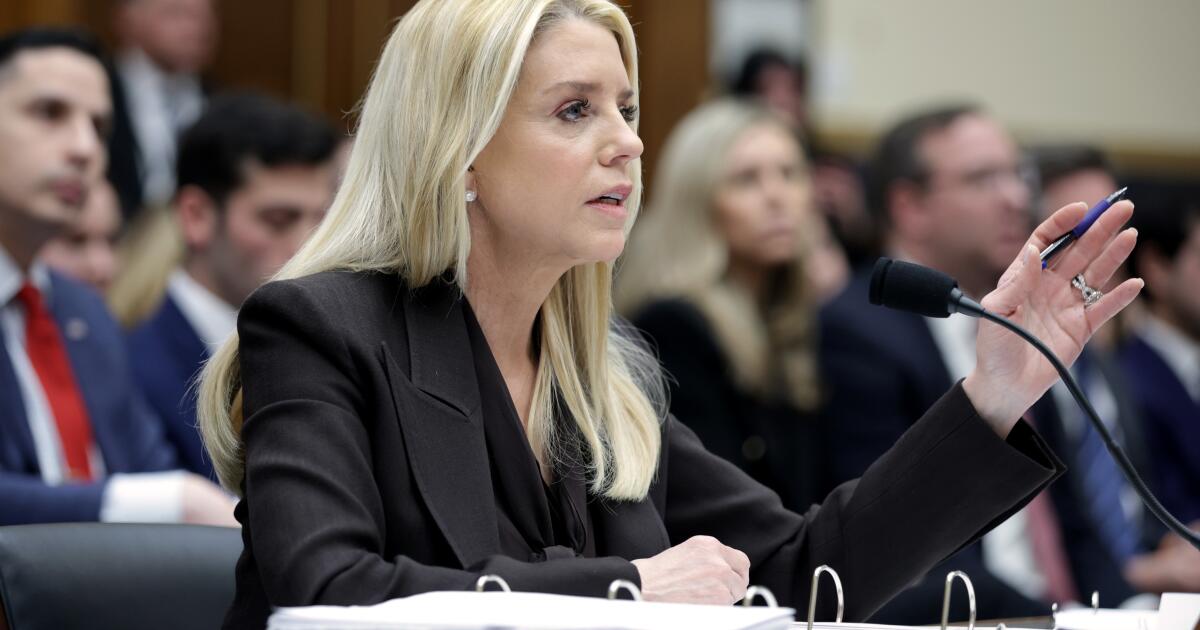
At a House Judiciary hearing on Wednesday, Atty. Gen. Pam Bondi was holding a document labeled “Jayapal Pramila Search History” that included a list of files from the unredacted Epstein archive accessible to lawmakers such as Rep. Pramila Jayapal (D-Wash.).
That means over the course of a year Bondi’s Department of Justice has made time to speak with Ghislaine Maxwell — the New York socialite who helped Jeffrey Epstein run his billion-dollar child-sex-trafficking operation — and it made time to surveil a Democratic lawmaker who conducts oversight as a member of the Judiciary Committee. But it has yet to meet with the victims of Epstein’s crimes who want to talk.
When she took office, Bondi promised us transparency. She didn’t promise we would like what we would see from her.
The general public’s awareness of Epstein’s heinous crimes came with political baggage. However at this point, the question we all should wonder is: How does redacting the names of the men who helped fund Epstein’s operation benefit either political party? It may be good for the rich and powerful men trying to avoid accountability, but it’s not exactly a campaign platform.
Yet here we are as a country, chained to the same vocabulary used during an election, so a conversation that should be about right and wrong is accompanied by poll numbers and analysis about the midterm elections. As if the Justice Department’s refusal to interview rape survivors is an inside-the-Beltway topic and not reflective of a larger moral crisis. We have seen Congress kept out of session to avoid voting on the release of the Epstein files; we have heard equivocation about whether Epstein was a pedophile. We know Epstein’s island was a place where evil resided.
The investigation, or lack of investigation, into Epstein’s fellow abusers should not be seen by anyone as a political quandary in which the object of the game is to keep your party in power. The fact that there is a Republican-vs.-Democrat divide on accountability for sex abuse reveals a national moral crisis. When the abuse of children is viewed through a partisan lens, how else can one describe this period in America?
Fifty years ago, when President Carter was tasked with healing the nation after the Watergate scandal, he told Americans in his inaugural address that he was leaning on his faith, and one prophet in particular.
“He hath shewed thee, O man, what is good; and what doth the Lord require of thee, but to do justly, and to love mercy, and to walk humbly with thy God?,” Carter said, quoting Micah 6:8. “This inauguration ceremony marks a new beginning, a new dedication within our government, and a new spirit among us all. A president may sense and proclaim that new spirit, but only a people can provide it.”
The Hebrew prophet Micah was from a rural area, not born into the wealth of the royal court. He was not being compensated by those who were. Instead, Micah reflected the voice of the people who were forced to live in poor conditions because of corruption. He described the actions of the morally bankrupt judges, political leaders and other elites in graphic, violent terms, condemning those “who hate the good, and love the evil; who pluck off their skin from off them, and their flesh from off their bones.”
This, he said, is what it is like being ruled by those who are not guided by what is good and what is evil, but rather what is most beneficial for themselves in the moment. When Micah spoke, it wasn’t about the latest poll numbers. His warnings about government corruption are not unique to any particular faith, nor are they married to any political party. They embody centuries of human history, a history that tells what happens to a society when power goes unchecked.
And be not mistaken, it was unchecked power — not any party affiliation — that provided Epstein and Maxwell with patronage. It was moral failure, not conservatives or liberals, that provided cover for their child-sex-trafficking ring.
So if for partisan reasons the abusers of children are not held accountable for their crimes, the language of politics fails us. The word for that is simply: evil.
YouTube: @LZGrandersonShow
Insights
L.A. Times Insights delivers AI-generated analysis on Voices content to offer all points of view. Insights does not appear on any news articles.
Viewpoint
Perspectives
The following AI-generated content is powered by Perplexity. The Los Angeles Times editorial staff does not create or edit the content.
Ideas expressed in the piece
-
The Department of Justice under Attorney General Pam Bondi has created a moral crisis by allowing the investigation into Jeffrey Epstein’s fellow abusers to become a partisan political issue rather than a matter of fundamental accountability and justice[3]. The DOJ has monitored a Democratic lawmaker’s access to Epstein files while reportedly meeting with Ghislaine Maxwell but declining to meet with Epstein survivors seeking to discuss their experiences[1][3].
-
Redacting the names of wealthy and powerful men implicated in Epstein’s crimes while exposing victims’ identities serves no legitimate governmental interest and only protects the rich and powerful from accountability regardless of political affiliation[3]. The failure to hold co-conspirators accountable after more than a year in office, combined with refusals to apologize to survivors, demonstrates a troubling prioritization of protecting certain interests over justice[3].
-
When child sexual abuse becomes filtered through partisan politics rather than evaluated on moral grounds, it reflects a fundamental failure of governance and represents a national crisis of conscience[3]. The politicization of this issue obscures what should be a universal principle: that accountability for crimes against children transcends party affiliation and election cycles[3].
Different views on the topic
-
The Department of Justice maintains that it records all searches conducted in its systems specifically to safeguard against the disclosure of victim information, suggesting that monitoring access to sensitive Epstein files serves a protective function rather than partisan surveillance[1]. Attorney General Bondi stated that the department has pending investigations in its office related to potential Epstein conspirators[2], indicating that prosecutorial work continues despite public criticism.
-
The release of Epstein files is an ongoing process requiring careful legal review to protect victims’ privacy and ensure proper handling of sensitive evidence[4]. The DOJ’s approach to redacting certain information may reflect legitimate institutional concerns about victim protection and the complexities of managing millions of declassified documents[1].