Iran’s foreign minister says message exchanges continue with Washington, but insists there are no negotiations, and no trust.
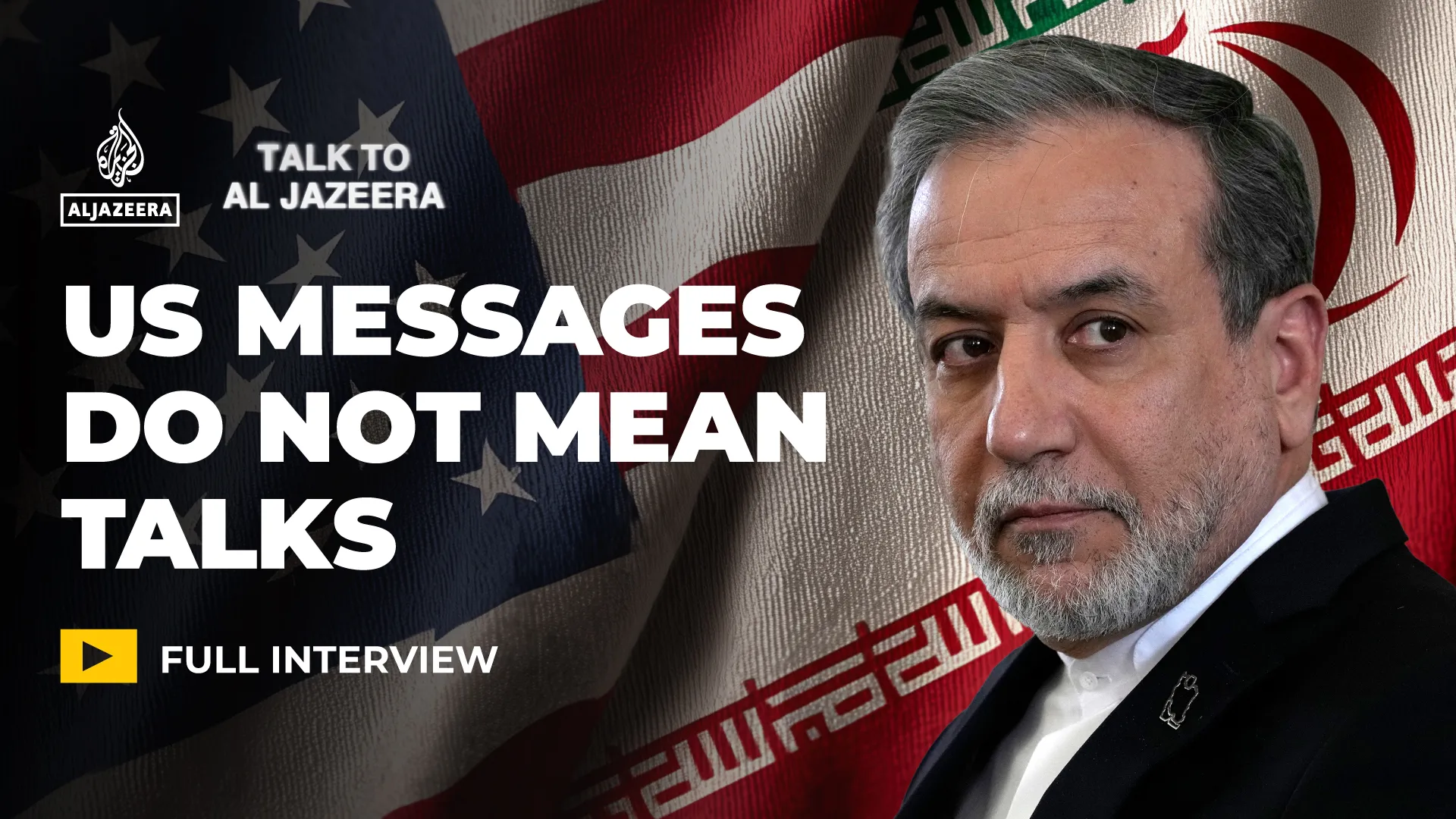
Iran’s Foreign Minister Abbas Araghchi tells Talk to Al Jazeera that Iran is not negotiating with the United States, despite ongoing exchanges of messages, including direct communication from US envoy Steve Witkoff.
Araghchi says talks lack trust, adding that no response has been given to US proposals, and that there is no basis for negotiations. Araghchi outlines Iran’s conditions for ending the war, warns against threats and deadlines, and signals a readiness to continue defending the country as regional tensions escalate.
WASHINGTON — President Trump says the United States is winning the war with Iran, even as thousands of additional American troops deploy to the Middle East.
He has pilloried other countries for not helping the U.S., only to say later he does not need their assistance. He has twice delayed deadlines for Iran to reopen the Strait of Hormuz. He has threatened to “obliterate” Iran’s energy plants if the vital waterway remains largely shut down and said the U.S. was “not affected” by the closure.
At one point this month, Trump claimed that one of his predecessors — who, he strongly suggested, was a Democrat — privately told him he wished he had taken similar action against Iran. Representatives for every living former president denied that any such conversation happened.
As the war entered its second month over the weekend, Trump’s penchant for embellishments, exaggerations and falsehoods is being tested in an environment where the stakes are much higher than a domestic political fight.
A president who has long embraced bluster and salesmanship to shape narratives and focus attention is confronting the unpredictability of war.
Leon Panetta, who served Democratic presidents as Defense secretary, CIA director and White House chief of staff, said he has “seen enough wars where truth becomes the first casualty.”
“It’s not the first administration that has not told the truth about war,” he said. “But the president has made it kind of a very standard approach to almost any question to in one way or another kind of lie about what’s really happening and basically describe everything as fine and that we’re winning the war.”
Michael Rubin, a historian at the American Enterprise Institute who worked as a staff advisor on Iran and Iraq at the Pentagon from 2002 to 2004, said Trump is “the first president of any party in recent history that hasn’t self-constrained to live within rhetorical boundaries.”
“So of course it creates a great deal of confusion,” he said.
The zigs and zags are the point
To his critics, Trump’s style is a sign that doesn’t have a coherent long-term strategy. But for Trump, the zigs and zags seem like the point, a method that keeps his opponents — and pretty much everyone else — always on their heels.
The approach was clear last week in the hours before he announced the second delay of the deadline for Iran to reopen the strait. Asked what he would do about the deadline, Trump said that he did not know and that he had a day before he had to decide.
“In Trump time, a day, you know what it is, that’s an eternity,” Trump said to laughter from members of his Cabinet.
But investors are unimpressed, with U.S. stocks closing out their worst week since the war began. To some on Capitol Hill, the freewheeling is more frustrating than amusing.
Rep. Gregory Meeks of New York, the top Democrat on the House Foreign Affairs Committee, lamented that Trump is “going back and forth and constantly contradicting himself.”
“The administration is winging it,” he said. “So how can you trust what the president says?”
Republicans were not willing to go that far, but their concern was apparent heading into a two-week break from Washington. Sen. John Kennedy of Louisiana said his constituents “support what the president has done.”
“But most of my people are also equally or even more so concerned about cost of living,” he said.
Republican Rep. Chip Roy of Texas, who sits on the House Budget Committee and is a member of the hard-right House Freedom Caucus, said his constituents were on board with “blowing some crap up.” Nonetheless, he expressed reservations about the prospect of ground troops and said the administration has not provided enough details in briefings for lawmakers. Such sessions, he said, only reveal information you “read in the papers.”
“Taking out bad guys, taking out conventional [weapons], taking out or at least working to take out nuclear capability, pressing to keep the straits open, all those are good things and I’ve been supportive and will continue to be supportive,” Roy said. “But we’ve got to have a serious conversation about how long this is going to go, boots on the ground, all those things, press for further briefings and understanding of where it’s all headed.”
Political risks ahead
While Trump has maintained deep support among Republicans, a poll last week from the Associated Press-NORC Center for Public Affairs Research indicates that the president risks further frustrating his voters if the U.S. gets involved in the kind of prolonged war in the Middle East that he promised to avoid. He campaigned against starting new foreign wars altogether, and his reversal on that already has irked some of his longtime supporters.
Although 63% of Republicans back airstrikes against Iranian military targets, the survey found, only 20% back deploying American ground troops.
That reflects the political challenges ahead for Trump, who did not prepare the country for such an extensive overseas conflict. If the war drags on or escalates, pressure on Republicans could build before the November elections, when their majorities in Congress are at risk. Some in the party have said sending in ground troops would be a red line that Trump should not cross.
The administration also will probably need congressional support for an additional $200 billion he seeks to support the war. That amount of money, which Trump has said would be “nice to have,” even as he said the war was “winding down,” would be a tough vote at any time. But it poses particular risks for Republicans in an election year.
White House spokesperson Anna Kelly said in a statement that Trump is “right to highlight the vast success of Operation Epic Fury,” the military name for the war in Iran.
“Iran desperately wants to make a deal because of how badly they are being decimated, but the President reserves all options, military or not, at all times,” she said.
Some see ‘logic’ to Trump’s approach
Rubin, the former Iran and Iraq advisor at the Pentagon, said there could be some “logic” to the president’s ever-evolving rhetorical approach to the war. He said Trump’s initial comments about ongoing negotiations, which Iran denied, could “spread suspicion and fear within the regime circles.”
“Perhaps Donald Trump or those advising him simply want the Iranians to grow so paranoid they refuse to cooperate with each other or perhaps they even turn on each other,” he said. “But then again, there’s always a danger with Donald Trump of assuming that his rhetoric is anything more than shooting from the hip.”
Rep. Adam Smith of Washington state, the top Democrat on the House Armed Services Committee, said Trump is not going to be able to fully achieve his objectives, even those that have been clearly articulated — including the complete elimination of Iran’s nuclear program — “in the current trajectory.”
And if that is the case, Smith said, the president has the option to rely on his rhetorical skills to simply say the U.S. won — and end the war.
“As I’ve jokingly said, nobody I have ever met or heard of in human history is better at exaggerating his own accomplishments than Donald Trump,” Smith said. “So go knock yourself out and claim this was some great success.”
Officials are set to publish more documents related to his appointment as UK ambassador to the US – but have so far only had access to the peer’s work phone.
As the United States-Israeli war on Iran enters its fourth week, the conflict seems to have escalated beyond President Donald Trump’s control.
The Iranian government has been able to endure the killings of its top political and military leaders and has launched retaliatory attacks on Israel and Gulf countries despite weeks of air strikes.
Recommended Stories
list of 4 itemsend of list
Tehran has also been able to impose a de facto blockade of the Strait of Hormuz, a narrow waterway through which a fifth of the world’s oil and liquefied natural gas supplies pass, sending oil prices soaring. Analysts said the conflict risks unleashing a global recession. And that has put pressure on Trump, prompting his administration to allow the sale of sanctioned Russian oil to try to ease the energy crisis and pressure allies to police the strait, so far unsuccessfully.
Trump’s response in how to deal with the situation has been anything but coherent.
On Saturday, Trump upped the ante, issuing a threat to “obliterate” Iran’s power plants if Tehran does not reopen the Strait of Hormuz within 48 hours. This came a day after he said the US was “winding down” its military operations in Iran.
Analysts said Trump launched the war without a clear goal and misjudged how Tehran would respond. The conflict has expanded across the Middle East.
So is Trump looking to exit the war – or escalate it?
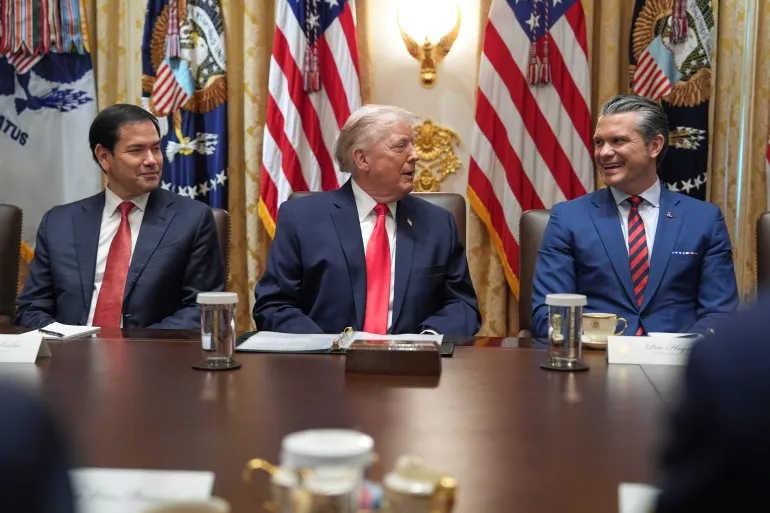
From left, US Secretary of State Marco Rubio, President Donald Trump and Defense Secretary Pete Hegseth attend a cabinet meeting at the White House [File: Evan Vucci/AP]
Trump’s mixed messaging on the Iran war
Here’s a brief look at the changing statements from Washington:
Is the war winding up or widening?
While one statement from Trump signalled that the US is considering “winding down” the war on Iran, another one indicated that the conflict would widen in the coming days.
On Saturday, Trump posted on his Truth Social platform that Washington was “very close to meeting our objectives as we consider winding down our great Military efforts in the Middle East with respect to the Terrorist Regime of Iran”.
Trump listed the goals of the war as: completely degrading Iran’s missile capability, destroying its defence industrial base, eliminating the Iranian navy and air force, never allowing Iran to get even close to having nuclear weapons, protecting Middle Eastern allies, and guarding and policing the Strait of Hormuz.
Both Trump and Israeli Prime Minister Benjamin Netanyahu have claimed repeatedly in the past few days that Iranian military capabilities have been “completely destroyed” even as Tehran continues to retaliate against Israel and strike countries in the region.
US military officials said they have carried out heavy bombardments of Iran’s coast, including with bunker buster bombs, but still have not been able to limit Tehran’s capacity to disrupt the Strait of Hormuz.
On Saturday, Trump said the US “has blown Iran off of the map” and insisted that he has “met my own goals … and weeks ahead of schedule!” He also reiterated that Iran’s “leadership is gone, their navy and air force are dead, they have absolutely no defense, and they want to make a deal”.
Iranian leaders have consistently denied reaching out to the US with a ceasefire offer.
Just an hour later, Trump returned to his Truth Social platform with a warning for Iran.
“If Iran doesn’t FULLY OPEN, WITHOUT THREAT, the Strait of Hormuz, within 48 HOURS from this exact point in time, the United States of America will hit and obliterate their various POWER PLANTS, STARTING WITH THE BIGGEST ONE FIRST!” Trump wrote.
Iran has since responded by saying it will hit energy sites across the Middle East if its power facilities are targeted. It has already fired hundreds of missiles and drones on Gulf countries, targeting US assets as well as energy facilities.
Between Trump’s claims to be “winding down” operations and upping the ante later, his administration announced it is sending three more warships to the Middle East with about 2,500 additional Marines.
The US military said about 50,000 military personnel are already deployed for the war against Iran.
(Al Jazeera)
When will the war on Iran end?
That has been among the foremost questions posed to US officials, including Trump, since the war on Iran was launched on February 28.
The next day, Trump told the Daily Mail that “it will be four weeks or so. It’s always been about a four-week process.” A day later, Trump said at the White House: “We projected four to five weeks, but we have capability to go far longer than that.”
On March 8, Defense Secretary Pete Hegseth told the CBS TV network’s 60 Minutes programme: “This is only just the beginning.” The next day, the US president told the same channel that he thinks “the war is very complete, pretty much.” And the US military operation was “way ahead of schedule”.
Then, on March 9, Trump said one could say the war is “both complete and just beginning”. Later the same day, the president said: “We’ve already won in many ways, but we haven’t won enough” and promised to go further and harsher against Iran.
On March 11, Trump said: “We don’t want to leave early, do we? We’ve got to finish the job.”
Why did US and Israel launch strikes on Iran?
Responses to this question are perhaps the most telling about US posturing in the war against Iran.
On March 2, Hegseth said the attacks were aimed at ending “47 long years” of war by “the expansionist and Islamist regime in Tehran” and were launched because Iran refused to negotiate with the US.
Hours later, Marco Rubio, the secretary of state, told reporters the US knew Israel was about to strike Iran, adding that the Trump administration believed the US needed to launch a pre-emptive strike before Iran’s retaliation potentially targeted US forces. “We went proactively in a defensive way to prevent them from inflicting higher damage,” he said.
This sparked a massive row in Washington with critics saying Israel had forced the US into war with Iran. Soon Trump rebutted his top diplomat, saying: “They [Iran] were going to attack. If we didn’t do it, they were going to attack first. … So if anything, I might have forced Israel’s hand.”
The next day, the White House press secretary, Karoline Leavitt, concluded that Trump just had a “good feeling” that Iran would strike so Washington attacked Tehran.
The launch of the war came as Washington and Tehran were scheduled to meet for another round of talks that were started late last year. Before the war, their Omani mediator said a deal was “within reach”.
The US and Israeli assertion that Tehran was on the verge of making a nuclear bomb has not been backed up by the United Nations nuclear watchdog. Last week, US Director of National Intelligence Tulsi Gabbard also told Congress that Iran was not in a position to make an atomic bomb.
Some analysts said the Trump administration was convinced to go to war by Netanyahu, who has been seeking US military intervention in Iran for decades. They said Trump was buoyed by a swift US military operation in Venezuela and did not think through Iran’s strengths before going into the war. In January, the US military abducted President Nicolas Maduro in a military operation in Caracas that took two and a half hours.
US President Donald Trump, left, greets Israeli Prime Minister Benjamin Netanyahu at the White House on September 29, 2025, on the fourth of his six visits to the US during Trump’s second term, which began in January 2025 [Alex Brandon/AP]
What does the conflicting messaging mean for US strategy?
Analysts said the moving goalposts in the Iran war show the policy limits of the current Trump administration as well as its strategy, to some extent, of keeping off-ramps available.
Zeidon Alkinani, a Middle East analyst at the Arab Perspectives Institute, told Al Jazeera that in the earlier days of the hostilities, there appeared to be clearer targets and limited objectives.
“There now seems to be a more chaotic reaction,” he said. He described the attacks as increasingly reciprocal, suggesting strikes on oil or energy facilities could prompt further escalation.
Last week, Iran attacked energy facilities in Qatar and caused “significant damage”, knocking out 17 percent of Qatar’s liquefied natural gas (LNG) export capacity. Qatar produces 20 percent of global LNG supplies. Iran said the attack was in retaliation for Israeli attacks on a gas plant.
Paolo von Schirach, president of the Global Policy Institute, told Al Jazeera that Trump changes his mind “very quickly” and it is hard to predict what his next step could be in the war on Iran.
The analyst said it was unclear to him what “tools” Trump has to end the war.
“We look at his message saying the war is winding down. OK, good. Things are quiet. Maybe there is an off-ramp somehow. But now he says that if the Iranians don’t open the Strait of Hormuz, then we [the US] are going to unleash hell and what have you,” von Schirach noted.
“It is not quite clear to me what he wants and what the tools are to accomplish this.”
Von Schirach added that it would be difficult to predict whether the US could force Iran into submission, given its size and population. Using as a reference Iraq, where 150,000 American soldiers were deployed during the Second Gulf War, the analyst predicted that the US might need as many as half a million soldiers if Trump “wants to take over Iran”.
President Trump frequently contradicts himself, sometimes in the same speech, social media post or even sentence. On Friday, he sent a torrent of mixed signals about the Iran war that raise more questions about the direction of the conflict and his administration’s strategy.
Within a few hours, Trump said he was considering winding down the war, his administration confirmed it was sending more troops to the Middle East and, in an effort to lessen the economic influence on global energy markets, the United States lifted sanctions on some Iranian oil for the first time in decades — relieving some of the pressure that Washington traditionally has used as leverage.
The confusing combination of actions deepens a sense among Trump’s critics that there is no clear, long-term strategy for the war the U.S. and Israel launched against Iran. Now in its fourth week, the war remains on an unpredictable path and a credible endgame is unclear as the global economy is being roiled.
‘Winding down’ the war
After another rough day in the financial markets, Trump said Friday afternoon on his social media network: “We are getting very close to meeting our objectives as we consider winding down our great Military efforts in the Middle East.”
Trump contended that the U.S. has adequately degraded Iranian naval, missile and industrial capacity and prevented Tehran from acquiring a nuclear weapon.
The president then suggested the U.S. could pull out of the conflict without stabilizing the Strait of Hormuz, the channel through which about one-fifth of the world’s oil supply travels. The strait has been ravaged by Iranian missile, drone and mine attacks during the war.
“The Hormuz Strait will have to be guarded and policed, as necessary, by other Nations who use it — The United States does not!” Trump wrote. But, in another contradiction, he said the U.S. would help if asked, “but it shouldn’t be necessary once Iran’s threat is eradicated.”
While oil that traverses the strait is usually bound for Asia and other places rather than North America, the chaos still affects the United States. Oil is bought and sold globally, so a shortage in oil for Asian countries leads to bidding up prices on oil sold to companies in America too.
That fact, coupled with an Israeli strike on Iran’s gas fields and an Iranian retaliation that crippled a major terminal to ship liquefied natural gas from Qatar, helped tank U.S. equity markets Friday, with the S&P dropping 1.5%. There also was a sharp increase in U.S. fuel prices.
More troops to the war zone
Even as Trump said the U.S. was close to winding down the war, his administration announced it was sending three more warships to the Middle East with about 2,500 additional Marines. It was the second time in a week that the administration said it was deploying more forces to the war zone. The military says some 50,000 are supporting the war effort.
Trump has often said he has ruled out sending in ground troops, but not always, and his administration has hinted at a possible deployment of special forces or similar units.
The Marines being sent to the region are an expeditionary unit designed for quick amphibious landings, but their deployment does not mean a ground invasion is certain. Analysts have suggested the presence of U.S. forces on the ground may be needed to ultimately secure the strait.
The surge in troops came just a day after news emerged that the Pentagon was seeking an additional $200 billion from Congress to fund the war. That extraordinarily high figure does not suggest that the war was winding down.
Lifting some sanctions on Iran
The administration said it would lift sanctions on the sale of Iranian oil, provided it was already at sea as of Friday. The move was an attempt to help lower skyrocketing energy prices by allowing freer sale of oil that Iran has let pass through the strait. It also extends a financial lifeline to the Iranian government that Trump is targeting.
His administration has tried other methods to lower oil prices. It has tapped the U.S. strategic petroleum reserve and lifted sanctions on some Russian oil. Yet Brent crude remained at $112 per barrel Friday, and analysts say oil prices are likely to remain high for months regardless of the next steps in the war.
The Iranian oil eventually would have reached another country, but now the United States and its allies can bid on it as well, Treasury Secretary Scott Bessent wrote on X.
“At present, sanctioned Iranian oil is being hoarded by China on the cheap,” Bessent wrote. “By temporarily unlocking this existing supply for the world, the United States will quickly bring approximately 140 million barrels of oil to global markets, expanding the amount of worldwide energy and helping to relieve the temporary pressures on supply caused by Iran.”
While 140 million barrels may seem like a lot, that is only a couple of days’ worth of oil on the global market.
Patrick De Haan, the head of petroleum analysis at GasBuddy, a U.S. fuel-tracking service, said he does not expect the temporary suspension to have a major influence on gas prices. The de facto closure of the strait has a much greater effect, he said. “Prices will likely still continue to rise so long as the Strait remains silent,” De Haan said.
And the contradictions in the position were obvious in Bessent’s post announcing the move, which labeled Iran “the head of the snake for global terrorism.” He said the administration would take steps to prevent Tehran from cashing in on the sales, but it was unclear how that would be done.
Even among some Republicans, the contradictions triggered rare public skepticism.
“Bombing Iran with one hand and buying Iran oil with the other,” South Carolina Rep. Nancy Mace posted on X on Saturday.
Riccardi writes for the Associated Press. AP business writer Dee-Ann Durbin in Ann Arbor, Mich., contributed to this report.
Good morning, and welcome to L.A. on the Record — our City Hall newsletter. It’s Noah Goldberg, with an assist from David Zahniser and Melissa Gomez, giving you the latest on city and county government.
Former Deputy City Atty. Michelle McGinnis wants to know why she was escorted out of City Hall in front of her colleagues, forced to turn in her work computer and placed on administrative leave in April 2024.
In her search for answers, a separate issue has arisen: whether her former boss is withholding or deleting text messages.
In a lawsuit against the city, McGinnis subpoenaed text messages about her between City Atty. Hydee Feldstein Soto and one of her top deputies, Denise Mills.
But according to a new petition that McGinnis filed in Los Angeles County Superior Court, Feldstein Soto produced zero text messages between her and Mills, and Mills produced just three with Feldstein Soto. The subpoena also asked for messages on Signal and other apps.
McGinnis’ lawyer, Caleb Mason, said the lack of texts strains credulity and probably means that some were deleted or withheld. McGinnis, who headed the criminal branch of the City Attorney’s Office, was fired in January 2025.
“It is obviously relevant and critical … to see what Ms. Feldstein [Soto] and Ms. Mills were saying to one another about Ms. McGinnis … that led to the extraordinary and unprecedented action of escorting a Branch Chief out of the building,” Mason wrote in a Feb. 23 brief.
A deputy city attorney representing Feldstein Soto and Mills disputed Mason’s claims in court filings, calling the new petition “uncomprehensible [sic]” and asserting that the two officials complied with the subpoenas. The attorney also sent 2,061 pages of documents to Mason.
Feldstein Soto, in a declaration, said that she “diligently searched for any documents” and shared them with her lawyer.
Mills said she did the same. In an effort to “retrieve any backup text messages,” she performed a factory reset of her phone on Jan. 30. McGinnis said the subpoenas were served on Dec. 15.
McGinnis’ lawyer said that was tantamount to spoliation — or destruction of evidence.
“Every court and every attorney in the country knows that ‘performing a factory reset’ means erasing information from a phone,” he wrote.
“It is reckless or negligent to reset a device when you know the opposing party is seeking that info,” said Laurie Levenson, a professor of law at Loyola Law School.
Still, Levenson said, politicians and lawyers often prefer speaking in person or on the phone to avoid their communications being exposed in a lawsuit. So it’s possible that the two didn’t exchange many text messages.
Feldstein Soto said in a statement that she has turned over all text messages about McGinnis. “There is nothing new here,” she said. “Ms. McGinnis was terminated, for cause. We remain confident in that decision.”
The city has argued that McGinnis “routinely opposed” Feldstein Soto’s policy and prosecutorial decisions.
McGinnis was placed on administrative leave due to a “pattern of insubordination and failure to meet minimal job requirements,” the city wrote in a legal filing in 2024.
The lawsuit that McGinnis filed against the city in 2024 alleged that Feldstein Soto retaliated against McGinnis and made prosecutorial decisions based on “personal relationships” or “perceived political gain.” The lawsuit also accused Feldstein Soto and Mills of “inappropriate alcohol consumption” in the office.
Other local politicians have also coughed up remarkably few text messages in response to public records requests.
Mayor Karen Bass came under scrutiny following the Palisades fire over the fact that her text messages auto-delete after 30 days, destroying potentially critical information about her decisions surrounding the devastating blaze. The Times sued the city after Bass’ counsel argued that her texts were “ephemeral” and not subject to public records requests. L.A. County Supervisor Kathryn Barger also said she auto-deletes messages after 30 days — and sometimes manually deletes them.
City Council President Marqueece Harris Dawson, meanwhile, turned over zero texts, emails, Signal and WhatsApp messages in response to a Times public records request for his communications with Bass from Jan. 6 to Jan. 16, 2025 — before, during and after the Palisades fire.
Harris-Dawson’s office said it had “conducted a search and found no responsive records for this request.”
You’re reading the L.A. on the Record newsletter
State of play
— IDK, VOTERS SAY: A majority of Angelenos have not made up their minds about the June 2 mayoral primary, according to a poll released this week. Bass had the most support at 20%, while reality TV star Spencer Pratt had 10% and Councilmember Nithya Raman had 9%, the poll found.
— HOMELESS DEATHS DROP: For the first time in the decade that homeless mortality has been tracked in Los Angeles County, fewer people have died on the streets and in shelters than the year before, the Department of Public Health reported Tuesday. A sharp decrease in overdose deaths drove a decline of 10% in the rate of homeless deaths from all causes in 2024, the most recent data analyzed by the county.
—LAST-MINUTE MEMO: The City Council was set to vote on a $177-million contract for the Legal Aid Foundation of Los Angeles to continue representing tenants for the next three years, with other groups providing related services. But the night before the March 3 vote, Feldstein Soto sent a confidential memo to council offices recommending that council members “reconsider the award of such a large contract to a frequent litigant against the city.”
— CAMPAIGN REVELATION: Community organizer Jordan Rivers, who is running against incumbent Tim McOsker to represent Council District 15, said he will continue his campaign after a report surfaced that he stabbed a neighbor when he was 12. Rivers, now 22, stabbed the 8-year-old boy in the neck and shoulders, inflicting “severe and life threatening physical and emotional injuries,” a lawsuit said. On Monday, Rivers said it was an “accident” that happened a decade ago.
“I do not believe that past situations or indeed past mistakes define or determine who a person is or what they are,” he said.
— LAPD REFORMS: A series of proposed changes to the city’s charter — essentially its constitution — could give elected leaders in Los Angeles more oversight over the Police Department and enable the police chief to fire problem officers. The changes, recommended by the city’s Charter Reform Commission, have long been sought by advocates and are likely to face fierce opposition.
— SUPE SPEAKS: Embattled Los Angeles schools chief Alberto Carvalho made his first public statement since the FBI raided his home and district office on Feb. 25. He denied any wrongdoing and asked to return to his duties.
“While the government’s investigation remains ongoing, no evidence has been presented by prosecutors supporting any allegation that Mr. Carvalho violated federal law,” the statement said.
— A WEEK OF WIPEOUTS: With city officials finalizing the list of candidates for the June 2 election, a number of hopefuls failed to gather enough signatures to qualify for the ballot. They include community leader Eddie Ha, publicist Dory Frank and entrepreneur Jeremy Wineberg on the Westside; residential connectivity specialist Rosa Requeno on the Eastside; neighborhood council member Jon Rawlings in the San Fernando Valley; and neighborhood council president Adriana Cabrera, civil rights attorney Chris Martin and social worker Michelle Washington in South L.A.
— REWORKING ULA (TAKE 3): The City Council voted Wednesday to create an ad hoc committee to look at potential changes to Measure ULA, the tax on high-end property sales passed in 2022. City leaders have made two previous moves to rewrite the measure, neither of which succeeded.
— VOTING OLYMPIC VALUES: The council voted Friday to “express concern” about LA28 Olympics committee chairman Casey Wasserman, saying his appearance in the Epstein files poses a “potential conflict” with the values of the Olympic movement. Several elected officials at City Hall, including Bass, had already called for Wasserman to step down.
— MEETING OF MAYORS: On Friday, about 20 mayors and city council members from across L.A. County, including Bass, came together to discuss the impact that immigration raids have had on their communities. Many raised concerns about the role of local law enforcement in allowing federal agents to act with what they described as impunity.
One mayor suggested that all the cities that contract with the L.A. County Sheriff’s Department should get together to demand accountability for deputies in their interactions with immigration agents.
QUICK HITS
Where is Inside Safe? The mayor’s signature program went to Washington and Lincoln boulevards in Councilmember Traci Park‘s district, bringing more than 20 people inside, according to a mayoral spokesperson.
On the docket next week: The Los Angeles chapter of the Democratic Socialists of America will meet on Saturday, March 21, at Immanuel Presbyterian in Koreatown. Members are expected to vote on whether to make an endorsement in the mayoral primary.
Stay in touch
That’s it for this week! Send your questions, comments and gossip to LAontheRecord@latimes.com. Did a friend forward you this email? Sign up here to get it in your inbox every Saturday morning.