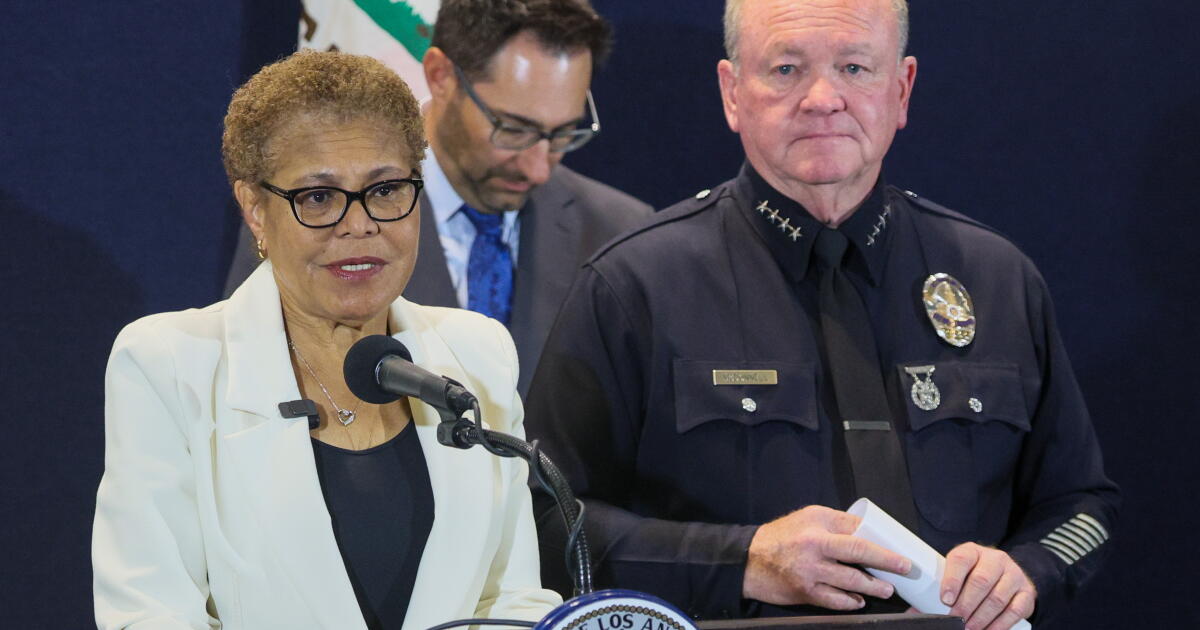
Bass orders review of how LAPD deals with mentally ill people
Mayor Karen Bass called the training that LAPD officers receive for handling mental health calls “woefully inadequate” and ordered an outside review of the department’s policies Thursday, saying recent shootings highlight continued shortcomings in how police deal with people in crisis.
Bass is particularly concerned by the relative lack of specialized intervention training for patrol officers who respond to the vast majority of service calls. While the SWAT team and other units receive such training, it is not standard across the Los Angeles Police Department.
“After the academy, they have spot training that is essentially videos that are played at roll calls,” Bass said in an interview week with The Times.
The mayor’s directive comes as she’s locked in a reelection fight with progressive challenger Nithya Raman, who, like Bass, has criticized the LAPD over shootings of mentally ill people.
“The ability of the city to respond to someone’s pleas for help is incredibly important in ensuring that we maintain the trust of the public,” Raman recently told The Times. “And right now, there is no alternative system besides LAPD to respond to many of the calls that are coming into 911 besides, of course, Fire Department calls.”
Polling by the UC Berkeley Institute of Governmental Studies, co-sponsored by The Times, shows Raman is favored by 39% of likely L.A. voters, compared to 28% support for Bass — with 33% still undecided.
LAPD officers have fired their weapons at people 16 times this year — down from 34 shootings in 2025, but recent incidents have highlighted how officers continue to turn to their guns when confronting individuals with mental illnesses. In years past, department statistics showed at least a third of all police shootings involved someone with obvious signs of emotional distress.
Bass was particularly disturbed by a July 29 incident in the Olympic patrol area in which police fatally shot a man who approached them with an aluminum bat.
Body-camera video captured officers approaching 33-year-old Alejandro Garcia as he was walking through traffic on Normandie Avenue underneath the 10 Freeway overpass. Officers ordered him to drop the bat, although it’s unclear whether he heard them. While Garcia could be seen holding the bat with both hands, the footage appeared to contradict an early LAPD account suggesting he swung at them.
The shooting could have been avoided if “the officers were trained differently or better,” Bass said, noting that one of the officers had been on the job for roughly five months.
The LAPD has yet to identify the officer or officers who opened fire.
Bass said it would have been appropriate for the department to deploy a unit that sends a social worker out with officers when responding to calls involving a person in crisis.
“You knew before that he had a bat and he was going around smashing cars,” she said.
About a week later, two officers shot and killed Canas Zimran, 44, in Boyle Heights after, department officials say, he approached officers with what was later determined to be a tree trimmer.
The shootings occurred despite policies that prioritize deescalation techniques and the use of “less-lethal” alternatives, such as bean bag rounds meant to subdue people without resorting to firearms.
Bass said the killings reflect, in part, a broader failure of the mental health system to get people the care they need. Also of concern, the mayor said, was the lack of training for officers on how to distinguish between symptoms caused by mental illness, physical and cognitive disabilities and drugs such as phencyclidine, or PCP, which seems to be having a resurgence on city streets.
Bass said her review would be a top-down evaluation that also scrutinizes the roles of dispatchers, supervisors and others involved in responding to reports of people behaving erratically.
She said the audit will examine calls from the last five years involving people with “with known histories of mental or behavioral health conditions” in which police officers avoided using force. The goal, Bass said, is to “identify common themes or best practices that successfully de-escalated the incident or allowed officers to gain compliance.”
Bass added that it’s also important to consider the needs of LAPD officers and ensure they “receive appropriate assistance” to cope with stress. She was struck by the willingness of younger officers to openly talk about the mental toll of the job, recalling a recent visit to a roll call in which an officer described feeling a lack of support after being involved in an on-duty shooting.
LAPD officials have said the department has made numerous changes in recent years to curb police shootings, including adopting deescalation training focused on slowing down volatile situations, particularly those involving people who may be mentally ill. Still, the agency’s critics pack police commission meetings each week to argue for removing police from such calls, saying that officers are too quick to fire on people — particularly those wielding knives.
Although the city has experimented with programs that send specialists to help deescalate such encounters, LAPD policy still requires armed patrol officers to clear a scene of any potential threats beforehand.
Bass said she always has been a proponent of approaches that don’t involve police, some of which are employed by her Office of Community Safety. But she said stabbings and other incidents that pose an immediate danger to the public still require a police response.
Beyond looking at how to avoid police shootings, Bass’ directive calls for further assessment of the department’s training for handling people who’ve been booked into jails and detention facilities, including how they are restrained and transferred to medical facilities.
Bass wanted to ensure the review was done by an outside body, hinting at her frustration with the inaction of department leaders and the police commission on addressing the issue.
“Much more needs to be done,” Bass said.