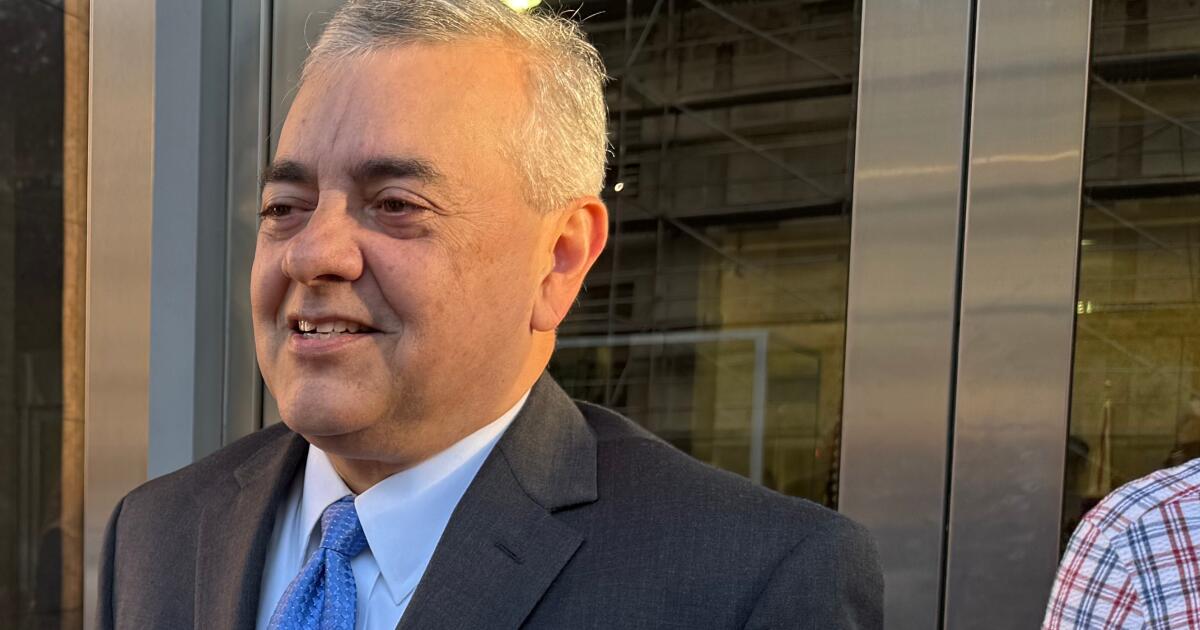
Gloria Romero, a former Democrat and state Senate Majority Leader, announced Monday she is running for lieutenant governor as part of a ticket with GOP gubernatorial candidate Steve Hilton, a former Fox News commentator.
“At the end of the day, it’s really about one-party rule in Sacramento. I’ve seen it. I left it,” Romero said in an interview. “We’ve got to make a change, otherwise we will never turn around on accountability or affordability and fight for working families like the Democrats once said the party stood for. Those days are gone. It’s a new day, and I’m proud to work alongside Steve in this exciting race to make California Golden again.”
Hilton, who has a long-standing political relationship with Romero, said her expertise in the state Capitol is among the reasons he selected her. Romero served in the state Senate and Assembly for about 12 years, including three as the state Senate’s first female majority leader.
“She’s been incredibly helpful already, helping me understand how Sacramento works and doesn’t work,” Hilton said. “When I’m the governor I will have to work with the legislature. And one of the most important things that I see as a real benefit from having Gloria there with me is that she’s not just been in the legislature, she’s led one of the chambers. She really understands how it works and still has relationships.”
Other candidates running for lieutenant governor include Treasurer Fiona Ma, former Stockton Mayor Michael Tubbs and Josh Fryday, a member of Gov. Gavin Newsom’s cabinet, all Democrats, and state Sen. Brian Jones (R-Santee).
Romero was a lifelong Democrat, including co-chairing President Obama’s 2012 reelection campaign in California. But she began to break with her party over education reform, notably her support for school choice.
“Education is the key to the American dream, and yet my party was so beholden to the teachers union, the alphabet soup of power influencers in Sacramento,” she said.
Invoking the words of the late President Reagan, Romero said she didn’t leave the Democratic party, the party left her. She became a registered Republican in September 2024 after what she calls a “political coup” to oust President Biden as the Democratic nominee. She then endorsed President Trump and spoke at a rally supporting him near Coachella.
She said the lieutenant governor’s role is typically a sleepy perch for politicians as they bide their time to run for higher office.
“It should not be that way,” Romero said, adding that the lieutenant governor’s role on the boards that oversee the UCs, Cal States and community college is a particularly good fit for her wheelhouse. “Education and turning around education, it’s in my blood, it’s in my dreams. It’s my passion.”
Unlike presidential elections, statewide contests do not feature running mates; each candidate must be elected on their own merits.
Hilton said Romero was the first member of his “golden ticket for California” and that he planned to roll out other statewide candidates who will join their effort.
“I know it hasn’t been done before. It’s not how things are normally done,” he said. “But right from the beginning, when I was thinking about my race for governor, one of the things that I really wanted to do was to put together a strong team, because turning around California is going to take a strong team.”
WASHINGTON — Twelve House Democrats who last year sued the Trump administration over a policy limiting congressional oversight of immigrant detention facilities returned to federal court Monday to challenge a second, new policy imposing further limits on such unannounced visits.
In December, those members of Congress won their lawsuit challenging a Department of Homeland Security policy from June that required a week’s notice from lawmakers before an oversight visit. Now they’re accusing Homeland Security of having “secretly reimposed” the requirement last week.
In a Jan. 8 memorandum, Homeland Security Secretary Kristi Noem wrote that “Facility visit requests must be made a minimum of seven (7) calendar days in advance. Any requests to shorten that time must be approved by me.”
The lawmakers who challenged the policies are led by Rep. Joe Neguse (D-Colo.) and include five members from California: Reps. Robert Garcia (D-Long Beach), Lou Correa (D-Santa Ana), Jimmy Gomez (D-Los Angeles), Raul Ruiz (D-Indio) and Norma Torres (D-Pomona).
Last summer, as immigration raids spread through Los Angeles and other parts of Southern California, many Democrats including those named in the lawsuit were denied entry to local detention facilities. Before then, unannounced inspections had been a common, long-standing practice under congressional oversight powers.
“The duplicate notice policy is a transparent attempt by DHS to again subvert Congress’s will…and this Court’s stay of DHS’s oversight visit policy,” the plaintiffs wrote in a federal court motion Monday requesting an emergency hearing.
On Saturday, three days after Renee Nicole Good was shot and killed by an Immigration and Customs Enforcement agent, three members of Congress from Minnesota attempted to conduct an oversight visit of an ICE facility near Minneapolis. They were denied access.
Afterward, lawyers for Homeland Security notified the lawmakers and the court of the new policy, according to the court filing.
In a joint statement, the plaintiffs wrote that “rather than complying with the law, the Department of Homeland Security is attempting to get around this order by re-imposing the same unlawful policy.”
“This is unacceptable,” they said. “Oversight is a core responsibility of Members of Congress, and a constitutional duty we do not take lightly. It is not something the executive branch can turn on or off at will.”
Congress has stipulated in yearly appropriations packages since 2020 that funds may not be used to prevent a member of Congress “from entering, for the purpose of conducting oversight, any facility operated by or for the Department of Homeland Security used to detain or otherwise house aliens.”
That language formed the basis of the decision last month by U.S. District Court Judge Jia Cobb in Washington, who found that lawmakers cannot be denied entry for visits “unless and until” the government could show that no appropriations money was being used to operate detention facilities.
In her policy memorandum, Noem wrote that funds from the One Big Beautiful Bill Act, which supplied roughly $170 billion toward immigration and border enforcement, are not subject to the limitations of the yearly appropriations law.
“ICE must ensure that this policy is implemented and enforced exclusively with money appropriated” by the act, Noem said.
Noem said the new policy is justified because unannounced visits pull ICE officers away from their normal duties. “Moreover, there is an increasing trend of replacing legitimate oversight activities with circus-like publicity stunts, all of which creates a chaotic environment with heightened emotions,” she wrote.
The lawmakers, in the court filing, argued it’s clear that the new policy violates the law.
“It is practically impossible that the development, promulgation, communication, and implementation of this policy has been, and will be, accomplished — as required — without using a single dollar of annually appropriated funds,” they wrote.
Bob Weir, a founding member of countercultural icons the Grateful Dead, known for his singular guitar playing, emotive singing and vibrant songwriting, has died at 78.
“It is with profound sadness that we share the passing of Bobby Weir,” a spokesperson for the musician confirmed to The Times. “He transitioned peacefully, surrounded by loved ones, after courageously beating cancer as only Bobby could. Unfortunately, he succumbed to underlying lung issues.”
Weir was diagnosed with cancer in July.
Weir-penned songs include Grateful Dead fan favorites “Sugar Magnolia,” “Jack Straw,” “Playing in the Band” and “Weather Report Suite.” His vocal performance on the rock-radio staple “Truckin’” counts among the band’s finest recorded moments.
The Dead released 13 studio albums with Weir, among them “Aoxomoxoa” (1969), “Workingman’s Dead” (1970), “American Beauty” (1970), “Wake of the Flood” (1973), “Terrapin Station” (1977) and 1987’s “In the Dark,” which featured the Top 10 single “Touch of Grey” and became the band’s highest-charting album, reaching No. 6 on the Billboard 200.
The Dead also released eight “official” live albums, as well as a long-running series of curated live shows known as Dick’s Picks and, later, Dave’s Picks. The band was the first to sanction fan taping at their concerts, spawning an abundance of homespun recordings that have been collected, traded and debated for decades.
Weir’s official role in the Grateful Dead was rhythm guitarist, alongside lead guitarist Jerry Garcia, but his complex style — marked by unique chord voicings, precise rhythms and a willingness to play through his bandmates instead of over them — elevated him from the standard rhythm player. “Bob’s approach to guitar playing is sort of like Bill Evans’ approach to piano was. He’s a total savant,” John Mayer told Guitar World magazine in 2017. “His take on guitar chords and comping is so original, it’s almost too original to be fully appreciated until you get deep down into what he’s doing. I think he’s invented his own vocabulary. … It’s a joyous thing to play along with.”
Weir’s first solo album, “Ace,” released in 1972, contained many songs that became standards in the Dead’s live show, including “Black-Throated Wind,” “Cassidy” and “Mexicali Blues.” “Blue Mountain,” Weir’s solo album from 2016, written in collaboration with musicians Josh Ritter and Josh Kaufman and inspired by Weir’s affinity for cowboy music and western iconography, became his highest-charting solo album, reaching No. 14 on the Billboard 200.
Weir also played in numerous side projects, post-Dead tribute acts and other rock bands, including Bob Weir & Wolf Bros, RatDog, Kingfish, Bobby and the Midnites, and the Weir, Robinson & Green Acoustic Trio with members of the Black Crowes. Dead & Company, featuring Weir, Dead bandmates Mickey Hart and Bill Kreutzmann, bassist Oteil Burbridge, keyboardist Jeff Chimenti and singer-guitarist Mayer, kickstarted a Deadaissance in 2015, reviving the band’s music and tie-dye-wearing, hacky-sack-kicking aesthetic for legions of new and existing fans. The band’s final tour before an indefinite hiatus, in 2023, drew nearly 1 million people.
Weir also was a dedicated collaborator, inviting friends to perform with him or guesting on their records or in concert. Willie Nelson, Joan Baez, the Allman Brothers, Sammy Hagar, Nancy Wilson, Stephen Marley, Billy Strings, Tyler Childers, Sturgill Simpson, the National, Margo Price and nouveau jam act Goose counted among his many musical compatriots. “Music is like transcendental medication and Bob Weir is my spirit guide,” Price said on Instagram in 2022. Weir’s friendship with the itinerant folk singer Ramblin’ Jack Elliott began in the early 1960s, and in the new millennium, Elliott and Weir frequently performed low-key shows together in Marin County, where both resided.
Robert Hall Weir was born Oct. 16, 1947, in San Francisco to John Parber and Phyllis Inskeep, a college student who later gave him up for adoption. He was raised by adoptive parents Frederic Utter Weir and Eleanor (née Cramer) Weir in Atherton, Calif. Weir struggled as a child due to undiagnosed dyslexia and was kicked out of every school he attended, including the private Fountain Valley School in Colorado Springs, Colo., where he met John Perry Barlow, who would later contribute lyrics to the Grateful Dead.
Weir met Garcia on New Year’s Eve, 1963, at a Palo Alto music store, and soon formed the jug band Mother McCree’s Uptown Jug Champions with Garcia and future Dead bandmate Ron “Pigpen” McKernan. Weir was just 16 years old. “There was some tension at home because I was neglecting my studies, and I grew up under the shadow of Hoover Tower,” Weir explained in an interview with Dan Rather. “My folks had Stanford in mind for me, not an itinerant troubadour. But they could also clearly see that I was following my bliss.”
About a year later, at McKernan’s urging, the trio, along with bassist Dana Morgan Jr. and drummer Kreutzmann, formed the Warlocks, an electric rock band, and played a handful of gigs before bassist Phil Lesh replaced Morgan. The group quickly discovered that a band called the Warlocks already existed and renamed themselves the Grateful Dead, a term Garcia found in a dictionary. Dead lyricist Robert Hunter and second drummer Hart joined the group in 1967.
As a member of the Dead, Weir was a kind of shape-shifting clairvoyant, creating ever-evolving sounds and forms that became essential to the fabric of American music culture. With the Dead, Weir was part of Ken Kesey’s Acid Tests in the mid-’60s, centered around experiments with LSD, and the band’s members were known to use nitrous oxide, marijuana, speed and heroin. The late ’70s launched an evident association with cocaine, and a period known as Disco Dead.
The band’s predilection for live improvisation, in which they refashioned and extended their songs via intuitive jams and imaginative transitions, drew legions of adoring fans — called Deadheads — who followed the band from city to city, and were the bedrock of the jam band movement that followed in the 1980s. The Dead’s graphic symbols, including “dancing” bears, the “Stealie” lightning skull and instrument-wielding terrapins, were plastered across innumerable merchandise and became a calling card of hippie-influenced counterculture over the ensuing decades.
Throughout the Dead’s existence, Weir was sometimes viewed as “the Other One” due to Garcia’s outsize presence in the band. Weir was its youngest member, and its most handsome. (Beautiful Bobby and the ugly brothers, the band used to joke.) He wrote and sang fewer songs than Garcia. But for others, Weir’s deference to Garcia — how he constructed a singular form of rhythm guitar playing to suit Garcia’s natural style, and used his deeper voice as a rich vocal counterpoint — was indicative of his generosity and willingness to put ego aside. In the 2014 documentary “The Other One: The Long Strange Trip of Bob Weir,” he said that he takes no pride in what he’s accomplished because he views pride as a “suspect emotion.”
Unlike his bandmates in the Dead, Weir had a long-running interest in personal style, and frequently opted for tucked-in button-down shirts, western wear and polo shirts instead of tie-dye and ponchos. “I just wanted to be kind of elegant,” he told GQ in 2019. “People were paying good money to see us, and at that time I figured that meant we ought to dress up a bit.” His denim cutoffs, which crept up in length over the years, were known as Bobby Shorts. Weir would grow his gray hair and beard into a style resembling actor Sam Elliott in the 1979 western “The Sacketts,” and began a collaboration with fashion designer James Perse that landed somewhere between cowboy and surfer.
Weir was single for most of his time in the Dead, and didn’t marry until 1999. With wife Natascha Münter, he had two daughters, Shala Monet Weir and Chloe Kaelia Weir. He was vegetarian for much of his life, and was passionate about animal rights, environmental causes and funding for the arts.
In interviews, Weir spoke of Eastern religion and philosophy, and his dreams, which dictated many decisions he made in his life. He frequently said in interviews that his relationship with Garcia never died, even after the Grateful Dead leader passed away in 1995. In 2012, Weir told Rolling Stone that Garcia “lives and breathes in me.”
“I see him in my dreams all the time,” he told the Huffington Post in 2014. “I would say I can’t talk to him, but I can. I don’t miss him. He’s here. He’s with me.”
Times staff writer Carlos De Loera contributed to this report.
If you asked Los Alamitos basketball coach Nate Berger to be honest about early expectations for a team that returned zero starters, he would have said a 1-9 start wouldn’t have been surprising.
But the Griffins, loaded with backups from last season and members of a good junior varsity team, are 8-6 going into an early Sunset League showdown with 16-1 Corona del Mar on Monday.
Tyler Lopez has been leading the way. The senior committed to Jessup University in Northern California is averaging 17 points and eight rebounds. Sophomore Isaiah Williamson, younger brother of former Eastvale Roosevelt standout Issac Williamson, has been making major contributions.
Berger has been pleased with his players’ growing experience and confidence after some early season struggles adjusting.
“I was pleasantly surprised how my team responded and some of these young players have jelled,” he said.
This is a daily look at the positive happenings in high school sports. To submit any news, please email eric.sondheimer@latimes.com.
American Reich: A Murder in Orange County, Neo-Nazis, and a New Age of Hate
By Eric Lichtblau Little Brown and Company: 352 pages, $30
If you buy books linked on our site, The Times may earn a commission from Bookshop.org, whose fees support independent bookstores.
Have you heard of Orange County? It’s where the good Republicans go before they die.
It should come as no surprise that Orange County, a beloved county for the grandfather of modern American conservatism, Ronald Reagan, would be the fertile landscape for far-right ideology and white supremacy. Reaganomics aside, the O.C. has long since held a special if not slightly off-putting place, of oceanfront leisure, modern luxury and all-American family entertainment — famed by hit shows (“The Real Housewives of Orange County,” “The O.C.” and “Laguna Beach,” among others). Even crime in Orange County has been sensationalized and glamorized, with themes veneered by opulence, secrecy and illusions of suburban perfection. To Eric Lichtblau, the Pulitzer Prize winner and former Los Angeles Times reporter, the real story is far-right terrorism — and its unspoken grip on the county’s story.
“One of the reasons I decided to focus on Orange County is that it’s not the norm — not what you think of as the Deep South. It’s Disneyland. It’s California,” Lichtblau says. “These are people who are trying to take back America from the shores of Orange County because it’s gotten too brown in their view.”
His newest investigative book, “American Reich,” focuses on the 2018 murder of gay Jewish teenager Blaze Bernstein as a lens to examine Orange County and how the hate-driven murder at the hands of a former classmate connects to a national web of white supremacy and terrorism.
I grew up a few miles away from Bernstein, attending a performing arts school similar to his — and Sam Woodward’s. I remember the early discovery of the murder where Woodward became a suspect, followed by the news that the case was being investigated as a hate crime. The murder followed the news cycle for years to come, but in its coverage, there was a lack of continuity in seeing how this event fit into a broader pattern and history ingrained in Orange County. There was a bar down the street from me where an Iranian American man was stabbed just for not being white. The seaside park of Marblehead, where friends and I visited for homecoming photos during sunset, was reported as a morning meet-up spot for neo-Nazis in skeleton masks training for “white unity” combat. These were just some of the myriad events Lichtblau explores as symptoms of something more unsettling than one-offs.
Samuel Lincoln Woodward, of Newport Beach, speaks with his attorney during his 2018 arraignment on murder charges in the death of Blaze Bernstein.
(Allen J. Schaben / Los Angeles Times)
Lichtblau began the book in 2020, in the midst of COVID. He wanted to find a place emblematic of the national epidemic that he, like many others, was witnessing — some of the highest record of anti-Asian attacks, assaults on Black, Latino and LGBTQ+ communities, and rising extremist rhetoric and actions.
“Orange County kind of fit a lot of those boxes,” Lichtblau says. “The horrible tragedy with Blaze Bernstein being killed by one of his high school classmates — who had been radicalized — reflected a growing brazenness of the white supremacy movement we’ve seen as a whole in America in recent years.”
Bernstein’s death had been only two years prior. The Ivy League student had agreed to meet former classmate Woodward one evening during winter break. The two had never been close; Woodward had been a lone wolf during his brief time at the Orange County School of the Arts, before transferring due to the school’s liberalness. On two separate occasions over the years, Woodward had reached out to Bernstein under the pretense of grappling with his own sexuality. Bernstein had no idea he was being baited, or that his former classmate was part of a sprawling underground network of far-right extremists — connected to mass shooters, longtime Charles Manson followers, neo-Nazi camps, and online chains where members bonded over a shared fantasy of harming minorities and starting a white revolution.
“But how is this happening in 2025?”
These networks didn’t appear out of nowhere. They had long been planted in Orange County’s soil, leading back to the early 1900s when the county was home to sprawling orange groves.
Mexican laborers, who formed the backbone of the orange-grove economy (second to oil and generating wealth that even rivaled the Gold Rush), were met with violence when the unionized laborers wanted to strike for better conditions. The Orange County sheriff, also an orange grower, issued an order. “SHOOT TO KILL, SAYS SHERIFF,” the banner headline in the Santa Ana Register read. Chinese immigrants also faced violence. They had played a large role in building the county’s state of governance, but were blamed for a case of leprosy, and at the suggestion of a councilman, had their community of Chinatown torched while the white residents watched.
Gideon Bernstein and Jeanne Pepper Bernstein, center, parents of Blaze Bernstein, speak during a news conference after a 2018 sentencing for Samuel Woodward at Orange County Superior Court.
(Jeff Gritchen/Pool / Orange County Register)
Leading up to the new millennium brought an onslaught of white power rock coming out of the county’s music scene. Members with shaved heads and Nazi memorabilia would dance to rage-fueled declarations of white supremacy, clashing, if not worse, with non-white members of the community while listening to lyrics like, “When the last white moves out of O.C., the American flag will leave with me… We’ll die for a land that’s yours and mine” (from the band Youngland).
“It’s come and gone,” says Lichtblau, who noticed these currents shifting in the early 2000s — and over the years, when Reagandland broke in certain parts to become purple. Even with sights of blue amid red, Trump on the landscape brought a new wave — one that Lichtblau explains was fueled by “claiming their country back” and “capturing the moment that Trump released.”
It can be hard to fathom the reality: that the Orange County of white supremacy exists alongside an Orange County shaped both economically and culturally by its immigrant communities, where since 2004, the majority of its residents are people of color. Then again, to anyone who has spent considerable time there, you’ll notice the strange cognitive dissonance among its cultural landscape.
It’s a peculiar sight to see a MAGA stand selling nativist slogans on a Spanish-named street, or Confederate flags in the back of pickup trucks pulling into the parking lots of neighborhood taquerias or Vietnamese pho shops for a meal. Or some of the families who have lived in the county for generations still employing Latino workers, yet inside their living rooms Fox News will be playing alarmist rhetoric about “Latinos,” alongside Reagan-era memorabilia proudly displayed alongside framed Bible verses. This split reality — a multicultural community and one of the far-right — oddly fills the framework of a county born from a split with its neighbor, L.A., only to develop an aggressive identity against said neighbor’s perceived liberalness.
It’s this cultural rejection that led to “the orange curtain” or the “Orange County bubble,” which suggest these racially-charged ideologies stay contained or, exhaustingly, echo within the county’s sphere. On the contrary, Lichtblau has seen how these white suburban views spill outward. Look no further than the U.S. Capitol insurrection on Jan. 6, also the book’s release date.
While popular belief might assume these insurrectionists came from deeply conservative areas, it was actually the contrary, as Lichtblau explains. “It was from places like Orange County,” he says, “where the voting patterns were seeing the most shift.” Some might argue — adamantly or reluctantly — that Jan. 6 was merely a stop-the-steal protest gone wrong, a momentary lapse or mob mentality. But Lichtblau sees something much larger. “This was white pride on display. There was a lot of neo-Nazi stuff, including a lot of Orange County people stuff.”
As a society, it’s been collectively decided to expect the profile of the lone wolf killer, the outcast, wearing an identity strung from the illusions of a white man’s oppression — the type to rail against unemployment benefits but still cash the check. Someone like Sam Woodward, cut from the vestiges of the once venerable conservative Americana family, the type of God-fearing Christians who, as “American Reich” studies in the Woodward household, teach and bond over ideological hate, and even while entrenched in a murder case, continuously reach out to the victim’s family to the point where the judge has to intervene. The existence of these suburban families is known, as is the slippery hope one will never cross paths with them in this ever-spinning round of American roulette. But neither these individuals nor their hate crimes are random, as Lichtblau discusses, and the lone wolves aren’t as alone as assumed. These underground channels have long been ingrained in the American groundscape like landmines, now reactivated by a far-right digital landscape that connects these members and multiplies their ideologies on a national level. Lichtblau’s new investigation goes beyond the paradigm of Orange County to show a deeper cultural epidemic that’s been taking shape.
Beavin Pappas is an arts and culture writer. Raised in Orange County, he now splits his time between New York and Cairo, where he is at work on his debut book.
Singles Henry, Come On and Bluebird demonstrated her shift to Americana stylings.
THE ROLLING STONES
The Rolling Stones may be retiring from touring, but fans can still look forward to a new album this AprilCredit: Reuters
MICK JAGGER, Keith Richards and Ronnie Wood may be hanging up their touring boots, but it still promises to be a momentous year for rock’s great survivors.
There was a huge 18-year gap between Hackney Diamonds (2023) and the Stones’ previous album of original songs, A Bigger Bang.
But in late April, we can expect a new one, again produced by US live wire Andrew Watt.
RAYE
Raye is set to follow up her Brits-winning album with a highly anticipated new release after debuting fresh tracks at Glastonbury ahead of an early 2026 launchCredit: Getty
WE can expect the much-anticipated follow-up to Raye’s all-conquering, soul-bearing, Brits-winning My 21st Century Blues.
The R&B singer debuted two unreleased songs at this summer’s Glastonbury with one, Where Is My Husband!, becoming the lead single from the as-yet-unnamed album.
Her official site promises an early 2026 release date.
FOO FIGHTERS
Foo Fighters are back in 2026 with a new album, first tracks with new drummer Ilan Rubin, and huge UK shows at Liverpool’s Anfield Stadium
With another new drummer, ex-Nine Inch Nails Ilan Rubin, announced in the summer, the first recorded music with him appeared in the shape of single Asking For A Friend.
Two massive UK shows at Liverpool’s Anfield Stadium are set for June.
ROBBIE WILLIAMS
Robbie Williams channels the mid‑’90s on his 13th album, BritpopCredit: Getty
INSPIRED by the mid-Nineties period after Robbie left Take That, Britpop is his 13th studio album.
It begins with the, er, rocket-fuelled Rocket, which is graced with suitably heavy riffing from Black Sabbath’s Tony Iommi.
Bearing in mind the recent exploits of Oasis, Blur, Pulp and Suede, why not this celebration by one of the era’s favourite singers?
Out on February 6.
CHARLIE XCX
Charli XCX heads in a new direction with her Wuthering Heights soundtrack, out February 13Credit: Getty
AFTER the Brat summer of 2024, the singer heads in another direction with her soundtrack album for Wuthering Heights.
Out on February 13, same day as Emerald Fennell’s film version of Emily Bronte’s novel, it has already yielded singles House, with Velvet Underground legend John Cale, and Chains Of Love.
Charli says: “It couldn’t be more different from Brat.”
PAUL McCARTNEY
Paul McCartney is back in the studio, finishing 25 new songs for the follow-up to McCartney IIICredit: Supplied
AS far as his epic music career is concerned, Macca will never “let it be”.
The Beatles legend confirmed work on the follow-up to 2020’s excellent McCartney III.
In the foreword to a memoir about his other band, Wings, he wrote: “Right now, I have 25 songs that I’m finishing . . . new songs that are interesting.”
He’s also mentioned in despatches sessions in LA with Andrew Watt (Stones, Lady Gaga).
THE FACES
Rock legends Rod Stewart, Ronnie Wood and Kenney Jones are back, recording their first album in over 50 years with a mix of unreleased and brand-new tracksCredit: AP
HERE’S a rock ’n’ roll reunion to savour.
The band’s three survivors, Rod Stewart, Ronnie Wood and Kenney Jones, have been preparing their first album in more than 50 years.
At least 11 songs have been recorded, which Jones says are “a mixture of stuff we never released but is worthy of releasing and some wonderful new stuff. Rod is writing the lyrics.”
COURTNEY BARNETT
The Aussie returns to electric guitar on her fourth album, recording in Joshua Tree – home of the legendary hard-rocking Desert SessionsCredit: Getty
THE Aussie rekindles her love of the electric guitar on her forthcoming fourth album.
After decamping to California, she’s been recording in Rancho De Luna, Joshua Tree, home of the legendary hard-rocking Desert Sessions.
First evidence of her labours is recent single Stay In Your Lane, complete with scuzzy bass lines and wonderfully deadpan vocals.
VAN MORRISON
Van Morrison, 80, follows up Remembering Now with blues-packed Somebody Tried To Sell Me A Bridge, featuring Buddy Guy, Taj Mahal and more, out January 23Credit: Getty
HOT on the heels of his sublime return to form, Remembering Now, comes this love letter to the blues, Somebody Tried To Sell Me A Bridge.
It includes Fats Domino’s Ain’t That A Shame, Blind Blake’s Delia’s Gone and features stellar
guests – Buddy Guy and Taj Mahal among them.
DANNY L HARLE
After producing hits for Dua Lipa and Caroline Polachek, Danny L Harle steps into the spotlight with debut album Cerulean, out February 13Credit: Getty
AFTER stellar production duties with Dua Lipa, Caroline Polachek and Olly Alexander, Harle steps into the limelight with the genre-hopping Cerulean (released February 13).
“This is my debut album. This is the big one,” says the North Londoner.
Singles already released Starlight (ft PinkPantheress) and Azimuth (ft Polachek) offer much promise.
BJORK
Icelandic icon Björk teases new music for 2026, her first since 2022’s Fossora, with a Reykjavik exhibition offering immersive audio-visual previewsCredit: Getty
THE Icelandic icon has given a strong hint of new material in the new year, her first since 2022’s Fossora.
She’s involved in a huge exhibition in Reykjavik involving immersive audio and visual installations.
A social media post reveals that the third and last of these is “a new work based on music from her forthcoming album, currently in development.”
LEIGH-ANNE
Former Little Mix star Leigh-Anne goes solo with 15-track debut My Ego Told Me To, blending reggae and pop while exploring family and empowermentCredit: PA
THE impressive former Little Mix singer can finally do things her way when
she releases her 15-track debut album as an independent solo artist. Following the singles Been A Minute, Burning Up and Dead And Gone, she delivers My Ego Told Me To in February.
Rooted in reggae and pop, it explores personal themes of family and empowerment.
GORILLAZ
Gorillaz return with ninth album The Mountain on March 20, blending Indian music with guest spots from Sparks, Gruff Rhys, Idles and Johnny MarrCredit: Supplied
MURDOC, Russel Hobbs, 2D and Noodle – the brainchildren of Damon Albarn and visual artist Jamie Hewlett – release The Mountain on March 20.
The ninth Gorillaz album brings Indian music to the fore but also finds room for guest appearances by Sparks, Gruff Rhys, Idles and Johnny Marr. Drummer Hobbs calls it “a journey of the soul – with beats.”
BRUCE SPRINGSTEEN
The Boss has a new solo album lined up for 2026, following a busy year of UK shows and archival releasesCredit: Danny Clinch Photography 2019
Another visit to the UK with the E Street Band followed by two significant raids on his archives – Tracks II with its SEVEN unreleased albums and an expanded Nebraska to coincide with the recent biopic.
Yet he told Rolling Stone: “I have a record finished. It’s a solo record . . . I imagine it will come out in ’26 some time.”
MUMFORD & SONS
Mumford & Sons return with their sixth album, Prizefighter, produced by Aaron Dessner and featuring guests including Gracie Abrams, Chris Stapleton and Hozier, out February 13Credit: Getty Images – Getty
THE trio of Marcus Mumford, Ben Lovett and Ted Deane have reunited with Taylor Swift associate, The National’s Aaron Dessner.
He has produced and co-writes Prizefighter.
Set for release on Feb 13, the band’s sixth studio album arrives less than a year after their UK No 1 fifth, Rushmere. Gracie Abrams, Chris Stapleton & Hozier guest.
LUCINDA WILLIAMS
Lucinda Williams returns with World’s Gone Wrong on January 23, tackling America’s divisions and duetting with Mavis Staples on Bob Marley’s So Much Trouble In The World
BEARER of one of the most passionate voices in American music, Williams returns with World’s Gone Wrong on January 23.
She addresses head-on the divisions in her country while taking specific aim at the sandy-haired White House incumbent.
She duets with the mighty Mavis Staples on a cover of Bob Marley’s So Much Trouble In The World.
THE DAMNED
The Damned honour late founder Brian James with covers album Not Like Everybody Else, out January 23, featuring unique takes on Sixties classicsCredit: PR/SUPPLIED
WHEN the punk pioneers’ founder member Brian James died earlier this year, the current line-up recorded a covers album celebrating the Sixties music loved by their fallen comrade.
Not Like Everybody Else is out on January 23.
Singer Dave Vanian turns There’s A Ghost In My House into a hoot and Captain Sensible takes the lead on Pink Floyd’s See Emily Play.
To rebel is to defy. It is to understand that the world as it is can and should be better.
So it’s no surprise rebels were everywhere on our movie screens in 2025. Filmmakers in the U.S. and abroad depicted the lengths to which people will go to stand up against the bland (and at times violent) vision of conformity they see around them. It’s a theme that comes through most organically in these films’ costume designs.
In “Wicked: For Good,” for instance, Cynthia Erivo’s Elphaba Thropp stands apart from the glossy superficiality of the Emerald City. Paul Tazewell, an Oscar winner earlier this year for the first “Wicked,” once again wrapped Elphaba’s defiant spirit in the very fabric of her costumes. As she fights for animal rights and defies the authority of that fraud of a Wizard, the titular witch dons dresses and capes (and, yes, even a knitted cardigan that had the internet abuzz) that ground her in that land “made of dirt and rock and loam” she sings about.
Cynthia Erivo as Elphaba in “Wicked: For Good.”
(Giles Keyte / Universal Pictures)
Not that all rebels choose to stand out. In Paul Thomas Anderson’s politically urgent thriller “One Battle After Another” — costumed by four-time Oscar winner Colleen Atwood — members of the French 75 revolutionary group know better than to draw attention to themselves.
“Take Deandra [played by Regina Hall], for instance, who’s always lived off the grid,” Atwood tells The Envelope. “They have lives, but they are still somewhere on the wanted list, and some weirdo can suddenly know who they are. So they really have to blend in. They have to be not noticeable. That was a big goal with everybody’s costume in the movie, all the French 75 costumes — and Leo as well.”
That’s why DiCaprio spends much of the film in a red bathrobe, making him both incredibly hard to miss and also decidedly ordinary-looking. “Would you wear it the whole time?” Atwood remembers asking herself: “Would he get rid of it? And Paul goes, ‘Why would you take off your clothes if you’re running?’”
Leonardo DiCaprio, left, and Benicio Del Toro in “One Battle After Another.”
(Warner Bros. Pictures)
Atwood’s choice to put Benicio Del Toro in a gi and a turtleneck was similarly driven by this approach: These are all people who move through the world wanting to disrupt the system without making such disruption all that conspicuous. Here we may also add the off-the-rack suits Teddy and Don (Jesse Plemons and Aiden Delbis) wear in “Bugonia” to face their kidnapped CEO; the beret-and-turtleneck-wearing revolutionary (Richard Ayoade) in “The Phoenician Scheme”; and the stylish, delightfully unbuttoned shirts Wagner Moura wears throughout “The Secret Agent.”
Not all instances of rebellion are so obviously political. Take Harry Lighton’s deliciously kinky dom-com “Pillion,” which finds shy young Colin (Harry Melling) entering into a BDSM relationship with an enigmatic biker called Ray (Alexander Skarsgård).
“Ray’s an anomaly; he’s the rebel, you can’t place him,” costume designer Grace Snell says. When we first meet him, he is wearing a striking white leather biking outfit: “I wanted him to be like a light at night on this bike and a shiny toy for Colin.”
Harry Melling, left, and Alexander Skarsgård in “Pillion.”
(Festival de Cannes)
The leather and kink gear that Skarsgård, Melling and the rest of the “Pillion” cast wear allowed Snell to give audiences the Tom of Finland fantasy Lighton’s film clearly demands. Yet the film is about a quieter rebellion.
“Colin’s kind of testing his boundaries and understanding who he is as a gay man, and exploring what that means for him,” Snell says. It’s why he spends much of the film in uniform, as a traffic warden, as a member of a barbershop quartet, and later as the new member of Ray’s biker gang.
“Pillion” is about self-fashioning at its most elemental: how gear and uniforms, roles and positions, can help you bloom into yourself; how in losing yourself in another you can find who you want to be.
Blending such a lesson in ways political and personal is Bill Condon’s “Kiss of the Spider Woman,” also costumed by Atwood. The musical is framed by the tension between Valentin (Diego Luna), a righteous revolutionary, and Molina (Tonatiuh), a gay hairdresser, who share a prison cell under Argentina’s military regime.
Diego Luna and Jennifer Lopez in “Kiss of the Spider Woman.”
(Roadside Attractions)
Along with designer Christine L. Cantella, Atwood aimed to honor the history the film was depicting and the message it embodies. “Not only is it set in a revolutionary time, but it’s also about two people opening each other’s eyes to the world,” Atwood says, “in a way that is such a great message for today.”
Atwood and Cantella had to balance the dingy reality of the prison — where Molina finds modest beauty in his silk robes — and the movie musical he loses himself in — where Jennifer Lopez’s Aurora is dressed like a silver-screen siren throughout. Lopez’s big number, where she dons an ode to the all-white ensemble Chita Rivera wore in the original Broadway show, including a fedora to match, is all about the lure of escapist Hollywood fantasy: “Turn off the lights and turn on your mind,” she sings.
As the ending of the musical attests, there may be a way to do both, to be politically engaged and still enjoy the beauty of the world around you. For, as these varied films attest, a rebel doesn’t just voice their discontent at the status quo. They wear it proudly.
Abbey Clancy shared the sad news that her family pet – her cat Maggie – has passed away at the age of 20 just weeks after they welcomed a new puppy
Abbey Clancy revealed one of her beloved family pets has died (Image: Getty Images)
Abbey Clancy has said she is ‘heartbroken’ after the death of her beloved cat Maggie. The 39-year-old model took to social media to share the sad news their family pet had passed away at the age of 20.
Posting a photo of two of her children cuddling Maggie to her Instagram stories, she wrote over the top: “‘Goodnight my beautiful baby. You were one in a million. 20 years with you I’m heartbroken.”
In another snap the mum-of-four posted a pic of one of her sons cuddling Maggie on what looked like the kitchen floor and wrote: “Lost without you baby,” followed by a red love heart.
Her sad news comes just weeks after Abbey – who shares daughters Sophia Ruby, 14, Liberty Rose, 10, and sons Johnny, seven, and six-year-old Jack with football pundit husband Peter Crouch, 44 – welcomed a new furry friend into the family.
Speaking on The Therapy Crouch podcast she does with Pete, Abbey revealed she’d recently got a new pet dog for her daughter Liberty. This is in addition to their black labrador, cavapoo, tabby cat, a stray kitten they recently adopted from Portugal and a lizard, which was a birthday request from her youngest son Jack for his fifth birthday.
The latest addition is a ‘teacup’ Maltese dog called Bambi, which is the same breed as Abbey’s mum’s dog, Bella. She said: “Lib was saying please, mummy, can I get a Bella? And I just thought, you know what? I’m going to get one.”
Though Pete protested he didn’t want any more pets in the house, Abbey didn’t listen and came home with Bambi in November. He recalled: “I’m sitting there on a Sunday, and Abbey walks in with it under her jumper, saying ‘It’s arrived!’ I just couldn’t believe it. We talk about losing the dressing room, right? I’ve lost the household.”
Abbey has insisted her love of having animals in the house stems from her own childhood when she wasn’t allowed pets. And the one pet she did have – a kitten – was given away by her mum to a policeman. She shared: “I’ve still got PTSD from my childhood because I was never allowed a pet. The one kitten I had, my mum gave away to a policeman.”
In a chat with OK! magazine, Abbey said: “I wasn’t allowed pets growing up. My mum was a bit of a clean freak, too – so I’m reliving my childhood through my kids. Every time they want a pet, I’m like ‘yeah’.
“I’m surprised Pete let us bring the stray cat home. He’s often said that if we introduce another human or animal in this house, he’s running away.”
Abbey also has a horse called Enzo that she rides every day and is in talks with animal charities to offer mistreated horses a new lease of life in the grounds of her sprawling country estate in Surrey.
Husband Pete joked: “I’m worried that, you know, we’re basically opening up a horse sanctuary.” It’s said that animal-mad Abbey is just waiting to be vetted before their new houseguests can move in.
She said: “Some have been rescued, they’ve been treated badly, they are rehabilitated but are homeless. You won’t be able to ride them, they’re just companions. But what better way to live out their remaining years than in the Crouch clan?”
STATESVILLE, N.C. — A business jet crashed Thursday while trying to return to a North Carolina airport shortly after takeoff, killing all seven people aboard, including retired NASCAR driver Greg Biffle and his family, authorities said.
The Cessna C550 erupted into a large fire when it hit the ground. It had departed Statesville Regional Airport, about 45 miles north of Charlotte, but soon crashed while trying to return and land, the North Carolina State Highway Patrol said.
Flight records show the plane was registered to a company run by Biffle. The cause of the crash wasn’t immediately known, nor was the reason for the plane’s return to the airport in drizzle and cloudy conditions.
Biffle was on the plane with his wife, Cristina, and children Ryder, 5, and Emma, 14, according to the highway patrol and a family statement. Others on the plane were identified as Dennis Dutton, his son Jack, and Craig Wadsworth.
“Each of them meant everything to us, and their absence leaves an immeasurable void in our lives,” the joint family statement said.
Biffle, 55, won more than 50 races across NASCAR’s three circuits, including 19 at the Cup Series level. He also won the Trucks Series championship in 2000 and the Xfinity Series title in 2002.
NASCAR said it was devastated by the news.
“Greg was more than a champion driver; he was a beloved member of the NASCAR community, a fierce competitor, and a friend to so many,” NASCAR said. “His passion for racing, his integrity, and his commitment to fans and fellow competitors alike made a lasting impact on the sport.”
The plane, bound for Florida, took off from the Statesville airport shortly after 10 a.m., according to tracking data posted by FlightAware.com.
Golfers playing next to the airport were shocked as they witnessed the disaster, even dropping to the ground at the Lakewood Golf Club while the plane was overhead. The ninth hole was covered with debris.
“We were like, ‘Oh my gosh! That’s way too low,’” said Joshua Green of Mooresville. “It was scary.”
The National Transportation Safety Board and the Federal Aviation Administration were investigating.
The Cessna plane, built in 1981, is a popular mid-sized business jet with an excellent reputation, aviation safety expert Jeff Guzzetti said. It has two engines and typically seats six to eight passengers.
In 2024, Biffle was honored for his humanitarian efforts after Hurricane Helene struck the U.S., even using his personal helicopter to deliver aid to flooded, remote western North Carolina.
“The last time I spoke with Cristina, just a couple of weeks ago, she reached out to ask how she could help with relief efforts in Jamaica. That’s who the Biffles were,” U.S. Rep. Richard Hudson, a Republican from North Carolina, said.
Wadsworth was Biffle’s friend and helped him with odd jobs, including delivering supplies to places hit by Hurricane Helene, roommate Benito Howell said.
“He didn’t know how to say no,” Howell said of Wadsworth, who had worked for several NASCAR teams. “He loved everybody. He always tried to help everybody.”
The joint family statement also spoke about Dutton and his son Jack, saying they were “deeply loved as well, and their loss is felt by all who knew them.”
With 2025 almost over, there have been 1,331 U.S. crashes this year investigated by the NTSB, from two-seat planes to commercial aircraft, compared to a total of 1,482 in 2024.
Major air disasters around the world in 2025 include the plane-helicopter collision that killed 67 in Washington, the Air India crash that killed 260 in India, and a crash in Russia’s Far East that claimed 48 lives. Fourteen people, including 11 on the ground, died in a UPS cargo plane crash in Kentucky.