Paramount dustup with Mark Ruffalo comes just before mediation talks in antitrust suit
As political pressure builds to resolve the standoff between California Atty. Gen. Rob Bonta and Paramount Skydance Chief Executive David Ellison over his company’s proposed Warner Bros. merger, the two sides are set to face off in a court-ordered mediation session this week.
It’s not clear whether Monday’s meeting will lead to an immediate breakthrough because the parties remain far apart on business concessions that Bonta has said are necessary to settle the antitrust lawsuit that has stalled Ellison’s proposed $111-billion takeover.
In addition, the fight has grown increasingly ugly after Paramount threatened to leave California. Then, on Friday, the company accused actor Mark Ruffalo — a prominent deal critic — of injecting “antisemitic tropes” into the campaign to thwart the industry-reshaping deal.
Leaders of prominent Jewish organizations, including the Simon Wiesenthal Center and the Anti-Defamation League, quickly came to Paramount’s defense, scolding the Emmy-winning actor best known for playing the Hulk and in numerous productions for HBO, the premium channel that Paramount is hoping to buy. Ruffalo is also known for being an outspoken political progressive.
“We are, as always, troubled when antisemitic tropes are invoked,” Paramount said in a statement. “Words like ‘genocide’ and ‘apartheid,’ applied to a corporate transaction, aren’t just wrong — they’re a bridge too far.”
The fracas began last week when Ruffalo highlighted support for Israel by Ellison’s father, Larry Ellison, and his software company, Oracle Corp., which has worked with the Israeli military amid the Israel-Gaza war.
Ruffalo recirculated a two-year-old video clip of Safra Catz, Oracle’s former CEO and a current Paramount board member. During an Israeli-American Council National Summit conference, she said she couldn’t discuss Oracle’s work with Israel’s military, but “we have some profoundly scary technology at Oracle and we wanted to make sure that it was available” to Israel after the Oct. 7, 2023, terror attacks by Hamas.
Ruffalo, in his post, described the war in Gaza as a “genocide” that “was built on an apartheid system of oppression powered by Oracle.”
In a subsequent post, Ruffalo defended his right to speak out against Oracle and the war in Gaza.

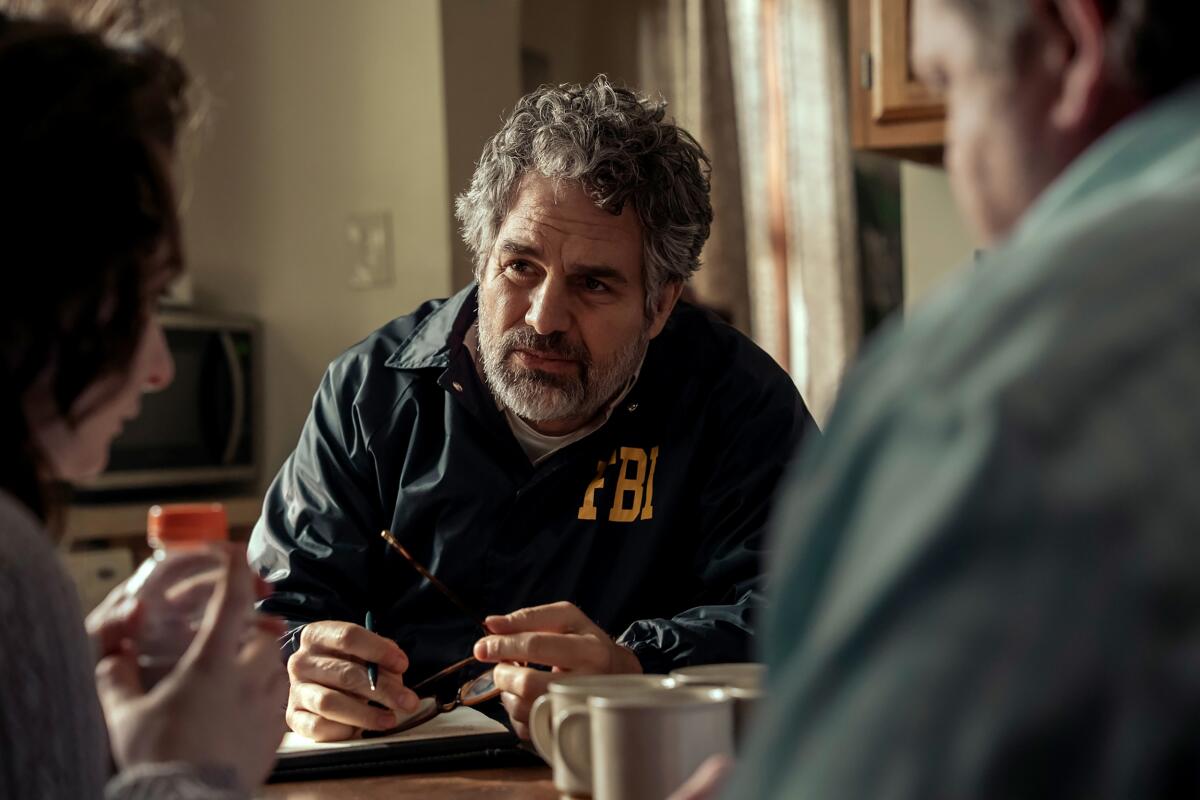
Mark Ruffalo stars in HBO’s drama “Task.”
(Peter Kramer / HBO)
“The accusation that I am antisemitic is appalling and fundamentally dishonest,” Ruffalo wrote on X. “Criticizing the actions of the Israeli prime minister, a military technology contract, or the executives who supply it is not the same as criticizing Jewish people.”
The fight intensified Sunday when Mark Goldfeder, head of the National Jewish Advocacy Center, lashed out at Bonta and suggested California’s top law enforcement official was doing Ruffalo’s bidding by filing the antitrust lawsuit.
“Your friend @MarkRuffalo said the quiet part out loud. His campaign against the Jewish Ellisons is about Israel, ‘genocide’, and ‘apartheid’,” Goldfeder wrote in a message on X directed at Bonta.
“Did you hear that too before you sued?” Goldfeder asked — a reference to a Feb. 27 message by Bonta, who at the time was responding to Ruffalo’s dismay after Paramount won the bidding war for Warner Bros., which also owns CNN.
In a nearly six-month-old post on X, Bonta wrote: “Mark, I hear you. I’m in conversation with my AG colleagues about Paramount/Warner Bros. As the epicenter of the entertainment industry, California has a special interest in protecting competition.”
Bonta and 11 other state attorney generals, all Democrats, from states including Colorado, Washington, Nevada and New York, filed the antitrust suit last month.
Paramount declined to comment on the latest developments.
Ruffalo has long been an outspoken critic of Israel’s involvement in Gaza. He’s also been a major irritant to David Ellison and other top Paramount executives as the actor took a starring role, drumming up opposition in Hollywood to Paramount’s proposed takeover of Warner Bros.
He helped lead a campaign that garnered signatures of more than 5,000 entertainment workers, including Ben Stiller, Bryan Cranston and Jane Fonda, who spoke out against the merger and its potential effect on Hollywood’s creative community.
Gov. Gavin Newsom has been privately advocating for a truce, in part, to avoid seeing another pillar of industry — the Paramount film studio — leave the state. Newsom reportedly said that he took Paramount’s threat “seriously.”
Mayor Karen Bass has also pushed for a settlement, which the Writers Guild of America criticized, accusing Bass of joining “Paramount’s pressure campaign,” when jobs are at stake.
A Los Angeles County report estimated that 4,500 jobs would be lost in Los Angeles if the merger goes through.
In recent weeks, key movie theater owners have scaled back their opposition, calling for talks to find a truce.
Bonta, in several interviews, has stressed the deal is about competition and antitrust law — not politics.
Paramount would have to sell businesses, what he calls “robust structural remedies,” to make the deal work, Bonta said last week on CNBC. He views Ellison’s pledge to make 30 movies a year post-merger as insufficient and unenforceable once the transaction closes.
Paramount last week demanded that Bonta and the other states post a $1.88-billion bond if the case stretches to March, which is when the judge has scheduled the trial. Paramount must increase its payout to Warner shareholders through “ticking fees” every quarter until the deal is complete.
The mediation talks are part of the judicial process.
During the CNBC interview Bonta criticized Paramount for raising issues that he doesn’t see as central to his group’s antitrust lawsuit.
“We do prefer to resolve cases in the boardroom instead of the courtroom,” Bonta told CNBC, a response to Democratic nominee for governor Xavier Becerra, who earlier this month said he, too, would like to see a settlement.
“For now we’re bringing our case,” Bonta said. “I hope they can focus on the actual allegations we make in our complaint.”