mayoral

Charges dropped against DPK Busan mayoral candidate; PPP cries foul

1 of 2 | Jang Dong-hyuk, leader of the People Power Party, casts his ballot in a by-election for chair of the National Assembly’s Climate, Energy, Environment and Labor Committee in Seoul on April 6. Photo by Asia Today

April 10 (Asia Today) — South Korea’s conservative People Power Party on Thursday sharply criticized the decision not to prosecute Rep. Jeon Jae-soo, the Democratic Party’s Busan mayoral candidate, calling it unfair and politically questionable.

People Power Party leader Jang Dong-hyuk said the case was closed immediately after Jeon was confirmed as a candidate, arguing that the timing raised serious concerns about impartiality.

The joint investigation team earlier ruled there were no grounds for prosecution in allegations that Jeon received luxury items, citing the statute of limitations.

People Power Party officials said investigators had identified a suspected timeline involving the alleged receipt of a luxury watch and money, and questioned whether the statute of limitations had been properly applied.

They argued that if the value exceeded 30 million won ($20,300), a longer statute of limitations would apply, and called for the investigation to continue.

Floor leader Song Eon-seok accused authorities of applying inconsistent legal standards, while other party officials also strongly criticized the handling of the case.

The People Power Party also urged Jeon to retire from politics.

The party said it would launch a task force to vet what it described as unqualified Democratic Party candidates. First-term lawmaker Seo Cheon-ho will lead the group.

It also approved a rule requiring local party chapter heads to resign immediately if a by-election occurs in their district, formalizing an internal accountability measure.

— Reported by Asia Today; translated by UPI

© Asia Today. Unauthorized reproduction or redistribution prohibited.

Original Korean report: https://www.asiatoday.co.kr/kn/view.php?key=20260410010003232

Source link

What a silly ‘Latinos Por Pratt’ salsa video says about L.A.’s mayoral race

You know the political silly season is upon us when campaigns start to make fools of themselves trying to court Latino voters.

In the Los Angeles mayoral race, that moment kicked off last week.

On Friday, a social media account called Latinos Por Pratt released an AI-animated music video praising the mayoral candidate and former reality television star Spencer Pratt. It starts with a fit, sunglasses-wearing Pratt rolling a trash bin brimming with detritus and Mayor Karen Bass past a crowd of cheering Angelenos. The Hollywood sign looms in the background as the title “Spencer, Saca La Bassura” flashes on the screen — Spencer, Take Out Trashy Karen, with “Bassura” a play on the mayor’s last name and the Spanish word for “trash.”

Cut to scenes of Bass playing tourist on her infamous trip to Ghana while the Palisades burn. Splice in Pratt dancing with his wife, Heidi Montag, onstage at a street party where onlookers wave a Mexican and a U.S. flag. And because L.A.’s Latino majority is overwhelmingly of Mexican descent, the thing was anchored by a peppy accordion, dramatic guitar plucks and a bold tuba, right? Right?

Uh, no.

Lyrics such as “Latinos for Pratt we’re singing / Because we’re tired of this dirty beat” play over brassy salsa rhythms that are more Miami and Cuban than L.A., where Latinos are mostly of Mexican and Central American heritage and the soundtrack of the city — corridos tumbados, cumbias, Latin rock and pop — reflect that.

That didn’t stop clueless, mostly non-Latino Pratt fanboys and fangirls from going gaga over it online. Nor did it stop Bass from joining in the we-need-Latino-voters fiesta.

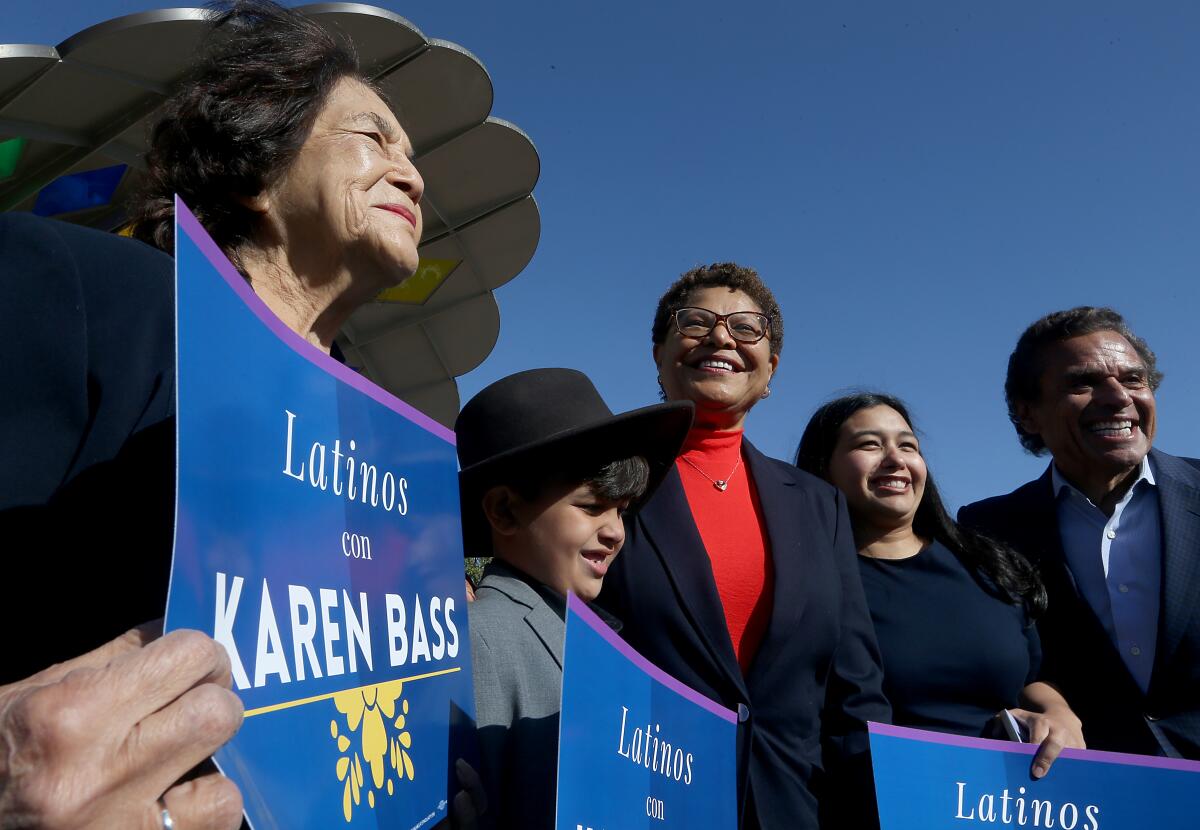
Soon after the video was released, a group called Latinos Con Bass brought out big-name speakers to Plaza de la Raza in Lincoln Heights — state Sen. Maria Elena Durazo (D-Los Angeles), Coalition for Humane Immigrant Rights head Angélica Salas, Service Employees International Union California President David Huerta — so they could pledge support for the incumbent with all the dutifulness of doctors reminding people to take their flu shot. Bass greeted the crowd with a peppy “¡Sí se puede!” — the standard Latino politico rallying cry for decades but one that’s not so kosher right now given its association with César Chávez, the legendary labor leader whom a New York Times investigation recently revealed to have sexually assaulted teenage girls.

Latinos Con Bass came off as a bunch of establishment types sticking up for one of their own instead of anything organic. But at least we know the track record of those involved. Latinos Por Pratt seems to be just one guy: Adrian E. Alvarez, a Cuban American whose online profile says he splits his time between the Miami area and L.A. If the lawyer by trade — who didn’t respond to numerous requests for comment — was really serious about winning Latino votes for his guy, he would’ve commissioned a corrido instead of a salsa tune. The Mexican ballad form has been trotted out by Angelenos for decades for everything from the tragic deaths of Robert F. Kennedy and Kobe Bryant and his daughter to the capture of sundry narco lords.

Those songwriters got it. Alvarez’s diss track doesn’t. And his use of Cuban Spanish on social media to promote it — carajo, fajame, mi gente — in place of Mexican Spanish equivalents such as güey, éntrale and raza sounds like a guy who doesn’t know South L.A. from South Beach.

But to dismiss “Spencer, Saca La Bassura” as an inauthentic joke is to miss what it says about this political moment. In a year when Latinos nationwide will make or break the Democrats’ effort to win back Congress, they’ll play an even more crucial role in L.A.’s mayoral race.

And it’s the Bass campaign that needs Latinos more than any of her opponents — because there’s no guarantee she’ll get them.

Five adults and children stand in a row.

Then-L.A. mayoral candidate Karen Bass, center, is flanked by pioneering farm labor leader Dolores Huerta, left, and former Mayor Antonio Villaraigosa, right, during a 2022 campaign event in Mariachi Plaza.

(Luis Sinco / Los Angeles Times)

A UC Berkeley Institute of Governmental Studies poll released last month and co-sponsored by The Times revealed that 56% of likely voters view the mayor unfavorably, the only candidate to have a majority of those surveyed look negatively on her. She’s the top choice among Latinos — 29%, compared with Pratt’s 16%. But 27% of Latinos remain undecided about whom they want as mayor, the highest percentage of any ethnic group.

Pratt has some name recognition among Latinos as a C-list celebrity, but he’s also a registered Republican who thinks L.A. should coordinate with the Trump administration’s deportation leviathan, a position that’s as popular among Angelenos as rooting for the San Diego Padres. That obviously presents an opportunity for Councilwoman Nithya Raman, who’s running for mayor to the left of Bass — if she can smartly seize it. But Raman represents a district with one of the lowest Latino populations in the city and has yet to make a name for herself across town — no wonder the Berkeley poll found just 9% of Latinos favored her, trailing even Presbyterian pastor Rae Huang.

Those shortcomings should give Bass — whose children are Mexican American and who has worked alongside Latino L.A.’s political establishment for nearly her entire political career — an advantage among Latinos. But all that star wattage didn’t win her the Latino vote four years ago against Rick Caruso. And L.A.’s biggest problems during the mayor’s first term — homelessness, beat-up streets, busted streetlights, President Trump’s immigration deluge — unduly affected the Latino areas of L.A. Even the inferno that engulfed the Palisades led to the loss of thousands of jobs for the nannies, house cleaners and gardeners that kept the neighborhood as pristine as it was.

Bass’ campaign will trumpet all of her supposed accomplishments and trot out endorsements as it did at the Plaza de la Raza event, but she lost the narrative of a healthy L.A. a long time ago.

Pratt — who doesn’t seem to know Los Angeles besides the Westside and television studios — will have to do far more than Bass and Raman to attract Latinos. But by repeatedly referring to the mayor as “Karen Bassura” — a juvenile, obvious insult that nevertheless sticks once you hear it — he’s at least making Spanish a far more constant part of his campaign than his rivals. And Alvarez’s music video, as silly and un-L.A. as it is, speaks to an enthusiasm among at least one Latino Pratt supporter that will most likely remain catchier and more inspired than anything the Bass and Raman campaigns come up with.

That reality seems to have already made Bass blink. She responded to “Spencer, Saca La Bassura” on social media a few days later with a photo of people at her Plaza de la Raza rally holding “Latinos Con Bass” signs with the caption “Latinos Con Bass > Ai Latinos.” It was meant as a political flex but came off as insecure posturing. Meanwhile, Latinos Por Pratt just released a teaser for another video, this time featuring Pratt as Batman carting out a clown-faced Bass and Raman as the villainous Two-Face.

Playing, again, to salsa. That’s weak sauce. Can someone try to really get Latino L.A.?

I promise: Sí se puede.

Source link

Adam Miller’s $2-million question: How much will he spend on his mayoral campaign?

Good morning, and welcome to L.A. on the Record — our City Hall newsletter. It’s Noah Goldberg, with an assist from David Zahniser and Rebecca Ellis, giving you the latest on city and county government.

Adam Miller is running for mayor.

You might not know that, and you might not even know who he is — and his campaign team wouldn’t blame you.

In fact, the Miller team’s own internal poll of 800 likely voters shows the tech entrepreneur with just 6% support, behind incumbent Mayor Karen Bass, City Councilmember Nithya Raman, conservative reality TV star Spencer Pratt and leftist Rae Huang. Only 13% of Angelenos even have an opinion of Miller, with 7% coming down on the positive side and 6% negative.

Miller’s pollster, Jefrey Pollock, admits it’s not often that a campaign brags about a humble 6% backing their candidate.

But during a video conference with reporters, Pollock argued that Miller’s support rises along with his name recognition. When likely voters were given more information about the candidates, he shot up to 20%, according to the poll. When provided with additional positive information about the candidates, Miller finished first, with 27%.

“Adam is the one who jumps up,” said Pollock, who runs Global Strategy Group.

After voters got the first dose of information, 22% supported Bass, down from 26%; 21% went with Pratt, up from 14%; 14% backed Raman, up from 12%; and 8% chose Huang, down from 9%.

In a poll earlier this month by the UC Berkeley Institute of Governmental Studies, co-sponsored by The Times, Miller also came out with 6% support. Bass was supported by 25% of voters, while Raman drew 17% and conservative reality TV star Spencer Pratt came in third at 14%. About a quarter of voters were undecided.

Paul Mitchell, vice president of the bipartisan voter data firm Political Data Inc., said the Miller campaign poll was compelling.

“What I see is a good argument that he can make the runoff,” Mitchell said. “This is a real deal.”

The question for Miller and his team then becomes, how can he introduce himself to more voters before the June 2 primary?

Miller is the former CEO of Cornerstone OnDemand, a global training and development company he built over the course of more than 20 years. The publicly traded company was eventually sold to a private equity firm for $5.2 billion. He is also a co-founder of Better Angels, a nonprofit focused on preventing homelessness and building affordable housing.

Among everyday Angelenos, he’s a no-name.

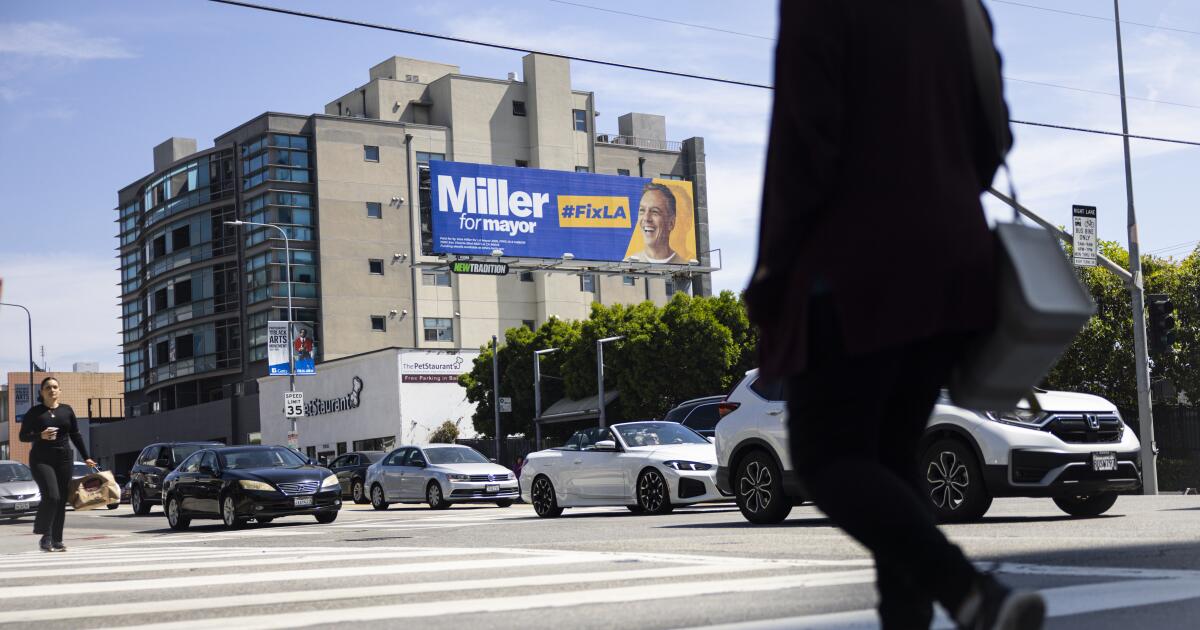
A television, social media and outdoor billboard advertising campaign launched this week should help change that, Miller’s team said. They said the “omnichannel” blitz cost seven figures but did not provide an exact amount.

The first billboard went up this week at Bundy Drive and Wilshire Boulevard, not far from Miller’s Brentwood home. More are expected next week in the San Fernando Valley.

Miller said he personally loaned his campaign a “majority” of the money for the ad blitz.

How much Miller is willing to spend on his mayoral ambitions?

In 2022, billionaire developer Rick Caruso threw more than $100 million of his own money into his campaign against Bass during the primary and runoff elections. He still lost by more than 10 percentage points.

“Obviously, we have the benefit of hindsight that that strategy did not work,” Miller said of the Caruso campaign. “There’s reasons my candidacy is different.”

For one thing, as opposed to Caruso, who was a Republican before registering as a Democrat to run for mayor, Miller is a lifelong Democrat. (That said, Miller voted for Caruso in 2022, said his spokesperson, Jaime Sarachit).

Miller is a moderate who sees himself as leader who gets things done. He believes the LAPD needs a minimum of 10,000 officers, up from about 8,700. He thinks the city should use anti-encampment laws to move homeless people away from sensitive areas like schools and day cares.

Miller would not directly answer a question about how much of his own money he will spend on his campaign. He has so far loaned it $2 million, “to get it up and running,” Sarachit said.

“That’s a significant sum, obviously,” said longtime L.A. political consultant Bill Carrick. “It’s a lot more efficient to write a check from your personal account than it is to go raise $2 million.”

But Miller said his campaign will largely be “traditionally financed,” meaning he plans to fundraise.

You’re reading the L.A. on the Record newsletter

Sign up to make sense of the often unexplained world of L.A. politics.

State of play

— AO-K’ed: Metro’s board on Thursday unanimously approved a new route for a rail line that would extend from South L.A. into West Hollywood — a milestone deal struck after last-minute negotiations between Bass and local leaders. The K Line northern extension would link with four major rail lines and increase the number of riders to 100,000 a day.

— SOCIALIST SNUB: The Los Angeles chapter of the Democratic Socialists of America will not endorse a candidate for mayor. Last weekend, the group voted on whether to reopen its endorsement process and consider backing Huang or Raman but ultimately decided to stay out of the fray for the June primary.

— GUNNING FOR COUNCIL: Leftist City Council candidate Estuardo Mazariegos was convicted of misdemeanor gun possession in 2009. He thinks the conviction is a strength, not a weakness.

— SMALLER BIGGER: On Tuesday, the City Council adopted a strategy that would delay the effects of SB 79 citywide by upzoning 55 single-family and low-density areas, allowing for buildings of four to 16 units that are up to four stories tall. Under SB 79, buildings adjacent to certain transit stops can be up to nine stories.

— NOT UP FOR DEBATE: USC canceled its Tuesday gubernatorial debate, a stunning about-face after days of fiery criticism that every prominent candidate of color was excluded. Although the university defended the methodology used to determine who was invited, it ended up calling off the event with less than 24 hours’ notice.

— PHANTOM SUIT: A man said he has no idea how he became a plaintiff in the county’s $4-billion payout for sex abuse in juvenile halls and foster homes. His lawsuit, which he says was filed without his consent by Downtown LA Law Group, deepens questions around possible fraud in the nation’s largest sex abuse settlement.

— TAX TAKEAWAY: The proposal from a group of business leaders to repeal the city’s business tax has qualified for the November ballot. Organizers said their success — gathering twice as many signatures as needed — shows that voters “want affordability and fairness to be addressed immediately.” Labor unions have vowed to fight the proposal, which would rip an $800-million hole in the city budget.

— HOUSING HUDDLE: Three of the mayoral candidates — Miller, Huang and Raman — took the stage Monday for a downtown forum. The trio went back and forth on housing, transportation and other issues, particularly the future of Measure ULA, the so-called mansion tax. Bass did not attend, citing a previous engagement in New Orleans, where she held a campaign fundraiser with U.S. Rep. Troy Carter (D-La.) and the city’s mayor, Helena Moreno. Pratt also did not show.

QUICK HITS

  • Where is Inside Safe? The mayor’s signature program visited Skid Row in Councilmember Ysabel Jurado‘s district, moving 25 people indoors.
  • On the docket next week: The City Council is on recess next week.

Stay in touch

That’s it for this week! Send your questions, comments and gossip to LAontheRecord@latimes.com. Did a friend forward you this email? Sign up here to get it in your inbox every Saturday morning.

Source link

Socialist Emmanuel Gregoire wins Paris mayoral race | Elections News

Gregoire headed a list uniting the traditional left, the Greens and the Communists to victory in French capital.

The Socialist Party’s Emmanuel Gregoire has won the Paris mayoral race, as the results of nationwide municipal elections showed gains for the traditional left and right, and a major win for the far right in the city of Nice.

Sunday’s run-off votes in more than 1,500 communes saw Gregoire on course to become mayor of the French capital, with exit polls showing that the far-right National Rally (RN) fell short of taking control of the key southern cities of Marseille and Toulon.

Recommended Stories

list of 3 itemsend of list

Gregoire, who headed a list uniting the traditional left, the Greens and the Communists, clinched the prized mayoralty with an estimated 51 to 53 percent of the vote, according to pollsters, seeing off Conservative rival Rachida Dati, who conceded defeat.

The 48-year-old son of a teacher and civil servant is stepping into the spotlight after previously serving as deputy to outgoing mayor and fellow Socialist Anne Hidalgo. During his bid, he had promised that Paris would stand as a “city of refuge” and a “bastion against the right and the far right”.

In Marseille, the second-largest city in the country, Socialist Mayor Benoit Payan was on track to be re-elected with 56.3 percent of the vote, according to an Elabe poll for BFM TV. RN’s chances of winning the coveted prize took a hit after the withdrawal of a hard-left candidate from France Unbowed (LFI) aimed at uniting left-wing voters.

Socialist Party chief Olivier Faure hailed the wins in Paris and Marseille, positioning his party as a bulwark against the far right. “Only the left can prevent France from this regression,” he said.

In Toulon, an Elebe poll showed centre-right candidate Josée Massi leading at 53.5 percent, with RN candidate Laure Lavalette conceding defeat. Yet, senior RN officials rejected suggestions that the party’s loss indicated it had hit a “glass ceiling” ahead of next year’s presidential election.

“The National Rally and its candidates have achieved tonight, in this municipal election, the biggest breakthrough in its entire history,” RN chief Jordan Bardella said, alluding to wins in local constituencies where it previously had no presence.

In the first round, Bardella’s anti-immigration party won re-election in the southern city of Perpignan, and it won in smaller cities, too. And on Sunday, exit polls indicated that Eric Ciotti, a former mainstream conservative who is now an ally of the RN, won in Nice, France’s fifth-biggest city.

Former Prime Minister Edouard Philippe was re-elected mayor in his northern city of Le Havre, according to the TF1 and LCI broadcasters, delivering a better-than-expected performance that boosts his hopes of running for president in 2027.

Philippe, a centre-right politician who served as prime minister under centrist President Emmanuel Macron, made a speech with a clear national message, saying his victory showed that “there were reasons to be hopeful” in the values of France and that the extremes can be beaten.

Turnout at 5pm local time (16:00 GMT) was just higher than 48 percent in France’s mainland, more than than in the 2020 vote held during the COVID-19 pandemic, but four points lower than in 2014, according to the Ministry of Interior.

Source link