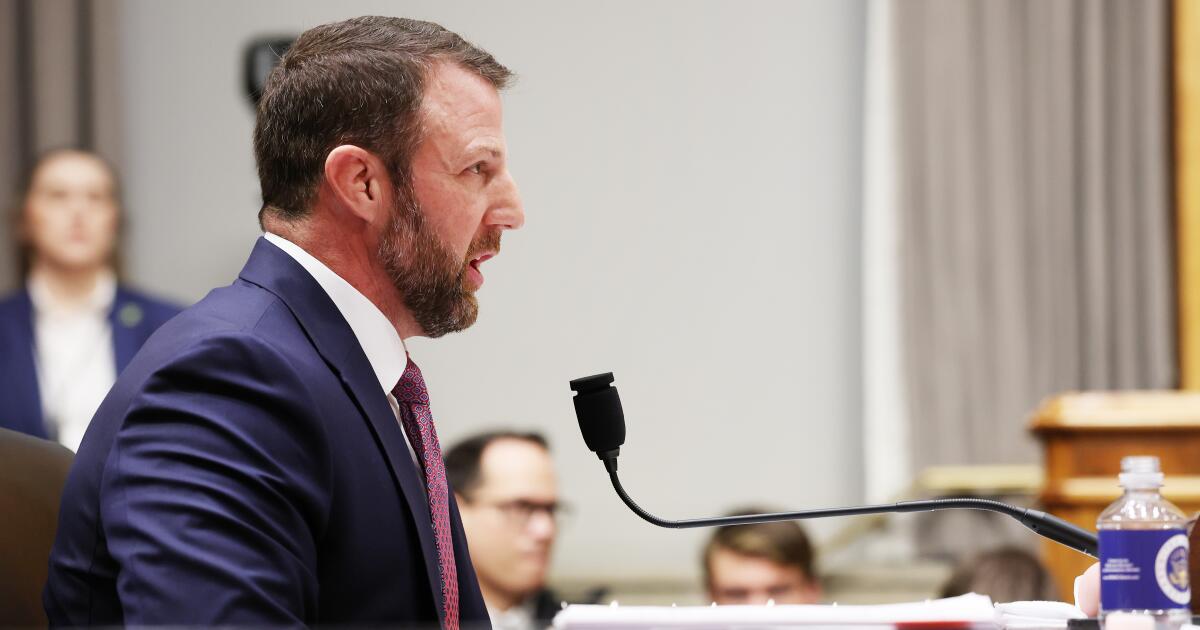
matters

Q&A: Why ending the Senate’s legislative filibuster matters

If Democrats win control of the Senate and White House in November, many progressives want to get rid of a long-standing Senate rule — the legislative filibuster — to ensure that their agenda in a Joe Biden presidency isn’t foiled by Republicans’ obstructions.

That would allow legislation to pass with 50 votes instead of the 60 required in recent decades for any significant initiatives. Whether to abolish or scale back the filibuster is one of the most consequential decisions Democrats would make, affecting the prospects for bills on healthcare, climate change, guns, immigration and more.

Proponents say the filibuster has been grossly misused, undermining the Senate’s effectiveness, and they believe Republicans would use it to block anything Biden tried to achieve. But critics in both parties warn that ending the filibuster would damage the Senate as an institution, and allow the majority to steamroll the other party.

What is the filibuster, and why does it matter?

The filibuster is a political blockade by a united minority to prevent a Senate vote on a bill. In recent decades, when the minority party won’t relent in its opposition, the majority must hold a so-called cloture vote — requiring a supermajority of 60 votes — to break the blockade and permit the Senate to act on the pending legislation.

Ideally for the minority party, if the majority can’t muster 60 votes, either it must compromise with the minority or its legislation dies.

Why do progressive Democrats want to get rid of the filibuster now?

If Democrats win a majority, they will almost certainly have fewer than 60 votes. Presumably Senate Majority Leader Mitch McConnell (R-Ky.) — if he wins reelection — would become the minority leader and instruct Republicans to filibuster any progressive legislation that comes before the Senate, much like he did as minority leader in President Obama’s first six years.

“We don’t think Mitch McConnell should be allowed to weaponize partisan obstruction … to prevent any opportunity to make the changes that the American people want,” said Eli Zupnick, spokesman for Fix Our Senate, a coalition of progressive groups advocating to eliminate the filibuster.

Among their Senate allies is Sen. Jeff Merkley (D-Ore.). “I’m holding conversations with [senators] saying, ‘Are we going to have a functioning legislative body or not?’” he said.

Will Senate Democrats actually end the filibuster?

That’s unclear. But an increasing number of Democrats have become supportive.

Sen. Jon Tester (D-Mont.) wants to keep the filibuster, but acknowledged that moderates like him could change their minds if Republicans use it to block a Democratic majority’s legislation.

“I didn’t come here just to watch somebody stonewall,” he said. “If it’s like the economy is going to hell and we’re not doing anything to help, that’s not healthy.”

Given the hesitance of those like Tester, few expect Democrats — if they’re the majority — to have enough votes to change the rules when the new Senate convenes in January. More likely, momentum would build if Republicans repeatedly filibuster.

Democratic leaders, including Sens. Richard J. Durbin of Illinois and Patty Murray of Washington, have voiced more support in recent days. Murray said in a statement that she’d prefer bipartisanship, but “I also know we’ve got a long list of challenges that grow more urgent by the day. And I’m not interested in watching Sen. McConnell or Senate Republicans keep us from acting if we have the chance.”

The top Democrat in the Senate, Sen. Charles E. Schumer of New York, has not ruled out the idea, nor has Biden. In the first presidential debate Tuesday, Biden sidestepped the issue: “Whatever position I take on that, that’ll become the issue.”

While Biden, a longtime senator before he was vice president, is considered an institutionalist who favors Senate tradition and bipartisanship, he also doesn’t want his agenda to be dead on arrival in the Senate.

Democrats’ anti-filibuster momentum already may be building, given their outrage at Senate Republicans’ power play to confirm a successor to Justice Ruth Bader Ginsburg — Amy Coney Barrett — even as voting has begun for the next president. Senate Republicans in 2016 blocked President Obama’s nominee after Justice Antonin Scalia died nine months before the election.

“If the Senate Republicans confirm Judge Barrett, Democrats must move to end the filibuster and expand the Court in the next Congress,” Sen. Edward J. Markey (D-Mass.) said.

Why keep the filibuster?

Proponents, including Sen. Dianne Feinstein (D-Calif.), say eliminating it would only deepen the polarization in Washington. The 60-vote requirement is supposed to encourage the majority to reach consensus with the minority on bills, though that’s increasingly rare.

The filibuster “really does require some level of bipartisanship. It requires some negotiation,” Sen. Angus King (I-Maine) said in 2018. “The majority can’t just run over the minority, and in the long run, legislation is better if it’s formed that way.”

Richard Arenberg, a former Senate Democratic aide who co-wrote “Defending the Filibuster: Soul of the Senate” in 2012, warned that without the filibuster, legislation could be enacted and then undone again as control of Congress and the White House changed hands.

“The legislative filibuster may be the single most important thing preserving the Senate’s constitutional role as a check on majority tyranny,” Sen. John Thune of South Dakota, a Republican leader, said recently.

What might Democrats do?

They could completely eliminate the filibuster. But options that stop short of that are viewed as more likely.

Merkley has proposed requiring a more active filibuster. Senators would have to be in the chamber to lodge their opposition or have to keep talking, alone or in tandem with allies. Either method would likely reduce the number of filibusters.

Absent the filibuster, could Democrats pass Medicare for All and the Green New Deal?

That’s unlikely, at least in the short term. Democrats would still need 51 votes, and neither program is thought to have that much support even if the party has additional members in next year’s Senate.

How did the filibuster come to be?

The Constitution says the Senate makes its own rules. In 1805, shortly after then-Vice President Aaron Burr killed Alexander Hamilton, he persuaded the Senate to get rid of its rule for cutting off debate. But according to Sarah A. Binder, a senior fellow at the Brookings Institution, that opened the door to the filibuster in the mid-1800s — with opposing senators talking nonstop to prevent a vote on bills.

In 1917, the Senate acted to curb the practice. The result was a precursor of the filibuster rule as it exists today: The Senate could end debate by a vote of two-third of all senators. The threshold was later reduced to three-fifths, or 60 votes.

For a half-century after 1917, filibusters were few; the Senate cast votes to end them no more than seven times in each two-year Congress, according to congressional statistics. Over time, however, they gradually increased and then spiked as politics became more polarized in recent decades.

The Senate over the last two years has set a new record: 258 votes to end filibusters. Yet even that doesn’t convey the impact of the obstructionist tactic: If the majority leader knows 41 senators would support a filibuster, he typically has shelved a bill because of the difficulty of corralling 60 votes.

Hasn’t the filibuster been scaled back already?

Yes. Amid Republicans’ obstruction of Obama’s appointees, in 2013 Democrats got rid of the filibuster for executive branch nominees and all judges except Supreme Court justices. Just four years later, Republicans got rid of the filibuster for Supreme Court justices, to confirm President Trump’s first nominee, Neil M. Gorsuch, 54-45.

Obama said the filibuster is a relic of Jim Crow times. True?

In his eulogy of civil rights icon Rep. John Lewis in July, Obama urged the Senate to eliminate the filibuster — calling it “another Jim Crow relic” — so the Senate could pass a new voting rights bill. While Obama overstated the connection — the filibuster has been used against many policies and nominees — history does show a link.

Southern Democrats for decades used the filibuster — or just the threat of one — to oppose Civil Rights-era bills, including anti-lynching legislation going back to the 1920s. In the mid-50s, Vice President Richard M. Nixon — acting as the president of the Senate — led an unsuccessful effort to repeal the filibuster to allow passage of a voting rights bill, according to Adam Jentleson, a former aide to Senate Majority Leader Harry Reid (D-Nev.) and author of the forthcoming book “Kill Switch: The Rise of the Modern Senate and the Crippling of American Democracy.” Perhaps the most famous filibuster was Sen. Strom Thurmond’s 24-hour, 18-minute talkathon against a Civil Rights bill in 1957.

Source link

How Credible Sources Shape Public Opinion and Why Your Choice of News Matters More Than You Think

Public opinion shifts fast, often faster than people expect. Many readers believe they form their views independently, yet every choice — from which headline to click to the sources they trust — shapes how they understand global events. Halfway through the second sentence, reliable platforms such as gayaone.com help you keep these choices intentional. When you control the quality of your information, you protect your ability to think clearly and make balanced decisions.

Why the Sources You Follow Influence the Way You See the World

People tend to underestimate the extent to which their news diet influences their beliefs. A steady stream of dramatic stories changes how safe they feel. A calm, fact-based report changes how they judge a political event. This happens because the mind absorbs structure, tone, and context, not only raw facts. Your awareness grows when you select sources that value accuracy over noise. Before establishing this habit, consider the key factors that indicate whether a source is trustworthy:

  • check how clearly the outlet separates fact from opinion;
  • look for consistent attribution to verified experts and institutions;
  • review whether the platform shows full context, not isolated fragments;
  • read how the outlet corrects mistakes;
  • assess whether the publication avoids sensational framing.

Once you pay attention to these details, your relationship with news becomes more intentional. You feel less pressure, you filter information faster, and you avoid the emotional traps that come from reckless content. This approach gives you a healthier, more stable understanding of public affairs.

How Credibility Guides Your Judgments Without You Noticing

Credible reporting does more than inform you. It shapes how you interpret social tension, economic shifts, and political decisions. When a publication stays consistent, you start to rely on its structure.

Clear reporting gives you room to form your own view instead of absorbing someone else’s assumptions. That independence matters when public narratives collide and every side claims authority. Without credible sources, your perspective drifts between loud opinions and short-lived trends.

Why Your Choice of Source Matters Even More During Complex Events

High-pressure events expose the difference between trustworthy journalism and shallow content. When countries face conflict, elections, or market shocks, the quality of your sources becomes crucial. A credible outlet explains what happened, why it matters, and what may come next. It avoids shortcuts that leave you confused. It also refuses to exaggerate uncertainty. This kind of structure protects your ability to stay calm while you process complicated issues.

In contrast, unreliable outlets flood you with claims that lack substance. They take advantage of confusion, and that confusion spreads from one reader to millions. Your choice of outlet then becomes a civic act: you decide whether you want to support responsible journalism or contribute to the noise that fuels misinformation.

Gaya One provides a clear and trustworthy path through crowded media spaces. The platform focuses on verified updates, sharp analysis, and balanced context, which helps readers develop informed perspectives instead of reactive opinions. You build stronger habits when you regularly return to a place that respects your time and intelligence. If you want reliable reporting that strengthens your understanding, explore Gaya One today and start using its curated categories to stay informed with confidence.

Source link

Angel City finding out what matters the most in L.A.: winning

It was a terrible, horrible, no good, very bad season for Angel City FC. But it’s not one the team is running away from.

“Did we put it all together this year?” team president Julie Uhrman asked. “No.”

In fact, the team won just one of its last eight games; missed the playoffs for the third time in four seasons; saw attendance plummet; lost Alyssa Thompson, its best and most exciting player, on a million-dollar transfer; and watched its two most-decorated players — Ali Riley and Christen Press — retire after a season in which they combined for two starts.

For sporting director Mark Parsons, however, it still counted as progress. Yet the team has a lot of work to do to clear the high bar of community impact and soccer success it set as its twin goals when it launched in 2022.

“This season was about putting in all the foundations and all the pieces where we get to go compete for championships from ’26 and beyond,” Parsons said. “And I could not be happier with the success we’ve been able to do. That helps us win in the future.

“Of course we’d have all loved to win a couple more games,” he added. “But the priorities were try and win, but build for the future.”

Alexander Straus, center, is introduced as Angel City coach by Mark Parsons, left, and Julie Uhrman.

Alexander Straus, center, is introduced as Angel City coach by sporting director Mark Parsons, left, and team president Julie Uhrman during a news conference in June.

(Al Seib / For the Times)

The die for the season, for bad or worse, was cast in the embers of the deadly Palisades fire last January. That first night, as Riley’s family home burned to the ground and other players were forced to relocate, Parsons could see the flames from the gated Brentwood estate of Bob Iger and Willow Bay, Angel City’s controlling owners. He was there interviewing for the job he would get nine days later.

And he was brutally honest about what he thought the club needed.

“I looked at them and said ‘We have a lot of work to do. Unless we get really lucky, it’s going to be a roller coaster. However, we will be really excited about our team by the end of the year,’” Parsons recalled this month.

Part of the problem has to do with how Angel City was built. The team has had three general managers or sporting directors in four seasons and four coaches, including interim manager Sam Laity, over that span. Parsons and Alexander Straus, his hand-picked coach who started in June, were hired to shore up that creaky foundation and bring consistency to the team’s soccer operations, which mostly had been spinning its wheels.

For Parsons, that basically meant tearing things down and starting over. And if he had to sacrifice his first season in doing so, it was a price he was willing to pay.

“We’re going to try and compete and win every single game, because that’s why we’re here,” he said. “We are not going to do that at the expense of building a championship-winning team. This season is about building the future, to not just get to the top, but to stay at the top.”

So the team made 29 transactions in his first nine months. In addition, seven players won’t be re-signed when their contracts expire at the end of the year, among them midfielder Madison Hammond and defender Megan Reid, who are 1-2 in appearances in club history, and Japanese defender Miyabi Moriya, a World Cup and Olympic veteran.

Of the additions, Parsons is especially high on midfielders Evelyn Shores and Hina Sugita, Icelandic attacker Sveindis Jonsdottir and Zambian international Prisca Chilufya. All joined in the second half of the season, adding to a core that included rookie of the year candidate Riley Tiernan and defenders Gisele Thompson, Sarah Gorden and Savy King.

Angel City's Sarah Gorden controls the ball against Racing Louisville on Sept. 27.

Angel City’s Sarah Gorden controls the ball against Racing Louisville on Sept. 27.

(Andy Lyons / Getty Images)

Of those eight, only Gorden is older than 28 and three of the others — Thompson, King and Shores — can’t legally buy a beer in California. Parsons will double down on one of those additions Tuesday, announcing he has signed Sugita, 28, a two-time World Cup player from Japan, through 2029.

“Most teams try not to do too much during the season. It can be unsettling,” Parsons said.

But for Angel City, every second mattered.

“The top teams in this league that have been pretty consistent the last couple of years took three years to get to a point of being in the top four. We don’t have three years,” Parsons said. “This is a city that is expected to compete and to win in a stadium that [is] rocking, that represents this community.”

That hasn’t happened for Angel City, which was founded with solid community support and an A-list ownership group of more than 100, including Hollywood stars, former U.S. national team players and deep-pocketed investors. The vision was to build a team that won games while making a deep and lasting impact on the community.

The club certainly has gotten the second part of that equation right by providing more than 2.5 million meals and more than 51,000 hours for youth and adult education; distributing equipment and staff for ongoing soccer programming for the children of migrants trapped at the U.S.-Mexico border; and funneling $4.1 million into other programs in Los Angeles. Last week the club awarded $10,000 grants and access to business coaching to 13 former players to help support the transition to the next stage of their lives.

From the start, Angel City games offered a welcoming place, especially for the LGBTQ community, and that helped the team finish first or second in the NWSL in attendance in each of its four seasons.

“We are committed to providing an environment of connection, community and belonging,” Uhrman said.

But while doing that the club struggled on the field, making the playoffs just once while going 30-42-24 over that span. As a result average attendance plunged nearly 16%, to 16,257 this year.

In its first three seasons, Angel City played before a home crowd that small just once, although the team still ranks second in the league, behind only the Portland Thorns. Making the team a draw again, Uhrman conceded, will require trying something new. Like winning.

“Our goal is to be a dynasty on the pitch and a legacy off the pitch,” she said. “And for that to be true, we need to win on and off the field. We need to have the positive impact in the community and continue to give back, but we also need to win championships.”

Some of the team’s most loyal supporters have grown tired of waiting.

“I’m just frustrated with the team’s performance,” said Caitlin Bryant of Burbank, a season-ticket holder from the first season who has not renewed for next year. “I’m done dragging myself down to BMO [Stadium] every other weekend until this thing turns around.

“The vibes are great. The stadium environment is great. But watching the team lose game after game, season after season, it’s exhausting and it’s not fun. I need the team to win.”

You have read the latest installment of On Soccer with Kevin Baxter. The weekly column takes you behind the scenes and shines a spotlight on unique stories. Listen to Baxter on this week’s episode of the “Corner of the Galaxy” podcast.

Source link

Bihar 2025 election result: Who won, who lost, why it matters | Demographics News

The National Democratic Alliance (NDA), led by Indian Prime Minister Narendra Modi’s Bharatiya Janata Party (BJP), is heading for a sweep in the legislative assembly elections in the eastern state of Bihar.

The election in India’s third-most populous state, with 74 million registered voters across 243 assembly constituencies, has been viewed as a key test of Modi’s popularity, especially among Gen Z: Bihar is India’s youngest state.

Recommended Stories

list of 3 itemsend of list

Vote counting concluded on Friday after two phases of voting on November 6 and November 11.

Here is more about the election results and what they mean.

What was the result of the Bihar election?

As of 5:30pm (1200 GMT) on Friday, the NDA had won two seats and was leading in 204 out of 243, while the opposition Mahagathabandhan, or the Grand Alliance, with the Indian National Congress and the regional Rashtriya Janata Dal (RJD) as the main parties, was leading in just 33 seats, according to the Election Commission of India (ECI).

The Bahujan Samaj Party (BSP), which is currently not part of either alliance, was leading in one seat. The All India Majlis-E-Ittehadul Muslimeen (AIMIM), another party that does not belong in either major alliance, had won or was leading in the remaining five seats.

BJP and allies

  • Within the NDA, the BJP had won or was leading in 93 seats with a 20.5 percent overall vote share. 
  • The regional Janata Dal (United) or JD(U), a key NDA constituent, had won or was leading  in 83 seats, with 19 percent votes overall.
  • Another local NDA ally, the Lok Janshakti Party (Ram Vilas) or LJPRV, had won or was ahead in 19 seats.
  • The Rashtriya Lok Morcha (RSHTLKM) was leading in four seats.
  • The Hindustani Awam Morcha (Secular), or HAMS, had won or was leading in five seats.

Opposition alliance

  • The Congress, India’s main opposition party, had won or was leading in five seats with 8.7 percent of the overall vote.
  • The Grand Alliance’s biggest party, RJD, had or was leading in 26 seats with 22.8 percent of the vote.
  • The Communist Party of India (Marxist-Leninist) (Liberation), or CPI(ML)(L), was leading in one seat.
  • The Communist Party of India (Marxist), or CPI(M), was ahead in one seat.

How are Tejashwi Yadav and Maithili Thakur doing?

As votes were being counted, two of the most watched constituencies were Raghopur and Alinagar.

Raghopur has long been an RJD stronghold. But for some time during counting, Tejashwi Yadav, the son of RJD leader Lalu Prasad Yadav and the party’s de facto chief now, was trailing behind BJP candidate Satish Kumar in the Yadav family bastion. This had switched to a 13,000 vote lead for Yadav by 1200 GMT, with most votes counted. If Yadav were to still lose, it will be a historic defeat for what was, many years, the first family of Bihar. He previously won the seat in 2015 and 2020. His father has also won from Raghopur twice in the past, while his mother, Rabri Devi, has won it three times.

Popular folk singer, Maithili Thakur, representing the BJP, was leading in the Alinagar seat, with the RJD’s Binod Mishra trailing by 8,588 votes — another close contest.

What is driving the results?

Female voters

Political analysts attribute the gains for the key governing party in this election to the appeals Modi’s party has made to female voters.

In September, the BJP transferred about $880m to 7.5 million women – with 10,000 rupees ($112.70) paid directly into their bank accounts – under a seed investment programme called the Chief Minister’s Women Employment Scheme. Modi’s office said: “The assistance can be utilised in areas of the choice of the beneficiary, including agriculture, animal husbandry, handicrafts, tailoring, weaving, and other small-scale enterprises.”

Women make up nearly half of all eligible voters in Bihar, where women’s political participation is on the rise. Female representation in the state has historically been low. But in 2006, Bihar reserved 50 percent of seats on local bodies for women, which has boosted their political representation.

Female voter turnout in the state has often surpassed that of men since 2010. The turnout among women this time was 71.6 percent, compared with 62.8 percent for men.

Voter ID checks

The opposition has also accused the ECI of deliberately revising the official voter list to benefit the BJP via a Special Intensive Revision (SIR) of the electoral rolls over the past few months. Registered voters were required to present documents proving they were Indian nationals and legal residents of the constituency in which they voted.

As Al Jazeera reported in July, however, many of the poorest people in Bihar do not hold any of the several documents that the ECI listed as proof of identity.

The opposition argues, therefore, that this new requirement could disenfranchise poor and vulnerable groups, including disadvantaged castes and Muslims, who typically vote for the RJD-Congress alliance.

In September, the ECI removed 4.7 million names from Bihar’s rolls, leaving 74.2 million voters. In Seemanchal, a Muslim-majority area, voter removals exceeded the state average.

What is the significance of these results?

Bihar is India’s third most populous state, home to 130 million people. It sends the fifth-highest number of legislators to parliament.

The latest vote has been viewed as a key popularity test for Modi, who was sworn in for his third premiership after he won the national elections in June 2024.

But the BJP failed to secure a majority in the national election on its own, forcing it to rely on regional allies such as the JD(U) to form the government.

Since the national election, the BJP has won most major state elections, and the streak seems to be continuing in Bihar.

Source link