How a last-minute deal doomed California’s ban on masked ICE agents
The judge was perplexed.
“Why were state law enforcement officers excluded?” U.S. District Judge Christina A. Snyder wanted to know.
The judge pressed California Deputy Atty. Gen. Cameron Bell to explain the thinking behind a pair of trailblazing new laws meant to unmask the federal immigration agents patrolling Golden State streets and compel them to identify themselves.
One of the laws required all law enforcement operating in the state to visibly display identification while on duty, with narrow exclusions for plainclothes, undercover and SWAT details. It applied to everyone else, including U.S. Immigration and Customs Enforcement officers.
But the other law, a ban on masks worn by on-duty law enforcement officers, applied only to local cops and federal agents, with a broad exemption for the California Highway Patrol and other state peace officers.
Snyder wanted to know: Why were the laws different?
She never got an answer. Bell said she couldn’t comment on the actions of the Legislature.

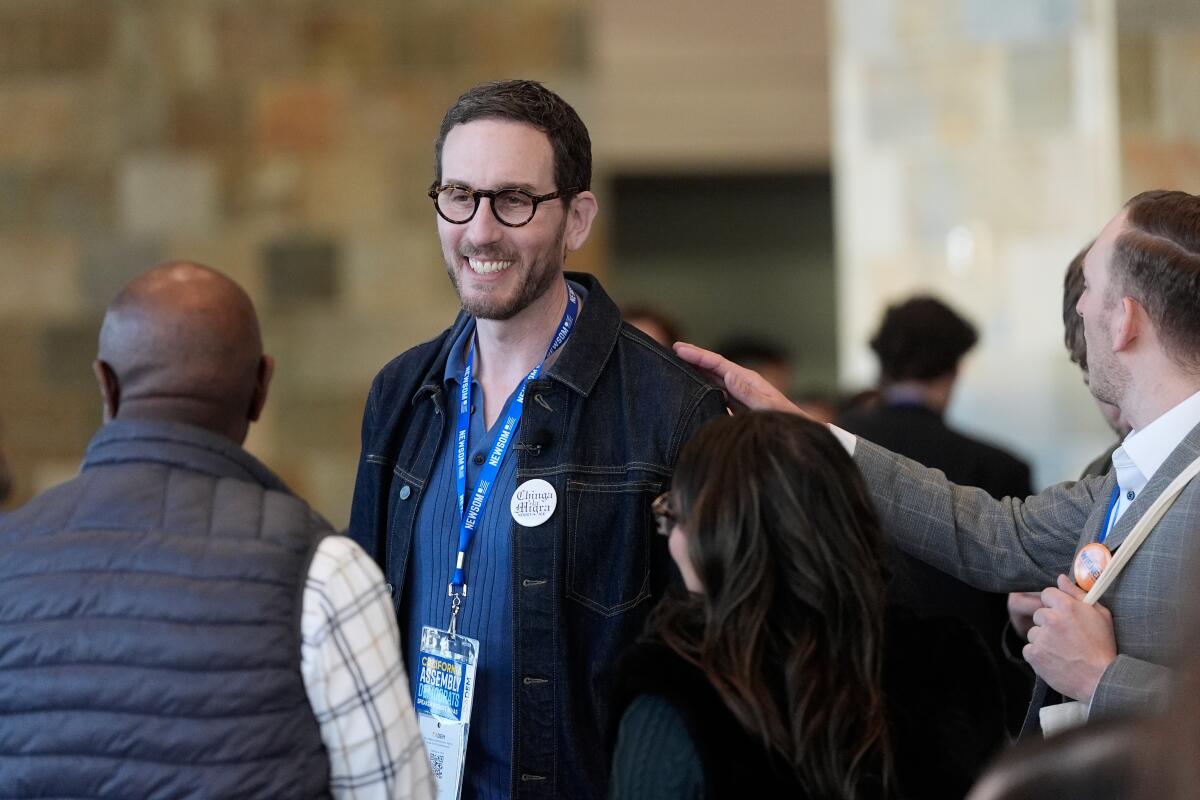
State Sen. Scott Wiener attends the California Democratic Party convention in San Francisco in February.
(Jeff Chiu / Associated Press)
In the halls of the statehouse last year, Sen. Scott Wiener’s (D-San Francisco) No Secret Police Act and Sen. Sasha Renée Pérez’s (D-Alhambra) No Vigilantes Act were referred to as “legislative twins,” a nod to their shared gestation and conjoined legal fate. If passed, both would immediately be challenged by the Trump administration.
That’s precisely what happened. Both measures became law — but only the ID law survived its first court battle, sending state legislators back to the drawing board on the mask ban.
Polls show unmasking ICE is overwhelmingly popular with voters, and both Wiener and Gov. Gavin Newsom took credit for getting the bill passed.
But behind the scenes, according to nearly two dozen sources familiar with the legislative process who spoke to The Times, a fight had been brewing between the two Democrats.
Days before the amendment deadline last summer, Newsom’s office proposed changes to Wiener’s mask ban that, according to legal experts and opponents, would have exempted most ICE and Customs and Border Protection operations from the bill. The governor’s team denies that was the intent of their proposal. The resulting compromise exempted state peace officers from the law instead.
Snyder struck it down on Feb. 9, writing that she was “constrained” to do so because the exemption of state police “unlawfully discriminates against federal officers.”
Interviews with more than 20 lawmakers, policy advisors, law enforcement and legal experts show how the Labor Day weekend deal came together, ensuring both Wiener and the governor a political victory that in short order became a court triumph for the president.
There are now more than a dozen similar bills winding through statehouses from Olympia, Wash., to Albany, N.Y., as legislators try to rein in a practice the majority of Americans see as dangerous and corrosive. In Sacramento, similar efforts are underway to pass a narrower version of the law, and both Newsom and Wiener have said they were proud to make California the first state to pass an ICE mask ban.
Both sides said the legislative process is messy, and that eleventh-hour amendment fights are inevitable in a statehouse where more than 900 bills were passed and close to 800 signed into law last year.
Yet neither the governor’s office nor the legislator’s team has offered clear answers for why both accepted a last-minute change on a nationally watched bill that each was informed could kneecap the law’s constitutional standing in court.
“Seeing the carve-out, I was immediately really surprised,” said Bridget Lavender, staff attorney at the State Democracy Research Initiative, the nation’s leading expert on the myriad legal efforts to unmask ICE across the U.S. “That’s ultimately what doomed it.”
Others were more blunt.
“When I saw the final bill I said, ‘What happened here?’” said one prominent constitutional scholar, who asked not to be identified because they were advising several other state legislatures on similar mask ban efforts. “I can’t believe this happened.”
All eyes were really on California.
— Bridget Lavender, staff attorney at the State Democracy Research Initiative
Legally, the mask ban was always going to be a cat fight. Law enforcement groups loathed it. Constitutional scholars were wary. The Justice Department contends both the mask ban and the ID law illegally interfere with the operation of the federal government, a violation of the Constitution’s supremacy clause, while California likens them to highway speed limits, which apply to everyone equally.
“There is a very strong argument that the law is constitutional so long as it applies to all law enforcement,” said Erwin Chemerinsky, dean of the UC Berekely Law School and an early champion of the original No Secret Police Act, known in Sacramento as SB 627.
Others saw it differently.
“It’s a very complicated question as to whether states can enact law enforcement policies that bind the federal government,” said Eric J. Segall, a professor at Georgia State University College of Law. “The answer [here] is probably not. I regret that’s the law, but I’m pretty sure that’s the law.”
Everyone agreed, the Golden State would set the precedent.
“All eyes were really on California,” Lavender said.
Judge Snyder agreed with the state, upholding the ID law. Judges for the 9th Circuit Court of Appeals sharply questioned both the federal government and California in a hearing Tuesday, repeatedly emphasizing the lack of clear precedent and constitutional uncertainty of the law.
“California has done something that we just haven’t seen before,” said Judge Jacqueline Nguyen.
Most scholars believe it will ultimately be settled by the Supreme Court.
The mask ban would be on the same track now, if not for the state police exemption.
“We knew we really had to thread that needle very carefully,” said state Sen. Patricia Fahy of New York, whose mask ban bill could soon be fast-tracked in Albany. “You had to put all law enforcement in it. I say that as a non-lawyer, but I knew that.”
Wiener knew it too. A Harvard-trained lawyer and a former deputy city attorney for San Francisco, he’d rebuffed early requests to exempt state and local officers from the bill and circulated Chemerinsky’s July 23 op-ed in the Sacramento Bee explaining the necessity of a universal ban, including to the governor’s team.
The state’s powerful law enforcement unions were livid. They railed against the bill in public and in the Legislature, testifying relentlessly about the harm that would flow to them from a ban — including being required to enforce it against armed federal agents.
“The last thing you want is two people with firearms on their hips getting into an argument,” said Marshall McClain, a regional director in the Peace Officers Research Assn. of California, among the state’s richest and most powerful lobbying groups.
Law enforcement objections shaped the changes the governor’s legislative office sought just days before the Sept. 5 amendment deadline, according to a stakeholder involved in those discussions.

Gov. Gavin Newsom speaks during a news conference in Los Angeles in 2024.
(Eric Thayer / Associated Press)
The most controversial ask from Newsom’s team was an exemption for all types of officers engaged in “warrant and arrest related operations” — precisely the type of enforcement Alex Pretti was filming when masked CBP agents tackled him to the ground and shot him to death in Minneapolis last month.
The governor’s office also sought an exemption for all officers engaged in “crowd management, intervention, and control” — the work ICE agent Jonathan Ross was doing when he shot and killed Renee Good less than three weeks earlier.
“We were working to ensure state officer safety and operational effectiveness, not exempt ICE,” said Diana Crofts-Pelayo, Newsom’s chief deputy director of communications.
Yet California Deputy Solicitor Gen. Mica Moore told the 9th Circuit on Tuesday that the state’s ID law only applies to officers engaged in “arrest or detention operations or … crowd control” — activities she characterized as central to its purpose.
Rather than swallow bad terms or risk Newsom’s veto, Wiener countered with the state police carve-out — a move constitutional experts advised him would leave the law at least some chance of survival.
The governor’s legislative team quickly accepted, leaving Bell and the attorney general’s office on the hook to defend the exemption.
Boosters argue that even with its fatal flaw, California’s law advanced such bans nationally in a pivotal moment last September.
“The politics have changed dramatically,” said Hector Villagra, vice president of policy advocacy for MALDEF, one of the mask ban’s sponsors. “[Today] people realize this is not normal in a democracy like ours.”