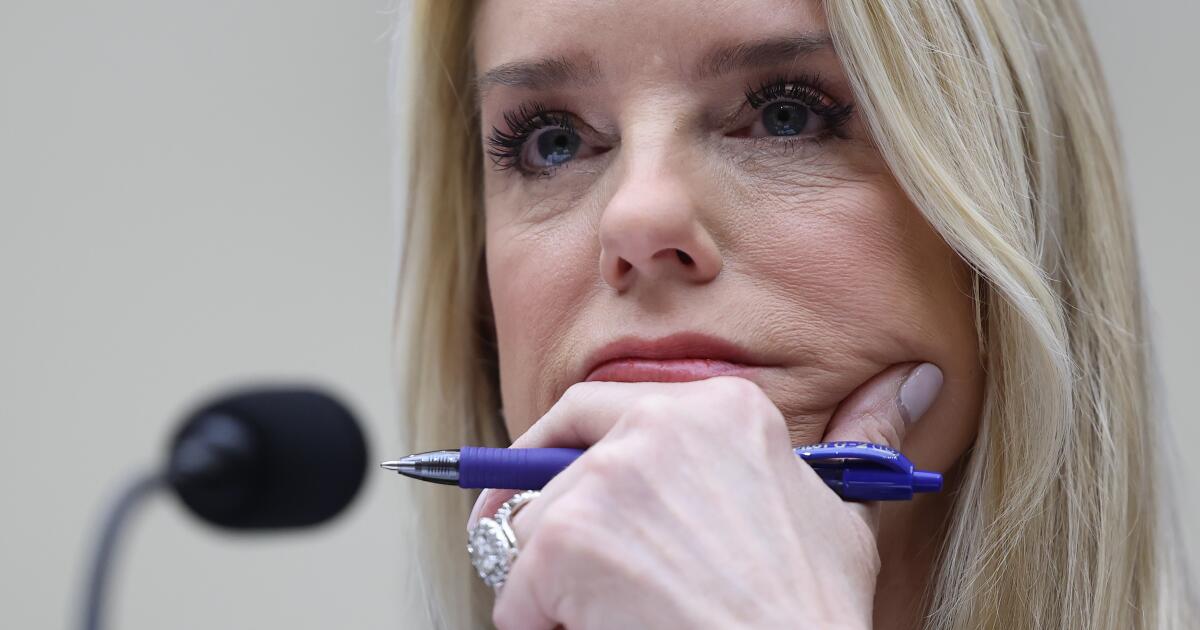
U.S. Atty. Gen. Pam Bondi declared a triumph against California on Friday, touting an appellate court ruling that she said blocked a state ban on immigration agents and other law enforcement officers wearing masks.
“The 9th Circuit has now issued a FULL stay blocking California’s ban on masks for federal law enforcement agents,” Bondi posted on the social media site X, calling the Feb. 19 decision a “key victory.”
Bondi, however, appeared confused about which case the court was ruling on this week.
A federal judge in Los Angeles blocked California’s first-in-the-nation mask ban 10 days earlier, on Feb. 9.
At the time, U.S. District Judge Christina A. Snyder said she was “constrained” to block the law because it included only local and federal officers, while exempting state law enforcement.
The state did not appeal that decision.
Instead, on Wednesday, the law’s author Sen. Scott Wiener (D-San Francisco) introduced a new mask bill without the problematic carve-out for state officers.
With the initial legal challenge already decided and the new bill still pending in the legislature, the 9th Circuit Court of Appeals has no reason to revisit the mask ban.
The ruling that Bondi appeared to reference involves a separate California law requiring law enforcement officers to display identification while on duty.
Snyder had previously ruled the “No Vigilantes Act” could take effect because it did not exempt state police, a decision the Justice Department appealed to the 9th Circuit.
The appellate court is set to review the matter early next month. Until then, the court issued an injunction that pauses the state law from taking effect.
Issuing a temporary administrative injunction is a common procedural move, allowing judges to freeze things in the status quo until the court has a chance to weigh the law and come to a decision.
Thursday’s order set a hearing in the Richard H. Chambers U.S. Court of Appeals in Pasadena for March 3, indicating the case is far from over.
Bill Essayli, who leads the U.S. attorney’s office in Los Angeles, also celebrated with a post on X, calling Thursday’s order “another key win for the Justice Department.” He too suggested the injunction somehow involved the mask case.
A spokesperson for the U.S. Justice Department did not immediately respond to a request for comment.
The law requiring officers to show ID is less controversial than the mask ban. But it may still face an uphill battle in the appellate court. A three-judge panel is set to hear the case, comprising two judges nominated to the bench by President Trump and one by President Obama. One of the Trump appointees, Judge Mark Bennett of Hawaii, has previously signaled skepticism over the administration’s immigration enforcement policies.
At issue in the ID case is whether California’s law interferes with or controls the operations of the federal government, actions prohibited by the supremacy clause of the U.S. Constitution. Snyder ruled that the identification law was more akin to speed limits on the highway, which apply equally to everyone, a decision the appellate court could reject.
A ruling is not expected before mid-March, and would not directly affect the push by state lawmakers to pass a revised mask ban.
Recent polls show more than 60% of Americans want U.S. Immigration and Customs Enforcement officers and other federal agents unmasked. More than a dozen states are pursuing laws similar to California’s.
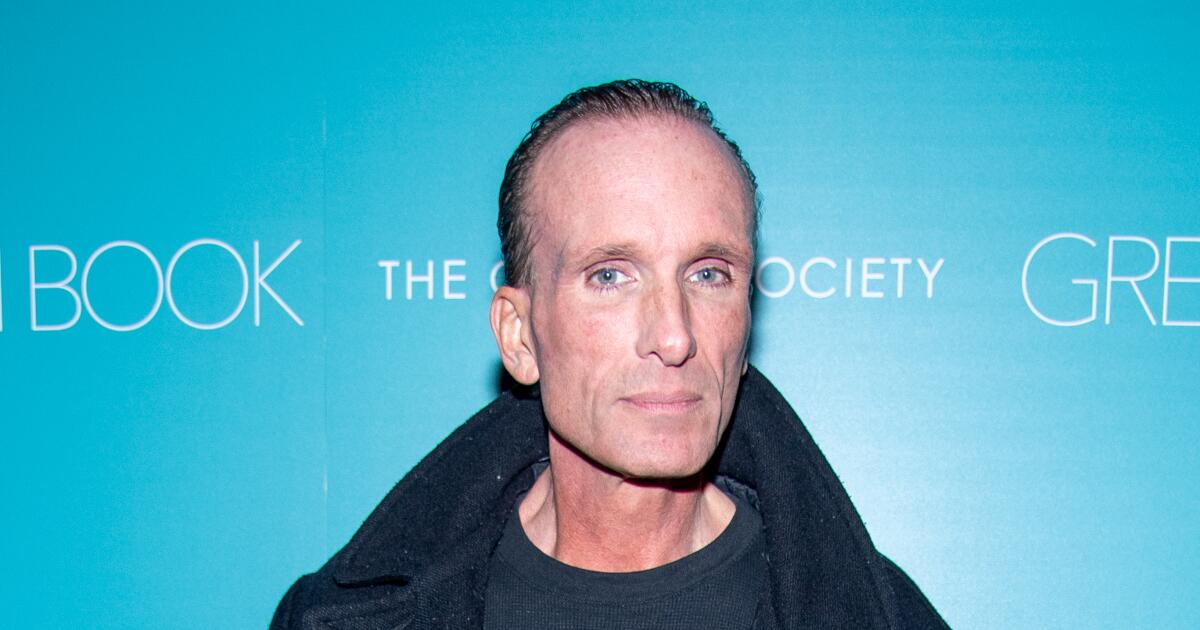
The cause of death for Peter Greene, a character actor known for playing villains in movies including “Pulp Fiction” and “The Mask,” has been revealed by New York City’s Office of Chief Medical Examiner.
Police found Greene, 60, dead in his apartment Dec. 12. They didn’t suspect foul play.
His death was ruled an accident, the M.E.’s office said via email. Greene died from a “gunshot wound of left axilla with injury of brachial artery,” the office said. In everyday English, that means he shot himself in his left underarm and injured a significant artery that starts in the shoulder and runs down to the elbow crease.
Police found the character actor in his Lower East Side apartment, Deadline reported, after neighbors heard Christmas music playing for days and one of them called authorities and the landlord for a wellness check.
Greene had a history of addiction, per the New York Post, and attempted suicide in the 1990s. He was scheduled to go in for a procedure to remove a benign tumor near his lung on the day he was found, the outlet said. His manager had talked to him two days before he was found.
“He sounded OK … It was just a totally normal conversation. He was a little nervous about the operation going in, but he said it wasn’t super serious,” manager Gregg Edwards told the Post in December. “He was talking about that and hoping that I was going to be OK and wishing me well as I was wishing him well. We’re good friends. I love the guy.”
Greene’s best-known role was the villain Zed, who was brought in to torture Bruce Willis and Ving Rhames’ characters in Quentin Tarantino’s 1994 classic “Pulp Fiction.” In “The Mask,” also released in 1994, he played mobster Dorian Tyrell, antagonist to Jim Carrey’s Stanley Ipkiss, a.k.a. the Mask.
Those roles came only a couple of years into Greene’s career, which per IMDb included nearly 100 TV and film credits from 1990 to 2026. His TV credits included episodes of “Chicago P.D.,” “Hawaii Five-0,” “Law & Order,” “Justified” and more.
He started out with parts in a couple of TV shows in the early 1990s before landing the lead role in “Laws of Gravity.” In 1995, Times movie critic Kenneth Turan called the 1992 film “independent American filmmaking at its best” and described Jimmy (Greene) as “a small-time street outlaw who, though horrified at the thought of actual work, is stable by local standards” in Brooklyn’s then crime-ridden Greenpoint neighborhood.
The New Jersey native, born Oct. 8, 1965, studied Method acting at the Lee Strasberg Theatre & Film Institute in New York City when he was in his 20s. He told Premiere magazine in 1996 that he ran away from home at age 15 and lived on the streets, using and dealing drugs and hiding from other dealers in theaters, where he got into acting. His drug use overlapped with his early success on screen.
After a 1996 suicide attempt, the actor said, he got treatment for addiction and sobered up.
A federal judge on Monday struck down a new California law that banned federal immigration agents and other law enforcement officers from wearing masks in the state, but an effort already is underway to revive the statute.
U.S. District Judge Christina A. Snyder in Los Angeles ruled that the No Secret Police Act does not apply equally to all law enforcement officers because it excludes state law enforcement, and therefore “unlawfully discriminates against federal officers.”
But, Snyder said, the ban does not impede federal officers from performing their federal functions, indicating that a revised law that remedies that discrimination may be constitutional.
State Sen. Scott Wiener (D-San Francisco), the author of the legislation, on Monday proposed a new prohibition on mask-wearing by all law enforcement officers in California, a change he argued would bring the ban into compliance with Snyder’s ruling.
Wiener said he will immediately file his updated bill in order to unmask U.S. Immigration and Customs Enforcement and other federal agents conducting unconstitutional enforcement in the state as soon as possible.
“We will unmask these thugs and hold them accountable. Full stop,” Wiener said, calling Snyder’s ruling a “huge win.”
Atty. Gen. Pam Bondi, who sued California to block the law from taking effect, cast the ruling in starkly different terms, as a win for the federal government and immigration agents doing a difficult job under intense scrutiny.
“ANOTHER key court victory thanks to our outstanding [Justice Department] attorneys,” Bondi wrote on X.
“Following our arguments, a district court in California BLOCKED the enforcement of a law that would have banned federal agents from wearing masks to protect their identities,” Bondi wrote. “These federal agents are harassed, doxxed, obstructed, and attacked on a regular basis just for doing their jobs.”
Wiener helped push two new California laws last year — the No Secret Police Act and the No Vigilantes Act — in the wake of intense and aggressive immigration enforcement by masked ICE and other federal agents in California and around the country.
The No Secret Police Act banned local law enforcement officers, officers from other states and federal law enforcement personnel from wearing masks except in specific circumstances — such as in tactical, SWAT or undercover operations. It did not apply those restrictions on California’s state law enforcement officers.
The No Vigilantes Act required any law enforcement officer operating in California to visibly display identification, including the name of their agency and their name or badge number, except in undercover and other specific scenarios.
Gov. Gavin Newsom signed the measures into law in September, though the state agreed to not enforce the measures against federal agents in the state while the Justice Department’s challenge was heard in court.
In her ruling Monday, Snyder blocked only the ban on masking by federal agents, and on seemingly narrow grounds.
Snyder said that the court “finds that federal officers can perform their federal functions without wearing masks. However, because the No Secret Police Act, as presently enacted, does not apply equally to all law enforcement officers in the state, it unlawfully discriminates against federal officers.”
“Because such discrimination violates the Supremacy Clause, the Court is constrained to enjoin the facial covering prohibition,” she wrote.
Weiner said it was “hard to overstate how important this ruling is for our efforts to ensure full accountability for ICE and Border Patrol’s terror campaign.”
Wiener said he and colleagues had crafted the No Secret Police Act in consultation with constitutional law experts, but had “removed state police from the bill” based on conversations with Newsom’s office.
“Now that the Court has made clear that state officers must be included, I am immediately introducing new legislation to include state officers,” Wiener said. “I will do everything in my power to expedite passage of this adjustment to the No Secret Police Act.”
He said ICE and Customs and Border Protection officers were “covering their faces to maximize their terror campaign and to insulate themselves from accountability. We won’t let them get away with it.”
Wiener is also pushing new legislation — called the No Kings Act — that would allow people in California to sue federal agents for violating their rights. Democrats in Congress are also demanding that immigration agents stop wearing masks as a condition for extending Department of Homeland Security funding.
In response to Wiener’s suggestion that he had removed state officers from the bill based on conversations with the governor’s office, Newsom’s office posted on X that Wiener “rejected our proposed fixes to his bill” and “chose a different approach, and today the court found his approach unlawful.”
In a separate statement, Newsom hailed Snyder’s upholding the identification requirement for officers as “a clear win for the rule of law.”
“No badge and no name mean no accountability. California will keep standing up for civil rights and our democracy.”
Bondi said her office would continue defending federal agents from such state action.
“We will continue fighting and winning in court for President Trump’s law-and-order agenda — and we will ALWAYS have the backs of our great federal law enforcement officers,” she said.
WASHINGTON — Democrats are threatening to block funding for the Homeland Security Department when it expires in two weeks unless there are “dramatic changes” and “real accountability” for U.S. Immigration and Customs Enforcement and other law enforcement agencies carrying out President Trump’s campaign of federal immigration enforcement in Minnesota and across the country.
Congress is discussing potential new rules for ICE and U.S. Customs and Border Protection after officers shot and killed two people in Minneapolis in January. Senate Democratic leader Chuck Schumer and House Democratic leader Hakeem Jeffries reiterated their party’s demands on Wednesday, with Schumer telling reporters that Congress must “rein in ICE in very serious ways, and end the violence.”
Democrats are “drawing a line in the sand” as Republicans need their votes to continue the funding, Jeffries said.
The negotiations come amid some bipartisan sentiment that Congress should step in to de-escalate tensions over the enforcement operations that have rocked Minnesota and other states. But finding real agreement in such a short time will be difficult, if not “an impossibility,” Senate Majority Leader John Thune (R-S.D.) said Tuesday.
Trump last week agreed to a Democratic request that funding for Homeland Security be separated from a larger spending bill and extended at current levels for two weeks while the two parties discuss possible requirements for the federal agents. House Speaker Mike Johnson (R-La.) said this weekend that he was at the White House when Trump spoke with Schumer and that they were “on the path to get agreement.”
But it’s unclear whether the president or enough congressional Republicans will agree to any of the Democrats’ larger demands that the officers unmask and identify themselves, obtain judicial warrants in certain cases and work with local authorities, among other asks. Republicans have already pushed back.
And House GOP lawmakers are demanding that some of their own priorities be added to the Homeland Security spending bill, including legislation that would require proof of citizenship before Americans register to vote. Sen. Lindsey Graham of South Carolina and other Republican senators are pushing for restrictions on sanctuary cities that they say don’t do enough to crack down on illegal immigration. There’s no clear definition of sanctuary jurisdictions, but the term is generally applied to state and local governments that limit cooperation with federal immigration authorities.
It’s also uncertain whether Democrats who are furious over the Trump administration’s increasingly aggressive immigration enforcement operations would be willing to compromise.
“Republicans need to get serious,” Schumer, a New York Democrat, said, adding that they will propose “tough, strong legislation” in the next day.
A look at Democrats’ demands and what Republicans are saying about them:
Agreement on body cameras
Republicans say they are open to officer-worn body cameras, a change that was already in the underlying Homeland Security spending bill. Homeland Security Secretary Kristi Noem backed that up on Monday when she ordered body-worn cameras to be issued to every DHS officer on the ground in Minneapolis, including those from ICE. She said the policy would expand nationwide as funding becomes available.
The bill already directed $20 million to outfit immigration enforcement agents with body-worn cameras.
Gil Kerlikowske, who served as commissioner of U.S. Customs and Border Protection from 2014 to 2017, said that most agents are “very supportive” of cameras because they could help exonerate officers. But he added that complex questions remain, including when footage should be released and when cameras must be activated.
“When do you turn it on? And if you got into a problem and didn’t have it on, are you going to be disciplined? It’s really pretty complex,” he said.
Schumer said Tuesday that the body cameras “need to stay on.”
Disagreement on masking
As videos and photos of aggressive immigration tactics and high-profile shootings circulate nationwide, agents covering their faces with masks has become a flash point. Democrats argue that removing the masks would increase accountability. Republicans warn it could expose agents to harassment and threats.
“State law enforcement, local folks don’t do it,” said Rep. Bennie Thompson, the top Democrat on the Committee for Homeland Security. “I mean, what’s so special about an ICE law enforcement agency that they have to wear a mask?”
But Republicans appear unlikely to agree.
“Unlike your local law enforcement in your hometown, ICE agents are being doxed and targeted. We have evidence of that,” Johnson said on Tuesday. He added that if you “unmask them and you put all their identifying information on their uniform, they will obviously be targeted.”
Immigration officers are already required to identify themselves “as soon as it is practical and safe to do so,” according to federal regulations. ICE officials insist those rules are being followed.
Critics, however, question how closely officers adhere to the regulations.
“We just see routinely that that’s not happening,” said Nithya Nathan Pineau, a policy attorney with the Immigrant Legal Resource Center.
Judicial vs. administrative warrants
Democrats have also demanded stricter use of judicial warrants and an end to roving patrols of agents who are targeting people in the streets and in their homes. Schumer said Tuesday that they want “arrest warrants and an end to racial profiling.”
Most immigration arrests are carried out under administrative warrants, internal documents issued by immigration authorities that authorize the arrest of a specific person but do not permit officers to forcibly enter private homes or other nonpublic spaces without consent. Traditionally, only warrants signed by judges carry that authority.
But an internal ICE memo obtained by the Associated Press last month authorizes ICE officers to use force to enter a residence based solely on a more narrow administrative warrant to arrest someone with a final order of removal, a move that advocates say collides with 4th Amendment protections.
Democrats have not made clear how broadly they want judicial warrants used. Jeffries of New York said that Democrats want to see “an end to the targeting of sensitive locations like houses of worship, schools and hospitals.”
Johnson said Tuesday that Democrats are trying to “add an entirely new layer” by seeking warrants signed by a judge rather than the administrative warrants that are signed by the department. “We can’t do that,” he said.
The speaker has said that an end to roving patrols is a potential area of agreement, but he did not give details.
Code of conduct and more accountability
Democrats have also called for a uniform code of conduct for all ICE and federal agents similar to that for state and local law enforcement officers.
Federal officials blocked state investigators from accessing evidence after Renee Good was shot and killed by an ICE agent on Jan. 7. Gov. Tim Walz, a Democrat, demanded that the state be allowed to take part, saying that it would be “very difficult for Minnesotans” to accept that an investigation excluding the state could be fair.
Hoping for a miracle
Any deal Democrats strike on the Department of Homeland Security is unlikely to satisfy everyone in the party. Rep. Ayanna Pressley of Massachusetts said she would never support an agreement that didn’t require unmasking.
“I ran for Congress in 2018 on abolish ICE,” Pressley said. “My position has not changed.”
Thune, of South Dakota, has repeatedly said it’s an “impossibility” to negotiate and pass something so complicated in two weeks. He said any talks should be between Democrats and Trump.
“I don’t think it’s very realistic,” Thune said Tuesday about finding quick agreement. “But there’s always miracles, right?”
Jalonick and Cappelletti write for the Associated Press. AP writer Rebecca Santana contributed to this report.
This article contains spoilers for Part 1 of Season 4 of “Bridgerton.”
Luke Thompson and Yerin Ha are lounging on a blue velvet couch in a swanky green room inside of Netflix’s offices in New York, bracing for the whirlwind that inevitably envelops every pair of actors who become the central couple in a season of the popular romance drama “Bridgerton.” And they’re still settling into the idea of being romantic leads.
“It doesn’t feel real,” Ha says fresh into their first press day in early December. “Because for a very long time, I didn’t think that it was possible for me — maybe I should have dreamed bigger. To keep saying that I’m the lead of a season feels really bizarre.”
“But maybe that’s a way of coping with it,” Thompson says. “I remember in Season 1, I just finished a Zoom call and I just sat in my living room and it was the first time I really touched into the idea that millions of people are watching this thing. Millions of people. And I never did it again.”
“You just did it for me now,” Ha says with a smidgen of dread that launches the pair into laughter. “That’s not really helping.”
Thompson, though, isn’t feeling the pressure of keeping the romance alive and extremely meme-able as they take up the mantle of the Regency-era fairy tale.
“It’s a show that’s proven time and time again that there’s huge appetite for romance,” he says. “It was a genre that might have been, not looked down on, but not really taken very seriously. To be able to incarnate some projection of romance for people, particularly in January and February, when people are feeling a bit miserable, maybe, it’s lovely to be part of that.”
The duo play Benedict and Sophie, affectionately dubbed #Benophie, a couple whose story gives the classic Cinderella tale a bit of steam and is one that readers of Julia Quinn’s “An Offer From a Gentleman,” which inspired this season, know well. Thompson’s Benedict, whom “Bridgerton” viewers have come to know as the artistic, pansexual second-oldest son of the Bridgerton clan, has long shown disinterest in settling down or adhering to societal norms. But then in Part 1 of Season 4, released Thursday, he meets Sophie Baek, a maid in her abusive stepmother’s home, at a masquerade ball hosted by his mother. Viewers eventually learn Sophie’s servitude is forced after her parentage is revealed — she’s the illegitimate daughter of an earl.
Yerin Ha as Sophie Baek and Luke Thompson as Benedict Bridgerton during their masquerade ball meet-cute in Season 4.
(Liam Daniel / Netflix)
Showrunner Jess Brownell says this season, they were is interested in prodding the wish-fulfillment fantasy many of us were introduced to at a young age.
“We learn about them as children from Disney movies,” she says. “For us, though, in interacting with this trope, it was really important to interrogate it a little bit. I think what our interrogation hopefully reveals is that oftentimes it’s the prince figure or the man of a ‘higher station’ who … needs to do some work on himself, to step out of his fantasy life a little bit and step more into reality to be worthy of the love of a Cinderella-type. It’s not to say that the Sophie character doesn’t have her own journey to go on, I think that she absolutely has to let her walls down and has to allow herself to dream of and believe in the possibility of love.”
Over a video call from that cozy couch inside Netflix’s offices, Thompson and Ha discussed navigating the spotlight as the newest “Bridgerton” couple, this season’s very unromantic declaration of love and trying to capture a swoon-worthy meet-cute behind an oversized mask.
The excitement for this season is already in full effect. How are you feeling about Benophie as the couple name? Am I even pronouncing it right?
Thompson: I don’t know!
Ha: I think that is right. I initially said Ben-off-ee like Banoffee pie, but then I realized it wouldn’t make sense because it’s So-fee. So Ben-o-fee would make more sense.
Thompson: There’s been a couple of fun AI pictures.
Ha: I actually just got one yesterday from my mom about our kids, our future kids. [Thompson laughs.] And I was like, “Mom, why are you on the internet looking at these things?” So it’s really out there, and I’m really being fed it out of my own will, but it’s amazing to see people already so excited about it and wanting to create things and future possibilities. It’s quite amazing. And the fans are actually so lovely.
Thompson: I think that’s one of the best things about social media, actually; that whole aspect of people projecting or imagining themselves or creating stuff sometimes. That’s something that we never used to be able to really get a handle on, but to be able to see the amount of energy and thought that people put into it is kind of amazing.
Ha: Also creative artistry. So many fans are drawing, sketching. It’s incredible. The amount of talent that people just share with us, it’s really beautiful.
1
2
3
4
1.The “Bridgerton” couples over the seasons: Simon Basset (Regé-Jean Page) and Daphne Bridgerton (Phoebe Dynevor) in Season 1.2.Kate Sharma (Simone Ashley) and Anthony Bridgerton (Jonathan Bailey) in Season 2.3.Colin Bridgerton (Luke Newton) and Penelope Featherington (Nicola Coughlan) in Season 3.4.Benedict Bridgerton (Luke Thompson) and Sophie Baek (Yerin Ha) in Season 4.(Liam Daniel / Netflix)
Luke, you’ve had three seasons to observe how others have taken on this mantle. Did Jonathan or Luke impart any words of wisdom as you stepped into lead duties? Did you have any observations in watching them navigate the spotlight and the intensity of this?
They were always very, very open to offering advice — Regé[-Jean Page, who led the first season as Simon Bassett, the Duke of Hastings], as well; all three of them. That’s been really, really helpful to know that it’s there. In terms of observing them, that’s why I’ve had a bit of a lucky ride, really, because I got to watch them. I mean this in a positive way — Regé is very serious. There’s something about the nature of the show that could encourage you to be a bit more light about it, but I think he really took it very seriously. Johnny [Jonathan Bailey, who plays Anthony Bridgerton] has this amazing energy that’s extremely contagious. I watched that and how that affects the atmosphere on set. And then Luke [Newton, who plays Colin Bridgerton] is very sensitive and he’s very careful and clued in terms of how and when he expresses himself. I’m so lucky I got to watch all of them do it and admire them and think about them and think also about how it would work for me.
What about you, Yerin? You’re a newcomer to this fictional world being thrown into the deep end. Did you get any useful feedback from Nicola Coughlan or Simone Ashley?
I didn’t have the years of looking at the other leads actually experience it. But Nicola and Simone, from the get-go when I was cast, they offered to give me advice and be like, “We’re here for you if you need it.” But the thing about it is, everyone is so different and unique with what they actually struggle with and what is going to be their challenge. I didn’t really know what I wanted advice about, but it was just always so nice and supportive to know that they were there if I needed them. But also, Luke, who was my main scene partner, was in “Bridgerton” for years, so I was able to also lean on him and also the other fellow castmates if I felt insecure or if I didn’t really know how to go about things.
Luke Thompson on “Bridgerton”: “It’s a show that’s proven time and time again that there’s huge appetite for romance,” he says. “To be able to incarnate some projection of romance for people, particularly in January and February, when people are feeling a bit miserable, maybe, it’s lovely to be part of that.”
(Tyler Twins / For The Times)
This being “Bridgerton,” the chemistry between Benedict and Sophie is so crucial to the magic of their story and how it develops over time. Tell me about the chemistry read. What do you remember about meeting each other?
Thompson: It was like this.
Ha: You’re third wheeling with us.
Thompson: It was on Zoom.
Ha: I was in Korea. It was 11 p.m. and I was trying to manage my nerves the entire day, which was quite stressful. And then I logged on, you [Thompson] were there. You had a striped shirt on, I remember — quite vividly, actually. I said that he looked quite tired. Maybe it was me projecting, thinking that he was having lots of auditions, reading with lots of people by then.
Thompson: I’m trying to think how many; we hadn’t auditioned that many people because it’s a very particular part. What we were asking or looking for was fairly particular. That’s the other thing I thought: How are we going to be able to do a chemistry read on Zoom? With all the awkwardness of doing it on Zoom — having to pretend that you’re turning your back and there’s a lake and having to sort of mime in front of the camera is so, so cheesy — despite all of that, I just remember reading scenes with you and feeling very relaxed. You know it when you see it. As soon as the Zoom call ended, I told you, Tom Verica [an executive producer and a director of the series] was a bit teary, and we were like, “Well, obviously it’s her.”
Ha: Obviously the stakes are so high on my end, because he’s already in the show, so I was so focused on just trying to be present and not trying to force anything. I think that’s when it gets a little bit weird. I just remember looking at you in the screen, and Luke’s such an open person anyways, and so it was quite easy to do the scene, despite that there was lots of interjections in the audition scene that we had to do, but we just pushed through.
What were the scenes that you had to do together that day? The lake scene —
Thompson: The lake scene and the tea scene. Just two.
In Season 4, viewers know Sophie (Yerin Ha) is the lady whom Benedict (Luke Thompson) meets at the masquerade ball, but he hasn’t connected the dots when they meet again later.
(Liam Daniel / Netflix)
In the world of romance, how two characters meet is often as important as how they get together. And the masquerade ball holds a lot of excitement and expectations for fans of the book. How did you feel tackling that scene? Did the masks help alleviate any nerves?
Ha: For me, it was a bit more pressure in the sense that my mask is so big [Thompson laughs], it’s hard to actually be quite expressive when your cheekbones are hidden under this mask. I just remember sometimes Tom would be like, “You got to express more with your eyes and your lips.”
Thompson: It’s basically like you were wearing a paper bag.
Ha: Yes! So, that was a challenge, but also, in a way, sometimes masks make you feel a little bit invincible … Sophie, especially in that night, the mask makes her brave and courageous; when she takes off the physical mask, that’s when the metaphorical mask actually comes into play.
Thompson: You’re right. The mask thing is integral to how they both meet. They even talk about it when they’re on the gazebo, the terrace; they have that whole scene where it is all about asking questions, not answering questions. To Benedict, [with] Sophie you’re constantly like, “Is she in earnest? Does she actually not know how to dance? Is she joking that she doesn’t know how to dance? Is she playing the role of someone?” There’s so many different questions about it — and I think that’s what’s so romantic about it. It’s so recognizable because that’s always what love at first sight is. It’s not that in that moment, two people completely see each other; there’s a game that starts happening. It’s all about what they allow the other to see or not, and sometimes there’s these really nice bits where they keep missing each other. There’s that amazing bit … when she’s spying through the door, and then just as she leaves, Benedict looks. It’s the pattern of their relationship, it’s how it’s always been — and it starts in this amazing little dream.
I imagine there was there a lot of discussions on what these masks should look like?
Ha: Yes. The costume team are incredible; they had, like, five different versions of it. Some of it was just completely covering my face with material. And then they were like, “Maybe not.” Because obviously Benedict sees her later as Sophie, and so why doesn’t he recognize her? They had to play this really fine line. But they are so creative and quick to change and adapt and bring in new designs. It turned out really beautifully.
Thompson: One of my fears actually reading the book was, “Oh, is it going to seem a little silly [that] Benedict doesn’t recognize her?” But actually, it’s so ornate, the mask is such a thing. When I since watched the episodes, I was like, yeah, I buy that he can see and feel something. He just can’t put it together.
Yerin Ha on becoming a leading lady in “Bridgerton”: “It doesn’t feel real,” she says. “Because for a very long time, I didn’t think that it was possible for me — maybe I should have dreamed bigger.”
(Tyler Twins / For The Times)
Yerin, our first glimpse of you as Sophie was as she’s putting on the mask — she’s a mystery to both Benedict and the viewers in that first episode, but we come to learn her story, which has echoes of Cinderella. What excited you about Sophie?
Ha: The thing for me is Sophie’s character and morals; it’s the fact that despite all the obstacles and the challenges, she’s still able to lead and live the world with a really caring heart. She’s still witty and she still has a bit of humor to her. But to be honest with you, the thing for me that I really connected with Sophie was her journey and discovery into self-love and knowing that she’s also deserving of it. That’s something I, at least, talk about a lot with my friends — and what does self-love look like and feel like and mean to me? I learned a lot through Sophie, as well, and knowing that it’s who you decide to bring into your life. Love is not just in someone, it’s about the people in the community that you created.
Benedict’s sexuality, his fluidity, has been something the writers have explored in building his overall arc. How will that be discussed or addressed as his relationship with Sophie develops?
Thompson: It’s a tricky one, right? Benedict is quite striking as a character — I can understand why people see all sorts of identities and words that would apply to him in a modern context. A lot of particularly male sexuality, generally, can be portrayed in quite a box-y, angsty way — where it’s like, “Oh, you’re either gay or you’re straight, or this or that.” What’s nice about a character is that it’s a unique construction. It’s not a representation of any particular experience. It seems like, for him, his sexuality isn’t necessarily a big determiner of his identity; it is a symptom of him wanting to explore. He’s curious and he’s open. I guess what I’m trying to say is, if you’re truly open, that means you can form a connection with anyone. You could argue that it’s a force that has kept him, so far, at least, in a relentless chase for freedom and dodging the falling in love part, and I think I’m more interested in that.
About that — let’s get into his misguided declaration of love at the end of Part I. You read the books, you knew it was coming. It was the moment we‘ve come to expect from this show — until the last line where he asks her to be his mistress. How did you decide to play that moment?
Thompson: It is contextual, historically. There’s that scene in the Gentleman’s Club where, clearly, he can see that there are people who have that arrangement and do love each other. But I also think that’s a cop-out. That’s maybe trying to soften what is essentially Benedict’s main flaw. He’s been shown to be caring in many ways. But I also think the problem with someone like that is, if you’re charming to everyone, how can you develop something specific with one person? All of his front makes it very difficult for him to fall for someone, and to really engage and really commit to someone. Him saying that thing can be seen as him trying to have his cake and eat it — like, I’m going to splice the sort of fantasy I’ve got and the real world, and just mash it together and that will work.
He’s a bit blind. Season 4 is about his blindness, literally, in terms of recognizing her, but also that he can’t see that that wouldn’t be a perfect solution. He is maybe a bit blind about it and doesn’t necessarily consider how that might feel for Sophie. I would also say that he doesn’t have the information he needs from Sophie at that stage about being the lady in silver, which is an interesting tension. It’s fascinating because it’s a really dumb move from a character that you wouldn’t necessarily think would come from a character like that, but actually, to me, it makes complete sense that it would come from him. Benedict’s dad died very early, so he has an image of a loving relationship as something pretty terrifying, so you can understand why he’d want to avoid that, or want to find his way to escape the real commitment … but also have his cake.
Yerin, how did you feel about it?
Ha: I was so disappointed. I remember when we were doing the scene, I did actually feel genuinely angry. Benedict lives more in the fantasy realm, and Sophie definitely lives in more of the reality realm, but in that moment, it’s almost like she’s getting drunk on his words. She’s almost imagining as if there’s going to be a proposal, even though she knows that back in those days, that wouldn’t even really work. But she’s hoping and dreaming. But the minute he says that, she wakes up and she realizes, “Actually, this can never be”; her walls are back up. It almost takes her back to a place of her childhood and how she feels as a kid … It brings a lot of trauma back for her. I just remember doing that scene and feeling like I wanted to slap Benedict.
Thompson: We should have tried it. One take. I think people would have loved that.
At the end of Part 1, Thompson’s and Ha’s characters share a declaration of love gone wrong: “I remember when we were doing the scene, I did actually feel genuinely angry,” Ha says.
(Tyler Twins / For The Times)
Did you work with an intimacy coordinator for that scene? How was it to film that first moment of intimacy between the characters?
Ha: It was really hot on the set — literally, metaphorically. It was hot. It was the candles, and the air traveled up and it was a tiny, narrow set. But Lizzie, our intimacy coordinator, she is the best, she is incredible. There’s different ways that you can kind of go about it, where it’s paint by numbers or a blueprint, and just find your way to like A, B and C, which is more the vibe that we went through. She’s so amazing in the energy and space that she creates. She guides us and listens to each of us and what we need and how to make it maybe look a little bit nicer or rougher or whatever it is. I really lean on her as an intimacy coordinator, and felt very safe in those scenes because it is quite vulnerable and exposing.
Thompson: It was a security blanket, isn’t it? It’s just nice having someone to monitor it, so you’re not just stuck, just you two, or you and the director, who sometimes, in my previous … experience, directors are often quite embarrassed about those scenes, which drives me mad because I’m like, “You’re not the one that has to do this.” It’s all about trust. It’s very important to have that person there to facilitate and to have an outside eye on it because what feels good doesn’t necessarily look good. You need to have them choreographed because the actors can only really relate from the inside out, so they don’t know what stories being told outside.
This season’s story has hints of “Cinderella” in it. Did you channel any classic romance heroes, heroines or stories as you prepped?
Thompson: The masquerade ball made me think about Romeo and Juliet a lot. It’s Romeo and Juliet-coded, the way they meet and just going off somewhere private. I don’t think consciously, I thought about that, but when we were doing it, it really brought that into my head.
Ha: I guess because it’s the constant “Cinderella” nod, I really relied heavily on “Cinderella.” It does veer off from the “Cinderella” story. And I do want to acknowledge that it’s a starting point, not the actual plot line. She was my favorite princess growing up. I had a full dress with a Cinderella icon on it. I would wear that every second day.
Thompson: That’s so sweet.
Ha: I just wanted to meet my prince.
The first half ends with Benedict and Sophie at a crossroads, an impasse.
Thompson: Benedict and Sophie meet in dream scenarios. They meet in the masquerade ball, which is Sophie’s dream. Then they meet in [Benedict’s] cottage, which is sort of Benedict’s dream place. Then in [Episode] 4, they have to go back to the ton and the real world. It’s a struggle that everyone knows very well, when you fall for someone, and there’s the honeymoon period where you’re spinning this story together. Then it’s like, how do you deal with the real world, and how do you deal with getting bored with each other or getting angry with one another? It’ll be interesting to see how they find each other again.
Ha: Even reading the scripts, I was like, how are they going to make this work, especially acknowledging the class difference as well, nobility and her being a servant. Fans will really want to see how it all plays out. When society tells you can’t be with someone, what are you going to do about it? Are you going to surrender to that or are you going to fight for it? That’s going to be the journey for Part 2.
With any fandom, parasocial relationships form. There’s an attachment and shipping of fictional characters, but it can sometimes extend to the actors outside of the characters. How do you navigate that?
Ha: I think we’re just being us. What’s really lovely about Luke is that I have so much love for him as a human being, but I can’t control what people project and I can’t control what people will think and create a narrative and story. But I know my truth, and I know that I respect Luke as a human, as an actor, as a colleague, as a friend. We’re very professional, but we’re also good friends.
Thompson: That’s right. It’s nice to have stuff projected on you — that’s the joy of being an actor. You want people to look at you, want them to get lost in some idea of you. My point of view is always to absolutely welcome that and also say, but I don’t have to set the record straight for anyone. It’s their show. Even when I meet fans in the street, I don’t really think, “Oh, they’re coming for me.” They’re seeing the show. It’s a slightly overused word, but it is just about getting those boundaries straight in your head. You can’t really enjoy the attention that you get from fans because you think it’s coming for you. But actually, if you’ve got that nice boundary, you get to enjoy the attention from the fans.