‘The Gray House’ review: An uninspired Civil War drama
“The Gray House,” a limited series now streaming on Prime Video, purports to tell the fact-based story of Elizabeth Van Lew, who spied for the Union in the Civil War while living in the midst of Southern society in Richmond, Va. And in very broad terms it does, though it fills up the space within those outlines with an army of imagined details and melodramatic plots and subplots.
It is not the first work for the screen that betrays history by attempting to make it more exciting than it already is, and if you go in ready not to wonder or care what did or did not actually happen, and which characters are real or invented, you may make out alright. (If you do care, there is Gerri Willis’ 2025 volume “Lincoln’s Lady Spymaster: The Untold Story of the Abolitionist Southern Belle Who Helped Win the Civil War.”)
So I will not ring a bell every time the miniseries, which admittedly bills itself as “inspired by a true story,” diverts from the record, even though in my head it may be clanging.
It’s July 4, 1860, nine months before the beginning of the Civil War. Elizabeth (Daisy Head) lives in a mansion in Richmond with her mother Eliza (Mary-Louise Parker), and the two are throwing a party. Guests, including the historical Swedish novelist and social reformer Fredrika Bremer (Oxana Moravec), congressman Sherrard Clemens (Ionut Grama), Virginia Gov. Henry Wise (Mark Perry) and his awful son Obie (Blake Patrick Anderson), unload expository dialogue and provide a primer for anyone not acquainted with the roots of the Civil War. Meanwhile, a runaway slave shows up out back, pursued by hounds, having heard that the Van Lew house is the place to run for help. The women, who are against secession and for abolition but are practiced in the art of deceiving their neighbors, are involved with the Underground Railroad in some way that’s not exactly clear.
Among their servants — the Van Lew slaves were (secretly) freed upon the death of Elizabeth’s father — are head porter Isham, played by Ben Vereen, who it is a pure pleasure to see back on screen, and Mary Jane (Amethyst Davis). A well-educated, determined young woman who is just back from Liberia, which did not suit her — she calls it a “tricky little way of ridding America of free Blacks” — the series gives her a lot of agency and makes her a virtual partner in the spy ring. White and Black, they live as much like a family as is possible when some people are labor and others are management and it’s the antebellum, then the wartime South.
Also involved in Elizabeth’s tradecraft are Scottish baker Thomas McNiven (Christopher McDonald) and Clara Parish (Hannah James), a beautiful prostitute who dreams “of Bronte’s moors” and gets, of all things, a big musical number in an out-of-place Western saloon, like Marlene Dietrich in “Destry Rides Again.” (The saloon is a standing set at Castel Film Studios in Romania, where the production was based; their backlot Western street, too, makes an implausible appearance.)

Ben Vereen as Isham Worthy, a porter in the Van Lew home.
(Bogdan Merlusca/Prime Video)
Out of the loop are Elizabeth’s brother, John (Ewan Miller), whose heart is in the right place, but who’s married to Laurette (Catherine Hannay), whose heart is not. An avaricious, envious flirt on the undisguised lookout for something better, she is angry that John wouldn’t use slave labor to build their house. She’s Scarlett O’Hara, minus the intelligence and charm.
Calling roll on the enemy, we find present Confederate President Jefferson Davis (Sam Trammell), in whose house — the eponymous Gray House — Mary Jane will be embedded, with a cocked ear and a photographic memory, to gather intel; Secretary of War (and then State) Judah P. Benjamin (Rob Morrow), who has a thing for Clara, to whom he opines on property rights while they share a bathtub; and a pip-squeak John Wilkes Booth (Charles Craddock), popping in and out no reason, unless it’s to foreshadow the death of Lincoln (who makes a rearview cameo), or just because everybody’s heard of him. Below them, but more in the action, are the nasty, thuggish Sheriff Stokely Reeves (Paul Anderson) and slave hunter Bully Lumpkin (Robert Knepper); and while thuggery and violence were endemic in a racist South, caricature and cliche do your history lesson no favors, however valuable it is.
Because Hollywood hates, let’s call it a love vacuum when it comes to screen heroines, Elizabeth will find herself the object of not one, not two, but (at least) three admirers, who prize her brains and spirit and talent for conversation. (She is no frilly, fizzy, fuzzy Southern belle, like the mean girls around her sister-in-law.) There is Hamton Arsenault (Colin Morgan), a sort of Rhett Butler lite, visiting from New Orleans with a huge live alligator, because I guess that’s something you could manage in 1860 just to make a splash at a party a thousand miles away. Capt. William Lounsbury (Colin O’Donoghue) is a dashing Union officer, escaping a Confederate prison, who passes through the Van Lew house on the way to freedom; they click together like Legos. Finally, there’s shy puppy dog Erasmus Ross (Joshua McGuire), who works at the Van Lew’s hardware store and will later have a post at a prison for captured Union soldiers, which the Van Lews will turn to their advantage.
“The Gray House” isn’t all bad, and its intentions are good, but it’s dramatically predictable and at eight episodes, some over an hour, goes on much, much longer than it needs to, letting scenes play out past profitability and wasting time on extraneous subplots involving minor characters — and minor minor characters — that do nothing to enrich the fabric of the show. A duel between two characters with no significant connection to the rest of the story exists here seemingly just because their historical counterparts did fight one, and gives the filmmakers the chance to add a duel — on horseback, like jousting with guns — to the show.
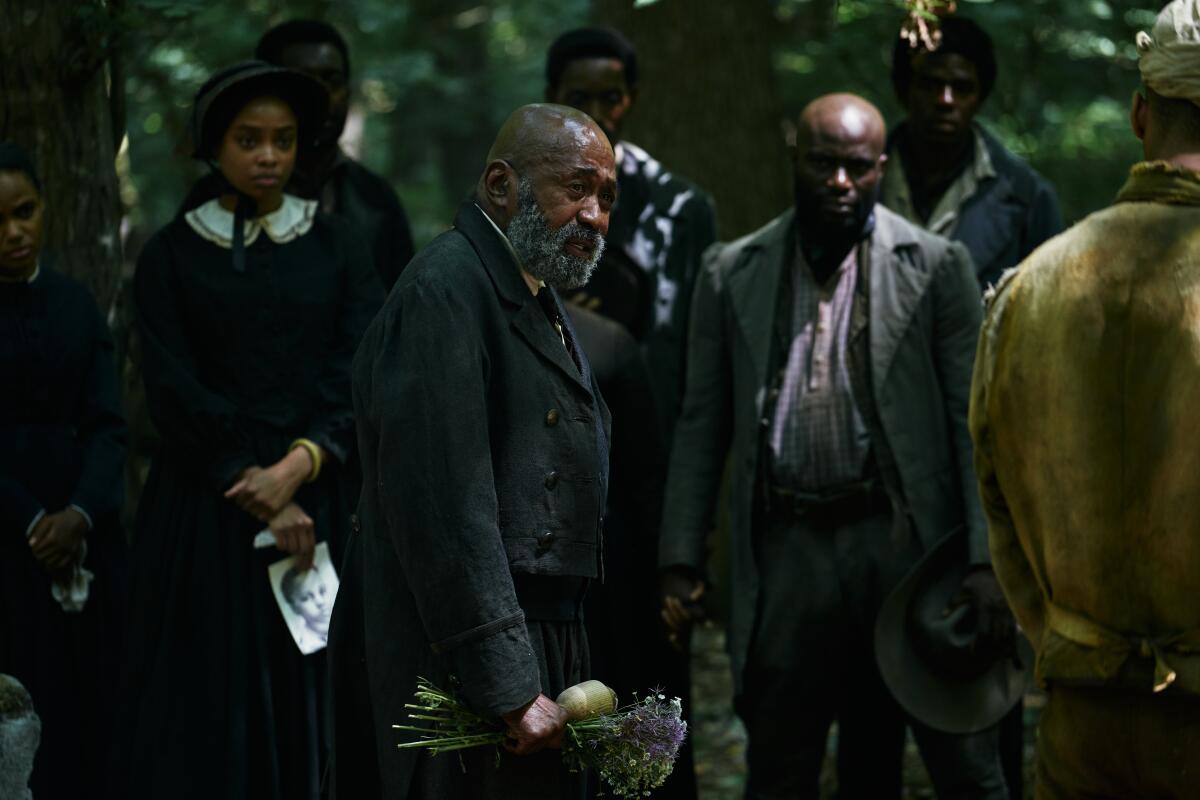
Parker is always fine, though the part requires a bit too much Southern breathiness. Davis and Head make strong impressions, masking the pedestrian, sometimes cornball dialogue. (The miniseries was written by Leslie Greif and Darrell Fetty, who collaborated on “Hatfields & McCoys”, with an undiscernable assist from John Sayles.) Keith David, who plays real-life activist minister Henry H. Garnet, gives a seven-minute speech on education as if he’s performing a Shakespearean monologue, after which he faces down a murderous sheriff like he’s Shaft. It’s a high point of the series, and the one scene I was happy to see go long.
Directed by Roland Joffé, who four decades ago was Oscar-nominated for “The Killing Fields” and “The Mission,” the production is a mixed bag; much care has been lavished on the costumes; the crowd scenes are well populated; printed material is done really well. (It matters.) Battle scenes — including Bull Run, where picnicking tourists are accurately shown in attendance — are convincingly rendered. But Romania, whether on or off the studio lot, only occasionally musters a decent impression of 19th century Virginia, reminding you, as “The Gray House” often does, that this is only a movie.