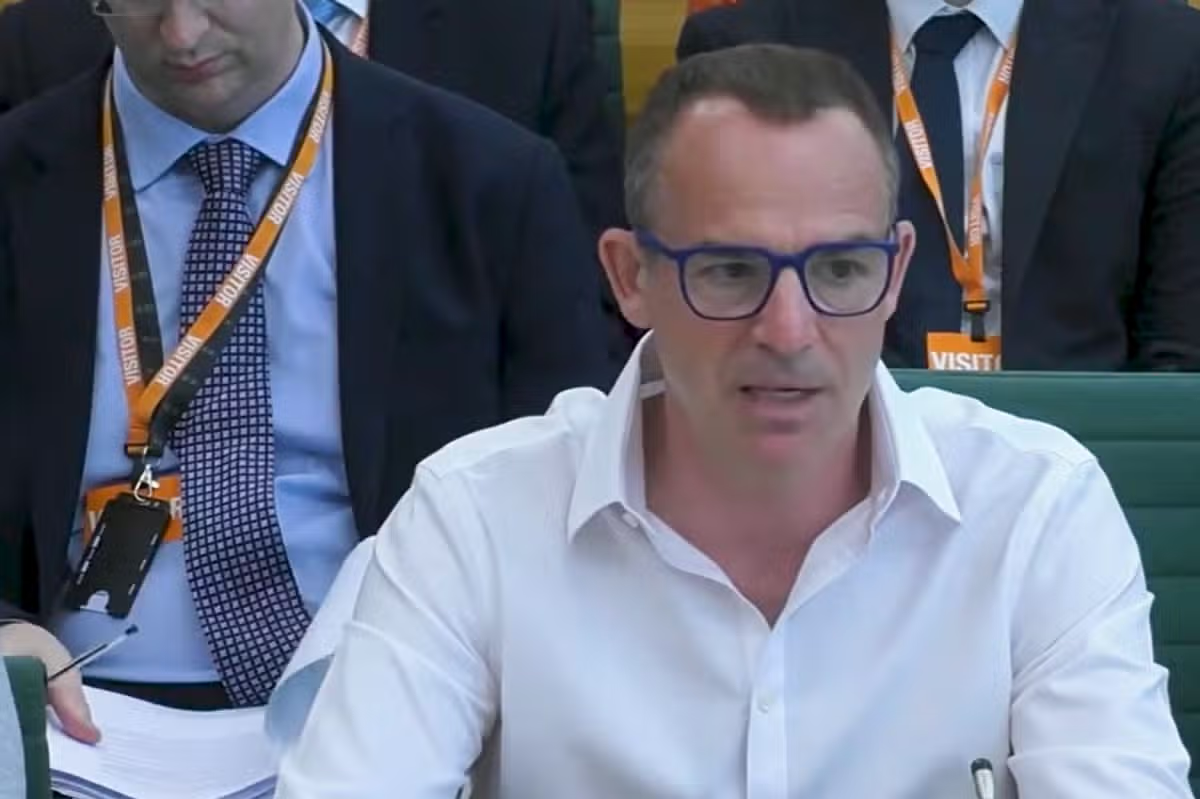
Martin Lewis

Martin Lewis says anyone going on holiday should keep five items in their wallet

The finance expert has said these could help make travelling much smoother

Martin Lewis has said that Brits going abroad should have up to five essential items in their dedicated ‘holiday wallet’. These important items could make travelling much easier, and in some cases, cheaper, through one simple money-saving technique.

According to the Money Saving Expert (MSE) website, founded by Martin Lewis, he has previously suggested that people set aside a separate wallet or purse for use only when abroad. He recommends keeping five items inside at all times, even when you get back to the UK, to make future holidays ‘easier’.

The financial broadcaster calls this his ‘overseas wallet or purse‘, and he has followed this advice for decades. In the 2013 blog post, the ITV regular said: “I genuinely have a second wallet I pick up when I go abroad. Not to better match my overseas shoes, but as a MoneySaving arsenal to ensure that when I am away, I get more bang for my buck.”

Starting with some of the most common and relevant to the average traveller. Martin suggested that this wallet should have a specific bank card for overseas use.

He said: “Everyone who regularly travels abroad should hold a specialist overseas credit card. This isn’t about borrowing, it’s simply an easy vehicle to get the best exchange rates in every country.

“Spending abroad on most plastic should be avoided. While banks and building societies themselves get the nigh-on perfect Visa/Mastercard wholesale rate, they then add a 3% load to what they charge us.” If you can’t get a credit card or don’t want one, prepay cards are effectively an electronic traveller’s cheque.

Martin wrote: “Load it up with cash in advance and use it while away. If you lose it, no problem, pay a replacement fee and the cash is re-credited.”

If you frequent the same country or region often, cash leftover from previous trips. Although it can be tempting to swap anything back into pounds straight away, it could be a welcome surprise for future trips – whether that be a few months, a year or more later.

If people are often travelling in European countries, such as Spain, France, Italy, and Greece, it might be worth keeping a UK Global Health Insurance Card (GHIC) in their travel wallet for emergency medical care . It is free on the official NHS site and lets UK travellers access state-run healthcare in EU countries and Switzerland for certain medical costs, often at the same price locals pay.

These cards don’t replace travel insurance, which you’ll need for things such as cancellations, private hospitals or repatriation. Check the expiry date at the bottom right of your card now, as many could be travelling with expired cards.

For anyone who drives abroad, keep your original driving license handy (and remember to swap it out of any physical travel wallets before packing them away). Martin said: “As well as the obvious car hire advantages, it’s also useful as ID, which is often demanded when paying by card.”

For those planning to drive outside the European Union, it’s either recommended or compulsory in 140 countries to have an International Driving Permit as well as your UK licence. The AA has a country-by-country guide to what’s needed here.

When travelling further afield, and over to the United States, a copy of your ESTA (Electronic System for Travel Authorisation) number will be handy to keep close. An ESTA lasts for two years, or until your passport expires, whichever comes first. Once it runs out, you’ll need to apply for a new one.

Although you don’t need to present the reference number at Border Protection when you land in the US, print or screenshot it and bring it to the airport. That’s because some airlines may require it at check-in, so check with yours.

Martin also said: “My wallet’s also packed with unspent small euro and dollar notes. After all, why pay to change back £30 or £40 of foreign currency? Leave it sitting for next time.” Martin also recommends keeping a photocopy of your passport. He said: “Just in case my passport goes missing, the key details can be very useful.”

Source link

‘Millions’ of Brits are overpaying for passports

The team at Money Saving Expert shared simple steps to take to get the best price for a new passport

Brits have been urged to follow some simple steps to ensure they get the best price for an essential travel document. According to experts, “millions” of people could have overpaid for their passports.

A passport is required for travel abroad. In the UK they are valid for 10 years for an adult, or five years for those under 16.

When your passport is due to expire, it is important you apply for a new one ahead of time, to ensure you don’t risk having to cancel a holiday. However, you may not realise that the way in which you apply for a new passport can affect the price.

Addressing this issue, the team at Money Saving Expert (MSE) said on its website : “Millions of Brits applying for a passport last year may have been able to save money by taking their own photo or applying online, MoneySavingExpert.com can reveal. If your passport’s due for renewal, here’s how to get it for less.”

The three main steps to remember are:

  • Apply online rather than via post
  • Take your own photo
  • Renew before fees rise on April 8

Applying online

MSE said: “Currently, it’s £12.50 cheaper to apply for a passport online through GOV.UK instead of using a paper form. Of course, this isn’t an option for those excluded from, or who struggle to use, digital services – though if this is the case, you may want to consider the Post Office’s ‘Check & Send’ service.”

Check & Send is an optional extra that costs £16 on top of the standard passport fee.

Take your own photo

MSE continued: “If it’s been a while since you last applied for a passport, you may be surprised to learn that you can now take your passport photo yourself at home and upload it directly into your online application. This means you don’t need to shell out for photos taken at high-street shops or photo booths, which can typically cost between £5 and £13ish.”

Here are some pointers to help you get your photo right first time:

  • You can use your smartphone – just make sure the photo is clear, in focus and in colour
  • Take it against a plain, light background. The photo should include your head, shoulders and upper body, with no other people or objects in the frame
  • Avoid editing or altering it. It will be cropped for you during the application process, so there’s no need to do that yourself

Renew before fees rise

Passport fees will rise on Wednesday, April 8. This is how much they will rise by:

  • Adult: takes up to three weeks to arrive – online cost now – £94.50, online cost from April 8 – £102, postal cost now – £107, postal cost from April 8 – £115.50
  • Adult fast-track – arrives one week after appointment – online cost now – £178, online cost after April 8 – £178
  • Adult ‘Premium’ – given at the appointment – online cost now – £222, online cost after April 8 – £239.50
  • Child – takes up to three weeks to arrive – online cost now – £61.50, online cost after April 8 – £66.50, postal cost now – £74, postal cost after April 8 – £80
  • Child fast-track – arrives one week after appointment – online cost now – £145, online cost after April 8 – £145

For full details and to renew online visit GOV.UK here.

Source link

MSE Martin Lewis urges holidaymakers follow rule ‘right now’

The MSE team and Martin Lewis said to do this quickly

If you’re planning a holiday this year, there’s one crucial item on your checklist that should be ticked off first before you begin planning where to go and what to wear.

The Money Saving Expert (MSE) News team and Martin Lewis have emphasised the importance of securing travel insurance as soon as possible after booking a holiday. Many people tend to leave it until the last minute, but as Martin Lewis recently explained on The Martin Lewis Money Show Live, without insurance, you may not be able to recoup your costs if something prevents you from travelling, potentially losing thousands.

According to MSE, during the show, Martin Lewis said: “Travel insurance is not just to cover you while you’re away. It’s also very important to cover you in case something happens before you go that stops you going.

“I have a rule: you should get your travel insurance ASAB – as soon as you book. ASAB.”

The financial expert added: “Right now, many people have already booked. If you don’t have your travel insurance and if your holiday’s booked, do it right now.

“The reason I do this is every year, someone asks me a question something like, ‘I’ve been diagnosed with cancer. We can’t go on the holiday. They’re saying we can’t have our money back. What do I do?’ And I’m impotent.

“Because the answer is, you get on your travel insurance. And they say, ‘Well, I haven’t got my travel insurance yet’. Do not get your travel insurance the day before you go. You get your travel insurance ASAB.”

Speaking to his co-host Jeanette Kwakye, who is also a former Olympic sprinter, she revealed that a viewer had contacted the programme regarding a difficult predicament they were facing.

Jeanette shared their message, reading: “I booked a holiday for Christmas last year, but I was then medically advised not to fly. The holiday was already paid for and I hadn’t taken out any travel insurance. I’m now being told I’ve lost all the money for the holiday. Is there anything that can be done?”

READ MORE: Travel expert Simon Calder issues Spain airport strike updateREAD MORE: Simon Calder predicts Easter ‘disruption’ with millions set to travel

Martin said: “Please don’t be the person this summer who asks me that question. If you’re going to get travel insurance, ASAB.

“The answer [to whether something can be done] is no. I mean, look, very simply, just think about it for a second. If you bought a tennis racket and you broke your arm, you can’t say to them, I want a refund because my arm’s broken.

“The tennis racket still works. The flights still work, the hotel still works. It’s not them that’s got the problem. It’s you. That’s the logic. That’s what you have insurance for.”

Foreign Office and travel insurance

While you can take out travel insurance, it is worth noting that it could be invalidated, even if you take it out when you book. For example, if you are planning on heading to Dubai, the Foreign Office has said on its GOV.UK website: “Your travel insurance could be invalidated if you travel against advice from the Foreign, Commonwealth & Development Office (FCDO).”

At present, it states: “FCDO advises against all but essential travel to United Arab Emirates.”

For detailed information and advice on Foreign travel insurance, visit the GOV.UK website online here. It also advises: “You should buy your travel insurance as soon as possible after booking your trip. Read the small print and familiarise yourself with any exclusion clauses for the policy.”

Alongside insurance, it is recommended that you review FCDO travel advice and register for alerts for your destination. GOV.UK confirms: “If you travel to a destination where FCDO advises against all but essential travel or all travel, your insurance may be invalidated.”

Source link

Martin Lewis issues ‘check now’ passport warning ahead of April 8

Money Saving Expert Martin Lewis urged Brits to check if they need to renew passports now

Brits have been urged to “check now” or face being hit by costly passport fees come April. Next month is set to bring a hike in passport charges.

At present, a standard adult passport costs £94.50 when applying online. However, this is due to increase to £102 from 8th April. The price of a child’s passport will also climb from £61.50 to £66.50.

In an update on his Money Saving Expert (MSE) website, Martin Lewis implored people to check whether they require a new passport now, in order to sidestep the forthcoming fee increases. He said: “Rising by up to £17.50. 8 April.

Check NOW if yours is due for renewal, there’s still time to get the lower rate.” Additional guidance on securing the best deal was also published elsewhere on MSE.

“If you need a new passport, it’s cheapest to apply online,” MSE said. “The only site you’ll ever need to go to is the GOV.UK website.

“It has options for getting your first passport, renewing an old one or getting one for your child. You can apply online, which is the cheapest option, or by paper at the Post Office.

“Last year, over seven million Brits saved by applying online.”

READ MORE: I used new EU airport entry system and it left me worried for summer travellersREAD MORE: HM Passport office warns Brits ‘you may not be able to travel’

How much are passport fees rising?

  • Adult: takes up to three weeks to arrive – online cost now – £94.50, online cost from April 8 – £102, postal cost now – £107, postal cost from April 8 – £115.50
  • Adult fast-track – arrives one week after appointment – online cost now – £178, online cost after April 8 – £178
  • Adult ‘Premium’ – given at the appointment – online cost now – £222, online cost after April 8 – £239.50 Child – takes up to three weeks to arrive – online cost now – £61.50, online cost after April 8 – £66.50, postal cost now – £74, postal cost after April 8 – £80
  • Child fast-track – arrives one week after appointment – online cost now – £145, online cost after April 8 – £145

It’s worth noting that there’s no child equivalent one-day service. Also, for all these types, you can pay £12 extra for a 54-page passport, which is “useful” for frequent travellers.

The Government website also cautions that no refund will be issued should you cancel your application or if you’re not entitled to a passport.

Burgundy passport

If you’re still in possession of a burgundy passport, there’s no need to panic – you won’t be required to renew it until closer to its expiry date, as they remain perfectly valid. MSE added: “Got a burgundy passport? Newly-issued UK passports have a blue cover, but you DON’T need to get a new passport straightaway – you can keep using your burgundy passport until it’s due for renewal. The blue passports will only be issued when you renew or apply for a new passport.

“Passports can take up to three weeks to be processed, so apply early. The Passport Office warns that renewing can take three weeks for both online and postal applications, so don’t leave it too late if you’re planning a trip.

“If you need a passport urgently, you’ll need to book an appointment at a passport office and pay online. Alternatively, call HM Passport Office (HMPO) on 0300 222 0000 to book an appointment and pay.” Responding to the price increase, the Home Office released a statement saying: “The new fees will help the Home Office to continue to move towards a system that meets its costs through those who use it, reducing reliance on funding from general taxation. The Government does not make any profit from the cost of passport applications.

“The fees contribute to the cost of processing passport applications, consular support overseas, including for lost or stolen passports, and the cost of processing British citizens at UK borders.”

Source link

Martin Lewis issues alert to anyone with more than £11,000 in savings

Martin Lewis has explained the personal savings allowance and when basic rate taxpayers with over £22,000 in savings could pay tax on interest earned

Martin Lewis has issued a tax alert for savers, with a particular warning for those holding more than £11,000 or £22,000 in savings, depending on their tax bracket. On his ITV programme this week, Mr Lewis provided savers with guidance on structuring their savings to prevent unnecessary tax charges on interest.

He began by explaining the personal allowance, which permits anyone to earn £12,570 before any tax is levied. This threshold has remained frozen since 2021, and last November Chancellor Rachel Reeves controversially extended this freeze until 2031.

The freeze has faced criticism for creating ‘fiscal drag’, meaning more of the lowest earners in the country now pay tax as inflation and wage rises leave them with less disposable income whilst facing higher taxation.

On this he said: “The first one, the personal allowance, £12,570 a year that you can earn from any source, earnings, rent, savings, interest without paying tax on. Most people get that unless you start earning over £100,000 when it’s taken away.”

Starting Rate for Savings Tax.

Mr Lewis said: “The next one not that many people know about is called the starting rate for savings. This is another £5,000 of savings. savings interest you can earn a year on top of the personal allowance. And this is designed for people who have low work earnings but high interest on savings. Often people who are retired. And here’s how it works.

“For every pound of earnings you earn above this allowance, you lose a pound on your starting savings rate. So imagine you earn £13,570. You’re a £1,000 above that. You can now only have £4,000 of tax-free interest in your savings due to the starting savings rate. And by the time you earn from work £17,570, this is gone. So it’s only for people on low work earnings and high interest on savings.”

Content cannot be displayed without consent

He previously outlined that those in the ‘perfect circumstance’ would receive £12,570 from earned income. Mr Lewis explained the individual would then gain £5,000 through the starting savings allowance, plus £1,000 from the personal savings allowance on top ‘because they all go on top of each other’.

He added: “You could earn £18,570 a year tax-free with £12,570 of it coming from work or other sources, and another £6,000 of it coming from savings. I hope that makes sense. The main two for most people are the personal allowance and the personal savings allowance, but for those on lower incomes, it’s worth reading the starting savings allowance guide that’s our money saving expert just so you really understand it.”

Personal savings allowance

Mr Lewis described this as the ‘big one’ and said: “Next, we get the big one that many of you will know about, the personal savings allowance. And this is on top of those two. This is the fact that a basic rate taxpayer, 20% taxpayer, can earn £1,000 a year of interest in any form of savings at all without paying tax on it. Now, the top savings accounts at the moment pay about 4.5 per cent. So, you need about 22,000, just a little over £22,000 in the top savings account before you earned £1,000 interest.

“So, if you got less than that, you’re not going to be paying tax on your savings interest because it’s tax free. High rate tax because it’s within your personal savings allowance. High rate taxpayers pay £500 a year of interest they can make each year tax free. It’s about £11,000 saved at the top rate.

“If you’re an additional rate taxpayer earning over £125,000, you don’t get one of these. So, you got your personal allowance, your starting rate for savings, and on top of that up to another £1,000 in your personal savings allowance.”

For the 2025/26 tax year, the UK Personal Allowance stays at £12,570, with a 20% basic rate (up to £50,270), 40% higher rate (£50,271-£125,140), and 45% additional rate (over £125,140) applying to England, Wales, and Northern Ireland.

ISAs

Mr Lewis stated that this week’s show was focused on ISAs, explaining: “You can put up to £20,000 a tax year in, as you know. And crucially, the interest earned in a cash ISA does not count towards the personal allowance, does not count towards the starting rate of savings does not count towards the personal savings allowance. It is totally separate from that. So, anything you earn in there is not taxable. I should note premium bonds work roughly the same way, but it’s not an annual allowance. It’s a maximum £50,000 you can put in in total. Those are the main ways that you can save without paying tax on them.”

Source link