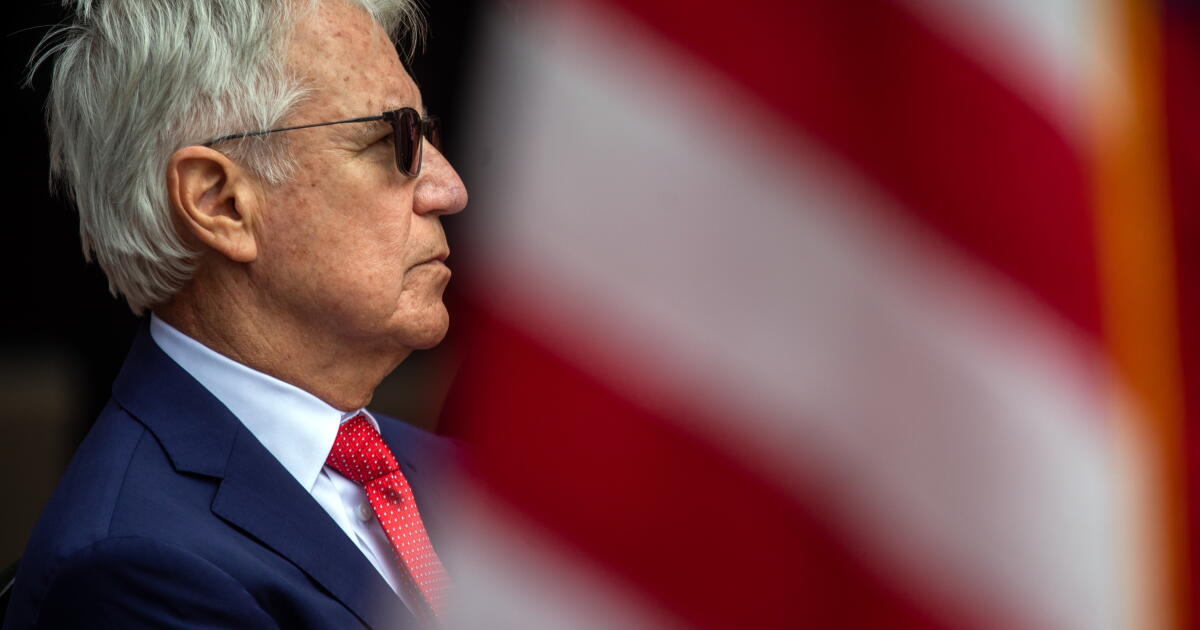
A political bogeyman has emerged in L.A.: Ousted D.A. George Gascón
A political advertisement released this summer claimed former L.A. County Dist. Atty. George Gascón “almost destroyed Los Angeles” and warned that, if elected as L.A.’s next city attorney, Marissa Roy will “do the same.”
Earlier this month, a seemingly out-of-nowhere rumor spread through City Hall and among rank-and-file cops that City Councilwoman Nithya Raman plans to name Gascón the city’s next police chief if she ousts Karen Bass in the mayoral contest.
Gascón told The Times last week he has no interest in the job and hasn’t spoken to Raman or her team. Raman has dismissed the rumor as a politically motivated lie started by the Los Angeles Police Protective League, the police union that supports Bass.
A spokesperson for the union said Raman’s allegation was “untrue”; Bass’ campaign also said it had nothing to do with the Gascón rumor.
Nevertheless, the claim has been amplified in a number of arenas in recent days. An article in the California Post raised the issue last week, but only cited the panic of anonymous police officers. The LAPD’s former top cop, Bill Bratton, signal boosted the issue in a tweet praising LAPD Chief Jim McDonnell, whose future could be in jeopardy if Raman wins.
Gascón declined to comment for this article, other than to shoot down the rumor that he could become LAPD chief.
After suffering a crushing defeat in his bid for reelection in 2024, Gascón all but disappeared from public life. He routinely declines interview requests and has receded from the leading role he once held in the nationwide progressive prosecutor movement.
But in the homestretch of the two most important contests on most Angelenos’ ballots this year, Gascón has been conjured as a bogeyman by opponents of progressive candidates. With polls showing Roy and Raman favored to win their respective races, political observers say the attempt to make Gascón relevant again may be a sign of panic from their opponents.
“At one point in time, Gascón clearly was box office poison and he may still be,” said Roy Behr, a Democratic consultant who isn’t involved in either race. “But this feels a lot like [President] Trump and the Republicans invoking Joe Biden’s name whenever they’re in trouble. In both cases, they’re clearly signs of desperation and not invoking any particular realistic possibilities.”
On Tuesday, billionaire developer and onetime mayoral candidate Rick Caruso said if Raman hired Gascón it would “take the city into a very dark place.”
“If you’re going to fire [Chief McDonnell], who are you going to appoint? Is it going to look like somebody like a Gascón?” Caruso asked. “Because I don’t think we need LAPD being a lab experiment for the [Democratic Socialists of L.A.] It’s going to take L.A. in the wrong direction.”
Caruso, who lost to Bass by nearly 10 points in the 2022 mayoral contest, has yet to offer an endorsement in this year’s race. But he has been publicly critical of Raman and invoked the Gascón police chief rumor at an event launching a new L.A. Department of Water and Power initiative. Bass was standing right next to him.
Gascón surged into office in 2020 amid nationwide demands for criminal justice reform after the murder of George Floyd by Minneapolis police. The former San Francisco district attorney and assistant LAPD chief promised to reduce mass incarceration and hold police accountable while also reducing crime. But his lone term in office was beset by turmoil.
Gascón instituted a number of unilateral policies on his first day in office — barring prosecutors from trying juveniles as adults, seeking the death penalty or charging certain misdemeanors — that left him at war with his own staff. A raft of lawsuits soon followed, as well as a battery of made-for-TV-news crimes that served as red meat to critics who wanted to blame Gascón’s reforms for violence. Crime went up early in his term, and although a Times analysis cast serious doubt on links between the spike and the district attorney’s policies, Gascón’s name became shorthand for labeling a politician as soft on crime.
Two attempts to recall Gascón from office failed. But after a bruising four years in office, current Dist. Atty. Nathan Hochman routed Gascón in 2024, effectively ending his political career.
In the city attorney’s race, L.A. County Deputy Dist. Atty. John McKinney has tried to draw a straight line between Gascón and Roy, insisting in one advertisement that she won’t prosecute misdemeanor crimes, including trespassing, theft and drug possession. The claim echoes Gascón’s blanket ban on prosecuting loitering, public intoxication and other minor drug offenses he believed played a role in criminalizing homelessness.
During the primary, text messages sent out in support of McKinney’s campaign also referred to City Atty. Hydee Feldstein Soto, a moderate, as a “Gascón-style” Democrat. Feldstein Soto never supported Gascón and endorsed one of his challengers in the 2024 primary.
Roy’s campaign declined to comment. She prefers using diversion programs to handle defendants suffering from mental illness or addiction issues, according to her campaign website, but hasn’t specifically said she’d ban deputy city attorneys from filing any particular case. She supported Gascón’s 2024 reelection bid and attended some of his rallies.
McKinney, whose shift from trial prosecutor to politician began when he became an outspoken critic of Gascón, also favors diversion for mentally ill and addicted defendants for nonviolent offenses and has referred to his platform as one of “compassionate accountability” toward unhoused defendants.
But, he stands by the comparison between Roy and Gascón.
“I think that when she talks about not prosecuting certain misdemeanors, it’s a blanket policy,” he said. “That’s very reminiscent of George Gascón.”
The invocation of the former district attorney in the mayor’s race is more complicated.
Bass and Gascón were known to have a frosty relationship. She didn’t support efforts to recall him in 2022, but she didn’t endorse her fellow Democrat’s reelection bid in 2024 either.
Raman never endorsed Gascón and the pair had “no relationship” while in office, according to two people with direct knowledge of their thinking who requested anonymity to discuss the matter candidly. In a tweet last week, she called the rumor about naming Gascón police chief a “bizarre lie.”
“This rumor was created by the Police Union Super PAC, which is spending millions of dollars to re-elect Mayor Bass,” Raman wrote.
In a statement, Raman said she would seek to remove McDonnell before his term ends in 2030, but did not mention any potential candidates for his replacement. She is seeking to remove McDonnell, in part, over the LAPD’s heavily criticized response to protests against the Trump administration’s immigration raids in L.A. last year, which saw officers trample people on horseback and deploy tear gas on citizens for the first time in decades. McDonnell, she says, has lost the trust of immigrant communities.
Tom Saggau, a spokesman for the police union, said the organization had nothing to do with the Gascón rumor. While the union is no friend to Roy, Raman or Gascón and has spent millions against all three candidates, Saggau said he first heard about the potential new police chief from a California Post reporter. None of the union’s members or directors had raised the issue beforehand, he said.
Still, in Saggau’s mind, perception trumps reality. He said there’s a reason people might believe Raman would pick a police chief who is considered persona non grata in law enforcement circles.
“Certainly they share some similar values when it comes to policing, especially on the prosecutorial side. Gascón was, I think it’s fair to say, lenient with some of his prosecutorial decisions,” Saggau said. “I think it’s her bouncing around on public safety items that has fed this rumor. … I think she’s just got a credibility issue when it comes to public safety.”
Times staff writers Itzel Luna and David Zahniser contributed to this report.