Nick Offerman is more than just his facial hair. For one thing, the actor made viewers weep with his Emmy-winning turn as Bill, a man who found unexpected love in “The Last of Us.”
Then again, Bill did have a great beard.
Fans who celebrated Ron Swanson and his mustache on “Parks and Recreation” have had much to enjoy with the two roles that earned Offerman Emmy nominations this year. As Chester A. Arthur, corrupt politician-turned-surprise president in Netflix’s limited series “Death by Lightning,” and retired professional wrestler and recovering addict Jinx in the Apple TV series “Margo’s Got Money Troubles,” he had two powerful redemption arcs to navigate. As well as some mighty coifs.
“I pride myself on that,” he deadpans. “It’s not something you can learn. I literally come by it honestly because it’s what Mother Nature provided me. Benedict Cumberbatch got the cheekbones and the nimble, articulate language tools. I got whiskers, and shoveling, and slow talking. We all get our things.”
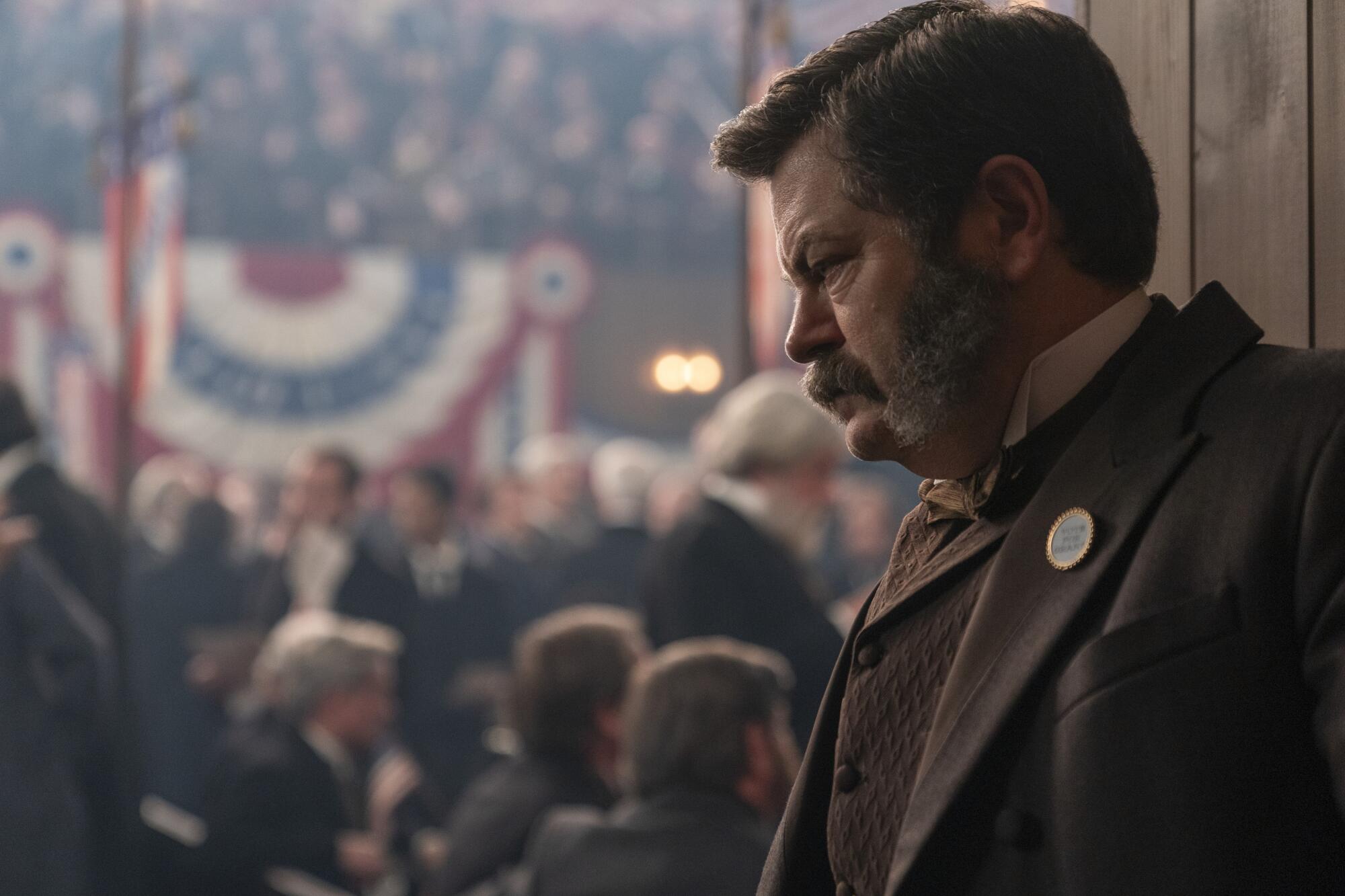
Nick Offerman as Chester A. Arthur in “Death By Lightning.”
(Larry Horricks/Netflix)
Speaking by video chat from the Goodman Theatre in Chicago, where he’s playing Eugene O’Neill opposite wife Megan Mullally’s Broadway diva in “Iceboy! The Musical,” Offerman is humble and erudite, poking fun at himself while praising colleagues. He is “sincerely gobsmacked” by the double nod. He is also fresh-faced, because he’s filming the Alex Garland film “Elden Ring” in London during his downtime. “Here is this meager little mustache that someone made me, and I glue it on every night,” he says, holding up two tiny hairy wings.
In contrast, Arthur’s mutton chops just won’t stop. “If a president is not thin and has facial hair, then it’s been suggested that I should play him,” Offerman says. “People send me all of them, you name it: McKinley, Harrison, Teddy Roosevelt.”
Of course, the actor goes beyond whiskers to create his roles. To play Arthur, he read “Destiny of the Republic” by historian Candice Millard, which the show is based on. He also read Scott Greenberger’s biography “The Unexpected President.”
But ultimately he found his character on the pages of creator Mike Makowsky’s scripts. “The incredible advantage of great writing is that they’ve answered a lot of the questions for you,” Offerman says, adding, “Makowsky told me that he had me in mind when he was writing it. Once you learn about Chester, you’re like, ‘That’s a mixed compliment.’”
Nick Offerman.
(Billy Delfs / For The Times)
He says working on “Death” was “exquisite,” likening the shoot to a camp for theater kids, delighting in the depth of talent in the cast, and recalling when he and star Michael Shannon, at the time performing plays together in Chicago, used to get up to youthful drunken shenanigans, “like climbing a building outside the L&L Tavern.”
Jinx would probably have enjoyed that in his early years. When we see him on “Margo,” he’s been brought low by pain, prescription drugs and a lost love (Michelle Pfeiffer), trying to make amends with his daughter Margo (Elle Fanning), who’s struggling with single parenthood.
“Jinx desperately wants to be a good guy, he wants to be a good dad, he wants to be a good lover,” says Offerman. “He wants to be the hero of any circumstance, but unfortunately he has these frailties that I know too well.”
Offerman trained for three months with bodybuilder Grant Roberts “to create the body of, thankfully, a former pro wrestler, so you don’t necessarily need terrific abs,” Offerman says. Then for three weeks during the shoot he worked with pro wrestler Chavo Guerrero Jr. “I’m a former fight choreographer for the stage, and I do my own stunts, so I’ve been waiting this whole time to play a swashbuckler. By the time we were done, I was flying off the top rope.”
The physical preparation helped him find his way into the role. “What I learned about pro wrestlers, who are incredibly generous and loving people, is that they are all hurt, all the time. They’re all performing through pain,” he notes. “So how can I summon everything I have to blow away this audience with superheroic energy, even though I’m just this dumb theater-school kid?”
Offerman with “Margo’s Got Money Troubles” co-stars Elle Fanning, center, and Michelle Pfeiffer.
(Apple TV)
Jinx’s look is also key to the portrayal. For present-day scenes, Offerman sports his own beard, with some color added. But for flashbacks, “they made my spray tan extra dark, gave me this gorgeous mane of hair and put some braids in my beard. I was just over the moon. People complain about three hours in the makeup chair. I don’t complain because someone is putting their masterpiece on my head. I have the tractor and the hay rack that they’re building their float on that’s going to win the Rose Bowl Parade. It’s such a privilege to get to drive their masterpiece around.”
He soon faced Fanning. “She’s such a badass professional. It was so fun because she inspires me to also be more flexible and creative.” He calls Pfeiffer “a cinematic Mt. Rushmore. That was very thrilling because I traditionally have not been cast as people who have heat with glamorous movie stars.” He giggles.
“I understand that I have value as a performer, but I still don’t get how I got this part,” he says, sounding a bit baffled. “This is the best part of my life. I’ve had some wonderful parts that I’m very grateful for, but I’ve never had scenes with such complicated emotional relationships.”
He adds a point that could apply to Chester Arthur as well. “It’s fun to be a protagonist who gets to indulge in human weakness, knowing that we hopefully will bring the audience back around to caring about you.”
Death, taxes and Jean Smart winning another Emmy are among life’s certainties.
But outside of the realm of the expected, what are we looking for when Emmy nominations arrive Wednesday?
I do have questions, namely:
Can two-time Emmy winner Zendaya earn a nod for “Euphoria,” a show that remained a ratings hit even if it seemed like people mostly watched to complain about it?
Might “Widow’s Bay,” television’s best new comedy, grab the momentum from “Hacks,” Smart’s Emmy-winning series that looked like it’d be taking a victory lap for its final season?
And, will voters stop encouraging Ryan Murphy or do we need to write another hundred think pieces about why “Love Story” felt so wrong?
For an Emmy season that looked more than a little underwhelming just a few weeks ago, those intrigues offer a wrinkle or two, something for us to chew on as we search for a candle that doubles as a receptacle for hot caramel sauce, as seen in the just-released final season of “The Bear” — a season that, because of its June release, won’t be eligible until 2027.
Meanwhile, here’s what we can look for this year.
Comedy series
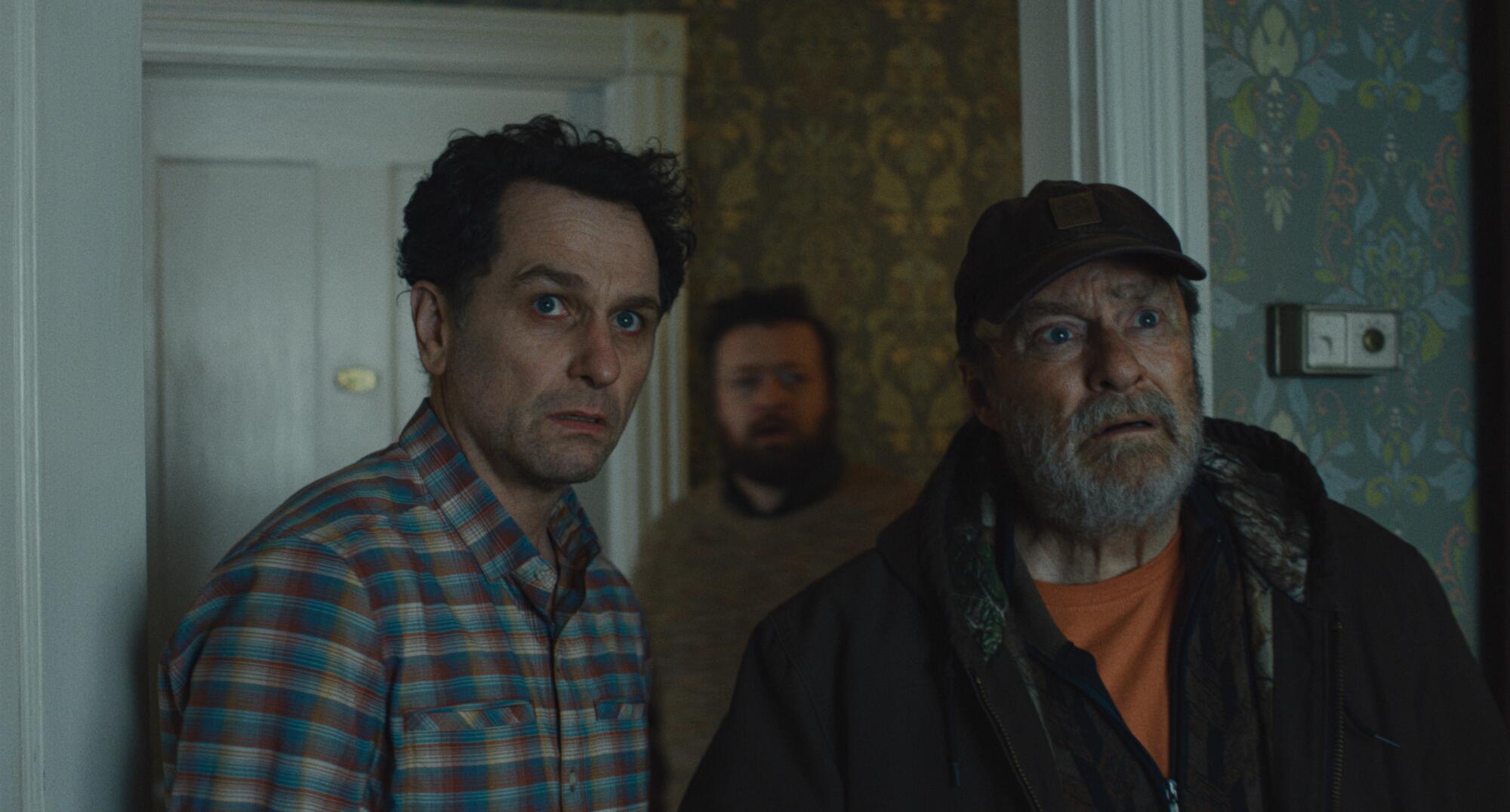
Matthew Rhys and Stephen Root in “Widow’s Bay.”
(Apple)
“Abbott Elementary” “The Bear” “The Comeback” “Hacks” “Margo’s Got Money Troubles” “Only Murders in the Building” “Shrinking” “Widow’s Bay”
Possible surprise: “Rooster” Possible snub: “The Bear”
Google “Widow’s Bay” and your first result will be: “Did you mean: the next Martha’s Vineyard and definitely not cursed.” It’s an inspired bit of marketing for a series that found the sweet spot between comedy and horror, making us shriek with laughter and revulsion, sometimes simultaneously.
The Apple TV series premiered on April 29, arriving so late that only seven of its 10 episodes are eligible for Emmy consideration. Apple had considered bumping it to October, so it could establish a beachhead with guild and Globes voters before competing at the 2027 Emmys, but decided to enter the fray this year to compete with shows that, while still favorites, are a bit past their prime.
The inaugural season of “Widow’s Bay” evolved as a classic slow burn, establishing the world of its cursed New England island with care and then burrowing into its characters and lore with the kind of detail that prompts full-blown obsession. The 811-song playlist that Patricia made for her Sunset Cocktails party? Who doesn’t have a spare 60 hours to listen? Mining the multitude of horror movie references that the show ingenuously employs? Of course! Something’s wrong with you if you didn’t rewatch “Jaws” after the episode where, out at sea, Stephen Root’s cantankerous Wyck has his own Captain QuintUSS Indianapolis monologue.
The question now: Did “Widow’s Bay” have enough time to hook Emmy voters? Or am I just so taken with this show, a series I myself came to late, that my enthusiasm is clouding my judgment? Short answer: “Widow’s Bay” may not get every nomination it deserves. (The late arrival makes its extraordinary season finale ineligible.) But I don’t think you can argue with perfection.
Comedy actress
Ayo Edebiri, left, with Liza Colon-Zayas in Season 4 of “The Bear.”
(FX)
Quinta Brunson, “Abbott Elementary” Ayo Edebiri, “The Bear” Elle Fanning, “Margo’s Got Money Troubles” Lisa Kudrow, “The Comeback” Jean Smart, “Hacks”
Possible surprise: Kristen Bell, “Nobody Wants This” Possible snub: Edebiri
Remember when the biggest Emmy question about “The Bear” revolved around whether it belonged in the comedy categories? Now, after a couple of seasons that tried viewers’ patience when it came to narrative momentum, it’s fair to wonder whether the series — and its cast — will continue to be nominated. In the absence of anything better and because the show, even when spinning its wheels, continues to offer much to enjoy, I think “The Bear” is safe for now. And its final season, which dropped after voting ended, reaffirms just how good the series and its stars can be when it’s cooking.
Comedy actor
Martin Short, right, with “Only Murders in the Building” co-stars Steve Martin and Selena Gomez.
(Patrick Harbron / Disney)
Steve Carell, “Rooster” Matthew Rhys, “Widow’s Bay” Jason Segel, “Shrinking” Martin Short, “Only Murders in the Building” Jeremy Allen White, “The Bear”
Possible surprise: Adam Brody, “Nobody Wants This” Possible snub: White
It’s worth remembering that “The Studio” won comedy series last year, and its co-creator, Seth Rogen, prevailed here. In its absence, this category is open for business, with Rhys, so good at shifting between his show’s droll humor and genuine terror, an obvious choice. Short figures to get a small boost from the Netflix documentary “Marty, Life Is Short,” which offers a moving look at the losses he has endured over the years and his inspiring endurance. Short has never won an acting Emmy and you know he’d give a great speech.
Comedy supporting actress
Kate O’Flynn in “Widow’s Bay.”
(Robert Clark / Apple TV)
Hannah Einbinder, “Hacks” Janelle James, “Abbott Elementary” Kate O’Flynn, “Widow’s Bay” Ashley Padilla, “Saturday Night Live” Michelle Pfeiffer, “Margo’s Got Money Troubles” Sheryl Lee Ralph, “Abbott Elementary” Jessica Williams, “Shrinking”
Possible surprise: K Callan, “Widow’s Bay” Possible snub: Padilla
Last note (I promise) on “Widow’s Bay.” Because its season finale aired after the May 31 eligibility deadline, K Callan’s showcase episode opposite Rhys isn’t eligible, though anyone who watched the series might be inclined to vote for the 90-year-old actor anyway. Dorothy’s walk down memory lane, filled with tantalizing stories (“He got bit by an animal and became that animal,” she says of an old boyfriend), Tennessee Williams stitch-quotes, existential wisdom and bombshell revelations, was pitch-perfect, one of the standout moments of the television year. (Another, of course, was Patricia’s Sunset Cocktails party, with a tour de force turn from O’Flynn.)
Comedy supporting actor
Harrison Ford, left, with Michael J. Fox in “Shrinking.”
(Kevin Estrada / Apple)
Paul W. Downs, “Hacks” Harrison Ford, “Shrinking” Ebon Moss-Bacharach, “The Bear” Nick Offerman, “Margo’s Got Money Troubles” Stephen Root, “Widow’s Bay” Michael Urie, “Shrinking” Tyler James Williams, “Abbott Elementary”
Possible surprise: Bowen Yang, “Saturday Night Live” Possible snub: Williams
Can we roll over last year’s “It’s time to give Harrison Ford an Emmy” campaign? Because it’s still time.
Drama series
Noah Wyle in “The Pitt.”
(Warrick Page / HBO Max)
“The Diplomat” “A Knight of the Seven Kingdoms” “Paradise” “The Pitt” “Pluribus” “Slow Horses” “Stranger Things” “Task”
Possible surprise: “The Testaments” Possible snub: “Stranger Things”
It’s hard to believe that “The Pitt” earned a mere 13 nominations for its first season, winning for series, casting and for actors Noah Wyle, Katherine LaNasa and Shawn Hatosy. Encore victories seem assured for all but Hatosy, who will bump from guest actor to supporting, where he’ll compete against castmate Patrick Ball, among others. “Pluribus” figures to score plenty of recognition too — it might even best “The Pitt” for most nominations. But its prognosis for victory would seem guarded at best.
Drama actress
Zendaya as Rue Bennett in “Euphoria.”
(Eddy Chen / HBO)
Kathy Bates, “Matlock” Carrie Coon, “The Gilded Age” Keri Russell, “The Diplomat” Rhea Seehorn, “Pluribus” Zendaya, “Euphoria”
Possible surprise: Chase Infiniti, “The Testaments” Possible snub: Bates
Zendaya won for the first two seasons of “Euphoria,” becoming the youngest person to win in 2020 and, two years later, the youngest actress to take two Emmys. So hate on her show all you want (seriously, go ahead, it was a mess), but voters will (rightfully) give her a pass. Winning another Emmy is off the table, though, making this a race between the gifted Seehorn, a perennial Emmy underachiever, and Russell, nominated five times as actor and still looking for her first trophy. How fun would it be if the Emmys turn into a reunion for “The Americans” with both Russell and Rhys winning?
Drama actor
Mark Ruffalo in “Task.”
(Peter Kramer / HBO)
Sterling K. Brown, “Paradise” Walton Goggins, “Fallout” Gary Oldman, “Slow Horses” Mark Ruffalo, “Task” Noah Wyle, “The Pitt”
Possible surprise: Jon Hamm, “Your Friends and Neighbors” Possible snub: Goggins
Brown, Oldman and Wyle were nominated last year, with Wyle winning. Ruffalo as the grief-stricken, alcoholic FBI agent in “Task” is an easy add. That leaves one spot, and it’ll probably go to a veteran actor — Goggins, Hamm, maybe Billy Bob Thornton for “Landman” — though Peter Claffey would be a better choice as the beloved gentle giant in “A Knight of the Seven Kingdoms.”
Drama supporting actress
Katherine LaNasa, left, and Sepideh Moafi in “The Pitt.”
(Warrick Page / HBO Max)
Isa Briones, “The Pitt” Taylor Dearden, “The Pitt” Allison Janney, “The Diplomat” Katherine LaNasa, “The Pitt” Sepideh Moafi, “The Pitt” Julianne Nicholson, “Paradise” Karolina Wydra, “Pluribus”
Possible surprise: Fiona Dourif, “The Pitt” Possible snub: Briones
Last year, “The White Lotus” accounted for four of the category’s nominees. In its absence, the women from “The Pitt” figure to equal that number and perhaps even surpass it, though it’s hard to see voters bypassing past favorites Janney and Nicholson or overlooking Wydra’s subtle work as the emotionless emissary of the alien hive mind in “Pluribus.” Then again, understated performances often go unrewarded. Just ask Wydra’s co-star Seehorn.
Drama supporting actor
Patrick Ball stars in Season 2 of “The Pitt.”
(HBO Max)
Patrick Ball, “The Pitt” Billy Crudup, “The Morning Show” Shawn Hatosy, “The Pitt” Gerran Howell, “The Pitt” Jack Lowden, “Slow Horses” Tom Pelphrey, “Task” Carlos-Manuel Vesga, “Pluribus”
Possible surprise: James Marsden, “Paradise” Possible snub: Vesga
Will we ever know what this category would look like if “Severance,” “The White Lotus” and “The Pitt” aired seasons during the same eligibility window? I’m not holding my breath. But with “Severance” and “The White Lotus” vacating six of the seven supporting actor slots from last year, there’s plenty of room for old favorites (Lowden, Crudup) and new (Vesga for his nonverbal brilliance in “Pluribus”) as well a trio of standouts from “The Pitt.”
Limited series
The cast of “Beef” Season 2.
(Netflix)
“The Beast in Me” “Beef” “DTF St. Louis” “Half Man” “Love Story”
Possible surprise: “All Her Fault” Possible snub: “Half Man”
It wasn’t exactly a banner year for limited series with only “Love Story” sparking cultural discourse — mostly for all the wrong reasons. Richard Gadd’s “Half Man” was provocative with its brutally violent look at male rage and unresolved trauma. But you can’t permeate the culture if viewers refuse to watch the second episode. That leaves “Beef,” Lee Sung Jin’s anthology series about enmity, envy and the multiple ways that blood orange juice can be made, as the presumptive front-runner. “DTF St. Louis,” the strange, affecting look at suburban loneliness, belongs at the head of the pack.
Limited series / TV movie actress
Sarah Pidgeon as Carolyn Bessette in “Love Story.”
(FX)
Claire Danes, “The Beast in Me” Sally Field, “Remarkably Bright Creatures” Carey Mulligan, “Beef” Sarah Pidgeon, “Love Story” Sarah Snook, “All Her Fault”
Possible surprise: Kerry Washington, “Imperfect Women” Possible snub: Field
Paul Anthony Kelly as John F. Kennedy Jr. in “Love Story.”
(FX)
Jason Bateman, “Black Rabbit” Charlie Hunnam, “Monster: The Ed Gein Story” Oscar Isaac, “Beef” Paul Anthony Kelly, “Love Story” Matthew Rhys, “The Beast in Me”
Possible surprise: Jamie Bell, “Half Man” Possible snub: Bateman
Linda Cardellini, “DTF St. Louis” Grace Gummer, “Love Story” Laurie Metcalf, “Monster: The Ed Gein Story” Cailee Spaeny, “Beef” Naomi Watts, “Love Story” Yuh-Jung Youn, “Beef”
Possible surprise: Constance Zimmer, “Love Story” Possible snub: Cardellini
Misplaced or otherwise, all the best performances from limited series are in supporting this year, including Spaeny’s scene-stealing schemer in “Beef” and Cardellini’s passive-aggressive perfection in “DTF: St. Louis.”
Limited series / TV movie supporting actor
Jason Bateman and David Harbour in “DTF St. Louis.”
(Tina Rowden)
Jonathan Banks, “The Beast in Me” Jason Bateman, “DTF St. Louis” Richard Gadd, “Half Man” David Harbour, “DTF St. Louis” Charles Melton, “Beef” Alessandro Nivola, “Love Story”
Possible surprise: Troy Kotsur, “Black Rabbit” Possible snub: Banks
And here you have Melton’s vulnerable people-pleaser trying his best to find the right color of Gatorade for Spaeny in “Beef” and unlikely BFFs Bateman and Harbour burrowing into the mind of the suburban American male in “DTF: St. Louis.”
Christa Miller, who plays consummate mother and opinionated neighbor Liz on “Shrinking,” has one piece of advice for parental dressing: Step away from the athleisure.
“You’re not going to feel confident in workout wear,” says Miller. She and the show’s costume designer, Allyson B. Fanger, are very intentional with Liz’s outfits, a master class in effortless yet accessible casual chic: Bold colors, layered tops, cheeky accessories and a liberal use of stripes. “The character totally could have been [in] Lululemon, but I didn’t want to fall into that trap.” Instead, Miller says they chose to spotlight Californian brands like Clare V, Jennifer Meyer, and fittingly, Mother, styled “a little off” for looks that have become so popular that Fanger created a LookLikeLiz hashtag on Instagram for fans.
Miller is just one of the stars pulling focus for their characters’ distinctive style on shows that are contenders in the Emmys race this year: Keke Palmer (“The ‘Burbs”), Sarah Snook (“All Her Fault”), Lucy Punch (“The Audacity”), Elle Fanning (“Margo’s Got Money Troubles”) and others all have fans buzzing about their fashion. And costume designers and style experts agree that the inspiration goes both ways.
“There was this expectation that once you became a mom, the attractive parts of you got set aside because you were just a mom,” says Shana Draugelis, founder and CEO of lifestyle and shopping website the Mom Edit, which recently ran a detailed feature on Liz’s wardrobe. “With the advent of Instagram, the whole style game has just completely leveled up.”
Liz’s looks, which Miller says are inspired by “Brentwood mom” style, reflect the character’s personality. “She’s not going to work, but she does want to have a certain element of presence,” says Fanger, who is a five-time Emmy nominee for her work on “Grace and Frankie.” “But there’s also a casual component to Los Angeles dressing. Mixing levels [of designers] lends itself to uniqueness, a strong point of view and a general coolness. You never look like you’re trying too hard.”
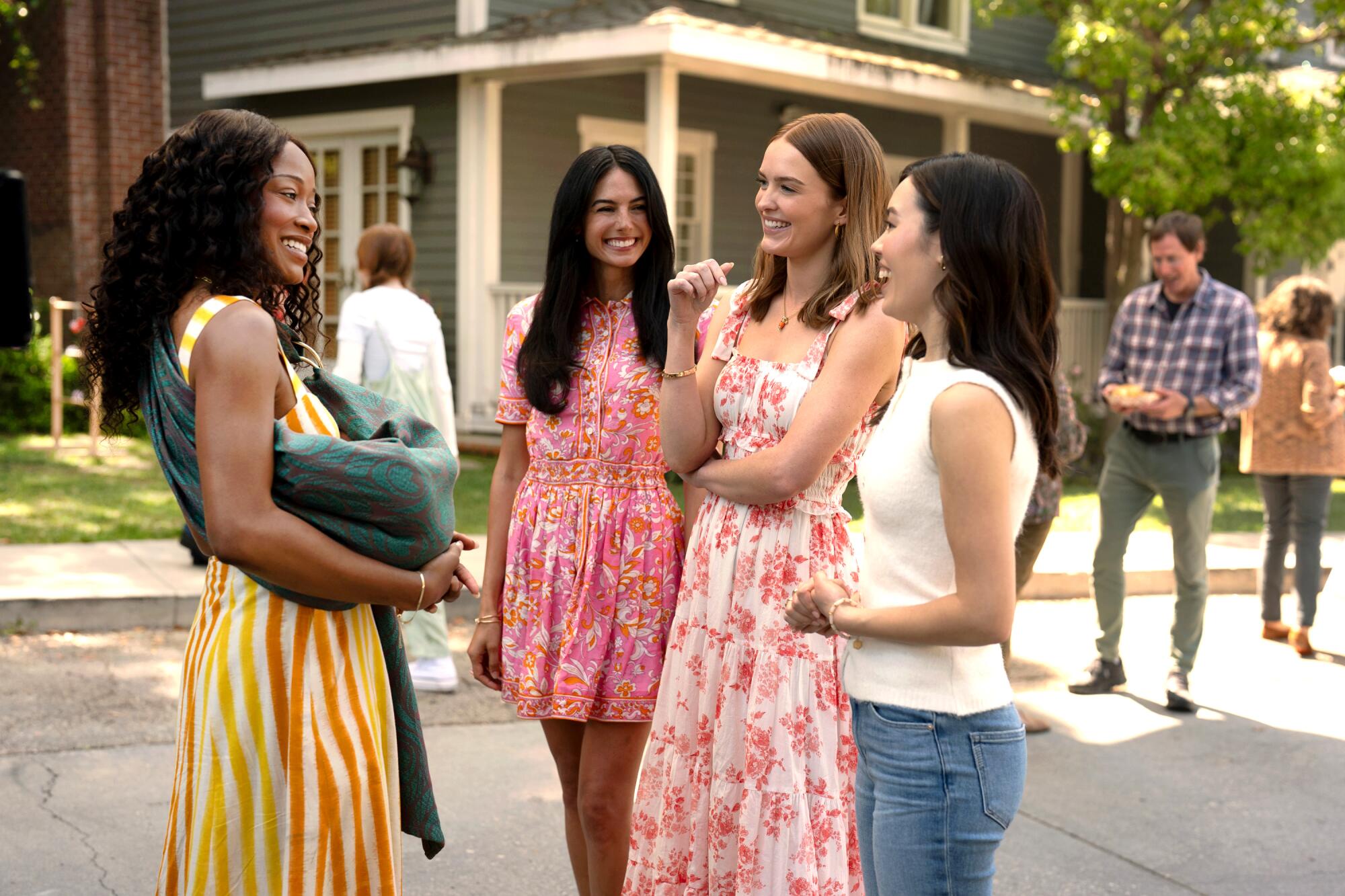
As Samira, a city native who moves to “The ’Burbs” with her husband and baby son, Keke Palmer stands out from the cul-de-sac crowd.
(Elizabeth Morris / Peacock)
Another character with a strong fashion POV is “The ‘Burbs” Samira (Palmer), a city girl and new mom who moves with her husband Rob (Jack Whitehall) and their baby son from the city to the idyllic (and fictional) Hinkley Hills. Clad in bright, slouchy-cool separates and statement accessories, Samira quickly makes a splash among her more blandly dressed neighbors.
“She’s the only Black woman in the neighborhood,” says the show’s costume designer, Trayce Gigi Field, who pulls quite a bit of, yes, Mother, but also likes to sprinkle in some lesser-known designers like Good ’Ol Whats-her-face jeans. She also paired Samira’s Howard University sweatshirt with biker shorts a la Princess Diana. “Showing her jewelry and her vibe and just having cooler clothes … it’s a great contrast to the other characters, except for Rob, [who] had the Black wife glow-up.”
Less brightly colored but no less interesting are Marissa (Snook) and Jenny (Dakota Fanning), who bond after the disappearance of Marissa’s son in an affluent Chicago neighborhood in “All Her Fault.” Their wardrobes are more subtle, yet show that there are different strata in the quiet luxury landscape. Publishing exec Jenny is well off, but nowhere near as wealthy as Marissa, who owns an accounting firm. (Perhaps not coatless “Succession” rich, but still.)
Sarah Snook, left, and Dakota Fanning connect as working moms in “All Her Fault,” albeit with subtle class distinctions between them.
(Sarah Enticknap / Peacock)
Costume designer Gypsy Taylor pulled “silks and beautiful fine wools and cashmeres” in warm toffee, chocolate and peachy tones by designers like Max Mara and Armani for Marissa, while Jenny “was a little bit more street: leather coats instead of cashmere. Or a beautiful J. Crew turtleneck as opposed to a Saks Fifth Avenue” one.
But perhaps the most amusing depiction was how Taylor contrasted the stay-at-home moms (and dads) with Marissa and Jenny, with most of the sartorial showdowns taking place during school pickups and dropoffs. “We just went hard yummy mummy on her,” says Taylor of PTA President Sarah Larsen (Melanie Vallejo). She used “too much Lululemon,” as well as Alo and PE Nation to round out the athleisure.
In “The Audacity,” Silicon Valley parents Duncan (Billy Magnussen) and Lili (Punch) portray a different kind of luxury, a casual minimalism that belies the residents’ mind-boggling net worth. “The focus is not so much showing off the wealth, but at least, you know, it’s still there,” says the show’s costume designer Farnaz Khaki-Sadigh. “So you see people like wearing a T-shirt, but it’s not your average T-shirt — more about the quality of the fabric than the designer name on it.”
As the wife of a tech magnate in “The Audacity,” Lucy Punch’s costumes tap into the ultra-minimalist luxury of Silicon Valley.
(Ed Araquel / AMC)
Finally, on the other side of the economic spectrum, there’s Margo (Elle Fanning) and her mother Shyanne (Michelle Pfeiffer) in “Margo’s Got Money Troubles.” When college student Margo unexpectedly becomes pregnant, Shyanne and Margo’s estranged father Jinx (Nick Offerman) step in; the series follows their struggle to support each other after baby Bodhi arrives.
Costume designer Mirren Gordon-Crozier says via email that her conversations with Fanning “centered around making Margo feel emotionally truthful rather than overly styled.” This meant vintage Levi’s, worn tees, thrift-store knits, “pieces that feel inherited or accumulated over time.” As for her mother, “Shyanne is much more performative. She understands the power of presentation and uses fashion almost as armor.”
But it’s not just the distinctive clothes that are uniting the people on these shows — it’s the fact that parenthood is just one aspect of these characters’ very full, very busy lives. “What does feel good to me is the fact that so many of these moms are being portrayed in Hollywood for something other than being a mom,” says Draguelis. “It just feels like being a mom is a continuation of who you are.”
So asked a Times colleague on our morning editorial call earlier this week, sharing her impression that the Oscars — which were handed out March 15 — just concluded. And though it may feel like Hollywood was awarding gold statuettes just yesterday, the Emmys wait for no man, least of all this one.
I’m Matt Brennan, editor in chief of the Envelope and I’ll be back in your inboxes for the next three weeks to share highlights from our four pre-nominations issues, starting with the June 4 edition. Whether you’re a voter prioritizing what to catch up with or an observer trying to get a handle on what’s in this year’s race, read on.
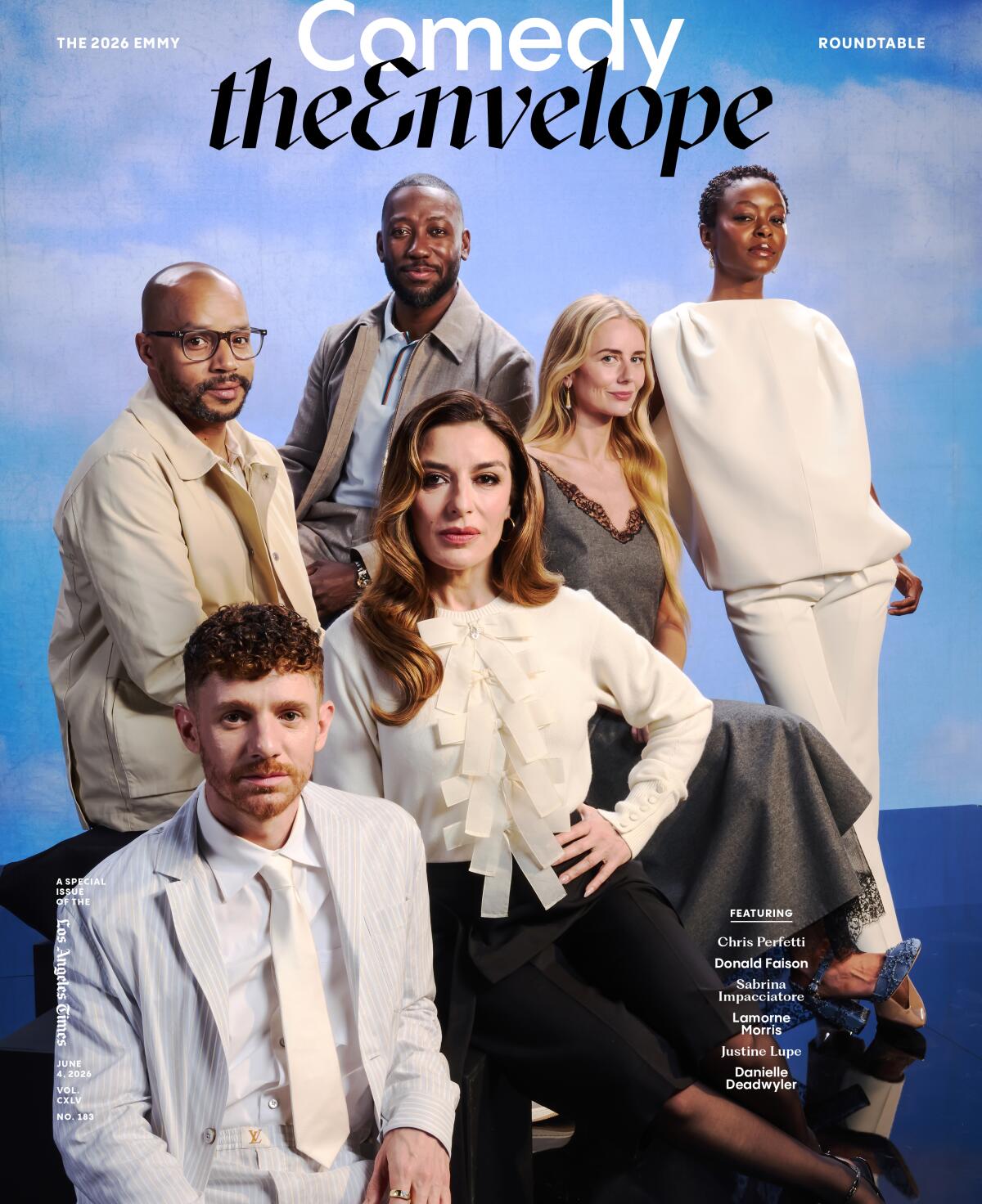
The Emmy Comedy Roundtable
(Christina House / Los Angeles Times)
Leave it to comedy legend Steve Carell to deliver a sage piece of advice on The Envelope’s 2026 Emmy Comedy Roundtable — without even participating in the conversation.
“Steve says this beautiful thing that characters don’t know whether they’re in a comedy or a drama,” Carell’s “Rooster” co-star Danielle Deadwyler relayed to nods of agreement and appreciation from the panel. “And that’s about as true as it gets. You bring full rigor and development and discipline to the making of a role, regardless of what genre.”
Of course, with Deadwyler, Donald Faison (“Scrubs”), Sabrina Impacciatore (“The Paper”), Justine Lupe (“Nobody Wants This”), Lamorne Morris (“Spider-Noir”) and Chris Perfetti (“Abbott Elementary”) around the table, the conversation, moderated by The Times’ Lorraine Ali, came with plenty of laughs too — about surviving bad reviews, being mistaken for other performers, breaking one’s castmates and much more. You can also watch it on YouTube here.
Meet ‘SNL’s’ resident ‘quiet little freak’
(Sela Shiloni / For The Times)
As someone who counts ex-Trump voters among my own family, “Saturday Night Live” cast member Ashley Padilla’s character in “Mom Confession” — about a stubborn MAGA parent who finally admits to her kids that she may have been wrong about the president — struck a chord with me when it aired in January. So I was delighted to see contributor Tim Grierson’s profile of the actor (and former Diane Keaton assistant) dig into what makes the sketch, like so much of her work on NBC’s variety series, tick.
“Padilla, who sports an ebullient manner and warm smile, has become a fan favorite by exploring how much humor (and tension) you can derive from stillness,” he writes. “Her best sketches … sparkle because of how expertly she builds suspense regarding where the setup is going.”
‘Margo’s Got Money Troubles’
Sex work is work. And in the right hands, it’s highly creative work. Case in point: HungryGhost, the alien alter ego Margot Millet (Elle Fanning) assumes when she launches an OnlyFans to make ends meet in “Margo’s Got Money Troubles.”
As contributor Tomris Laffly reports, the DIY artistry that brings HungryGhost to life in “Margo” reflects the layers of craftsmanship required to bring her to the screen, from hand-bedazzled cowboy boots to bulk-bought containers of turquoise eye shadow. “She’s a director,” executive producer and director Dearbhla Walsh says of Margo, an aspiring writer. “You could always see the creation [process], how Margo brought theater into her OnlyFans.”