Marco

MotoGP: Marco Bezzecchi wins season opener as Marc Marquez retires

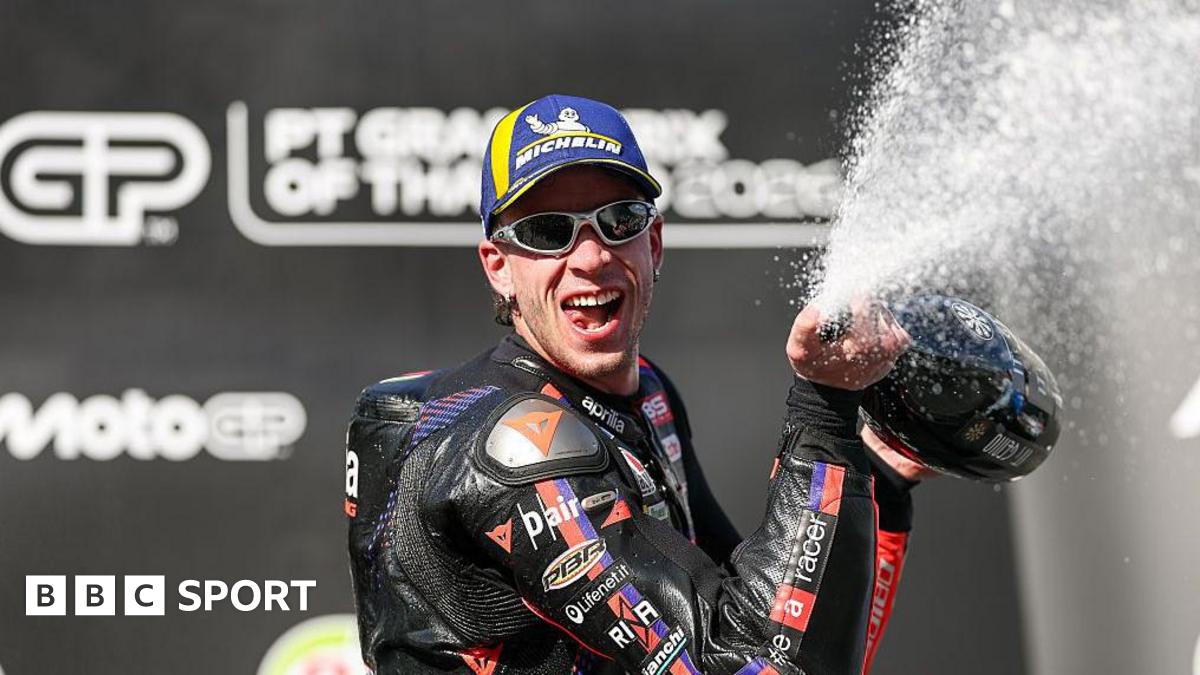
Italy’s Marco Bezzecchi won the opening race of the MotoGP season with a flawless performance in Thailand, as defending champion Marc Marquez retired late on.

Aprilia rider Bezzecchi started on pole and never looked back as he stormed into a massive lead before sealing victory by more than five seconds.

KTM’s Spanish rider Pedro Acosta followed up Saturday’s sprint race victory by coming second, while compatriot Raul Fernandez of Trackhouse finished third.

Bezzecchi’s victory came after he crashed out of the sprint race on the second lap.

“Yesterday was a small mistake with a big consequence, so it was important today to try to bounce back,” said Bezzecchi.

“My pace was good with the medium [rear tyre], we worked super well all weekend, so I knew that I could be fast if I was in front. So I tried my all to make a good start and the bike was perfect.”

Ducati’s Marquez exited the race with five laps to go after suffering a type puncture while in fourth position.

The Spaniard, who is chasing a record-equalling eighth title this season, was closing in on Acosta and Fernandez but damaged his tyre after running wide, ending hopes of a podium finish.

Earlier this week Marquez said he was still recovering from a shoulder injury that forced him to miss the final four races of last season.

Bezzecchi was fastest in all three practice sessions and set a new track record in qualifying, while this was his third-straight grand prix victory – having won the final two races in 2025.

Bezzecchi’s Aprilia team-mate and 2024 champion Jorge Martin came fourth, while Trackhouse’s Ai Ogura finished fifth.

Last year’s runner-up Alex Marquez did not finish the race after a late crash, while 2022 and 2023 world champion Francesco Bagnaia finished ninth.

Source link

U.S. Secretary of State Marco Rubio to visit Israel amid Iran concerns

Feb. 27 (UPI) — Secretary of State Marco Rubio will visit Israel Monday and Tuesday to discuss Iran and other issues, the State Department announced Friday.

The visit comes amid concern that the United States will attack Iran, despite continued negotiation between the two. On Thursday, the U.S. embassy in Israel told its staff that they could leave because of “safety risks,” though there is no emergency.

“Persons may wish to consider leaving Israel while commercial flights are available,” the State Department said in its new guidance. “In response to security incidents and without advance notice, the U.S. Embassy may further restrict or prohibit U.S. government employees and their family members from traveling to certain areas of Israel, the Old City of Jerusalem, and the West Bank.”

CNBC reported Friday that Omani Foreign Minister Badr al-Busaidi will meet Friday with Vice President JD Vance and other officials in Washington for “previously unreported talks in an effort to stave off war with Iran.”

Al-Busaidi has mediated talks between American and Iranian officials to ease tensions over President Donald Trump‘s demands that Iran abandon its nuclear program.

Rubio’s visit to Israel is to “discuss a range of regional priorities including Iran, Lebanon and ongoing efforts to implement President Trump’s 20-Point Peace Plan for Gaza,” State Department spokesperson Tommy Pigott said in a statement.

Democrats are speaking out against a potential strike.

“The American people are still waiting for the strategic justification for a war with Iran that puts thousands of American personnel across the region in harm’s way,” Sen. Chris Coons, D-Del., said on X. “What is the evidence of an imminent threat?”

Trump said in his State of the Union speech Tuesday that he is still planning to work the differences out diplomatically.

“My preference is to solve this problem through diplomacy, but one thing is certain: I will never allow the world’s No. 1 sponsor of terror — which they are by far — to have a nuclear weapon,” he said.

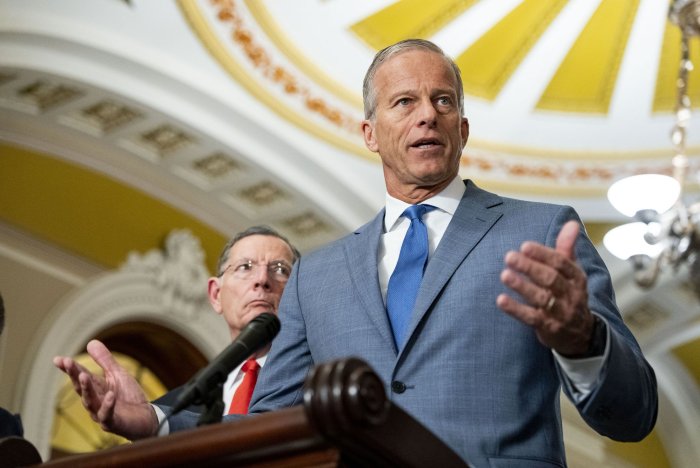
Senate Majority Leader John Thune, R-S.D., speaks during a press conference after the weekly Republican Senate caucus luncheon at the U.S. Capitol on Wednesday. Photo by Bonnie Cash/UPI | License Photo

Source link

Resilient Marco Penge earns share of lead at Genesis Invitational

It was a long day at the office for Marco Penge, but the overtime hours were well worth it for the 27-year-old from Lancashire, England, who shot a bogey-free 64 Friday and is tied for the lead with Jacob Bridgeman after two rounds of the Genesis Invitational at Riviera Country Club.

Penge surged to the lead with birdies on five of the last seven holes, then watched as Bridgeman closed with three birdies to catch him at 12 under par.

“I was biding my time on the front nine — the targets are so small here — but I found my swing coming down the stretch and that allowed me to be more aggressive,” said Penge, who won three times on the DP World Tour last year to earn his first PGA Tour card. “It’s tough for a European to come over here and do the things Rory [McIlroy] and Tommy [Fleetwood] are doing but I managed the course well today.”

Penge was in the last group Thursday and was on the 10th hole when play was suspended due to darkness. He carded four birdies and two bogeys on the back nine early Friday morning to join McIlory, Bridgeman and countryman Aaron Rai at five under par. He had only 38 minutes between finishing his first round and starting the second, but showed no signs of fatigue.

Marco Penge reacts after putting on the 18th green during the second round of the Genesis Invitational.

Marco Penge reacts after putting on the 18th green during the second round of the Genesis Invitational at Riviera Country Club on Friday.

(Caroline Brehman / Associated Press)

“Not really, I wasn’t any more tired than usual,” he said. “When you see you’re near the top your adrenaline gets you through it.”

Although he did not get paid time and a half for playing 27 holes instead of the normal 18, a healthy check will come his way Sunday afternoon if Penge can hold his position.

Likewise for Bridgeman, who rode his momentum from the day before to also card a 64, opening his round with an eagle and posting eight birdies to more than offset bogeys at No. 7 and No. 12.

“I putted really well, hit my driver great and I’m excited to be in the hunt for the second straight week,” Bridgeman said after coolly sinking an eight-foot birdie putt on the last hole. “Yesterday was a learning experience. The 18th was playing a lot longer than I thought today. It’s shocking how soft and how fast these greens are. This is the most pure layout I’ve ever seen.”

Jacob Bridgeman hits from the 18th fairway during the second round of the Genesis Invitational at Riviera Country Club.

Jacob Bridgeman hits from the 18th fairway during the second round of the Genesis Invitational at Riviera Country Club on Friday.

(Caroline Brehman / Associated Press)

McIlroy, the world’s No. 2-ranked player, looms one shot back after a six-under 65 and two-time winner Adam Scott rocketed into contention with two eagles and six birdies — an eight-under-par 63 marred only by his bogey at 18. Scott has won twice at Riviera, in 2005 (a rain-shortened 36 holes) and 2020, and is tied for fourth with Xander Schauffele at -9.

Schauffele, ranked 13th in the world, also had a prolonged day. He was tied for 29th at even par through 11 holes when play was suspended Thursday and played the last seven holes of the first round in three-under-par. The 2016-17 Rookie of the Year notched the last of his 10 Tour victories at the Baycurrent Classic last October.

“I’m tired man… I’m looking forward to laying down sometime soon,” said the 32-year-old who lives in Jupiter, Florida but was born in San Diego and played his college golf at Long Beach State and San Diego State.

Asked about tournament host Tiger Woods’ suggestion to reschedule the event to the summertime, Schauffele said: “Wherever it is and whatever the conditions are — dry, damp, moist — I just enjoying playing here.”

Rai led by one stroke when play was suspended Thursday but bogeyed 18 early Friday to drop into a tie and shot a second-round 69, leaving him tied for 12th with South African Aldrich Potgeiter, Ryan Fox and 2021 Genesis champion Max Homa at the halfway point.

“My ball striking was better than yesterday and I got more looks at birdie,” Potgeiter said after shooting 68 for a second straight day. “The course is looking great… with the amount of rain we’ve had they did a good job.”

World No. 1 Scottie Scheffler was tied with Keegan Bradley for last place at five-over when he walked off the course Thursday evening and shot two under over his last eight holes early Friday morning to begin the second round tied for 65th at +3. He had three birdies and six pars on the back nine for a 68 in the second round to get to even par and was among 51 in the 72-player field to make the cut.

“It’s nice to be able to get another two cracks at the course,” a relieved Scheffler said after having to drain a four-foot birdie putt at the 17th to extend his consecutive cuts streak to 68—the longest active streak on Tour. “This place and I have a weird relationship. I feel like I can play well here, I just haven’t yet. I was very aware I had to get to at least even par to keep going. I had to battle because the closing stretch is tough here.”

Scheffler has not missed a cut since the FedEx St. Jude Championship in August of 2022.

The conditions were ideal and scores reflected that on the second day of the 100th edition of a tournament that is still up for grabs, with 22 players within nine shots of the lead. One of them is Max Greyserman, who is tied for sixth with Australian Min Woo Lee at -8.

“Starting off with an eagle is always nice,” said Greyserman, a 30-year-old who lives in Palm Beach and is seeking his first pro win. “I hit a lot of nice drives. If you miss the fairways around here things get tricky. The kikuyu grass is interesting. I didn’t grow up on it. I played Genesis last year at Torrey [Pines] and I’ve played here four times before this week. It’s a good test, a fair test, a fun test.”

Source link

Marco Rubio wants to build a ‘new Western century’. Will Europe join? | Politics News

Speaking at the annual Munich Security Conference on Saturday, United States Secretary of State Marco Rubio urged European countries to collaborate with the US to build a “new Western century”, describing US-Europe ties as “civilisational”.

“We are part of one civilisation – Western civilisation,” he said.

Recommended Stories

list of 4 itemsend of list

His rallying speech comes after more than a year of President Donald Trump’s rhetoric about mass immigration in Europe and his administration’s latest National Security Strategy, which warns of “civilisational erasure” in Europe.

Last year, US Vice President JD Vance also lambasted European “liberal values” in his first address at the security conference.

As European leaders grapple with the rise of far-right political parties, how will they respond to this new demand from the US, and what does it mean for the future of transatlantic relations?

United States Secretary of State Marco Rubio, centre, arrives for the Munich Security Conference in Munich, Germany on February 13, 2026.
US Secretary of State Marco Rubio, centre, arrives for the Munich Security Conference in Germany, February 13, 2026 [Michael Probst/AP Photo]

What did Rubio say?

The top US diplomat focused on several key areas he views as imperative for Europe to address, which included ending “liberalist” policies the Trump administration views as responsible for Europe’s “post-war decline”, creating new supply chains to reduce reliance on countries such as China, and ending mass migration, which he said is leading to the erasure of Western “civilisation”.

“The work of this new alliance,” Rubio said, “should not be focused just on military cooperation and reclaiming the industries of the past. It should also be focused on, together, advancing our mutual interests and new frontiers, unshackling our ingenuity, our creativity, and the dynamic spirit to build a new Western century.”

Liberalism and mass migration

Rubio argued that the “euphoria” of the Western victory in the Cold War had led to a “dangerous delusion that we had entered ‘the end of history’”, where every nation would be a liberal democracy and “live in a world without borders, where everyone became a citizen of the world”.

He used this as a plank to lash out against opening “doors to an unprecedented wave of mass migration that threatens the cohesion of our societies, the continuity of our culture, and the future of our people”.

“Mass migration is not, was not, isn’t some fringe concern of little consequence. It was and continues to be a crisis which is transforming and destabilising societies all across the West,” he said.

Taking aim at liberalist policies, he added that, to “appease a climate cult, we have imposed energy policies on ourselves that are impoverishing our people”.

New supply chains

Rubio said the US and its allies should bring more industry and jobs back home, not just to build weapons but to lead in new, high‑tech fields.

He added that the West should control key minerals and supply chains, invest in space travel and artificial intelligence, and work together to win markets in the Global South.

In particular, he said, is the need for a “Western supply chain for critical minerals not vulnerable to extortion from other powers”.

Earlier this month, Trump hosted ministers from dozens of countries for a critical minerals conference in Washington. The meeting was the first of a new Critical Minerals Ministerial, a US initiative to build alliances aimed at countering China’s control over critical mineral supply chains around the world.

What does a ‘new Western century’ mean?

While the overarching message of Rubio’s speech was that the US still seeks a partnership with Europe, said Trita Parsi, executive vice president of think tank Quincy Institute for Responsible Statecraft, his remarks revealed, “The US will entirely set the parameters of that partnership and that it will be based on ideas Europe long has abandoned: An embrace of empire and colonisation.”

Rubio’s remarks at the conference suggest that the US under Trump wants Europe to accept “a civilisational divide of the world in which the ‘West’ must restore its dominance over other civilisations”, Parsi told Al Jazeera.

“In essence, Rubio listed the criteria for how Europe can become well-behaved vassals of the United States,” he said.

How did European leaders react to Rubio’s speech?

European leaders appeared to welcome Rubio’s speech at the conference; it was followed by a standing ovation. However, while lauding his call for stronger ties with the US, they notably did not address his comments about migration and liberal values.

European Commission President Ursula von der Leyen told reporters on the sidelines of the Munich Security Conference: “We know that in the [Trump] administration, some have a harsher tone on these topics. But the secretary of state was very clear. He said, ‘We want [a] strong Europe in the alliance’, and this is what we are working for intensively in the European Union.”

French Foreign Minister Jean-Noel Barrot responded to Rubio’s speech: “Referring to [our] common legacy can only be welcomed with applause in Europe.”

“We will deliver a strong and independent Europe,” he said. “Independent, of course, irrespective of the speeches that we hear at the Munich Security Conference, however right they may be.”

Calling Rubio a “true partner”, German Foreign Minister John Wadephul said: “[It was] a very clear message from Secretary Rubio that we have … to stay and stick to our international rules-based order, which is, of course, in [the] first line the United Nations. This is our Board of Peace. We have to make it more effective, as Rubio said this morning.”

Finnish Foreign Minister Elina Valtonen said she was “very satisfied with the tone” and the content of Rubio’s speech.

What does this mean for Europe?

European leaders have been facing a dilemma – particularly over migration and defence – for some time, for a number of reasons. The mass migration crisis prompted by unrest in other parts of the world has already caused far-right parties to surge in popularity. Now, the Trump administration has voiced support for many of these parties and is also urging Europe to take stronger action on migration and defence.

Therefore, many European leaders have already started taking action in these areas.

For instance, most European countries are already working on boosting their defences and cracking down on migration.

Last year, the United Kingdom announced plans for a big boost in defence spending in advance of Prime Minister Keir Starmer’s meeting with Trump early last year amid fears the US would withdraw support for Ukraine in its war with Russia. Notably, Rubio skipped a meeting about Ukraine with European leaders at the Munich conference.

Many countries have also tightened controls over immigration. Denmark has led the way in implementing increasingly restrictive policies in its immigration and asylum system, with top leaders aiming for “zero asylum seekers” arriving in the country. Recently, the UK said it was studying the Danish model as well.

Europe is also working to make its energy and technology supply chains more sovereign, reducing dependence on foreign suppliers, particularly in the face of Trump’s trade war, which has seen him impose reciprocal trade tariffs on many countries around the world.

Many European leaders have come under increasing pressure from the rise in popularity of far-right parties calling for greater restrictions on immigration, as well.

In recent years, far-right, anti-immigration sentiment has been increasing in countries like the United Kingdom, the Netherlands, and France. In 2023, the far-right Party for Freedom (PVV), led by Geert Wilders, won the election in the Netherlands. France’s National Rally (RN), led by Marine Le Pen, won the snap election in 2024. The same year, Nigel Farage’s right-wing Reform UK party made significant inroads in the general elections and, last year, a YouGov poll placed Reform as the UK’s most popular political party.

Besides this, ideas which were once far-right fringe notions, such as remigration – the notion of forcibly expelling non-white European citizens – are gaining traction among far-right conservatives in Europe. The idea has been promoted by Herbert Kickl, the leader of Austria’s far-right anti-immigration Freedom Party (FPO) and Alice Weidel, the leader of the AfD in Germany.

While some European leaders have geared up to resist the rise of far-right politics – partly by appeasing them with new, more restrictive migration policies – Trump has, however, embraced it.

What does this mean for US-Europe relations?

All this ultimately means that “Europe has a choice to make”, said Trita Parsi, executive vice president at the think tank Quincy Institute for Responsible Statecraft. “It can pursue strategic autonomy and seek to find a balance between the great powers, and within that seek a dignified partnership with America in which it is not subjugated into vassalage.”

“[Or] Europe can continue on its current path in which it subordinates itself slowly but surely fully to Washington’s interests, priorities, impulses, and ideas about civilisational empire,” he told Al Jazeera.

Parsi pointed to the standing ovation at the conference that followed Rubio’s speech, simply for offering to remain partners with Europe.

“Whether they disregarded Rubio’s parameters, did not understand them, or simply found it unimportant because Europe desires to be a junior partner to the United States regardless of the parameters, remains to be seen,” he said.

For their part, European leaders appeared to place the greatest importance on repairing US-Europe relations above all else at the Munich Security Conference.

During his address at the conference on Friday, German Chancellor Friedrich Merz called on the US and Europe to “repair and revive transatlantic trust together”. “Let me begin with the uncomfortable truth: A rift, a deep divide has opened between Europe and the United States,” he said.

“Vice President JD Vance said this a year ago here in Munich. He was right in his description,” Merz said, as he called for a “new transatlantic partnership”.

Source link

Danish PM says more Greenland talks due after meeting US’s Marco Rubio | Donald Trump News

New opinion poll finds seven in 10 US adults disapprove of President Donald Trump’s handling of Greenland issue.

Denmark’s prime minister and Greenland’s premier met ⁠with United States Secretary of State Marco Rubio and agreed that talks would be pursued on the running of Greenland, the semi-autonomous Danish territory that President Donald Trump has threatened to take over.

Rubio held a 15-minute meeting with Danish Prime Minister Mette Frederiksen and Greenland’s Premier Jens-Frederik Nielsen on the sidelines of the Munich Security Conference on Friday.

Recommended Stories

list of 4 itemsend of list

Greenland’s leader Nielsen said in a post on social media that during the meeting with Rubio, “it was emphasised that the conversations being made are the right way forward and the interests of Greenland were once again clearly highlighted”.

Prime Minister Frederiksen said on X after the meeting: “Constructive talk with Secretary of State Marco Rubio together with Jens-Frederik Nielsen, Chairman of Naalakkersuisut, at the Munich Security Conference.”

“Work will continue as agreed in the high-level working group,” she said.

The meeting between the Danish and Greenlandic leaders and the US state secretary comes amid severely strained ties between Europe and Washington, and NATO allies, amid President Trump’s repeated threats to take over Greenland and criticism of European nations as “decaying” and “weak”.

Speaking to reporters on Friday, Trump said, “We’re negotiating ‌right ‌now for Greenland.”

“I ‌think Greenland’s going to want us, but we get along very well with Europe. We’ll see how it all works out,” he said.

After months of bellicose language regarding the US’s necessity to acquire Greenland, Trump abruptly stepped back from his threats last month, saying that he had reached an understanding with NATO Secretary-General Mark Rutte that would give the US greater influence in the mineral-rich Arctic territory.

Late last month, the US, Denmark and Greenland also launched talks to find a diplomatic path out of the crisis.

Poll finds most US adults disapprove of Trump’s Greenland plan

The US administration has cited key national security concerns related to Russia and China to justify its demand to take control over Greenland and has accused Denmark, and Europe more broadly, of being unable to defend the strategic territory.

But, according to a new opinion poll conducted by The Associated Press and NORC Center for Public Affairs Research, Trump’s push to seize control of Greenland has gone down badly with the US public and members of his own party.

The survey, conducted between February 5-8, found that about seven in 10 US adults disapprove of how Trump is handling the Greenland issue – a higher disapproval rating than the share of those who dislike how he is handling foreign policy generally.

Even among Republican supporters, about half disapprove of his attempt to turn Greenland into US territory, according to the poll.

Sweden said on Thursday that it would send fighter jets to patrol Greenland as part of a newly launched NATO mission in the Arctic aimed at placating Trump’s concerns over the threats posed by Moscow and Beijing.

The government said in a statement that Swedish-made Gripen fighter jets would patrol Greenland as part of the newly-launched NATO mission, Arctic Sentry.

“As a NATO ally, Sweden has a responsibility to contribute to the security of the entire territory of the Alliance. The Arctic region is becoming increasingly important from a strategic perspective,” Sweden’s Prime Minister Ulf Kristersson said.

In a separate statement, the Swedish Armed Forces said the fighter jets would be based out of Iceland, where six aircraft have been stationed since early February as part of the rotating incident response force, NATO Air Policing.

Swedish special forces would also be sent to Greenland to take part in training exercises for a couple of weeks, the military said.

Source link