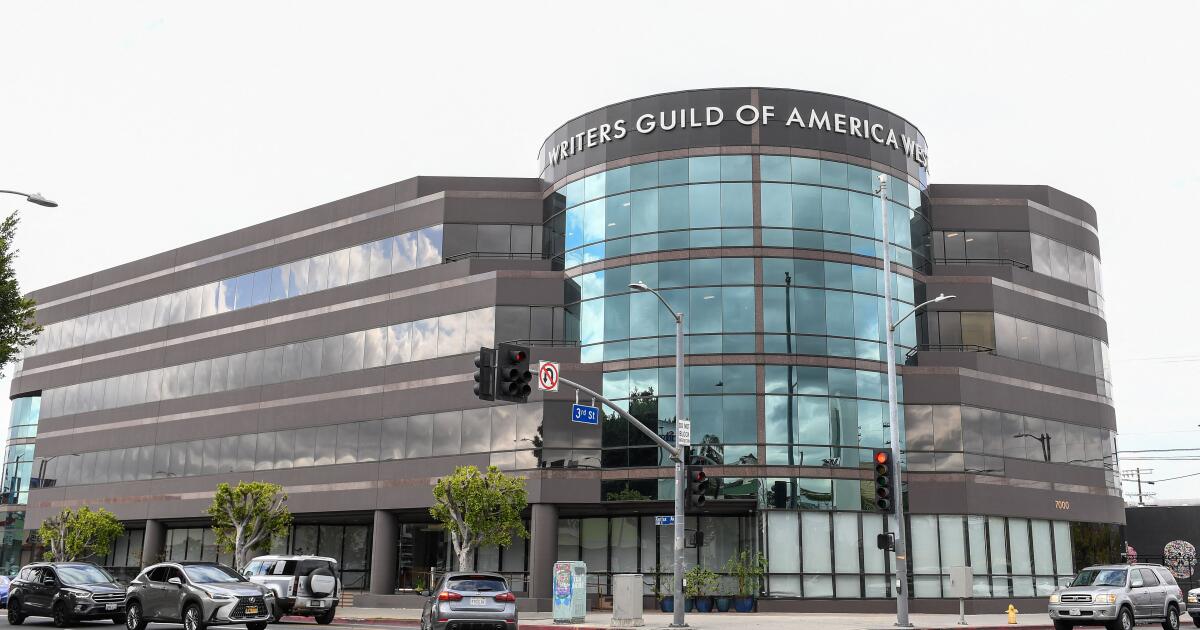
The Writers Guild of America and the Alliance of Motion Picture and Television Producers have reportedly reached a tentative four-year deal for a new contract.
Puck co-founder and reporter Matt Belloni first reported news of the tentative deal Saturday. The agreement represents a departure from standard practice, adding one more year to the WGA’s usual three-year contract. Additionally, it includes health plan and pension increases, bumps in streaming pay and protections that will police licensing for AI training.
The new contract is still subject to ratification following a vote by union members. The WGA and AMPTP did not immediately respond to requests for comment.
This tentative deal is a promising signal that the Writers Guild could avoid a strike after 2023’s historic work stoppage that lasted 148 days.
Separately, the Writers Guild of America West’s staff union has been on strike since mid-February.
The union’s current contract is set to expire May 1. WGA is the first of the Hollywood unions to reach a deal. SAG-AFTRA and the Directors Guild of America still need to reach an agreement with the studios.
The actors’ union began negotiations with the studios in February and extended those talks in March, but paused in order for the AMPTP to finish negotiations with the writers’ union. SAG-AFTRA and DGA’s contracts each expire June 30.
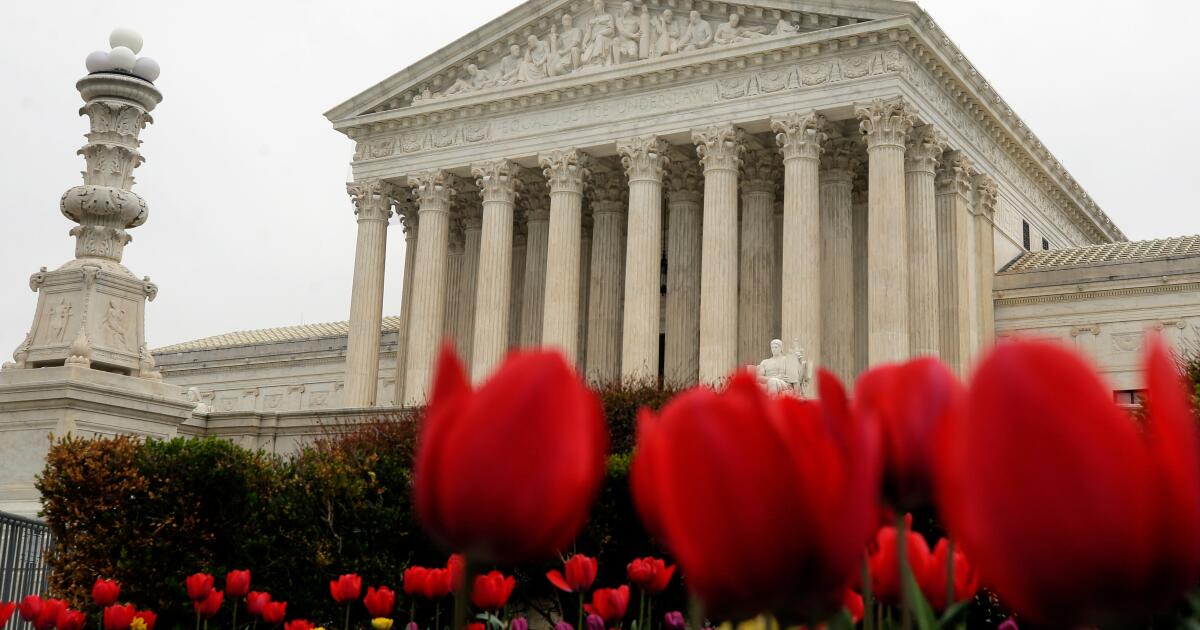
WASHINGTON — Supreme Court Justice Samuel A. Alito Jr. fell ill at an event in Philadelphia last month and was treated for dehydration before returning home to suburban Washington, the court’s spokeswoman said Friday.
Alito’s illness did not require an overnight hospital stay and he was back on the bench the following Monday, spokeswoman Patricia McCabe said in a statement.
Alito was an active questioner during arguments that day in an important case about mailed ballots and participated in all the court’s hearings over the ensuing two weeks.
Alito, who turned 76 on Wednesday, is the second-oldest member of the court, after 77-year-old Justice Clarence Thomas.
The episode was first reported by CNN, which also said the treatment was administered at a Philadelphia hospital. The court did not say where Alito had been taken.
The incident is the latest example of the justices’ reticence to discuss their health, at least until the news somehow leaks.
In 2020, the court confirmed that Chief Justice John G. Roberts Jr. had spent a night in the hospital after a fall that required stitches in his forehead, only after the Washington Post reported it first.
Alito was driven by his security detail from Washington to what CNN said was a dinner following a Federalist Society panel that looked at his 20 years on the court.
When he didn’t feel well in the evening, “he agreed with his security detail’s recommendation to see a physician before the three-hour drive home” to northern Virginia, McCabe said. He was given fluids for dehydration, she said.
While the justice has not said anything about retirement, speculation has swirled that Alito might soon step down, which would give President Trump the chance to appoint a fourth justice, after the three who were confirmed during his first term.
While Alito is young by Supreme Court standards, he might not want to stay around and gamble on the possibility of Democrats flipping the Senate in the November elections and seeing a Democrat capture the White House two years later.
Retiring in the summer would allow Trump to name a similarly conservative but much younger replacement who would almost certainly win confirmation from the Republican-led Senate.
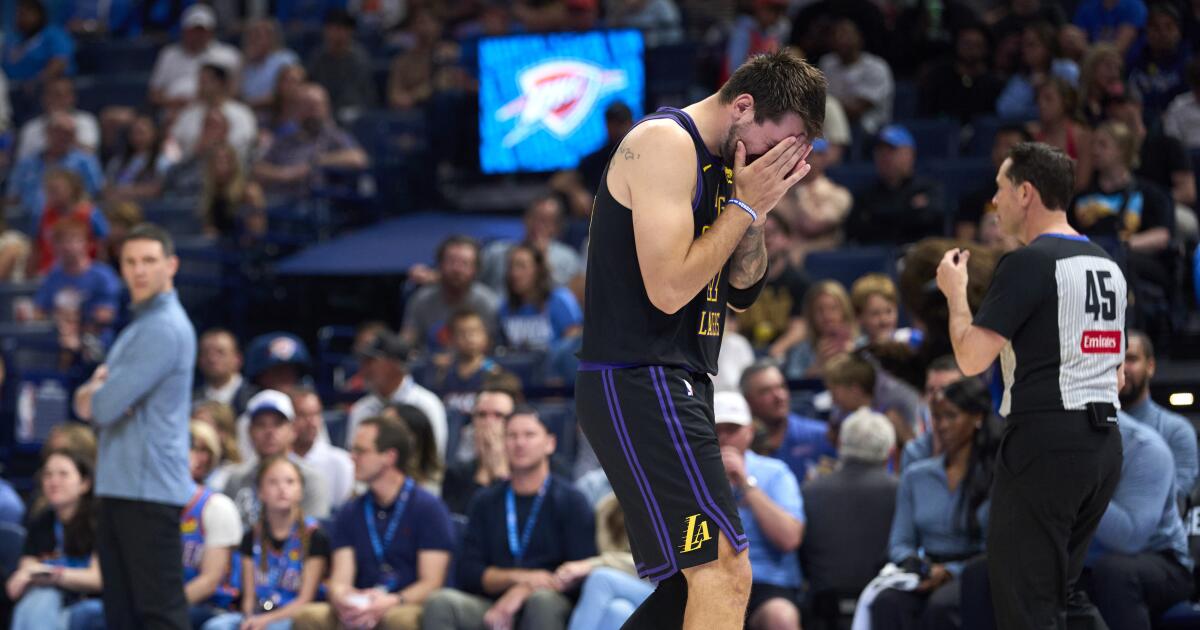
OKLAHOMA CITY — In the aftermath of their worst loss of the season, few Lakers players or coaches had spoken to Luka Doncic after he limped off the court in the third quarter Thursday against the Oklahoma City Thunder. Austin Reaves didn’t know the extent of Doncic’s hamstring injury, but he knew how the Lakers superstar would approach the latest hurdle in this winding season.
“He’s a competitor,” Reaves said of Doncic, “so he’ll do all he can do to put himself in a position to come back when he can.”
Doncic will undergo an MRI on Friday on the left hamstring injury he suffered in a 43-point loss to the Thunder. He already missed four games before the All-Star break with the same injury, but the Lakers withheld expectations on his status for the final five regular-season games.
After Sunday’s game in Dallas, the Lakers face the Thunder at home Tuesday, play consecutive games at Golden State on Thursday and against Phoenix at home Friday and finish the regular season Sunday against Utah.
Doncic’s injury left the Lakers backcourt extra shorthanded Thursday as Marcus Smart missed his sixth consecutive game Thursday. The veteran guard could return against Dallas, coach JJ Redick said. He has been day-to-day since injuring his right ankle against Orlando on March 21.
If Smart is unable to return in Doncic’s absence, the Lakers could shift even more ball-handling responsibility to Reaves and LeBron James while relying on Bronny James as an additional guard off the bench. The 21-year-old James has played in five consecutive games, tying his longest stretch of his second pro season.
The Lakers (50-27) are already guaranteed a top-six seed in the Western Conference, but are still jostling for seeding. They have a one-game lead for the No. 3 seed over No. 4 Denver, which is on a seven-game winning streak.
Approaching the end of the regular season, the Lakers looked at Thursday’s game against the defending NBA champions as a test, forward Jake LaRavia said. They were 15-2 in March with 13 wins in their last 14 games. The Lakers were playing like an evolved form of the team that lost by 29 to the Thunder in Oklahoma City in November.
But like that first rout, Thursday’s featured a flurry of Lakers turnovers, suffocating Oklahoma City ball pressure and an efficient masterclass from Shai Gilgeous-Alexander.
“This close to the end of the season, we would’ve wanted it not to go that way,” said LaRavia, who had six points and a team-high eight rebounds Thursday. “It was pretty much the same story, I feel like, the first time we played here this year.”
The Lakers built much of their March success on successful revenge performances. They bounced back after previous losses to the New York Knicks, Houston Rockets and the Orlando Magic. They lost by seven to the Nuggets on March 5 then responded with nine consecutive wins, their longest winning streak of the season, including an overtime thriller against Denver that clinched the head-to-head tiebreaker that could factor into the tight standings.
Redick praised his team’s “playoff mentality” during the run. It was also when the team was largely its healthiest.
Doncic had played all but one game since the All-Star break. Reaves, who missed six weeks with a calf injury this season, has started in 22 consecutive games. When James returned from an elbow injury, the star trio found a clear hierarchy that lifted the team to new heights.
Doncic, who became just the 10th player in NBA history to score 600 points in a single month, is the “head of the snake,” said James, who is averaging just 12.3 shots in the last 12 games but is shooting 54.4% from the field. Doncic’s brilliant March unified the team behind his most valuable player push, his thrilling shot-making and even his smiling dunk against Washington.
With the team exuding the type of joy that often characterizes Doncic’s game, James believes the Lakers can maintain their momentum despite Doncic’s uncertain status and a deflating loss.
“Nothing is rattled,” James said. “It’s one game, it’s part of the NBA season, it’s the defending champions. We get it. We understand.”
Companies whose stock prices have historically shown high correlation to movement in interest rates recently saw an all-time high as odds of rate hikes may seem more plausible for investors than rate cuts.
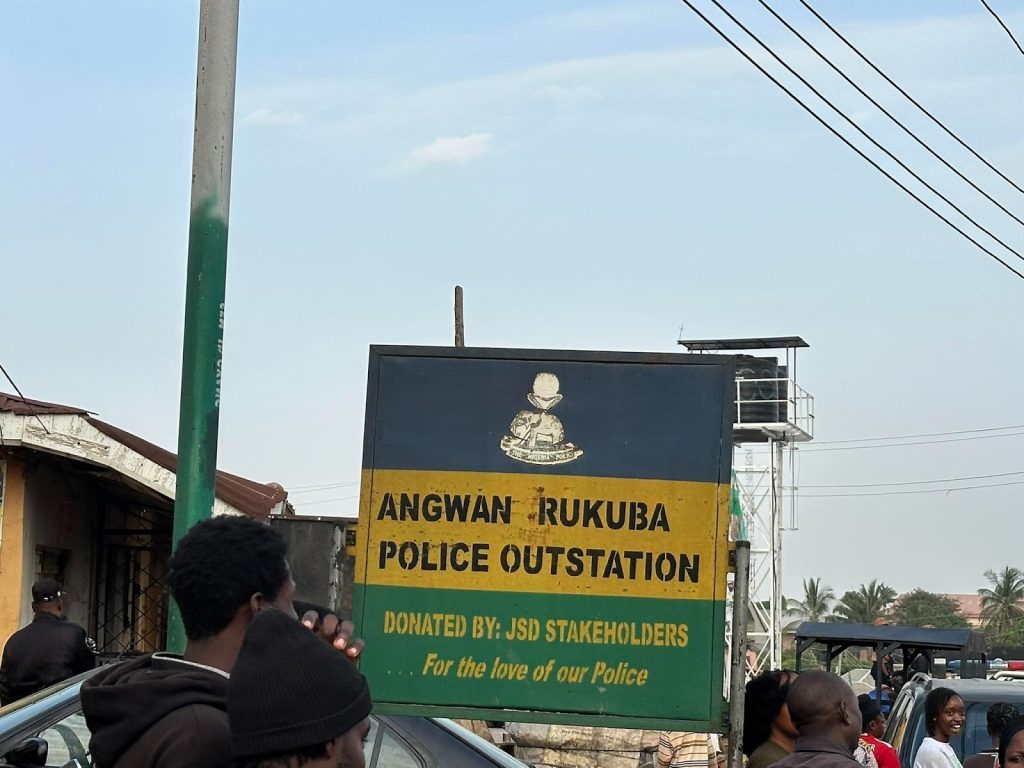
Sunday evenings are usually a beehive of commercial activity at Angwan Rukuba Junction, but it turned deadly on March 29, at around 7:45 p.m., when assailants opened fire on people at random in the area, located in Jos North Local Government Area (LGA), Plateau State, in North Central Nigeria.
Eyewitnesses gave differing accounts of the attackers’ arrival, with some saying they came in a red Sharon van, while others reported they arrived on motorcycles. They were described as dressed in black camouflage, with their faces covered, and armed with guns and cutlasses. The motive and identity of the assailants remain unknown, and no group has claimed responsibility.
At least 27 people were killed, including a pregnant woman, while others were injured, according to Dalyop Mwantiri, President of the Berom Youth Moulders Association.
Sunday Akintola, a resident, said the high number of casualties was due to people being caught unawares, as residents initially assumed the gunshots were stray bullets from officers of the National Drug Enforcement Agency, which “usually come to harass young men in the area”. “Once people stepped in, they were shot at close range, while others were chased and struck with machetes,” he noted.
Although there is a police station at the junction where the incident occurred, residents said the response was slow, alleging that some officers on duty fled when the attack began, before reinforcements later arrived from the state headquarters.
The police outpost at Angwan Rukuba. Photo: Matthew Tegha.
Alfred Alabo, the spokesperson of the Plateau Police Command, says they “are currently combing the nearby bushes to ensure that the suspects are arrested or dislodged”.
Angwan Rukuba is located just 10 minutes from both the Jos Main Market and University of Jos facilities, including the Senior Staff Quarters, Main Campus, and Permanent Site, as well as private housing for university staff and students. It also borders a large stretch of hills, including the popular Gog and Magog.
Notably, it is not a rural farming settlement or a mining community, but a densely populated, urban residential area with a diverse mix of residents, including students, civil servants, and traders. As such, the incident does not fit the typical pattern of farmer–herder clashes often reported in Plateau State.
Residents at the Angwan Rukuba junction. Photo: Matthew Tegha.
“This is right inside Jos. It is a mixed community; it is really a melting pot because everybody is here, and an injury to one is an injury to all,” said Julie Sanda, Director General of the Plateau Peace Building Agency (PPBA). “It was an unprovoked attack.”
Violence in Plateau State is multidimensional, involving terror attacks, conflict between farmers and herders in rural communities, and ethno-religious tensions that have rocked the city since 2001. However, one thing is common about these incidents in the Jos–Bukuru metropolis: they often lead to revenge attacks among ethno-religious groups, driven by deep-seated mistrust, which has in turn contributed to polarised settlements.
“If you know anything about Jos, if this incident had happened ten years ago, I don’t think we would be here today. It shows the resilience of the people and their courage,” Julie said.
Shortly after the attack on Sunday, the Plateau State Government imposed a dusk-to-dawn curfew in Jos North LGA until Wednesday, April 1. However, residents took to the streets in protest, displaying the bodies of the deceased. Additionally, the University of Jos has rescheduled its ongoing semester examinations. Caleb Mutfwang, the state governor, also visited the community on Monday, March 30.
Governor Mutfwang addressing residents in Angwan Rukuba, Jos Metropolis. Photo: Matthew Tegha.
“I assure you that those responsible for this evil act will not go unpunished,” he said.
The state government has also reiterated its ban on commercial motorcycles in the Jos–Bukuru metropolis, which covers Jos North and Jos South LGAs. “Meanwhile, the hours of operation for tricycle riders (keke) still remain 6:00 a.m. to 7 p.m.,” according to Davou Gyang Jatua, the state Commissioner of Transport.
Residents who spoke to HumAngle said that, in recent months, unfamiliar motorcyclists — some of whom do not know locations within the metropolis — have been moving around. “Whenever I see keke and okada (motorcycles) out very late, I know there’s a risk of evil acts being perpetrated using them,” said Zoe Machunga, a Jos resident.
In the weeks leading up to the attack, some social media accounts had posted videos inciting violence in Jos, although it remains unclear whether such messaging contributed to the incident. The governor said the social media users responsible for the posts have been apprehended, a claim confirmed by Alfred, the police spokesperson, during a radio interview on Monday.
“Injustice has made healing difficult in Plateau State,” said Joseph Lengmang, a peace and security expert and former Director General of PPBA. “Peacebuilding efforts remain incomplete, and some underlying issues still need to be addressed.”
A sudden armed attack occurred on March 29 at Angwan Rukuba Junction in Jos North, Plateau State, Nigeria, resulting in the death of at least 27 people, including a pregnant woman.
Assailants, dressed in black camouflage, attacked the area with guns and machetes, and despite being near a police station, the initial response was slow.
Get our in-depth, creative coverage of conflict and development delivered to you every weekend.
Subscribe now to our newsletter!
The local community, comprising a mix of students, civil servants, and traders, organized protests following the incident, which was described as an unprovoked attack, distinct from the farmer-herder clashes common in the region.
In response, the Plateau State Government imposed a curfew and affirmed the ban on commercial motorcycles. It also took steps against violence incited by social media, with some arrests made. The attack reflects the ongoing ethnic and religious tensions in Plateau State, with peacebuilding efforts criticized for being incomplete. The incident underscores the broader challenges in achieving lasting peace and addressing deep-seated mistrust among various groups in the region.
1 of 4 | John Hinckley Jr. is flanked by federal agents as he is driven away from court April 10, 1981. On March 30, 1981, John Hinckley Jr. shot U.S. President Ronald Reagan outside a Washington hotel. UPI File Photo | License Photo
March 30 (UPI) — On this date in history:
In 1842, Dr. Crawford Long became the first physician to use anesthetic (ether) in surgery.
In 1858, a U.S. patent was granted to Hymen Lipman for a pencil with an attached eraser.
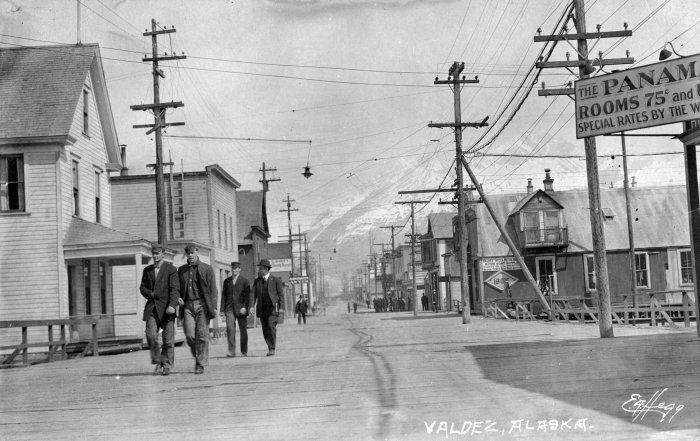
In 1867, U.S. Secretary of State William Seward reached an agreement with Russia for the purchase of Alaska for $7.2 million in gold.
File Photo by Library of Congress/UPI
In 1870, the 15th Amendment, granting African American men the right to vote, was adopted into the U.S. Constitution.
In 1923, the Cunard liner Laconia arrived in New York City, the first passenger ship to circumnavigate the world. The cruise lasted 130 days.
In 1975, the South Vietnamese city of Da Nang fell to North Vietnamese forces. UPI correspondent Paul Vogle described “the flight out of hell” as refugees attempted to flee the city.
In 1981, John Hinckley Jr. shot and injured U.S. President Ronald Reagan outside a Washington hotel. White House Press Secretary James Brady, a Secret Service agent and a Washington police officer also sustained injuries. Hinckley was released from a psychiatric hospital in September 2016.
In 1999, a jury in Oregon awarded $81 million in damages to the family of a smoker who died from lung cancer. A state judge reduced the punitive portion to $32 million.
In 2006, Jill Carroll, a freelance reporter for The Christian Science Monitor, was freed in Baghdad after being held for 82 days by kidnappers.
In 2018, at least a dozen Palestinians died in the first week of the so-called Great March of Return protests in Gaza. More than 180 people died in the nearly weekly protests through the end of 2019.
In 2023, a Manhattan grand jury took the unprecedented step of voting to indict a former president, formally charging Donald Trump in an investigation into hush-money payments made to adult film actor Stephanie Clifford, known professionally as Stormy Daniels.
1. The Correspondent by Virginia Evans (Crown: $28) A lifelong letter writer reckons with a painful past.
2. Kin by Tayari Jones (Knopf: $32) The bond between two lifelong friends in the South is tested as they take different paths in life.
3. Vigil by George Saunders (Random House: $28) A spirit guide must shepherd the soul of a dying, unrepentant oil tycoon into the afterlife as he confronts his legacy of corporate greed all while supernatural visitors demand a reckoning.
4. Heart the Lover by Lily King (Grove Press: $28) A woman reflects on a youthful love triangle and its consequences.
5. Lost Lambs by Madeline Cash (Farrar, Straus & Giroux: $28) A family comes undone in a small coastal town.
6. Once and Again by Rebecca Serle (Atria Books: $27) A family of women have an astonishing gift: The ability to redo one moment in their lives.
7. Judge Stone by James Patterson and Viola Davis (Little, Brown & Co.: $32) The bestselling author and Oscar-winning actor team up for a small-town legal thriller.
8. Lady Tremaine by Rachel Hochhauser (St. Martin’s Press: $29) A reimagining of the myth of the evil stepmother at the heart of “Cinderella.”
9. Sisters in Yellow by Mieko Kawakami (Knopf: $30) The tumultuous bonds of sisterhood are explored in the gritty Tokyo of the 1990s.
10. Brawler by Lauren Groff (Riverhead Books: $29) A collection of short stories tackling the relentless battle between humanity’s dark and light angels.
…
Hardcover nonfiction
1. The Best Dog in the World by Alice Hoffman (editor) Fourteen authors celebrate the life-changing bond with their canine companions in a collection of essays. (Scribner: $22)
2. Strangers by Belle Burden (The Dial Press: $30) A woman explores her marriage, its end and the man she thought she knew.
3. A World Appears by Michael Pollan (Penguin Press: $32) An exploration of consciousness and a meditation on the essence of our humanity.
4. You with the Sad Eyes by Christina Applegate (Little, Brown & Co.: $32) The actor opens up about her tumultuous childhood, her five-decade-long career and the MS diagnosis that upended it all.
5. Young Man in a Hurry by Gavin Newsom (Penguin Press: $30) The California governor tells his origin story.
6. Good Writing by Neal Allen and Anne Lamott (Avery: $27) Two writers show you how to turn a worthy sentence into a memorable one.
7. One Day, Everyone Will Have Always Been Against This by Omar El Akkad (Knopf: $28) Reckoning with what it means to live in a West that betrays its values.
8. Mobilize by Shyam Sankar, Madeline Hart (Bombardier Books: $30) A Palantir executive’s call to strengthen America’s industrial base.
9. Kids, Wait Till You Hear This! by Liza Minnelli (Grand Central Publishing: $36) The entertainment legend shares her story.
10. Stay Alive by Ian Buruma (Penguin Press: $35) An account of life in Berlin from 1939 to 1945 under a murderous regime.
…
Paperback fiction
1. Project Hail Mary by Andy Weir (Ballantine: $22)
2. Theo of Golden by Allen Levi (Atria Books: $20)
3. Heated Rivalry by Rachel Reid (Carina Press: $19)
4. Dungeon Crawler Carl by Matt Dinniman (Ace: $20)
5. The Lion Women of Tehran by Marjan Kamali (Gallery Books: $19)
6. The Antidote by Karen Russell (Vintage: $19)
7. Hamnet by Maggie O’Farrell (Vintage: $19)
8. I Who Have Never Known Men by Jacqueline Harpman (Transit Books: $17)
9. Stone Yard Devotional by Charlotte Wood (Riverhead Books: $19)
10. The God of the Woods by Liz Moore (Riverhead Books: $19)
…
Paperback nonfiction
1. The Demon of Unrest by Erik Larson (Crown: $22)
2. Raising Hare by Chloe Dalton (Vintage: $21)
3. The Art Thief by Michael Finkel (Vintage: $18)
4. All About Love by bell hooks (William Morrow Paperbacks: $17)
5. The Beginning Comes After the End by Rebecca Solnit (Haymarket Books: $17)
6. Miracles and Wonder by Elaine Pagels (Vintage: $20)
7. On Tyranny by Timothy Snyder (Crown: $14)
8. The Wager by David Grann (Vintage: $21)
9. The Backyard Bird Chronicles by Amy Tan (Knopf: $36)
10. I’m Glad My Mom Died by Jennette McCurdy (Simon & Schuster: $20)
The NBA gave Luka Doncic one mulligan. The league wouldn’t grant the Lakers superstar a second.
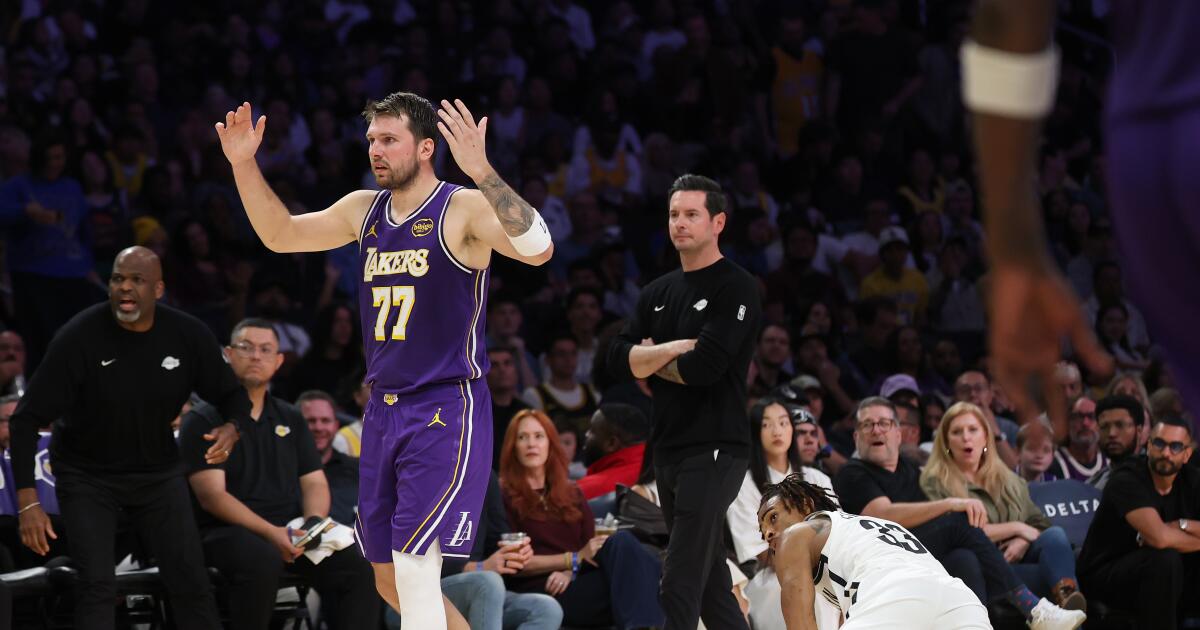
Doncic will serve a one-game suspension because of technical foul accumulation, the NBA announced Saturday, sidelining him for Monday’s game against the Washington Wizards after he picked up his 16th technical foul of the season in the Lakers’ win over the Brooklyn Nets on Friday.
Doncic said he was trying to get away from Brooklyn’s Ziaire Williams when he pushed the Nets forward aside with 5:12 remaining in the third quarter. Doncic had just been called for an offensive foul while the Lakers were attempting to inbound the ball. Williams was shouting in Doncic’s direction. Doncic attempted to move past Williams and the 24-year-old from Lancaster then waved his arm behind him and slapped Doncic in the throat. Both were given technical fouls.
Doncic said referees told him his push was “exaggerated.”
“Which was obviously [not the case],” said Doncic, who scored 41 points with eight rebounds and three assists in the win.
This is the second time in a week that Doncic has faced the mandatory suspension after getting his 16th technical foul, but he avoided the fate after the NBA rescinded a technical he picked up against Orlando on March 21. The reversal kept Doncic available for the Lakers’ matchup with Eastern Conference-leading Detroit on March 23 in which Doncic scored 32 points, but missed the potential game-tying three at the buzzer of a tense 113-110 Lakers loss that ended a nine-game winning streak.
Monday’s game will likely not have the same drama.
The Wizards (17-56) have lost 17 of their last 18 games. The only win came against the Utah Jazz, another team that’s attempting to position itself for the lottery more than the playoffs. Washington will be without Trae Young (quad) and Anthony Davis (finger), the team’s two major midseason acquisitions.
With another bottom-feeding team coming to Crypto.com Arena, Doncic and the Lakers might actually benefit from resting the superstar. He played through left hamstring soreness Friday, and the Lakers (48-26) host the playoff-bound Cleveland Cavaliers on Tuesday. The days between Friday’s win and Monday’s game will be the Lakers’ first two-day break since the All-Star Game.
Doncic, the NBA’s leading scorer, has charged into the most valuable player conversation by helping lift the Lakers into third place in the Western Conference. He has scored 30 or more points in 12 consecutive games, the longest such streak for his career.
The Lakers have won 15 of their last 20 games with Doncic averaging 35.5 points per game during the span. With 102 steals on the season, including three against the Nets, Doncic also became the first Laker since Kobe Bryant in 2012-13 averaging 30 or more points per game with 100 or more total steals.
The Lakers could also be without guard Marcus Smart, who has missed the last three games because of a right ankle contusion. He also suffered a hip injury in a separate fall against Orlando, but he is showing improvement and remains day-to-day, Lakers coach JJ Redick said Friday.
Talks broke down this week that would lead to widespread disruption for travellers over Easter to airports in places like Mallorca and the Canary Islands
Robert Rowlands Deputy editor, money and lifestyle, content hub and Maria Ortega
13:52, 27 Mar 2026
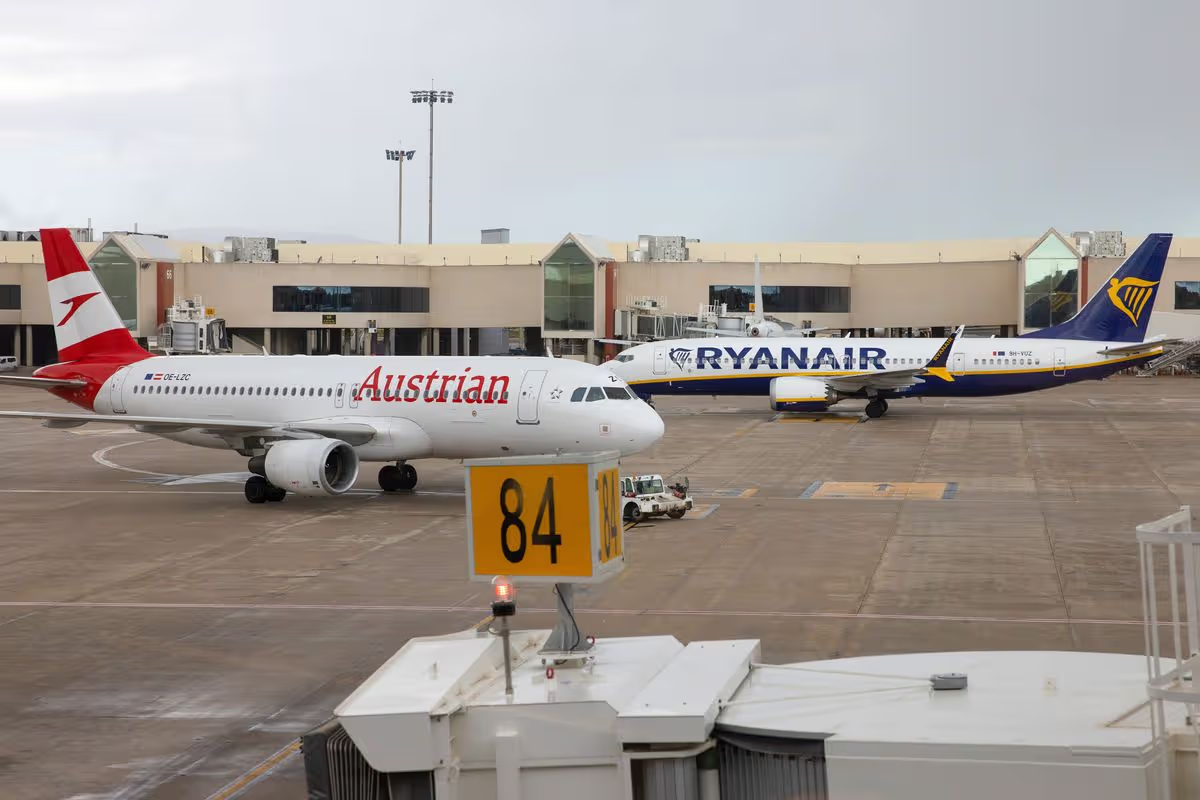
Palma de Mallorca Airport is one of the airports that has been at the centre of debate over industrial action(Image: Getty)
UK tourists have been given a significant update over planned strike action at multiple airports in Spain. Talks broke down this week before officials announced that strikes would be held over several dates in March and April.
Airports set to be affected by the measures included Barcelona, Palma de Mallorca, , Gran Canaria, Málaga, Alicante, and Tenerife (South and North). Now an update has been reported in the Spanish press.
Two sets of strikes at Spanish airports have been partly cancelled, according to Spanish media reports. There had been concerns about extensive disruption at major airports throughout Spain owing to industrial action.
Larazon now reports that trade unions have postponed imminent strikes due to start today that would have seen staff at airport services operators Groundforce and Menzies walk out. The update comes after advances in wage negotiations – but strikes planned for later on have yet to be cancelled, according to local media.
Spanish reports say that trade unions have called off the first day of strike action at Groundforce, Air Europa’s ground handling company, and the first two days of the strike scheduled for this weekend at Menzies, another airport ground handling operator. This is according to sources from the UGT trade union speaking to Efe.
The partial and indefinite strikes planned Groundforce strikes were set to began this Friday. They would have coincided with the beginning of the Easter holiday exodus.
Ultimahora reports that the industrial action at Groundforce had been scheduled for the morning, afternoon and night shifts (from 5am to 7am, from 11am to 5pm, and from 10pm to midnight) with plans set to continue indefinitely. Additionally, the UGT has agreed to call off the first two days of industrial action at Menzies, planned for this Saturday and Sunday. In Menzies’ case, the strike had been called exclusively by UGT – the main union at the firm – for 28 and 29 March, and between 2 and 6 April.
The English language Majorca Daily Bulletin reports that 24-hour strikes for Menzies staff from April 2 to April 6 have not yet been scrapped. It also reported that there is no sign of further suspensions to the other planned strike action for Groundforce staff.
The strike notice at the ground handling operator covered all businesses within the group (Menzies Aviation Ibérica and Menzies Ground Services) and around 3,000 employees. The union had cautioned that, should no deal be struck with the company, the strikes would be rolled out to every weekend until the year’s end.
Groundforce operates at Madrid, Barcelona, Palma de Mallorca, Alicante, Málaga, Gran Canaria, Valencia, Ibiza, Bilbao, Lanzarote and Fuerteventura. Menzies operates at Barcelona, Palma de Mallorca, Málaga, Alicante, Gran Canaria, Tenerife South and Tenerife North.
1 of 3 | Union Station is largely empty amid lockdowns and social distancing due to the COVID-19 pandemic April 24, 2020, in Washington, D.C. On March 26, 2020, new unemployment claims in the United States surged to 3.3. million, the largest weekly increase in U.S. history to date amid job losses related to the pandemic. File Photo by Tasos Katopodis/UPI | License Photo
March 26 (UPI) — On this date in history:
In 1830, the Book of Mormon was published. There are about 200 surviving first editions of the book, one of which was stolen before being returned to its owner in 2013.
In 1971, East Pakistan declared independence as Bangladesh, sparking the Bangladesh Liberation War. The war ended Dec. 16, 1971, when West Pakistan surrendered.
In 1975, the city of Hue in South Vietnam fell to the North Vietnamese army.
In 1991, Mali’s dictator, Gen. Moussa Traore, was overthrown in a violent overnight military coup. Fifty-nine people died.
In 1992, former heavyweight boxing champion Mike Tyson, convicted of raping a teenage beauty pageant contestant, was sentenced to six years in prison. Tyson was released after three years.
File Photo by Jim Ruymen/UPI
In 1997, 39 members of the Heaven’s Gate religious cult were found dead in a large house in Rancho Mirage, Calif., in what authorities said was a mass suicide.
In 1999, Dr. Jack Kevorkian, the euthanasia advocate, was convicted of second-degree murder in an Oakland County, Mich., courtroom for the videotaped “medicide” of a man suffering from Lou Gehrig’s disease.
File Photo by Vaughn Gurganian/UPI
In 2000, acting Russian President Vladimir Putin was elected president by a more than 20 percent margin. Putin won a third term in 2012.
In 2014, a National Labor Relations Board regional director ruled that Northwestern University scholarship football players were employees of the school and entitled under federal law to form a union.
In 2020, new unemployment claims in the United States surged to 3.3. million, the largest weekly increase in U.S. history to date amid job losses related to the COVID-19 pandemic.
In 2024, a Singapore-based cargo ship struck the Francis Scott Key Bridge in Baltimore, causing a catastrophic collapse of the structure. Six people died in the failure of the bridge, which crossed the Patapsco River.
On a day when No. 1 seeds dominated, UCLA wasn’t the exception.
The top-seeded Bruins led wire-to-wire, beating No. 8-seed Oklahoma State 87-68 in the second round of the NCAA tournament on Monday night at Pauley Pavilion to advance to the Sweet 16.
They will face No. 4-seed Minnesota on Friday in Sacramento.
While UCLA started much better than it did in its opening-round game, there were still elements to nitpick. The Bruins were outscored 21-18 in the third quarter, Oklahoma State won the offensive rebounding battle and outside of Lauren Betts — who scored a career-high 35 points while shooting 15 of 19 — the offense fell flat at times in the second half.
But with arguably the best post player in the country, the Bruins overcame all of that.
UCLA (33-1) jumped out to an 11-2 lead while the Cowgirls (24-10) went the final 4:26 without scoring and shot 0 for 8 from the field during that span. The Bruins turned that into a 25-point lead and were up 46-26 at halftime.
Unlike the first-round victory over California Baptist on Saturday, UCLA came out cold to start the third quarter. The Bruins missed six shots in a row while Oklahoma State went on a 9-0 run to narrow the deficit to 13.
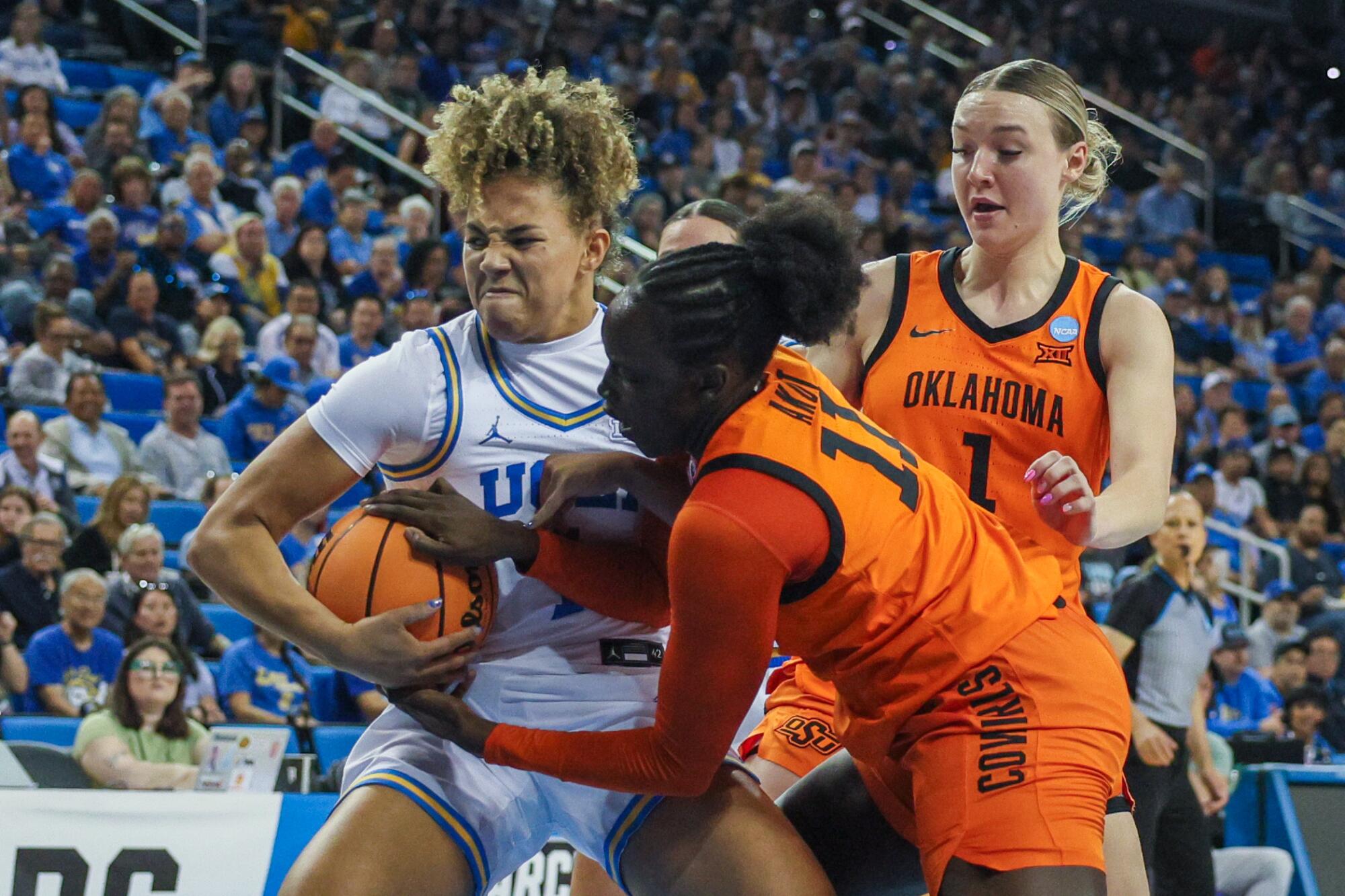
UCLA guard Kiki Rice, left, fights for the ball with Oklahoma State forward Achol Akot during the Bruins’ win Monday.
(Ronaldo Bolanos / Los Angeles Times)
The Cowgirls shot 51.4% from the field in the second half to stay within striking distance while UCLA’s offense went mostly cold. But Oklahoma State’s leading scorer, Achol Akot (23 points), had four fouls by the start of the fourth quarter and had to spend much of the quarter on the bench.
Betts scored 11 consecutive UCLA points in the final four minutes of the third to put the Bruins ahead by 19. In addition, she finished the game with nine rebounds and five assists.
Gianna Kneepkens (15 points) made a couple of key shots in the fourth quarter to help jolt the Bruins’ shooting, but it was still Betts’ dominant showing that kept UCLA well ahead. Of UCLA’s 87 points, 50 came in the paint.
UCLA’s next opponent, the Golden Gophers (24-8), advanced on a buzzer-beater against No. 5-seed Mississippi on Sunday. The Bruins beat Minnesota 76-58 on the road during conference play earlier this season.
PHILADELPHIA — On the night reigning NCAA champion Florida was eliminated by Iowa, UCLA tried to follow the Hawkeyes’ lead against Connecticut, the team that had worn the crown the previous two years.
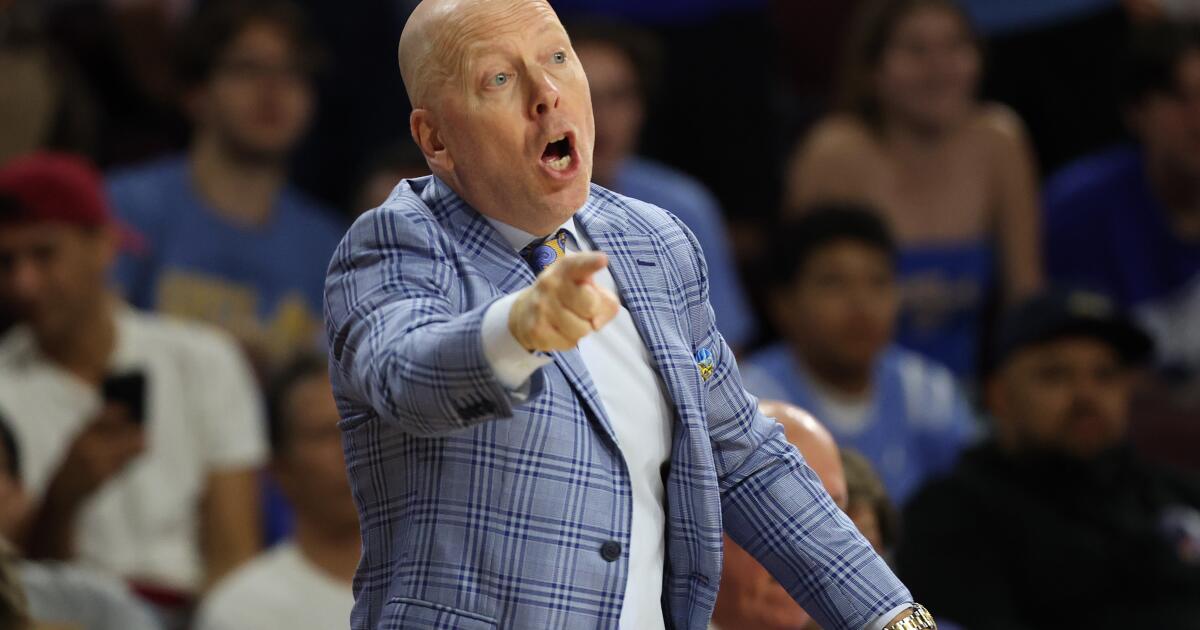
And for the second straight game they were hoping to win without leading scorer Tyler Bilodeau, whose sprained knee still hadn’t healed enough for coach Mick Cronin to risk putting him on the floor.
Seventh-seeded UCLA battled, managing to take a brief lead in the second half. But in the end, No. 2 Connecticut’s size and power were too much for the Bruins to overcome in a 73-57 loss in the second round of the NCAA tournament Sunday.
Four players scored in double figures for UCLA. Xavier Booker finished with 13 points, Eric Dailey Jr. had 12 points and Donovan Dent and Skyy Clark each finished with 11. But the Bruins couldn’t contain Connecticut forward Alex Karaban, who erupted for 27 points, as the Huskies advanced to the Sweet 16 to play No. 3 Michigan State in Washington, D.C., on Friday.
The Bruins got off to a good start, building an 18-12 lead before the Huskies caught fire, hitting seven straight shots at one point to seize a 38-33 halftime lead.
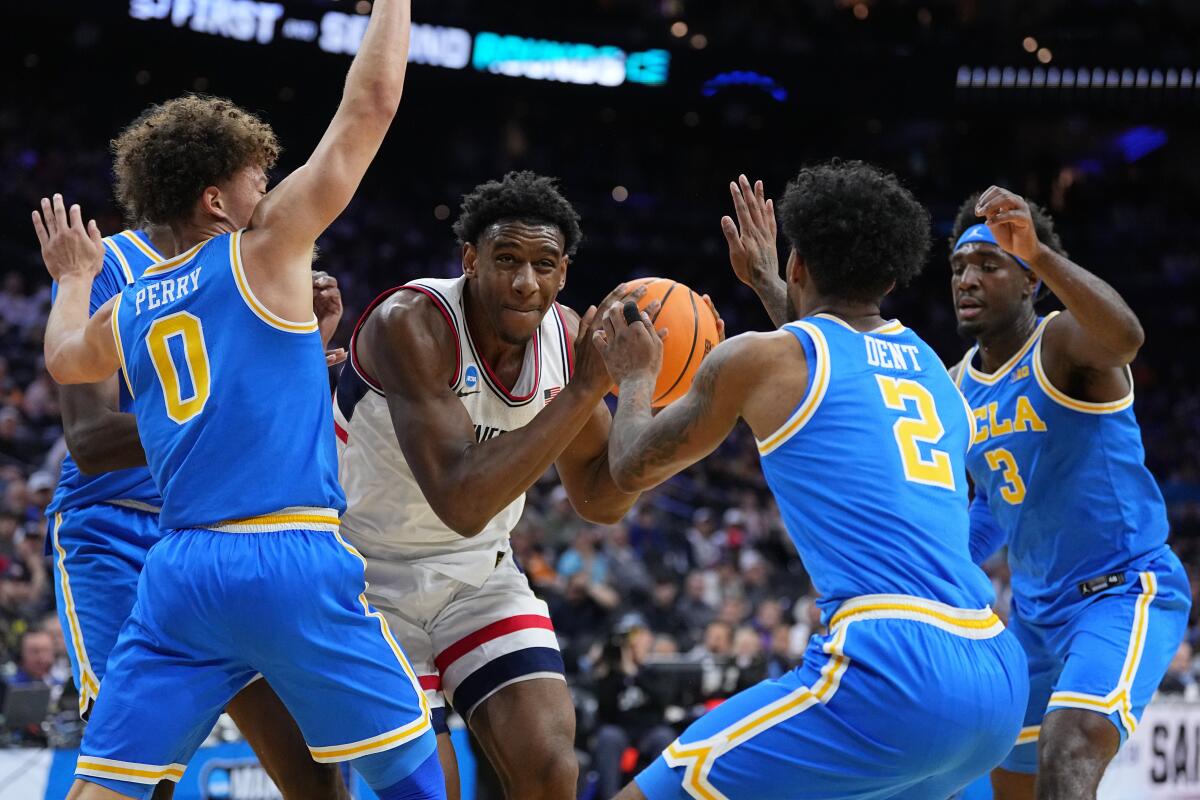
Connecticut’s Tarris Reed Jr., center, tries to work past (from left) UCLA’s Trent Perry, Donovan Dent and Eric Dailey Jr. during the first half Sunday.
(Matt Rourke / Associated Press)
UCLA (24-12) started the second half on a 6-0 run, regaining a 39-38 edge on a corner jumper by Clark.
Connecticut (31-5) didn’t wait long to retake control, going on a 14-0 run over the next five minutes, with Karaban scoring 10 points over that span.
UCLA answered with an 8-0 run, with Dailey’s three-point play cutting Connecticut’s lead to 56-52 and reigniting the Bruins’ hope of an upset. Connecticut, however, responded with a decisive 9-0 run, taking a 67-54 lead with 4:24 left.
UCLA struggled with its shooting most of the night, going 19 for 49 (39%) in comparison to Connecticut’s 23 for 49 (47%). Both teams had the same number of free-throw attempts (21), but the Bruins made just 67% of their shots and the Huskies made 90%.
On Monday came the latest evidence of dysfunction within the Trump administration’s counterterrorism apparatus, when Joe Kent, the director of the National Counterterrorism Center, resigned, citing his opposition to the war in Iran. But the disarray is not new.
In July 2025, Sebastian Gorka, the senior director for counterterrorism on President Trump’s National Security Council,announced that he was “on the cusp of releasing the unclassified new presidential U.S. counterterrorism policy.” Yet eight months later, while America wages war on a notorious state sponsor of terrorism, the strategy has yet to be released.
Meanwhile, the Department of Homeland Security has not published a National Terrorism Advisory since September and has failed to issue the annual Homeland Threat Assessment report since Trump returned to office. This remains the case, even as counterterrorism experts have warned about the possibility of Iranian-backed sleeper cells being activated because of the current conflict with Iran.
Without a strategy that clearly lays out American priorities and responses, America’s counterterrorism defenses are divided, disorganized and under-resourced. It is this malfunction that left Trump answering a question about whether Americans should expect more violence in the homeland with aneffective shoulder shrug: “I guess.”
The homegrown backlash to the Iran conflict began on March 1, when a naturalized U.S. citizen opened fire at a bar in Austin, Texas. The gunman, who waswearing clothing pointing to his support of Iran, killed three before being killed by police gunfire. On March 7, two Islamic State-inspired teenshurled improvised explosive devices at a group of far-right protesters outside the New York City mayor’s mansion. March 12 then saw two attacks. First, a shooting erupted at Old Dominion University, as a former U.S. National Guardsman who had been prosecuted for Islamic State-related plottingkilled an ROTC instructor. Then, a U.S. citizen with family ties to Lebanondrove his vehicle into Temple Israel in West Bloomfield, Mich., before dying in an exchange of gunfire with synagogue security officers.
In three of the four attacks, further violence was stopped by heroic takedowns on scene. Perhaps most notably, the Old Dominion attacker was neutralized by students, who stabbed the gunman to death. The heroic stories,while worth uplifting, underscore a bleaker truth: amid war abroad, Americans have been forced to take counterterrorism into their own hands in their own communities, left to fend for themselves against AR-15s, improvised explosive devices and weaponized vehicles.
The diversity of the attacks and the perpetrators makes matters worse. The attackers include a U.S. National Guard veteran who served several years in prison on terrorism charges, two teenagers who traveled to a different state with violent intentions, a man with an apparently long history of mental illness, and a U.S. citizen who lost family members in the latest Israeli-Hezbollah hostilities. Their targets also point to a complex and unpredictable terrorism environment.
Absent more predictable trends, law enforcement will be spread thin, asked to protect an impossible array of locations across the country against an impossible diversity of threats. In this environment, an effective national counterterrorism strategy would likely point to stopping terrorism further upstream, interrupting radicalization and violent mobilization at an earlier stage. Yet the Trump administration has effectively eviscerated its prevention infrastructure, largely dismantling the Department of Homeland Security’s Center for Prevention Programs and Partnerships.
Notably, too, none of the attacks to date seem to be coordinated or directed by the Iranian regime, with the war instead inspiring Western lone actors to attack their own communities. Yet Iran has long engaged in assassination plots in the United States, often by enlisting third-party criminal groups, and may yet seek to activate such a program. As journalists Peter Beck and Seamus Hugheswarn: “Iran’s past calculus was low-grade operations in the United States, enough to keep the FBI busy but not large enough to trigger serious military consequences. With the latter now already a reality, the Islamic Republic has less to lose by orchestrating bolder attacks.”
The Trump administration has repeatedly invoked Iran’s history of support for terrorist proxies to justify the conflict: On March 2, for instance, Trump explained that one of the operation’s objectives was “ensuring that the Iranian regime cannot continue to arm, fund and direct terrorist armies outside of their borders.” Indeed, should it follow its historical model, Iran will likely continue to make external operations and inspired violence a significant part of its response, adding sleeper cell activation and sponsored individuals to the ranks of homegrown violent extremists who have so far plagued America’s homeland since hostilities broke out. But without a more defined strategy, America will likely struggle to mount an effective response.
If, as the old saying goes, “all politics is local,” then the modern-day corollary in an era of smartphones is, “all conflict is global.” Whenever there is a war in the Middle East, as kicked off in Gaza following the Hamas terror attacks in southern Israel on Oct. 7, 2023, it exacerbates the terrorism threat landscape around the world, including in the West. When images and videos of the errant U.S. missile attack on a girls’ school flood the internet, it raises the temperature, making attacks by lone actors and other violent extremists with only tangential connections to the conflict more likely.
The breadth of the violence, however, was not guaranteed or pre-ordained. As a Shiite-majority nation, Iran has long held fractious and even hostile relationships with Sunni jihadist actors. The extent of the violence indicates a broader anti-American sentiment prevailing across diaspora communities, likely precipitated by the decades-long war on terror, greatly aggravated by Israeli abuses in Gaza since Oct. 7, 2023, and punctuated by the killings of schoolchildren. The Iran war, in other words, seems to be superseding earlier grievances and instead uniting disparate extremist forces against the United States.
In this environment, the Trump administration needs to stop being so cavalier about counterterrorism. Devoid of an actual strategy and without a director of the National Counterterrorism Center, the United States is even more vulnerable to an attack on the homeland than it would be with those in place. Writing on X, Robert A. Pape, a longtime scholar of terrorism, posted: “After tracking terrorism for 25 years, this is a flashing red light — as bright as I’ve seen prior to a serious attack.”
Only a serious approach to countering terrorism will keep the United States safe, and this is the moment for the Trump administration to demonstrate that it recognizes the stakes. In counterterrorism, inattention can be deadly.
Jacob Ware is a terrorism researcher and the co-author of “God, Guns, and Sedition: Far-Right Terrorism in America.” Colin P. Clarke is the executive director of the Soufan Center. His research focuses on terrorism, counterterrorism and armed conflict.
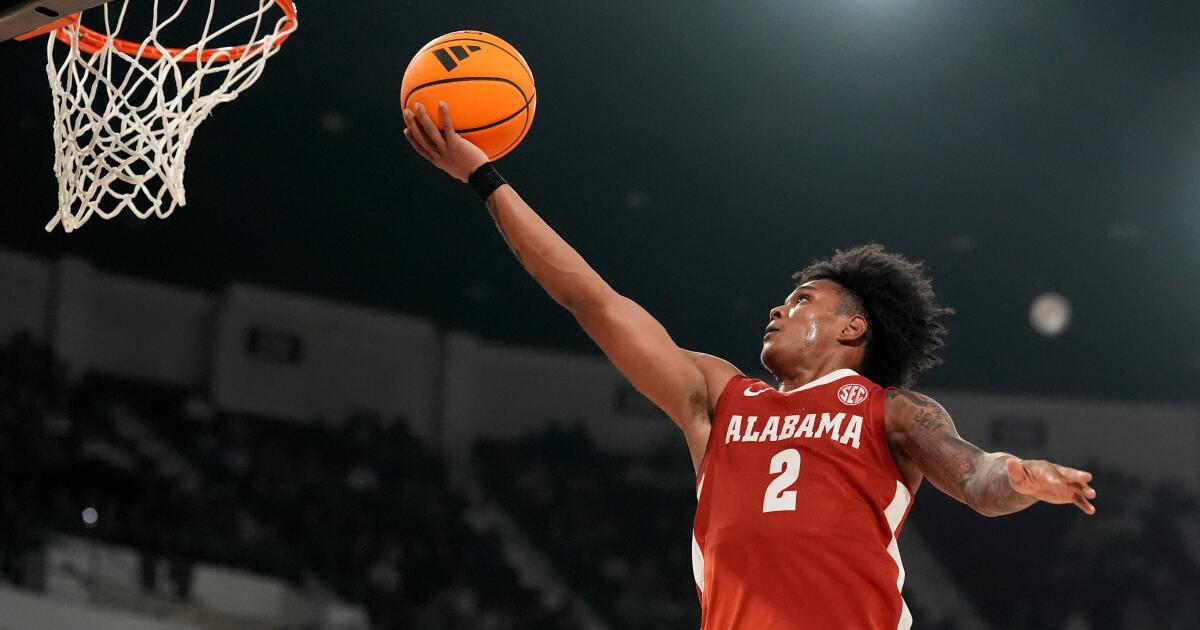
Aden Holloway, the second-leading scorer for the Alabama men’s basketball team, was arrested Monday on a felony drug charge and may not be available for the Crimson Tide during March Madness, pending the university’s investigation into the matter.
Alabama coach Nate Oats said that after he told his players about the situation, the team went out and had “a really good practice” four days ahead of its first-round NCAA tournament game against Hofstra.
“Aden’s one of our guys, and everybody wants to wrap their arms around [him],” Oats said Monday during an appearance on the Crimson Tide Sports Network. “Everybody makes some mistakes in life, but [the players] also understand we’ve got to move on … and the team’s got to go play Friday.
“So I thought we did a good job of that this morning, kind of addressing the situation, what we currently knew at the time, and got our guys focused on practice.”
Holloway’s arrest came after the West Alabama Narcotics Task Force searched a residence near campus and “recovered more than a pound of marijuana, paraphernalia and cash,” the Tuscaloosa Police Department said.
The 21-year-old player is facing a first-degree charge of marijuana possession, not for personal use, which is a Class C felony and carries a penalty of up to 10 years in prison and a maximum fine of $15,000.
Police said Holloway also will be charged with failure to affix a tax stamp, another felony. Holloway was taken to jail shortly before 10 a.m. and was released less than an hour later on a $5,000 bond.
Alabama said in a statement Monday: “The University is aware of the allegations and is working to gather more information. The student has been removed from campus pending further investigation by the UA Office of Student Conduct.”
Oats said players need to be held accountable if they fail to meet the standards set by the program.
“So, you know, we had to suspend [Holloway] pending the investigation by the UA office of student conduct,” Oats said. “And we’re certainly disappointed in his behavior. But that being said, we still love him. He’s still our guy. We’re helping him get the help he needs, and we’re going to continue to help him whatever way we can.”
Meanwhile, the Crimson Tide, the No. 4 seed in the Midwest Region, continues to prepare to face 13th-seeded Hofstra on Friday without a player who averages 16.8 points a game. Sophomore guard Labaron Philon Jr. leads the team with 21.7 points a game, and sixth-year senior Latrell Wrightsell Jr. is averaging 12.8 points.
“I did tell our team, this team more than any team I’ve ever coached is better equipped to handle a situation like this,” Oats said. “I don’t know how many games we went into where we had a game time decision. Guy goes, warms up, and we got to decide whether he’s going to play or not an hour before the game. … We’ve won plenty of games with guys not available, so our guys will be ready to go against Hofstra.”
1 of 8 | On March 17, 1776, the Continental Army under Gen. George Washington forced British troops to evacuate Boston. The historic moment was depicted in the 1911 painting The Evacuation of Boston by William James Aylward. File Image courtesy of the New York Public Library
March 17 (UPI) — On this date in history:
In 1762, New York City staged its first parade honoring the Roman Catholic feast day of St. Patrick, the patron saint of Ireland. It was led by Irish soldiers serving in the British army. In 2002, President George W. Bush became the first sitting U.S. president to take part in the event, more than six months after the Sept. 11, 2001, terror attacks on the city.
In 1776, the Continental Army under Gen. George Washington forced British troops to evacuate Boston. The Boston area marks Evacuation Day along with its St. Patrick’s Day parade each year.
In 1901, 71 paintings by the late Dutch painter Vincent van Gogh were shown at the Bernheim-Jeune gallery in Paris and caused a sensation across the art world.
In 1974, the oil-producing Arab countries agreed to lift a five-month embargo on petroleum sales to the United States. The embargo, during which gasoline prices soared 300%, was in retaliation for U.S. support of Israel during the October 1973 Middle East War.
In 1990, Lithuania rejected the Soviet Union’s ultimatum to renounce its declaration of independence a week prior. The Soviets implemented sanctions against Lithuania and conducted a military operation in 1991 before other Soviet republics eventually declared their independence.
In 1992, South African Whites, by a margin of 68.7% to 31.2%, voted to end minority rule. Nelson Mandela was elected two years later as the first president in a fully representative democratic election.
In 2003, as war with Iraq seemed a certainty, U.S. President George W. Bush gave Iraqi President Saddam Hussein and his sons 48 hours to leave the country. The ultimatum was rejected.
In 2024, Russian President Vladimir Putin won a fifth term in office, making him the longest-serving leader of the country in about two centuries. A Russian election watchdog called the election unconstitutional.
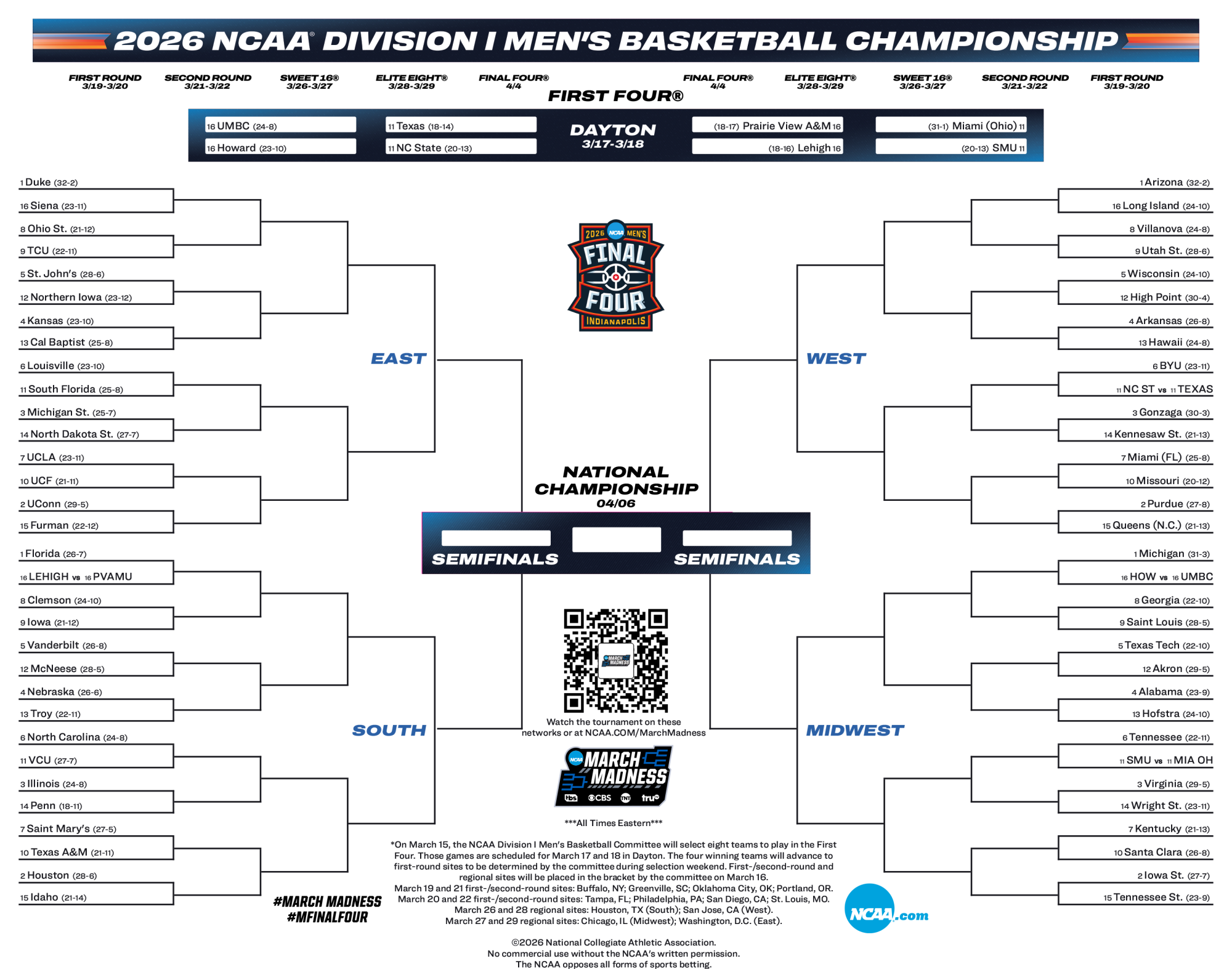
The 68-team bracket for the 2026 NCAA men’s basketball tournament is set. Matchup starting times and broadcast information will be announced later on Sunday.
The men’s First Four begins Tuesday and first-round games begin on Thursday.
First Four
Tuesday-Wednesday (at Dayton, Ohio) No. 11 Texas (18-14) vs. No. 11 North Carolina State (20-13) No. 11 Miami (Ohio) (31-1) vs. No. 11 Southern Methodist (20-13) No. 16 Maryland Baltimore County (24-8) vs. Howard (23-10) No. 16 Prairie View A&M (18-17) vs. No. 16 Lehigh (18-16)
East Region
FIRST ROUND Thursday (at Greenville, S.C.) No. 1 Duke (32-2) vs. No. 16 Siena (23-11) No. 8, Ohio State (21-12) vs. No. 9 Texas Christian (22-11) Friday (at San Diego) No. 5 St. John’s (28-6) vs. No. 12 Northern Iowa (23-12) No. 4 Kansas (23-10) vs. No. 13 California Baptist (25-8) Thursday (at Buffalo) No. 6 Louisville (23-10) vs. No. 11 South Florida (25-8) No. 3 Michigan State (25-7) vs. No. 14 North Dakota State (27-7) Friday (at Philadelphia) No. 7 UCLA (23-11) vs. No. 10 Central Florida (21-11) No. 2 Connecticut (29-5) vs. No. 15 Furman (22-12)
West Region
FIRST ROUND Friday (at San Diego) No. 1 Arizona (32-2) vs. Long Island University (24-10) No. 8 Villanova (24-8) vs. No. 9 Utah State (25-8) Thursday (at Portland) No. 5 Wisconsin (24-10) vs. No. 12 High Point (30-4) No. 4 Arkansas (26-8) vs. No. 13 Hawaii (24-8) No. 6 Brigham Young (23-11) No. 11 Texas / North Carolina State No. 3 Gonzaga (30-3) vs. No. 14 Kennesaw State (21-13) Friday (at St. Louis) No. 7 Miami (25-8) vs. No. 10 Missouri (20-12) No. 2 Purdue (27-8) vs. No. 15 Queens (21-13)
Midwest Region
FIRST ROUND Thursday (at Buffalo) No. 1 Michigan (31-3) vs. No. 16 Maryland Baltimore County / Howard No. 8 Georgia (22-10) vs. No. 9 Saint Louis (28-5) Friday (at Tampa) No. 5 Texas Tech (22-10) vs. No 12 Akron (29-5) No. 4 Alabama (23-9) vs. No. 13 Hofstra (24-10) Friday (at Philadelphia) No. 6 Tennessee (22-11) vs. No. 11 Miami (Ohio) / Southern Methodist No. 3 Virginia (29-5) vs. No. 14 Wright State (23-11) Friday (at St. Louis) No. 7 Kentucky (21-13) vs. No. 10 Santa Clara (26-8) No. 2 Iowa State (27-7) vs. No. 15 Tennessee State (23-9)
South Region
FIRST ROUND Friday (at Tampa) No. 1 Florida (26-7) vs. No. 16 Prairie View A&M / Lehigh No. 8 Clemson (24-10) vs. Iowa (21-12) Thursday (at Oklahoma City) No. 5 Vanderbilt (26-8) vs. No. 12 McNeese (28-5) No. 4 Nebraska (26-6) vs. No. 13 Troy (22-11) Thursday (at Greenville, S.C.) No. 6 North Carolina (24-8) vs. No. 11 Virginia Commonwealth (27-7) No. 3 Illinois (24-8) vs. No. 14 Pennsylvania (18-11) Thursday (at Oklahoma City) No. 7 Saint Mary’s (27-5) No. 10 Texas A&M (21-11) No. 2 Houston (28-6) vs. Idaho (21-14)
No. 7-seed UCLA’s (22-11) push for another deep NCAA tournament run begins Friday against No. 10-seed Central Florida (21-11) in Philadelphia in the East Regional. If the Bruins win, they will face the winner of No. 2 Connecticut (29-5) versus No. 15 Furman (22-12).
Cronin was hoping the Bruins, who flew home from the Big Ten tournament in Chicago on Sunday morning, would get a break and open postseason play Friday rather than Thursday. He recalled playing in the American Athletic Conference tournament championship on Sundays and still getting assigned Thursday NCAA tournament games, but Purdue coach Matt Painter told Cronin on Saturday night that he should be in line for a Friday NCAA tournament opener and the forecast proved accurate.
Cronin said the universal UCLA program focus on NCAA tournament success drove his decision to hold forward Tyler Bilodeau and guard Donovan Dent out of a 73-66 Big Ten semifinal loss to Purdue on Saturday night at the United Center. Bilodeau’s injury was a minor knee sprain suffered in the win over Michigan State on Friday, while Dent suffered a minor calf strain early in the game against the Boilermakers. Both are expected to be ready to play Friday.
“Tyler could have played [against Purdue.] You know, Donny could have played. They would have been playing hurt,” Cronin said after the loss to the Boilermakers. “I wouldn’t have played them in a regular season game. I just try to take care of guys.”
The coach said the extra minutes played by Eric Freeny, Xavier Booker, Steven Jamerson II and Brandon Williams will help the Bruins when the full lineup is in place for NCAA tournament games.
He called the team’s effort to push eventual Big Ten champion Purdue valiant, but the games ahead in March simply mean more to the Bruins.
“With all due respect to the Big Ten, you could see how hard our guys are trying to win,” Cronin said. “But our guy are well aware, because they practice under 11 banners that say national championship every day. They warm up under another banner with 19 Final Fours on it. We don’t even have one with conference championships cause there’s 36 or something. There’s so many. So [this] week is what it’s about for us.”
UCLA enters the tournament on a 4-1 streak, looking especially strong since the calendar hit March.
“I was happy with the way we competed,” Cronin said when asked whether he learned anything about his players during a spirited Big Ten tournament run. “… We got talent, we just haven’t always had our mind on defense, which is very rare for teams that I coach. We got great guys. Since March 1 or whenever the heck we played Nebraska, it’s been a noted change in our team, we’ve just got to keep it up. And we’ve got to get some rebounds out of the five spot.
”… We’re at UCLA, no matter who we take the floor against in the NCAA tournament, we’re going to be the ones wearing the baby blues and four letters. So we believe in ourselves.”
UCF is coached by former Duke star Johnny Dawkins. Point guard Themus Fulks is a key leader for the Knights, earning third team All-Big 12 honors after averaging 14.1 points and 6.7 assists per contest during the regular season.
UCF posted top-25 wins over Kansas, Texas Tech and Brigham Young.
Don’t blame the beleaguered voter for the record-low statewide turnout of 34% of registered voters in Tuesday’s primary election. Don’t call the stay-at-homes lazy or berate them for failing to do their duty. Don’t wonder why the patriotism stirred by Sept. 11 didn’t translate into an energized electorate.
The truth is, for many Californians, there were just too many reasons not to vote. The lack of hot contests on the Democratic ballot resulted in dismal turnouts of 23% in heavily Democratic Los Angeles County and 27% in San Francisco. The confusing rules of the primary had been changed again as to who could vote for which slate of candidates.
The campaign was overshadowed first by the Super Bowl and then by the Winter Olympic Games. When the political ads finally got the public’s attention, their constant carping and attacks surely turned off many voters. On election day some locales, including Los Angeles, were plagued with the failure of some polling places to open on time, ballots that weren’t delivered and voting locations that were changed or yanked.
The real culprit, however, was the ridiculously early primary date, more than eight months before the Nov. 5 general election. Many Californians didn’t even realize an election was coming up.
The Legislature and governor should make sure this doesn’t happen again. Lawmakers need to take a close look at SB 1975, by Sen. Ross Johnson (R-Irvine), a bill that would move the primary for state and local candidates to the second Tuesday in September every election year while maintaining a separate presidential primary in March.
The idea is to enable California to have a rational primary date while retaining some clout in the choosing of the presidential candidates. More discussion is in order about whether September balloting would allow enough time for an informative general election campaign. However, nine states have August primaries, and 10, including New York, vote on the second Tuesday in September, the day Johnson has proposed. A cheaper proposal would be for the state to stop playing presidential primary leapfrog for ever-earlier dates and move all primaries back to June.
Election officials struggle to make it convenient for Californians to vote, but the process remains complex and confusing. “It felt more like doing your taxes,” one expert said. The first step toward rationality is getting rid of this March madness.
Tens of thousands of people have gathered around the world for al-Quds Day, an annual event on the final Friday of Ramadan demonstrating solidarity with Palestine and opposition to Israeli occupation.
Rallies took place across numerous countries, including Iran, Malaysia, Indonesia, Kashmir and Yemen. In Tehran, thousands marched, chanting “death to Israel” and “death to America” as the United States-Israeli military campaign entered its 14th day of conflict.
The event has long been associated with Iran, and was established by the country’s first supreme leader, Ayatollah Ruhollah Khomeini, in 1979.
This year’s observance coincided with the US-Israel attack on Iran that has killed at least 1,444 people, including the Iranian supreme leader, Ali Khamenei.
Crowds turned out in Tehran and other cities, despite ongoing US and Israeli strikes in the region during the commemoration, state media reported.
Demonstrators worldwide expressed solidarity with both Palestinians and Iranians. In Kashmir, protesters burned mock coffins bearing images of US President Donald Trump and Israeli Prime Minister Benjamin Netanyahu while shouting slogans against the United States and Israel.
For the first time in 40 years, the United Kingdom banned London’s al-Quds Day march, citing risks of public disorder related to the “volatile situation in the Middle East” and potential confrontations between opposing groups. This marks the first protest ban since 2012, when authorities prohibited marches by the far-right English Defence League.
According to Iran’s Health Ministry, another 18,551 people have been injured in US-Israeli attacks on Iran since February 28.
The index provider reviews the S&P 500 every quarter using rigorous criteria on market capitalisation, profitability, liquidity and sector balance to ensure it reflects the largest and most representative top 500 US companies.
ADVERTISEMENT
ADVERTISEMENT
The latest update will bring Vertiv Holdings, Lumentum Holdings, Coherent Corp. and EchoStar Corporation into the index.
They replace Match Group, Molina Healthcare, Lamb Weston Holdings and Paycom Software, with the changes taking effect before the market opens on Monday 23 March.
With trillions of dollars in assets tracking the S&P 500, the rebalance typically prompts buying from passive funds, often providing a short-term lift to new members.
Shortly after the S&P Global announcement, on Friday 6 March, all four companies’ shares rose on average 8% as investors began anticipating the increased flow.
Three out of the four incoming firms supply critical infrastructure for the AI boom, from power and cooling systems to high-speed optical components.
According to S&P Global, the changes show how sustained AI investment has become a structural force in the market, to the point that it is reshaping the index composition.
Big Tech is guiding for roughly €600bn in AI spending this year alone.
Vertiv
Vertiv Holdings specialises in critical digital infrastructure, offering power management, thermal management and modular systems that support high-density computing in data centres.
The company has seen explosive demand for liquid cooling and high-power solutions as AI workloads drive energy consumption far beyond conventional levels.
According to Vertiv’s fourth quarter 2025 earnings, released in February, organic orders grew 252% year-on-year in the final quarter, pushing its backlog to $15bn (€13bn) –– a 109% rise from the previous year.
The book-to-bill ratio reached approximately 2.9 times and full-year 2026 guidance points to organic sales growth of 27% to 29%, indicating very strong requisition.
The firm’s strong performance reflects its central role in enabling the hyperscalers’ expansion of AI infrastructure.
Inclusion in the S&P 500 is expected to increase visibility and liquidity through passive fund inflows. This milestone underscores Vertiv’s evolution into a key enabler of the physical infrastructure powering AI growth.
Lumentum
Lumentum Holdings develops advanced optical components, lasers and transceivers that deliver the ultra-high-speed connectivity required inside data centres and across communications networks.
Its products are essential for handling the massive bandwidth demands of AI model training and inference.
In early March, Nvidia announced a multi-year strategic partnership with Lumentum that includes a $2bn (€1.7bn) investment to expand capacity, advance US-based manufacturing and deepen research and development collaborations.
This partnership came alongside multibillion-dollar purchase commitments for advanced laser components.
The S&P 500 addition elevates the profile of optical technologies as a foundational layer in next-generation AI infrastructure.
For Lumentum, the move reinforces its position as a critical supplier in the race to scale AI systems efficiently and at unprecedented speeds.
Coherent
Coherent Corp. focuses on photonics and laser technologies, with a strong emphasis on silicon photonics and high-speed optical interconnects designed for large-scale AI computing clusters.
The company has repositioned its portfolio to tackle latency and power-efficiency challenges in hyperscale environments.
Similar to Lumentum, the company recently disclosed a parallel strategic partnership with Nvidia, also including a $2bn (€1.7bn) investment and multibillion-dollar purchase commitments for advanced optics.
The collaboration targets technologies vital for future data centre architectures and supports expanding US manufacturing.
The S&P 500 inclusion recognises Coherent’s transformation and the structural demand from global AI build-outs.
Greater institutional interest and enhanced liquidity are widely expected once the rebalance takes effect. This development cements the company’s role as an indispensable partner in the infrastructure underpinning rapid advances in AI.
EchoStar
EchoStar Corporation is the outlier of the group as it is the only company being added to the S&P 500 that is not directly tied to the expansion of AI infrastructure.
The firm delivers satellite communications, video entertainment and broadband services, primarily through its DISH network operations.
The addition brings dedicated exposure to the communications sector, balancing the heavy tilt toward AI infrastructure providers in this quarterly update.
In line with its fellow entrants, EchoStar has delivered triple-digit gains over the past year, reflecting resilience in the telecom space amid broader technology shifts.
The move complements the data centre focus of the other new companies and underscores how communications continues to shape the composition of the US’ flagship equity index.
The quarterly adjustments follow a pattern of the S&P 500 evolving alongside technological shifts. While passive inflows deliver an immediate boost, the longer-term impact lies in better alignment with the sectors driving the modern economy.
Many airlines are operating restricted schedules due to airspace restrictions in the Middle East, with 21,915 of the 38,193 services scheduled to fly since February 28 cancelled
15:11, 11 Mar 2026Updated 15:11, 11 Mar 2026
Yesterday, British Airways announced that it has suspended all flights to and from Amman, Bahrain, Doha, Dubai, and Tel Aviv until later this month,(Image: Getty Images)
Dozens of flights to and from the UK have been cancelled today as the war in Iran continues.
Many airlines are operating restricted schedules due to airspace restrictions in the Middle East, with 21,915 of the 38,193 services scheduled to fly since February 28 cancelled.
On Wednesday morning, Dubai International Airport was forced to temporarily pause operations due to a drone strike nearby, which wounded four people. Authorities have confirmed that flights have since continued.
Emirates and Etihad are still operating limited schedules from Dubai and Abu Dhabi airports, respectively. Qatar Airways said it is “doing everything possible to support affected passengers and help reunite them with family and loved ones” while Qatari airspace remains closed.
The airline said that operations will resume“ once the Qatar Civil Aviation Authority confirms the safe reopening of Qatari airspace.”
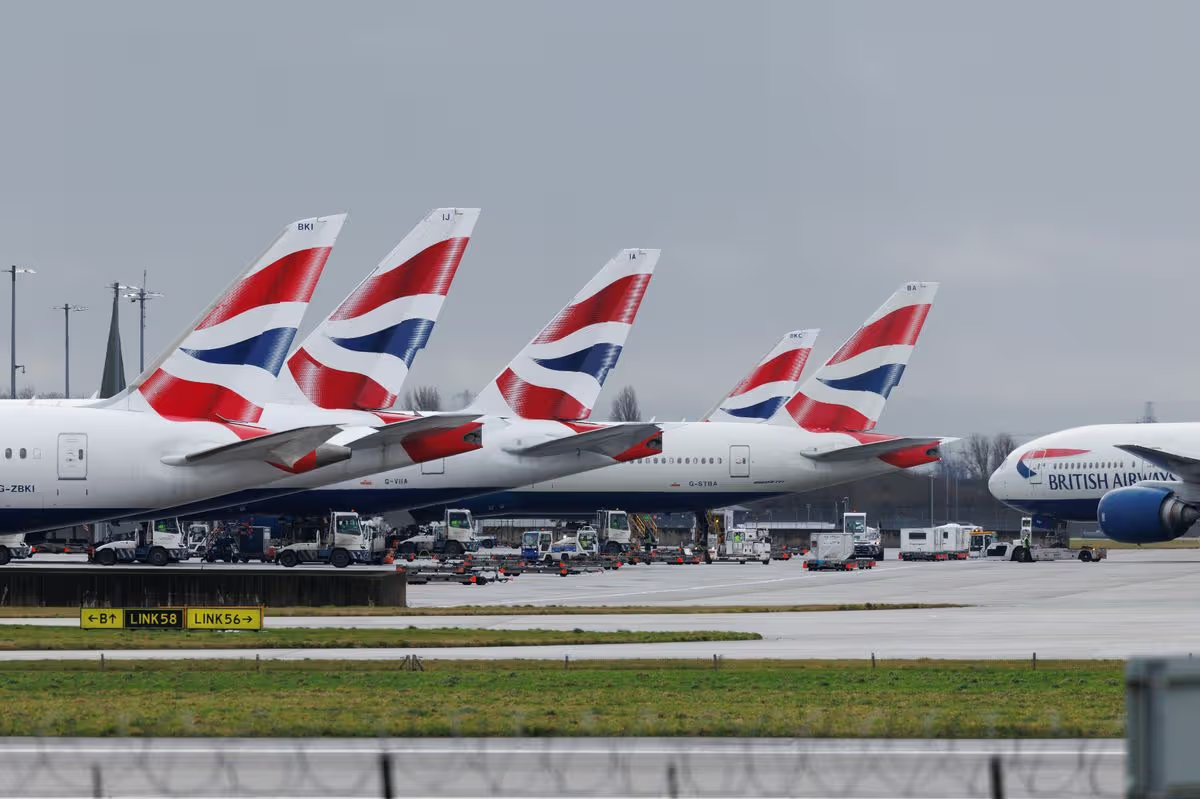
Yesterday, British Airways announced that it has suspended all flights to and from Amman, Bahrain, Doha, Dubai, and Tel Aviv until later this month, while its services to and from Abu Dhabi are cancelled until later this year. The decision means hundreds of BA services will be cancelled over the coming months.
Flight data shared exclusively with the Mirror by analytics firm Cirium shows that 55 of the planned services due to fly today had been cancelled as of 12.45 pm, which is 2.49% of the total scheduled to fly into the UK from the Middle East and vice versa.
UK flights cancelled on March 11
Arrival Country: Flights; Cancelled; Cancel %
Qatar: 18; 17; 94.44%
United Kingdom: 493; 15; 3.04%
United Arab Emirates: 32; 11; 34.38%
Bahrain: 3; 3; 100.00%
United States: 113; 2; 1.77%
Jordan: 3; 1; 33.33%
Israel: 7; 1; 14.29%
Germany: 116; 1; 0.86%
Denmark: 29; 1; 3.45%
Cyprus: 20; 1; 5.00%
Uganda: 1; 1; 100.00%
Ireland: 121; 1; 0.83%
If you are due to fly from or to the Middle East in the coming days, make sure you check your airline’s website for instructions and the Foreign Office website for the latest advice.
What have the airlines said?
Aegean Airlines – Greece’s largest carrier cancelled flights to Tel Aviv until March 20; Beirut, Erbil and Baghdad until March 25; Dubai and Abu Dhabi until March 19; and Riyadh until March 14.
Air France–KLM – Air France cancelled flights to Tel Aviv and Beirut through March 13, and to Dubai and Riyadh until March 12. KLM suspended flights to Dubai, Riyadh and Dammam until March 10, and to Tel Aviv for the rest of the winter season.
Cathay Pacific – Cancelled all flights to and from Dubai and Riyadh until March 31.
Delta – Cancelled flights from New York to Tel Aviv until March 22 and from Tel Aviv to New York until March 23.
Emirates – Operating a reduced flight schedule but expects to return to full operations within days, depending on airspace availability and operational requirements.
Etihad Airways – Resumed a limited commercial flight schedule between Abu Dhabi and several key destinations.
Iberia Express cancelled all flights to and from Tel Aviv through March 10.
Lufthansa Group – Lufthansa, Austrian Airlines, Swiss and Brussels Airlines suspended Tel Aviv flights through April 2 and Beirut flights through March 28. Flights to Tehran are suspended until April 30, and to Amman, Erbil, Dammam, Dubai and Abu Dhabi until March 15.
Norwegian Air – Now plans to start flights to Tel Aviv and Beirut on June 15, instead of the previously scheduled April 1 and April 4.
Qatar Airways – Operating a limited schedule to and from Doha, with some flights resuming from March 9 following temporary authorisation from Qatar’s civil aviation authority.
Saudia Airlines – Suspended flights to Amman, Kuwait, Abu Dhabi, Doha and Bahrain until March 10, and to Moscow and Peshawar until March 15. Limited operations to Dubai have resumed.
Wizz Air – Suspended flights to Israel until March 29, and flights from mainland Europe to Dubai, Abu Dhabi, Amman and Jeddah until mid-September.