How Pakistan managed to get the US and Iran to a ceasefire | US-Israel war on Iran
Islamabad, Pakistan – Just under 90 minutes remained until United States President Donald Trump’s deadline to destroy Iran’s “civilisation” late on Tuesday in Washington, DC, when he took to his favourite social media platform, Truth Social, again.
He said he had agreed to a two-week ceasefire with Iran after almost six weeks of bombing.
Recommended Stories
list of 4 itemsend of list
Soon after, Iranian Foreign Minister Abbas Araghchi confirmed the ceasefire on X, giving a world on edge a chance to breathe again.
Beyond the fact of the ceasefire, much remains unclear. Trump claimed Iran would allow unimpeded transit through the Strait of Hormuz while Araghchi said passage through the waterway would need to be done under the auspices of the Iranian armed forces. Other key differences quickly emerged: Was Lebanon included in the ceasefire? Has the US agreed to allow Iran to pursue uranium enrichment? Has Trump agreed to a 10-point Iranian list of demands or accepted that merely as a conversation starter?
But there also was a common glue that bound both Trump’s statement and Araghchi’s assertions: acknowledgement of Pakistan’s central role as the mediator that managed to persuade warring nations deeply distrustful of each other back to the negotiating table.
Trump said he agreed to the ceasefire “based on conversations with Prime Minister Shehbaz Sharif and Field Marshal Asim Munir, of Pakistan”, adding that they had “requested that I hold off the destructive force being sent tonight to Iran”.
Araghchi was even more profuse in his praise for Pakistan. “On behalf of the Islamic Republic of Iran, I express gratitude and appreciation for his dear brothers HE Prime Minister of Pakistan Sharif and HE Field Marshal Munir for their tireless efforts to end the war in the region,” he said in a statement, adding that Iran had accepted the ceasefire “in response to the brotherly request of PM Sharif”.
Sharif, who had publicly called on the US and Iran to accept a ceasefire a short time before, posted again 90 minutes later, highlighting what may be Pakistan’s most significant diplomatic achievement in years.
“With the greatest humility, I am pleased to announce that the Islamic Republic of Iran and the United States of America, along with their allies, have agreed to an immediate ceasefire everywhere including Lebanon and elsewhere, EFFECTIVE IMMEDIATELY,” he wrote, inviting both delegations to Islamabad on Friday “to further negotiate for a conclusive agreement to settle all disputes”.
By Wednesday afternoon, Sharif had spoken directly with Iranian President Masoud Pezeshkian too. Formal talks were expected to begin in Islamabad on Friday with a US delegation that could potentially be led by Vice President JD Vance, accompanied by Trump’s envoy Steve Witkoff and son-in-law Jared Kushner, who had previously been engaged in dialogue with Iran before the war.
The war, which began on February 28 when the US and Israel launched coordinated strikes that killed Supreme Leader Ali Khamenei and struck Iran’s military and nuclear infrastructure, has killed more than 2,000 people in Iran in five weeks, disrupted roughly a fifth of the world’s oil supplies and threatened to draw in regional powers.
That it has been paused, even temporarily, is the result of weeks of painstaking diplomacy that few believed Pakistan could deliver.
Early moves and a balancing act
Pakistan’s diplomatic engagement began almost immediately after the first US-Israeli attacks of the war, largely behind the scenes.
When the first strikes hit Tehran, Foreign Minister Ishaq Dar, who is also deputy prime minister, was in Saudi Arabia, attending a meeting of the Organisation of Islamic Cooperation. Within hours, Pakistan’s Ministry of Foreign Affairs issued a statement, and Dar called Araghchi to convey solidarity.
By March 3, Dar was addressing the country’s Senate, outlining Pakistan’s position. “Pakistan is ready to facilitate dialogue between Washington and Tehran in Islamabad,” he told lawmakers.
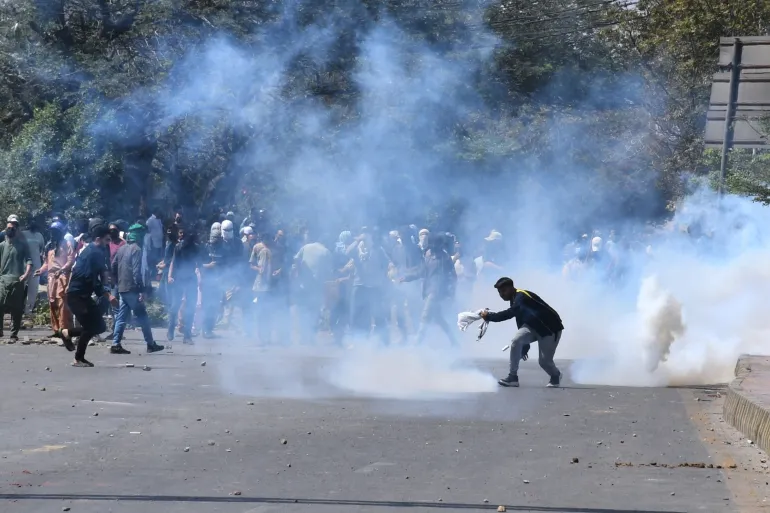
At home, meanwhile, protests erupted. In Karachi, demonstrators tried to storm the US consulate on March 1, leaving at least 10 people dead.
Pakistan’s Shia Muslim population, estimated at 15 to 20 percent of the country’s roughly 250 million people, was watching closely. As sectarian tensions rose, Munir summoned Shia clerics to Rawalpindi and warned that violence inside Pakistan would not be tolerated.

At the same time, Islamabad was dealing with multiple pressures. It remained engaged in what officials described as an “open war” against the Afghan Taliban. It was also grappling with rising fuel costs due to disruptions to shipping in the Strait of Hormuz and concerns over remittances from Pakistani workers in Gulf states.
On March 12, Sharif travelled to Jeddah with Munir to meet Saudi Crown Prince Mohammed bin Salman, expressing “full solidarity” while urging restraint against mounting Iranian attacks against Gulf countries.
It was a delicate balancing act. Pakistan had to maintain its mutual defence pact with Riyadh, signed in September, without being drawn into a direct confrontation with Iran, its southwesterly neighbour with which it shares a nearly 1,000km (620-mile) border.
Qamar Cheema, executive director of the Islamabad-based Sanober Institute, said Pakistan’s early condemnation of the US-Israeli strikes proved crucial.
“When Pakistan condemned American strikes,” he told Al Jazeera, “that was where Pakistan won over the Iranians as well. This role as a global peacemaker is the result of personal diplomatic investment in Iran and the protection of international law.”
Masood Khan, a former Pakistan ambassador to the United Nations and the US, said regional actors were looking for “reliability, impartiality, consistency, restraint and deliverables”.
“We fit the bill and delivered on all counts,” Khan told Al Jazeera. “We did not seek strategic opportunism. We earned their trust.”
War escalates as diplomacy deepens
On the night of March 16-17, Israeli strikes killed Ali Larijani, secretary of Iran’s Supreme National Security Council, and, since Khamenei’s death, one of the most powerful figures in Tehran.
On March 18, Israeli jets struck South Pars, the world’s largest natural gasfield, which Iran shares with Qatar and which accounts for roughly 70 percent of Iran’s domestic gas production.
The attack triggered a new wave of Iranian retaliation on Gulf energy infrastructure, sending oil and gas prices soaring.
Against this backdrop, Dar arrived in Riyadh on March 18 for a meeting of 12 foreign ministers convened by Saudi Arabia.
The gathering produced a joint statement condemning Israeli actions. Turkiye and Pakistan resisted harsher language that could have undermined Islamabad’s credibility with Tehran, according to officials aware of the deliberations in Riyadh.
It was in Riyadh that a quadrilateral mechanism also took shape, bringing together Pakistan, Saudi Arabia, Turkiye and Egypt.
Betul Dogan-Akkas, assistant professor of international relations at Ankara University, said the format emerged partly from divisions within Gulf diplomacy. While some Gulf countries, such as the United Arab Emirates, were by late March increasingly losing patience with Iran’s attacks and raising the prospects of hitting back, others, while also upset with Iran, were still pushing for de-escalation.
“The intra-GCC [Gulf Cooperation Council] disagreements over a ceasefire and a diplomatic dialogue with Iran created the need for exactly that kind of actor,” Dogan-Akkas told Al Jazeera, adding that Pakistan’s ties with both sides made it a natural choice for a mediator.
From March 22 to 23, officials confirmed that Munir spoke directly to Trump. The US president had already announced a five-day pause on strikes targeting Iranian energy infrastructure by then, signalling he was open to a diplomatic exit.
![The foreign ministers of Pakistan, Turkiye, Egypt and Saudi Arabia gathered in Islamabad on March 29, their second such meeting in ten days. [Handout/Pakistan's Ministry of Foreign Affairs]](https://i0.wp.com/www.aljazeera.com/wp-content/uploads/2026/04/FM-meeting-Isb-1775655081.jpg?w=640&ssl=1)
On March 23, Pakistan formally offered to host talks. Sharif echoed the offer publicly hours later on X, tagging Trump, Araghchi and Witkoff.
Initial reactions were mixed. Reports suggested talks could take place in Islamabad within days with Vance, Witkoff and Kushner named as possible members of a US delegation.
Iran, however, denied that negotiations were under way while the White House sought to dampen speculation. “The US will not negotiate through the press,” White House spokeswoman Karoline Leavitt said.
On March 26, Dar confirmed that the US had shared a 15-point proposal with Iran via Pakistan. It demanded commitments on Iran’s nuclear programme, limits on its ballistic missiles and the reopening of the Strait of Hormuz.
Tehran rejected the proposal and responded with a 10-point counteroffer, demanding an end to hostilities, sanctions relief, reparations, recognition of its sovereignty over the strait and the withdrawal of US forces from the region.
The positions remained far apart. But the fact that both proposals passed through Islamabad underscored Pakistan’s central role.
On March 29, the foreign ministers of Pakistan, Saudi Arabia, Turkiye and Egypt reconvened in Islamabad. Before the meeting, Sharif held a lengthy call with Pezeshkian, his second in five days.
After the talks, Dar travelled to Beijing, reflecting China’s growing involvement. He met Chinese Foreign Minister Wang Yi, and the two sides outlined a five-point initiative that included a ceasefire, early dialogue, civilian protection, restoration of shipping through the Strait of Hormuz and a larger UN role. On Tuesday, Trump confirmed that China appeared to have played a role in pushing Iran towards talks.
Some critics have described Pakistan’s role as that of a messenger, but Ishtiaq Ahmad, professor emeritus of international relations at Quaid-i-Azam University in Islamabad, rejected that notion.
“A messenger transmits, but Pakistan shaped the sequencing, timing and framing of proposals,” he told Al Jazeera. “It had leverage with all sides.”
Dogan-Akkas said Tehran’s choice of Pakistan as mediator was deliberate.
“I believe it is a strategic choice to not project a powerful middle power with a US military base as the mediator but to have another regional country convey the message,” she said.
The Munir factor
Central to Pakistan’s role was its army chief, Munir.
His relationship with Trump dates back to early last year when Pakistan arrested the alleged perpetrator of the Abbey Gate bombing in Kabul in 2021, which occurred as thousands of Afghans tried to flee after the Taliban takeover. Thirteen American service members were killed in that attack.
But their relationship truly took root after the brief conflict between Pakistan and India in May when Trump publicly claimed credit for brokering a ceasefire, a claim acknowledged by Pakistan but rejected by India.
![General Asim Munir became Pakistan's army chief in November 2022, and after the four-day conflict with India in May last year, he was promoted to the rank of field marshal. [Handout/Inter-Services Public Relations]](https://i0.wp.com/www.aljazeera.com/wp-content/uploads/2026/04/AM-ISPR-1775656006.jpg?w=640&ssl=1)
That episode opened a direct channel between Munir and the White House. He has since visited Washington, DC, twice, and Trump has publicly praised him on several occasions.
Pakistan also maintained connections with figures close to the Trump administration, including through business engagements involving Witkoff’s family.
Trump himself acknowledged Pakistan’s ties with Iran, telling reporters that Pakistanis “know Iran very well, better than most,” after hosting Munir for an unprecedented lunch in June.
However, Ahmad cautioned against overstating the personal dimension.
“The personal equation helped accelerate decision-making at a critical moment, but the mediation was not built on personalities alone,” he told Al Jazeera.
“It rested on institutional alignment between Pakistan’s civil and military leadership and on sustained engagement with Washington over the past year. Even if personalities shift, the channel Pakistan has built is now institutionalised,” he said.
Cheema argued that the calculus was also structural.
“Trump understands that in the entire Muslim world, this is the only nuclear-capable country, and it can change the course of history,” he told Al Jazeera, referring to Pakistan.
Countdown to a ceasefire
It was on Sunday on the Christian holiday of Easter when tensions peaked. As Pope Leo XIV called for peace from the Vatican, Trump issued a stark warning on Truth Social.
“Tuesday will be Power Plant Day, and Bridge Day, all wrapped up in one, in Iran,” he wrote, threatening to blow up all of Iran’s bridges and power facilities if it did not reopen the Strait of Hormuz.
Iran dismissed the remarks, but behind the scenes, Pakistani officials intensified their diplomatic efforts.
By Monday, Pakistan had put forward a two-phase ceasefire proposal with Munir in contact with Vance, Witkoff and Araghchi.
Trump initially rejected the plan. He set a final deadline of 8pm Washington, DC, time on Tuesday (midnight GMT) and, hours before it expired, warned of catastrophic consequences.
“A whole civilization will die tonight, never to be brought back again,” he posted. “I don’t want that to happen, but it probably will.”
According to officials, Munir continued engaging both sides in the final hours, even as much of the diplomacy remained out of public view, until Sharif’s public appeal came with about five hours remaining.
The breakthrough followed shortly after.
As Trump announced the ceasefire and Iran confirmed it, the immediate impact was visible.
Oil prices dropped by 16 percent. The Strait of Hormuz was set to reopen for the first time in five weeks. And Islamabad was ready to become the centre of diplomatic activity.
What comes next?
The temporary ceasefire is not a peace deal. Iran’s Supreme National Security Council described it as a victory while warning that “our hands are on the trigger.”
Key differences remained unresolved, and expectations for the upcoming talks are cautious.
Despite Sharif’s claim that Lebanon was included, Israeli Prime Minister Benjamin Netanyahu’s office said the arrangement does not cover Lebanon, and Israeli attacks there on Wednesday killed dozens of people and wounded hundreds.
Still, analysts said Pakistan’s role marks a significant shift.
A country that was not at the table for talks that resulted in the 2015 Iran nuclear deal or the Abraham Accords has now positioned itself at the centre of a major diplomatic effort.
“This is the first time Pakistan has simultaneously managed active conflict mediation between two adversaries under ongoing military escalation without direct contact between them,” Ahmad said.
Dogan-Akkas offered a more cautious assessment, noting that Pakistan does not have a long history of mediation compared with countries such as Kuwait, Oman or Qatar.
The outcome, she said, reflects Pakistan’s ties in the Gulf and its improving relationship with Washington rather than a deeply institutionalised mediation role.
When Pakistan quietly facilitated US Secretary of State Henry Kissinger’s secret trip to Beijing in 1971, its role remained unacknowledged for years.
This time, recognition came almost immediately, from both Washington and Tehran.
“Our effort this year is a continuation of the facilitation we undertook between the US and Iran in 2025,” Khan, the former envoy, said.
“But the stakes this time were very high. We did not want to see the richest bloc of the Muslim world decimated nor the world pushed towards a wider war.”
He added a note of caution.
“No relationships are, however, assured in perpetuity. Look at the Trump-Modi bonhomie in the first Trump administration and its unravelling now,” he said, referring to the warm friendship between the US president and Indian Prime Minister Narendra Modi, which appears to have cooled during Trump’s second term.
Even so, he argued, Pakistan has already secured a lasting gain.
“While ultimate success will depend on the outcome of the process, however, even at this preliminary stage, Pakistan has already carved a niche for itself in diplomatic chronicles,” Khan said.