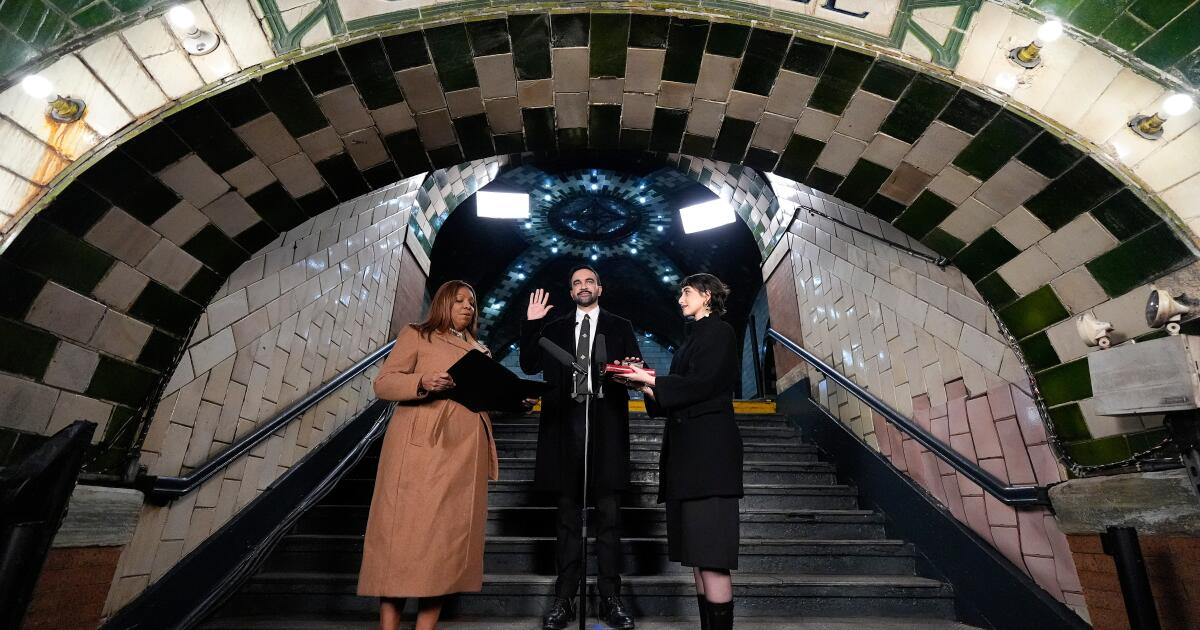
mamdani

In his first 100 days, Mamdani brings a unique star power to New York City governance

In his first 100 days in office, New York City Mayor Zohran Mamdani has governed with a star power unusual in politics.

Crowds of supporters show up to his news conferences. Basic municipal services have been infused with newfound excitement. Celebrities help him promote his agenda.

In the process, he’s been able to notch a few notable early wins. And he’s reached a detente, at least for now, with President Trump, a mercurial leader with an affinity for celebrities.

But as Mamdani, a Democrat, marks an early milestone in his mayoralty, it remains to be seen whether he’ll be able to leverage his fame into achieving the progressive policy proposals that propelled him to office.

Though he still has staunch critics, many of whom still view his past criticisms of the police department and Israel as major problems, Mamdani has been able to ease concerns among at least some skeptics.

“It’s early but so far, so good,” said Jay Jacobs, chair of the state’s Democratic Party, who made waves for not endorsing Mamdani during the election. “We may not agree on everything philosophically, but he is getting the job done.”

‘The biggest needs and the smallest needs’

As the mayor approached his 100th day — long a benchmark for judging an administration’s opening vision — his team has moved to highlight the administration’s commitment to the everyday responsibilities of the job.

While much of those duties are typical for his local office — picking up trash, plowing snow and filling potholes — the 34-year-old mayor has leaned on his knack for viral content creation to drive interest and awareness of government programs.

To hype up his child-care program for 2-year-olds, Mamdani recruited Cardi B to help judge a jingle contest that will determine the initiative’s theme song. His slick social media videos helped recruit thousands of new snow shovelers as a storm bore down on the city. A public service announcement he made brought more than 50,000 new subscribers to the city’s emergency alert system in a single week.

A few weeks ago, alongside Natasha Cloud of the New York Liberty, Mamdani announced a bracket-style competition in which people could vote on small projects for him to come and personally fix on his 100th day.

On Friday, Mamdani selected a winner — a garbage-filled lot in the Bronx — and helped pick up some of the junk with a sanitation crew, following a celebratory event that featured an overflowing trash can mascot and a cheerleading squad.

“I think every single day it’s an opportunity to meet the needs of New Yorkers,” he said. “And what we’ve seen over the course of this 100 days is that New York City wants to see a city government that is able to meet the biggest needs and the smallest needs.”

The celebrity status, though, can also prompt backlash. During a bitter cold snap, his surprise appearance on “The Tonight Show Starring Jimmy Fallon” was seen by some as insensitive at a moment when the death toll of homeless New Yorkers was rapidly rising.

“Too much styling and profiling,” said Curtis Sliwa, a Republican who ran against Mamdani during last year’s election, noting longstanding problems with street homelessness, public housing and infrastructure.

Still, Sliwa, who hammered Mamdani during the campaign but recently appeared in a comedy skit with the mayor during the City Hall press corps’ annual roast, appeared to give Mamdani some credit, even if it came with a caveat.

“We just had Eric Adams, swagger man who’d party to the break of dawn, and now we have a guy who seems like he’s got a normal working schedule,” said Sliwa, referencing the city’s previous mayor. “So having Zohran as the alternative, I think for a lot of people even if they disagree with him, there’s some stability.”

Still a star among supporters

On the night of Mamdani’s election party, hundreds packed the streets, some spontaneously, waiting for a glimpse of the mayor-elect leaving the venue. Departing campaign aides were cheered, by name, well after midnight. One attendee likened the street party to Beatlemania.

“I feel like I’m at a presidential inauguration,” said Medhavie Agnihotri, a 25-year-old tech consultant. “This is the first time in a while I’ve felt this hope.”

His star power has not appeared to wane since then.

Outside City Hall, New Yorkers and tourists frequently stop for selfies, peering through the iron gates in search of the mayor.

This week, on the mayor’s 97th day in office, a crowd gathered in the lobby of the busy Bellevue Hospital in Manhattan to watch as Mamdani announced the city would start transferring Rikers Island jail detainees with serious medical illnesses to a specialized unit at the hospital.

He entered to woos and applause from the onlookers, as many held up cellphones to record videos of the mayor. Dozens more watched along from a set of elevated walkways.

One man, Ricardo Granados, a 67-year-old retiree, was on his way to take his son to a medical appointment but stopped to see what all the hubbub was about just before the news conference started. He appeared delighted to learn the mayor was going to show up, saying he met Mamdani previously when the mayor was campaigning in his neighborhood.

“I’m extremely fond of him. I think he’s going to make a real difference,” Granados said. “He wants to find out who needs what and he wants to help.”

Izaguirre writes for the Associated Press. AP writer Jake Offenhartz contributed to this report.
Source link

Anti-Muslim rhetoric rises among Republicans; GOP leaders silent

Anti-Muslim rhetoric from some Republicans in Congress intensified this week against the backdrop of the Iran war, with several lawmakers — including one who said that “Muslims don’t belong in American society” — drawing condemnation from Democrats but little response from GOP leaders.

The derogatory language has been percolating among Republican officials for months, often prominent when criticizing New York Mayor Zohran Mamdani, who is Muslim. But against the backdrop of the Iran war, a country with an overwhelmingly Muslim population, and attacks at a synagogue in Michigan and a college in Virginia, the tone sharpened this week.

“The enemy is inside our gates,” Sen. Tommy Tuberville of Alabama wrote Thursday in response to a photo of Mamdani sitting on the ground during an iftar dinner at New York City Hall. The photo was juxtaposed with a picture of the Sept. 11 attacks.

Hours later, Tuberville added: “To be clear, I didn’t ‘suggest’ Islamists are the enemy. I said it plainly.”

The rhetoric intensified Friday as GOP lawmakers responded to the attacks in Michigan and Virginia by urging a halt to all immigration into the United States. Some singled out Muslims specifically.

For many Muslims, it’s a political moment that carries echoes from the early 2000s, when the Sept. 11 attacks and the Afghanistan and Iraq wars generated hostility toward Muslim communities in the United States, often accompanied by discrimination and racist violence.

“When members of Congress speak, it’s not just words,” said Iman Awad, the national director for policy and advocacy for the Muslim American advocacy group Emgage Action. “It shapes public perception. It legitimizes prejudice.”

GOP rhetoric targeting Muslims spreads online

Rep. Andy Ogles (R-Tenn.) in his social media post stated flatly that Muslims don’t belong in the United States. He stood behind it after criticism mounted, later writing that “paperwork doesn’t magically make you American” and that “Muslims are unable to assimilate; they all have to go back.”

Asked about Ogles’ post Tuesday, House Speaker Mike Johnson (R-La.) said he had spoken to members “about our tone and our message and what we say.” He said Ogles used “different language than I would use,” but added that he believes the issue raised by the comments is “serious.”

“There’s a lot of energy in the country, and a lot of popular sentiment that the demand to impose sharia law in America is a serious problem,” Johnson said. “That’s what animates this.”

Sharia is a religious framework that guides many Muslims’ moral and spiritual conduct. References to “sharia law” have often been invoked by officials to suggest Muslims are attempting to impose religious practices on communities in the United States.

Many Republicans point to a Muslim-centered planned community near Dallas as proof of “sharia law” — though the developers have denied the allegations and said they are being targeted only because they are Muslim.

With Johnson not condemning Ogles’ remarks — or recent comments from Rep. Randy Fine (R-Fla.) that “the choice between dogs and Muslims is not a difficult one” — the anti-Muslim rhetoric grew louder. After the photo circulated of Mamdani at the iftar dinner, several Republicans responded with critical posts.

Democrats broadly condemned the Republican messages. Sen. Chuck Schumer of New York, the leader of Senate Democrats, called Tuberville’s post “mindless hate.”

“Islamophobic hate like this is fundamentally un-American and we must confront and overcome it whenever it rears its ugly head,” Schumer said.

Mamdani — in response to Tuberville’s post that “the enemy is inside our gates” — said: “Let there be as much outrage from politicians in Washington when kids go hungry as there is when I break bread with New Yorkers.”

Attacks in Michigan and Virginia spark more rhetoric

Federal officials identified a man who rammed his vehicle into a hallway at Temple Israel in West Bloomfield Township, Mich., this week as a naturalized citizen born in Lebanon. Officials have said that the man — who was killed by security guards at the temple — had lost four family members in an Israeli airstrike in Lebanon during the ongoing war in the Middle East, just after sunset as they were having their fast-breaking meal during the Muslim holy month of Ramadan.

In Virginia, Mohamed Bailor Jalloh opened fire in a classroom at Old Dominion University before ROTC students subdued and killed him. Court documents showed that he had served time for attempting to aid the militant group Islamic State and was released less than two years ago.

Some Republican lawmakers claimed vindication for their views. Others pushed for legislation. Rep. Tom Emmer of Minnesota, the House Republican whip, said that “the security of our nation hinges on our ability to denaturalize and deport terrorists.”

Rep. Riley M. Moore (R-W.Va.) said he would introduce a bill to denaturalize and deport any naturalized citizen who “commits an act of terrorism, plots to commit an act of terrorism, joins a terrorist organization or otherwise aids and abets terrorism against the American people.”

Similar rhetoric and policy efforts have surfaced before and stoked controversy. Protesters connected to demonstrations in recent years over the Israel-Hamas war were arrested and targeted by authorities, including former Columbia University graduate student Mahmoud Khalil, a Palestinian activist the government has sought to detain and deport.

Mamdani responds

Middle East conflicts bringing domestic tensions is nothing new. With the war in Gaza, both Muslim and Jewish communities have faced faith-based discrimination and attacks.

Mamdani said the posts invoking the 9/11 attacks are problematic not just because of the words, but because of “the actions that often accompany them.”

“I think too of the smaller indignities, the indignities that many New Yorkers face, but that Muslims are expected to face in silence,” the mayor said. “Of the exhaustion of having to explain yourself to those who are not interested in understanding. Of the men who introduce themselves by their given name only to be called Muhammad for years on end.”

The stark silence from Republican leaders, including President Trump, reflects a broader change in the party. After the Sept. 11 attacks in 2001, Republican President George W. Bush visited the Islamic Center of Washington to explicitly warn against Muslim discrimination.

“America counts millions of Muslims amongst our citizens, and Muslims make an incredibly valuable contribution to our country,” Bush said during the visit, adding: “They need to be treated with respect. In our anger and emotion, our fellow Americans must treat each other with respect.

“Those who feel like they can intimidate our fellow citizens to take out their anger don’t represent the best of America, they represent the worst of humankind, and they should be ashamed of that kind of behavior,” Bush said.

Cappelletti writes for the Associated Press.

Source link