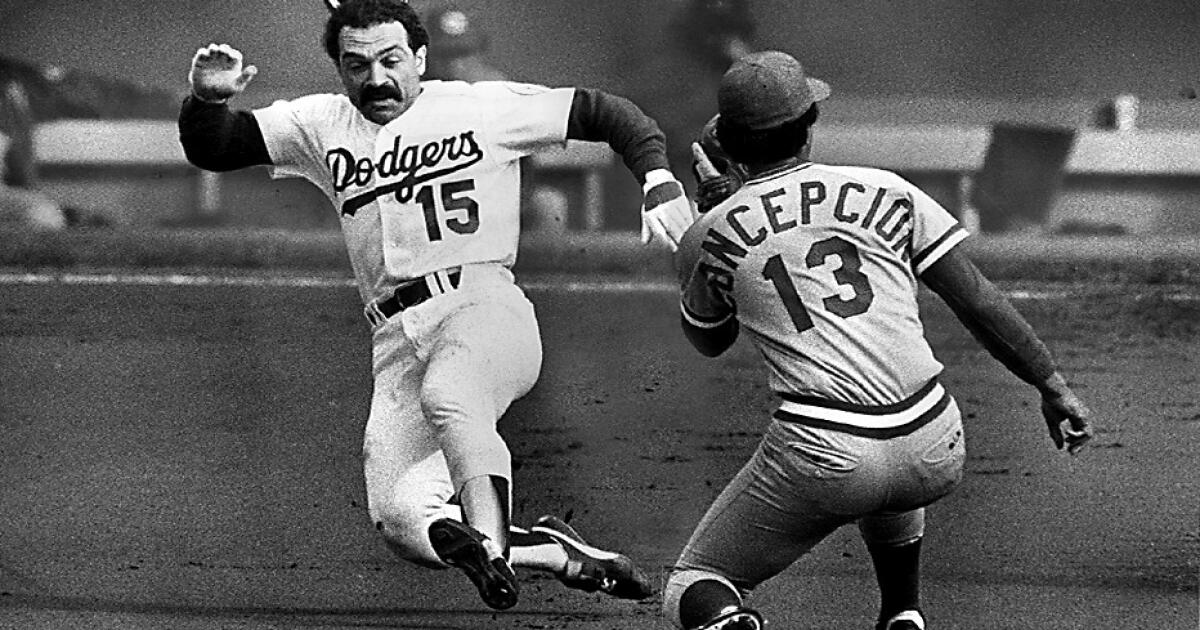
Davey Lopes, part of Dodgers’ long-running infield, dies at age 80
Davey Lopes, the no-nonsense, base-swiping second baseman on a historic Dodgers infield that played together for a record 8½ seasons, died Wednesday at age 80, the Dodgers announced.
The first 10 years of Lopes’ 16-year major league career were spent with the Dodgers, and he returned to the organization in 2011 to serve as first-base coach for five years. Lopes was a four-time All-Star who won two stolen base titles, one Gold Glove and helped the Dodgers to four World Series, including the championship in 1981.
Taken in the second round of a 1968 Dodgers draft haul considered the most talented in baseball history, the 5-foot-9, 170-pound Lopes rose from a rough-and-tumble Rhode Island upbringing to become the team’s everyday second baseman and leadoff batter by 1973.
Lopes played outfield in the minor leagues but became part of a bold move by Dodgers manager Walter Alston before the 1973 season: Lopes would move to second base, Bill Russell from center field to shortstop and Steve Garvey from third to first base. Ron Cey would be installed at third. The Dodgers moved longtime coach and scout Monty Basgall — known as an exceptional infield instructor — from the front office to the field to help the players adjust to their new roles.
The quartet took the infield together for the first time in the second game of a doubleheader against the Cincinnati Reds in a sold-out Dodger Stadium on June 23, 1973. They stuck together through their 1981 World Series championship season, after which Lopes was traded to the Oakland Athletics for Lance Hudson, a utility player who never reached the major leagues.
Lopes continued to play well, not retiring until 1987 at age 42. He stole 557 bases and was successful in 83% of his attempts, one of the best rates in major league history. He also displayed power for a leadoff batter, hitting 155 home runs, including a career high of 28 for the Dodgers in 1979.
Although Lopes’ lifetime batting average was .263, he had an excellent eye, walking nearly as many times as he struck out and logging an excellent .349 on-base percentage. He scored 1,023 runs in 1,812 career games.
As games progressed, Lopes typically batted after the pitcher, who was at the bottom of the order. He became adept at stalling tactics that gave pitchers ample rest if they’d just returned to the dugout after running the bases.
Times assistant sports editor Houston Mitchell, a lifelong Dodgers follower, described what happened next: “Lopes was a magician at wasting time to give the pitcher a chance to towel off and cool down a bit. Especially if there were two out. Lopes would spend an extra moment or two in the on-deck circle. He’d take his time getting the round weight off his bat. Then he would slowly walk to the batter’s box.”
David Earl Lopes was born May 3, 1945, and raised in East Providence, R.I., a town of Irish, Portuguese and Cape Verdean immigrants seeking jobs in factories and along the waterfront. One of 12 children, Lopes was a toddler when his father died. Lopes’ mother, Mary Rose, worked as a domestic.
Lopes often described his upbringing as difficult, referring to his neighborhood as a “ghetto” and describing it to Times columnist Jim Murray as “roaches, rats, poor living conditions, drugs as prevalent as candy.”
“If it hadn’t been for sports, there’s no telling what I’d be or where I’d be,” Lopes told The Times’ Ross Newhan in 1973. “All I had to do is step off the porch to a choice of all the things you associate with a ghetto.”
Long before he became an accomplished base stealer, Lopes said he became an expert at shoplifting. “I never stole anything major, just clothes and baseballs and bats,” he told Murray.
Lopes needed an adult role model and one came along in the coach at an opposing high school, Mike Sarkesian, who grew up in a Providence tenement but became the basketball coach and athletic director at Iowa Wesleyan College the year Lopes graduated from high school.
“Whatever I missed by having not really had a father, Sarkesian provided,” Lopes told Newhan. “He could relate to my problems, my environment. The drive, the determination, not to give in to the ghetto, to make something of my life, stems from my relations with him.”
Sarkesian recruited Lopes to play baseball at Iowa Wesleyan. Two years later, Sarkesian became athletic director at Washburn University in Topeka, Kan., Lopes went with him. Lopes was taken by the San Francisco Giants in the eighth round of the 1967 MLB draft but opted to return to Washburn, where he played baseball and basketball well enough to be inducted into the school’s Hall of Fame in 1987.
The Dodgers drafted him in the second round a year later and Lopes signed for $10,000. He skipped spring training his first two minor league seasons to complete his classes at Washburn and graduated in 1969 with a degree in elementary education.
Lopes spent the 1968 and 1969 seasons at Class-A Daytona Beach, and married Linda Lee Vandover during his first season. The night before the wedding he broke up no-hitters in both games of a doubleheader with late-inning hits.
A promotion to triple-A Spokane came in 1970. His manager was Tommy Lasorda and the team was exceptional, posting a record of 94-52. Among his teammates were Garvey and Russell as well as other future major leaguers Bill Buckner, Bobby Valentine and Tom Paciorek.
Lasorda recalled Lopes as so shy he wouldn’t speak to anyone. “It took two years, but he finally came around,” Lasorda said. “[He] finally got to the point where he felt he belonged.”
Lopes showed improvement at the plate his second year at Spokane, batting .306 with Cey as a teammate. The Dodgers moved their triple-A affiliate to Albuquerque in 1972 and in his third season at that level Lopes exhibited the blend of power and speed that would be his calling card, posting a slugging percentage of .476 while stealing 48 bases.
Five years in the minor leagues after having attended college meant Lopes was 27 when he made his major league debut that September. He was the opening day second baseman the following year and turned 28 a month into the season.
Lopes quickly made up for lost time, his stolen base totals increasing in each of his first three full seasons from 36 to 59 to 77. On Aug. 24, 1974, he stole five bases in a game against the St. Louis Cardinals, becoming the first NL player to do so since 1904.
It wasn’t long before the best catcher in baseball, the Reds’ Johnny Bench, lauded Lopes, saying, “He’s the best there is at stealing. Lopes not only has the knowledge and speed, but also the quick acceleration. He has everything.”
The once reticent Lopes also showed leadership qualities as early as 1976, when a throw by new Dodgers outfielder Dusty Baker had missed the cutoff man.
“We don’t play that way,” Lopes told Baker.
“Hey, I almost threw him out.” the Dodgers newcomer replied.
“We don’t play that way,” Lopes emphasized.
“I’d never had a player get in my face like that, and I didn’t like it too much,” Baker recalled of the incident. “I looked up and the whole team was coming over to back up Davey.”
Lopes was popular with fans as well. In 1980, he received 3,862,403 votes to lead all MLB players and start at second base in the All-Star Game at Dodger Stadium. That was his third of four consecutive All-Star appearances.
The Dodgers were consistent winners with Lopes, Garvey, Russell and Cey anchoring the infield, but lost the World Series in 1974 to the Athletics and in 1977 and ’78 to the Yankees. In 1981, however, they broke through, winning the Fall Classic for the first time since 1966 by defeating the Yankees in six games.
“They can do anything they want with us now,” said Lopes, who set a record by stealing 10 bases in 10 attempts that postseason. “I’ve got the ring. They can’t take that away from me.”
Youngster Steve Sax, however, did take his job. Lopes, 36, was traded to the A’s during the offseason. He was hardly through, playing another six seasons and even stealing 47 bases in 99 games in 1985 for the Chicago Cubs to become the first 40-year-old player to steal more bases than his age.
Lopes retired after the 1987 season and spent the next four years as a coach under Valentine with the Texas Rangers. Next he coached for three years under another former teammate, Baltimore Orioles manager Johnny Oates, and for four years with the San Diego Padres under Bruce Bochy.
In 2000, Lopes got his shot at managing, signing a three-year deal with the Milwaukee Brewers, who posted losing records in his first two seasons. When the Brewers won only three of their first 15 games in 2002, Lopes was fired.
“A lot of people discouraged me from taking [the Brewers job] because they thought I was just setting myself up for failure,” Lopes told The Times’ Ross Newhan, sensing the odds were catching up to him, “but I was determined to show them I could do it.”
Lopes returned to the Padres as a first-base coach from 2003-2005. He spent one season as the Washington Nationals’ first-base coach and baserunning adviser, and he served in the same capacity for the Phillies from 2007 to 2010.
The Phillies led the major leagues in stolen base percentage three times during his tenure and won the 2008 World Series championship, but that season began with a serious health issue for Lopes. Days before spring training, he was diagnosed with prostate cancer. It was in remission by opening day.
In 2011, Times columnist Bill Plaschke lobbied for the Dodgers to add Lopes to the coaching staff. General manager Ned Colletti did just that. Lopes displayed an empathy for young players, saying, “I’ve been there, I know what it’s like when you’re young and you need to know somebody is covering your back. Sometimes you feel lost, and you need a coach or manager to alleviate that.”
Lopes served as Dodgers first-base coach for five years — immediately improving the team’s base-stealing prowess — before closing out his five-decade baseball career in 2017 as a coach for the Nationals under his old teammate Baker.
“I’m not doing much. I’m retired, taking it easy,” Lopes said about retirement on a podcast. “It was not a difficult decision to make, but one I was kind of hesitant to make. But it all works out.
“I got the opportunity to play, manage or coach for a long, long time. I’m extremely thankful. I was one of the lucky ones in the big leagues for 45 straight years. That’s a long time. I have no complaints.”
Lopes is survived by two brothers, Patrick and John, and four sisters, Jean, Judith, Mary and Nina.