mahan

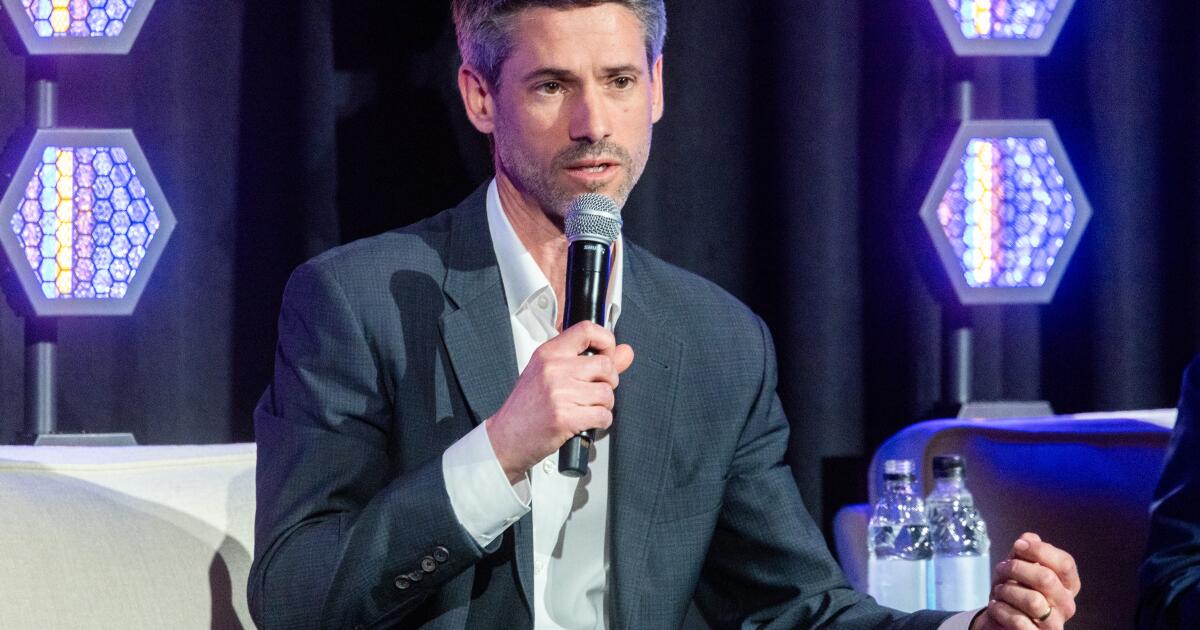
Mahan backers fund Super Bowl ads for newest gubernatorial candidate

Only one of the candidates for California governor will appear in a splashy Super Bowl ad on Sunday, though a rival has locked in a valuable spot on Animal Planet’s lighthearted, cuddly “Puppy Bowl” before the big game.

A Silicon Valley-backed independent expenditure committee booked $1.4 million in airtime on NBCUniversal’s Peacock streaming service, which will feature the big game along with NBC, and on other broadcast networks on Sunday to introduce Matt Mahan, the mayor of San José who entered the governor’s race in late January.

A 30-second ad depicts Mahan, a moderate Democrat, as a “fixer of problems” in a big city “just miles from the big game” and touts his record reducing homelessness, building housing and reducing crime.

The ad was produced by a committee run independently of Mahan’s campaign and funded mostly by Silicon Valley executives, including $1 million from Michael Seibel of Y Combinator and $500,000 each from Riot Games co-founder Marc Merrill and his wife, Ashley.

“This Super Bowl ad kicks off our support for Matt Mahan’s run for governor,” said committee spokesman Matt Rodriguez. “His unmatched record on tackling crime, homelessness and housing in San José while focusing on the basics that Californians care about is very different than the old playbook of toxic politics.”

The committee has so far raised more than $3.2 million, according to Rodriguez, who provided the information about the contributors.

Other financial backers include Neil Mehta and Brian Singerman, two Bay Area venture capitalists, along with Paul Wachter, an investor who has advised former Gov. Arnold Schwarzenegger and celebrity figures such as LeBron James and Dr. Dre on their business ventures.

As an independent committee, the group is barred from coordinating with Mahan and his campaign. A spokesperson for Mahan declined to comment on the committee or its game day ad.

Mahan, a moderate Democrat, has broken with Gov. Gavin Newsom on crime and other issues and is pitching himself as a pragmatist who would prioritize results over party politics or fighting with the Trump administration as Newsom has. Mahan’s campaign is not yet required to disclose donations but said it has raised more than $7 million since he entered the race, more than any candidate besides Tom Steyer, a progressive billionaire whose campaign is primarily self-funded.

Steyer, an investor turned climate activist, has already spent more than $27 million on his campaign. Most of that money went to producing and airing ads in which Steyer touts his wins supporting various ballot measures and pledges to break up utility monopolies to lower costs.

His latest ad debuts during Animal Planet’s “Puppy Bowl,” a pregame show that features two teams of adoptable dogs tussling over toys in a model football stadium. In the spot, a Realtor tells a couple that in order to afford a home, they might need to go back in time to 1980, “when the average home in California cost $100,000.”

With a burst of sparks, Steyer appears inside the time-traveling DeLorean from the 1985 film “Back to the Future” and says, “You shouldn’t have to go back in time to afford a home in California.” He then pledges to stop “Wall Street speculators from buying up homes” and pricing out “regular Californians.”

To have a legitimate shot at winning a governor’s race in a state as vast as California, home to some of the nation’s most costly media markets, candidates must raise millions of dollars to air ad campaigns robust enough to introduce themselves to voters or undercut their competitors.

According to campaign finance disclosures, former Rep. Katie Porter raised $6.1 million in 2025, the most of any candidate besides Steyer. But Mahan’s entry into the race has excited the tech and business interests that have until now avoided giving.

“The race is now kicked into gear,” and some candidates who have been fundraising for months — or years — “may find themselves lapped by the Mahan machine,” said Andrew Acosta, a Democratic strategist.

Though tech funders appear to be coalescing around the Silicon Valley mayor, he is “not going to come out of the gate lighting the campaign on fire because no one knows him,” Acosta said. With three months until primary ballots start hitting mailboxes, it’s a challenge for Mahan — though one that could be solved with enough money.

Steyer’s campaign criticized the wave of tech figures flocking to Mahan, saying business titans don’t spend their money without expecting something in return.

“This isn’t charity — it’s an investment so they get richer while everyone else gets priced out of California,” Steyer spokesman Kevin Liao said. “While San José remains the least affordable housing market in the world, Tom Steyer is ready to take on powerful special interests, make billionaires and corporations pay their fair share, and make California affordable for working people.”

With the threat of a proposed billionaire’s tax on California’s November ballot, new restrictions on AI and social media simmering in the Legislature and the impending exit of Gov. Gavin Newsom — who has been a reliable tech ally during his tenure — Silicon Valley leaders have made moves in recent weeks to boost their influence in California politics.

Google co-founder Sergey Brin and a handful of other CEOs recently loaded $35 million into a ballot measure committee and spent some of it on two separate efforts to lower housing costs.

Meta and Google have also ramped up spending on lobbying and super PACs in an effort to elect tech-friendly candidates and fight against AI regulation in statehouses both in California and around the country.

Source link

Tax billionaires, cut rents and other takeaways from California’s first gubernatorial debate

Gov. Gavin Newsom, barred from running for reelection, still took heat Tuesday during the first debate in California’s 2026 race for governor.

Six Democrats and one Republican on the stage in Newsom’s hometown of San Francisco took direct aim at the governor’s record on homelessness, efforts to ban the sale of new gas-powered cars and opposition to an anti-crime ballot measure that Californians overwhelmingly passed two years ago.

Former Los Angeles Mayor Antonio Villaraigosa, who unsuccessfully ran against Newsom for governor in 2018, pointed to state spending on homelessness as an example of ineptitude.

“We spent $24 billion at the state, along with billions more from the counties and the cities throughout the state, and homelessness went on,” he said. “We cannot be afraid to look in the mirror.”

The televised debate revealed the schism between the moderate and progressive Democrats hoping to replace Newsom, as well as efforts by Steve Hilton, the sole Republican who took part, to coalesce the conservative vote.

Hilton, a former Fox New commentator and British political strategist, called on his top GOP rival, Riverside County Sheriff Chad Bianco, to drop out of the race.

“My Republican colleague Chad Bianco is not here tonight to face these Democrats or his record in 2020, during the Black Lives Matter riots,” Hilton said at the event, which was co-sponsored by the nonprofit Black Action Alliance, which was founded to give Black voters a greater voice in the Bay Area.

Bianco “took a knee when told to by BLM, now he says he was praying,” Hilton said. “Chad Bianco has got more baggage than LAX.”

Bianco was invited to the debate but said he was unable to attend because of a scheduling conflict. His campaign did not respond to requests for comment about Hilton’s attacks.

The, at times, feisty debate came amid a gubernatorial race that thus far has lacked sizzle or a candidate on either side of the aisle who has excited Californians. Public opinion polls show that most voters remain undecided.

Seven of the dozen prominent candidates running to replace Newsom participated in the gathering at the Ruth Williams Opera House in front of a live audience of about 200 people. Rep. Eric Swalwell (D-Dublin) was scheduled to participate but canceled, citing the need to go back to Washington, D.C., for congressional votes. Former Rep. Katie Porter (D-Irvine) also did not attend the debate.

The two-hour clash, at times plagued by audio issues, was hosted by two local Fox News affiliates and moderated by KTVU political reporter Greg Lee and anchor André Senior, as well as KTTV’s Marla Tellez.

Five takeaways from the debate:

Making California affordable again

When grilled about how they planned to tackle the high cost of living in the state — gas prices, rent, utility bills and other day-to-day financial challenges — most of the candidates prefaced their answers by talking about growing up in struggling households, often with immigrant parents who worked blue-collar jobs.

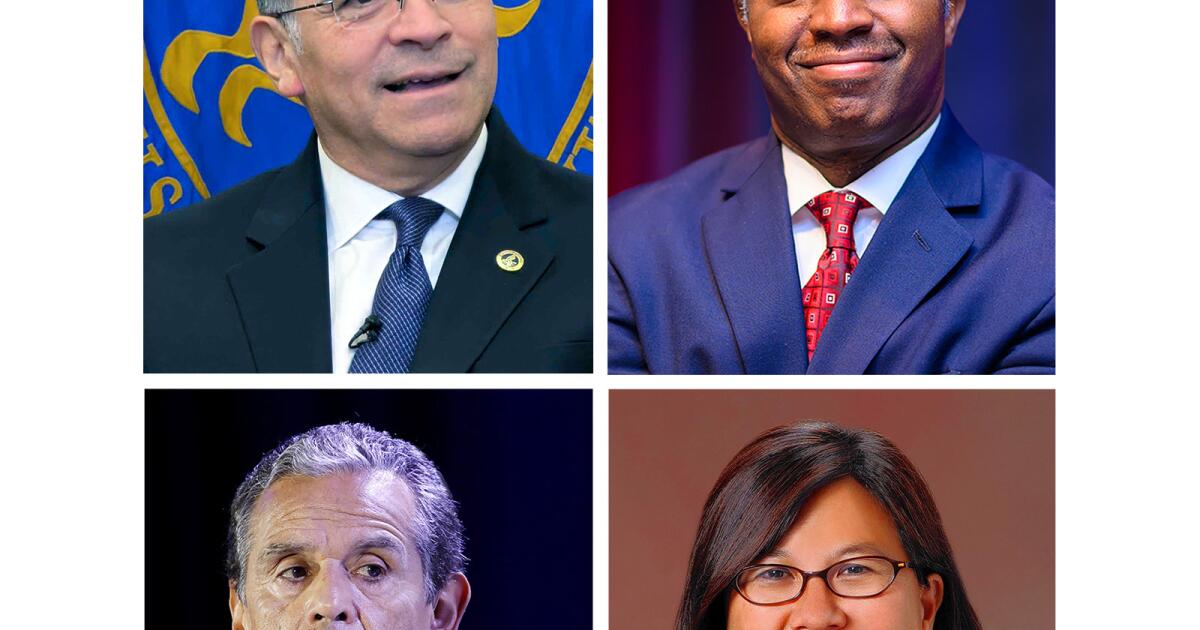
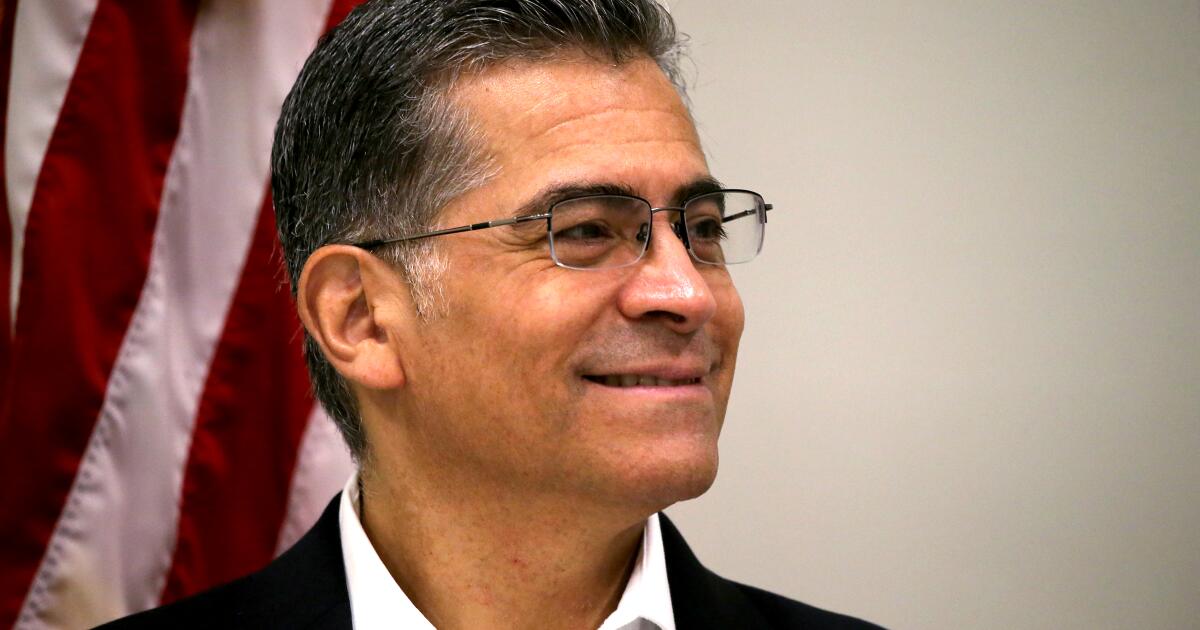
Former U.S. Health and Human Services Secretary Xavier Becerra said he would stabilize rents and freeze utility and home insurance costs “until we find out why they’re increasing.” California Supt. of Public Instruction Tony Thurmond said he would raise taxes on billionaires and create tax credits to help families afford the high cost of living.

Villaraigosa and Hilton said they would lower gas prices by cutting regulations on California’s oil refineries.

Hilton blamed the state’s high cost of living squarely on Democratic policies. “They’ve been in power for 16 years,” he said. “Who else is there to blame?”

Billionaire hedge fund founder turned climate activist Tom Steyer said he favors rent control. Steyer and former state Controller Betty Yee said they would prioritize zoning and permitting reform to build more housing, particularly near public transit. Both Steyer, a progressive, and San Jose Mayor Matt Mahan, a moderate, spoke about using new technology such as pre-fabricated homes to build more affordable housing.

Protecting immigrants

In the wake of the Trump administration’s chaotic immigration raids that started in Los Angeles in June and have spread across the nation — recently resulting in the shooting deaths of two people by federal agents in Minneapolis — the Democrats on stage unanimously voiced support for immigrants who live in California. Some pledged that, if elected, they would use the governor’s office to aggressively push back on President Trump’s immigration policies.

“We’ve got to say no to ICE, and we’ve got to take on Trump wherever he raises his ugly head,” Villaraigosa said.

Steyer, whose hedge fund invested in a company that runs migrant detention centers on the U.S.-Mexico border, and Thurmond both said they support abolishing Immigration and Customs Enforcement, and Thurmond and Mahan said they support a pathway to citizenship for undocumented immigrants.

Politicians politicking

Antonio Villaraigosa, left, talks to Betty Yee

Antonio Villaraigosa, left, talks to Betty Yee during the California gubernatorial candidate debate Tuesday in San Francisco.

(Laure Andrillon / Associated Press)

Amid the debate’s dodging, weaving, yammering and spicy back-and-forth, there were a few moments when the candidates rose above the din.

Villaraigosa, the former two-term mayor of Los Angeles and a former speaker of the California Assembly, insisted that the moderators call him “Antonio” instead of Mayor Villaraigosa.

“It’s my name, everybody. I’m just a regular guy,” he said, prompting a laugh.

Mahan, on the other hand, tried mightily to portray himself as being above the dirty business of politics.

“The truth is that our politics has been oversimplified,” he said. “It’s become this blood sport between populists on both sides, and you deserve real answers, not the easy answers.”

Yee, who has been running on her background as controller and a member of the California Board of Equalization, cast herself as the financial savior the state needs in trying economic times of budget deficits and federal cuts.

“We have not been accountable or transparent with our dollars for a long time,” she said. “Why are we right now and [in successive] years spending more than we’re bringing in? This is where we are. So accountability has to be a tone set from the top.”

The rich guy and the new guy

Steyer, who paints himself as a repentant billionaire devoted to giving away his riches to make California a better place for all, did not directly answer a question about his position on a controversial proposed ballot measure for a new tax on billionaires to fund healthcare. But he said he supported increasing taxes on the wealthy and boasted of having the political backing of bus drivers, nurses and cafeteria workers because he was the rich guy willing to “take on the billionaires for working families.”

Mahan, the latest major candidate to enter the race, wasn’t impressed.

“Tom, I’ve got about 3 billion reasons not to trust your answer on that,” he said, an apparent reference to Steyer’s net worth.

Although he supports closing tax loopholes for the wealthy, Mahan said he opposes the billionaire tax because “it will send good, high-paying jobs out of our state, and hard-working families, in the long run, will all pay more taxes for it.”

Money also spoke Tuesday

Although the battle over campaign fundraising didn’t overtly arise during Tuesday’s debate aside from Mahan’s comment about Steyer, it still was getting a lot of attention. Campaign fundraising disclosures became public Monday and Tuesday.

Unsurprisingly, Steyer led the pack with $28.9 million in contributions in 2025, nearly all of it donations that the billionaire spent on his campaign. Other top fundraisers were Porter, who raised $6.1 million; Hilton, who collected $5.7 million; Becerra, who banked $5.2 million; Bianco, who received $3.7 million in contributions; Swalwell’s $3.1 million since entering the race late last year; and Villaraigosa’s $3.2 million, according to documents filed with the California secretary of state’s office.

Mahan, who recently entered the race, wasn’t required to file a campaign fundraising disclosure, though he is expected to have notable support from wealthy Silicon Valley tech honchos. Former state Controller Betty Yee and state schools chief Tony Thurmond were among the candidates who raised the least, which spurs questions about their viability in a state of more than 23 million registered voters with some of the most expensive media markets in the nation.

Yee defended her candidacy by pointing to her experience.

“All the polls show that this race is wide open. You know, I think voters have had enough. I’ve been around the state. I’ve spoken to thousands of them,” she said. “Enough of the lies, the broken campaign promises, billionaires trying to run the world. You know, look, I’m the adult in the room. No gimmicks, no nonsense, straight shooter, the woman who gets things done. And we certainly can’t afford a leader who thinks grandstanding is actually governing.”

Mehta reported from Los Angeles and Nixon reported from San Francisco. Data and graphics journalists Gabrielle LaMarr LeMee and Hailey Wang contributed to this report.

Source link

San José Mayor Matt Mahan is running for California governor

San José Mayor Matt Mahan announced he is running for California governor Thursday, pitching himself as a pragmatic Democrat who would prioritize state residents’ quality of life over the principled progressivism that has become entrenched in California politics — including on crime, homelessness, housing and affordability.

“I’m jumping in this race because we need a governor who is both a fighter for our values and a fixer of our problems,” said Mahan, one of the state’s most outspoken Democratic critics of departing Gov. Gavin Newsom. “We can fix the biggest problems facing California, and I believe that because we’re making real progress on homelessness, public safety [and] housing supply in San José.”

Mahan claimed policies under his watch have reduced crime and the number of unsheltered residents, helped police solve every city homicide for nearly the last four years, and should be emulated statewide.

“I want to follow through on that work by holding state government accountable for partnering with cities and counties to deliver better outcomes,” he said.

Mahan, the father of two young children whose wife, Silvia, works in education, said last year that it wasn’t the right time for him to run for governor, despite calls for him to do so from moderate forces in state politics and business. But he said he changed his mind after failing to find a candidate among the already crowded Democratic field who he felt he could support — despite meeting with several of them to discuss their plans if elected.

“I have not heard the field embrace the kinds of solutions that I don’t think we need, I know we need, as the mayor of the largest city in Northern California,” Mahan said. In “the current field, it feels like many people are more interested in running either against Trump or in his image. I’m running for the future of California, and I believe that we can fight for our values on the national stage while being accountable for fixing our problems here at home.”

Mahan, a 43-year-old Harvard graduate and tech entrepreneur from Watsonville, was elected to the San José City Council in 2020 and then as mayor of the Bay Area city in a narrow upset in 2022. In 2024, he was reelected in a landslide.

More recently, he has been pushing a concise campaign message — “Back to Basics” — and launched a nonprofit policy organization by the same name to promote his ideas statewide. His former chief of staff, Jim Reed, recently left his office to lead the initiative.

Although he isn’t well-known across the state, influential Californians in politics said he’s nonetheless a candidate who should be taken seriously — including progressives who have not always seen eye to eye with him, such as Rep. Ro Khanna (D-Fremont).

“Matt Mahan is a person of integrity who has made great progress on housing in San José, cost of living, and public safety. He is a terrific Mayor and would be a formidable candidate for Governor,” Khanna said in a statement to The Times.

While in office, Mahan has cut a decidedly moderate path while eschewing some progressive policies that other party leaders have championed in a state where Democratic voters far outnumber Republicans.

He has backed Newsom, a two-term governor and potential Democratic presidential candidate, on some of the governor’s signature initiatives — including Proposition 1, a plan to ramp up and in some instances require people on the street to undergo mental health treatment. He also joined Newsom in opposing a proposed wealth tax on California billionaires, saying it would “backfire” by driving business out of the state — including in Silicon Valley’s tech sector, where many of his constituents work.

However, Mahan has not been shy about criticizing Newsom, either — including for taking a brash, President Trump-like online demeanor in pushing back against Trump and other critics of California, including in the business world, and for not doing more to solve entrenched issues such as crime, drug addiction and homelessness.

He broke with Newsom and other Democratic leaders to back Proposition 36, the 2024 ballot measure that increased penalties for theft and crimes involving fentanyl. After the measure was passed overwhelmingly by voters, he accused Newsom of failing to properly fund its statewide implementation.

Mahan also pushed through a plan in San José to arrest people on the street who repeatedly decline offers of shelter, which some progressives lambasted as inhumane.

San José, California’s third-most populous city after Los Angeles and San Diego, has a growing reputation for being a safe big city — with a recent report by SmartAsset ranking it the safest large city in the U.S. based on several factors including crime rates, traffic fatalities, overdose deaths and median income.

Mahan said income inequality is “a very real issue” and “a threat to our democracy.” But he said the solution is not the proposal being floated to tax 5% of the assets of the state’s billionaires to raise funds for healthcare. He said the proposal would have the opposite effect and diminish state tax revenue by driving wealthy people out of the state, as similar policies have done in European countries that have implemented them, but he did not specify how he would backfill the impending federal healthcare funding cuts that will affect the state’s more vulnerable residents.

He said he has heard directly from business leaders and others in Silicon Valley who are worried about the impact of such a tax, which they believe “strikes right at the heart of Silicon Valley’s economy, which has been an engine of prosperity and economic opportunity for literally millions of people in our state.”

He said California should instead focus on “closing loopholes in the tax code that allow the wealthiest among us to never pay taxes on their capital gains,” and on finding ways to make government more efficient rather than “always going back to the voters and asking them to pay more.”

Mahan said San José has made “measurable progress” on the issues that voters raise with him at the grocery store: “crime, the high cost of living, unsheltered homelessness, untreated addiction.” But the city is limited in what it can do without “state leadership and real accountability in Sacramento and at the county level,” he said.

Mahan has already elicited early support among wealthy venture capitalists and tech industry leaders, who would be able to bankroll a formidable campaign.

In response to a post in early January in which Mahan said the wealth tax would “sink California’s innovation economy,” the angel investor Matt Brezina responded, “Is Matt running for governor yet? Silicon Valley and California, let’s embrace Matt Mahan and his sensible policies. Matt understands how wealth is created, opportunity is created and society is advanced.”

Brezina did not respond to a request for comment, nor did Newsom.

Others would prefer Mahan not run.

Santa Clara County Democratic Central Committee Chair Bill James said Mahan “hasn’t engaged” with his group much, seems to consider “the more centrist and even the more conservative population in the area to be his base,” and frames his policy agenda as that of a “moderate Democrat” when “it’s a little Republican too.”

“Matt may run as a Democrat and feel like he is a Democrat, but his policy positions are more conservative than many Democrats we interact with here in Santa Clara County,” he said.

Assemblymember Alex Lee (D-San José), chair of the Legislative Progressive Caucus, said he also would prefer Mahan focus on San José, especially given the “very big year” ahead as the region hosts several major sporting events.

“Our mayor is right that there needs to be more focus on the city getting ‘back to basics,’ and I don’t know how running for governor and doing a big statewide race really brings the core governance needed for a city,” Lee said. “Everyone and their mom is running for governor right now, and I just think it’s better-suited for us to have his focus here.”

Lee said the Democratic Party is a “very big tent,” but voters should be aware that Mahan has aligned himself with the “most MAGA conservative” voices on certain issues, such as Proposition 36.

“He bucks the Democratic Party,” Lee said.

Source link