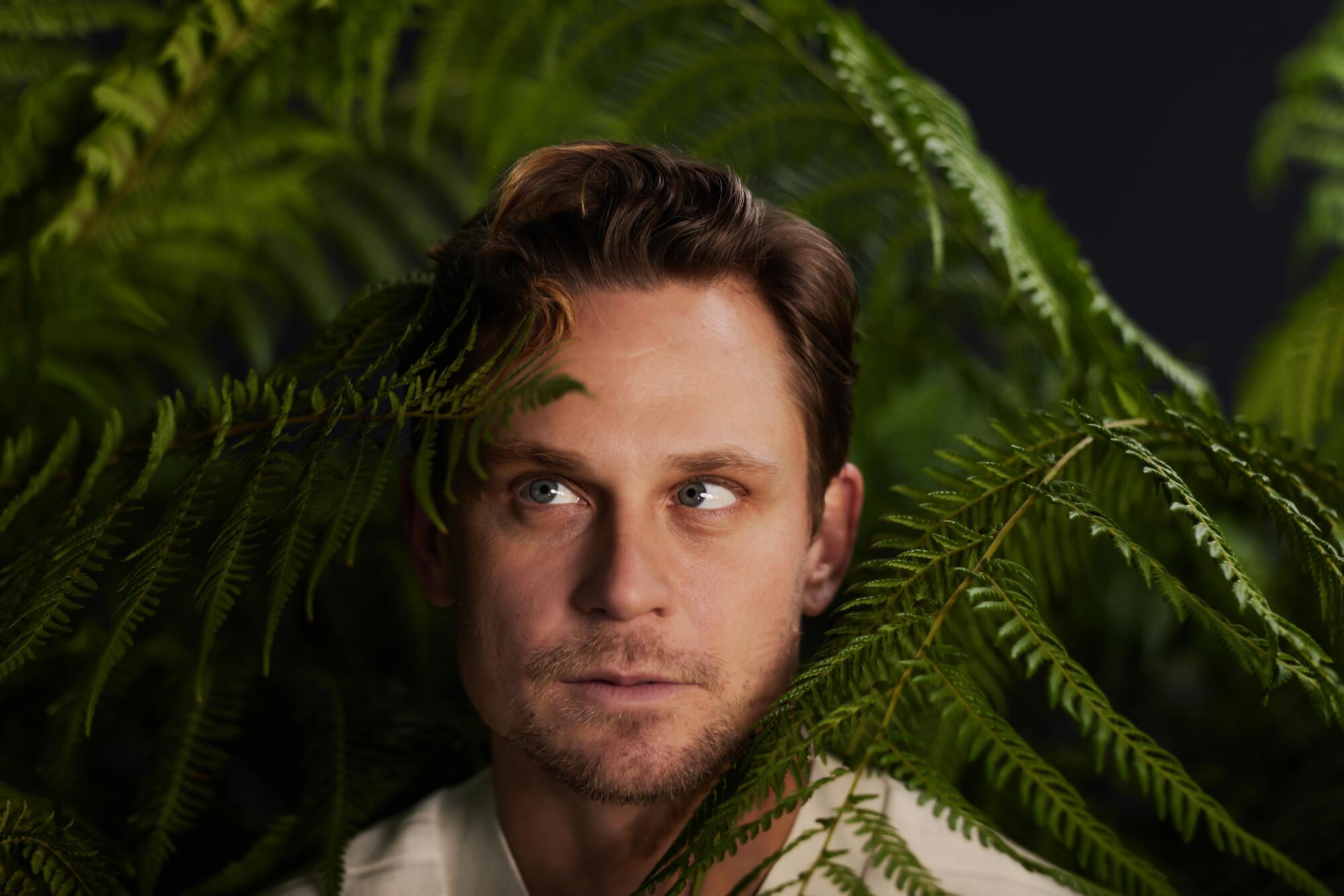
Michelle Pfeiffer, Katherine LaNasa, more on 2026 Emmy Drama Roundtable
Sit at a table with a bunch of actors and it inevitably becomes an impromptu acting class, one in which even the Michelle Pfeiffer is leaning over to observe. At least that’s what happened on a recent afternoon when The Envelope gathered six actors from some of this season’s most talked about television series for its 2026 Emmy Drama Roundtable.
It all began when Pfeiffer (“The Madison”) shared that, while studying acting, she couldn’t grasp the technique created by Sanford Meisner, which trains actors to stop overthinking and encourages them to listen and respond actively to their scene partners. The revelation immediately activated Katherine LaNasa (“The Pitt”), who beckoned Tom Pelphrey (“Task”) to join her in a spontaneous application. (Both had studied the method.)
“I like your jacket,” LaNasa said, locking eyes with Pelphrey.
“You like my jacket?” he replied playfully.
“I do like your jacket … You’re smiling at me.”
The exchange, which had a flirtatious energy, continued for a minute, before Pelphrey and LaNasa emphasized that it’s essentially looking at and listening to what the other person is doing.
“Somehow I was doing it wrong and I didn’t understand why I was doing it wrong,” Pfeiffer said.
This openness and encouragement carried the entire conversation, which brought together Pfeiffer, who plays Stacy Clyburn, a wealthy New York City matriarch whose life is upended by the tragic death of her husband, which compels her to move to Montana; LaNasa, who brings depth to the burnout plaguing steadfast, straight-talking charge nurse Dana Evans; Pelphrey, in his turn as Robbie Prendergast, a sanitation worker who robs drug houses at night to provide for his family; Zahn McClarnon, who stars as Det. Joe Leaphorn, a stoic man battling his past and the loss of his son in “Dark Winds”; Billy Magnussen, who portrays Duncan Park, the eccentric and profit-hungry CEO of a tech company in “The Audacity”; and Karolina Wydra, who plays Zosia, the eternally cheerful liaison to a utopian, hive-minded collective in “Pluribus.” Read on for excerpts from our discussion.
I know all your characters are going through some personal things, but if you were to transform into them for 24 hours, what would you do with that day?
Magnussen: I live with Duncan daily because I think your job as an actor is to check the morality of the character you’re playing. And at the same time, you have to question your own morality, see where you stand, to then deal with that character. Duncan’s a really messed-up guy, and doing it for five months … I was on set 16 hours a day every day. I was with him nonstop. And his temperament and pace was just out of this world. It’s exhausting. So what would I do? I would try to go to a spa, personally, because it’s exhausting.

Wydra: Do you find that it gets blurry after a little while?
Magnussen: I still know who Billy is.
McClarnon: But there’s times where you can’t see that line between [fiction and] reality, just moments. I’ve found myself in those moments where I know the difference, obviously, but I’m so emotionally attached to Deanna Allison, who plays my wife on the show, where I can’t separate them anymore. It’s not like 24 hours, but just moments where I’m like, “Wait a second, where am I? Am I in the show? Is this Joe Leaphorn or is this Zahn?” Usually in the middle of the season, it starts to get a little blurry for me.
Magnussen: Do you think it’s the job, though, to keep it separated? Or do you guys believe in Method acting?
Wydra: Rhea Seehorn, who is on “Pluribus,” who’s incredible, who’s my partner in crime, she gave me a book about Method [acting] — the Method and what really Method was. And it’s not what we think it is. We all do Method acting, but it’s not staying in the character and living in the character forever. … And that’s what people think Method is, is that you never break the character, you take the character home, but it’s not. It’s building a world. Building it, personalizing it.
Pfeiffer: Isn’t that what we all do? Some actors will go live on the ranch. They won’t take a bath for six months. They really take it to another level, which I’m not willing to do … From the minute I commit to something, it’s right there [in my head], I’m thinking about it. It can be a year away, and it’s right here torturing me, which is I think why I’m a bit of a commitment-phobe. My agents always call me “Dr. No” because I know no matter what, even if I’m not consciously aware of it, it’s there just badgering me.
LaNasa: I have found that people want Dana, want my character, in real life. And it’s cool because she’s very comforting to people. But I had an experience recently in New York where this table of girls, they were having some party, and someone said, “Oh, you mean a lot to us.” And I said, “Oh, are they nurses?” Well, some of them are. And then they asked at the end of their dinner would I take a picture. And then one girl told the other people to leave and then she told me her illness journey. And I had breast cancer. She was going through breast cancer. And it was really interesting. And it was the most meaningful that I’d ever felt about taking a character home where it’s like … I think I spoke about my wellness journey because I was playing the role. It ended up coming up through the press. … And for some reason, because I was Dana in someone’s mind, it meant something. And I thought, “Well, this was actually useful. This breaking of that wall between character and person was actually useful.”

Tom, you get the call that you’re cast as Robbie in “Task.” What’s the first thing you do to figure him out?
Pelphrey: When I read the first two episodes, I felt like I understood Robbie’s soul perfectly, but I knew that I would have to break my ass to get that accent right. So that was where I focused most of my conscious energy and discipline and time, was just [on the] technical, just on the accent. The fun part was, because he would be my age, thinking about growing up in Philly at that time and who his heroes would be, having ideas for tattoos, stuff like that. We had more time than you get sometimes before we had to start filming because we knew and then the writers’ strike happened. I had a lot of months to sit with him and emotionally and spiritually. And I’d just become a father. Obviously [with] Robbie, everything he does is for his kids.
Pfeiffer: It changes everything. It opens your heart.
Pelphrey: I was a new person. And I understood him in that regard perfectly and I couldn’t have before. I could have imagined it and now I knew for sure.

For “The Audacity,” Billy, you spoke with some tech folks. What did you come to understand about what they’re after as innovators versus what you’re after as a creative?
Magnussen: Listen, no one’s a villain in their own story. I believe that from Day 1, these people probably came to the Valley with genuine ideas. The genesis of their idea was to connect and really bring something powerful and important to society and people. And, “Oh wait, we’re making a lot of f— money.” And through that lens, you start being blinded by this humanity that’s around you or caring for people around you rather than a bottom line. When you’re in an incestuous pool or in a small bubble, culture is created. And like Facebook, their slogan was “Move fast and break things.” Being a bull in a china shop is not a good idea anywhere, but for some reason that was the culture. People just started doing that more and more and breaking things and breaking things and breaking things. I don’t think they started off that way, but the culture just bred them to become this way. I personally relate that to, I don’t want to say Hollywood or the entertainment world, but we’ve seen the toxicity. And we’ve been slowly trying to filter that out, I think, of Hollywood. But when you have a microclimate kind of culture feeding in toxic behavior and rewarding toxic behavior over and over again, it breeds it. So you start to have to scrape away that cancer. But again, the genesis of all these ideas were pure. We were 6 years old just dreaming to be something or being like, “I could do this.”
Pfeiffer: Pretending to be something else, other than what we were.
Magnussen: I empathize with that. I don’t think people are bad. I just think they’re lost sometimes.

Karolina, your character in “Pluribus,” Zosia, is carrying the weight of almost every person in the world. What do you remember about those discussions with [creator] Vince Gilligan and how he helped you unpack this character and the relationship with Carol, Rhea [Seehorn]’s character?
Wydra: I took a break for five years from acting before Zosia came into my life. I walked away at 39 to have kids and my agent and my manager dropped me and it was really terrifying to also be a woman and turning 40, to have children at that time. When Lou [her second son] was maybe a year-and-a-half [old], I got the itch of like, “God, I miss acting so much. How am I ever going to come back? How am I going to get an opportunity?” And I was 43 at the time and out of nowhere I got an email being like, “Hey, there’s this thing …” from a commercial agent that I was on their roster, but I did not work with them. And they said, “There’s this audition.” And I go, “OK.” I read it and I said, “Who wrote it?” And she said, “Vince Gilligan for Apple TV.” I went, “What? OK.” And I didn’t know anything about the project and it was always my dream to work with Vince from when I saw “Breaking Bad.”
Long story short, I’m here and the whole journey has been so wild, so insane. When I first would talk to him about Zosia, I was like, “God, how am I going to tackle the world and someone that has the highest emotional intelligence, someone that does all these different things? And how do you see the Others? How do you want them to move about the world and the complexities of who they are?” Vince is such a beautiful human being. He’s like, “They’re just happy and content.” You go, “OK, yeah, but … what else?” For me, Zosia is extremely spiritual. Meditation was my key, my go-to to get into that zone of connection to humanity, not in the physical but very spiritual way where, [if] you meditate enough, the ego gets lifted and you truly feel connected, and you feel one with everyone. And the wild thing, I think the greatest gift, was becoming a mother; I understood what it means, unconditional love. Because my heart lives outside my body all the time. And so becoming a mother was a gift to play Zosia, because I unconditionally love Carol. And now, no matter what she throws at me, I just love her, and take care of her, and I want to nurture her.

Michelle, you get the call from Taylor Sheridan, who also created “Landman” and “Yellowstone.” He says he wants to meet with you and he wants to do it on his turf in Texas, not yours. There’s no script. What does someone like Taylor Sheridan say to someone like Michelle Pfeiffer that will get her to agree to the show?
Pfeiffer: Well, he gave me a lot of tequila.
LaNasa: Writing this down: Tequila, check.
Pfeiffer: I got a call that he wanted to meet with me, that he had an idea for something, “But you have to come to Texas.” And I said, “Is there anything? Is there an outline? Is there a paragraph?” “No, no. He wants to explain it to you in person.” I had to stay the night in Fort Worth and then met with him and he gave me tequila, and then after a while I had to stop drinking. He gave me a very rough outline of the show, of the character … She’s been with the love of her life for 50 years. It’s the marriage that we all dream of having. And he dies suddenly, tragically, and … all of a sudden the rug is really just emotionally and psychologically pulled out from underneath them. And it’s how do you rebuild a life and it’s the study of grief. He said that I had committed that night, which I did not. I’d had a few cocktails. We went back and forth a little bit about [the fact] that I really would like to read something. And he said, “Well, I would really like to cast this before I write anything.” Then I realized I wasn’t going to win this battle and I reached out to Helen Mirren [who starred in Sheridan’s “1923”], who I don’t know, but I figured she doesn’t suffer fools and she would give me the truth about what it’s like to do this. She couldn’t have spoken [more] highly of everything. She said the scripts are wonderful. The production is wonderful. And loves Montana. And so I took a leap of faith. I never do that.
What stands out to you about his process versus then working with your husband, David E. Kelley, also a prolific writer, who adapted “Margo’s Got Money Troubles”?
Pfeiffer: I couldn’t be luckier working for two of the most talented and prolific writers in the history of television. [They’re] not that much different. I purposefully didn’t want to bug David because it’s not like we had any hard-and-fast rules about not working together, but we weren’t really actively seeking it out because that can get a little dicey, just looking at it from afar. I really cherish my marriage, and our family, and I just didn’t want to mess it up. I really mostly went to the director and every now and then I might throw a little something his way. And [with] Taylor … I would go through Christina [Alexandra Voros], our director, because he’s just not honestly that accessible because he’s got a bit going on. I personally don’t like to spend my time trying to rewrite things. It’s more interesting to me to try to make something work and then I end up finding something I never would’ve decided. It just takes you to a new place and it’s so much more interesting than anything I would have conjured up.

Zahn, you’re not only the lead in “Dark Winds,” but also an executive producer and directing episodes. I know there was a moment where your character was supposed to shoot someone in the face early on. And you felt strongly, “My character’s not someone that would do this.” Talk to me about leaning into speaking your mind.
McClarnon: There’s not a lot of Native characters on television. The foundation of that character obviously comes from Tony Hillerman’s books. So the foundation was set for that character. And when I got to a point in the season where I’m supposed to kill a man, shoot him in the head in the middle of the desert — first off, I didn’t see that in the books. And I know it’s television and we want drama and all that stuff, but also, to be honest with you, I want Native kids — see, I’m going to cry now — to have something to look up to. We grew up with these stereotypes and we grew up with these tropes of Native Americans. The only one I can really remember that I really looked up to was Will Sampson in “One Flew Over the Cuckoo’s Nest” because he was playing a trope, but he becomes the hero at the end of the story. It’s one of my favorite films. So when it came to that point where the writer said, “He’s going to kill this rich white man in the desert and shoot him in the head,” morally, I think Joe Leaphorn is more than that.
And it was simple. I sat down with the showrunner [John Wirth] and we talked about it, and we went back and forth for about a week. And I’m so glad that I have access to somebody like that. I have access where they’re not telling me, “No, this is the way it’s written. This is what you’re going to do.” So yeah, we decided not to shoot the guy in the head, where I’d just leave him out in the desert to fend for himself.
Katherine, you’ve talked to nurses and medical professionals in the making of “The Pitt,” but you were also a patient during your breast cancer journey, interacting with them a lot from the other side. What is something that they’ve told you or even something you observed in that time that really spoke to you about what they’re going through on the day to day in these jobs?
LaNasa: It’s funny, I’d always wanted to work with John Wells. I go through this period of all this unemployment, and then I get this job for John Wells. I had had cancer a year before and then had complications up to like six months before. It wasn’t until I got to the emergency room set that I was like, “Oh, this whole period … ” — the spirituality of that. I really believe that we need to be grateful for our life while we’re living it, no matter what’s going on. Because I still have my children, and I have nature, and I have my husband, and cooking, and my dog, and so many wonderful things. And I was really trying to hold onto that. It’s always this idea that maybe something is for a reason or whatever — now I’m going to cry. The fact that that was so purposeful, that I understood so deeply what it was to be a patient, what it was to be terrified going into the emergency department. I also understood how much it mattered when a nurse took a little extra time and was a little bit kind.
Pfeiffer: You’re going to make me cry.
LaNasa: And there was one particular nurse — I had my cancer, went through my radiation and then [went] back and forth, back and forth [to the ER]. And there was a week, the second trip to the ER [they thought I might have multiple sclerosis]. “Now do I have MS on top of having had cancer?” And I had a breakdown in the ER. And she’s like, “Listen, first six months after cancer are really bumpy, and it’s not going to stay like this. Do you need an Ativan?”
Magnussen: Did not see that turn.
LaNasa: It was that human touch. Or when they would come and give you a warm blanket or something. There’s a nurse, Kathy Garvin at County, who told me she wouldn’t do the job that she does being the [emergency department] charge nurse if it wasn’t in a county hospital. She wants to do that hard work for people that really need her. For the most underprivileged, for the unhoused. And I try to honor that in the story and to just bring that to life — their generosity and their humility.

The Envelope’s 2026 Emmy Drama Roundtable: From left, Zahn McClarnon, Michelle Pfeiffer, Tom Pelphrey, Katherine LaNasa, Billy Magnussen and Karolina Wydra.
There’s a lot of discussion in the industry right now about runaway production and can L.A. rebuild and what’s lost. I’m curious how you feel about this topic.
Magnussen: I live in Georgia and … one of our biggest exports as Americans is our culture. And if we just keep it isolated to Hollywood, I think we lose out at expressing everything we are as Americans.
McClarnon: We shoot on the Tesuque Pueblo. There’s 19 pueblos in New Mexico. We have taken over their old casino and we’ve converted it into a soundstage. We use their back lot. We obviously help out the tribe with renting the place out. And so I like shooting in New Mexico and supporting the local community, especially local Natives.
Pfeiffer: I think there’s room for all of it. We shot [a movie] in London that took place in Los Angeles. And it’s ridiculous that our entire industry has left. Los Angeles is really hurting. And a lot of people are hurting. All those jobs, all of those restaurants where people used to eat, people used to shop. And I think to not give the same sort of tax incentives that other states are doing — look, if it takes place in Georgia, you should go to Georgia. But I think Los Angeles was really built on the movie [industry].
LaNasa: I have a 34-year-old and a 12-year-old. I remember with my 34-year-old, even just being a young, starting-out mother, I would be like, “Well, I’m not going out of town. I have a child.” I would never go do a TV show out of town. I had a kid and the kid was in school and I needed to provide consistency for that child. And then with my second one, that was impossible. We would just not have been able to work. But it’s really hard on families. We are actors and we’ve come here to pursue the industry. We’ve moved here and we’ve risked something … L.A., for all of its problems, is a city of dreamers. It’s a city of people that came to pursue their art. And I am one of those people. And so in a way, I wasn’t really a citizen like the other citizens of Atlanta. I was outside. I didn’t have my community.
Magnussen: I know, but that’s the thing I have an issue with is this idea that, “It’s only there.”
Pelphrey: I’ll say this. Love that we get to film all over our beautiful country. Would love to keep the jobs in this country. That would be the nice part. Because when everybody’s like, “Oh great, we can go to Belarus or London.” Guess what? All of us get to go. Our crew doesn’t get to go — the people that we know that we need, that we work with, that we make these things with. We get to go wherever the f— we want, actors, directors, but the crew doesn’t.
