Madness

A simple-majority vote would end the madness on passing state budget

Sacramento

Frustrated by his fellow Republicans in the state Senate, Gov. Arnold Schwarzenegger finally is starting to come around — coming around to the recognition that California’s daunting budget hurdle is destructive and dopey.

California is one of only three states — the others being Arkansas and Rhode Island — that require a supermajority legislative vote for passage of a budget. California mandates a two-thirds majority, an inanity given that a 60% vote in elections is considered a landslide.

Republicans — almost always comprising the legislative minority in California — have staunchly defended the two-thirds requirement, contending that it’s what makes them relevant. But too often it makes the entire Legislature look ridiculous.

Every state but California has enacted a budget for the fiscal year that began July 1. California has missed the deadline for 17 of the last 21 years. If the stalemate continues, it “could raise credit concerns,” the bond-rating agency Standard & Poor’s warned Friday.

Because no budget has been passed, some companies that do business with the state are being stiffed. The state has withheld more than $3 billion in payments to vendors, hospitals, nursing homes, hospices, child-care centers, community colleges. . . .

Call it tyranny by the minority in the Legislature.

Schwarzenegger isn’t exactly calling it that, nor calling for the two-thirds vote to be scuttled. But he did take a significant step in that direction last week at a money-strapped adult healthcare center in Santa Maria. There, the governor praised one Republican — local Sen. Abel Maldonado — for being an “extraordinary leader” and breaking party ranks to vote for the budget. Schwarzenegger also tried to generate public pressure on the 14 other GOP senators to follow suit.

The governor was asked why Sacramento can’t ever seem to get its budget work done on time.

“Yes, we have had this mess, as you know, for decades,” Schwarzenegger replied. “I think that everyone now has come to the conclusion — all the leaders — that we must work, as soon as the budget is over, on a system that allows us to have a budget on time.

“If that means we should go and shoot for, as some suggested, a simple majority to pass the budget rather than a two-thirds vote, maybe that’s the solution.”

Schwarzenegger also mentioned an idea that he said former President Clinton gave him. In Arkansas, when Clinton was governor, he and the Legislature agreed on a program priority list. When the state fell short of money, the lowest priority programs automatically were cut.

“It’s all laid out . . . so there’s no fight over it,” Schwarzenegger said.

There would be in California, I suspect. The Legislature is in session much longer, and there are many interest groups with squeaky wheels.

Gubernatorial spokesman Adam Mendelsohn downplayed Schwarzenegger’s seeming tilt toward a simple-majority budget vote.

“He’s just encouraging debate,” Mendelsohn said. “He’s saying everything’s up for debate. . . . It’s frustrating for him to watch the Legislature fail to do its job.”

Actually, the Assembly did pass a $146-billion bipartisan budget with Republican support. It’s only in the Senate that the spending proposal has been blocked by Republicans demanding deeper cuts.

Senate GOP leader Dick Ackerman of Irvine echoes most Republicans in contending that eliminating the two-thirds vote requirement could lead to a taxpayers’ disaster if Democrats controlled both the legislative and executive branches, as they did when Gray Davis was governor.

“Think back,” he says, “if we hadn’t had the two-thirds vote to stop tax increases.”

That typical thinking assumes the two-thirds vote requirement for a tax hike also would be scrubbed. It should be. Lawmakers illogically are allowed to cut taxes with a majority vote but need two-thirds to raise them. The state can go bankrupt just as fast lowering taxes as it can increasing spending, and proved that during the Davis days.

But for the sake of punctual budgets, let’s forget the tax vote. Keep it at two-thirds and merely lower the budget vote.

That gets the support of the Legislature’s most fiscally conservative member, veteran Sen. Tom McClintock (R-Thousand Oaks).

Let the majority party rule and be accountable for the consequences, McClintock says. Give ‘em the rope to hang themselves. And with a two-thirds vote still required for tax hikes, he notes, “spending can’t run away.”

The budget two-thirds vote was enacted in 1933 during the Depression. The idea was to hold down spending. It never really worked.

A decade ago, a bipartisan citizens budget commission found that “the vast majority of states that have simple-majority requirements have weathered their budgetary crises more effectively than California. None of these states have produced deficit spending remotely close to California’s.”

The panel concluded: “There is no evidence [the two-thirds vote] does anything to slow the increase in state spending. Instead, it encourages horse trading [and] pork-barrel legislation. . . . Stories abound of ‘buying’ votes to reach the two-thirds.”

McClintock agrees. Normally, he says, “there are a few morally flexible members of the minority party who are bought off with promises of all sorts of lard for their districts.”

This summer, the Senate GOP has been trying to sell its budget votes for legislation crimping Atty. Gen. Jerry Brown’s ability to block public works projects that don’t control greenhouse gases. This is shaping up as the grand compromise on the budget. Schwarzenegger and McClintock both consider it a good cause, but neither think it should have held up the budget.

“I don’t believe in tying unrelated subjects to any measure,” McClintock says.

But that’s the sort of tawdry horse trading that comes with a nutty two-thirds vote rule — a rule too often abused, as Schwarzenegger is finding.

george.skelton@latimes.com

Source link

March Madness: Lauren Betts and UCLA advance to the Sweet 16

On a day when No. 1 seeds dominated, UCLA wasn’t the exception.

The top-seeded Bruins led wire-to-wire, beating No. 8-seed Oklahoma State 87-68 in the second round of the NCAA tournament on Monday night at Pauley Pavilion to advance to the Sweet 16.

They will face No. 4-seed Minnesota on Friday in Sacramento.

While UCLA started much better than it did in its opening-round game, there were still elements to nitpick. The Bruins were outscored 21-18 in the third quarter, Oklahoma State won the offensive rebounding battle and outside of Lauren Betts — who scored a career-high 35 points while shooting 15 of 19 — the offense fell flat at times in the second half.

But with arguably the best post player in the country, the Bruins overcame all of that.

UCLA (33-1) jumped out to an 11-2 lead while the Cowgirls (24-10) went the final 4:26 without scoring and shot 0 for 8 from the field during that span. The Bruins turned that into a 25-point lead and were up 46-26 at halftime.

Unlike the first-round victory over California Baptist on Saturday, UCLA came out cold to start the third quarter. The Bruins missed six shots in a row while Oklahoma State went on a 9-0 run to narrow the deficit to 13.

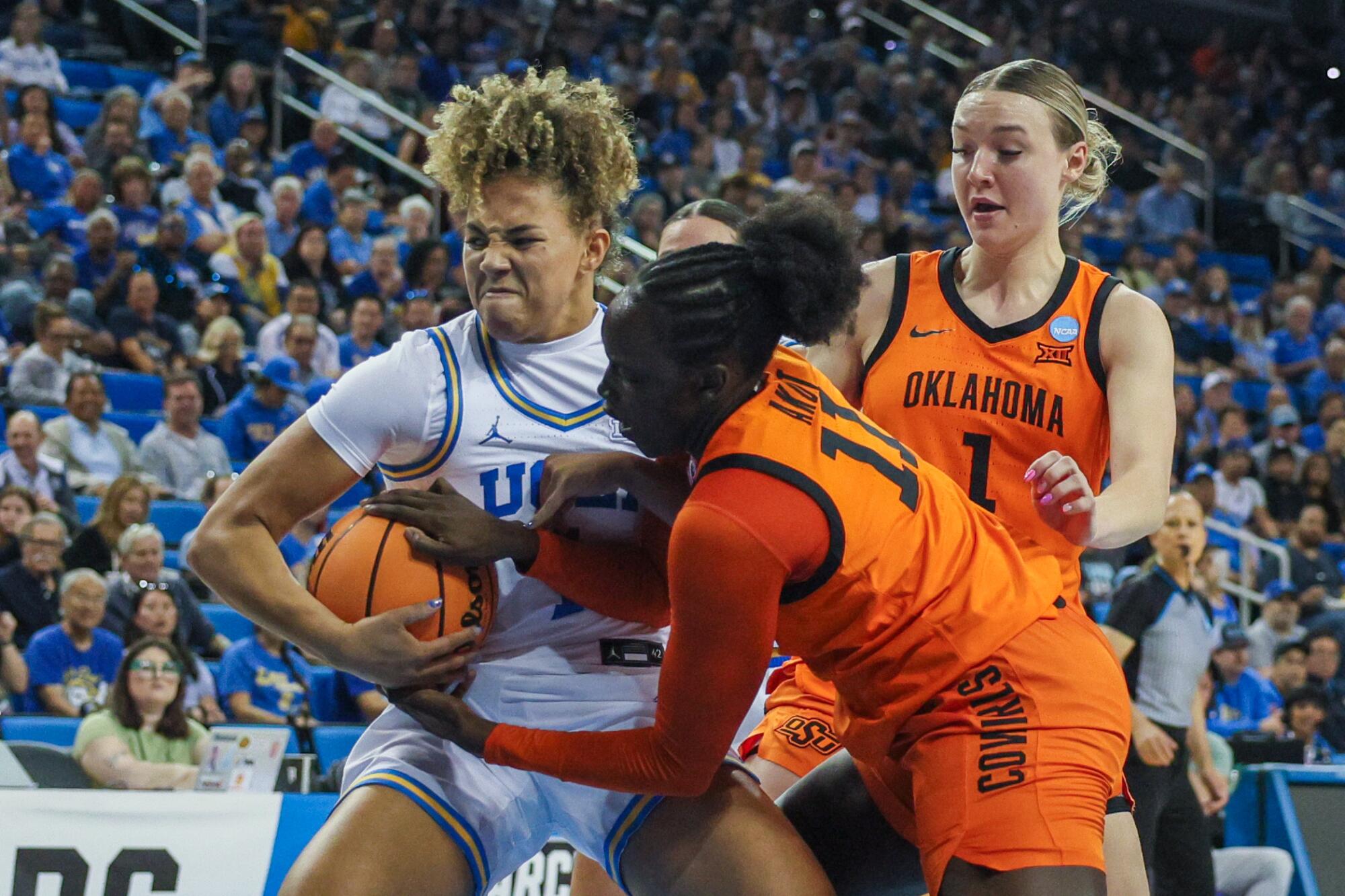
UCLA guard Kiki Rice, left, fights for the ball with Oklahoma State forward Achol Akot during the Bruins' win Monday.

UCLA guard Kiki Rice, left, fights for the ball with Oklahoma State forward Achol Akot during the Bruins’ win Monday.

(Ronaldo Bolanos / Los Angeles Times)

The Cowgirls shot 51.4% from the field in the second half to stay within striking distance while UCLA’s offense went mostly cold. But Oklahoma State’s leading scorer, Achol Akot (23 points), had four fouls by the start of the fourth quarter and had to spend much of the quarter on the bench.

Betts scored 11 consecutive UCLA points in the final four minutes of the third to put the Bruins ahead by 19. In addition, she finished the game with nine rebounds and five assists.

Gianna Kneepkens (15 points) made a couple of key shots in the fourth quarter to help jolt the Bruins’ shooting, but it was still Betts’ dominant showing that kept UCLA well ahead. Of UCLA’s 87 points, 50 came in the paint.

UCLA’s next opponent, the Golden Gophers (24-8), advanced on a buzzer-beater against No. 5-seed Mississippi on Sunday. The Bruins beat Minnesota 76-58 on the road during conference play earlier this season.

Source link

March Madness: UCLA’s Sweet 16 ambitions thwarted in loss to UConn

On the night reigning NCAA champion Florida was eliminated by Iowa, UCLA tried to follow the Hawkeyes’ lead against Connecticut, the team that had worn the crown the previous two years.

And for the second straight game they were hoping to win without leading scorer Tyler Bilodeau, whose sprained knee still hadn’t healed enough for coach Mick Cronin to risk putting him on the floor.

Seventh-seeded UCLA battled, managing to take a brief lead in the second half. But in the end, No. 2 Connecticut’s size and power were too much for the Bruins to overcome in a 73-57 loss in the second round of the NCAA tournament Sunday.

Four players scored in double figures for UCLA. Xavier Booker finished with 13 points, Eric Dailey Jr. had 12 points and Donovan Dent and Skyy Clark each finished with 11. But the Bruins couldn’t contain Connecticut forward Alex Karaban, who erupted for 27 points, as the Huskies advanced to the Sweet 16 to play No. 3 Michigan State in Washington, D.C., on Friday.

The Bruins got off to a good start, building an 18-12 lead before the Huskies caught fire, hitting seven straight shots at one point to seize a 38-33 halftime lead.

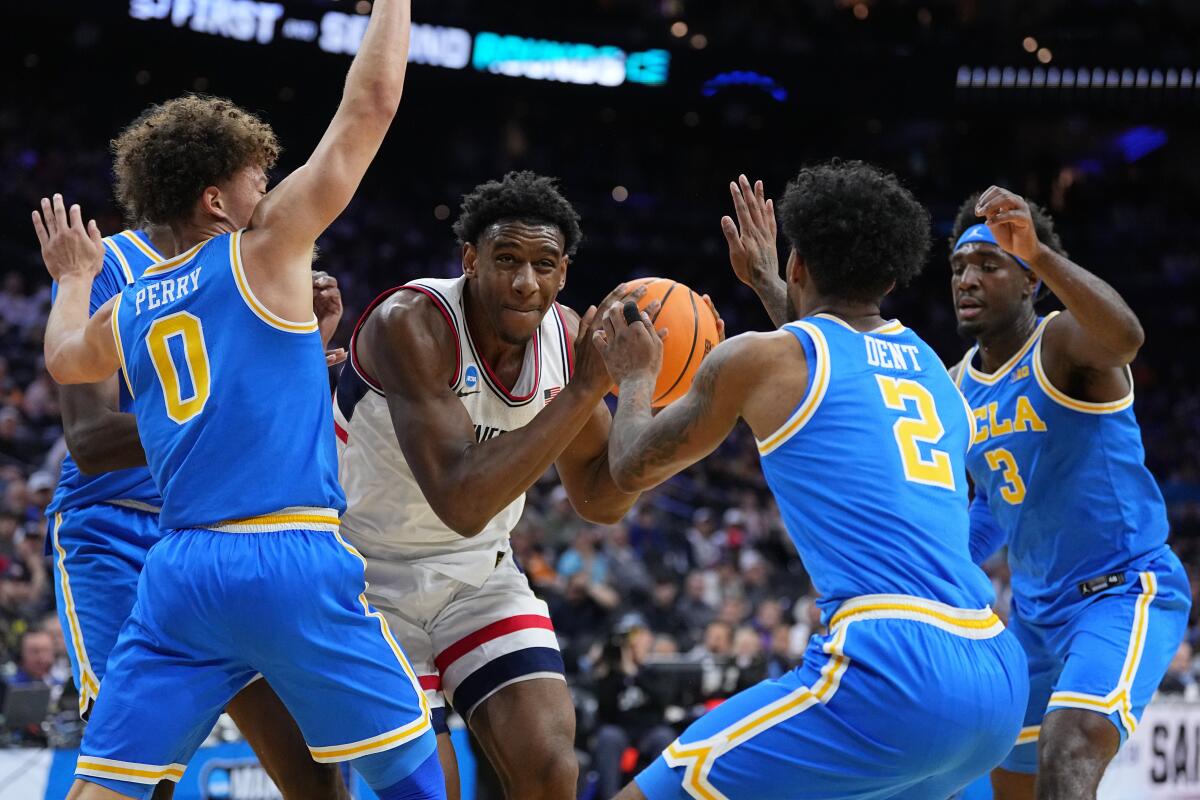
Connecticut's Tarris Reed Jr., center, tries to work past (from left) UCLA's Trent Perry, Donovan Dent and Eric Dailey Jr.

Connecticut’s Tarris Reed Jr., center, tries to work past (from left) UCLA’s Trent Perry, Donovan Dent and Eric Dailey Jr. during the first half Sunday.

(Matt Rourke / Associated Press)

UCLA (24-12) started the second half on a 6-0 run, regaining a 39-38 edge on a corner jumper by Clark.

Connecticut (31-5) didn’t wait long to retake control, going on a 14-0 run over the next five minutes, with Karaban scoring 10 points over that span.

UCLA answered with an 8-0 run, with Dailey’s three-point play cutting Connecticut’s lead to 56-52 and reigniting the Bruins’ hope of an upset. Connecticut, however, responded with a decisive 9-0 run, taking a 67-54 lead with 4:24 left.

UCLA struggled with its shooting most of the night, going 19 for 49 (39%) in comparison to Connecticut’s 23 for 49 (47%). Both teams had the same number of free-throw attempts (21), but the Bruins made just 67% of their shots and the Huskies made 90%.

Source link

Alabama’s Aden Holloway arrested on drug charge ahead of March Madness

Aden Holloway, the second-leading scorer for the Alabama men’s basketball team, was arrested Monday on a felony drug charge and may not be available for the Crimson Tide during March Madness, pending the university’s investigation into the matter.

Alabama coach Nate Oats said that after he told his players about the situation, the team went out and had “a really good practice” four days ahead of its first-round NCAA tournament game against Hofstra.

“Aden’s one of our guys, and everybody wants to wrap their arms around [him],” Oats said Monday during an appearance on the Crimson Tide Sports Network. “Everybody makes some mistakes in life, but [the players] also understand we’ve got to move on … and the team’s got to go play Friday.

“So I thought we did a good job of that this morning, kind of addressing the situation, what we currently knew at the time, and got our guys focused on practice.”

Holloway’s arrest came after the West Alabama Narcotics Task Force searched a residence near campus and “recovered more than a pound of marijuana, paraphernalia and cash,” the Tuscaloosa Police Department said.

The 21-year-old player is facing a first-degree charge of marijuana possession, not for personal use, which is a Class C felony and carries a penalty of up to 10 years in prison and a maximum fine of $15,000.

Police said Holloway also will be charged with failure to affix a tax stamp, another felony. Holloway was taken to jail shortly before 10 a.m. and was released less than an hour later on a $5,000 bond.

Alabama said in a statement Monday: “The University is aware of the allegations and is working to gather more information. The student has been removed from campus pending further investigation by the UA Office of Student Conduct.”

Oats said players need to be held accountable if they fail to meet the standards set by the program.

“So, you know, we had to suspend [Holloway] pending the investigation by the UA office of student conduct,” Oats said. “And we’re certainly disappointed in his behavior. But that being said, we still love him. He’s still our guy. We’re helping him get the help he needs, and we’re going to continue to help him whatever way we can.”

Meanwhile, the Crimson Tide, the No. 4 seed in the Midwest Region, continues to prepare to face 13th-seeded Hofstra on Friday without a player who averages 16.8 points a game. Sophomore guard Labaron Philon Jr. leads the team with 21.7 points a game, and sixth-year senior Latrell Wrightsell Jr. is averaging 12.8 points.

“I did tell our team, this team more than any team I’ve ever coached is better equipped to handle a situation like this,” Oats said. “I don’t know how many games we went into where we had a game time decision. Guy goes, warms up, and we got to decide whether he’s going to play or not an hour before the game. … We’ve won plenty of games with guys not available, so our guys will be ready to go against Hofstra.”

The Associated Press contributed to this report.

Source link

2026 March Madness bracket: NCAA men’s tournament is set

The 68-team bracket for the 2026 NCAA men’s basketball tournament is set. Matchup starting times and broadcast information will be announced later on Sunday.

The men’s First Four begins Tuesday and first-round games begin on Thursday.

First Four

Tuesday-Wednesday (at Dayton, Ohio)
No. 11 Texas (18-14) vs. No. 11 North Carolina State (20-13)
No. 11 Miami (Ohio) (31-1) vs. No. 11 Southern Methodist (20-13)
No. 16 Maryland Baltimore County (24-8) vs. Howard (23-10)
No. 16 Prairie View A&M (18-17) vs. No. 16 Lehigh (18-16)

East Region

FIRST ROUND
Thursday (at Greenville, S.C.)
No. 1 Duke (32-2) vs. No. 16 Siena (23-11)
No. 8, Ohio State (21-12) vs. No. 9 Texas Christian (22-11)
Friday (at San Diego)
No. 5 St. John’s (28-6) vs. No. 12 Northern Iowa (23-12)
No. 4 Kansas (23-10) vs. No. 13 California Baptist (25-8)
Thursday (at Buffalo)
No. 6 Louisville (23-10) vs. No. 11 South Florida (25-8)
No. 3 Michigan State (25-7) vs. No. 14 North Dakota State (27-7)
Friday (at Philadelphia)
No. 7 UCLA (23-11) vs. No. 10 Central Florida (21-11)
No. 2 Connecticut (29-5) vs. No. 15 Furman (22-12)

West Region

FIRST ROUND
Friday (at San Diego)
No. 1 Arizona (32-2) vs. Long Island University (24-10)
No. 8 Villanova (24-8) vs. No. 9 Utah State (25-8)
Thursday (at Portland)
No. 5 Wisconsin (24-10) vs. No. 12 High Point (30-4)
No. 4 Arkansas (26-8) vs. No. 13 Hawaii (24-8)
No. 6 Brigham Young (23-11) No. 11 Texas / North Carolina State
No. 3 Gonzaga (30-3) vs. No. 14 Kennesaw State (21-13)
Friday (at St. Louis)
No. 7 Miami (25-8) vs. No. 10 Missouri (20-12)
No. 2 Purdue (27-8) vs. No. 15 Queens (21-13)

Midwest Region

FIRST ROUND
Thursday (at Buffalo)
No. 1 Michigan (31-3) vs. No. 16 Maryland Baltimore County / Howard
No. 8 Georgia (22-10) vs. No. 9 Saint Louis (28-5)
Friday (at Tampa)
No. 5 Texas Tech (22-10) vs. No 12 Akron (29-5)
No. 4 Alabama (23-9) vs. No. 13 Hofstra (24-10)
Friday (at Philadelphia)
No. 6 Tennessee (22-11) vs. No. 11 Miami (Ohio) / Southern Methodist
No. 3 Virginia (29-5) vs. No. 14 Wright State (23-11)
Friday (at St. Louis)
No. 7 Kentucky (21-13) vs. No. 10 Santa Clara (26-8)
No. 2 Iowa State (27-7) vs. No. 15 Tennessee State (23-9)

South Region

FIRST ROUND
Friday (at Tampa)
No. 1 Florida (26-7) vs. No. 16 Prairie View A&M / Lehigh
No. 8 Clemson (24-10) vs. Iowa (21-12)
Thursday (at Oklahoma City)
No. 5 Vanderbilt (26-8) vs. No. 12 McNeese (28-5)
No. 4 Nebraska (26-6) vs. No. 13 Troy (22-11)
Thursday (at Greenville, S.C.)
No. 6 North Carolina (24-8) vs. No. 11 Virginia Commonwealth (27-7)
No. 3 Illinois (24-8) vs. No. 14 Pennsylvania (18-11)
Thursday (at Oklahoma City)
No. 7 Saint Mary’s (27-5) No. 10 Texas A&M (21-11)
No. 2 Houston (28-6) vs. Idaho (21-14)

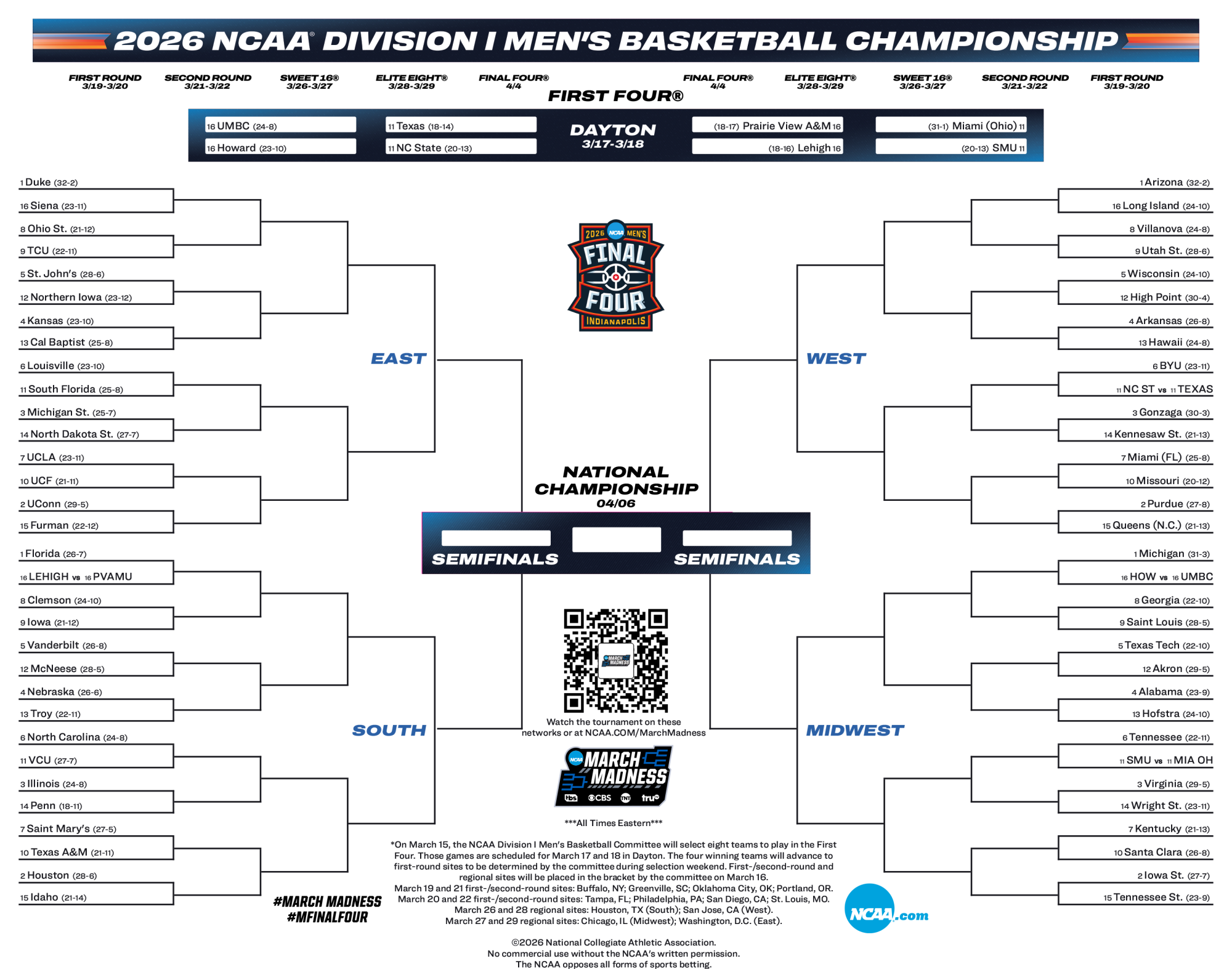
Men's NCAA basketball bracket 2026.

Source link

Insanity of March Madness – Los Angeles Times

Don’t blame the beleaguered voter for the record-low statewide turnout of 34% of registered voters in Tuesday’s primary election. Don’t call the stay-at-homes lazy or berate them for failing to do their duty. Don’t wonder why the patriotism stirred by Sept. 11 didn’t translate into an energized electorate.

The truth is, for many Californians, there were just too many reasons not to vote. The lack of hot contests on the Democratic ballot resulted in dismal turnouts of 23% in heavily Democratic Los Angeles County and 27% in San Francisco. The confusing rules of the primary had been changed again as to who could vote for which slate of candidates.

The campaign was overshadowed first by the Super Bowl and then by the Winter Olympic Games. When the political ads finally got the public’s attention, their constant carping and attacks surely turned off many voters. On election day some locales, including Los Angeles, were plagued with the failure of some polling places to open on time, ballots that weren’t delivered and voting locations that were changed or yanked.

The real culprit, however, was the ridiculously early primary date, more than eight months before the Nov. 5 general election. Many Californians didn’t even realize an election was coming up.

The Legislature and governor should make sure this doesn’t happen again. Lawmakers need to take a close look at SB 1975, by Sen. Ross Johnson (R-Irvine), a bill that would move the primary for state and local candidates to the second Tuesday in September every election year while maintaining a separate presidential primary in March.

The idea is to enable California to have a rational primary date while retaining some clout in the choosing of the presidential candidates. More discussion is in order about whether September balloting would allow enough time for an informative general election campaign. However, nine states have August primaries, and 10, including New York, vote on the second Tuesday in September, the day Johnson has proposed. A cheaper proposal would be for the state to stop playing presidential primary leapfrog for ever-earlier dates and move all primaries back to June.

Election officials struggle to make it convenient for Californians to vote, but the process remains complex and confusing. “It felt more like doing your taxes,” one expert said. The first step toward rationality is getting rid of this March madness.

Source link