French protests: Is it game over for Macron’s centrists before elections? | Protests News
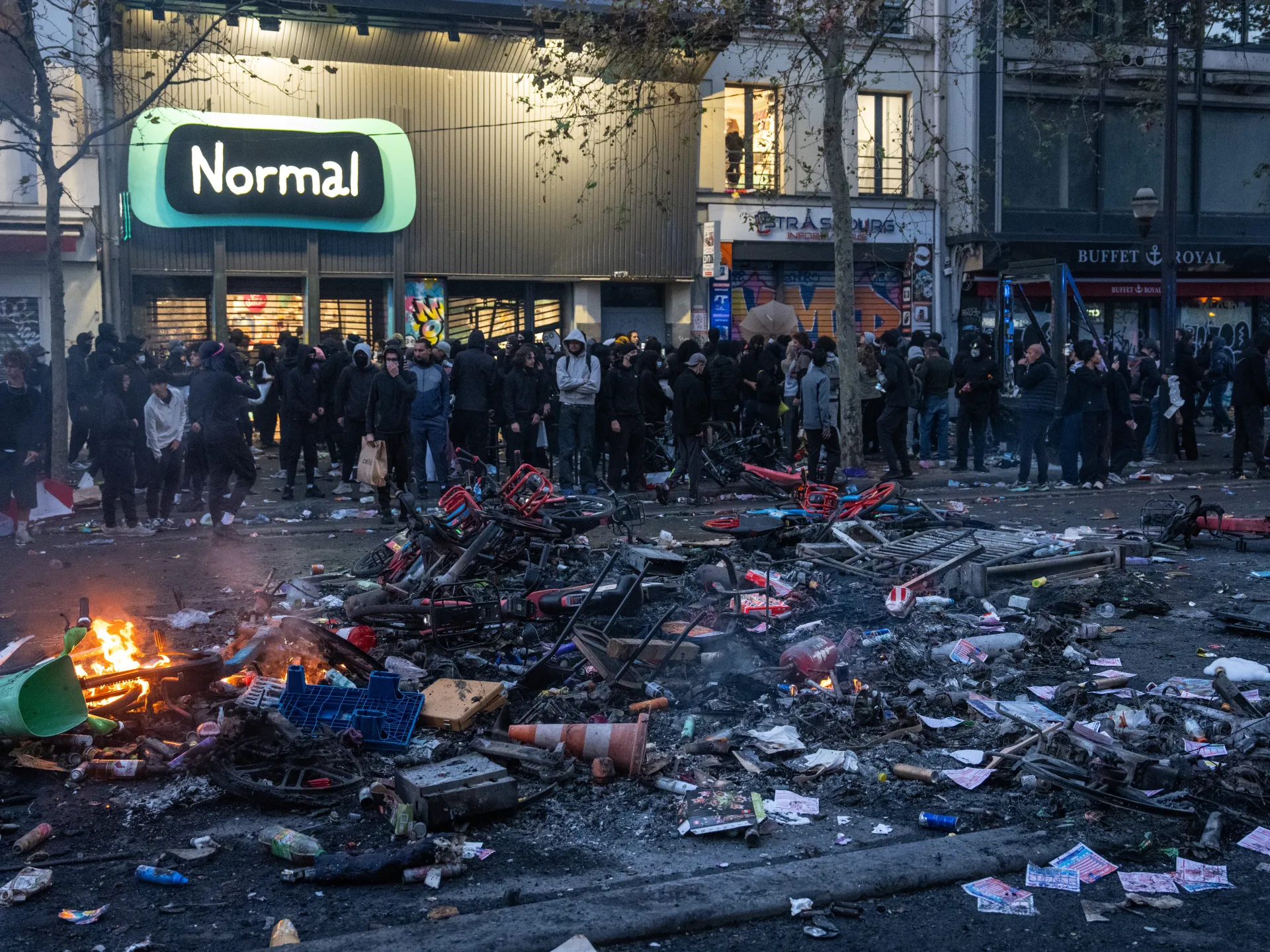
Paris, France – After nationwide protests turned violent, French President Emmanuel Macron on Sunday night tried to strike a balance between acknowledging the concerns of students demanding changes to the education system and criticising rioters.
“Those who have destroyed property must pay. Those who have looted must reimburse their victims. Those who sought to bring down the republic will be held accountable,” Macron said.
But the president’s speech was not what Yanis, a 20-year-old from Ivry-sur-Seine, a suburb just southeast of Paris, wanted to hear.
“He gave his usual ‘bla bla bla speech’ without putting forward anything concrete,” he said. “We’ll be back on the streets anyway. There will be one demonstration after another until something changes – every weekend, without a break”.
As France grapples with widespread anger that bubbled over in the form of violent protests last weekend, appetite – at least among the country’s youth – for centrist politics of the kind that Macron represents appears to be rapidly shrinking.
The unrest in France comes months before the country’s 2027 presidential election and has further sharpened political divisions, with parties seeking to present themselves as the answer to the frustration visible on the streets.
The populist-left leader Jean-Luc Melenchon has embraced the student movement with enthusiasm, while far-right firebrand Marine Le Pen has focused on the disorder that came with the demonstrations, framing it as a crisis of security and authority. The centrist Prime Minister Sebastien Lecornu has accused the extreme left of instigating violence as a “warm-up round” for the presidential election.
Polling before the election points to a contest in which both the far left and the far right could play a central role. But while the country is demanding change, there is little consensus on what that change should look like. Macron, who has been in power for two terms, will need to step aside after the election, as the constitution bars him from running again.
“Candidates have no choice but to take a stand and address young people,” said political analyst Beligh Nabli, a professor of public law at UPEC-Paris XII. “They have a political obligation to have a message aimed at young people. That message must not be empty, but it will have to answer their demands.”
Since launching their protest in mid-September, students have demanded better schools, more teachers and a more equal system. But the movement quickly spilled out of the schoolyards and into the streets, tapping into broader social and economic anxieties.
The protests have brought these issues to the centre of the political debate in a way that might not otherwise have happened, given young people’s comparatively low electoral participation and the tendency of political campaigns to focus on older voters and issues such as pensions, say analysts.
“If it wasn’t for this mobilisation, it would have been business as usual,” Nabli said. “We would have seen a kind of relative indifference from the candidates towards young people because they are not the social group that mobilises the most in elections, in contrast with those over 60.”
France Unbowed – La France Insoumise (LFI) in French – the left party led by Melenchon, has strongly supported the student movement to the point that critics have accused the party of spurring youth resentment and exploiting the unrest for political gain. Yet the party’s appeal among young voters predates the protests. Its programme addresses several of the movement’s central grievances, including investment in education, teachers’ pay and the abolition of Parcoursup, an online platform students must use for higher education applications that many say lacks transparency.
According to an OpinionWay poll for Les Echos, published on Thursday, Melenchon leads among voters aged 18 to 24, with 49 percent backing him – a 10-percentage-point increase compared with 2022.
For some young protesters, support for Melenchon reflects both opposition to the far right and frustration with the political centre.
“I’m going to vote for La France Insoumise to counter the far right, the National Rally, and the centre, which is basically going to give us a repeat of Macron’s policies,” said Lydia, 21, a student at the Ecole du Louvre who took part in a protest at the museum on Monday.
But she said she was under no illusion that the party would necessarily solve France’s problems. She also criticised what she sees as the demonisation of LFI by critics, arguing that even moderately left-wing positions are increasingly labelled extreme. “It’s becoming rather exceptional to have empathy; it’s becoming something extreme left-wing,” she said.
On the other side of the political spectrum, Le Pen and her National Rally party have sought to make the unrest a question of law and order, accusing the government of failing to be able to control the country, and its main competitor, Melenchon, of stoking violence. Le Pen remains the leading contender in the presidential race with 32 percent of the vote, while the National Rally ranked second among voters aged 18 to 24, behind France Unbowed.
“Yesterday, you saw our cities, our streets, and our country mistreated, battered, and looted,” Le Pen said in a video message on Sunday night. “We are experiencing a profound crisis of trust and authority – one that poses a threat to our democracy.” She added that France was “caught in a vice – effectively held hostage – between violence and powerlessness”.
Caught between these competing narratives is the centrist bloc of Macron, whose presidency began amid the Yellow Vest protests and is now approaching its end against the backdrop of another major wave of social unrest. That earlier movement, initially triggered by a rise in fuel taxes, grew into a broader revolt against the cost of living and what demonstrators saw as Macron’s favouring of the elite.
One of the differences between now and then is that any government coming next will not have the fiscal room to quell the unrest by handing a cheque. Last year, the government recorded a deficit of 5.1 percent of France’s gross domestic product, one of the highest among European countries. By contrast, the European Union average is 3.1 percent. Any future president will have to deal with Macron’s headache: How to save money without deepening public anger.
The current mobilisation has exposed a wider sense of disillusionment with the political establishment. The president’s popularity stands at 15 percent, the lowest ever.
In his speech on Sunday night, Macron blamed “insurrectionists from fringe far-left groups, joined by numerous criminals” for the violence. But he only briefly spoke about the students’ demands and offered no specific new policy measures to address them. Instead, he tasked Lecornu with bringing together students, teachers, unions and elected officials to develop proposals in the coming days, while promising a tougher response to violence.
The unrest presents an opportunity for his opponents to argue that his presidency has failed to address deep-rooted inequalities. At stake is the support of a generation of young people who feel let down by the state and increasingly disconnected from the political establishment – and who all sides of the political spectrum are poised to woo in the coming months before the election.