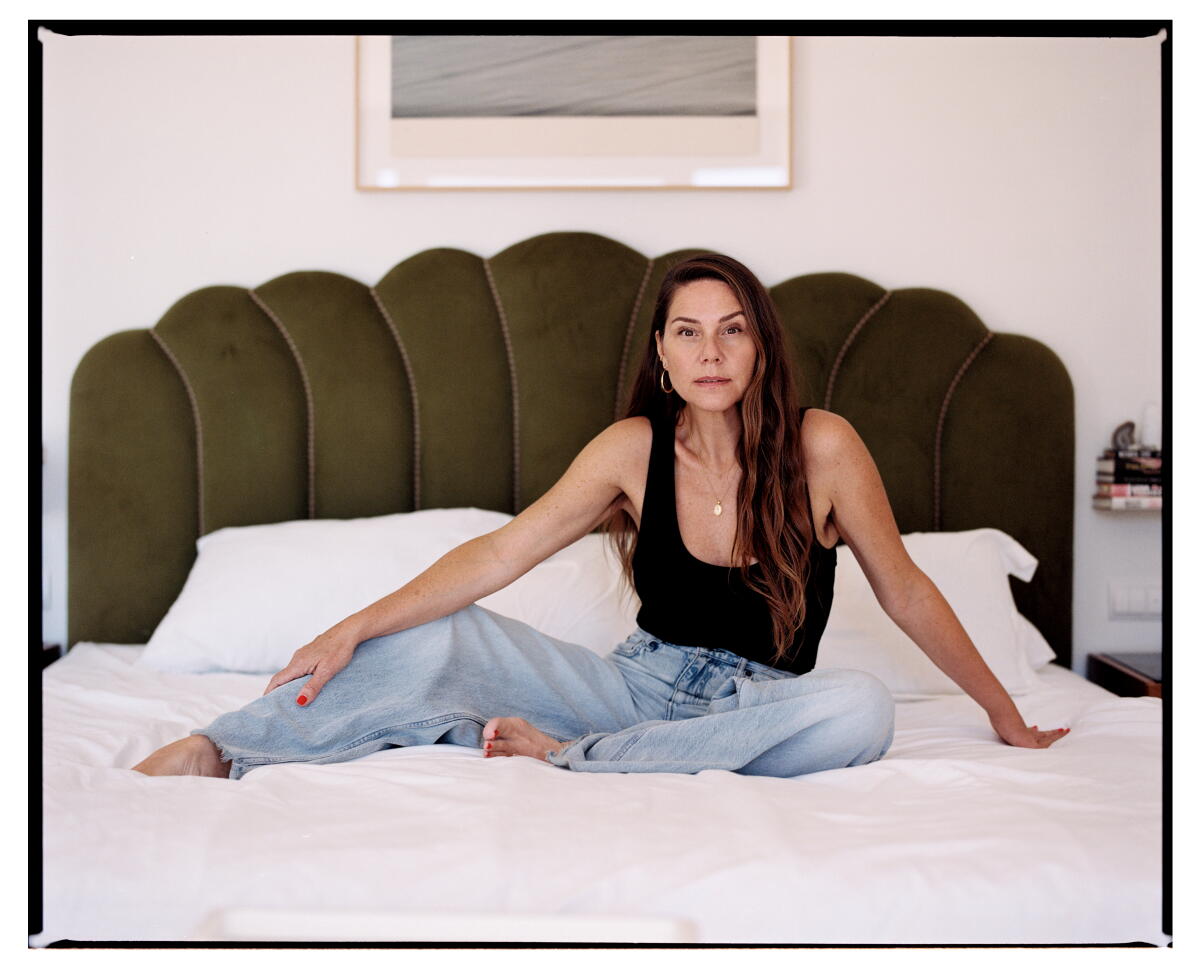
Erika Lust discusses her new book ‘Lust’
What is pornography? We tend to think of it monolithically, as something created by and for hetero men, reinforcing sexist stereotypes and machismo behavioral codes. For over 20 years, Erika Lust has been fighting against those preconceptions, creating adult content that expands the parameters of pornography while approaching it as something akin to mainstream independent cinema. Her subscription-only website features content that leaps over gender boundaries, and has pulled in fans around the globe.
In her new book “Lust,” the filmmaker makes a convincing case for an ethical, intelligent porn that can expand our ideas about sex and intimacy. I recently chatted with Lust about sex, power and the internet.
✍️ Author Chat
Are we calling it pornography? Adult content? What do you call it?
For me, it is pornography. What I do is pornography because I work with explicit images, but I also work with cinema, and I strive for cinematic vision and craft. I don’t just pick up a camera, film people having sex and put it online. It is a whole creative process. So when I talk about my work, I see myself first as a filmmaker whose subject matter happens to be pornography.
What compelled you to create adult content?
I was born in Sweden, and I became a feminist quite young. I studied political science in college. When I was exploring my sexuality in my late teens and early twenties, I became more and more interested in finding out about our desires and who we are and what we are attracted to. And then I started to watch porn [and] felt horrible watching it. I felt a little bit troubled by the images. Why are all these female characters just there to please the man? It wasn’t about the women, it wasn’t their stories, and that made me feel a bit angry. When I talked to other women about this, they felt the same way. I felt there was something to explore there. Of course at the time, I had no idea I would be doing this for a living.
There are a lot of tired tropes about adult content that you debunk in your book. That the performers come from broken homes and are forced to do things on camera without their consent and so on.
It’s so easy for people to think that in the sex industry there’s going to be exploitation. But my experience is the opposite. Because people I work with dare to talk about sex. The conversation is over the table, not under the table. The people I have met and worked with in this business are intelligent and smart, with a very clear plan of their future. They take care of themselves, their bodies and their sexuality.

In “Lust,” Erika Lust debunks tropes and stereotypes surrounding the production of pornography.
(Jahel Guerra)
How has technology affected how we think about sex?
There’s a lot of sex anxiety going on in our society, and I think that also has a lot to do with technology and how it has taken over our lives. And I’m reading more articles about the intimacy crisis, and the fear that people have of connecting with other people, and young people who are not having sex. Technology has gone wild. It has taken over our lives. People are afraid of other people, of friction, of negotiating boundaries. They don’t know how to explain their own desires so they would rather talk to robots. I think we need to disconnect from technology, and think more deeply and talk to each other — not just about sex, but about everything.
Given the ubiquity of free adult content on the web, how do you compel customers to subscribe to your site?
I think people that subscribe are looking for something completely different, something more elevated, and they understand that that kind of film costs money. I can’t shoot without paying my crew and my staff. Shooting with an Alexa camera is not the same thing as picking up my mobile phone. And then I need crew members who can work with that technology, I need gaffers and electricians, I need to pre-light the set the day before, and so on. The budgets that I’m working with are really budgets for independent films. We have a staff of 45 working with me and my husband.
It’s the last artistic underground, really. I did notice that Bruce LaBruce, a filmmaker whom you mention in your book, has a collection of his films presently being shown on Criterion Channel.
I never think it’s going to become mainstream. My true hope is that we can at least be known as an independent porn culture making quality films that aren’t exploitative. That people understand that it exists, and that it’s an option apart from the mainstream porn websites.
This Q&A was edited for length and clarity.
📰 The Week(s) in Books

Chuck Lorre has written a memoir, “Sitcom,” about his career
(Christopher Patey / For The Times)
How does Bonnie Garmus follow her blockbuster 2022 novel “Lessons in Chemistry”? With “Peck & Peck,” a “whimsical and winning ode to the written word, and send-up of the pretensions of its gatekeepers,” writes Leigh Haber.
Chuck Lorre, one of the most successful and prolific writers and producers in TV history, has written “Sitcom,” a memoir in which he reveals, among other things, his decade-long tenure as a card-carrying Scientologist. Writing the book “was cathartic,” he tells Mary McNamara. “There’s a little bit of therapy going on in this book. I got to say some things out loud that in the past I would have kept hidden because they were embarrassing.”
At a time when it seems like anger and hostility has become the fossil fuel of everyday life, author and conflict expert Priya Parker’s new book “The Art of Fighting” argues for civil and spirited debate as a balm for our troubled times. “As a conflict resolution facilitator for the last 25 years, I can say that healthy community needs healthy conflict,” Parker tells Margaret Wappler.
Finally, Maddie Connors talked to Michael Douglas about his new memoir, “One Helluva Ride,” a book about his life and career. “Your 80s may be a good time to share,” the 82-year-old actor tells Connors. “People interested in movies, we give them a certain insight into the process, and maybe they could learn something. For others, it’s just gossip.”
📖 Bookstore Faves

Formerly a pop-up bookstand, Reverie Bookstand is a brick-and-mortar bookstore on Sunset Boulevard in Echo Park.
(Reverie Bookstand)
Located on a busy stretch of Sunset Boulevard in Echo Park, Reverie Bookstand is doing its level best to buck the AI tsunami, selling used books created by humans in a variety of subjects. In an email exchange, owner Tim Horner tells us what’s selling in his store.
What prompted you to open the store?
I was driving by and I saw it was for lease. I had been selling books for some years as a scout for other bookstores, and also at flea markets where I would pop up with a ”bookstand.” So it wasn’t a brand new idea; I had always dreamt of it. The owner of the building was a part of a small team that ran a collective DIY venue and gallery called Echo Curio around 12 years ago. It has since shut down, but Echo Curio was a place I came to as a young person back in the day. So the landlord was sympathetic to the cause and the idea of having a bookstore here. So I went for it.
What genres does the store tend to emphasize?
I specialize in poetry, mysticism, occult and out-of-print secondhand books and paper goods. All the books here in the store are used books. So far it hasn’t been difficult to keep the shelves full, I know some spots.
Who are you customers?
The clientele here is diverse. Students, working-class people, artists, local neighborhood families, musicians and people from all walks of life who simply love books and reading. A thing I am grateful for is how kindhearted and empathetic (most) book people are. It gives me a lot of strength and motivation everyday to know that my book-buying addiction is not in vain but is actually going to some strange use in helping connect people with literature.
What’s selling right now?
The things that are selling the most are things California-related and writers from California especially — Joan Didion, John Steinbeck, Octavia Butler.
Why do we still need bookstores when AI can write books for us?
I think bookstores are relevant still because we all need some type of human connection for our well-being, and books encourage that behavior. Whether it’s connecting with a space and people or connecting with authors, a bookstore is a place where you can actually browse for something and be in the moment with other people that are possibly interesting. The gesture alone validates itself in that you’re telling the world. I am open to ideas, things, places, people, and along the way you find a book you didn’t know existed, a nicer copy of something you already have, or a book you’ve been meaning to read but had forgotten about. And until this point there is no tangible way to browse for these things I have online yet and hopefully ever.
Reverie Bookstand is located at 1519 Sunset Blvd., Los Angeles.