MSE, founded by Martin Lewis, has shared the handy trick online
14:51, 27 Apr 2026Updated 15:09, 27 Apr 2026
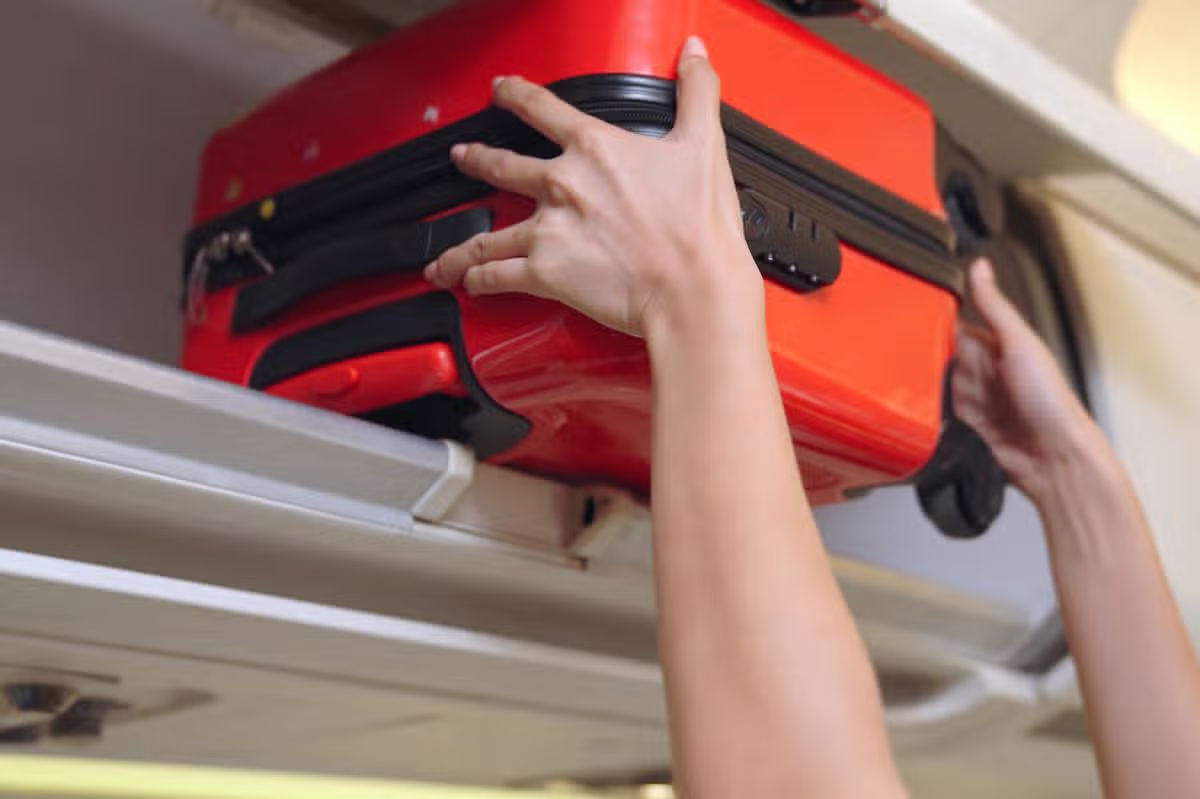
easyJet customers could benefit from the handy MSE tip(Image: Getty )
Money Saving Expert (MSE) has shared a handy trick that could help you get more items on board your next flight. This means you may not need to pay for extra luggage.
On its website, the financial experts have said that anyone flying with easyJet may be able to boost their luggage allowance in a post-security “loophole”. MSE wrote: “If you don’t want to pay for a second bag, there is a loophole to get one on for free.
“It lies in post-security shopping. In addition to your standard hand luggage allowance,easyJet allows you to take one shopping bag on board.” It directs people to the easyJet website, where it notes under ‘Accessories’ that passengers are “allowed to bring some extra things into the cabin. e.g. umbrella, overcoat, crutches, walking stick, one standard bag of goods bought at the airport.”
MSE, founded by Martin Lewis, continued: “It’s worth noting that easyJet says this must be “one standard bag of goods bought at the airport” – and of course, we’re not suggesting you purchase unnecessarily. But if you do have a carrier bag from duty-free or similar, it’ll give you some room for manoeuvre when you walk through the departure gate.
“Some passengers report they’ve been able to stuff the odd item which won’t fit in their hand luggage into it, or even a handbag – others say they’ve successfully boarded with a carrier bag they brought with them specially.” Currently, each easyJet passenger, including children and infants, may purchase up to three checked (hold) bags. A standard checked bag allows 23kg, and you can add extra weight in 3kg increments up to a maximum of 32kg per bag.
If you’re travelling with family or friends on the same booking and flight, you can combine your total weight allowance. This allowance can be distributed across all booked bags, provided no single bag exceeds 32kg. The maximum total dimensions (length + width + height) must not exceed 275cm.
This means it’s good news for travellers. If you’ve picked up a few extras after passing through security, you may now have space to bring a bit more on board.
As well as announcing a new rule, Ryanair is in the process of installing more self-service bag-drop kiosks, with 95% of the airports it operates from to have them by October
The airline has issued a baggage update (Image: Getty Images)
Ryanair is changing its luggage rules, it announced today.
From November 10, all check-in and bag drop services at all airports it operates from will close 60 minutes prior to scheduled departure, up from 40 minutes currently.
The budget airline claims this is to provide “more time for passengers to get through airport security and passport queues” which will “reduce the very small number of passengers who currently miss their flight departure as they are getting stuck in these airport queues.”
The change means the 20% of Ryanair passengers who check their bag will have slightly more time to get through airport security and passport queues and arrive at their departure gate before boarding starts.
Ryanair is in the process of installing more self-service bag-drop kiosks, with 95% of the airports it operates from to have them by October.
Ryanair CMO, Dara Brady, said: “From Tuesday 10 November next, Ryanair customers will see airport check-in and bag drops close 60 minutes before scheduled departure, instead of today’s 40 minutes. This will allow these 20% of our customers (who check in a bag) more time to clear through airport security and passport queues, and get to their departure gate on time, especially during busy travel periods when some of these airport queues can be longer.
“We are also installing self-service kiosks at over 95% of Ryanair airports before October. This means a quicker bag-drop service, less queuing at airport desks, and an even more punctual service for the 20% of our customers who still wish to check in a bag, while the 80% (who don’t check in a bag) will be unaffected by this small 20-minute change, as they will continue to check in online before they arrive at the departure airport and they go straight through airport security to their departure gate.”
Over the past week, Ryanair passengers have been affected by the new entry/exit system (EES), which has led to long queues at some European airports. Passengers scheduled to fly from Milan Bergamo to Manchester were left behind due to difficulties at passport control.
The system was rolled out across all Schengen Area border checkpoints on April 10. Over the last few weeks it has meant that passengers have taken longer to get through airport security and some have even missed flights as a result.
EES requires non-EU nationals, including British citizens, to register biometric data. This includes facial scans and fingerprints, which are subsequently verified each time they cross a European Schengen Area border. EES is operated by the respective border control authority in each nation rather than by airports or airlines.
Ryanair has since addressed the incident at Milan Bergamo airport. Its spokesperson said: “Should these passengers have presented at the boarding gate desk before it closed, they would have boarded this flight.”
Anyone planning on boarding a plane with hold luggage has been urged to make one change to their suitcases before they fly – as it will help keep belongings safe
Changing one thing about your luggage could help make it much safer (stock photo)(Image: Jackyenjoyphotography via Getty Images)
Plane passengers need to make one crucial change to their hold luggage. If you’re jetting off and you’ve got bags destined for the plane’s cargo hold, you’ll know just how nerve-wracking it can be to be parted from your belongings. There’s always that nagging worry that your luggage could be lost or stolen before you reach the baggage carousel at your destination, leaving you stranded without clothes, toiletries and other essentials during your holiday.
To tackle this, most travellers will attach luggage tags to their bags. These hold small pieces of paper where you can jot down vital information, such as your email address and phone number, so that should your bag go missing or end up on the wrong flight, airport staff can reach out to you if and when it’s located.
However, one woman on social media has flagged that these tags might not be the most secure option when you’re separated from your bags, particularly as some people inscribe their full name and home address on them.
In a TikTok video, Sammy urged fellow passengers to do something different with their tags, claiming it would help safeguard their personal details from anyone who might attempt to sneak a peek at their information.
She said: “This is something I’ve never seen anyone talk about, and I had to figure it out on my own. This is not safe for you for a plethora of reasons. You have your full name on there, you have your phone number, you have all of your contact information.
Content cannot be displayed without consent
“These will flip over. You’re going to have your luggage, and it’s going to flip over, and anyone who sees it can not only take a photo of it, but also anyone who sees your content online that shows your luggage can get all of your information.”
Sammy described the risk of having your details stolen from your luggage tag as “so dangerous” and “so not worth it”. In its place, she advised opting for a luggage tag featuring a full cover. These typically open like a book and fasten with a popper or Velcro, ensuring nobody can access your personal details without deliberately taking your luggage.
You can also accomplish the same outcome by removing the piece of paper from your tag and flipping it around so your details aren’t visible from the outside. You could then write something along the lines of “information overleaf” or “please turn over” on the blank side facing outwards, so airport staff know exactly where to look should they need to get in touch with you.
Those commenting on the post put forward further alternative solutions, such as listing a dummy email address that you can monitor should you ever lose your luggage, but don’t use for anything else.
One person said: “I have a fake name with my spam email that I’ll check if I ever lose my bag.”
Another added: “I write my name and flight number on the front, then put ‘see reverse for personal details’ with my address.”
A third wrote: “Thank you!! I’ve been saying the same thing for years, and people think I’m nuts. Same with names on kids or pets clothing!”
Should you opt to include only your email address without your name, ensure the email itself doesn’t contain your name within the address.
Using a false name, as one commenter proposed, is not recommended, as should your bag go missing, you won’t be able to verify it’s yours if your ID fails to match the name on the luggage tag. That said, you can choose to display only your surname or initials on the card to safeguard as much of your personal details as possible.
TUI, easyJet, Jet2 and British Airways hand luggage rules aren’t just about what the airlines will let you bring onboard – passengers are subject to airport rules too
There are some common items that are banned in hand luggage (Image: Getty Images/Stock Image)
Brits heading on their holidays will want to take note of hand luggage rules – and not just the ones that help you swerve those pesky extra fees.
While many of us fly with different airlines including TUI, easyJet, Jet2 and British Airways, hand luggage rules aren’t just about what these firms allow; they’re also dependent on your airport, destination and other factors. These restrictions are universal across various airlines when departing from the UK, but it’s important to note that there could be different rules at the airport you’re flying back into the UK from.
If you’re found to be carrying a prohibited item in your hand luggage, it could be confiscated at airport security. On the UK government website, it states: “Airport security staff will not let anything through that they consider dangerous – even if it’s normally allowed in hand luggage.”
Therefore, it’s vital to check any hand luggage restrictions before arriving at the airport to ensure a safe and seamless journey. It’s also important to check the size limits for your carry-on bag before your flight, as they vary by airline.
List of common items banned in hand luggage
Corkscrew: but it is allowed in hold luggage.
Knife (with a sharp or pointed blade and/or blade longer than 6cm) – but it could be allowed in hold luggage depending on the airline.
Large scissors (with blades longer than 6cm) – but it could be allowed in hold luggage depending on the airline. However, you can carry small scissors, such as sewing or embroidery scissors, in your hand luggage, but the blade must be shorter than 6cm.
Fireworks, flares and other pyrotechnics (including party poppers and toy caps): these are also not allowed in hold luggage.
Non-safety matches: and they are not allowed in hold luggage either. However, safety matches are allowed in hand luggage, but not in hold luggage.
Liquids: The majority of UK airports require liquids to be under 100ml; however, some airports have scrapped this rule. This includes: Birmingham, Bristol, Edinburgh, London Gatwick, London Heathrow, London City, Teesside, Belfast International, Belfast City, and Newquay. As rules have evolved, it’s advisable to check directly with the airport for both your outbound and inbound flights, as countries outside the UK may also impose different restrictions. The government outlines that you cannot take frozen liquids, including frozen breast milk, in your hand luggage, but there are some exceptions to the 100ml rule. Passengers are allowed to take “liquid containers up to 2 litres through security at all UK airports” for medical purposes, special dietary requirements, or baby food or milk. Liquids above 100ml purchased at the airport or from duty-free can be taken on board.
Cigarette lighters : they must be placed in a resealable plastic bag in carry-on luggage and kept on you throughout the flight. The government states that passengers may carry only one lighter on board an aircraft, and it cannot be packed in hold luggage.
Niche items banned in hand luggage
Heavy bats and sticks (including baseball, softball and cricket bats): – although they are allowed in hold luggage.
Golf clubs, darts, walking/hiking poles, catapult, crossbow and martial arts equipment (including knuckledusters, clubs, coshes, rice flails and nunchuks): but they are all permitted in hold luggage.
Firearms (including replica firearms): but they could be allowed in hold luggage, so it’s best to check directly with your airline before travel.
Harpoon or spear gun: but they might be allowed in hold luggage, so check directly with your airline before travel.
Work tools: this includes drills, a tool with a blade or shaft longer than 6cm, Stanley knife, saw, screwdriver, hammer, pliers, wrench or spanner, bolt gun or nail gun, crowbar and blowtorch). However, they can be taken in hold luggage.
Do you have a travel story to share? Email webtravel@reachplc.com
There are some specific perks that families can take advantage of at no extra cost when flying with Jet2. The airline has two policies in place to make travel easier for families with young children – and they are both completely free.
Some of these perks will only apply to families with children born between certain dates after 2024. They are usually applied automatically at check-in by the customer service team, but knowing about them in advance can mean parents can take full advantage.
When flying with Jet2, any infant (under the age of two on the date of the flight) can travel free of charge. During the booking process, families can select the option to have a child who meets the age requirements sit on an adult’s lap at no cost.
Even though little ones don’t get their own bag with this ‘free’ ticket, adding them to your booking will increase the amount allowed in an adult’s checked luggage by 10kg, the airline confirmed. This allowance is added to an accompanying adult’s 22kg hold bag, giving one suitcase a maximum weight of 32kg.
A spokesperson for Jet2 said: “Although infants don’t have their own checked baggage allowance, if you have hold luggage on your booking, we’ll automatically increase your allowance by an extra 10kg per infant, free of charge. That gives you some more room for any extra items you want to check in for your infant. This additional allowance does not need to be pre-booked.”
While this allowance is often technically added to one adult’s allowance, families report that total baggage allowance can usually be pooled across multiple cases, provided no single case exceeds 32kg. Infants under two when they fly can also benefit from extra items, in addition to the luggage carried by family members in their group.
At no extra cost, Jet2 allows families to bring up to two items on board. These can include:
A collapsible pushchair, pram or buggy
A car seat or booster seat
A baby carrier
A travel cot
In Jet2’s rules, it claims that “each item must weigh no more than 32kg”. Families are allowed to bring more than two items if needed, but the airline stated that any extra items (or weight beyond your allowance) “will be charged as standard excess baggage”.
This kind of policy is typical of many family-friendly airlines, such as easyJet and Ryanair. These items can either be checked in on arrival and put in the luggage hold or taken to the gate.
A statement on Faro Airport’s official website reads: “Passport controls on arrival at Portugal may take up more time, as the passport will have to be stamped and there are additional questions that may be asked by the border control officers.”
The new system being put in place is the European Union’s European Entry/Exit System (EES), which started on October 12, 2025. It is a new digital border system that has changed requirements for British citizens travelling to the Schengen area EES checks are being introduced in a phased way for non-EU and UK travellers, with full operation expected from April 2026.
The package holiday provider issued advice to passengers in a social media post
TUI responded to a passenger’s question on social media (stock photo)(Image: Getty)
Holidaymakers may need to think twice before packing a common grooming item in their hold luggage. Airline passengers have been advised that items containing lithium batteries must be packed in hand luggage, not in hold baggage. This could include electric shavers and any similar products, which passengers often pack in their toiletries bag.
Issuing the advice on social media, TUI highlighted its policy to passengers. The package holiday provider was responding to a question from one of its customers, who reached out to the airline on X.
Sharing a question for TUIUK, a passenger named Anthony Chesney asked where he should pack two items he wanted to take on his trip. The customer wrote: “Hi, I’m flying to the Dominican Republic next week and am wondering if I can put my rechargeable speaker and shaver in my hold luggage?”
Responding to Anthony’s message, the travel company revealed that both items would need to be placed in his hand luggage if they contain lithium batteries. A TUI team member said: “Hey Anthony, if they contain a lithium battery then we advise these need to be in your hand luggage but if not, then hold baggage is completely fine.”
Passengers can find more information about TUI’s luggage allowance and rules on its website. There are specific guidelines for passengers using electronic devices.
Content cannot be displayed without consent
Sharing advice online, TUI told customers: “You’re allowed to carry devices like mobile phones, digital cameras or MP3 players in your hand luggage. If you’re carrying any larger electrical items – a laptop, for example – you’ll need to take them out of your hand luggage before you get to the security search point.
“This is because they’ll need extra screening. Small vehicles powered by Lithium Batteries commonly known as Hoverboard, Segway, Balance Wheel, Solowheel and Airwheel are not allowed to be carried in either carry-on baggage or checked-in baggage.”
The airline added that there are ‘new airport security measures for electronic devices’. The rules require passengers to ensure they are fully charged for airport security checks.
TUI explained: “If you’re carrying any electronic devices in your hand luggage that are capable of holding a charge, you’ll need to make sure they’re fully charged when you go through airport security.
“This is part of new security measures that have been introduced by airports in the UK and abroad. We recommend you keep things like mobile phones switched on until you board the plane, as there might be more checks at the departure gate.”
Ryanair has strict hand luggage rules with the free small personal bag limited to 40x30x20cm, but there are some surprising items you can bring onboard
Ryanair do not allow pets onboard, but they will allow human remains(Image: Getty)
As you prepare to board flights for your spring and summer holidays, knowing exactly how big your hand luggage should be and what you can and can’t pack can be a stressful affair – but Ryanair’s regulations allow some surprisingly unusual items.
While their free ‘small personal bag’ policy continues to leave countless travellers scratching their heads over whether their bag qualifies, the airline appears considerably more relaxed about what’s actually inside it.
Most airlines, Ryanair included, allow passengers to bring a ‘small personal bag’ on board free of charge, provided it fits beneath your seat.
If you haven’t bought the additional hand luggage option, there’s a considerable risk you’ll face a fine for carrying a bag larger than 40x30x20, making it absolutely essential that everything you pack serves a purpose.
Ryanair bans a lengthy list of items from their flights, including certain razors, some alcoholic beverages and sports equipment – however, people are astonished to discover what you are actually permitted to bring aboard.
The catalogue of items the airline allows on board encompasses many things that wouldn’t necessarily seem essential to the average traveller. Essentially, if it doesn’t appear to pose any danger, they’ll welcome even the most peculiar of items on board.
According to the Ryanair website, passengers can in fact travel with ashes on board the aircraft as a permitted item in cabin bags or as an addition to their standard allowance. However, these must be accompanied by both a death certificate and cremation certificate.
They state: “Please make sure that any ashes are very securely packaged inside a suitable container with a screw-top lid and that this is protected against breakage.”
Additionally, passengers are permitted to bring a parachute in their carry-on luggage, including paragliding wings, provided they conform to the standard size and weight restrictions.
For those wanting extra peace of mind, you can even bring your own life jacket, as long as it contains two carbon dioxide cylinders and two spares.
Confusion frequently arises regarding which electronic devices are permitted in hand luggage, and it turns out the answer is far more generous than most would expect. According to their website, Ryanair permits “up to 15 personal electronic devices” onboard.
These include smartphones, tablets, laptops, cameras, handheld gaming consoles, headphones and power banks. The caveat is that each must not exceed 100 Wh, which applies to spare lithium batteries and power banks, all of which are permitted provided they fall within this limit.
The stipulations for these electronic devices are somewhat more precise, however, with the airline specifying: “Spare lithium batteries must be individually protected to prevent short circuits by: placement in original retail packaging, or insulating terminals by taping over exposed terminals, or placing each battery in a separate plastic bag or protective pouch.”
Regarding items deemed ‘strictly prohibited’, this primarily refers to objects that could inflict harm or present a significant danger. Their catalogue includes:
Guns, firearms and other devices that discharge projectiles — devices capable, or appearing capable, of being used to cause serious injury by discharging a projectile.
Stunning devices — devices designed specifically to stun or immobilise
Explosives and incendiary substances and devices
The following items Ryanair state must not be carried on board for health and safety reasons, but can be carried in your hand luggage.
Items designed for chopping, such axes, hatchets and cleavers,
Ice axes, ice picks and ice skates,
Razors and razor blades (except safety or disposable razors with enclosed blades and razor heads held in plastic compartments),
Box cutters,
Knives with blades of more than 6cm, including lockable or flick knives, ceremonial or religious knives and hunting knives made of metal or any other material strong enough to be used as a potential weapon, craft knives and utility knives and scrapers,
Scissors with blades of more than 6cm, as measured from the fulcrum,
Martial arts equipment with a sharp point or sharp edge, including throwing stars,
Swords and sabres,
Swordsticks, meat cleavers, machetes, Scalpels, crampons, grappling irons, hooked bars of iron and plates with iron spikes used in mountaineering,
Harpoons and spears,
Ski poles and walking or hiking poles
crowbars, drills and drill bits, including cordless portable power drills
tools with a blade or a shaft of more than 6 cm capable of use as a weapon, such as screwdrivers and chisels,
saws, including cordless portable power saws,
blowtorches,
bolt guns and nail guns,
hammers, pliers, wrenches and spanners
Baseball and softball bats,
Clubs and batons, such as billy clubs, blackjacks and night sticks,
Martial arts equipment (for example, knuckledusters, coshes, flails),
Tennis rackets, squash rackets and so on,
Cricket bats,
Hockey sticks, hurley sticks and lacrosse sticks,
Kayak and canoe paddles,
Skateboards,
Billiard, snooker and pool cues,
Darts,
Fishing rods.
When it comes to liquids, each container must not exceed 100 ml and must be transported in a single, see-through plastic bag measuring up to 20 cm x 20 cm.
Ryanair requires that you’re able to “completely seal the bag” and accommodate it within your hand luggage. It will probably be removed from your baggage for separate screening.
TUI, easyJet, Ryanair and Jet2 can have different rules around what duty free bags you can bring onboard as part of your hand luggage allowance – we take a look at what passengers need to know
13:22, 08 Apr 2026Updated 14:17, 08 Apr 2026
Some airlines are more generous than others when it comes to hand luggage(Image: Getty Images)
Before heading to the airport, it’s crucial to be aware of any hand luggage restrictions and certain duty-free rules that not everyone knows about, with airlines including TUI and Ryanair.
Many of us fly with different airlines, depending on the route, airport and price, so it’s tricky to keep up with the various hand luggage allowances or restrictions. Most airlines allow passengers to take on board a small personal bag for free, which can include a backpack or handbag, while others offer a generous addition of a free cabin bag.
There can also be confusion when it comes to carrying on duty-free, alongside your personal bag or cabin bag. Holidaymakers have often been left questioning whether they can carry it on separately or if they have to pack it into one of their bags.
To ensure you’re fully prepared for your next getaway, we’ve outlined the key hand luggage rules for four major UK airlines. So you know exactly how big your bag needs to be and what to do with your duty-free goodies before boarding your flight.
Ryanair
When it comes to duty-free, Ryanair allows passengers to carry on their duty-free items alongside their cabin bags. Additionally, passengers can purchase checked bags of 10kg, 20kg, or 23kg while flying with Ryanair.
All Ryanair fares include a small personal bag (40 x 30 x 20 cm), but it must fit under the seat in front of you. There is technically no weight limit to this bag, which is typically a handbag, laptop bag, or small rucksack, but passengers must be able to carry it onboard, unless there is an exception.
When booking Priority boarding, travellers can take an additional 10kg cabin bag (55 x 40 x 20cm) on the plane, which is stored in the overhead lockers. While infants (aged from 8 days to 23 months) have no cabin allowance, parents or guardians can bring a 5kg baby bag ( 45 x 35 x 20 cm) and two baby items on board for free. For more information, visit the Ryanair website.
easyJet
In terms of duty-free, the airline states: “You’re allowed to bring some extra things into the cabin. e.g. umbrella, overcoat, crutches, walking stick, one standard bag of goods bought at the airport.”
Everyone flying with easyJet is entitled to bring one small bag (45 x 36 x 20 cm) on board for free, which must fit under the seat in front. It can weigh up to 15kg, but it’s important to note that its size, including handles and wheels, cannot exceed the specified measurements.
The airline notes that travellers “need to be able to lift and carry the bag” themselves. easyJet passengers can pay for an additional cabin bag (56 x 45 x 25 cm) that fits in the overhead lockers, which also comes with their Speedy Boarding service.
For an easyJet Plus member or customer who has booked an Inclusive Plus fare, they can also take a large cabin bag on board, in addition to the standard cabin bag. Of course, there’s the option to book checked-in luggage too.
TUI customers can take one piece of hand luggage (55 x 40 x 20cm) on board for free, excluding infants. It can weigh up to 10kg, and they can also take one small personal bag (40 x 30 x 20cm) on board, which must fit under the seat in front.
A duty-free bag is also allowed on board, and TUI outlines its requirements for liquids purchased at the airport. They said: “Any liquids you buy from duty-free must be carried in a sealed security bag – you’ll be given this bag when you buy the item at the airport. You’ll need to keep the item and the receipt sealed in the security bag throughout the journey.”
A checked-in bag of 20kg or 25kg is also available to book for an extra fee. For more information, visit the TUI website.
Jet2
Holidaymakers are entitled to take a small bag (40 x 30 x 20cm), such as a handbag or laptop bag – or a duty free bag – that must fit under the seat in front.
You can also take one piece of hand luggage (56cm x 45cm x 25cm) on board for free, provided it fits within the measurements, including wheels and handles, and doesn’t weigh more than 10kg.
Parents with infants under 2 years old are also provided with an additional 10kg allowance. They can also take two items per child or infant on board free of charge, including a collapsible pushchair, car seat or booster, a baby carrier, and a travel cot.
When it comes to hand luggage, there are certain packing restrictions to be aware of, and these are typically universal across all airlines. These include the following:
• Liquids: Many airports require liquids to be under 100ml, while some UK airports have ditched this rule. As rules have changed, it’s best to check directly with the airport for both your outbound and inbound flights, as countries outside the UK may have different restrictions.
• Lighters: As outlined on the government website, travellers can only carry one lighter on board a plane. It cannot be packed in hold luggage; instead, it should be placed in a resealable plastic bag in carry-on luggage and kept in your possession throughout the flight.
• Food and powders: While you can carry certain food items and powders in your hand luggage, they can obstruct images on X-ray machines. This means that bags may need to be manually checked at security, which can cause delays. The government advises packing suitable items into your hold luggage to minimise delays.
• Frozen items: Typically, you cannot carry frozen items in your hand luggage onto your flight, such as food, liquids or ice packs. However, there are some exceptions, such as for medicines, medical equipment, dietary requirements, baby food and baby milk. It’s best to check directly with the airline you’re flying with to ensure you meet their requirements.
• Sharp objects: While you can carry scissors on a plane, the blade must be shorter than 6cm to be placed in carry-on luggage. Small sewing or embroidery scissors are generally allowed, while other larger, sharp items can be packed into hold luggage. It’s best to check directly with your airline for specific requirements.
Some airlines may have specific requirements for some of the above items, so before heading to the airport, it’s best to check directly with your airline to avoid being caught out. After all, there’s nothing worse than having something confiscated at airport security.
Do you have a travel story to share? Email webtravel@reachplc.com
ANOTHER airline has confirmed that luggage fees will be increasing due to the ongoing fuel crisis.
The conflict in the Middle East has resulted in the cost of jet fuel soaring due to the closure of the Strait of Hormuz, meaning airlines are looking at ways to offset costs.
Sign up for the Travel newsletter
Thank you!
United Airlines is the latest to increase luggage costs due to rising fuel pricesCredit: Reuters
And United Airlines has since increased its baggage fees, the second airline to do so.
The new rules mean checked bags now cost $10 (£7.50) extra, working out to $45 (£33) for domestic flights, or $50 (£37) if it it booked 24 hours before a flight.
A second checked bag will now cost up to $60 (£45) if booked last minute.
The airline said: “United is raising first and second checked bag fees by $10 for customers traveling in the US, Mexico and Canada and Latin America beginning with tickets purchased Friday, April 3.”
Last month, JetBlue was the first airline to confirm that they would be increasing luggage costs in response to fuel prices going up.
Checked bags have gone up by $4 (£3) for off peak, economy travellers – who will pay $39 (£30).
Peak economy travellers will have to pay $9 (£6.80) extra, so to $49 (£37).
Passengers paying for luggage less than 24 hours before the flight will pay an extra $10 (£7.50).
A JetBlue spokesperson told local media: “Adjusting fees for optional services used by select customers, such as checked baggage, allows us to continue offering more competitive fares.”
Some airlines are already cancelling flights.
UK-owned Skybus has cancelled its daily flights between London Gatwick and Newquay earlier than planned.
Due to finish by end of May, it has since cancelled all of the routes and cited lack of passengers as well as rising costs.
Aircraft also forced to take off without possessions, Spanish media report
11:54, 01 Apr 2026Updated 12:46, 01 Apr 2026
Travellers at Terminal T4 of Adolfo Suarez Madrid-Barajas Airport, as two ground handling strikes hit passengers(Image: Getty Images)
Spanish media have reported that luggage has been left behind or simply not been unloaded from aircraft as a massive strike across 12 airports continues in the run-up to Easter. After the second day of the indefinite strike called at 12 Spanish airports by Groundforce, at least six planes had to depart this Monday from Madrid-Barajas Airport without passengers’ luggage, ABC reported
The strike continues at Groundforce’s ground handling facility, a Globalia group company that provides services to the airports of Madrid, Barcelona, Palma de Mallorca, Alicante, Málaga, Gran Canaria, Valencia, Ibiza, Bilbao, Lanzarote, Fuerteventura, and air cargo in Zaragoza.
These work stoppages, called by the unions CCOO, UGT, and USO due to wage disputes with the company, are scheduled for Mondays, Wednesdays, and Fridays during the morning, afternoon, and night shifts – from 5 to 7am, 11am to 5pm, and from 10pm to midnight.
Some airports have had little disruption, Europress reported. Palma Airport was said to be operating almost as normal early on Wednesday morning, with isolated delays due to a ground staff strike.
Specifically, there have been two delays to departures and four delays to arrivals, according to information from Aena obtained by Europa Press. Ibiza Airport, which is also affected by the ground staff strike, has not reported any incidents.
Union FeSMC-UGT said widespread impacts include widespread delays averaging nearly one hour per flight, flights left unattended, with essential ground handling services clearly overwhelmed, and cancellations, especially during peak hours.
They also claimed thousands of bags have been left unloaded or delivered late, generating an unprecedented logistical collapse.
A spokesman said: “All of this constitutes the epilogue to irresponsible management by the company, which has opted for conflict instead of dialogue. A company that, judging by the facts, seems to care very little about its workers, its customers, and the thousands of affected passengers.
“The current situation reflects a complete breakdown in labour relations and an unprecedented deterioration of the internal climate, with an uncertain future if there is no immediate change in attitude.”
Meanwhile, ground handling company Menzies, which provides services to airlines such as Norwegian, EasyJet, and Canaryfly in the Canary Islands, reached an agreement and called off a strike planned for April 2nd, 3rd, 4th, 5th, and 6th, coinciding with the peak days of Holy Week.
The strike, which had been called due to the company’s “organisational insolvency,” was going to affect approximately 3,000 of the group’s employees in Spain, 600 of them in the Canary Islands. It should be noted that the first days of the strike were scheduled for last Saturday and Sunday, but were cancelled due to the start of negotiations between the union representatives and the company.
Negotiations have concluded with an agreement between all parties, representing significant progress in labour rights and improved working conditions, thanks to the “constant effort and advocacy of UGT,” the union stated in a press release.
Passengers arrive to discover their posessions have been left behind as days of walkouts start at sites – full list
12:17, 31 Mar 2026Updated 12:17, 31 Mar 2026
Trolleys to transport suitcases in Terminal T4 of Adolfo Suarez Madrid-Barajas Airport, this Easter, as two ground handling strikes at Groundforce and Menzies airlines hit(Image: Getty Images)
Passengers flying from 13 Spanish airports hit by strike action have landed to discover all their luggage has been left behind, local media has reported. Canarias said the first day of the strike by Groundforce workers, the ground handling operator that services Air Europa flights, resulted in continuous delays across all the airline’s flights and passengers arriving at Canary Island airports without their luggage, having had to leave it behind at their point of origin.
Alternating work stoppages are taking place between 5 and 7 am, 11 am and 5pm, and 10 pm and midnight, the first day of the strike affected 13 Spanish airports, three of them on the islands of Gran Canaria, Lanzarote, and Fuerteventura, where delays occurred throughout the day. These delays did not originate at the island airports but rather on flights arriving primarily from Madrid, Barcelona, and Bilbao, with delays approaching an hour.
Airports impacted are Barcelona-El Prat, Madrid-Barajas, Ibiza, Palma de Mallorca, Gran Canaria, Tenerife, Fuerteventura, Bilbao, Lanzarote, Alicante, Valencia and Malaga. The Groundforce strike is scheduled for this Wednesday (April 1) and Good Friday (April 3), with the possibility of becoming indefinite.
Because the aircraft operate on a network, delays accumulated throughout the day, causing significant disruptions to flights departing from the three affected airports in the archipelago. At major airports on the Iberian Peninsula, such as Madrid, Barcelona, and Bilbao, planes departed without luggage in their holds throughout Monday, leaving many passengers arriving at their destinations without their belongings.
It’s worth remembering that the most affected route is Madrid-Gran Canaria, on which Air Europa operates seven flights daily. According to Orlando Robledano, secretary of the aviation sector at the UGT union, the strike’s impact on Canary Island airports has been reduced due to the minimum services imposed by Groundforce on all Lanzarote Airport employees. Even members of the works council received this notification requiring them to comply with these minimum services, making it impossible to achieve the level of participation required for a strike of this nature.
This, coupled with the fact that domestic flights at Canary Island airports are protected and must be serviced regardless of delays, meant that the problems were less severe at the islands’ airports than at those on the mainland. Other affected airports include Alicante, Valencia, Palma de Mallorca, Ibiza, and Málaga.
Hosteltur reported that strikes at Canary Island airports during the peak days of Holy Week, between Maundy Thursday (April 2) and Easter Monday (April 6) may be called off as workers at Menzies—who provide check-in, boarding, and baggage services to airlines such as Norwegian, EasyJet, and British Airways—along with the works council and their union representatives from UGT, are close to reaching an agreement to call off the strike that was set to affect nearly 3,000 of the group’s employees in Spain, 600 of them in the Canary Islands.
At least six planes took off from Madrid-Barajas Airport on Monday without their passengers’ luggage due to an indefinite strike by the ground handling company Groundforce. On this first day of the strike, disruptions are being reported at all airports, although the most significant impacts are felt in Madrid and Barcelona, according to union sources, Telecinco reported.
Passengers report long queues and checked baggage left on the tarmac during the first day of the strike The indefinite strike by Groundforce ground staff began this Monday at Barcelona Airport, with protests taking place at three different times. The affected services are all those related to ground handling.
Long queues were reported at Barcelona’s El Prat Airport, where Alberto García said: “There have been some delays, and some planes have even departed with very little luggage. It was the protesters themselves who informed passengers that their bags would not arrive on time.
“The unions continue fighting for their objective and are demanding that the company comply with the wage agreements stipulated in the collective bargaining agreement.” At this time, many people have seen their flights significantly delayed or have had their luggage left behind.
In Madrid, people have had to wait for extended periods to check their luggage. Some report waiting for “four or five hours.”
Many planes, especially those arriving from Madrid, “are arriving without luggage, and the problems are spreading,” a UGT spokesperson told Europa Press, adding that “there is no guarantee that luggage will arrive.” The delays “affect not only direct flights but also many connecting flights, since passengers arrive without their luggage and therefore miss their next flight.”
A MAJOR airline has become the first to increase luggage charges in response to the fuel crisis caused by the Iran conflict.
American carrier JetBlue has confirmed that the cost of taking baggage onboard is to go up – and others could follow suit.
Sign up for the Travel newsletter
Thank you!
JetBlue is the first airline to increase luggage fees due to the Iran crisisCredit: Getty
The new costs will see checked bags go up by $4 (£3) for off peak, economy travellers, so will now be $39 (£30).
And the cost for peak economy travellers will go up by $9 (£6.80) so to $49 (£37).
Passengers paying for luggage less than 24 hours before the flight will pay an extra $10 (£7.50).
A JetBlue spokesperson told local media: “Adjusting fees for optional services used by select customers, such as checked baggage, allows us to continue offering more competitive fares.”
But airlines, especially budget ones, could choose to leave the cost of flights alone to remain competitive and instead raise the cost of extra fees.
In the UK, both Ryanair and easyJet have said their fares won’t be affected by the fuel crisis for now.
However, the crisis is being caused by the closure of the Strait of Hormuz – and the longer it continues, the more they will be at risk.
The Strait of Hormuz is one of the world’s most important oil routes, with around 20million barrels passing through every day – roughly 20 per cent of global supply.
A ribbon may seem like the easy choice to help you find your bag among a sea of luggage, but one airport worker says there’s a reason why this hack isn’t recommended. Here’s what you can do instead.
This common hack can cause issues with your bags(Image: Getty Images)
If you were to rank the most stressful parts of flying, then finding your luggage at the carousel would no doubt come near the top.
You wait and wait for the luggage belt to start up, and once it does, there’s a huge rush of people grabbing their cases, many of which look strikingly similar. That’s why there are so many hacks out there to help you ensure your suitcase stands out from the dozens of others on the conveyor.
A common hack is to take a colourful piece of ribbon and tie it around a handle, which means when it’s coming down the belt, you can spot it among the other similarly coloured cases.
However, according to one airport worker, using this hack with ribbon, string, or any other dangly item could be a bad idea, and could even delay your luggage pickup even further.
John, who works at Dublin Airport, previously spoke to RSVPLiveabout why travellers should avoid the hack, saying: “Ribbons that people tie onto their suitcases to help identify them can cause issues with the bag being scanned in the baggage hall.
“If the bag can’t be scanned automatically it can end up in manual processing, which could mean your bag doesn’t make it to the flight”.
As well as interfering with scanning systems, ribbons and other items can also get stuck in the conveyor belt’s machinery, which means the entire carousel could automatically come to a stop, delaying everybody’s bags.
Old airline stickers and tags from previous flights can also cause issues according to John. Machines may not know which barcode to scan, causing delays, or it could even mean your luggage is sent to the wrong destination.
If you want to personalise your case to make it stand out from the crowd, use a colourful luggage strap, add some coloured tape around a handle, or add a distinctive sticker so you can spot it on the carousel.
Luggage covers are another option for checked bags. These covers slip over your suitcase and are available in bright colours and prints, or even personalised options. As a bonus, these covers can help to protect the exterior of your case from damage when being handled. You can also opt for waterproof covers, so if your luggage is left on a trolley in the rain or is close to a leak, the contents won’t be damaged.
Airport workers have also warned that the colour of the case that you choose is important. Black suitcases are the most common choice for travellers, but they’re the most likely to be lost or stolen.
Finding a black suitcase can also be incredibly difficult. Many lost property offices will be full of suitcases of the exact same type and colour, making it less likely you’ll be reunited with your bag.
Have a story you want to share? Email us at webtravel@reachplc.com
Some surprising items are restricted under airport security rules when travelling with hand luggage only
Vita Molyneux and Ketsuda Phoutinane Spare Time Content Editor
04:52, 22 Mar 2026
Double check the rules before you fly(Image: Jose A. Bernat Bacete via Getty Images)
If you’re jetting off this Easter and planning to cram your essentials into a carry-on bag, there are certain items that could land you in hot water without you even realising.
Hand luggage liquids generally need to be under 100ml to pass through airport security, including water bottles, face oils, moisturisers and hand gel.
However, some items that aren’t technically liquids can still cause issues at security. Fulton Umbrellas have put together a list of some surprising items you can and can’t take with you on your journey.
First up is soft cheese, which if you’re travelling back to the UK from the EU, falls under the 100ml limit. The same applies for jams, chutneys, sauces and anything sold in liquid form like antipasti or olives, reports the Express.
Some countries have even stricter rules when it comes to travelling with food, so always check before you pack.
Another item to avoid packing in your carry-on is protein powder. This is because powders can interfere with x-ray machines and will therefore need to be manually checked by staff.
This can be a time-consuming process, so it’s quickest and safest to just leave it at home. And if you really can’t do without it, pop it in your checked bag.
Surprisingly, in the UK, there is one item you are permitted to take on board that you might not expect. If you’re only taking carry-on luggage but fancy indulging in a bit of arts and crafts on the plane, you are allowed to bring a small pair of scissors on board.
The standard guideline in the UK is that any pair of scissors with a blade length less than 6cm is permissible.
For anything larger, it’s advisable to pack them in your checked luggage. Different airlines may have varying regulations regarding items with blades, so it’s wise to verify if you need to carry scissors with you.
5 key hand luggage rules explained as Ryanair warns travellers on restricted item – The Mirror
Need to know
Before jetting off abroad, there are five key hand luggage rules you need to be aware of, with Ryanair warning passengers ahead of the Easter and summer holidays to stop packing one particular item
There are five crucial hand luggage restrictions to be aware of before jetting off abroad(Image: Getty Images)
Hang luggage rules you need to be aware of
Liquids:UK airports have restrictions on the amount of liquids you can take in your hand luggage and through security. Many airports require liquids to be under 100ml, while some UK airports have ditched this rule. As rules have changed, it’s best to check directly with the airport for both your outbound and inbound flights, as countries outside the UK may have different restrictions in place.
Lighters: As outlined on the government website, travellers can only carry one lighter on board a plane. It cannot be packed in hold luggage, and instead, should be put in a resealable plastic bag in carry-on luggage and kept in your possession throughout the flight.
Food and powders: While you can carry certain food items and powders in your hand luggage, they can obstruct images on X-ray machines. This means that bags may need to be manually checked at security, which can cause delays. The government advises packing suitable items into your hold luggage to minimise delays.
Frozen items: Typically, you cannot carry frozen items in your hand luggage onto your flight, such as food, liquids or ice packs. However, there are some exceptions, such as for medicines, medical equipment, dietary requirements, baby food and baby milk. It’s best to check directly with the airline you’re flying with to ensure you meet their requirements.
Sharp objects: Ryanair has warned passengers to stop packing “objects with a sharp point or sharp edge” in their hand luggage, including “scissors with blades of more than 6cm”. While you can carry scissors on a plane, the blade must be shorter than 6cm to be placed in carry-on luggage. Small sewing or embroidery scissors are generally allowed, while other larger, sharp items can be packed into hold luggage. It’s best to check directly with your airline for specific requirements.
TRAVELLERS are rushing to Amazon to bag a large-sized Samsonite suitcase that’s now almost half-price in the retailer’s Spring Sale.
This soft-shell, big-brand luggage usually costs £209, but has since dropped to £112.
Sign up for the Travel newsletter
Thank you!
Samsonite’s soft-shell Base Boost case has a 112.5-litre capacity
Samsonite Base Boost Soft Luggage, £112.19 (was £209)
The retail giant’s Spring Deal Days sale is now in its penultimate day, with thousands of prices plummeted across the site.
With the holiday season fast approaching, small wonder the online giant has decided to drop prices across a wide range of suitcases.
And yes, you’ll find all sorts of third-party options for much less – but if you’re looking for assured levels of quality on your hols, then go for a well-known maker like Samsonite.
Originally £209, the Base Boost Soft Luggage Suitcase has been dropped to just £112.19.
This, by contrast, is a 112.5-litre beast that’s best for families and those long trips away.
Despite its size, it remains incredibly lightweight at just 3.1kg, which gives you more of an opportunity to fill up the case while steering clear of those dreaded overweight baggage fees.
It comes in black and navy blue, with the black being a little cheaper.
For security, it’s got a fixed TSA combination lock built-in for stress-free travel, and inside, it’s got a buckle system to keep your clothes in place and a zipped mesh divider for easy organisation.
Better yet, Samsonite also includes a 10-year warranty with this case.