lucas

Lucas Museum inches toward gated compound as it cordons off courtyard

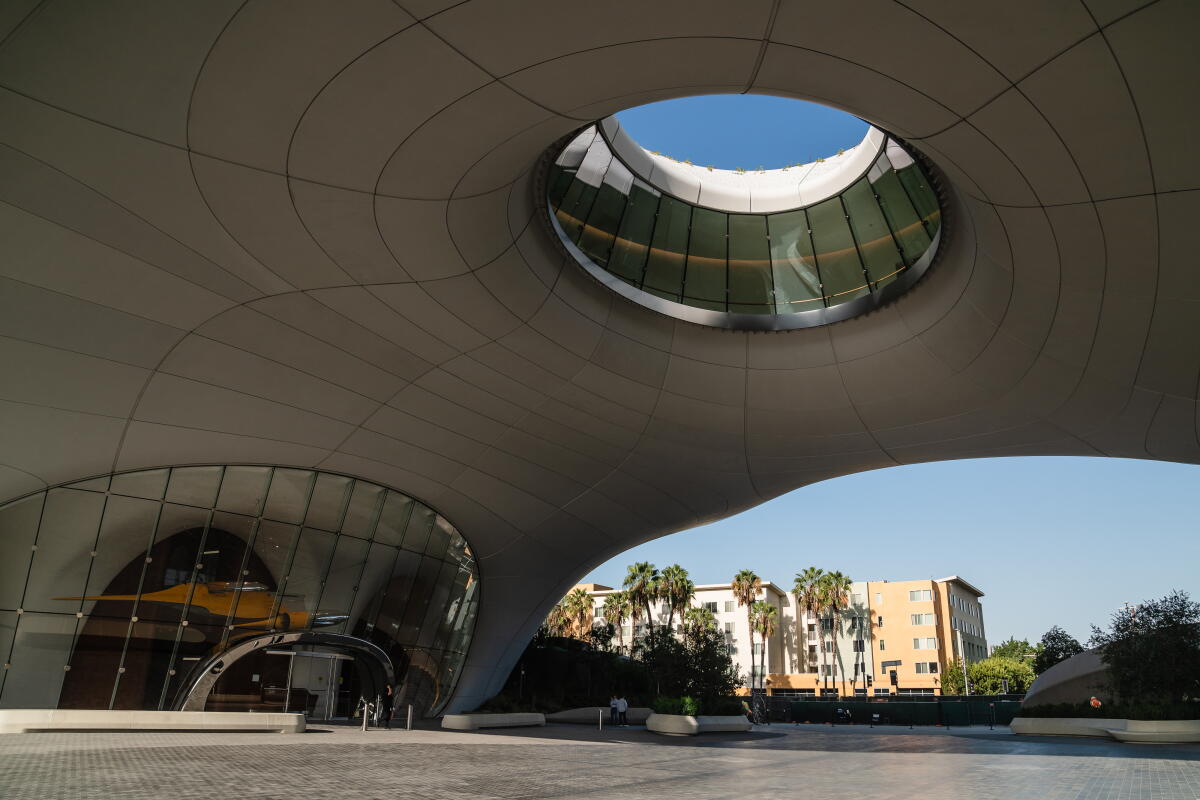
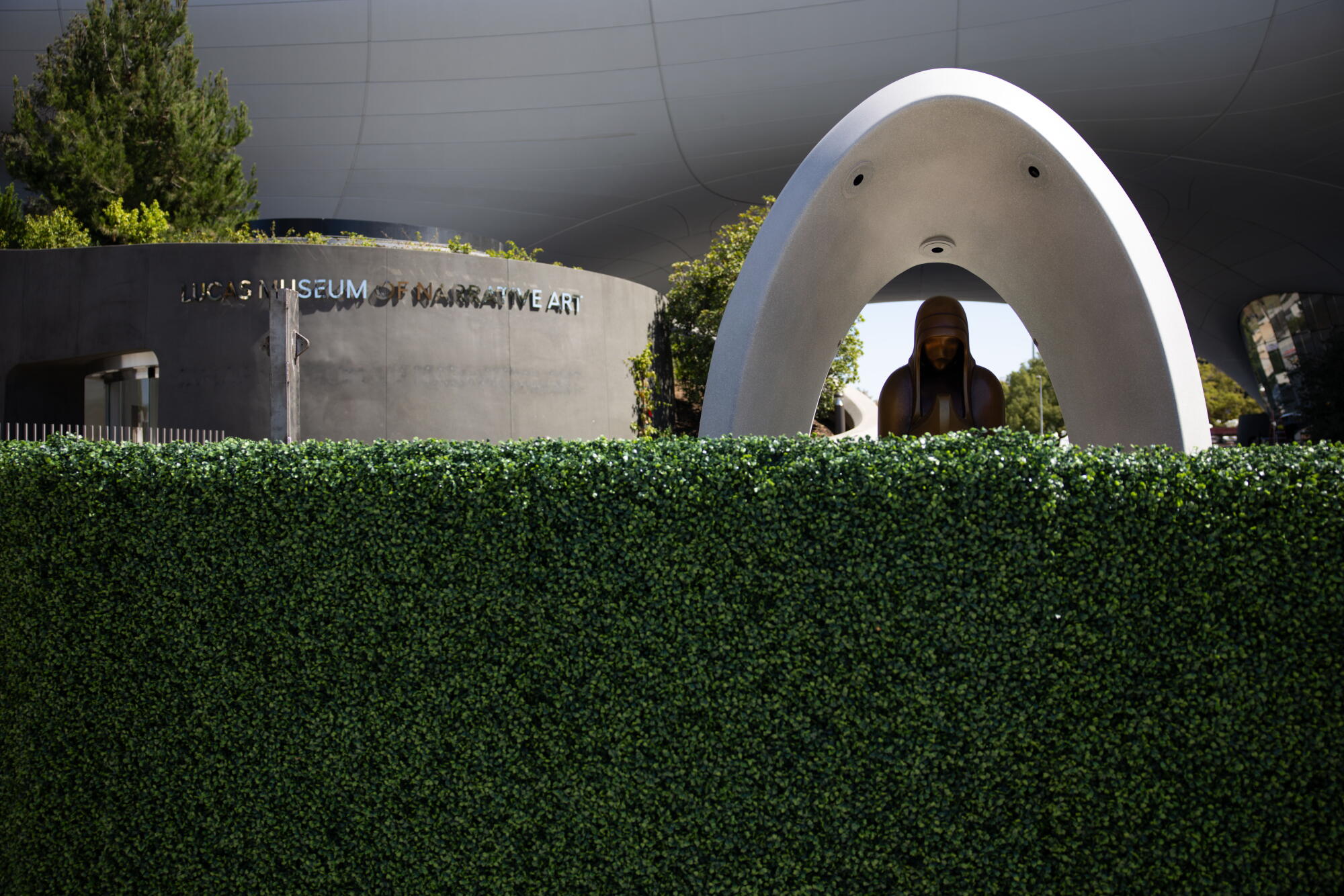
The Lucas Museum of Narrative Art’s central plaza, which spreads out beneath the building’s curved, hovering form, was always meant to be a generous civic space. Ma Yansong, the museum’s architect, has called it the “Gateway” between the museum and Los Angeles, opening to both Expo Park and the surrounding South L.A. neighborhood.

But that gateway, it turns out, is more like a gate.

This weekend — the first that the museum was open to the public — fences covered in plastic greenery blocked entry to the plaza from both sides. Standing sentry, bizarrely, were tall, cartoonish statues — half storm troopers, half USC Trojans. Visitors were directed to enter through the museum’s two enclosed security booths off the plaza.

In the coming weeks, permanent plaza fences will be erected here — curvy stainless-steel structures that MAD Architects principal Dixon Junliang Lu compared to the lacy filigree of Art Nouveau architecture. Lu added that they would eventually be draped in real greenery, not the plastic version.

While certainly an improvement on the current barriers (which are a shockingly makeshift solution for a museum that cost over $1 billion), the plaza’s main entryways will remain gated off, confirmed both Lu and Lucas Museum spokesperson Seth Fowler.

Green gates around a museum courtyard.

Gates have been erected around the main courtyard of the Lucas Museum of Narrative Art.

(Kayla Bartkowski / Los Angeles Times)

“It’s about creating the best possible visitor experience when you’re there, with an eye on safety,” said Fowler, who cited a need to protect the plaza from car traffic on both sides and the ability to control visitor flow among the reasons for the enclosure.

Visitors without tickets, Fowler added, are still able to enter the plaza, as well as the museum’s cafe and gift shop, after passing through security, “pending capacity limits.” They can enter the museum’s adjacent park without security screening.

Museums of course have legitimate security concerns, especially in and around such a high-traffic location. A growing list of threats, from violence to vandalism, has changed the calculus for what’s acceptable in public life. But surely the building’s talented design team could have developed a security plan that better preserved the plaza’s open arms? Lu acknowledged that the fence design had “evolved as the project developed and the operational and security requirements became more defined.”

When I visited the Lucas earlier this month for its press preview, I assumed the plaza’s (then chain-link) fences were temporary — a byproduct of construction still underway. I had no idea that its primary entryways would remain closed off to the public.

The plaza is one of the museum’s most powerful gestures, creating much-needed civic room for Expo Park, and the city. The gates blocking it, and the security checkpoints along its flanks, will dramatically limit the public’s desire to enter, and change the tenor and experience of a space that should feel porous and inclusive. What could have been a grand welcome has become a gated off, highly controlled space that now feels separate from the park and the neighborhood. Sure, anyone can come, but they are no longer invited.

An Art Nouveau style fence on wheels.

Art Nouveau style fencing will eventually replace the temporary green fencing, but guests will still be directed through security in order to enter the museum’s main courtyard.

(Kayla Bartkowski / Los Angeles Times)

Just a few miles away at LACMA’s new David Geffen Galleries, visitors can enter the plazas beneath that building without first passing through security. In fact, I don’t know of a single civic plaza (and there are not enough!) in Los Angeles that requires passing through security checkpoints to enter. Think about this scenario in other cities. In New York, can you imagine having to go through metal detectors to sit at the Met steps? Or to enter Central Park?

Speaking of parks, it’s inconsistent and puzzling that the museum’s beautiful park, which edges right up to the building, can be entered without having to also pass through security. I, for one, am thankful. Access to this area is already being limited to some degree. Its long fences, with relatively small openings, are not exactly screaming “come in.” The green space, as it was this Saturday, will be closed to nonticket holders on USC game days. And if locals who live to the west of the museum want to reach Expo Park outside of the Lucas park’s hours — 8 a.m. to sunset — they need to make their way around the entire complex; which a few are already grumbling about.

It’s hard not to wonder whether these barriers represent something more than security: the extension into public space of the gated, closely guarded world inhabited by co-founders George Lucas, Mellody Hobson and those in their orbit. Is this truly what museum security requires, or has the logic of a private compound shaped an institution that was supposed to welcome the city? That is the uneasy promise of privately controlled public space: It looks open to everyone, but access ultimately depends on the owner’s discretion.

It is an especially peculiar contradiction for a museum whose site is being leased from the state at just $30 a year and was founded to celebrate the “people’s art” — comics, illustrations, movie imagery — and to bring that art to the broadest possible public. Renderings introducing the project never showed the walls and fences that now cover the plaza’s perimeter. (A model produced later, now in the museum, does.)

Temporary fencing and gates around a museum.

Temporary fencing around the Lucas Museum, alongside the Art Nouveau style fencing that will eventually replace it.

(Kayla Bartkowski / Los Angeles Times)

I last encountered this type of scenario when visiting the Eiffel Tower, whose base has been closed since Paris’s 2015 terrorist attacks. (The attacks did not occur at the tower itself.) Its sealed perimeter, only accessible via lines and screening, now makes one of the world’s wonders feel less like a wondrous part of the city than an attraction held behind glass.

I’m not suggesting we leave major public spaces vulnerable. But security can be built into buildings’ plazas in myriad ways without sealing them off: reinforced planters and seating can stop vehicles; grade changes, landscapes and water features can establish protective distance; clear sight lines, lighting, cameras and visible staff can improve oversight; and retractable barriers can be deployed during large events or credible threats. Screening can remain at the museum doors, leaving outdoor space free.

At the end of the day, civic space depends on a willingness to share some level of uncertainty. A public plaza brings all kinds of people together, including those we don’t know and can’t entirely predict. If every risk leads us to add another checkpoint, fence or barrier, we may gain a sense of control but lose the ability to create the kind of public togetherness that forms a bonded city.

If this plaza, and this museum, are truly meant to serve the public it should be clear that all are welcome once they arrive. Openness is more than an architectural effect: It depends on having the freedom to enter without having to justify our presence.
Source link

First impressions of the Lucas Museum on opening day

After more than two decades of planning and years of building, the Lucas Museum of Narrative Art opened to the general public Tuesday, and a vast campus that had been nearly empty for weeks of press previews filled to capacity with eager fans, including some who traveled across oceans to see what all the hype is about.

Actor D’Arcy Carden stopped by early, beating the cadre of guests crowding the main plaza beneath the now-famous oculus of the 300,000-square-foot Ma Yansong-designed building. A Stormtrooper drove by on a flatbed truck, shortly before R2-D2 greeted visitors in the courtyard, wearing an official staff badge. (The line for a selfie with the droll droid stretched as far as the eye could see.) Museum leaders have long said that “Star Wars” artifacts account for about 7% of the 100,000 square feet of gallery space, but one worker quipped 90% of opening-day attendees likely had a vested interest in the franchise.

This proved true, for the most part: Many visitors clearly knew and loved “Star Wars,” and Princess Leia buns and Yoda ears abounded. (Two Padmé Amidalas ran into each other, and according to a restaurant worker, one brave soul showed up in “Star Trek” gear.)

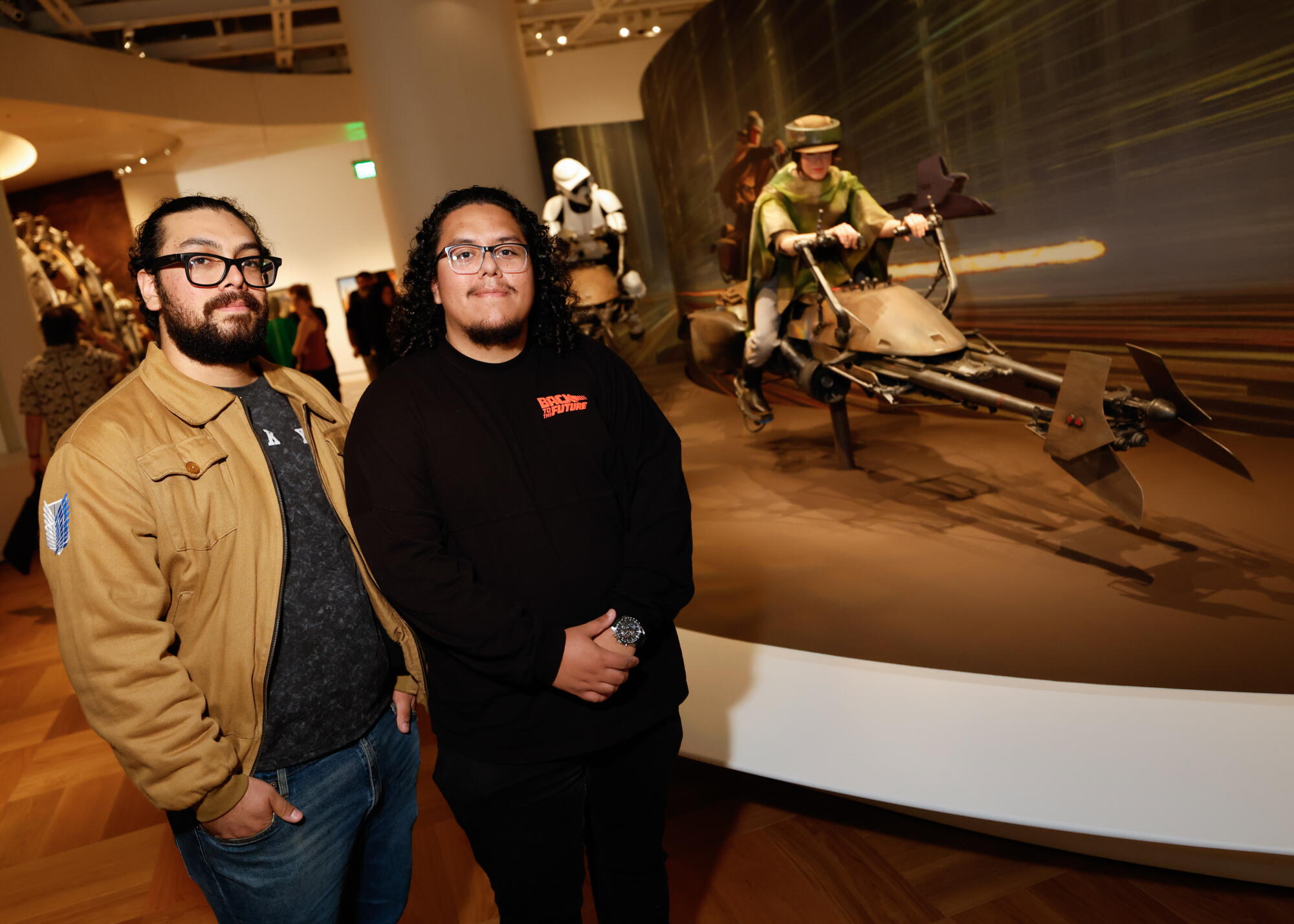
Two men pose in a "Star Wars" gallery.
David Perez, 27, (right) donned his “Back to the Future” gear, hoping to see art from the movie. But he and his brother Carlos Perez, 28, (left) were quite pleased with the “Star Wars” artifacts in the Cinema section.

(Carlin Stiehl / For The Times)

Still, the museum, as its famous co-founder George Lucas has repeatedly said, is about more than just one story, however beloved. That sentiment cropped up repeatedly in interviews, too: Early guests seemed to believe the museum’s brochure, which notes that the galleries are about the “narrative art” of illustrating stories.

Co-founders Lucas and businesswoman Mellody Hobson (also Lucas’ wife) gave remarks early Tuesday to the first 100 visitors, consisting of students from USC, Los Angeles Technology Center, Otis College of Art and Design and Los Angeles City College, who were all handed free tickets.

An exterior view.

A yellow Naboo N-1 Starfighter hangs above the education lobby, across from the main plaza, guarding the research library.

(Carlin Stiehl / For The Times)

“I’ve spent more than 50 years collecting the work of artists who don’t always get their due — illustrators, cartoonists, muralists, painters — because I believe their images are as vital as any other art form,” Lucas said. “They deserve to be in a museum.”

“This is a museum of the ‘people’s art’ — the images are illustrations of the beliefs we live with every day,” said Hobson, “and for that reason, this art belongs to everyone.”

Later that day, The Times asked visitors to share their impressions of a museum that, until now, has lived largely in the imaginations of fans and in abundant social media posts online. The museum has drawn loads of applause but also plenty of criticism, mostly for its lack of context via wall text, and for displaying art that not everyone agrees should be elevated.

Do the people love the “people’s art”?

Responses have been edited for length and clarity.

Alden Chang stands on the sculpture garden back lawn of the Lucas Museum, posing with a handmade sign.

Alden Chang and his wife flew 6,800 miles from Taiwan to thank George Lucas for creating the “Star Wars” films and franchise. Chang told The Times that he also wrote an academic paper examining “Star Wars” fan culture in Taiwan.

(Carlin Stiehl / For The Times)

Alden Chang, 32, green product engineer from Taiwan

You flew all the way from Taiwan, just for this?

Chang: Yeah, halfway across the world to meet George Lucas and Miss [Mellody] Hobson.

Did you get to meet them?

Chang: Yeah, I just shook hands with them this morning. It’s like a dream come true.

How long ago did you and your wife get here, and how long are you staying?

Chang: For eight days. We came here on Sept. 18.

Is this the highlight of the trip?

Chang: Sure. [Laughs.] It’s my main mission and my main goal.

(Later, in an email, Chang told The Times that he also wrote an academic paper examining “Star Wars” fan culture in Taiwan.)

Two men stand with a picture of Snoopy.

Friends Robert Meier, left, and Marc Downing used to work as ushers at the Music Center together. Growing up, Marc rode his bike where the Lucas Museum now stands.

(Carlin Stiehl / For The Times)

Marc Downing, 71, retired, from Exposition Park and Robert Meier, 70, educator, from Highland Park

Downing: I go to all the museums. This was the newest museum, so I had to come and see this.

How does this compare to the other L.A. museums?

Downing: This is ultra modern, ultra space-future. I’m glad the museum is here; highly recommend it. And I’m proud that it’s in my city, and I’m glad that it’s in the neighborhood that I grew up with.

What made you want to be a member of the museum, Robert?

Meier: It’s giving to the neighborhood. I’ve admired George Lucas — I used to have a relative in Marin County, and growing up, we’d go to lunch, and I’d see George Lucas and his family. We’d be at the same restaurant together.

Downing: Well, speaking of this neighborhood: This used to be a parking lot. I remember it very well. And I used to come here and ride my bike in this neighborhood as a kid.

A man sits on a curved wooden bench in a museum.

C.S. Lee sits on a bench at the south viewpoint of the museum, gazing out onto the sculpture garden below. “This is why you live in Southern California. This is why you live in L.A.: for days like these.”

(Carlin Stiehl / For The Times)

C.S. Lee, 54, actor, from Koreatown

Lee: “Star Wars” was the very first movie I ever saw in my life as a 4-year-old when I immigrated here from Korea. We landed in Hawaii, in Waikiki Beach. Our family friends took us to a drive-in movie cinema place, and they said, “You want to come see a movie?” And it was “Star Wars” and “King Kong,” double billing. And my mom said when I saw the screen, my eyes popped out of my head because I’d never seen a movie before.

How do you think “Star Wars” impacted how you saw narrative and story?

Lee: I think I carried that all through my life: the story of “Star Wars.” I was like, “Oh, the good guys won!” And it was such an uplifting thing for me to hold on [to] all these years.

What did you think about the rest of the museum?

Lee: It’s so beautifully done: all the curves, all the light. You got the wind coming through the trees that they planted. I mean, honestly, I was just looking out, thinking to myself, “Wow, this is why you live in Southern California. This is why you live in L.A.: for days like these.”

The view of the sculpture garden and grounds beyond that C.S. Lee was contemplating from the south viewpoint.

The view of the sculpture garden and grounds beyond that C.S. Lee was contemplating from the south viewpoint.

(Carlin Stiehl / For The Times)

What about the building itself?

Lee: We rarely get to see architecture like this. But I think it’s good for people to see the artistry and the imagination of what people can build.

Janet Jacobs, 62, architect and Hanjin Jacobs, 25, audio equipment manufacturer technician, mother and son on a family trip from Portland (pictured at the top of the story)

I see you’re wearing a “Star Wars” T-shirt.

Janet: Yes, I am — actually from 1977.

Wow, really?

Janet: Yeah, I’ve had it for that long [laughs].

What was your overall takeaway from the museum?

Janet: I know George Lucas wanted to create this museum in a different way, like he didn’t have a sequence of events or a roadmap, he just wanted people to experience it the way they wanted to, so that’s all great. We do wish some of the things were explained a little more. Like, I know who Ralph McQuarrie is; [my kids] do not. So that would’ve been nice. Like in a typical museum, you do have a little blurb.

[My son] brought up a really good point: how ironic it is that it’s about storytelling, but yet there seems to be no storyline.

Two people hang loose in front of a KAWS sculpture.

Andrew Liu, left, and Matthew Haak hang loose in front of a KAWS sculpture. They actually didn’t know it was opening day, but were happy to be there anyway.

(Carlin Stiehl / For The Times)

Matthew Haak, 26, architectural designer, and Andrew Liu, 26, behavioral therapy assistant, both from University Park

Haak: We are not “Star Wars” fans. I haven’t watched a single “Star Wars” movie. I’ve somehow evaded them my entire life.

So, if not for “Star Wars,” why did you come out today?

Haak: I’ve been watching this building being constructed for the past two years. I’m just geeking out over the organic curvilinear forms. Not a single hallway has been straight. And they even have real expensive details, like light coves on the base [of the wall]. All of these things really stand out to me. Also, curved walls like this are so expensive; architects never get a budget to do stuff like that.

I was just surprised: It’s not just “Star Wars” stuff. There’s so much art; it’s so cool.

A woman dressed as Padmé Amidala in front of a statue of Princess Leia.

Nicole Garcia — dressed as Padmé Amidala in her lakeside gown — poses in front of a statue of Princess Leia.

(Carlin Stiehl / For The Times)

Nicole Garcia, 24, cosplayer/costumer from Corona and Veronica Antonucci, 40, administrative assistant from Orange County

So, this might be an obvious question [given their fun outfits], but what brought you guys out today?

Antonucci: This little thing called “Star Wars”!

Garcia: Growing up with “Star Wars,” I always loved all the pieces, knowing that, for example, there’s miniature pieces that look just huge on-screen, and seeing them in-person is just, like, I want to shrink myself down and just be there.

Antonucci: It’s also amazing that it’s not just “Star Wars,” and it’s also so much more that everyone should come out and see.

Is there anything else you were particularly excited to see?

Garcia: I was shocked to see “Fritz the Cat.”

Antonucci: I was really excited to see the Frida [Kahlo]. I didn’t know she was gonna be here, so I think when I saw her, I gasped.

Is there anything else you’d like to add?

Garcia: I just hope the future generations of kids come back to see this, growing up with museums more often, and just learning how to make art — like, physically make art — and be inspired.

Antonucci: Actually, we talked about feeling jealous of all the kids who are going to be here on their school field trips, because we didn’t get to experience this.

Two women stand beside a Norman Rockwell painting.

Nikki Foster, left, loves a good field trip. She texted her group chat to visit the museum, and her bestie, Shalonda Dean, responded, so they both cleared their calendars for the visit.

(Carlin Stiehl/For The Times)

Shalonda Dean, 47, consulting business founder and president, and Nikki Foster, 45, live event production executive, both from Beverly Hills

You both gravitated toward Norman Rockwell’s “The Problem We All Live With” — why did it stand out to you?

Dean: Being a Black woman, I can identify with this little Black girl. Even in 2026, I think this painting depicts a lot of what Black women are going through today, whether it be in the workplace, navigating motherhood, navigating life. And I think this is an example of the barriers that we’re constantly breaking through every day, even today.

Foster: I’ve never seen it in person until now. So when we saw it, we were like, “It’s here, it’s here!” Just to be able to lay our eyes on it, and not have to go to another country, another state — here in Los Angeles. This is divine. It’s a divine day.

A man in a black suit on a wooden bench.

“I love meeting people,” Vincent Zabierowski said. “People are my main inspiration. I’m very lucky I get to be in a place where people want to be, and people want to soak up all that creative energy and just experience art.”

(Carlin Stiehl / For The Times)

Vincent Zabierowski, 23, host at the Skywalker Grill and freelance illustrator, lives near Downtown L.A.

As an artist yourself, what are your favorite pieces in the museum?

Zabierowski: I love a lot of the things that are in the graphic novel collection, like the Jack Kirby, the Garfields. My favorite is the Art Nouveau artist Alphonse Mucha. The Diego Rivera mural, that one was really amazing — and just the history here, having it be in L.A.

How does your work as an illustrator inform how you see these pieces?

Zabierowski: When I was going through it with some of my co-workers, I would [ask] “Do you know why they use a blue pencil?” And it’s because, when you take a photograph or a scan, that blue pencil disappears. So it was just really cool to see the behind-the-scenes and understand.

So seeing those blue pencil marks tells you that a piece is real?

Zabierowski: A person made it! I feel like a lot of people see artwork in textbooks, or they see artwork on their phones, or they see artworks on posters, and it takes a lot of skill and intelligence and training to be able to do those pieces of artwork.

Source link

Inside Lucas Museum’s starry opening party with Oprah, Mark Hamill

If George Lucas invites you to a party, you go.

That much was clear Saturday at the Lucas Museum of Narrative Art’s opening-night soiree, where the guest list was as celebrity-heavy as any Academy Awards after-party. As the festivities kicked off around sunset in the courtyard under the museum’s towering elliptical oculus, Oprah Winfrey hugged Robert De Niro, and Harrison Ford and Calista Flockhart skipped the red carpet after chatting with Spike Lee. Laura Dern and Greta Gerwig laughed together by the entrance while Samuel L. Jackson plopped down on a curved bench, joking, “Hey, look what I did!”

For the record:

1:22 p.m. Sept. 20, 2026A previous version of this article said James Cameron was photographed along with a large group of directors at the Lucas Museum of Narrative Art. He was not.

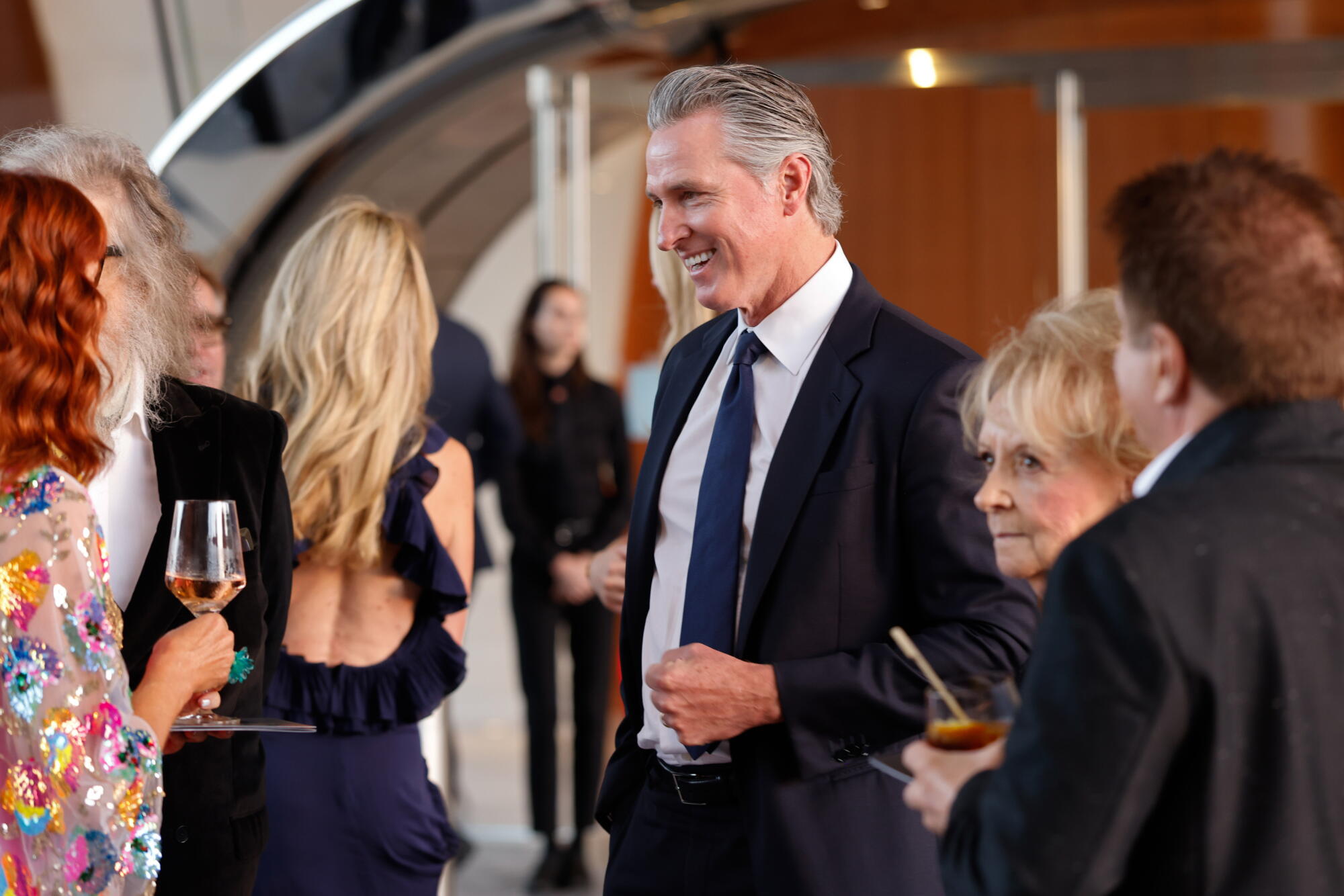
He didn’t sit for long because Cynthia Erivo and Andy Garcia showed up and there were more hugs and handshakes and hellos. Owen Wilson, Leonardo DiCaprio, Kim Kardashian, Meg Ryan, Jack Quaid, Gov. Gavin Newsom, Rep. Nancy Pelosi, Justin Trudeau, Mark Hamill and Magic Johnson were there too, and that was just the beginning.

Gov. Gavin Newsom talks to guests at a party.

Gov. Gavin Newsom attended the opening-night party for the Lucas Museum of Narrative Art alongside a host of other notable guests and celebrities.

(Carlin Stiehl / For The Times)

After a rousing performance by a white-robe-clad vocal collective called Voices of Fire, co-founded by Pharrell Williams, Lucas’ wife Mellody Hobson noted that, “George kept saying, ‘Will this person come? Do you think this person will come?’”

“I said, ‘They will all come,’” Hobson said as the crowd laughed during opening remarks on a raised platform in the museum’s grand lobby.

And so they did. There was even a banner moment inside the posh fifth-floor Skywalker Grill where a group of directors gathered to be photographed in what could very well become a seminal photo of Hollywood influence in the 21st century. The shot included Lucas, Jon M. Chu, Chris Columbus, Francis Ford Coppola, Lee Daniels, Guillermo del Toro, Jon Favreau, Bryce Dallas Howard, Ron Howard, Peter Jackson, Chris Meledandri, Denis Villeneuve, Christopher Nolan, Spike Lee, Tyler Perry, Steven Spielberg, Frank Miller, Robert Rodriguez, Nathan Fielder and David Benioff.

Organizers were scrambling to find Gerwig, but she had dashed off somewhere else.

Mark Hamill and Marilou York at a museum party.

“Star Wars” legend Mark Hamill and his wife, Marilou York, were guests at the Lucas Museum of Narrative Art opening party.

(Carlin Stiehl / For The Times)

There were artists in attendance too, of course, but not as many. Jeff Koons, Refik Anadol, Judy Baca and Takashi Murakami strolled through the crowd, as did museum directors including the Broad’s Joanne Heyler and Los Angeles County Museum of Art’s Michael Govan, who was relieved to be attending someone else’s party after hosting so many of his own in April and May when the new Geffen Galleries opened.

Lucas and Hobson went to great lengths to explain why the Lucas Museum matters and why it is different from other museums. Their comments, in many ways, sought to address the criticism that has been lobbed at the museum since it held its press preview a few weeks back.

Though it has received a number of rave reviews, critics have called narrative art a false conceit and argued that the juxtaposition of masterworks with pop culture ephemera does not work. Much of the criticism has been focused on a perceived lack of context since there is almost no wall text clarifying why certain curatorial choices were made.

George Lucas and Mellody Hobson stand in front of grass wall.

George Lucas and his wife Mellody Hobson hosted an extravagant opening party at the Lucas Museum of Narrative Art.

(Carlin Stiehl / For The Times)

“When I started it, everybody said, ‘You’re crazy. You shouldn’t do it. It’s not going to work. People are going to come after you,’” Lucas said of his plans for the museum. “I said, ‘People have come after me all my life, especially in the movies.’”

Lucas also addressed why he curated the museum’s 100,000 square feet of gallery space on his own, noting that at a certain point plans were “getting off the rails.”

“I’m going to have to take this over because people don’t understand what I’m doing,” Lucas recalled thinking. “The idea that illustration is an art form and illustrators are artists was just too much for somebody who had been taught otherwise by the art schools that they went to and the universities that they went to.”

People with PhDs often can’t see the big picture, Lucas said, “You can’t say ‘This is art. This is not art.’ Art is in the eye of the beholder. If it is emotional to you, then it’s art. And, of course, I’ve been criticized up and down and sideways for that. But I believe it wholeheartedly — that you get to decide what art is.”

A choir in white robes enters a museum plaza.

Members of the Virginia Beach vocal collective Voices of Fire, co-founded by Bishop Ezekiel Williams and Pharrell Williams perform at the Lucas Museum.

(Carlin Stiehl / For The Times)

Lucas noted that throughout his career he has worked with many illustrators, “and I will tell you, they are as talented as any artist I’ve ever met. This is the way of giving back to them something that they’ve all wanted … inevitably, all of the illustrators say the same thing — everybody from R. Crumb to Rockwell — they all say, ‘I wish I could be in a museum,’ but they can’t. There isn’t a major museum in the world that’ll have this kind of art in it. I’m hoping this will change that.”

Lucas’ comments came after his friend and co-host Queen Latifah noted to the cheering crowd that, “Paris has the Louvre, New York has the Met and now L.A. has the artistic equal.”

Guests mingle at the Lucas Museum of Narrative Art opening party.

Guests mingle at the Lucas Museum of Narrative Art opening party.

(Carlin Stiehl/For The Times)

It took more than a decade for the Lucas Museum to land in L.A. after a search that included Chicago and San Francisco as well as lots of civic pushback and lawsuits over the use of public parkland.

“We did not realize how hard it would be to give a city a museum,” Hobson said during her remarks, later joking: “If your husband or spouse comes home and says they want to build a museum, I suggest your response is a hard no.”

Laura Dern and Greta Gerwig stand in front of a grass wall.

Laura Dern, left, and Greta Gerwig spent the early part of the night chatting and laughing.

(Carlin Stiehl / For The Times)

Hobson went on to extol Lucas’ vision and his ability to never waver from his dream for the museum.

“He was driven to create a space that would showcase the brilliant illustrators that he thought were too often overlooked and ignored,” Hobson said. “And if critics say that a museum of narrative art is too much like a popcorn movie and not enough like an art film, well, we love popcorn movies in our family.”

Like a popcorn movie, the evening ended happily with a drone show in the night sky narrated by Winfrey and Jackson, and featuring images from the museum’s collection including the Cave of Altamira, N.C. Wyeth’s “The Storybook,” Julie Bell’s “The Huntress,” Banksy’s “Girl With Balloon,” the “Star Wars” Millennium Falcon and Maxfield Parrish’s “Ecstasy.”

Afterward the party moved inside from the rooftop terrace for a performance by the Black Eyed Peas.

Source link

Fair Games Coalition protests Lucas Museum ahead of the Olympics

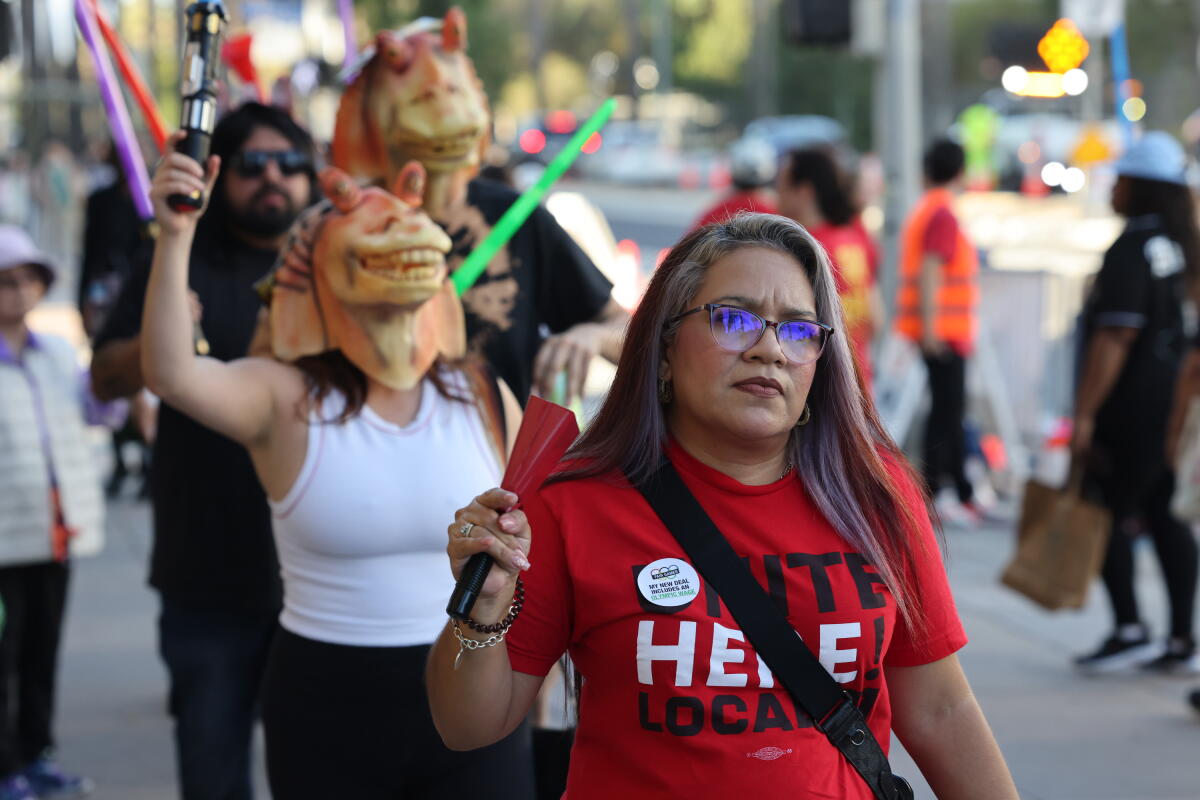
Days before the Lucas Museum of Narrative Art officially opens, protesters from the Fair Games Coalition — wearing Jedi robes and Jar Jar Binks masks and carrying lightsabers — rallied together outside the new museum.

Dozens of people from the group fighting for better worker protections during major sporting events were loudly blowing horns, banging drums and chanting, “Sí se puede,” directly across from Exposition Park’s newest museum. The group was at the museum’s private opening party Saturday night to take a stance against museum co-founder Mellody Hobson‘s recent resignation from the Los Angeles Olympics organizing committee, LA28.

“We launched the campaign with some real, reasonable demands,” said Jessica Durrum, the director of the Fair Games Coalition, for the Los Angeles Alliance for a New Economy. “If the Olympics are coming to town, we want to make sure there are lasting benefits for our communities.”

The Fair Games Coalition, which is made up of over 80 organizations, formed to fight for better labor deals during major events like the Super Bowl and the Olympic and Paralympic Games. Some of the unions in the coalition include United Teachers Los Angeles, National Union of Healthcare Workers, United Food and Commercial Workers Local 770, United Farm Workers and various community groups.

Ahead of these events, the group is asking that employers provide union and living wage jobs, funding for 50,000 units of housing for working families, a moratorium on short-term rentals and protections for immigrant workers.

Gladys Avyla marches in a No Games Coalition protest outside The Lucas Museum of Narrative Art

Gladys Avyla marches in a Fair Games Coalition protest outside the Lucas Museum of Narrative Art.

(Jonathan Alcorn / For The Times)

Gladys Avyla, a member of Unite Here Local 11, has worked as a cleaner at the W Hotel in Hollywood for the last 14 years. Several years ago she had to move to Victorville when her rent in L.A. got too high. Avyla said that with these major sporting events coming through town she’s worried the cost of living will continue to rise as her work gets busier and busier.

“Rent is very high, and everything is expensive. It’s hard living here. We need a wage increase for the Olympics because everything costs so much,” Avyla said in Spanish. “We need help for all workers. We’re human beings, but, honestly, we aren’t treated like human beings.”

Hobson, who co-founded the billion-dollar museum alongside her husband, George Lucas, resigned from LA28 earlier this week. She reportedly stepped down from the position due to the demands of running the Lucas Museum.

But the Fair Games Coalition claims she responded to their requests to meet and discuss their concerns by resigning. The 35-person board led by Casey Wasserman, who was recently under heat for his ties to Jeffrey Epstein and Ghislaine Maxwell, is meant to help plan and execute the upcoming Olympic Games.

“That’s how you hide your head in the sand. But we’re not giving up. She still has clout and still has a lot of power in the city of Los Angeles with the Olympic Committee,” said the Rev. Gary Bernard Williams from St. Mark United Methodist Church, a member of the coalition. “There’s going to be a lot of money flowing at the top. Very little money will be trickling down to the workers who need it the most.”

Demonstrators at a Fair Games Coalition protest at the Lucas Museum of Narrative Art.

Demonstrators at a Fair Games Coalition protest at the Lucas Museum of Narrative Art.

(Jonathan Alcorn / For The Times)

LA28 and the Lucas Museum did not immediately respond to a request for comment.

During this year’s World Cup, where several games were hosted in L.A., Unite Here Local 11, the union which represents workers including dishwashers, concession workers, bartenders and servers and SoFi Stadium’s food-service operator Legends Global, came to a tentative agreement days before the first match. Pastor Bridie Roberts, who works as the community organizing director at Unite Here Local 11, said having the Fair Games Coalition’s support was helpful during the negotiations.

“Our members face serious, critical decisions every single day about how to make ends meet and they work with some of the biggest tourism companies in the world that will profit in the billions of these games,” said Roberts. “We feel that the games have potential to bring real outcomes for working people, but only if we fight for them.”

Source link

Lucas Museum map: How to plan your visit to new Narrative Art museum

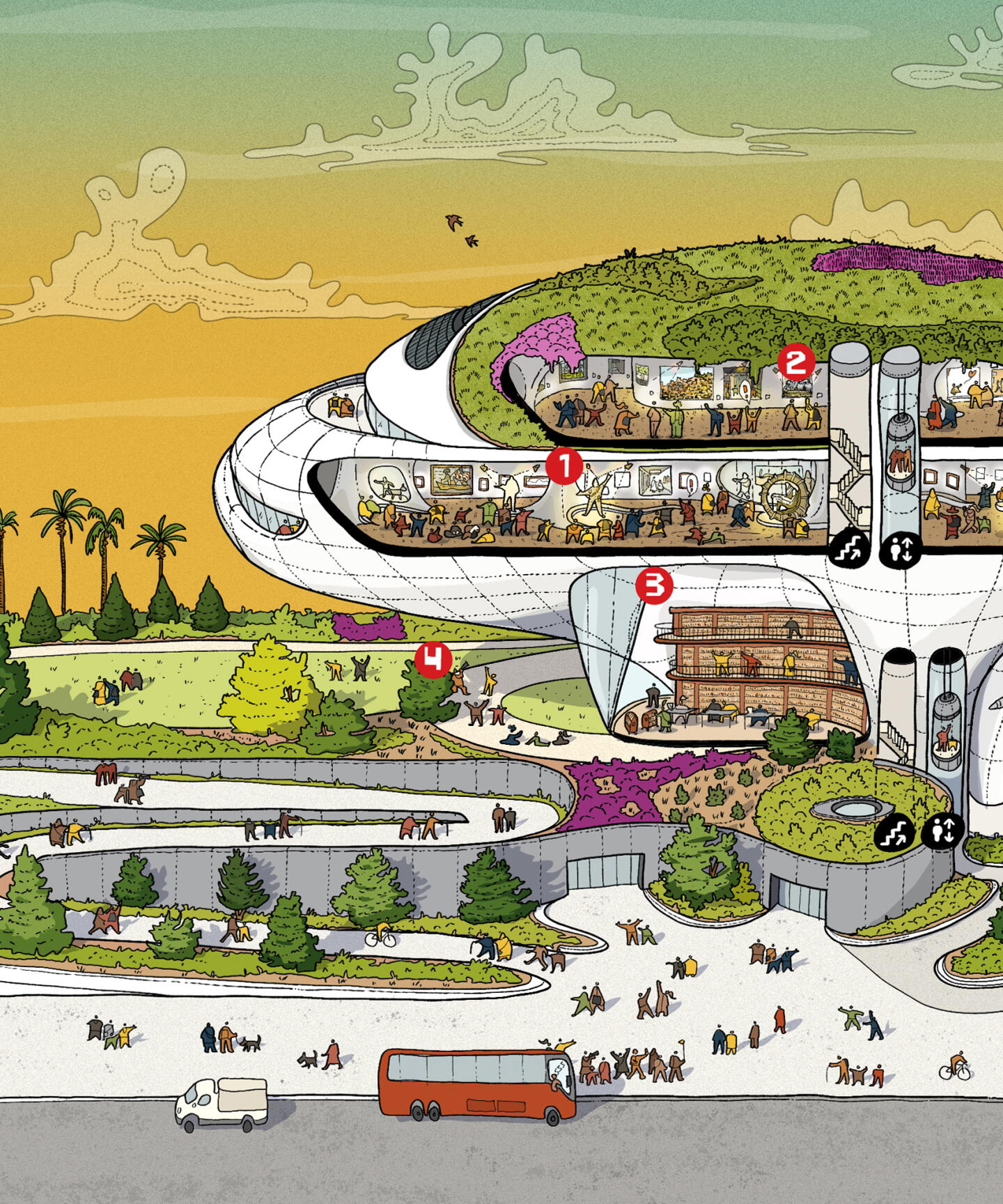
Comparing the Lucas Museum of Narrative Art to a spaceship has become an internet cliche, but the otherworldly campus really does feel like it exists in a galaxy far, far away. Nestled in Exposition Park beside the Natural History Museum and down the block from the soon-to-open Samuel Oschin Air and Space Center (with its actual spaceship), the Lucas Museum’s Ma Yansong-designed building sticks out like a green thumb.

There are 11 acres of lush public park space to explore, dotted with “Star Wars”-themed statues and a hanging garden, as well as benches and an amphitheater for outdoor events. A waterfall tucked on the north end of the building acts as a cooling mechanism for the 300,000-square-foot structure, but also serves as a gathering spot for jovial seagulls.

If you get peckish, there are two options: A cafe on the ground floor with typical sandwich and salad fare as well as a Starbucks; and a fifth-floor restaurant called Skywalker Grill with a full bar, curved cherry wood walls and lovely views of downtown L.A. (Nab a reservation or you’ll likely never get in.)

There are 100,000 square feet of gallery space, with the art spread mostly across the fourth floor — and in a fifth-floor murals gallery where you’ll find a selection of Banksys hidden in a back corner. More than 30 discrete galleries have something for almost everyone and are curated by broad themes including motherhood, community, romance, sports, science fiction and comics.

And, yes, there is a “Star Wars” exhibit, but it’s just a small part of the overall scene. If you come explicitly for that, your day will be filled with unexpected discovery.

Here’s a useful map to guide your way.

Source link

What to see at Lucas Museum of Narrative Art: an essential hit list

p]:text-cms-story-body-color-text”>

George Lucas and Mellody Hobson want their massive spaceship of a museum to be an experience. Across 300,000 square feet and 11 acres of park space, there’s a lot to take in. Staring up at the 90-foot-diameter oculus four stories above the entrance plaza makes one feel like a speck in the galaxy.

Instead of trying to conquer everything on a first visit — there are more than 1,300 works — hit our highlights below. If you aim to walk around the striking building to view a mishmash of masterpieces, children’s illustrations, movie memorabilia that’s heavy on “Star Wars” and comic strips, you’ll have a good time. If you’re hoping to learn about what’s on display or how adjacent pieces relate, curb your enthusiasm. It’s almost as if the museum is making a statement: you don’t need some analysis to connect with the works. If you complain about the collection, the co-founders don’t care. “Is it fine art? It’s finer art because it’s actually telling a story,” Lucas said at a museum party last week.

The oculus at the entrance of The Lucas Museum of Narrative Art.

The 90-foot-diameter oculus provides unique viewing from the fourth-floor gallery.

(Ariana Drehsler / For The Times)

The gee-whiz elevators.

The gee-whiz elevators at the entrance of the museum.

(Ariana Drehsler / For The Times)

Whoosh up in the glass-tube elevators to the massive fourth floor to begin. Best to explore the bulk of the galleries when your gas tank is full. Then head up a floor to see the murals. Take a break at the rooftop Skywalker Grill before ambling to the library and grounds. Skip the first floor’s “History of Narrative Art.” The exhibition is mostly screens, projections and reproductions, with a handful of great works from the 16th and 17th centuries and feels superficial at times. If you care about whether something is an original or a copy, check the gallery labels. Hungry for more detail? There’s a $30 exhibition catalog in the gift shop.

Prepare to get your steps in and feel a little turned around once it opens Sept. 22. Admission is $25 for adults, free for kids.

Source link