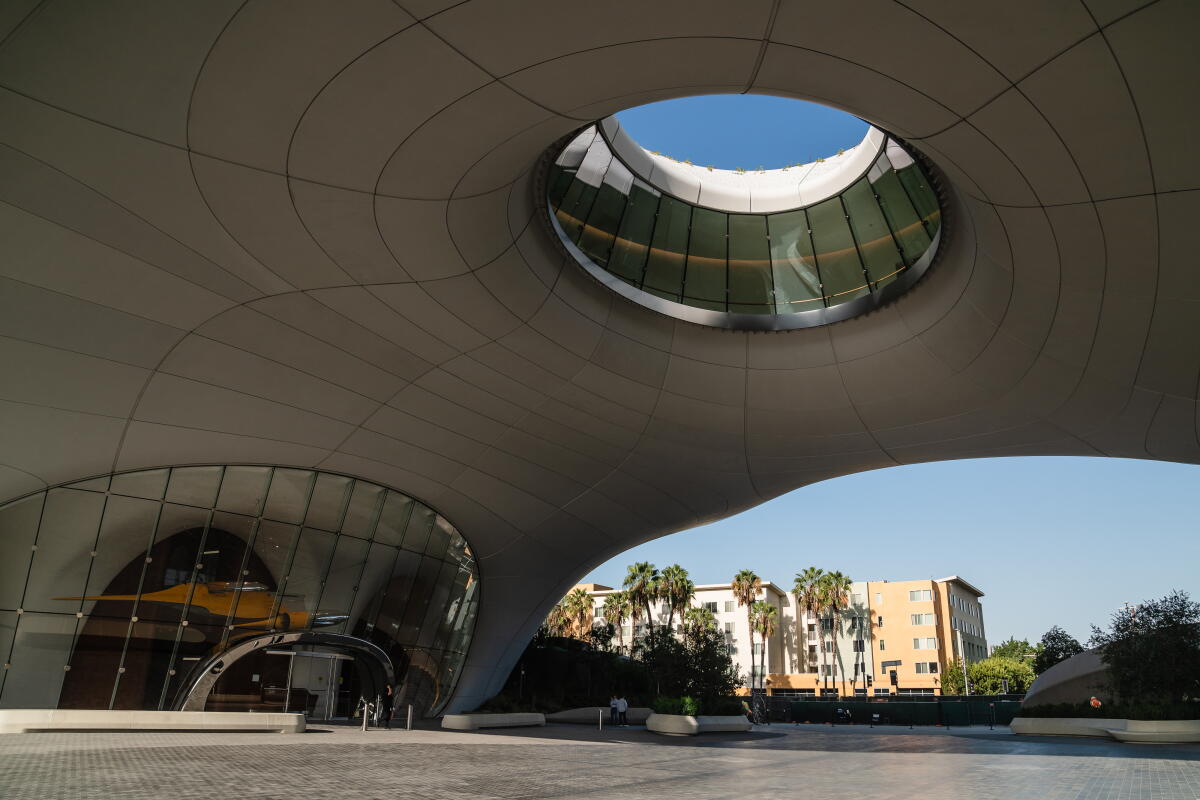
lucas museum

Lucas Museum unveils first exhibitions curated by George Lucas himself

It will be more than a “Star Wars” bonanza when the Lucas Museum of Narrative Art opens to the public Sept. 22. The highly anticipated $1-billion museum on Thursday announced about 20 inaugural exhibitions curated by George Lucas across more than 30 galleries — and only one is related to cinema, with a focus on “Star Wars” memorabilia, including large-scale vehicle installations, production designs, props and costumes.

The full scope of the 1,200-plus objects will only be revealed when guests step through the museum doors into more than 100,000 square feet of gallery space on the first day of fall.

The futuristic-looking 300,000-square-foot museum in L.A.’s Exposition Park was designed by Ma Yansong of Mad Architects with executive architect Stantec and includes 11 acres of park space that extend to the museum’s roof, designed by Mia Lehrer of Studio-MLA. Co-founded by Lucas and his wife, Mellody Hobson, the museum will rotate the famous filmmaker’s vast collection of narrative art, which contains objects not found in more traditional museums, including manga, comics and children’s tales. The idea is to present the myriad ways images are used to tell an endless variety of stories. Lucas has called his collection “the people’s art.”

A mother flanked by her children.

Dorothea Lange, “Migrant Mother,” Nipomo, Calif., 1936. Gelatin silver print, 18 3/4 x 14 1/2 in.

(Lucas Museum of Narrative Art, PKY.1062)

Exhibitions currently on deck include a variety of themed shows such as one on the architecture of the building; one titled “Everyday Life,” dedicated to visual stories about “childhood, community, family, love, motherhood, play, school, sports and work”; another titled “Civic Life” featuring “artists’ portrayals of experience in the courthouse, the polling place, the political headquarters”; an exhibit titled “Narrative Forms” highlighting “narrative art across genres of adventure, fantasy, romance and science fiction” by artists including Julie Bell, Boris Vallejo, Ken Kelly, Georges Méliès, John C. Berkey and Jeffrey Catherine Jones; and children’s literature illustrations by Beatrix Potter, Leo Politi, E.H. Shepard and Jacob Lawrence.

A painting of a husband and wife exiting their car and walking into their house as each holds a child.

George Hughes, “Home at Last,” cover for the Saturday Evening Post, Sept. 1, 1951. Oil on board, 30 x 24 in.

(Lucas Museum of Narrative Art, PKY.993. © SEPS by Curtis Licensing)

There will also be exhibitions devoted to the work of individual artists and genres such as comics and graphic stories from illustrators Mœbius, Marie Severin, Jack Kirby, Alison Bechdel, Jim Lee, Frank Miller and Rafael Navarro; illustrations and book covers by Frank Frazetta; the work of fairy tale and children’s illustrator Jessie Willcox Smith; the lush art of Maxfield Parrish; a selection of work by iconic American artist Norman Rockwell; selected works of Thomas Hart Benton; and early 20th century book illustrations by N.C. Wyeth.

A news release about the inaugural exhibitions noted that they are drawn from the museum’s founding collection of more than 40,000 works.

“The exhibitions trace the evolution of human culture through storytelling, from ancient sculptures of gods and goddesses to Renaissance paintings to photographs, comics and modern cinema,” the release says. “Many exhibitions are organized by theme, focusing on myths about love, family, community and adventure that connect every generation. These shared stories, told over and over in many forms, bind us together and define our human experience.”

A painting of a city street scene.

Ernie Barnes, “The Critic’s Corner,” 2007. Acrylic on canvas, 23 1/2 x 35 3/8 in.

(Matt Kroening / Lucas Museum of Narrative Art)

The road to the opening of the Lucas Museum has been winding. In 2017, Lucas first announced his decision to build his museum in L.A., with construction beginning the following year. The building was initially scheduled to open in 2021 — a goal that was pushed to 2023 due to COVID-19 pandemic-induced delays. From there, the debut was pushed to 2025, and finally 2026. The museum announced its final opening date last November.

Lucas’ role at his namesake museum has also not always been clear, and the museum’s development has been marked by a series of high-profile staff shakeups. The museum’s original director and chief executive, Sandra Jackson-Dumont, stepped down from her role in early 2025 after less than five years. She didn’t speak publicly about her departure but the museum issued a statement that her decision was based on a “new organizational design” that would split her job into two positions, with Lucas responsible for content direction.

Three months later, the museum laid off 15 full-time employees, a number of whom were from the education and public programming team. Seven part-time, on-call employees were also eliminated. The layoffs were described to The Times in harrowing terms by two employees who asked to remain anonymous.

In December — soon after the museum announced its opening date — news broke that chief curator Pilar Tompkins Rivas had stepped down from her role.

To date, no new chief curator has been named, but a rep for the museum wrote in an email that Lucas “is responsible for curatorial and content direction for the museum and continues to work closely with the curatorial team on his decades-long vision to celebrate storytelling and narrative art.”

Source link

2026 marks an explosion of L.A. museum openings including Lucas Museum

This year marks a veritable museum-palooza as Los Angeles debuts four new major arts complexes, with three in the wings likely to open in advance of the 2028 Summer Olympics.

Immerse yourself in a psychedelic explosion at Meow Wolf, plan an afternoon liaison with Van Gogh at LACMA’s new David Geffen Galleries, inhale the scent of nature inside Refik Anadol’s AI arts museum, Dataland, or simply geek out over George Lucas’ jaw-dropping collection of “Star Wars” memorabilia.

Whatever your arts craving may be, this astoundingly rich new lineup of new local museums has you covered.

LACMA’s David Geffen Galleries

The new David Geffen Galleries, opening in 2026, are composed entirely of Brutalist concrete.

The new David Geffen Galleries, opening in 2026, are composed entirely of Brutalist concrete.

(Christopher Knight / Los Angeles Times)

The Los Angeles County Museum of Art’s David Geffen Galleries are set to debut this April to members, before opening for general admission at the beginning of May. The $720-million Geffen Galleries will display 2,500-3,000 objects from LACMA’s collection.

The building, designed by Pritzker Prize-winning architect Peter Zumthor, is described by supporters as a “concrete sculpture” and will host 90 exhibition galleries across 110,000 square feet. The Wilshire Boulevard museum’s inaugural exhibition will organize artwork by the Pacific, Indian and Atlantic Oceans and the Mediterranean Sea instead of by medium or period.

“The idea is for you to make your own path — not to speak at you, but to let you wander like you would through a park or a place,” LACMA Director and Chief Executive Michael Govan said in an interview with The Times. “That change in attitude, and how the building is built, is really exciting.”

Some of the most-anticipated works on display include Georges de La Tour’s “The Magdalen With the Smoking Flame” (1640), Henri Matisse’s “La Gerbe” (1953) and Vincent Van Gogh’s “Tarascon Stagecoach” (1888).

Lucas Museum of Narrative Art

Los Angeles, CA - May 19: The gardens at the Lucas Museum designed by Studio-MLA on Monday, May 19, 2025 in Los Angeles, CA.

The gardens at the Lucas Museum, designed by Studio-MLA, on Monday, May 19, 2025.

(Jason Armond / Los Angeles Times)

After more than 10 years of anticipation, George Lucas and Mellody Hobson’s museum will open in Exposition Park this September. With over 10,000 square feet of galleries, the museum will feature a wide array of artwork and pop culture ephemera, including Lucas’ personal trove of “Star Wars” film franchise treasures, “Peanuts” comic strips, “Alice’s Adventures in Wonderland” illustrations, a Richard Sargent painting and covers of the Saturday Evening Post.

Lucas donated his collection to curate the Lucas Archives, which, in addition to “Star Wars,” will encompass props and production art from Lucasfilm projects, such as the “Indiana Jones” franchise.

One of the museum’s defining features is its massive green-roof garden designed by Mia Lehrer and her landscape architecture firm Studio-MLA.

“This brings everything together,” Lehrer said in an interview with The Times. “Design, ecology, storytelling, infrastructure, community. It’s the fullest expression of what landscape can be.”

Meow Wolf

Rainbow lighting lands on the facade of an art piece that looks like a white building.

A work-in-progress piece set to be featured in Meow Wolf L.A. as seen during a walk through at the group’s warehouse in Santa Fe on Oct. 15, 2025.

(Gabriela Campos/For The Times)

Meow Wolf’s L.A. location will reimagine a ’90s movie theater with its takeover of the Cinemark at West L.A.’s Howard Hughes entertainment complex outside Culver City. Meow Wolf’s sixth permanent exhibition comes on the heels of the immersive art creator’s 52,000-square-foot psychedelic art installation in Las Vegas, which was disguised as a dystopian grocery store called Omega Mart and promptly went viral on TikTok.

Complete with sci-fi elements, a meditative space and a 30-foot-tall mushroom tower, Meow Wolf’s new location will open at the end of 2026. Although organizers have kept much of the exhibition under wraps, visitors can expect to be transfixed by a thoroughly Los Angeles tale.

“It’s cool that we’re creating a story about a pilgrimage, because L.A. is that for so many artists, especially people involved in storytelling,” Shakti Howeth, Meow Wolf‘s creative director, told The Times. “It’s one of those places that’s built on layers and layers of dreams, and we’re really exploring that here. Not only dreams but broken dreams — the compost that can happen when you digest broken dreams.”

Refik Anadol’s Dataland

Los Angeles, CA: New media artist Refik Anadol will open his new AI museum, DATALAND.ART, in the Grand L.A.

Refik Anadol’s Infinity Room is meant to be a multisensory experience.

(Dataland)

Opening this spring at the Frank Gehry-designed Grand L.A., Dataland dubs itself the world’s first museum of AI arts. Turkish American artist Refik Anadol designed his own AI model, named the Large Nature Model, which only sources material with permission from original creators, making it what Anadol calls “ethical” AI. Partners include the Smithsonian and the Cornell Lab of Ornithology.

“I’m calling this new art form not AR, not VR, not XR — so we are still finding a name for it. The best name so far, and people love it, is generative reality,” Anadol told The Times.

Dataland will feature five galleries, including the Infinity Room, which Anadol first created in 2014 as a student at UCLA. In another exhibit, he trained an AI model on half a million scents and built a machine to push those scents into the gallery to create a totally immersive viewing experience.

Opening Later

The Armenian American Museum and Cultural Center of California

Slated to complete construction in downtown Glendale in late 2026, the 51,000-square-foot Armenian American Museum has been in the works for more than a decade. With a $67-million budget, the museum will include permanent and temporary exhibitions, as well as an auditorium, learning center, archives collection and a demonstration kitchen.

The museum is an initiative of the Armenian Genocide Centennial Committee Western US, and planning began as the group prepared to mark the the 100th anniversary of the Armenian Genocide in 2015. The museum is adorned with the 36 letters of the Armenian alphabet and a glass hazarashen skylight, inspired by traditional roofs in homes across the Armenian Highlands.

“The Armenian American Museum was once an idea, then a vision, and today is rising before our eyes,” museum Executive Chairman Berdj Karapetian said in a statement. “This progress is the result of an extraordinary collective effort by Armenians and non-Armenians here in California, across the United States and around the world.”

The Samuel Oschin Air and Space Center

The Samuel Oschin Air and Space Center in Los Angeles, CA

The Samuel Oschin Air and Space Center in Los Angeles is a major expansion of the California Science Center.

(Myung J. Chun / Los Angeles Times)

A solid opening date has not yet been announced, but the $400-million Samuel Oschin Air and Space Center at the California Science Center in Exposition Park is busily preparing for liftoff. Construction on the building began in 2022. The shiny new building will be home to the Korean Air Aviation Gallery, Kent Kresa Space Gallery and the Samuel Oschin Shuttle Gallery, which will host the Space Shuttle Endeavour.

Endeavour will be displayed in launch position, making it the tallest authentic spacecraft displayed vertically in the world, with a height of 20 stories. One of three surviving space shuttles, Endeavour made 25 successful missions into space.

The center is also expected to have 20 planes and jets, including a Boeing 747, a mock flight deck and a pair of introductory films produced by J.J. Abrams’ company Bad Robot, one of which will end with a simulated launch.

“It is an amazing experience, and we want to really build it up,” Jeffrey N. Rudolph, president and chief executive of the California Science Center, told The Times. “It’s not just about the hardware but about the people and the educational aspects.”

The Broad Expansion

Exterior rendering of the future Broad expansion from Hope Street.

Exterior rendering of the future Broad expansion from Hope Street.

(The Broad. © Diller Scofidio + Renfro (DS+R))

Opening in 2028, the Broad expansion will contain 70% more gallery space, two outdoor courtyards, a live programming space and views of the museum’s art storage vault. First announced in 2024, the $100-million addition is slated for completion before the 2028 Summer Olympics.

Located in downtown L.A., the expansion was deemed necessary after the museum significantly exceeded visitor projections. The new building will invert the existing Broad museum’s architectural design, with a smooth, gray structure attached to the original construction.

“The idea is that it adds new facets to the visitor’s journey through the expanded Broad,” said Joanne Heyler, founding director and president of the Broad, in an interview with The Times. “In a way, the existing building is always sort of talking to you. And there will be a similar thing happening with the expansion, but just a slightly different conversation, like you’re listening to its sibling.”

Source link