NATO Deputy Secretary General Radmila Shekerinska, left, joined the European Group of Five in Krakow, Poland, on Friday to discuss efforts to strengthen Euro-Atlantic security and NATO’s deterrence and defense. Talks included a deal for the E5 countries — Britain, France, Germany, Italy and Poland — to produce low-cost drones to support Ukraine and proved better defense for NATO nations in Europe. Photo by NATO
Feb. 21 (UPI) — Britain announced it has made a deal with four NATO allies to launch an initiative that would see the five nations manufacture low-cost drones to protect Europe.
The European Group of Five (E5) — Britain, France, Germany, Italy and Poland — announced on Friday that they will launch the Low-Cost Effectors & Autonomous Platforms initiative, or LEAP, which is “inspired by Ukraine’s battlefield innovation,” the British government said in a press release.
The purpose of the program is to jointly develop low-cost autonomous drones that the North Atlantic Treaty Organization can use to counter Russian provocation in the airspace above NATO-allied nations, Politico reported.
The first focus of LEAP, according to British officials, will be the development of a new surface-to-air weapon that is lightweight and affordable in order to defend against Russia’s drone and missile threats.
“European security is at a pivotal moment,” Luke Pollard, Britian’s Minister for Defense Readiness and Industry, said after the E5 meeting. “The U.K. and our E5 partners are stepping up — investing together in the next generation of air defense and autonomous systems to strengthen NATO’s shield and keep our people safe.”
Over the course of the last year, Russian fighter jets have violated NATO partner’s airspace, including fighter jets over Estonia and drones over Poland, which the E5 countries said has spurred their new plans.
At a meeting Friday in Krakow, Poland, the E5 members met to with NATO Deputy Secretary General Radmila Shekerinska to discuss the plans, which she said would be beneficial for Ukraine, which she said needs its allies to step up their support, as well as for all member nations of NATO in Europe.
Britain noted Friday that the new drone initiative comes as it also works with its European allies to develop long-range precision weapons and hypersonic weapons, with plans to spend more than $500 million on those initiatives just this year.
“The stronger each ally becomes, the stronger NATO will be,” Shekerinska said.
Team USA members celebrate their first goal in the first period of the men’s hockey semifinal game against Slovakia at the Milano Santagiulia Ice Hockey Arena in Milan, Italy, on February 20, 2026. Photo by Aaron Josefczyk/UPI | License Photo
Weekly insights and analysis on the latest developments in military technology, strategy, and foreign policy.
The U.S. Air Force has released details of a live-fire test of the Rusty Dagger, one of two new Extended Range Attack Munitions (ERAM) being developed under a crash program. The milestone suggests that Ukraine is a step closer to getting its hands on thousands of air-launched ERAMs that will provide the country with a powerful new and relatively low-cost standoff strike capability. The event is also significant in terms of the Pentagon’s focus on rapidly developing and bringing into operational service new, less-expensive weapons that can be built at scale.
The Air Force recently confirmed that the ERAM standoff cruise missile was tested at the Eglin Test and Training Range in Florida on January 21, 2025, less than 16 months from the program’s initial contract award. The service’s statement doesn’t mention the Rusty Dagger by name, but the weapon is clearly seen in a sequence of photos that show the missile heading vertically down to engage a static target before its live warhead detonates. It’s unclear what platform was used to launch the missile during the test.
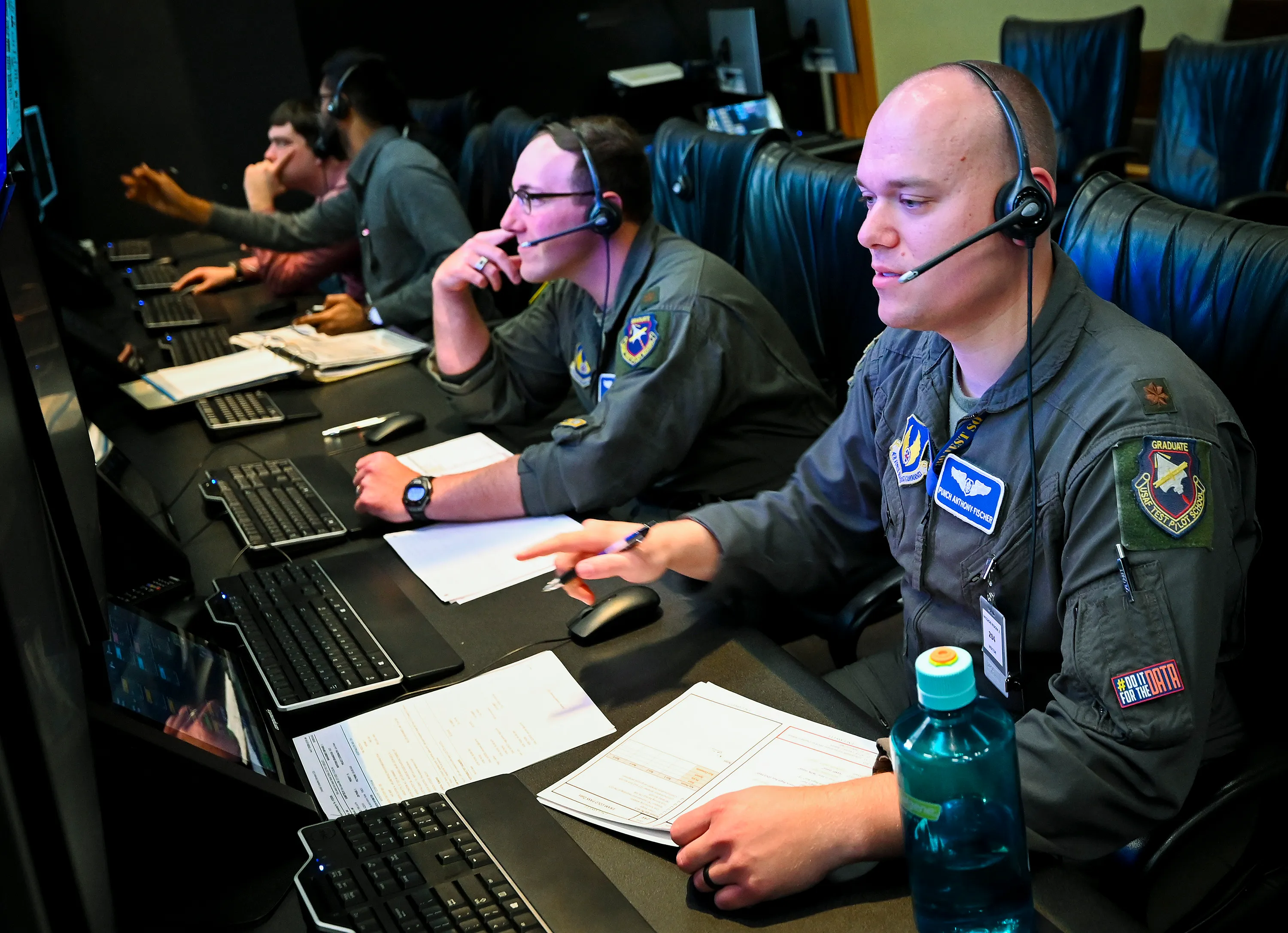
Engineers and test conductors in the Central Control Facility monitor the Extended Range Attack Munition live-fire test Jan. 22, 2025, at Eglin Air Force Base, Florida. U.S. Air Force photo by Kayla Prather Samuel King Jr.
ERAM is understood to have a range of between 150 and 280 miles. It is in the 500-pound class and has a blast/fragmentation warhead with at least some degree of penetrating capability.
Alongside industry, the Eglin test was run by the Air Force Life Cycle Management Center’s Armament Directorate and the 96th Test Wing, a unit that you can read more about in this TWZ article.
“The event, which met all primary objectives including a full warhead detonation, gathered critical data to mature a new, cost-effective, long-range strike capability,” the Air Force said.
“Moving from a contract to a live-fire demonstration in under two years proves we can deliver lethal, cost-effective capability at the speed of relevance,” said Brig. Gen. Robert Lyons III, Portfolio Acquisition Executive for Weapons, in an Air Force statement. “This is how we rebuild our military — by empowering our teams and industry partners to cut through bureaucracy and deliver the tools our warfighters need to prevail.”
A full, unedited view of the Extended Range Attack Munition live-fire test on Jan. 22, 2025, at Eglin Air Force Base, Florida. via U.S. Air Force Samuel King Jr.
“The future fight demands we create an asymmetric advantage by developing cost-effective, attritable systems like ERAM that give commanders the ability to generate mass,” added Brig. Gen. Mark Massaro, 96th TW commander. “This test is a critical milestone on that path. The expert teams who executed this complex mission provided the high-fidelity data we need to validate this system, ensuring that when it reaches the warfighter, it is a proven and ready tool for the right target. This is the cornerstone of building a more lethal and effective Joint Force.”
A slide from an April 2025 U.S. Air Force briefing laying out a shared timeline for projected “Other Transaction” (OT) type contracting actions for various low-cost air-launched munitions programs, including ERAM and ETV. USAF
It was reported in August 2025 that Washington had approved the sale of 3,350 ERAM missiles to Kyiv. That package is said to be worth around $850 million, with most of the funds coming from Ukraine’s European allies.
As well as the Rusty Dagger from Zone 5 Technologies, CoAspire developed the Rapidly Adaptable Affordable Cruise Missile (RAACM) under the ERAM program. It’s unclear if Ukraine will receive only one of these designs or a mixture of both types. You can read more about the implications of the ERAM for Ukraine and the Ukrainian Air Force platforms that might be in line to carry the munitions here.
Two candidate weapon prototypes competing for the US Air Force’s Extended-Range Attack Munition program 👇. Both Coaspire and Zone 5 Technologies were awarded contracts late last year in support of the #ERAM program. Both are expected to enter testing this year. https://t.co/9cGBuB9z3spic.twitter.com/gc3ZDtX54m
RAACM Cruise Missile Video Long Range Flights Summer 2025 Cleared for Public Release
Suffice it to say, the ERAM will provide the Ukrainian Air Force with an important new capacity to strike targets beyond the reach of many of the weapons currently in its arsenal, including Western-supplied precision-guided bombs. It will make Ukraine better able to hold at risk a range of Russian targets far from the front lines — command-and-control facilities, air defenses, logistics hubs, military-industrial capacity, and airfields, for example — helping offset Russian advantages in terms of manpower, weaponry, and resources.
In addition to what it will provide Ukraine, the ERAM effort could well prove to be a big deal for other U.S. allies and partners, and the U.S. military itself.
In the RFP, it was said that ERAM would be “pivotal for accelerating Ukraine’s capability to meet warfighter needs efficiently and effectively and provides an affordable mass weapon to be produced at scale.” The Air Force added: “The Government is seeking to prototype and adapt commercial autonomous modular open-architecture vehicle [sic] that can deliver affordable long-range effects. The resultant prototype will provide a platform that is mass producible.”
Exactly the same concerns are increasingly at the front of war planners’ minds in the United States, too.
When it comes to planning around a potential future high-end conflict with China, the U.S. military is now looking closely at new kinds of weapons with standoff range. Importantly, these need to be rapidly developed and then their production capacity and stockpiles scaled up.
A number of U.S. efforts are now underway with the aim of reducing costs and speeding up large-scale production of weapons systems, especially uncrewed platforms. In parallel to these are plans to prepare missile stockpiles resilient enough for any future high-end conflict, especially one against China.
The original RFI for ERAM included the requirement that 1,000 examples of the new missile could be built within two years, for an average production output of around 42 missiles per month.
As such, ERAM is very much a test case for this kind of program.
Notably, Zone 5 is also involved in the U.S. Air Force’s Enterprise Test Vehicle (ETV). Under this program, four companies — the others are Anduril, Leidos subsidiary Dynetics, and Integrated Solutions for Systems, Inc. — were tapped to design and deliver prototype ETVs. Ostensibly low-cost cruise missiles, the designs in question skirt an increasingly blurry line separating traditional cruise missiles from uncrewed aerial systems, especially longer-range kamikaze drones, as well as decoys.
A rendering of the ETV design from the Zone 5 company. Zone 5 via DIU
Looking at the same kind of space more broadly, it is clearly a growth area among defense contractors, both well-established ones like Lockheed Martin and relative newcomers such as Anduril and Kratos.
A Lockheed Martin rendering of a group of notional lower-cost air-launched stand-off munitions. Lockheed Martin
In August of last year, it was reported that the first ERAM missiles were expected to be delivered to Ukraine “in around six weeks.”
So far, there’s no sign that the missiles have arrived, but that possibility cannot be ruled out, especially bearing in mind an end-to-end test of the Rusty Dagger a little more than a year ago.
Whether it’s now in Ukrainian hands or not, the combat experience of ERAM in Ukraine will be hugely valuable, not just in terms of the technology that will be employed, but also as a prototype program for how the U.S. military might develop and field its next generation of weapons in this class.