Chinese authorities have reportedly taken possession of an F-35 cockpit canopy and weapons-bay door that were inexplicably diverted to Hong Kong while being shipped from Australia to the United States. The incident appears to have left physical components that incorporate aspects of the fighter’s low-observable design in the hands of a country that has spent years doing whatever it could to gain information on the aircraft and America’s stealth technology secrets in general.
So, what does all this mean? Let’s put it in perspective.
The parts in question were being shipped by UPS from Australia to the United States in late May, according to people familiar with the matter cited by Bloomberg. The components from a Royal Australian Air Force F-35A were being sent to the United States for inspection and possible repair or disposal.
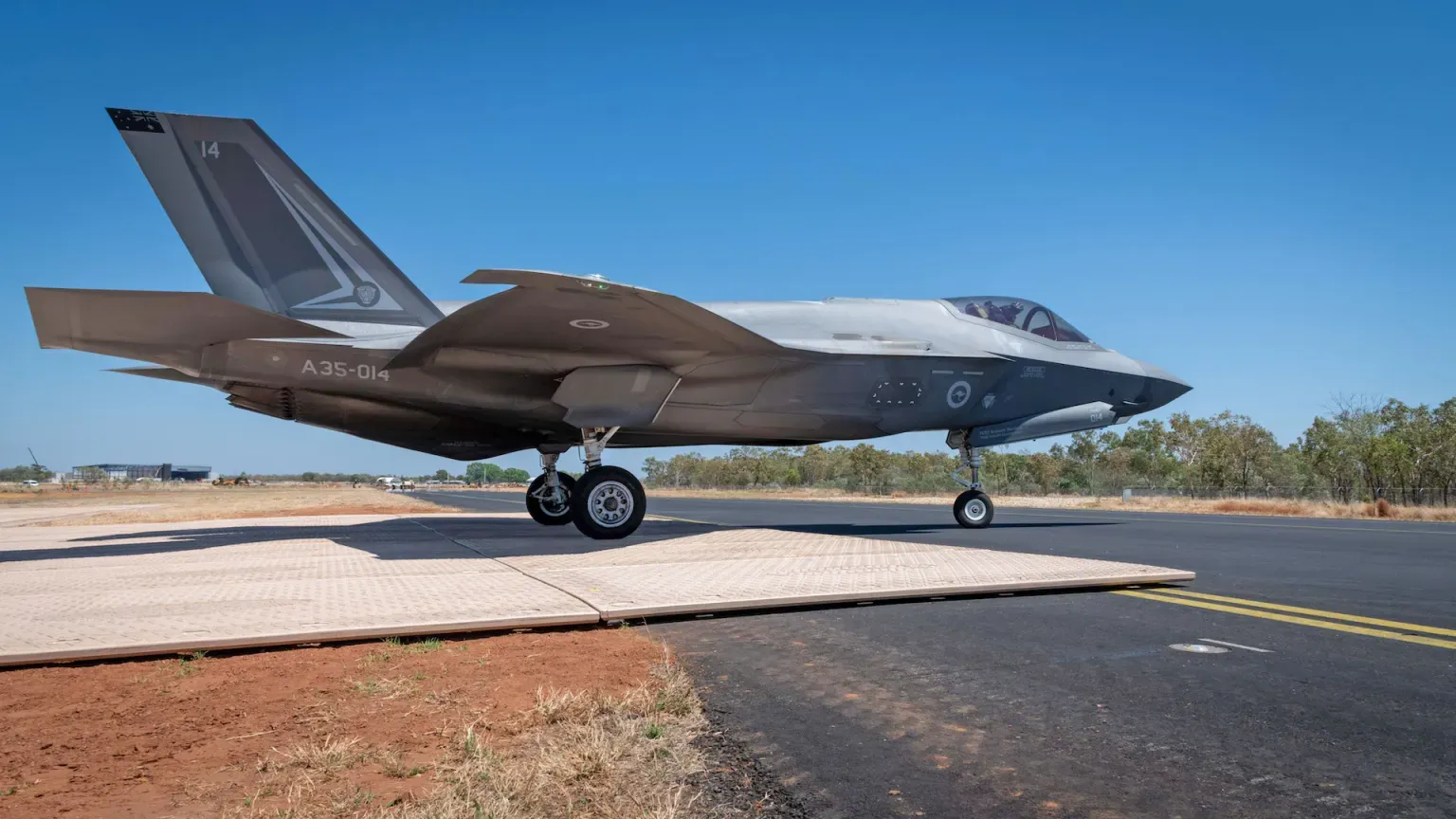
A Royal Australian Air Force F-35A from 75 Squadron taxiing at RAAF Base Tindal, Northern Territory. Australian Defense Force
F-35 sustainment procedures explicitly cover the movement of F-35 parts, including unserviceable components, through the program’s logistics network. The U.S. Air Force’s transportation guidance directs F-35 shipments outside the Defense Transportation System to follow approved Joint Program Office procedures. In other words, moving an unserviceable Australian F-35 component to the United States for inspection, repair, or disposition is consistent with the normal sustainment process.
What is highly unusual is where this particular shipment ended up. F-35 components moving through an established international logistics system apparently stopped in South Korea, were then routed to Hong Kong. Chinese authorities subsequently took possession of the parts and have not returned them, according to the sources cited by Bloomberg.
F-35 canopy component replacement at Luke Air Force Base, Arizona. U.S. Air Force photo by Senior Airman Ridge ShanSecretary of War Pete Hegseth autographs the weapons bay door of an F-35 at Lockheed Martin Air Force Plant 4, in Fort Worth, Texas. DoW photo by U.S. Navy Petty Officer 1st Class Alexander Kubitza
“For security reasons, we can’t discuss the status of specific shipments or our shipping procedures,” Lockheed Martin told us in response to a request for clarification about the incident. The company added that it “follows all U.S. regulations established by the Department of War and regulated by the Defense Logistics Agency (DLA) regarding the shipment of aircraft components. Our teams handle every shipment with the utmost diligence and safeguards to ensure the integrity of the F-35 program and the security of our allied partners.”
The Pentagon’s F-35 Joint Program Office has acknowledged a “shipment issue” involving F-35 components and said U.S. authorities and industry partners are working to recover them and investigate what happened.
Lockheed Martin, UPS, and the Pentagon have not publicly provided a detailed account of how the shipment was diverted or what happened to the parts after they reached Hong Kong.
Australian Defense Minister Richard Marles also confirmed that Canberra was aware of the incident and was working with the United States and Lockheed Martin.
Acting Prime Minister and Minister for Defense, Richard Marles, accompanied by Chief of Air Force Air Marshal Stephen Chappell at RAAF Base Edinburgh, South Australia. Australian Defense Force
Marles has sought to play down the potential security implications of the components, saying his understanding was that the shipment did not contain sensitive equipment or sensitive parts. That does not by itself answer the more specific question of what could potentially be learned from these particular pieces of an F-35. After all, not every physical component of an F-35 is necessarily highly classified or capable of revealing meaningful information about the aircraft’s design. At the same time, a cockpit canopy and weapons-bay door involve structures, materials, interfaces, tolerances, and treatments that all have to work within the aircraft’s low-observable design. If radar-absorbing material or other specialized treatments remain on the components, that could potentially make them far more sensitive from a technological exploitation standpoint.
The condition of the parts is also unknown. We do not know how much of their coatings or other treatments remain intact, whether Chinese authorities have examined them, or what information could actually be extracted from them in their current state.
Above all else, there is little specific information in the public domain about what F-35-related technical information Chinese intelligence already has acquired over the years, what physical components or materials it may already possess, or what additional information could be gained through espionage, cyber operations, industrial access, observation of deployed aircraft, or other means.
Without these facts, it is impossible to gauge what damage could have been done by this loss. Still, viewed in a vacuum of those unknowns, simply having an F-35 canopy and weapons-bay door in Chinese possession represents a significant loss of control over sensitive physical hardware — there is no way around that reality — and the severity of that loss could be substantial depending on the physical state of the parts.
The circumstances are particularly sensitive because, as we mentioned in the opening of this article, China has pursued multiple avenues for acquiring information on the F-35 for many years, with publicly documented cases involving cyber operations, technical information, supply chains, and human expertise. Some aspects of China’s subsequent stealth aircraft designs have also prompted comparisons with U.S. aircraft, although claims that China simply ‘cloned’ entire aircraft are not supported by the available evidence.
China And The F-35: A History Of Espionage
In 2014, U.S. authorities charged Chinese businessman Su Bin with conspiring with two other Chinese hackers to break into the computer systems of U.S. defense contractors. Prosecutors alleged that the group targeted information on aircraft including the F-35 and F-22. The alleged hacking campaign ran from 2009 to 2013.
Su Bin later pleaded guilty and was sentenced to nearly four years in prison. The Justice Department’s 2026 case against former Air Force fighter pilot Gerald “Runner” Brown connects the two cases. Prosecutors allege that Brown used a co-conspirator to negotiate his work training Chinese military pilots with Su Bin.
Brown, a retired U.S. Air Force major who spent more than 24 years in the service, subsequently worked as a contract simulator instructor training U.S. military pilots on the A-10 and F-35. In February 2026, the Justice Department charged him with providing and conspiring to provide unauthorized defense services to Chinese military pilots.
According to the criminal complaint, Brown traveled to China in December 2023, where he allegedly began training People’s Liberation Army Air Force (PLAAF) personnel. Prosecutors say he also answered questions about the U.S. Air Force for three hours on his first day in China. Brown has been charged, and the allegations have not been adjudicated. He is one of multiple former Western aviators alleged to have provided training services and/or intelligence to Beijing.
The Honeywell case provides yet another example, this time involving the defense industry’s supply of technical information.
In 2021, the State Department reached a $13-million administrative settlement with Honeywell over alleged violations of the Arms Export Control Act and International Traffic in Arms Regulations (ITAR). Honeywell had voluntarily disclosed alleged unauthorized exports and retransfers of ITAR-controlled technical data.
The case involved 71 engineering drawings containing dimensions, geometries and layouts for manufacturing castings and finished parts used across multiple aircraft, engines and military systems. The State Department said the unauthorized exports and retransfers involved Canada, Ireland, Mexico, China, and Taiwan.
Among the systems covered by the drawings were components associated with the F-35 and F-22. The case did not allege that Honeywell deliberately sought to provide China with sensitive military technology; rather, it concerned alleged violations of export-control requirements.
A U.S. Air Force F-22 (nearest camera) flies alongside an F-35A. U.S. Air Force photo by Lt. Sam Eckholm
There has also been a physical supply-chain precedent.
In 2022, F-35 deliveries were temporarily halted after the Pentagon discovered that a magnet in the aircraft’s Honeywell-built turbomachine pumps —which provide critical power functions to the jet — contained a cobalt and samarium alloy produced in China. The material itself was not considered a security or flight-safety threat, but the discovery demonstrated how difficult it can be to maintain complete visibility over a global supply chain involving thousands of companies and multiple tiers of subcontractors.
Taken together, these cases demonstrate several different pathways through which China has appeared in the F-35 security story: cyber theft, unauthorized technical-data transfers, supply-chain exposure, and alleged exploitation of former Western military expertise.
The Hong Kong incident would add another major category: physical access to actual F-35 components.
These are only some of the publicly documented examples. There is no public way to know the full extent of information or physical material Chinese intelligence may have acquired over the years, but is very likely far larger in scope than what is available in the open source.
Chinese Access Concerns Have Shaped F-35 Export Policy
The proposed sale of F-35s to the United Arab Emirates became deeply entangled in U.S. concerns about Abu Dhabi’s growing military and technology relationship with China.
A 34th Expeditionary Fighter Squadron F-35A conducts inflight refueling above the United Arab Emirates. U.S. Air Force photo by Tech. Sgt. Kat Justen
Washington had approved a potential package involving 50 F-35As, but U.S. officials and lawmakers expressed concerns about Chinese intelligence activity and technology in the UAE. Among the broader concerns were Chinese telecommunications infrastructure and the possibility of Chinese military or intelligence access to facilities associated with advanced U.S. weapons. A Congressional U.S.-China Economic and Security Review Commission report later cited the potential presence of Chinese intelligence collection capabilities and military facilities in the UAE as risks to the proposed F-35 sale.
The State Department recently approved a potential $24.3-billion sale to the Kingdom involving 48 F-35s and associated equipment. But U.S. intelligence agencies have reportedly warned that China’s military and technology relationship with Saudi Arabia could create opportunities for Beijing to obtain sensitive F-35 information.
According to reporting based on U.S. officials familiar with intelligence assessments, a Defense Intelligence Agency report raised concerns about Chinese military access to Saudi bases, Chinese technology in Saudi telecommunications infrastructure, and whether secure facilities could be maintained for F-35 operations. The assessments also questioned whether Saudi Arabia would limit contact between Chinese military and intelligence personnel and F-35-related sites.
What Could The Components Reveal?
As we noted earlier, there is no way to gauge the intelligence impact of the loss at this stage. The central unknown of what China already knows about the F-35, and what it may already have in its possession — especially related to these components — is the key variable here.
Regardless, an F-35 canopy and weapons-bay door can provide information that cannot otherwise be easily obtained and gives a different level of fidelity in terms of material exploitation than what construction data and blueprints alone could.
The F-35’s low observability is the product of an extremely complex combination of airframe shaping, construction materials, external coatings, manufacturing tolerances, speciality apertures, and more.
U.S. Air Force 325th Maintenance Squadron low-observable maintainers work on an F-35A at Tyndall Air Force Base, Florida, in August 2024. U.S. Air Force photo by Airman 1st Class Victoria Moehlman
A canopy is a particularly demanding part of any stealth aircraft. It has to satisfy optical and structural requirements while also controlling radar reflections. The cockpit is historically a major source of radar reflectivity, including the pilot’s helmet. Therefore the canopy’s materials, construction, interfaces, and specialized treatments can be critical to the aircraft’s overall low-observable performance, and especially from the critical frontal aspect.
The F-35’s canopy has been an ongoing work in progress for many years. It has had chronic material issues, especially when it comes to delamination. Multiple iterations spread over two decades have recently resulted in a major improvement of the issue. The tight balancing act of keeping the canopy transparent enough, while controlling the F-35’s stealthy signature and having that mix of materials be robust enough to last for a reasonable amount of time has been a major investment for the program. If the canopy is of a later variation, that loss alone could be substantial and could help China with their own low-observable canopy development programs even if they already had original information on the F-35’s canopy original design dating back years.
Evidence of the F-35’s canopy delamination issue on an early example of the F-35B. Crown Copyright
The F-35’s canopy has been a notorious work in progress, specifically the low observable coating/delamination issue which has improved a lot in recent years with new materials and processes. So no, you do NOT want to lose that in to China! https://t.co/9V0jdRAiwA
The F-35’s weapons-bay door has its of sensitivity issues. It is effectively a major section of the aircraft’s outer shell, with its structure, edges, interfaces, tolerances and treatments all having to function without creating unacceptable radar signatures. Its construction and material attributes can be reasonably extrapolated for the rest of much of the F-35’s outer mold-line. Above all else, if the radar absorbent material remained intact on the door, that would signify a major loss when viewed without any understanding of what China already knows about the F-35’s radar absorbing surface treatments. Historically speaking, RAM technology is among America’s closest guarded material sciences secrets.
A Belgian Air Force service member inspects the open weapons bay of an F-35A at Luke AFB, Arizona. U.S. Air Force photo by Airman 1st Class Tekorey Watkins
For the time being, Australian officials have said they do not understand the parts to be sensitive. The investigation will ultimately have to establish what the components actually contain and what could be learned from them.
The incident comes at a moment when China’s own stealth fighter efforts are undergoing an extraordinary expansion.
The PLAAF is now operating the J-20, China’s first operational fifth-generation stealth fighter, in increasingly large numbers. The smaller J-35 is also moving toward broader service, including a carrier role for the People’s Liberation Army Navy.
Aircraft maintainers clean the fuselage of a J-20 fighter during the Changchun Air Show in the Jilin Province of China, in September 2025. Photo by Zhang Xiangyi/China News Service/VCG via Getty Images
China has also moved into what Western observers generally describe as sixth-generation fighter development.
Two new tailless combat-aircraft designs emerged publicly in December 2024. One is the large Chengdu aircraft commonly referred to as the J-36, while the other is associated with Shenyang and is variously called the J-XDS or J-50. Both have continued flight testing and yielded several prototypes with individual refinements.
The exact capabilities and eventual operational roles of these aircraft remain uncertain. They are developmental designs, not established operational equivalents of the F-35 or other sixth-generation systems. However, China is clearly building an increasingly broad ecosystem of fifth- and next-generation low-observable combat aircraft, both crewed and uncrewed. In the latter category is a growing number of stealthy drones, including long-endurance types.
China didn’t likely need physical access to an F-35 canopy or weapons-bay door to develop the J-20, J-35, or its next-generation aircraft. But additional information about how a mature Western stealth aircraft handles materials, coatings, interfaces, manufacturing, and the integration of those elements can still have great potential value to an industry developing its own systems. This includes technologies intended to counter the U.S. combat aircraft and their low-observable characteristics.
The F-35 has been produced in large numbers, is operated by a growing coalition of countries, and has been subjected to years of testing and operational experience. Its low-observable design represents decades of accumulated U.S. research and industrial know-how. At the same time, the global scale of the program inevitably makes control over sensitive information more complicated. More aircraft, more maintainers, more industrial partners, and more international logistics mean more points at which information and physical hardware have to be controlled. Over time, a program of this size will see an erosion in its secrets, but a major loss can drastically accelerate what should be a more gradual and control decline in security.
The Lockheed Martin F-35 production line at Fort Worth, Texas. Lockheed Martin photo by Alexander H Groves
The potential intelligence value of the components also has to be considered in the context of foreign material exploitation, or FME. Major military powers maintain dedicated capabilities to recover, examine and characterize foreign weapons, aircraft, sensors, materials and other equipment. The objective is not necessarily to reproduce an entire system. More important is determining how something is built, what materials and manufacturing techniques are used, how individual components perform, and where industrial strengths or limitations may lie.
That is why countries have historically gone to extraordinary lengths to recover even crashed or damaged pieces of sensitive military hardware. The bigger the prize, the more risk an intelligence service would be willing to take in order to realize a recovery.
The sensitivity surrounding the physical remnants of an F-35 is not new. When a Japan Air Self-Defense Force F-35A disappeared over the Pacific in 2019, the search quickly became more than a rescue operation. U.S. and Japanese forces mounted an extensive effort to locate the wreckage, with U.S. Navy P-8A aircraft and a destroyer joining the search. TWZnoted at the time that even scattered F-35 wreckage could expose valuable technological secrets, while the aircraft’s location on the seabed raised the prospect of an underwater espionage and recovery operation.
That concern has also been evident in subsequent F-35 recovery operations. That concern has been reflected in subsequent F-35 recoveries. In 2022, the U.S. Navy recovered an F-35C from roughly 12,400 feet in the South China Sea after a carrier landing accident, removing the possibility that the aircraft could be accessed by another country.
Unanswered Security Questions
At this point, there is no public evidence that the Hong Kong diversion was a deliberate Chinese intelligence operation, although it is certainly possible. It is also unclear whether Chinese authorities have examined the F-35 parts or what level of new and useful information has been recovered from them.
If, as reported, Chinese authorities have taken possession of the parts and have not returned them, that would be an extraordinary development. If the diversion was genuinely the result of a shipping or logistics error, the outcome would itself be extraordinary. It would raise serious questions about the security controls surrounding the movement of F-35 hardware even without evidence of deliberate interference.
The timing is also notable. Chinese President Xi Jinping arrived in Washington this week for a state visit with President Donald Trump, with the two leaders meeting amid broader disputes involving technology, security, and the future of U.S.-China relations. Whether the F-35 shipment comes up directly in those discussions is not known, but it would be an obvious subject for U.S. and Chinese officials to address through diplomatic channels.
“Ladies and gentlemen, the President of the United States Donald J. Trump and First Lady Melania Trump, accompanied by the President of the People’s Republic of China Xi Jinping and Madame Peng Liyuan.” pic.twitter.com/hyPHOBC99Q
For now, however, the central question remains how the parts got there. Until that is answered, we won’t know if this was a simple logistics failure or a deliberate intelligence operation. And beyond that, what China already knew about the components it now may have in its possession — a question we may never truly get an answer to.
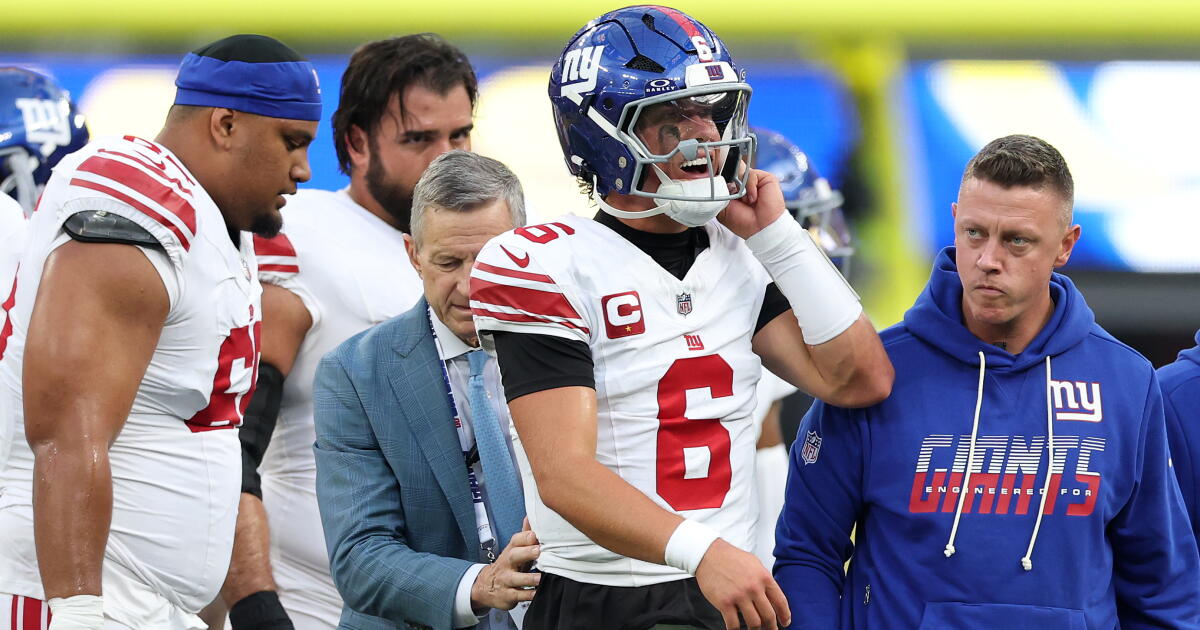
Harbaugh stopped short of confirming the multiple media reports that Dart suffered a sprained MCL when his leg bent in an unnatural manner after he was hit hard by Rams linebackers Byron Young and Josaiah Stewart early in the first quarter.
“That’s in the neighborhood of it, I would say,” Harbaugh said of those reports after the his team’s 28-6 loss. “We’ll get an MRI tomorrow and have a real good feel for it, and give you more information from there.”
SNY Giants reports that Dart could miss two to four weeks with the injury. Still, it could have been much worse. A torn ACL could have ended the season for the second-year quarterback who missed two games last year after sustaining a concussion.
“Never play to hurt anybody,” Young, a fourth-year player and 2025 Pro Bowl selection for the Rams, posted in an Instagram Story after the game. “I pray for a healthy recovery.”
Former NFL quarterbacks Peyton and Eli Manning seemed to fear the worst while watching the situation unfold live on their alternative broadcast of the game on ESPN2.
“Oh no. Oh no. No, no, no, no, no,” Peyton Manning said as he watched Dart writhe on the ground while holding his knee. “That is not what we want to see. Gosh!”
“Tough to watch,” Eli Manning said as a replay aired. “Hate to see that. Hope he’s OK.”
Dart was able walk off the field and into the locker room gingerly but under his own power. ESPN’s Jordan Raanan reported that the former USC and Mississippi quarterback actually wanted to return to the game but was not allowed to do so by his team.
Instead, Dart watched the second half from the sideline in street clothes, with video appearing to show him telling someone, “They wouldn’t let me come back out.”
Veteran quarterback Jameis Winston filled in for Dart and completed 11 of 27 passes for 111 yards with one interception.
Dart was one of several key Giants (1-1) players to suffer injuries during the loss. Top pass rusher Brian Burns sprained his left ankle and left tackle Andrew Thomas sustained an apparent lower-body injury, with neither player returning to the game.
Wide receiver Malik Nabers had to pop his right shoulder into place after dislocating it during the first quarter. He stayed in the game but indicated afterward he would undergo X-rays the next day.
Maybe this is what the Chargers are — lurching, sputtering and unable to consistently move the football, despite an offensive overhaul packed with high expectations.
Just as they did in their abysmal season opener, the Chargers struggled at home Sunday and failed to establish a rhythm on their way to a 26-14 loss to the Las Vegas Raiders.
The Chargers lost their opener to the Arizona Cardinals by an identical score — 26-14.
A week after losing an opener for the first time in his career as an NFL head coach, Jim Harbaugh is off to his first 0-2 start as a coach in college or the pros.
It won’t get any easier. The Chargers play at Buffalo on Sunday against the 2-0 Bills, who have scored a combined 77 points in victories over the Houston Texans and Detroit Lions.
After that, the Chargers play at Seattle, at home against Denver, at Kansas City, and against the Rams as rare visitors at SoFi Stadium. Four opponents, four Super Bowl-winning coaches.
These first two games were supposed to be the soft start, of at least a relatively gentle ramp-up to the thorny part of the schedule.
Well, that’s out the window. The Chargers were dominated by Arizona, a team that won just three games last season, then dropped another home game to the Raiders. As head coach of the Chargers, Harbaugh had won all four of his previous matchups against Las Vegas.
The Chargers last started 0-2 in 2023, when they went on to finish 5-12.
Sunday, the Chargers were unable to get the ball downfield and repeatedly committed penalties and miscues that short-circuited drives. For instance, normally sturdy tackle Joe Alt was flagged for false starts three times.
Snapshot of another major problem: Trailing by a field goal late in the third quarter, the Chargers had a third-and-inches on their side of the field. They could have run a tush-push with 6-foot-6 Justin Herbert. They could have used 220-pound running back Omarion Hampton to hammer up the middle for a first down.
Instead, they had Herbert drop back into shotgun and sent Tre’ Harris in motion from right to left. Then, they snapped the ball at the precise moment the receiver was between center Jake Slaughter and the quarterback. The snap bounced off Harris’ knee, Herbert had to pounce on the loose ball and the threat was thwarted.
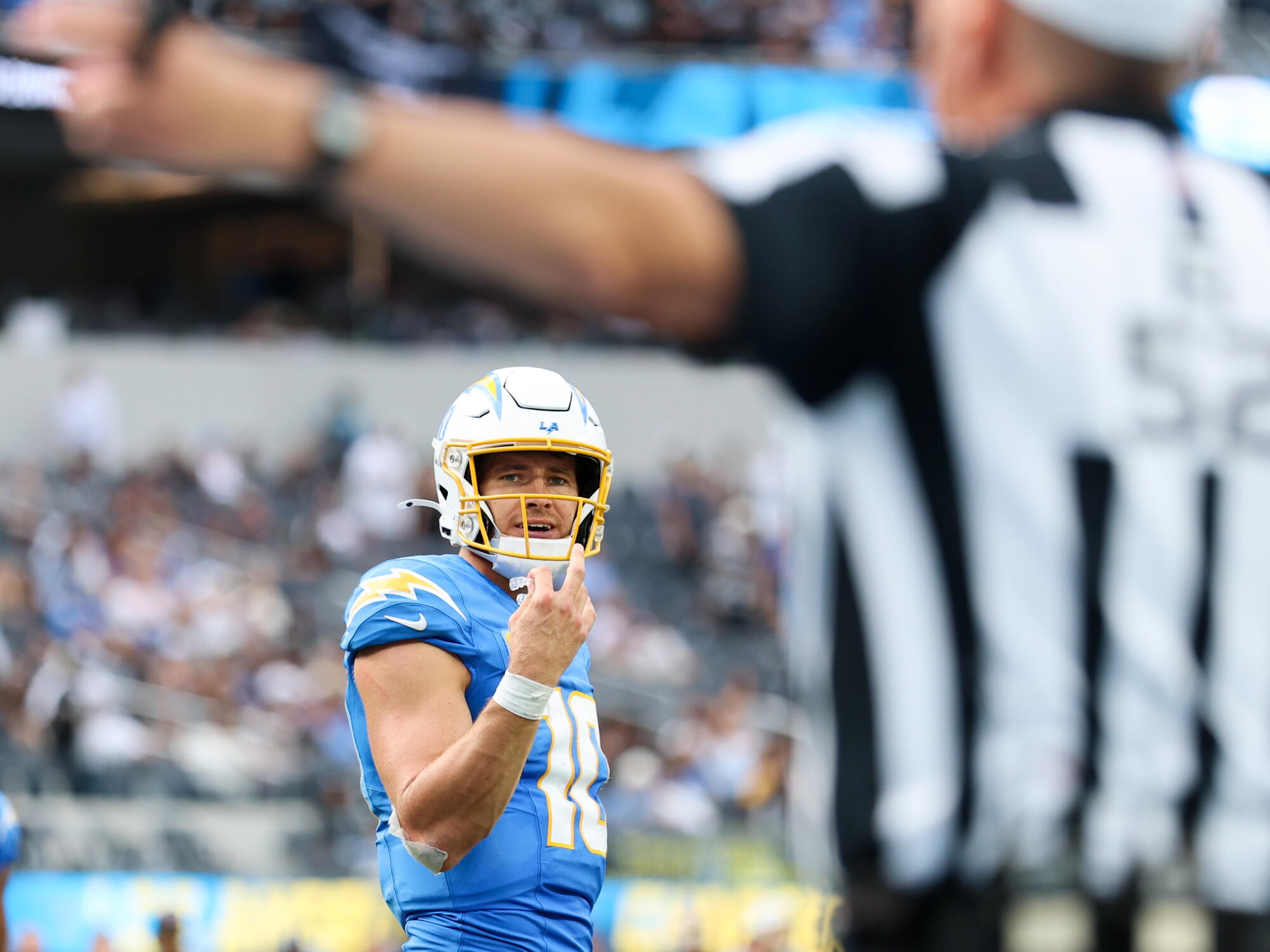
The normally stoic Herbert couldn’t hide his frustration. He appeared to angrily yell before retreating to the home sideline.
Chargers quarterback Justin Herbert reacts after an offensive holding penalty on Joe Alt results in a safety late in the fourth quarter Sunday against the Raiders.
(Allen J. Schaben / Los Angeles Times)
Later, with slightly less than four minutes remaining, when the Chargers seemingly had a bit of momentum. They had just gotten a first down on a Raiders penalty — 12 men on defense — and had inched across the 50.
Herbert handed off to Hampton on a draw, and the second-year back was met by linebacker Nakobe Dean and promptly fumbled — one of six on the day for the Chargers. Safety Jeremy Chinn scooped up the ball and returned it 43 yards to the 16.
The final insult came on the Chargers’ last possession when Alt drew a holding penalty while trying to stop pass rusher Maxx Crosby, resulting in a safety.
Raiders fans at SoFi Stadium erupted in glee. For the Chargers, that singsong, taunting “Raiii-derrrs” chant will surely haunt their dreams. The TV cameras didn’t help matters, finding a lone Chargers fan amid an ocean of Raiders fans, a blue dot bobbing in a silver-and-black sea.
Three plays later, Kirk Cousins found Cody White with an 11-yard pass, the second touchdown of the day for the erstwhile practice-squad receiver.
The Chargers took a 14-10 lead midway through the third quarter when Herbert connected with tight end Oronde Gadsden II for a 10-yard touchdown.
But the Raiders responded on the ensuing possession when Cousins threw a 13-yard touchdown pass to White to put Las Vegas up, 17-14.
A key play in that drive showed the creativity of Klint Kubiak, in his first season as coach of the Raiders. Cousins took the snap and pitched the ball to Ashton Jeanty, who in turn threw it back to Cousins.
The quarterback then hit a wide-open Dareke Young for a 27-yard gain, giving the Raiders the ball deep in Chargers territory.
The Raiders led at halftime, 10-7, breaking a tie with four seconds remaining in the second quarter when Matt Gay kicked a 59-yard field goal.
Both teams struggled to find an offensive rhythm in the first half, and each quarterback was picked off.
The Raiders scored first on a 40-yard touchdown reception by Tre Tucker, who was so wide open behind the defense he was able to turn and wait for the ball to arrive.
The Chargers answered in the second quarter when Hampton pounded across the goal line from the one.
That’s something the Raiders failed to do at the end of the opening quarter, when they had a first-and-goal from the four, yet couldn’t score on four consecutive Jeanty runs.
The Chargers had a similarly frustrating moment in the first quarter when Herbert found tight end David Njoku behind the Las Vegas defense and delivered the ball for what should have been a big gain.
Njoku bobbled the pass, however, and the ball was grabbed by rookie safety Hezekiah Masses, who had another pick in the fourth quarter during his first career start.
Making matters worse, Njoku suffered a knee injury on the play and did not return.
But the Chargers’ new offensive coordinator knows his unit must show urgency and improvement Sunday against the Las Vegas Raiders after a rude wake-up call in the season opener.
“You have a lot of visions coming to a new team and working on something for months. The vision never looked like that,” McDaniel said of the Chargers’ 26-14 loss to the Arizona Cardinals. “That’s the beautiful thing about football; like life, time spent forecasting [and] visualizing things going a certain way … no one cares about that.
“So, it was a case of humble pie.”
Quarterback Justin Herbert never looked fully comfortable. He completed 17 of 27 passes with 207 yards, one touchdown and one back-breaking interception.
The time-of-possession disparity also played a big role in the loss, with the Cardinals controlling the ball roughly 15 minutes longer.
Herbert knows that can’t happen again.
“It’s another opportunity for us to go play football, to be better, and to put our brand of work out there,” Herbert said. “I don’t think we were happy or content with [the] Week 1 effort. So, we’re doing everything we can to fix it and be better.”
Facing a Maxx Crosby-led Raiders defense that held McDaniel’s former team, the Miami Dolphins, to 13 points in Week 1, the Chargers are focusing on often-overlooked aspects, such as understanding assignments, communicating more clearly, cleaning up penalties and operating as a collective.
“These are elementary things,” McDaniel said.
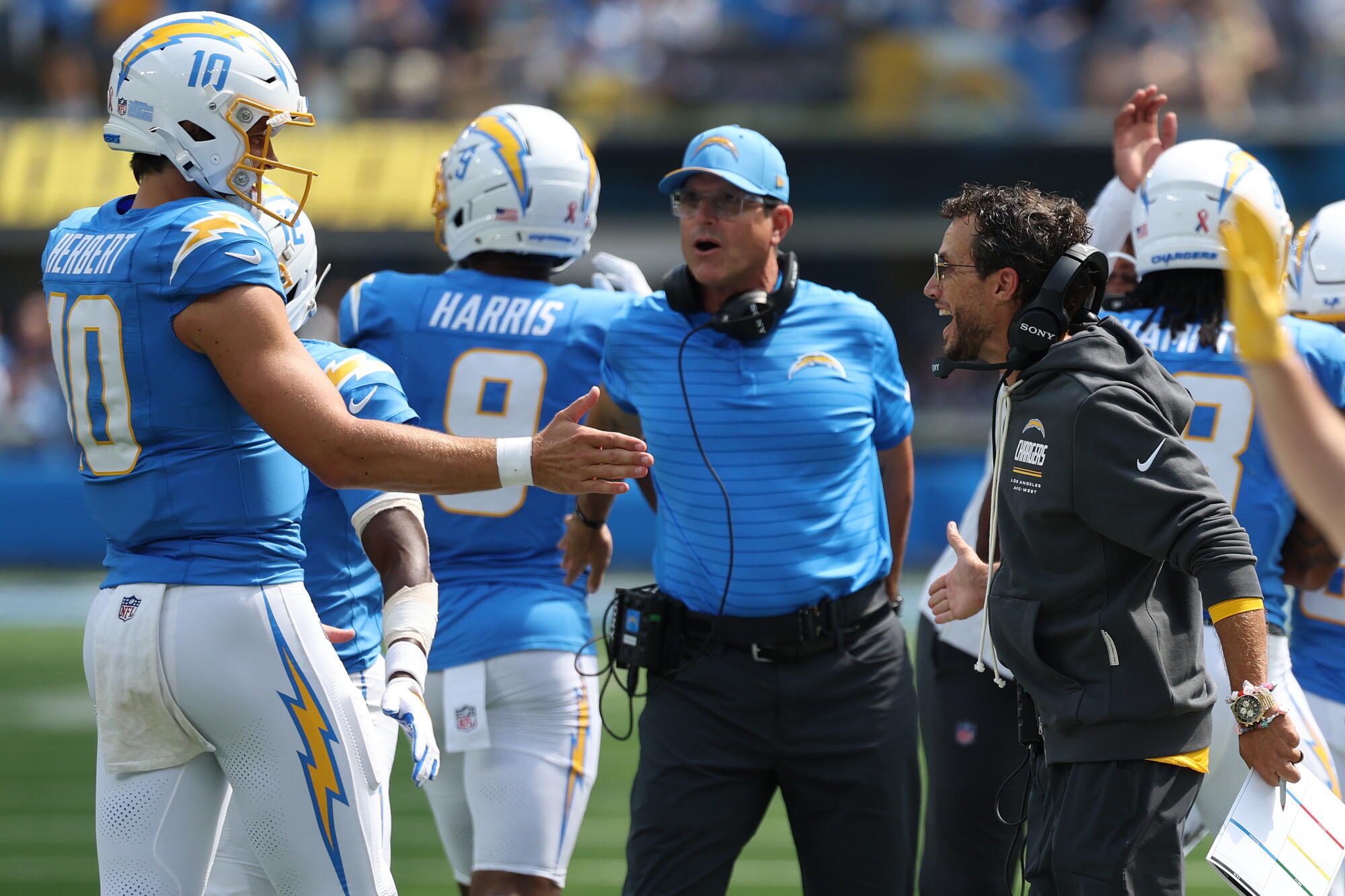
Chargers quarterback Justin Herbert celebrates with coach Jim Harbaugh, center, and offensive coordinator Mike McDaniel after a touchdown against the Cardinals on Sept. 13.
(Harry How / Getty Images)
The offense will need more production from several players, especially if wideout Ladd McConkey, who is questionable to play with a rib injury, is unavailable.
Wide receivers Quentin Johnston and Tre’ Harris, who each saw six targets in Week 1, should see increased involvement, as should speedy rookie Brenen Thompson.
“He’s been really good,” coach Jim Harbaugh said of Thompson. “Great opportunity for him [and a] great challenge.”
Tight end Oronde Gadsden II is another player who could play a key role in a revitalized passing attack.
“I would expect [Gadsden] to be more involved outside of an unforeseen situation where the game and the parameters with which you’re playing change, in which case we’ll address that,” McDaniel said.
Perhaps the most important player to watch Sunday will be Omarion Hampton. The second-year running back had just 12 carries for 43 yards and one touchdown while also losing a fumble against the Cardinals.
“Really just flush [Week 1],” Hampton said about the Chargers’ approach to facing the Raiders. “[And] look at all the stuff we can work on. Come back, regroup as a team, talk about what we need to do to move forward and make it not happen again.
“We all think the same thing … urgent to get how we want to play. That’s really the main thing going on in the locker room.”
Changes also will be apparent on the offensive line.
Trey Pipkins III (knee) won’t play against the Raiders, ending the rotation at left guard, at least for now. And while the team would rather be at full strength, Kayode Awosika — who played well against the Cardinals — will get a chance to prove himself without sharing snaps.
Nonetheless, as McDaniel emphasized, talk of expectations and adjustments don’t matter — it’s what shows up on film that does.
Good thing the Chargers’ new play-caller craves adversity.
“It’s been my favorite week of my employment here,” McDaniel said. “Because — I know [through] my experience in this league — do not measure anything beyond how a group of people handles adversity in the National Football League.
ARLINGTON, Texas — Paige Bueckers scored 19 points, Jessica Shepard had her fifth triple-double of the season with 13 points, 11 rebounds and 12 assists, and the Dallas Wings beat the Sparks 97-77 on Thursday night for their fifth straight victory.
Both teams were returning from the break for the FIBA World Cup in Germany, where Bueckers helped lead the United States to the title.
Dallas (25-16) tied the franchise record for wins in a season set by the 2003 WNBA champion Detroit Shock (25-9). The Wings have three games remaining in the regular season.
Shepard has the third-most triple-doubles in a season in WNBA history, trailing Alyssa Thomas’ six in the 2023 and eight in 2025.
Maddy Siegrist added 12 points and Arike Ogunbowale had 11 for Dallas. Kitija Laksa and Aziaha James each scored 10 off the bench. Odyssey Sims did not play in the fourth quarter after injuring her right knee late in the third.
From Maddie Lee: The trouble started as Dodgers left-hander Blake Snell threw in the Great American Ball Park bullpen before the game.
“I felt good all day, and then the second-to-last pitch of the bullpen, I threw a slider and then I felt it grab,” Snell said of the groin tightness that would later take him out of the Dodgers’ 6-2 loss to the Reds early. “So I was like, ‘Alright, let’s see what we can do.’ ”
Guiding the ball without driving hard off his back leg, Snell’s velocity was down a tick or two through a 19-pitch first inning. He gave up one hit, a single to Sal Stewart, which he quickly erased with a successful pick-off that caught Stewart in an inning-ending run-down.
“I was going to try to get through five [innings],” he said, “but I just knew I didn’t really have a good shot at doing that and remaining healthy.”
In a conversation with manager Dave Roberts, pitching coach Mark Prior and head athletic trainer Thomas Alberts, they all agreed the best course of action would be to pull Snell from the game. Right-handed reliever Blake Treinen replaced him in the second inning.
With only 10 games left in the season, it’s unclear when Snell will be ready to pitch again.
“The next couple days are really going to decide,” Snell said. “But I’d love to throw on my next [scheduled start day]. Either there or a couple days after. But definitely, I want to try to get one more in the regular season.”
Get the latest on L.A.’s teams in the daily Sports Report newsletter.
By continuing, you agree to our Terms of Service, which include arbitration and a class action waiver. You agree that we and our third-party vendors may collect and use your information, including through cookies, pixels and similar technologies, for the purposes set forth in our Privacy Policy such as personalizing your experience and ads.
USC’s Trent Mosley to miss Rutgers game
From Ryan Kartje: Trent Mosley, USC’s rising star freshman receiver, will miss this week’s Big Ten opener against Rutgers and could be out an extended period of time after suffering an injury during the Trojans’ Week 2 win over Louisiana.
USC coach Lincoln Riley said that he doesn’t expect Mosley to be out “extremely long term,” but that any timeline for his return was “still a little inconclusive … depending on how he responds.”
Riley didn’t offer any details on the nature of the injury, but he said that it became clear after USC’s 49-30 win over Louisiana that “there was something we needed to get looked at.” Mosley still spoke to reporters after the game.
From Connor Dullinger: In a bid to pack the Rose Bowl and Pauley Pavilion, tickets to all UCLA home football and men’s and women’s basketball games will be free for undergraduate, graduate and extension students going forward, UCLA athletics announced Wednesday.
Previously, the Bruins had to purchase a Den Pass for $199 to gain access to home football and men’s basketball games. Students who have already purchased the Den Pass for the 2026-2027 academic year will be reimbursed.
“We have an exciting team led by [head football coach] Bob Chesney and a lot of momentum surrounding UCLA Athletics,” new UCLA chief executive and athletic director Tim Harris said in a news release. “Now it’s time for our students to help set the standard. Arrive early. Be loud. Be relentless. We can’t wait to see a sea of Bruin Blue at the Rose Bowl this Saturday.”
The free student tickets are one of many changes Harris has made in an effort to bring new energy to the school’s signature sports that had struggled under previous athletic director Martin Jarmond.
But as coach Sean McVay prepares his team for Monday night’s game against the New York Giants, the Super Bowl-favorite Rams’ suddenly not-so-super offense also demands scrutiny.
Consider: Every starter is back from a unit that in 2025 led the NFL in offense and scoring, including quarterback Matthew Stafford, the reigning NFL most valuable player.
And yet the Rams managed just 190 yards and scored one touchdown in their 27-7 loss to the San Francisco 49ers.
Cal Raleigh had two hits and three RBIs, Josh Naylor had two hits and two RBIs and the Seattle Mariners kept their slim playoff hopes alive with a 7-2 victory over the Angels on Wednesday night.
Randy Arozarena also walked, singled and scored three runs for Seattle, which is 5 1/2 games behind Texas and Houston in the American League West and 6 1/2 games behind the Chicago White Sox for the third AL wild-card spot with nine games left.
It was 2-2 when Angels starter Yusei Kikuchi (1-6) walked Arozarena and Dominic Canzone with one out in the fifth. Raleigh roped an RBI double to left for a 3-2 lead, and Julio Rodriguez was walked intentionally to load the bases.
Ally Sentnor, Ary Borges and Taylor Suarez scored in Angel City’s 3-1 victory over the Seattle Reign on Wednesday night at BMO Stadium.
In the 18th minute, Angel City midfielder Maiara Niehue’s volley attempt drew a handball on Seattle Reign midfielder Angharad James-Turner. Sentnor converted her second penalty kick in consecutive weeks to open the scoring.
Off a corner kick from defender Evelyn Shores in the 40th minute, an unmarked Borges headed it home to double the lead. Within 30 seconds of subbing on, Suarez raced past multiple defenders and placed it in the side-netting for the 3-0 lead in the 81st minute.
1897 — England’s Joe Lloyd beats Scotland’s Willie Anderson by one stroke to win the U.S. Open in Wheaton, Ill.
1920 — The forerunner of the NFL, the American Professional Football Assn., is founded in an automobile showroom in Canton, Ohio. Twelve teams pay a $100 fee to obtain a franchise.
1938 — Don Budge completes the Grand Slam with a four-set victory over Gene Mako in the U.S. Lawn Tennis Assn. championships.
1954 — Rocky Marciano knocks out Ezzard Charles in the eighth round at Yankee Stadium in New York to retain his world heavyweight title.
1955 — In the first color telecast of a football game by NBC, No. 10 Georgia Tech defeats No. 9 Miami 14-6 in Atlanta. The winning score comes in the final minute when linebacker Jimmy Morris returns an interception 25 yards for a touchdown.
1961 — The Minnesota Vikings, the newest NFL franchise, beats the league’s oldest franchise, the Chicago Bears, 37-13 win in the season opener. Minnesota’s Fran Tarkenton, playing his first NFL game, comes off the bench to become the only quarterback to throw four touchdown passes in his first game.
1966 — In his head coaching debut, coach Joe Paterno leads Penn State past Maryland 15-7.
1967 — Johnny Unitas of the Baltimore Colts passes for 401 yards and two touchdowns in a 38-31 victory over the Atlanta Falcons.
1977 — The U.S. wins the Ryder Cup 12½-7½ at Royal Lytham & St Annes England. It’s the last time that a Britain and Ireland team competes for the Ryder Cup. The Ryder Cup expands the GB&I to include golfers from all of continental Europe in 1979.
1994 — UNLV receiver Randy Gatewood catches 23 passes for 363 yards and a touchdown in a 48-38 loss to Idaho.
2000 — Dan Marino’s No. 13 jersey is retired by the Miami Dolphins.
2002 — Suzy Whaley becomes the first woman to qualify for a PGA Tour event, earning an exemption to the 2003 Greater Hartford Open by winning a PGA Section Championship. Whaley is also is the first woman to win a Section Championship.
2016 — Cam Pedersen kicks a 37-yard field as time expired and North Dakota State of the FC, rallies to beat No. 13 Iowa 23-21 for its sixth straight win over an FBS opponent.
Compiled by the Associated Press
This day in baseball history
1912 — Brooklyn’s Casey Stengel makes his major league debut against the Pittsburgh Pirates, finishing with four singles, two RBIs and two steals in a 7-3 win.
1920 — Bobby Veach of the Detroit Tigers hit for the cycle in a 14-13 12-inning win over the Boston Red Sox at Navin Field. Veach had six hits, achieving the cycle with a double in the ninth.
1930 — Cleveland’s Earl Averill drove in eight runs with three consecutive home runs to lead the Indians to a 13-7 victory over the Washington Senators in a doubleheader opener. Averill added another homer in the nightcap, setting an American League record with 11 RBIs in a doubleheader.
1941 — Stan Musial makes his major league debut.
1947 — Jackie Robinson named Rookie of the Year by The Sporting News.
1968 — Gaylord Perry of the San Francisco Giants pitched a no-hitter, a 1-0 victory over the St. Louis Cardinals and Bob Gibson. Ron Hunt homered for the only run.
1984 — Reggie Jackson became the 13th player to hit 500 home runs. The milestone shot came off Kansas City pitcher Bud Black. His homer came exactly 17 years after his first career hit.
1984 — Rookie pitcher Dwight Gooden of the New York Mets struck out 16 Phillies in a 2-1 loss at Philadelphia. Five days earlier, Gooden fanned 16 Pittsburgh Pirates tying a major league record for 32 strikeouts in two consecutive games.
1988 — Jeff Reardon became the first pitcher to save 40 games in both leagues as the Minnesota Twins beat the Chicago White Sox 3-1. Reardon, who saved 42 games for the Montreal Expos in 1985, pitched the ninth inning for his 40th save in 47 opportunities.
1996 — Hideo Nomo pitched a no-hitter against the Colorado Rockies, leading the Dodgers to a 9-0 victory. Nomo walked four batters and struck out eight.
2004 — San Francisco’s Barry Bonds hit the 700th home run of his career, joining Babe Ruth (714) and Hank Aaron (755) as the only players to reach the milestone. Bonds connected in the third inning at home, a 392-foot solo shot to left-center. San Francisco beat San Diego 4-1.
2004 — Seattle’s Ichiro Suzuki broke Lloyd Waner’s season record for singles with his 199th in a 6-3 win over Oakland. Suzuki’s two hits gave him 235 for the season, 22 shy of the major league record set by George Sisler of the St. Louis Browns in 1920.
2008 — Seattle’s Ichiro Suzuki matched Willie Keeler’s major league record of eight straight 200-hit seasons, beating out an infield single in the eighth inning for his third hit against Kansas City.
2018 — Christian Yelich became the first major leaguer to hit for the cycle twice in one season against the same team, driving in four runs to lead the Milwaukee Brewers over the Cincinnati Reds 8-0.
2024 — With a stolen base in the 1st inning, Bobby Witt Jr. becomes the first shortstop to have more than one 30-30 season, as he now has 30 steals and 32 homers; he also just the 8th player to accomplish the feat in consecutive seasons.
Compiled by the Associated Press
Until next time…
That concludes today’s newsletter. If you have any feedback, ideas for improvement or things you’d like to see, email me at houston.mitchell@latimes.com. To get this newsletter in your inbox, click here.
Cal Raleigh had two hits and three RBIs, Josh Naylor had two hits and two RBIs and the Seattle Mariners kept their slim playoff hopes alive with a 7-2 victory over the Angels on Wednesday night.
Randy Arozarena also walked, singled and scored three runs for Seattle, which is 5 1/2 games behind Texas and Houston in the American League West and 6 1/2 games behind the Chicago White Sox for the third AL wild-card spot with nine games left.
It was 2-2 when Angels starter Yusei Kikuchi (1-6) walked Arozarena and Dominic Canzone with one out in the fifth. Raleigh roped an RBI double to left for a 3-2 lead, and Julio Rodriguez was walked intentionally to load the bases.
Angels first baseman Vaughn Grissom made a sliding, backhand stop of Naylor’s potential double-play grounder, but his throw to second sailed into left field for an error, two runs scoring on the play for a 5-2 Seattle lead.
Mariners reliever Carlos Vargas (1-0) struck out Josh Lowe and Christian Moore — each on three pitches — with the bases loaded to end the bottom of the fifth, and Seattle pushed the lead to 7-2 on RBI singles by Canzone and Raleigh in the sixth.
Kikuchi threw 37 pitches during a two-run, three-hit first in which the Mariners scored on Raleigh’s sacrifice fly and Naylor’s RBI single.
WASHINGTON — Gov. Gavin Newsom said he would not run for the Democratic presidential nomination in 2028 if Kamala Harris does so, appearing to offer deference to the former vice president ahead of a race that could draw a historically crowded field of candidates.
“I wouldn’t run if she ran,” Newsom told CNN’s Jake Tapperin an interview posted Monday. “Why would I? I wouldn’t do that to her. … I wouldn’t do it to you, I wouldn’t waste everyone’s time.”
Newsom appeared to acknowledge a desire to avoid the possibly messy fight for California backers that could ensue if both were to run, saying there would be “pure crossover” between Harris’ supporters and his.
The governor’s effective yield to Harris diminishes the possibility of a showdown between two of California’s most powerful political figures in an election whose stakes are viewed by the Democratic Party as existential. The possibility of Harris making a second attempt at the presidency after her loss to President Trump in 2024 has hung as the biggest question over the potential Democratic field.
Both Newsom and Harris have acknowledged they are considering presidential bids in 2028, but Harris has closely held her intentions. She said last week that she had not decided whether to run, telling former soccer player Megan Rapinoe in a podcast interview that she was focused on working full time to help Democrats win the midterms.
A spokesperson for Harris declined to comment. Representatives for Newsom did not immediately respond to a request Monday afternoon.
Harris has appeared as the party front-runner in multiple polls about 2028, including one in July that showed herbeating Newsom by double digits. But questions have continually circulated within the party about whether voters who are scarred from the party’s 2024 loss would be enthusiastic about a Harris run.
Several California donorstold The Times in May that they did not plan to support Harris or did not want to discuss a possible bid by her; in a few corners, more enthusiasm came through for Newsom.
The dynamics around the 2028 Democratic primary continue to evolve as party hopefuls jockey for the spotlight, and they shifted notably with the selection of South Carolina as the party’s first primary state. That choice could give Harris a boost if South Carolina’s Black voters move in her favor.
Harris and Newsom came up in politics in the same era and have never before run in an election against each other, operating their political careers largely in parallel rather than in competition. In February, Newsomsaid on CNN that he had “never gotten in the way of her ambition” and he didn’t “imagine I would in the future,” saying “fate” would determine whether they ran against each other.
Newsom swung through South Carolina this month, the type of move generally interpreted as laying the groundwork for a presidential bid. In the CNN interview, Newsom noted that he did not know whether Harris would run and agreed it was a “pretty good case” to make when Tapper raised the argument that Harris had had her chance at the presidency and Newsom had not yet.
The governor suggested that a fight between him and Harris would split their supporters’ vote in a way that would be “a gift from God for everybody else” in the race, saying “it services no greater good” for both of them to run. He also nodded to their overlapping political circles.
“I know her base of supporters, I know her friends. The [Venn] diagram on that is just pure crossover,” Newsom said. “I wouldn’t do that.”
The interview was filmed in Montana, where Newsom’s in-laws own a ranch, as Newsom and Tapper fly-fished together. The full segment was set to air Tuesday.
Newsom said that in order to decide to run, a candidate needs to be able to “meet the moment.”
“You gotta be honest with yourself,” he said. “Do you represent the zeitgeist of the moment or are you wasting everybody’s time?”
Alison Hammond looked incredible as she showed off her 13 stone weight loss in a glam gown during London Fashion WeekCredit: GettyAlison looked sensational in her purple sequinned gownCredit: Getty
Alison looked sensational as she posed backstage ahead of the Vin + Omi “Anarchy” show during London Fashion Week.
The TV presenter was seen in a purple sequinned gown as she stared moodily at the camera.
Sign up for the Showbiz newsletter
Thank you!
With full glam makeup and voluminous hair, Alison looked absolutely fabulous.
The TV presenter was seen in a purple sequinned gown as she stared moodily at the cameraCredit: GettyAlison is known for presenting ‘This Morning’ TV showCredit: Shutterstock EditorialAlison, who is mum to Aidan, 21, works out three to five times a weekCredit: AlamyHer astonishing weight loss is actually the result of a gym routine, a toyboy boyfriend and a £2.85 supermarket secretCredit: Getty
Former newsreader and Strictly Come Dancing star Katie Derham is hosting the BBC Proms
Katie Derham has opened up on her grief(Image: Getty Images)
BBC host Katie Derham received a marriage proposal on a first date.
The former Strictly Come Dancing star is a former ITV news presenter but in 2010 she announced she was returning to the BBC where she started her career as a researcher.
Since then she’s worked extensively across radio and she was one of the contestants on Strictly Come Dancing in 2015 when she was partnered with Anton Du Beke and impressed both the judges and viewers, topping the leaderboard and making it through to the final. She returned for the Christmas special two years later which she won with Brendan Cole.
As she teams up with Celebrity Traitors star Nick Mohammed to present the BBC’s Last Night of the Proms on Saturday, September 12, which will feature a Dolly Parton tribute, we take a look at her life offscreen.
Katie Derham’s heartbreak
Katie, who was born in Kent, is now 56 and she admits that her last birthday was a poignant moment for her because her mother Margaret was the same age when she was diagnosed with early onset Alzheimer’s.
Margaret died aged just 61, from complications of pancreatitis. Opening up to HELLO! magazine’s Second Act podcast Katie said: “I’ve stopped being quite so angry (over her death) as I was for many years. She never met my second daughter, and she had such a bright and interesting mind.”
She added: “It seems particularly cruel. She was 61 when she died – that’s nothing is it?” Katie also spoke about how she felt she had to “step up” and be the “mother of the family” after Margaret died.
The mother-of-two continued: “I don’t know how she (Margaret) responded to the menopause, I don’t know what she was like as a young grandma – I don’t know what she was like as an older grandma.”
Marriage proposal
Katie met her husband, John Vincent, now the chief executive and co-founder of fast food chain Leon Restaurants, when he caught her gatecrashing the Cambridge University May Ball – and proposed to her.
“It sounds so bad now, in retrospect. But with a big smile and a big twinkle, he said “Well, you know, give me a snog and I won’t throw you out,” she revealed to HELLO!
“It did make me laugh. And we spent the night dancing around, but I thought (proposing) was a joke, I genuinely never thought I’d see him again. But he told his mum and dad ‘I met this girl at this ball and I’m pretty sure I’m going to marry her.’”
They met up again when John took the plunge and called the BBC switchboard during her shift as a financial news researcher in 1992. They went on to marry seven years later and they are the proud parents of two daughters.
Last Night of the Proms: The Finale is on BBC One on Saturday, September 12 from 9pm
MELBOURNE — The Rams arrived here as the star-studded favorite to win Super Bowl LXI at SoFi Stadium.
They left star-crossed, stunned and searching for answers on their long flight back to Los Angeles.
The Rams sleep-walked through much of the season opener against the rival San Francisco 49ers, who sent them to a 27-7 defeat before a sold-out crowd of 100,021 on Friday at Melbourne Cricket Ground, in the first NFL game in Australia.
Coach Sean McVay’s strategy of arriving the day before the game backfired and resulted in a dull performance by a team that features some of the biggest stars in the NFL.
Quarterback Matthew Stafford, the reigning NFL most valuable player, completed only 15 of 25 passes for 155 yards with an interception. With the game out of reach, McVay pulled Stafford late in the fourth quarter and had backup Stetson Bennett lead the Rams’ final possession.
All-Pro receiver Puka Nacua, the NFL leader in catches last season, caught five passes for 74 yards and never broke loose. Davante Adams, who led the NFL in touchdown catches last season, caught only three passes as Raheem Morris, the Rams’ former defensive coordinator, outschemed McVay and his staff.
The additions of All-Pro cornerback Trent McDuffie, record-setting edge rusher Myles Garrett and cornerback Jaylen Watson were supposed to supercharge the Rams’ defense.
Rams defensive end Myles Garrett sits on the bench late in the fourth quarter during a 27-7 loss to the 49ers on Friday.
(Doug Benc / Associated Press)
But 49ers quarterback Brock Purdy passed for three touchdowns, and the Rams recorded no sacks.
It made the decision by 49ers coach Kyle Shanahan to have his team spend a week in Melbourne to acclimate the correct one.
Shanahan, McVay’s friend/mentor/nemesis, had bristled at the fact that the 49ers were chosen as the Rams’ opponent because it took away the ability of 49ers fans to descend onto SoFi Stadium.
Shanahan also wasn’t happy that the Rams’ next game is Sept. 21 on “Monday Night Football,” while the 49ers are playing on Sept. 20. Add in the fact that the 49ers also must play in Mexico in November, and there was plenty of motivation beyond the game itself.
The Rams trailed, 10-7, at halftime after managing a five-yard touchdown run by Kyren Williams and not much else.
Rams wide receiver Davante Adams attempts to catch a pass in the fourth quarter against the 49ers.
(Robert Cianflone / Getty Images)
The 49ers wasted no time extending their advantage, taking the opening possession of the second half and moving down the field on Christian McCaffrey runs and a Purdy pass to Demarcus Robinson, whose 39-yard touchdown in the second quarter had given them the lead. Purdy capped the drive by lofting a two-yard touchdown pass to Mike Evans for a 17-7 edge.
And the Rams’ offense finally woke up.
Stafford connected with tight end Davis Allen, Nacua and Adams and tight end Colby Parkinson as the Rams moved to the 49ers’ two-yard line. However, after a one-yard catch by Nacua, the 49ers stuffed Stafford’s sneak attempt.
The 49ers capitalized, marching 99 yards in 11 plays, with Purdy capping the drive on a 15-yard touchdown pass to Deebo Samuel for a 24-7 lead.
The Rams could not mount a comeback.
Tight end Tyler Higbee fumbled after catching a pass with 11:08 left, and the 49ers added a field goal to extend the lead to 20 points.
WASHINGTON — An appeals court on Thursday upheld a block on President Trump’s executive order limiting mail voting, a decision that comes as the Supreme Court considers the same case and states have already started sending out ballots for the high-stakes midterm elections.
The three-judge panel refused to lift a preliminary injunction against the order issued last week by U.S. District Judge Indira Talwani. It prohibits the U.S. Postal Service from implementing Trump’s directive. The Postal Service has said it would not deliver ballots from states that did not pre-clear their envelope design with the federal government and submit a list of voters to an online portal, which has yet to be activated.
Election officials warn that it’s impossible to comply with those terms, especially with the first mail ballots already being sent out in Alabama, North Carolina and Wisconsin.
The panel of three judges nominated by former President Biden agreed with the plaintiffs that the president does not have the power to regulate states’ election policy.
“Appellants have not made a strong showing that the district court erred in determining that the Final Rule is likely unlawful,” they wrote, a reference to a rule published by the Postal Service to implement Trump’s order.
The panel wrote that the Trump administration had done little to dispel arguments by many election officials that the changes would bring “chaos and widespread disenfranchisement.”
“Indeed, appellants have not even seriously challenged this aspect of the district court’s ruling, much less demonstrated why it is clearly erroneous,” the order states.
The government also hasn’t shown evidence of past fraud to justify the restrictions, the judges said.
A request for comment from the White House was not immediately returned.
The panel’s decision comes even as the Supreme Court is already considering the same case, which is part of a frenzied legal rush as states are beginning to send out mail ballots for this fall’s midterm elections. Democrats and civil rights groups in a separate lawsuit in Washington, D.C., also are trying to halt the executive order.
The 1st Circuit also had upheld a previous hold Talwani placed on the executive order. But that ruling was lifted by the Supreme Court in a procedural decision that did not determine whether the plan was constitutional.
The plaintiffs swiftly filed new lawsuits after the Postal Service finalized its rule governing mail ballots.
Riccardi and Whitehurst write for the Associated Press.
PITTSBURGH — Jared Jones pitched six strong innings, Jake Mangum had an RBI double in the second inning and the Pittsburgh Pirates beat the skidding Angels 1-0 on Friday night.
The MLB-worst Angels (53-88) lost for the 10th time in 11 games. The Pirates have won five of six games.
Jones (3-6) blanked the Angels on three hits to win for the first time in eight starts since beating Cleveland on July 18. He struck out nine, walked one, and threw 63 of 91 pitches for strikes.
Wilber Dotel pitched two innings, and Mason Montgomery worked the ninth to complete the four-hitter and the Pirates’ ninth shutout of the season. Montgomery had his ninth save.
Ryan Johnson (3-8) was the hard-luck loser, giving up one run and four hits over six innings with six strikeouts and two walks. He has a 1.67 ERA in his last six starts and has given up zero or one run in five of those outings.
Prized rookie shortstop Konnor Griffin returned from the injured list for the Pirates and made an immediate impact when he scored the lone run from first base on Mangum’s one-out double to right field in the second inning.
Griffin had been sidelined since July 6 after undergoing surgery to repair a torn tendon in his left ring finger. The Pirates signed the 20-year-old to a nine-year, $140-million contract, the richest in franchise history, in April.
The Angels hit back-to-back singles to open the top of the second, but Jones got Christian Moore to foul out, then struck out Jose Siri and Adam Frazier. The Halos have been shut out 12 times.
Up next: Angels LHP Yusei Kikuchi (0-5, 5.65 ERA) faces RHP Braxton Ashcraft (14-5, 3.59) on Saturday night in the middle game of the series.
Yoshinobu Yamamoto was flawless over his first five innings in the Dodgers’ 8-6 loss to the St. Louis Cardinals on Wednesday, giving up no hits with seven strikeouts and one walk.
“It comes down to starting pitching,” Roberts said pregame, after his team gave up 13 runs in a loss Tuesday. “And obviously it’s a young, hungry team out there. Came out last night swinging the bats, so it’d be nice to put up a zero, get a lead, and go from there.”
Roberts’ wish appeared granted, as the Dodgers led 3-0 in the first after Freddie Freeman ended his career-long 47-game homer drought with a three-run blast against Cardinals lefty Brycen Mautz.
But the once-cruising ace encountered turbulence. He later gave up a pair of two-run homers, with the Cardinals’ Thomas Saggese launching the first in the sixth and Leo Bernal the second in the eighth.
“[Tuesday] night I really liked the way we just kind of fought, saw some different arms, got the closer up, and things to build on,” Roberts said pregame.
On Wednesday, not even a Mookie Betts two-run homer in the seventh could lift the Dodgers (82-57) to a win.
Yamamoto’s night was done after seven innings. He threw 93 pitches, had eight strikeouts and gave up five hits, two walks and four runs, a few mistakes away from a completely different outing.
Tanner Scott stepped in for Yamamoto in the eighth, allowing a Joshua Báez double three pitches in. And after Ivan Herrera moved Báez to third via a groundout, Alec Burleson tied the score at five with a sacrifice fly to right.
Jack Dreyer kept things stable with a clean ninth. However, in the 10th, Brock Stewart (0-2) uninspiringly gave up three runs. Orange County native Nathan Church got the Cardinals’ wheels turning iwith a single up the middle, advancing José Fermin to third. Saggese delivering the go-ahead run on an infield single. One pitch later, Báez put the game out of reach with a two-run double
The Dodgers could only get one run back in the bottom of the miserable 10th.
CT3 comes home
Chris Taylor, his wife Mary and son Theo watch a video tribute to his career before the start of Wednesday’s game.
(Ronaldo Bolanos / Los Angeles Times)
The Dodgers welcomed back former longtime utility player Chris Taylor to Dodger Stadium and presented him with a video tribute and his third World Series ring.
“It’s pretty much what I identify my career as — over 90% of my entire career was in Dodger Blue,” Taylor said. “This is the place I call home. Always proud to be a Dodger, and it means a lot to me that they would do this for me. So, I’m extremely humbled.”
Taylor, a 12-year veteran who retired earlier this season, said Wednesday night was the first time he was able to watch a game with his family.
Injury Updates
Shohei Ohtani reacts after striking out in 10th inning Wednesday.
(Ronaldo Bolanos/Los Angeles Times)
Roberts said the plan is still for Shohei Ohtani to return to pitching this season. However, there is no timetable for when he’ll throw his next bullpen session, and shutting down Ohtani as a pitcher remains a distant possibility.
“We’re not there quite yet, but it’s certainly an option,” Roberts said.
Roberts also shed light on some of the work Ohtani’s doing to get back on the mound.
“He’s doing plyos,” Roberts said. “He does that a handful of times a week. … That’s kind of where we’re at right now.”
Will Smith was given a breather after going one for five with two RBIs in his first game back from a three-month stint on the IL on Tuesday.
“It was good to see him get a knock,” Roberts said. “I thought he swung the bat pretty well. So, it’s a premeditated day off today. He’ll be back in there tomorrow, but I guess no news is good news.”
It wasn’t a full day off, as Smith pinch-hit for Hunter Feduccia in the ninth and scored the Dodgers’ run in the 10th.
Rōki Sasaki’s blister is healing as planned, and he shouldn’t miss additional time.
“I saw him yesterday at the end of the bench; it’s healing well,” Roberts said. “He’s still moving his arm, playing catch. So I think it’s going to be a shorter term getting him back.”
Roberts doesn’t yet know whether Sasaki will take a spot in the bullpen or rotation upon his return.
Gavin Stone could potentially pitch in September, according to Roberts.
“Gavin’s been good,” Roberts said. “I think right now — and again, this is not talking to the guys in the, you know, player development — but it’s more of just getting him to stay upright, stay healthy, is the win for 2026.”
The Dodgers’ August woes followed them into the first day of September.
Roster expansion, returning three players from the injured list, the mental relief of turning the calendar page — none of that gave the Dodgers the boost they needed against the Cardinals on Tuesday.
Instead, the Dodgers lost 13-8 to a team that entered the day 4 ½ games out of the last National League wild-card spot.
“I just think tonight we just got behind the eight ball,” manager Dave Roberts said.
During the Dodgers’ past seven series (following a high-scoring trip to Chicago), their rotation has recorded a top-five ERA (2.97) in the majors. But on Tuesday, left-hander Eric Lauer coughed up seven runs in three innings.
Dodgers second baseman Alex Freeland chases the ball as the Cardinals’ Nathan Church hits an RBI in the third inning Tuesday at Dodger Stadium.
(Robert Gauthier/Los Angeles Times)
It was a personal outlier as well in Lauer’s time with the Dodgers. Lauer had given up more than three runs in just two other outings since the Dodgers acquired him from the Blue Jays in mid-May, and Tuesday marked his shortest start.
“I felt good warming up, felt good in the bullpen, then got out there and kind of just lost it,” Lauer said. “And you know it’s one of those things where you try to make adjustments and you try to work on things between, and I think I might have been just tinkering a little too much in between and getting outside of myself. So I think really just focusing on what I do well and repeating that and not trying to get too fancy and getting back to the basics is really all I can do.”
The Dodgers had briefly moved Lauer from the rotation into the bullpen, but he reclaimed his starting role when right-hander Roki Sasaki landed on the IL last week with a blister on his right middle finger.
Lauer’s start Tuesday began to go downhill in the second inning when he gave up back-to-back solo homers to Ramón Urias and Thomas Saggese with two outs.
Those two runs could have been quickly forgotten if Lauer had gotten back on track. The next inning, however, he surrendered five runs as the Cardinals kept chipping away with five singles, a hit batter, a walk and a sacrifice fly.
The Dodgers struck back in the bottom half of the inning — but not exactly with authority.
Mookie Betts’ bases-clearing double was assisted by a Cardinals defensive miscue. Right fielder Jordan Walker and second baseman José Fermín both raced after Betts’ shallow fly. As Fermín dashed back, Walker slid to attempt the catch — and took out Fermín’s feet from under him.
The ball fell to the ground. With two outs, Dodgers baserunners were going on contact and all three crossed the plate before Cardinals first baseman Alec Burleson could retrieve the ball and throw it.
Betts’ bat stayed hot. And he contributed another RBI double in the fifth — this one smoked up the left-field line to drive in one run. But it didn’t do much to put a dent in the Cardinals’ lead.
The Cardinals continued to tack on against the Dodgers’ bullpen, powered by three more home runs, off right-hander Seth Halvorsen, lefty Alex Vesia and lefty Justin Wrobleski, fresh off the injured list.
Dodgers utility player Kiké Hernández pitches during the ninth inning of a blowout loss to the Cardinals at Dodger Stadium on Tuesday.
(Robert Gauthier/Los Angeles Times)
Catcher Will Smith, who the Dodgers also activated from the IL Tuesday, put the ball in the air in his first four at-bats and was finally rewarded in the seventh inning with an RBI double. He drove in another run in the ninth, grounding into a fielder’s choice with the bases loaded, as part of a three-run last-ditch rally.
“I think that there were some positives with the at-bats,” Roberts said. “I liked some of the swings. I like taking walks when given to us. I like being able to push and runs across.”
All four players who the Dodgers activated on Tuesday appeared in the game. In addition to Smith and Wrobleski, second baseman Alex Freeland (recalled from triple A) started the game, and Dalton Rushing (reinstated from the IL) struck out in his lone pinch-hit at-bat. Rushing will provide a left-handed bat off the bench until he’s graduated from his throwing program and built up on the defensive side.
The score was so lopsided by the ninth inning that utility player Kiké Hernández took the mound to finish the game — but without his signature pitching helmet.
Zack Wheeler gave up one run in six strong innings, Edmundo Sosa hit a tiebreaking homer in the seventh and the visiting Philadelphia Phillies completed a three-game sweep with a 5-2 win over the Angels on Sunday.
Sosa, whose pinch-hit grand slam in the ninth gave Philadelphia a 5-3 win Friday night, led off the seventh with a solo shot off Angels starter Yusei Kikuchi (0-5) to give the Phillies a 2-1 lead.
The Phillies added two insurance runs in the eighth on Luis Arraez’s pinch-hit sacrifice fly and Brandon Marsh’s pinch-hit RBI single for a 4-1 lead. Bryce Harper added an RBI double in the ninth for a 5-1 lead.
Alex McFarlane threw a scoreless seventh and Orion Kerkering gave up a run on Mike Trout’s ninth-inning RBI double while recording the final four outs for his second save.
The Phillies won for the 13th time in 15 games. The Angels have lost seven straight, matching their longest losing streak of the season.
Wheeler (11-5) allowed four hits, struck out six and walked three to outduel Kikuchi, who gave up two runs and six hits in seven innings, striking out six and walking one.
Wheeler went 0-3 with an 8.38 ERA in his previous four games and appeared headed for another shaky start when he walked Wade Meckler, hit Trout with a pitch and gave up a single to Vaughn Grissom to load the bases with no outs in the first.
But Wheeler got Moisés Ballesteros to ground into a run-scoring double play and struck out Christian Moore on three pitches to start a 5⅓-inning stretch during which he retired 16 of 19 batters.
J.T. Realmuto hit a solo homer in the third to tie it at 1 for the Phillies.
Before the game, the Angels placed rookie right-hander George Klassen (2-2, 3.67 ERA) on the 15-day injured list because of left lower-back inflammation.
Up next: Angels: RHP Walbert Ureña (8-9, 2.94) will oppose Yankees RHP Elmer Rodriguez (0-2, 4.70) Monday night in Anaheim.
Kyle Schwarber hit a go-ahead RBI double and Trea Turner had a two-run single in the 10th inning in the Philadelphia Phillies’ 4-2 victory over the Angels on Saturday night.
Phillies closer Jhoan Duran (2-4) threw a scoreless ninth and gave up an unearned run in the 10th as Philadelphia won for the 12th time in 14 games. The Angels (52-84) have lost six straight.
The top of the 10th began with automatic runner Brandon Marsh getting thrown out at third on J.T. Realmuto’s grounder to short off Angels reliever Trevor Martin (0-1). Justin Crawford singled, advancing Realmuto to third.
Schwarber blooped an RBI single to left-center for a 2-1 lead, Crawford taking third and Schwarber second on the throw. Turner squibbed a grounder through the right side of a drawn-in infield for a two-run single and a 4-1 lead.
Angels shortstop Zach Neto capped a 12-pitch at-bat in the eighth with a solo homer off Phillies reliever Jonathan Bowlan, tying the score 1-all and snapping a string of 30 consecutive innings without an extra-base hit for the Angels.
Neto’s 23rd homer spoiled a superb start by Phillies left-hander Cristopher Sánchez, who allowed two hits, struck out eight–bringing his season total to 202–and walked one in seven innings to lower his ERA to 2.52.
The Phillies (76-60) blew a chance to tack on to a 1-0 lead in the eighth, an inning that began with a Turner single and stolen base and a Harper walk. Turner was caught off the second-base bag and picked off.
Harper took second and third on a wild pitch, but Luis Arraez grounded to first, Harper holding. Harper was called safe on a daring steal of home off Martin, but the call was overturned by replay, ending the inning.
Angels starter Ryan Johnson managed to give up one run in five innings despite issuing four of his five walks and throwing 60 of his 88 pitches in the first two innings. The Phillies took a 1-0 lead in the second when Alex Bohm singled, Bryson Stott walked and Marsh hit an RBI single.
Up next: Phillies RHP Zack Wheeler (10-5, 3.40 ERA) was set to face Angels LHP Yusei Kikuchi (0-4, 6.25) on Sunday in the series finale.
ABBY Lee Miller showed off her incredible figure in a black swimsuit as she enjoyed a trip away this week.
The Dance Moms star, 60, was soaking up the sun in Long Island, New York, and took to Instagram to share snaps from the trip with her fans.
Abby Lee Miller looked incredible as she posed poolside this week for new snapsCredit: Instagram/therealabbyleeThe star enjoyed cocktails by the pool as she was staying in Long IslandCredit: Instagram/therealabbylee
Staying at the four-star Hotel Indigo, Abby beamed for the camera as she took a dip in the pool in a black one-piece swimsuit.
She matched the swimwear with statement gold jewellery and had her brunette tresses styled into a bouncy blowdry.
Sign up for the Showbiz newsletter
Thank you!
Sipping on a mocktail, Abby posed for several poolside shots.
She later added a butter yellow beach coverup over her bathing suit while relaxing by the pool.
Abby rose to fame in 2011 on Dance MomsCredit: GettyShe has been rocking an incredible new look over recent yearsCredit: Instagram/therealabbylee
Abby captioned her post: “Couldn’t have asked for a better spot to stay while I was on Long Island this summer! 🌊☀️
“@indigoeastend was not only beautiful, but the perfect place to relax and enjoy all the amenities, from the pool to their fabulous restaurant, @bistro72, with a gorgeous sunset view! Top of the pyramid👏🏼👏🏼“.
Before her health woes, the TV star and dance instructor dropped from a size 24 to a size 16 and has been looking incredible over recent years since becoming cancer-free in 2019.
Abby rose to fame in 2011 when Dance Moms hit screens as the strict dance coach and leading personality of the show.
The series, which launched the careers of stars such as JoJo Siwa, was centred around the young girls who were members of the Abby Lee Dance Company and their mothers, who were also in competition with each other.
Kelvin and Liz Fletcher share the highs and lows of farming on Fletcher’s Family Farm
Kelvin Fletcher said collecting sheep samples was not the easiest job(Image: ITV)
Kelvin and Liz Fletcher shared fears for their Cheshire farm following a heartbreaking loss.
The couple shares the highs and lows of farming in their ITV series, Fletcher’s Family Farm. However, in the latest repeat episode, Kelvin and Liz faced a setback. They also bid a bittersweet farewell to their beloved alpacas as they needed to make space on the farm.
Kelvin Fletcher and Liz welcomed vet Angelica to the farm for a health check on their flock following the death of their beloved pet lamb, Aga.
“It kind of looks a bit chaotic, but this is the smoothest it’s ever happened,” Liz shared when referring to them rounding up the sheep.
Kelvin noted, “We’re improving. It just shows we are improving. With the ewes and lambs separated, it’s time for a not-so-pleasant job of the season.”
“Put your hand up if you want a poo bag,” Kelvin shouted to his kids, who seemed more than enthusiastic about picking up sheep poo.
The former soap star went on to share his fears, “To try to prevent losing any lambs, vet Angelica will take the poo samples collected today for testing so we can treat any early signs of infection.”
She explained to Kelvin, “As they grow up, they build some kind of immunity, but lambs are naive to them, and worms are everywhere at pasture, so we need to make sure that they have a good level of exposure when they’re young, which means that they will build up their immune response, but at the same time, the burden is not too high and make them sick. “
Sharing their previous loss, he continued, “We’re taking a belt and braces approach this year, as through the winter worms were a real problem and proved to be fatal for a couple of our lambs, including our beloved Aga. Aga was an orphan lamb, whom we fell in love with, but later lost to a worm infection.”
With all the samples collected, vet Angelica went back to the lab to test the sheep poo.
Luckily for the Fletcher family, the results came back all clear, as he informed viewers, “Angelica has been back in touch with the good news that the worm count isn’t dangerous, but as advised, we still treat them.
“It’s not the easiest job to do, but such an important one, and this time it was such a great team effort. Right, so now it’s that simple chase and getting them back out, back out in the pasture. “
Fletcher’s Family Farm is available to watch on ITVX.
ATLANTA — Dodgers manager Dave Roberts could see the kind of inning right-hander Tyler Glasnow had to begin his start Tuesday, plagued by soft contact and bad luck, derailing a younger version of him.
“That’s an outing that a couple years ago I think might have gotten away,” Roberts said after the Dodgers’ 4-3 loss to the Braves, ending a six-game winning streak. “And I don’t think he would’ve been as efficient getting through the fifth like he did. But there’s just a lot of growth with Glas. Just can’t wait to see more. Like I told him after the start, it’s just really good to have him back.”
Glasnow’s return was a major step for the Dodgers as they assemble their postseason pitching staff. The next will be two-way superstar Shohei Ohtani’s return to pitching — which could happen as soon as this weekend.
Ohtani is scheduled to throw a bullpen session Thursday or Friday, pitching coach Mark Prior said. Then Ohtani and the Dodgers will finalize next steps. But Roberts didn’t rule out the possibility of Ohtani making a short start Sunday in Detroit.
But let’s not get ahead of ourselves.
Tuesday marked Glasnow’s first start since May 6 in Houston, when back spasms cut his outing short after one inning. He’d been pitching so well to start the year (2.72 ERA in seven starts) that the Dodgers hoped he could avoid the IL, even for precautionary reasons.
Instead, he did have to go on the IL and had to halt his throwing progression multiple times for flare-ups, prolonging his time on it.
Even so, in Glasnow’s last two weeks on the IL, he seemed “at peace” to Roberts. So, the manager was confident that the growth in mindset that the Dodgers had witnessed over the last year would carry through the down time.
“I felt that he just got to a place — and I don’t know if it was last year’s postseason or what — but the game slowed down,” Roberts said. “Nothing spiked him. I think there was just a maturity in how he went about things. Coming out of the [bullpen], something he’s never done … in the postseason, and performing the way he did. And then coming into this spring training, he just seemed like another level of confident, that I just felt it was palpable.
“So that translated into the season. And I was so bummed, like we all were, to see him go down.”
The Dodgers’ rotation weathered the loss of Glasnow and Blake Snell (arthroscopic elbow surgery) admirably. And both are back in time for the stretch run.
“It felt like a long time,” Glasnow said. “I think any time you’re out that long, just doing rehab the whole time, it definitely sucks. So it’s exciting to be able to get back. But I’m glad, too, my body’s in a spot where I felt like I was before.”
His stuff followed suit.
“Even with all the talent that we have on our roster, [Glasnow] might surpass it with his raw stuff, and the ability to shut down any team at any time,” Prior said before the game. “Do we expect that to be Day 1, today, who knows? We’re facing, obviously, one of the best teams in baseball. But it’s really good to have him back because he changes a lot of things with our personnel.”
Though Glasnow gave up four hits and three runs in the first inning, only one of those hits, Drake Baldwin’s leadoff single, was hit hard. The rest were simply hit where the Dodgers’ defense couldn’t field them.
He finally escaped by striking out Braves No. 7 hitter Mike Yastrzemski, with the help of a successful ABS challenge.
In that 35-pitch first inning, Glasnow threw the kitchen sink at the Braves. But that included a lot of first-pitch four-seam fastballs — and six straight fastballs to Baldwin.
“Coming out in the second, I just felt more in rhythm,” Glasnow said, “and slider was working a lot better, and just felt a lot better.”
Shohei Ohtani slides into third for a triple to lead off the ninth inning Tuesday.
(Erik S. Lesser / AP)
Glasnow leaned on that slider, making sure to throw it at different points in the count — “just trying to not be so predictable,” he said — pairing it with his four-seamer and sinker.
It took him just 13 pitches to strike out the side. He retired three straight batters in the third with roughly the same plan of attack.
In the fourth, he started mixing in his knuckle curve again, even ending the inning on that pitch and Austin Riley failed to check his swing on a curve that broke into the dirt, for strike three.
After that first inning, Glasnow gave up only two more hits. And in five innings, he recorded seven strikeouts.
“I thought all night long, he threw the ball fantastic,” Roberts said. “The stuff, the strikeouts, swing and miss, how he navigated that first inning to not let it spiral, reset. He did everything he could to prevent runs tonight.”
Glasnow left with the score tied. The bottom of the Dodgers’ lineup evened the score, with RBI singles from Alek Thomas, Hunter Feduccia and Alex Call.
The score remained knotted until the eighth inning, when Dodgers left-hander Tanner Scott gave up a leadoff double to Matt Olson — the first extra-base hit of the game — and a two-out RBI single to Ozzie Albies to give the Braves the lead.
“We’ve had to lean on our ‘pen, man, the last two months really,” Roberts said. “The last two months we’ve played a lot of one-, two-run ballgames. There’s no margin. I thought we pitched well enough to win tonight. Unfortunately it just didn’t happen.”
To open the ninth inning, Ohtani struck back with a triple off the left-field wall. But the Dodgers stranded him there against Braves closer Raisel Iglesias.