Two decades after owner Arte Moreno decided the Angels should play under the Los Angeles name, elected officials representing Anaheim are pursuing two paths toward getting their hometown back into the team name.
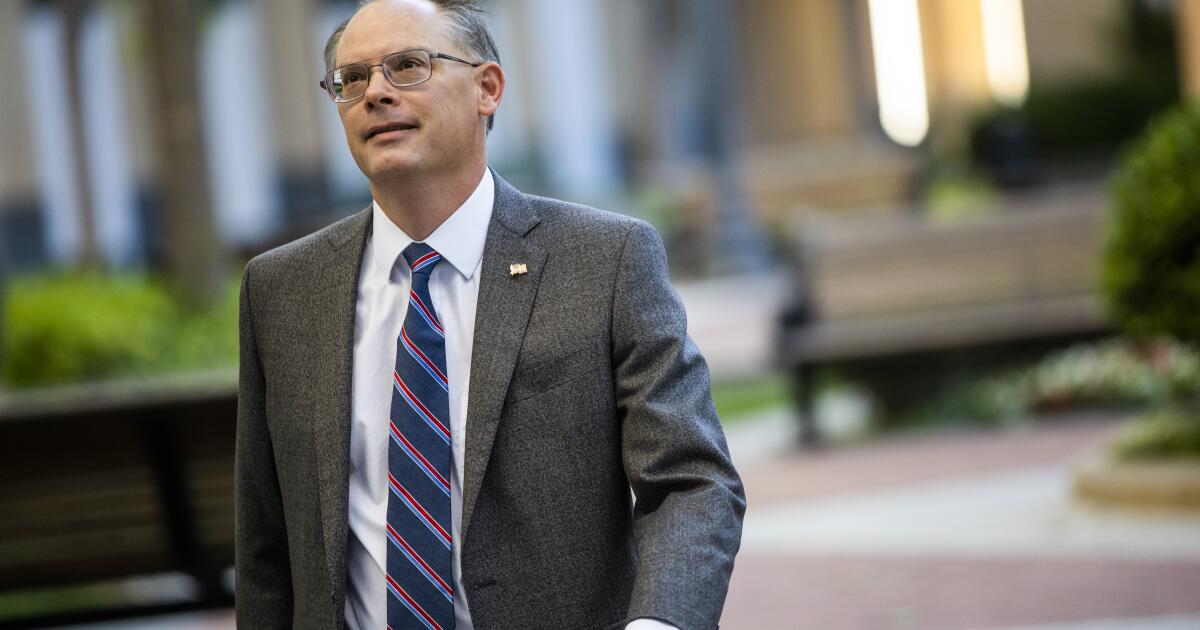
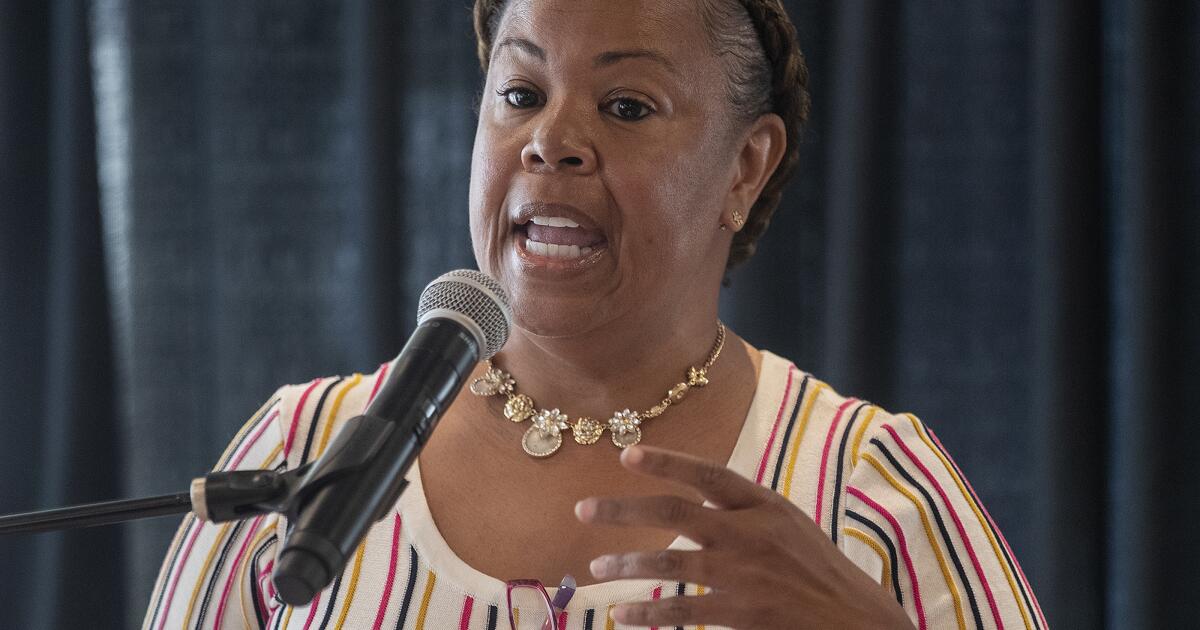
Assemblyman Avelino Valencia, whose district includes Angel Stadium, has introduced state legislation that could require any sale or new lease of the stadium property be conditioned upon the team reverting to the Anaheim Angels name.
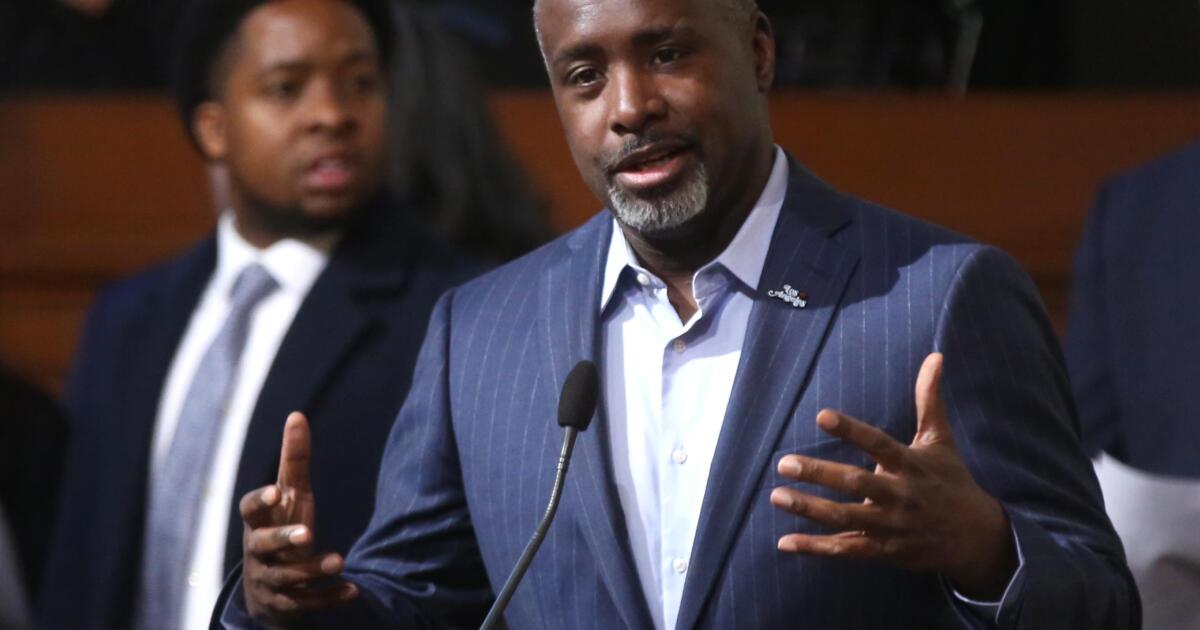
Meanwhile, Anaheim Mayor Ashleigh Aitken has asked the city attorney to explore whether the Angels have violated their current lease by dropping the Anaheim name from legal documents.
Valencia’s bill — dubbed the “Home Run for Anaheim Act” — aims to mandate what the city of Anaheim could not negotiate in its ill-fated deal with Moreno in 2019: If a team owner wants to develop the parking lots around the city stadium, the team should carry the city’s name.
“The Angels have been supported by the city and its residents for 60 years,” Valencia said. “I think it’s rightfully owed to the residents that, if the team wants to play in Anaheim and be in partnership with Anaheim when it comes to future developments of that stadium and surrounding property, then the name should also resemble that.”
Angels spokeswoman Marie Garvey said the team had no comment.
The Angels’ current stadium lease extends through 2032, with the team holding options to extend the lease through 2038.
The city and team had agreed on a deal in which the Angels would remain in Anaheim through 2050, with the team buying the 150-acre stadium property for $150 million, renovating or replacing the stadium, and building a ballpark village atop the parking lots.
The state objected, however. The Surplus Land Act requires public property up for sale must first be made available for affordable housing, and the city negotiated only with the Angels. The city agreed to a $96-million settlement.
The Anaheim City Council ultimately killed the deal three years later, after an FBI investigation uncovered — and former mayor Harry Sidhu acknowledged in a plea agreement — that Sidhu provided confidential information to the team “so that the Angels could buy Angel Stadium on terms beneficial to the Angels” and that he “expected a $1,000,000 campaign contribution from the Angels.” The government has not alleged any wrongdoing by the Angels.
Valencia’s bill was developed in consultation with city leaders and publicly endorsed by Aitken and former mayors Tom Daly and Tom Tait.
Under the bill, if the city can obtain an exemption from the Surplus Land Act, the team could not buy or lease Angel Stadium unless “materials refer to that team as the Anaheim Angels.”
The bill would only apply to Anaheim, and its provisions would not take effect “if the city of Anaheim is able to come to an agreement with the Major League Baseball team known as the Los Angeles Angels about their affiliation.”
Valencia said the city could make a case for an exemption because he believed the Surplus Land Act was designed for smaller properties like school sites and municipal office buildings. He said the community should have the primary say in how such land should be used, even if that might mean less housing on the Angel Stadium site.
“We definitely need more housing because it’s so dang expensive to live, but the amount of housing (in Anaheim) that has gone up in the last 10, 15 years, I think, mitigates some of that,” Valencia said.
“I think folks in Anaheim think that Anaheim is doing their fair share of developing housing. I don’t want to muddy the concept by saying Anaheim is saying, ‘We don’t need any more housing. We have been so proactive in that space. But I think people are going to be thrilled that we want to make the Angels have Anaheim back in the name.”
In 2005, after city officials declined Moreno’s request to change the team name from Anaheim Angels to Los Angeles Angels, the owner adopted the “Los Angeles Angels of Anaheim” name. The city sued and lost, with a jury finding that the Angels had not violated a stadium lease requirement that the team name “include the name Anaheim therein.”
When the city sued the Angels and asked for an injunction to stop the name change pending trial, Orange County Superior Court Judge Peter Polos denied the request. He did, however, warn the Angels he would grant the injunction if the team dropped the “of Anaheim” and simply called themselves the Los Angeles Angels.
“When it comes to official designations, and to how they’re registered, I want us to look into how Anaheim is being used by the team in any official filings,” Aitken said, “and what their requirements are to do so.”
When Aitken asked City Attorney Robert Fabela to investigate, Fabela said the matter would be discussed in closed session as a “potential litigation item.”
Epic Games, the developer of the popular video game “Fortnite,” is laying off more than 1,000 employees and cutting $500 million in costs.
Chief Executive Tim Sweeney announced the cuts Tuesday morning in a message to employees. He said it has nothing to do with AI and instead pointed to what he said was a lack of “Fortnite” engagement last year.
“Despite Fortnite remaining one of the most successful games in the world, we’ve had challenges delivering consistent Fortnite magic with every season,” said Sweeney in a statement.
The company’s flagship game was first released in 2017. Since then, it’s been a key part of internet culture — where character-specific dances became widespread trends and major musicians, like Travis Scott and Ariana Grande, have hosted concerts in the virtual realm.
But Epic has been slow to optimize the computer game for mobile play. A “Fortnite” app was first introduced in 2018, but soon removed due to a legal battle against Apple and Google over app store practices. Sweeney said the company is still in the “early stages of returning to mobile and optimizing Fortnite for the world’s billions of smartphones.”
Many of Epic’s woes also come from industry-wide challenges, like “slower growth, weaker spending, and tougher cost economics,” Sweeney wrote. And Epic isn’t the only one suffering. In recent years, gaming companies like Electronic Arts and Microsoft’s Xbox division have all cut down their workforces.
Epic Games was founded in 1991 and is headquartered in Cary, North Carolina. It has dozens of offices around the world, including in Los Angeles. Beyond “Fortnite,” the company is known as a leader in 3D engine technology and interactive entertainment.
Over the years, Epic Games has steadily built itself into a major Hollywood player. Its 3D creation tool, the Unreal Engine, has been used to produce visual effects and virtual worlds for shows like Walt Disney Co. and Lucasfilm’s “The Mandalorian” and HBO’s “Westworld.”
In 2024, Disney inked a deal with Epic Games to create a games and entertainment universe with the company’s brands, including Star Wars, Marvel and Pixar. Disney invested $1.5 billion in Epic Games for a minority stake in the company. Newly minted Disney Chief Executive Josh D’Amaro managed the collaboration with Epic Games in his previous role as parks chief to create a Disney world within the popular “Fortnite” game.
Looking ahead, Sweeney plans to focus the company on building “awesome Fortnite experiences” with fresh content and continue to accelerate its developer tools like the Unreal Engine.
Welcome back to this week’s Lakers newsletter, where we are remembering that all good things must come to an end.
The Lakers’ longest winning streak since the 2019-20 season ended in Detroit on Monday much in the same fashion that it was built. The Lakers announced themselves as a legitimate playoff threat by piling up thrilling, clutch time wins. Another team’s clutch time win snapped the Lakers’ nine-game streak. Win or lose, the Lakers are finding new lessons in every one of the close games.
All things Lakers, all the time.
Get all the Lakers news you need in Thuc Nhi Nguyen’s weekly newsletter.
By continuing, you agree to our Terms of Service, which include arbitration and a class action waiver. You agree that we and our third-party vendors may collect and use your information, including through cookies, pixels and similar technologies, for the purposes set forth in our Privacy Policy such as personalizing your experience and ads.
Bend but don’t break
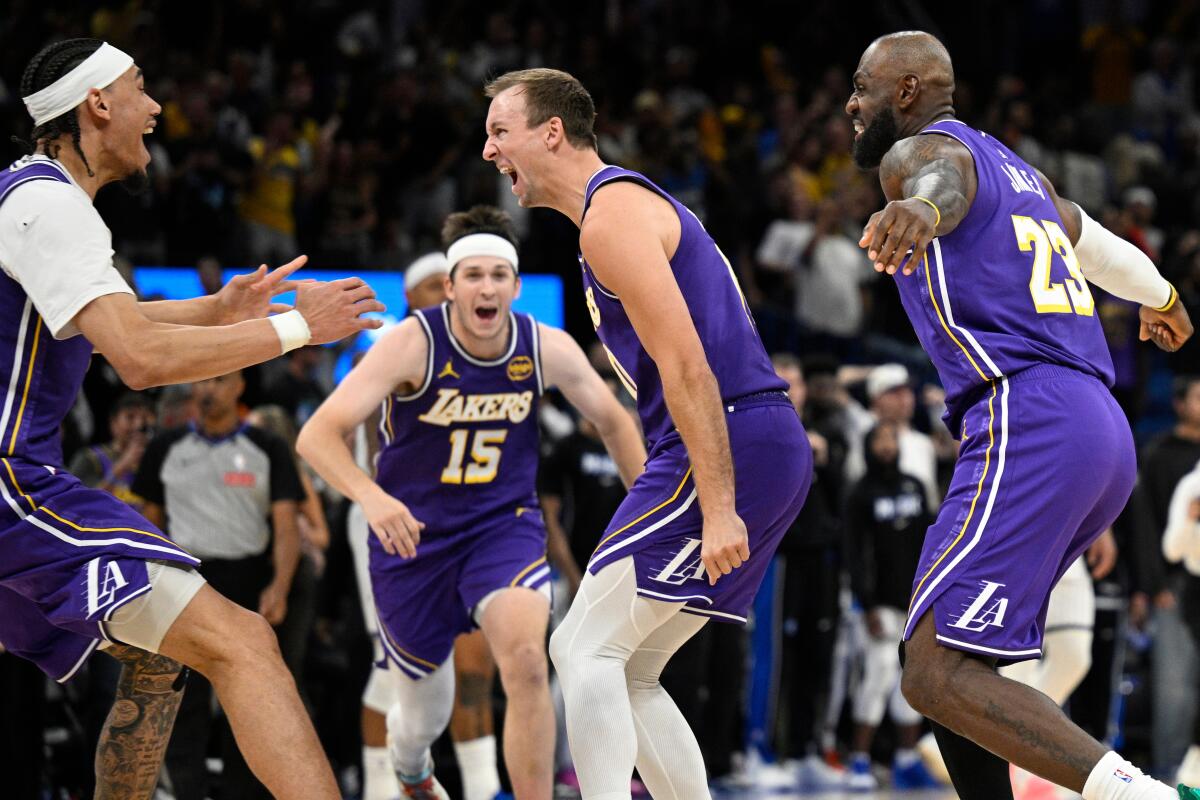
Luke Kennard, second from right, celebrates after his winning basket.
(Phelan M. Ebenhack / Associated Press)
The missed shots. The missed calls. Every missed opportunity against the Orlando Magic could have been a moment for the Lakers to “let go of the rope,” Austin Reaves said.
But why didn’t they?
“I think it’s just …” Reaves said, pausing to find the right word after the Lakers rallied from down five points with 50 seconds left to win by one.
“Belief.”
We thought the Lakers’ early season clutch success might have been a mirage against bad teams. But through the most difficult stretch of the season — nine of 11 games against teams with winning records including seven against teams .600 or better — the late-game execution has remained largely on point.
The Lakers (46-26) still have a league-leading 22-7 record in games within five points in the last five minutes. The Lakers are 6-2 in clutch games in March. Before the loss to Detroit, their 82-point clutch time defensive rating this month is an astronomical improvement from their overall 115.7 points allowed per 100 possessions.
They have played the fewest number of clutch minutes this season, in part because they kept getting blown out earlier this season. Their first 12 losses were all by 10 or more points. Those losses tipped the team’s point differential into the red despite their overwhelming winning record. They were signs that the Lakers bent and immediately broke.
Just as much as the clutch wins, coach JJ Redick looks at recent close losses — the last four came by a combined 14 points against Orlando, Phoenix, Denver and Detroit — as signs of progress.
“Our resolve and resilience — you need to be connected to do that as a team, not just individually,” Redick said. “I think where we were earlier in the year, all of us, probably the coaching staff included, was like, ‘When things go bad, you revert back to your means of self preservation, whatever that may look like for each individual.’ … We’re bending multiple times in a game, and we’re staying the course and trusting each other.”
The Lakers have two of the best individual stars to trust in key situations.
Luka Doncic put on a clutch clinic in Houston: Within five consecutive offensive possessions, Doncic hit a pirouetting step-back three, split a double team with a behind-the-back dribble to throw a no-look lob to Rui Hachimura, spun through another trap for a second alley-oop to LeBron James and nailed the dagger three. The dazzling display elicited roars from his teammates.
Some of James’ recent clutch highlights haven’t been as loud but are just as significant: His Superman dive to save a loose ball against Denver, the forced turnover that gave the Lakers the last possession against the Magic and the hard cut to the basket that drew two defenders to leave Luke Kennard wide open for the game-winning shot. The Lakers never doubted.
“We got Hall of Fame players,” Reaves said, “guys with a lot of talent that compete at the highest level, and when you got that, no game’s ever over.”
LeBron James rewrites another narrative
LeBron James looks for a pass during a game against Sacramento earlier this month.
(Ronaldo Bolanos/Los Angeles Times)
After 23 years of hearing every compliment and every criticism imaginable, James is still smiling through it all. Because through chatter that the Lakers are better without their 22-time All-Star who is making $52.6 million this season, James offered this interview equivalent of a one-handed dunk:
“It sells papers a lot easier and clippings and podcasts if you say ‘LeBron, that their team is better off without him,’ ” James said after he had a triple-double in the Lakers’ win over the Miami Heat during his NBA-record 1,612th regular-season game. “A lot of people will try to, like, view it, so I get it. But they’re absolutely wrong.”
James then scrunched his face into a sarcastic, close-eyed smile.
The Lakers started their winning streak without James, but they couldn’t have continued it if he hadn’t returned in this fashion.
Since missing three games with elbow and hip injuries, James has starred in his new role as possibly most dangerous third option ever. The NBA’s all-time leading scorer’s usage rate dropped from 28.2% in his first 44 games of the season to 21.3% across the six games before Detroit. Before this season, his usage rate has never been lower than 27.6% for an entire year.
But Redick said the team knows it’s at its best when James has the third-highest usage rate. More important, James is playing like he knows that too.
James was held scoreless in the first half against Detroit for just the third time in his career. Redick praised James for his “selfless” play against the Pistons. He finished a rebound short of a triple-double: 12 points, 10 assists and nine rebounds.
“It’s the role that I’m playing for the ball club,” James said. “In order for us to win ball games, it’s the role that I’m playing.”
James is taking three fewer shots a game in the last seven games compared to his season average and averaging a quiet 18 points and 6.1 assists per game. But he has been exceptionally efficient: 58% shooting from the field and he still leads the league with 5.7 fastbreak points per game. Reaves said he sometimes forgets that he’s throwing lobs to a 41-year-old.
“I’m going, I’m going to kill you one day on accident just throwing the ball like I forget that you’re 41,” Reaves said he told James. “I’m still throwing it to 35-[year-old] LeBron.”
On tap
Wednesday at Pacers (16-56), 4 p.m. PDT
The Lakers’ six-game trip ends in Indianapolis with the Pacers, who just snapped the NBA’s longest losing streak Monday. They had lost 16 consecutive games before knocking off the Magic, but still have the worst record in the league. Ivica Zubac is out for the rest of the season after the former Clippers big man fractured his rib.
Friday vs. Nets (17-55), 7:30 p.m. PDT
Michael Porter Jr. is averaging a career-best 24.2 points, 7.1 rebounds and three assists. That’s basically all there is to know about the Nets.
Monday at Wizards (16-55), 7 p.m. PDT
The Wizards’ 16-game losing streak is now the longest in the NBA after the Pacers’ recent win. Anthony Davis was traded to the Wizards from Dallas in February but remains sidelined because of a finger injury. Fellow midseason acquisition Trae Young (quad) is also expected to miss the game.
Status report
Rui Hachimura (right calf soreness)
Hachimura is day-to-day after he got hit in the calf against Miami. The injury bothered Hachimura enough that he went back to the locker room late against Orlando. He got imaging and “it was clean,” Redick said.
Marcus Smart (right ankle soreness)
Smart injured his ankle against Orlando when forward Goga Bitadze fell on the Lakers guard. Smart also has some lingering right hip soreness from another fall during that game, but is day-to-day, Redick said.
Maxi Kleber (lumbar back strain)
Kleber joined the team on the trip in Detroit after missing seven games. During his rehab process, Kleber participated in a practice with the South Bay Lakers last week.
Favorite thing I ate this week
The gumbo at Fixins in downtown Detroit.
(Thuc Nhi Nguyen / Los Angeles Times)
With the weather difference from Orlando to Detroit, I landed in the Midwest in desperate need of comfort food. I fed my soul at Fixins in downtown Detroit, filling up on their gumbo. The hearty stew had chicken and sausage (with an option to add shrimp) and was served over rice with a cornbread muffin. On a chilly Midwest day, it healed me. There’s a Fixins location in L.A. too, so expect to find me there the next time I need my Southern food fix.
The announcement of the end of CBS News Radio last Friday was met with elegiac tributes to the service that built the foundation of William Paley’s company nearly 100 years ago and brought the heroic work of journalists such as Edward R. Murrow to millions of listeners.
But for the 700 affiliates carrying CBS News Radio, the concerns are more practical as they are faced with finding new national programming that will replace it. CBS Radio News will go silent on May 22.
The shutdown of the historic radio division was part of a division-wide staff cut that will affect 6% of the CBS News workforce. Affiliate stations learned of the decision only minutes before it was released to the press.
The local all-news radio stations carrying the service had to post messages on social media to assure listeners that they were not disappearing — only the national newscasts that were provided by CBS.
KNX, the all-news station in Los Angeles that has carried CBS programming since 1936, posted a lengthy segment on the impending closure and explained how “KNX News is not going anywhere.”
KNX was owned by CBS until 2017. The New York-based Audacy, under its previous name Entercom, acquired the CBS radio stations in 2017. KNX and the other Audacy news stations such as WBBM in Chicago, KCBS in San Francisco and WWJ in Detroit remained CBS affiliates, carrying the hourly CBS newscasts.
The Audacy all-news outlets, which reach around 9 million listeners a month, provided about one-third of U.S. coverage for CBS News Radio, the most of any station group carrying the service.
Audacy said it will find a replacement for CBS News Radio to provide national and international coverage, noting that the mission of its all-news stations will not be affected.
“The vast majority of our news and talk programming remains original and locally-produced, and we are beginning conversations with other national news providers to ensure our listeners continue to have access to world-class programming they value and trust.” said Chris Oliviero, chief business officer for Audacy.
Educating the listening public and advertisers that the stations will be fundamentally the same once CBS is gone will require some effort. KNX and the other Audacy all-news stations have a long association with CBS, which launched their formats starting in the late 1960s.
Along with the hourly newscasts, the stations carried “The Osgood Files,” a massively popular commentary segment hosted by the late former “CBS Sunday Morning” host Charles Osgood, for 46 years until 2017. The jingles and sounders used to identify CBS News network programming heard on the stations for decades have also been part of the listening experience.
Among the possible replacements for CBS News Radio is ABC News Audio, which is the largest network radio news service in the U.S. with 1,500 affiliates. The Audacy stations currently use ABC News content outside of its hourly newscasts.
KFI-AM currently carries the ABC News Audio newscasts in Los Angeles. Exclusivity of the ABC News Audio affiliations are determined on a market-by-market basis, according to a representative at the network.
Fox News Media, the home of the conservative-leaning cable channel, also offers a radio service with hourly newscasts and dedicated reporters, which airs on several hundred stations (the company does not supply a specific number).
While Fox News Radio delivers straight reporting, the service is likely to find a home on some of the conservative talk stations that are currently CBS News affiliates.
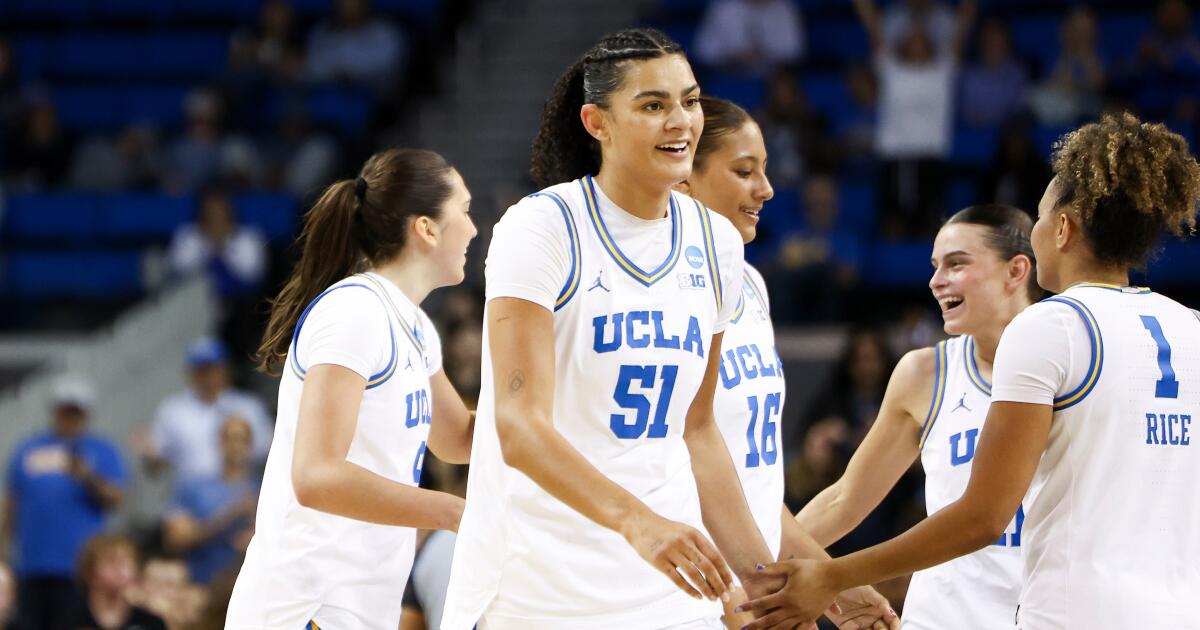
From Marisa Ingemi: There were always going to be tears. In the final game at Pauley Pavilion for six UCLA seniors, it was going to be a stunning defeat or a cathartic release before the next step in the NCAA tournament mission.
It was the latter, as the decorated group of Bruins took their final stroll around the perimeter of the court and waved to the fans, tears glistening and smiles wide.
The top-seeded Bruins led wire-to-wire, beating No. 8-seed Oklahoma State 87-68 in the second round of the NCAA tournament on Monday night at Pauley Pavilion to advance to the Sweet 16. The Bruins will face No. 4 seed Minnesota on Friday in Sacramento.
One of UCLA’s seniors, Lauren Betts, put together the best game of her career with 35 points while shooting 15 of 19 at the moment her team needed it most.
“That’s really cool,” Betts said. “I mean, I can’t deny, like, that is really cool. I feel like the points, they really don’t mean anything to me. To me, like, I really just want to win games with this team. The fact that we won today is what matters most to me, and that we’re moving on to the Sweet 16.”
Get the latest on L.A.’s teams in the daily Sports Report newsletter.
By continuing, you agree to our Terms of Service, which include arbitration and a class action waiver. You agree that we and our third-party vendors may collect and use your information, including through cookies, pixels and similar technologies, for the purposes set forth in our Privacy Policy such as personalizing your experience and ads.
USC women are routed
From Chaunte’l Powell: Monday night served as a litmus test for ninth-seeded USC to see how a program on its way back to prominence measured up against top-seeded powerhouse South Carolina.
The Trojans were no match in the frontcourt against South Carolina, suffering 101-61 season-ending loss in the second round of the NCAA tournament.
South Carolina’s Joyce Edwards and Madina Okot got going early, scoring nine of the Gamecocks’ first 11 points. South Carolina would finish the game with 60 points in the paint. Edwards finished the game with 23 points and 10 rebounds and Okot had 15 points and 15 rebounds.
USC freshman Jazzy Davidson, who scored a phenomenal 31 points in her NCAA tournament debut Saturday against Clemson, missed her first two shots. But she recovered and found some offensive rhythm, finishing with 16 points. Kennedy Smith picked up the slack in the first half, scoring nine of USC’s first 15 points. Unfortunately, she struggled after that and finished four for 15 from the floor.
From Thuc Nhi Nguyen: The brush from a fingertip toppled the Lakers’ longest winning streak in six seasons.
The Lakers’ nine-game win streak ended Monday with a 113-110 loss to the Detroit Pistons when Luka Doncic missed a tying three-pointer at the buzzer after LeBron James’ inbounds pass was deflected by Tobias Harris.
Doncic had 32 points, seven rebounds and six assists, but was three for 13 from three and missed two big shots in the final seconds.
The superstar guard had been on a historic heater, averaging 40 points over the previous nine games. With nine seconds left, James tried to inbound the ball over Harris and across the court to Doncic, who had to chase down the deflected pass that also went off forward Maxi Kleber’s arm. Doncic collected the ball and danced with Detroit forward Jalen Duren, pump faking, spinning and stepping back before launching a sky-high three.
Kawhi Leonard scored 28 points in 25 minutes and the Clippers pummeled the Milwaukee Bucks 129-96 on Monday night.
Brook Lopez added 19 points, Darius Garland had 15 points and six assists, and the Clippers won consecutive games after four straight losses. They made all 18 of their free throws and got back to .500 with 10 games remaining in the regular season after having a 6-21 record on Dec. 18.
Gary Trent Jr. paced the Bucks with 20 points off the bench. Ryan Rollins led their starters with 13, and Milwaukee had five players in double figures. The Bucks have lost 10 of their last 14 games, including three of four since sitting superstar Giannis Antetokounmpo because of a left knee injury.
From Maddie Lee: The Dodgers’ rotation order is set for the first homestand of the season.
To round out the series against the Arizona Diamondbacks, after Yoshinobu Yamamoto takes the mound Thursday on opening day, he’ll be followed by Emmet Sheehan and Tyler Glasnow. Roki Sasaki is penciled in for Monday against the Cleveland Guardians, followed by Shohei Ohtani on March 31.
Off days on Sunday and April 2 make it possible for the Dodgers to give all their pitchers at least five days’ rest between their first and second starts without needing a sixth starter.
Left-hander Justin Wrobleski is pegged to be that additional starter when the schedule features less frequent days off. In the meantime, he’ll be available to throw multiple innings out of the bullpen.
1936 — Detroit’s Mud Bruneteau ends the longest game in NHL history with a goal after 116 minutes and 30 seconds (six overtimes) to edge the Montreal Maroons 1-0 in the semifinals of the Stanley Cup playoffs.
1941 — Long Island University wins the NIT championship with a 56-42 victory over Ohio.
1945 — NYU battles back from a ten-point deficit with two minutes to go to send the NCAA tournament national semifinal game into overtime. NYU wins 70-65. At the time, a team got one free throw when fouled near end of game, but could elect instead to inbound the ball. Ohio State is fouled three times, opts to shoot the foul shot and misses each time.
1956 — San Francisco’s Bill Russell has 26 points and 27 rebounds to lead the Dons to an 83-71 win over Iowa and their second-straight national title and 55th consecutive victory, then an NCAA record.
1962 — Paul Hogue scores 22 points and grabs 19 rebounds and Tom Thacker adds 21 to lead Cincinnati to a 71-59 victory over Ohio State for its second NCAA basketball championship.
1970 — Jerry West of the Lakers wins his only NBA scoring title, accumulating 2,309 points in 74 games for a 31.2 ppg. average.
1973 — Kansas City-Omaha’s Nate “Tiny” Archibald becomes the first player in NBA history to lead the NBA in both scoring (34.0 ppg.) and assists (11.4 apg.) in the same season.
1975 — Muhammad Ali knocks out Chuck Wepner in the 15th round to retain the world heavyweight title in Cleveland.
1975 — Princeton becomes the first Ivy League school to win the NIT title with an 80-69 win over Providence.
1979 — Indiana State, led by Larry Bird, advances to the NCAA Championship game by squeezing past DePaul 76-74. Bird has 35 points, 16 rebounds and 9 assists.
1980 — Louisville beats UCLA 59-54 to win the NCAA basketball title.
1992 — Pittsburgh’s Mario Lemieux becomes the 36th player in NHL history with 1,000 points, getting an assist in the second period of the Penguins’ 4-3 loss to the Detroit Red Wings.
1994 — Kansas State’s Askia Jones scores 62 points in 28 minutes in a 115-77 victory over Fresno State in the NIT quarterfinals. Jones shoots 18-for-25 from the floor, including 14-of-18 on three-pointers, and 12-for-16 from the line.
2013 — Florida Gulf Coast goes from shocking the men’s college basketball world to downright impressing it. The Eagles beat San Diego State 81-71 to become the first No. 15 seed to reach the Sweet 16 of the NCAA tournament.
2017 — Devin Booker scores 70 points, becoming the sixth different player in NBA history to reach that total, but the Boston Celtics get 34 points from Isaiah Thomas and outlast the Phoenix Suns 130-120.
2018 — Nathan Chen completes six quadruple jumps in the free program to become the first U.S. winner of the men’s world figure skating title since 2009.
2018 — Loyola Chicago romps to a 78-62 victory over Kansas State to cap off a stunning run through the bracket-busting South Regional. The Ramblers (32-5) match the lowest-seeded team ever to reach the Final Four, joining LSU (1986), George Mason (2006) and VCU (2011). The South is the first regional in tournament history to have the top four seeds — including overall No. 1 Virginia — knocked out on the opening weekend.
Compiled by the Associated Press
Until next time…
That concludes today’s newsletter. If you have any feedback, ideas for improvement or things you’d like to see, email me at houston.mitchell@latimes.com. To get this newsletter in your inbox, click here.
Kawhi Leonard scored 28 points in 25 minutes and the Clippers pummeled the Milwaukee Bucks 129-96 on Monday night.
Brook Lopez added 19 points, Darius Garland had 15 points and six assists, and the Clippers won consecutive games after four straight losses. They made all 18 of their free throws and got back to .500 with 10 games remaining in the regular season after having a 6-21 record on Dec. 18.
Gary Trent Jr. paced the Bucks with 20 points off the bench. Ryan Rollins led their starters with 13, and Milwaukee had five players in double figures. The Bucks have lost 10 of their past 14 games, including three of four since sitting superstar Giannis Antetokounmpo because of a left knee injury.
The Clippers dominated the three-point line at both ends of the court, making 17 of 38 shots from long range (45%) while frustrating the Bucks before they used a meaningless fourth-quarter flurry to finish at 39% (16 for 41). That included the Clippers sinking 11 of 22 attempts in the first half, including a seven-for-12 stretch to help fuel a 43-point second quarter.
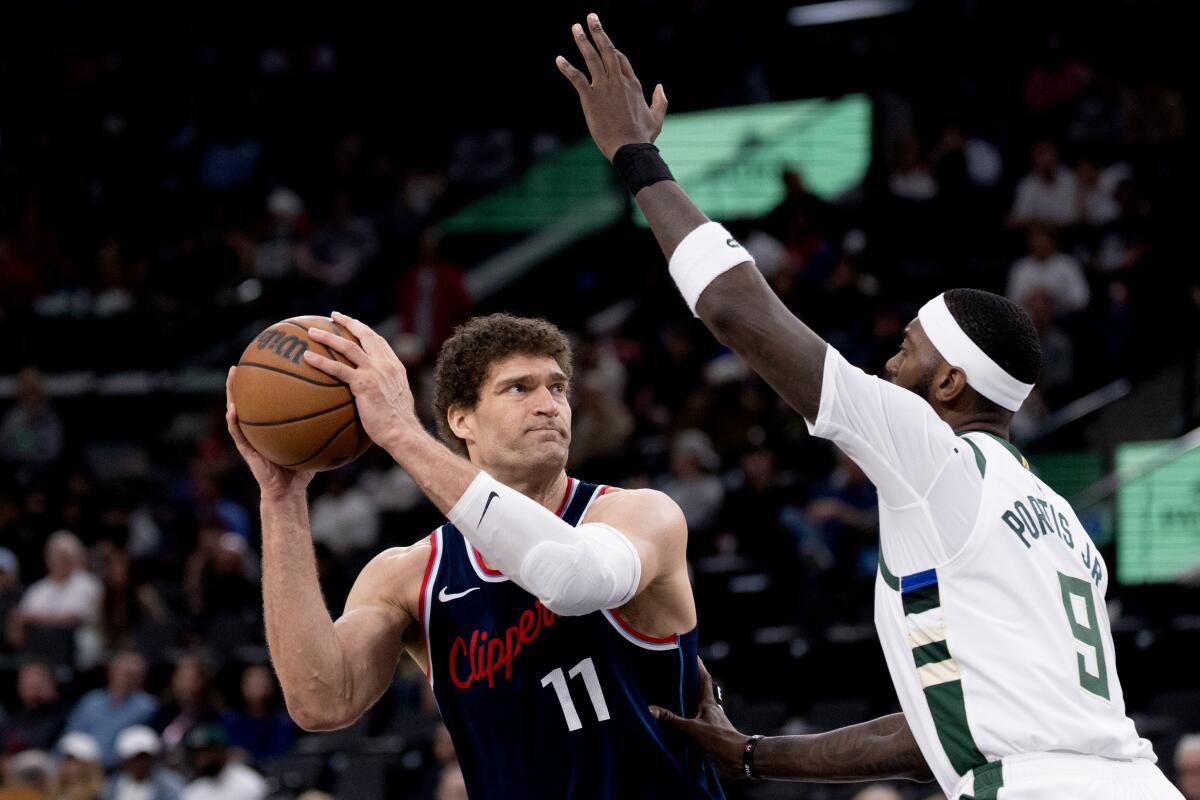
Brook Lopez looks to pass against Bucks forward Bobby Portis in the second half.
(Eric Thayer / Los Angeles Times)
The onslaught continued into the second half as the Clippers went up by 46. Even the 7-foot-1 Lopez got in on the fun, shooting four of five on threes in the third quarter.
Leonard, who sat out the fourth quarter, shook off a sluggish start to go eight for 18 from the field and make nine foul shots. He had 16 points in the second quarter.
In his 14th NBA season, Leonard is averaging a career-high 28.3 points per game, helping push the Clippers back to an all-but-certain spot in the play-in tournament following their miserable start.
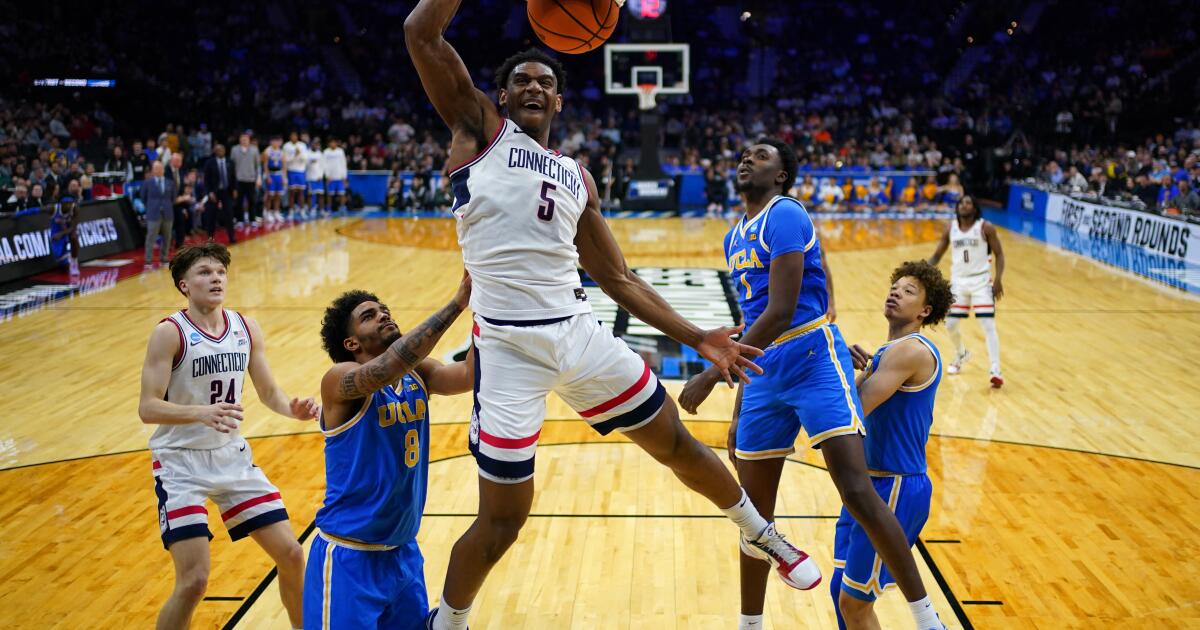
Would UCLA have beaten Connecticut if Tyler Bilodeau was healthy? That’s what will haunt the Bruins and their fans for the rest of March Madness.
Even without their leading scorer the seventh-seeded Bruins battled valiantly, briefly taking the lead in the second half. But in the end they simply didn’t have enough firepower to knock off No. 2 Connecticut, which surged late in its 73-57 win in the second round of the NCAA tournament on Sunday.
“My message to our team is no excuses,” UCLA coach Mick Cronin said. “Somebody brought up Tyler. We didn’t bring it up. It’s five-on-five. Sadly, I’ve got a lot of practice in dealing with that in NCAA tournament play, but it sucks for him.
“At the end of the day, someone said to me what would have happened if you had your guy? You never know. But I thought the bottom line was they played harder than us. Their defense was better than our offense, and I take responsibility for that.”
UCLA (24-12) failed to reach the Sweet 16 for the third consecutive season. The Bruins struggled with their shooting most of the night, going 19 for 49 (39%) in comparison to Connecticut’s 23 for 49 (47%). Both teams had the same number of free-throw attempts (21), but the Bruins made just 67% of their shots and the Huskies made 90%.
Get the latest on L.A.’s teams in the daily Sports Report newsletter.
By continuing, you agree to our Terms of Service, which include arbitration and a class action waiver. You agree that we and our third-party vendors may collect and use your information, including through cookies, pixels and similar technologies, for the purposes set forth in our Privacy Policy such as personalizing your experience and ads.
Buying time until JuJu Watkins returns. Keeping the ship afloat until the talented recruiting class that includes Saniyah Hall makes its way to campus.
But the Trojans showed Saturday that’s not the case. They’re making a plate and eating now.
The No. 9 seed Trojans gutted out a 71-67 overtime win over No. 8 seed Clemson in what USC coach Lindsay Gottlieb described as “a culture win.”
That game featured many tests for a young team in March and the Trojans responded well to the challenges. They are advancing on the back of freshman Jazzy Davidson’s 31 points and senior Kara Dunn’s 22.
From Bill Plaschke: The truth of this Dodgers season was recently found in a place where all sports truths are clipped and tapered and styled into reality.
The barbershop.
Of course, the barbershop, where ball talk is real talk, and where the expectations around the Dodgers upcoming quest for a three-peat recently smothered me like a hot towel to the head.
I was sitting in the chair in mid-shave when a bald gentleman barged into the shop searching not for a cut, but a promise.
“Say it!” he shouted to me from just inside the door. “Say what everybody around here believes!”
“No, say it about the Dodgers!” said the man, and he was serious. “Say that they have the best team in history and they’re going to win another championship! Say it, because that’s what everybody thinks!”
The shop quieted, chairs swiveled, and suddenly everyone was looking at me, at which point I said the one word I’ve never written in any of the last dozen or so Dodger preview columns.
The NBA rescinded Doncic’s 16th technical foul, the league announced Sunday, allowing Doncic to avoid a mandatory one-game suspension that would have kept him out of Monday’s game against the Eastern Conference-leading Detroit Pistons.
Doncic and the Lakers appealed the call after he was given a technical for taunting against Orlando Magic forward Goga Bitadze in Saturday’s Lakers win. Bitadze’s technical foul was also rescinded after the European players were arguing while Doncic was shooting free throws. Doncic claimed Bitadze made a vulgar comment toward Doncic’s family in Serbian while Bitadze said he first heard inappropriate comments from Doncic and only repeated what he heard the Lakers guard say.
Nick Schmaltz scored his second goal of the game at 1:46 of overtime to give the Utah Mammoth a 4-3 victory over the Kings on Sunday night.
Schmaltz carried the puck in on a two-on-one rush with defenseman Mikhail Sergachev on his left and fired a snap shot between goalie Darcy Kuemper‘s legs.
After the Kings controlled play in the three-on-three overtime and nearly ended it on Alex Laferriere’s shot that went off the right post, Kevin Stenlund won a faceoff against Quinton Byfield to set up Schmaltz’s seventh winning goal of the season.
Troy Terry scored on a breakaway 1:29 into overtime for his second goal of the game after Mikael Granlund tied it late in regulation and the Ducks rallied to defeat the Buffalo Sabres 6-5 on Sunday night.
Anaheim ended Buffalo’s seven-game road winning streak when Tage Thompson couldn’t keep in the puck in the Ducks’ zone and Terry held on a 2-on-0 break to score on a backhander.
Granlund tied the score at 5 with 1:44 remaining in the third period on a power play with Ville Husso pulled for an extra attacker.
Portland’s Kristoffer Velde scored in the 13th minute and Timbers defender Kamal Miller picked up a red card seven minutes later, but James Pantemis surrendered only a João Klauss goal to help them hold on for a 1-1 draw with the Galaxy on Sunday.
Velde scored for the second time this season to give Portland (1-3-1) a 1-0 lead early. But things became difficult from the 20th minute on when Miller received his card for a foul on Klauss.
Antony Alves Santos notched his first assist this season on the score and Joao Ortiz picked up his second.
Klauss came up with the equalizer in the 30th minute with assists from Marco Reus and Gabriel Pec. It was the fifth goal for Klauss, who has certainly helped ease the loss of superstar Riqui Puig for a second straight season because of injuries. Klauss spent his first three seasons with St. Louis City, where he scored 25 goals in 79 appearances.
1939 — Long Island University finishes the season undefeated after a 44-32 victory over Loyola of Chicago in the NIT championship.
1944 — Maurice Richard, playing in his second Stanley Cup playoff game, scores five goals in a 5-1 win over the Toronto Maple Leafs in Game 2 of the Stanley Cup semifinals. Toe Blake has five assists.
1948 — Kentucky, behind Alex Groza and Ralph Beard, defeats Baylor 58-42 for the NCAA basketball championship.
1956 — Bill Russell leads San Francisco to an 83-71 victory over Iowa in the NCAA basketball championship.
1957 — North Carolina defeats Wilt Chamberlain and Kansas in triple-overtime to win the NCAA men’s championship. The Tar Heels win 54-53 to finish the season with a 32-0 record.
1968 — Lew Alcindor scores 34 points to carry UCLA to a 78-55 win over North Carolina in the NCAA basketball championship.
1974 — N.C. State ends UCLA’s streak of seven national championships with an 80-77 victory in double overtime of the NCAA tournament semifinals. David Thompson leads the Wolfpack with 28 points and 10 rebounds while teammate Tom Burleson scores 20 and pulls down 14 rebounds.
1991 — London beats Frankfurt 24-11 in the first World League of American Football game.
1994 — Wayne Gretzky scores his 802nd goal, passing Gordie Howe as the top goal scorer in NHL history. The Kings center scores in the second period for his 62nd NHL record.
1996 — Michelle Kwan caps a nearly perfect season by winning the women’s title at figure skating’s world championships for the United States’ first singles sweep since 1986.
2002 — Brendan Shanahan of the Red Wings scores his 500th goal, breaking a scoreless tie at 7:48 of the third period. Detroit beats Colorado 2-0.
2002 — Iowa State’s Cael Sanderson becomes the first undefeated four-time NCAA wrestling champion at the NCAA championships. Sanderson beats Lehigh’s Jon Trenge 12-4 to win at 197 pounds and finish his career with a 159-0 record.
2007 — Kobe Bryant becomes the second NBA player to score at least 50 points in four straight games when he has 50 in the Lakers’ 111-105 win at New Orleans. Only Wilt Chamberlain has more, scoring at least 50 points in seven consecutive games during the 1961-62 season.
2010 — The NFL changes its overtime rules for playoff games to give both teams an opportunity to get the ball.
2014 — Quardell Young drives the length of the court for a go-ahead layup with 0.9 seconds left and Wisconsin-Whitewater holds off Williams to win the NCAA Division III men’s championship 75-73. The Warhawks (29-4), whose football team took the national championship in December, win the basketball championship for the second time in three years and fourth time in four trips to the final.
2016 — Guard Russ Smith of the Delaware 87ers scores an NBA D-League-record 65 points in a 140-129 loss to the Canton Charge.
2022 — After 114 consecutive weeks as world #1 female tennis player, 25 year old Australian Ash Barty makes unexpected retirement announcement.
2023 — Harry Kane overtakes Wayne Rooney’s record to become England’s all-time greatest goalscorer in 2-1 victory over Italy with his 54th goal.
Compiled by the Associated Press
Until next time…
That concludes today’s newsletter. If you have any feedback, ideas for improvement or things you’d like to see, email me at houston.mitchell@latimes.com. To get this newsletter in your inbox, click here.
When UCLA baseball coach John Savage scouts prospects, he looks at their projections and skill upside. Most important, he wants players dedicated to the culture he’s developed during his 22 years as a coach.
“We want people that fit into our program, that want to be a part of a winning culture,” he said.
Most of his current roster consists of players who came up short in last year’s College World Series. This year, the No. 1 team in the country has its eyes set on winning a national title in Omaha. The Bruins (21-2 overall, 9-0 in the Big Ten) are coming off a three-game weekend home sweep of Maryland.
Sign up for UCLA Unlocked
A weekly newsletter offering big game takeaways, recruiting buzz and everything you need to know about UCLA sports.
By continuing, you agree to our Terms of Service, which include arbitration and a class action waiver. You agree that we and our third-party vendors may collect and use your information, including through cookies, pixels and similar technologies, for the purposes set forth in our Privacy Policy such as personalizing your experience and ads.
The Times spoke to Savage about the expectations the Bruins set for themselves and his longevity with UCLA. The following interview has been edited for length and clarity.
Your team entered the year ranked No. 1 nationally and has gotten off to a strong start. How have you managed expectations?
Savage: It’s really about the people you have in the clubhouse. They’ve been born and raised through our program. Now it’s their junior years. They went to Omaha their sophomore year. They had a difficult year their freshman year. It’s been a work in progress, and I think the expectations are probably the heaviest inside our room. Everybody’s held to a very high standard and they believe in one another, they believe in the program. It’s refreshing to coach people that want to be coached, and to have people that love UCLA, and want to stay at UCLA.
After returning a large percentage of last year’s production, what differences have you noticed in this roster compared to previous teams?
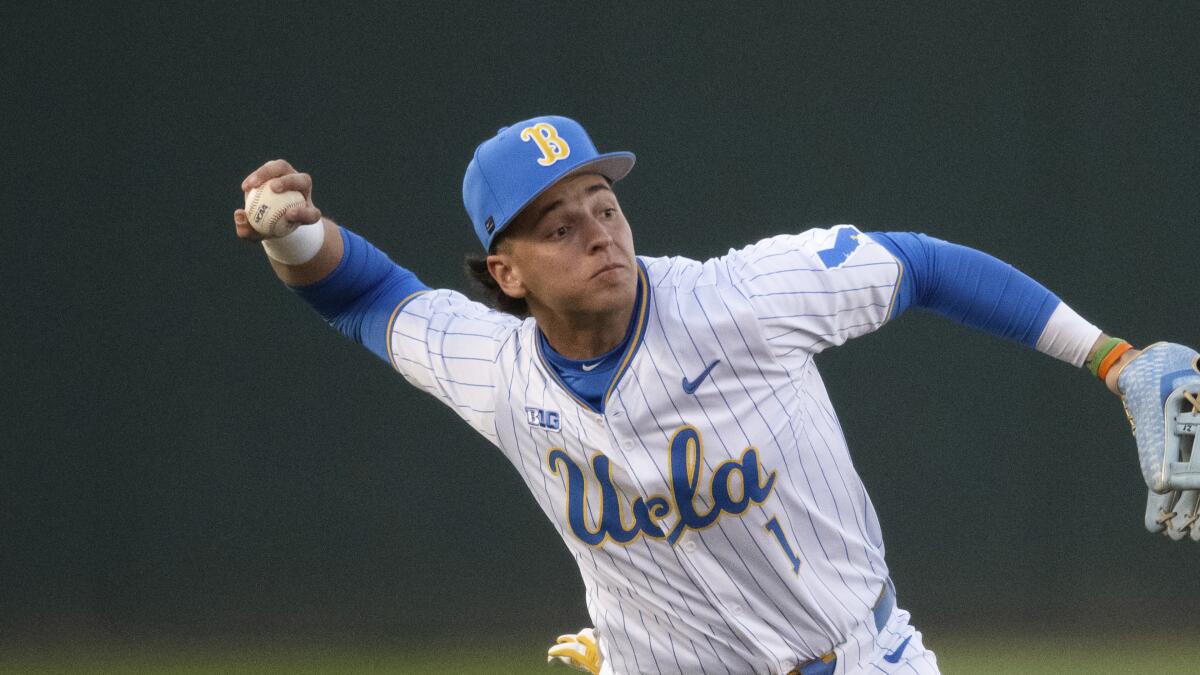
UCLA shortstop Roch Cholowsky.
(Kyusung Gong / Associated Press)
Savage: I think the leadership is fantastic. Roch Cholowsky, Cashel Dugger, Michael Barnett, Jack O’Connor — our captains, they do a wonderful job of making sure guys are accountable. Everybody’s a year older. Everybody’s a little stronger. Everybody’s a little faster. A lot of guys that work extremely hard to upgrade their physicality, and then certainly it’s a mental game. We’ve worked really hard on the mental side of things to make sure that we’re combining both phases.
What has allowed your program to retain so much of its core talent year to year?
Savage: I would say loyalty, personal relationships, wanting to be at UCLA, to get a degree from UCLA, coaching staff, facilities, location. But, I would say most importantly, relationships. We didn’t win a national championship last year and these guys seem to be on that sort of mission.
Last season’s run to Omaha ended just short of the championship series. How much has that experience motivated this year’s group early in the season?
Savage: You see where you’re going. People always talk about Omaha, but if you never go, it’s hard to really envision what it looks like. It’s something that if you experience, you want to go back. It’s the mecca of college baseball and the city of Omaha has done a wonderful job of developing this tournament over 75 years. It’s an experience that you go and you definitely want to go back as a player and certainly as a coach.
How has recruiting or roster construction changed, if at all, now that UCLA is competing in the Big Ten instead of the Pac-12?
Savage: It’s still UCLA. I’ve been here 22 years, we’ve produced 30 major leaguers. It’s a place that you certainly could go and enjoy your college life and go play in the major leagues. The Big Ten is getting better in baseball, with the addition of UCLA, USC, Oregon and Washington. Obviously, it has helped the baseball side of things quite a bit. But there’s a lot of programs that are investing throughout the Big Ten in baseball and it’s only going to get better. Baseball is baseball. You gotta go play any time, anywhere.
With the travel demands that come with a conference like the Big Ten, what adjustments have you made to keep players fresh and focused?
Savage: We don’t charter. We’re all commercial. We fly out of LAX on Wednesday morning and we get back late Sunday night. It’s a challenge and it’s certainly one that it’s a daily and weekly operation. In terms of managing school, they all go to class. Not a lot of remote classes, really, so we love the challenge and the opportunity to grow as a young player and a young person.
You’re now in your 22nd season leading the Bruins. What has kept you motivated to continue evolving as a coach after more than two decades in Westwood?
Savage: I love being at UCLA. I love what it stands for. It’s a combination that I’m really looking for in terms of baseball, schedule, league, school — it’s just an elite combination. You have to make sure you’re grounded. You have to make sure you’re very consistent. You have to make sure that you have true values that are consistent with the university and that equates to winning. Winning is really, really difficult, especially now at the Power 4 level.
When players leave UCLA after their careers — whether they go to pro baseball or move on to other careers — what do you hope they carry with them from their time in your program?
Savage: That they understand how to be a contributor to an organization, to a business, how to lead a family, how to lead a group in work. Just be a person that people like to be around and a person that has a vision, that they want to get better and they want to do well in their lives and they want to have impact on other lives. That’s ultimately what we’re looking for, that they can handle themselves in any phase of life.
UCLA men are out, UCLA women stay strong
UConn’s Tarris Reed Jr. tries to get through UCLA’s Trent Perry, from left, Donovan Dent and Eric Dailey Jr. in the first half Monday.
(Matt Rourke / Associated Press)
UCLA coach Mick Cronin never wavered.
If senior forward Tyler Bilodeau felt any pain, he was not playing the NCAA tournament.
The No. 7 seed Bruins could not overcome No. 2 seed UConn’s interior game and suffered a 73-57 loss. The Bruins kept it close early, trailing by just five at halftime.
Cronin will help UCLA cope with the sudden end to its season and then immediately work on sorting out next season’s roster.
While fans questioned Cronin’s aggressive coaching style, the Bruins did play significantly improved defense through the final four weeks of their season and his players never wavered in their support of him.
Now Cronin will start over, working to forge comparable buy-in from the next wave of players.
The UCLA women walk to the bench during a time out against Cal Baptist.
(Gina Ferazzi / Los Angeles Times)
It’s rare for a No. 1 seed in the women’s NCAA tournament to miss the Sweet 16, but the Bruins (32-1) say they expect a big test when they face No. 8 seed Oklahoma State (24-9) at 7 p.m. Monday night at Pauley Pavilion.
It will be the final game the Bruins’ celebrated senior class will play at Pauley Pavilion.
UCLA coach Cori Close provided the following scouting report on Oklahoma State.
“I think that what stands out is their ability to shoot the three, their versatility, their work down the tunnel with the high ball screen,” Close said. “They’re extremely good in transition. It’s going to be so important for us to make them play later into the shot clock, which is going to be easier said than done. But I guess with the exception they don’t have like a really tall big, but they actually remind me in terms of their style and some of the actions that they run of Oklahoma. Their guard play.
“And one of the big things that we talk a lot about is trying to make them play later in the clock than they’re comfortable with. Now we go through all the analytics, and the later you have them play in the shot clock, the less efficient they become. They’re 13th in the country in offensive efficiency. They’re really, really good.
“Defensively I think that we obviously need to really hunt the paint. We’ve got some advantages with our size there. But they’re a really good team.”
Survey says
We asked “How far will the UCLA men advance in the NCAA men’s tournament. After 648 votes, the results:
They lose in the second round, 36.5% They lose in the Sweet 16, 27.5% They lose in the Elite Eight, 17.3% They win it all, 12.6% They lose in the first round, 3.2% They lose in the Final Four, 2.5% They lose in the championship game, 0.4%
Do you have a comment or something you’d like to see in a future UCLA newsletter? Email newsletters editor Houston Mitchell at houston.mitchell@latimes.com. To get this newsletter in your inbox, click here.
Hi, and welcome to another edition of Prep Rally. I’m Eric Sondheimer. One month into the high school baseball season, the top teams in the City Section are becoming clear.
Get our high school sports newsletter
Prep Rally is devoted to the SoCal high school sports experience, bringing you scores, stories and a behind-the-scenes look at what makes prep sports so popular.
By continuing, you agree to our Terms of Service, which include arbitration and a class action waiver. You agree that we and our third-party vendors may collect and use your information, including through cookies, pixels and similar technologies, for the purposes set forth in our Privacy Policy such as personalizing your experience and ads.
Top City teams emerge
With league play having begun, top teams are stepping forward in City Section baseball one month into the season.
To no one’s surprise, West Valley League rivals Birmingham (10-1, 3-0) and El Camino Real (9-3, 3-0) deserve to be ranked No. 1 and No. 2 in the City Section going into their first matchup of the season Tuesday at Birmingham. They are slated to play three league games. Both teams’ pitching has been outstanding.
Birmingham junior Nathan Soto is 3-0 with an 0.34 ERA. Sophomore Carlos Acuna is 4-0 with a 1.44 ERA. El Camino Real’s Jackson Sellz is 3-0 with an 0.54 ERA. Hudson December and Andrew Katz have also contributed on the mound. Look for a low-scoring game with some bunts Tuesday.
Bell (12-1, 2-0) is back to playing the way the Eagles performed in 2024 when they won the City title. Jayden Rojas, the City player of the year as a sophomore, is batting .421 and 4-0 on the mound with an 0.32 ERA. The Eagles are the heavy favorite to win the Eastern League.
Carson (9-1-1, 3-0) has taken early charge of the Marine League race, getting some clutch hits from Skylar Vinson.
Sun Valley Poly (6-3, 3-0) already has wins over Sylmar, North Hollywood and Kennedy in the Valley Mission League. Fabian Bravo is the pitcher/hitter to watch.
Perhaps the biggest surprise is Monroe at 11-0 and now the favorite to win the East Valley League. Four-year varsity pitcher Miguel Gonzalez is 4-0 with an 0.85 ERA and 32 strikeouts and only three walks in 24 2/3 innings. The leading hitter with 21 hits is junior Luis Martinez. The Vikings have yet to face a top opponent, so it remains to be seen which playoff division they will end up in.
Garfield, Sylmar, San Fernando, Cleveland and Narbonne are all capable of working their way into an Open Division playoff berths after slow starts.
Basketball awards time
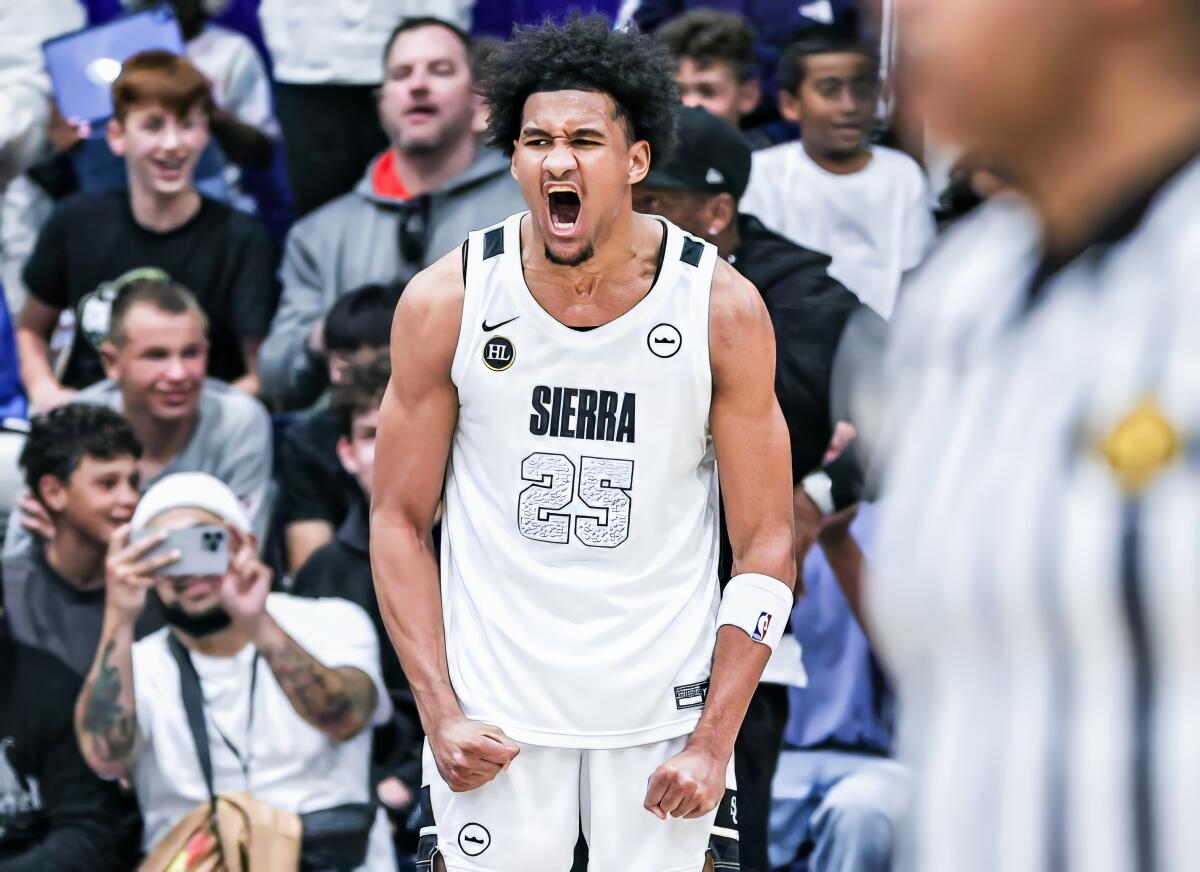
Maxi Adams of Sierra Canyon was The Times’ boys’ basketball player of the year.
(Craig Weston)
During a season in which the individual talent for boys and girls basketball was extraordinary, earning all-star recognition became quite an achievement.
The Times’ boys’ basketball player is Maxi Adams of Sierra Canyon. Here’s the report.
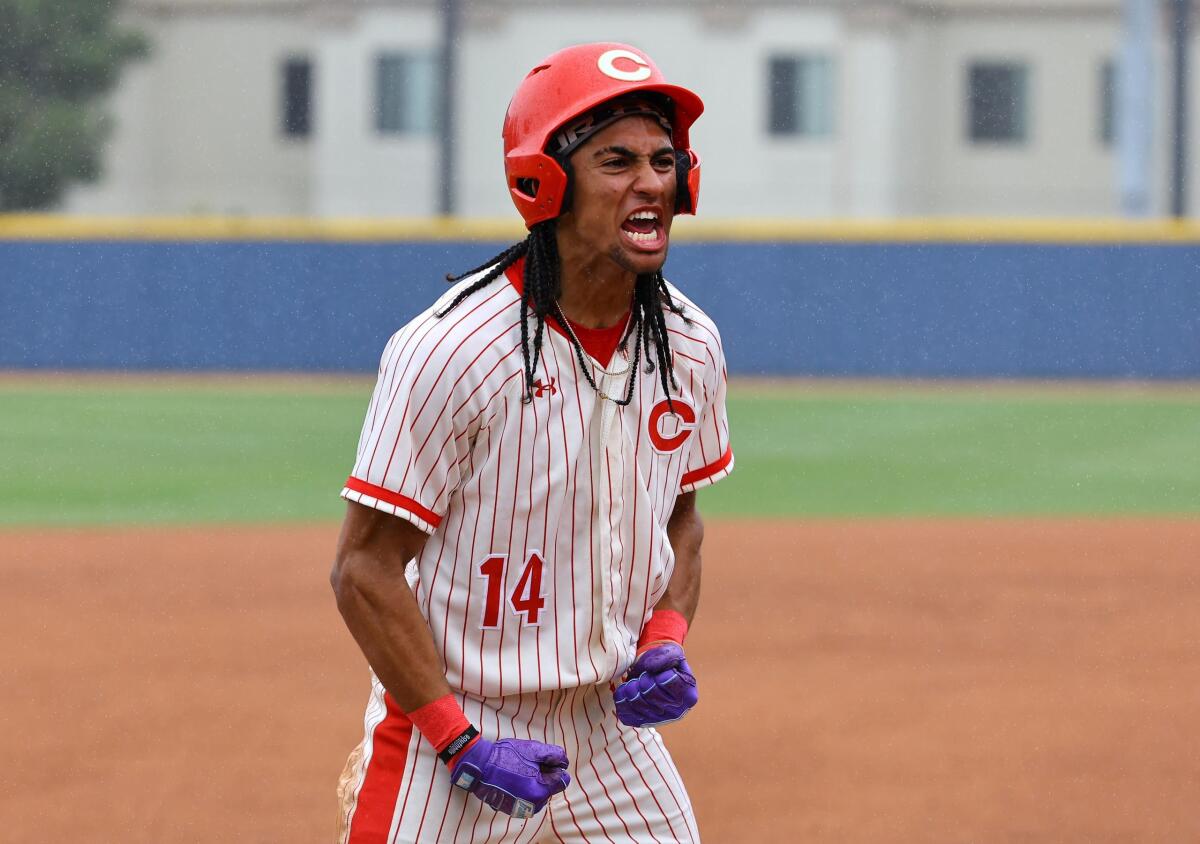
The versatile Anthony Murphy of Corona showed off his speed and power in 8-3 win over King, getting a home run, triple, double and single. That’s called hitting for a cycle. And he almost did it again in the next game with a home run, a double and two singles. He also struck out all three batters he faced in a relief role.
Corona (7-0) is set to face Corona Santiago (9-2) in a three-game series this week. To say scouts will be out en masse when Santiago’s Striker Pence pitches Wednesday might be an understatement. He’s only a sophomore with a fastball that can reach 100 mph. The games are Monday at Santiago, Wednesday at Corona and Friday at Santiago.
Santa Margarita has lost standout shortstop Brody Schumaker for the rest of the season because of a shoulder injury. Freshman Cooper Holland provided a lift in Las Vegas with 11 RBIs. The new shortstop is sophomore Warren Wulfemeyer, whose grandfather, Mark, is one of the most recognizable names in Orange County basketball history.
Former Sherman Oaks Notre Dame pitcher Justin Lee, the 2023 player of the year by The Times, was clocked throwing his fastball between 97 and 99 mph pitching for UCLA.
Two unbeaten teams, St. John Bosco and Sherman Oaks Notre Dame, are ranked No. 1 and No. 2 in this week’s this week’s top 25 rankings by The Times. St. John Bosco has shut out five of its seven opponents. Jack Champlin is creating options for the St. John Bosco coaching staff. He continues to be a great closer but is also effective as a starter.
The National High School Invitational begins Wednesday in Cary, N.C. Southern California is well represented with Orange Lutheran, St. John Bosco, Aquinas and Harvard-Westlakek participating.
Friday marks the end of the sit-out transfer period in the Southern Section. Players who did not move become eligible. Bishop Alemany could be the team to watch. Mikey Martinez, who helped Crespi win the Mission League title last season as a pitcher and outfielder, will join the Warriors.
Softball
Murrieta Mesa continues to dominate with 14 consecutive wins to start the season. Sophomore Tatum Wolff is hitting .533 with 24 hits, including eight doubles.
Chaminade is 9-0 and came through with a break-through win over defending Mission League champion Sherman Oaks Notre Dame 7-6, scoring five runs in the seventh. The Eagles have an outstanding sophomore pitcher in Finley Suppan, the daughter of former major leaguer Jeff Suppan. Here’s the report.
JSerra (13-2), Fullerton (11-1), Norco (9-2), Oaks Christian (10-1) and Etiwanda (14-1) continue to be teams on the rise.
City Section softball is wide open as teams test themselves against Southern Section opponents. Defending champion Granada Hills is 5-5.
Banning is 7-6. Carson is 7-5. They will join San Pedro in another tough Marine League battle.
Track and field
The impressive early marks in the 100 meters for boys signals some real fast times will be coming later in the spring.
Benjamin Harris of Servite leads the way at 10.23 seconds. Next are Quran Clayton Jr. of Oak Hills and Jorden Wells of Servite at 10.28. Others include Nicolas Obimgba of Torrance (10.34), Zion Phelps of Loyola (10.39), Jaden Griffin of Newbury Park (10.43), Wesley Ace of Gardena Serra (10.51), Quincy Hearn of Sherman Oaks Notre Dame (10.52) and AJ McBean of Mira Costa (10.55).
Many are football players using track to get faster, and college recruiters are noticing.
Ejam Yohannes of Loyola has stamped himself the favorite in the 400 with a time of 46.11. Imagine if he improves a little what he might be running coming June.
Dean Guzman of Moorpark cleared 6-9 in the high jump at the Maurice Greene Invitational.
For girls, Olivia Kirk of Calabasas ran a state-leading 11.51 in the 100 meters at Oaks Christian. Teammate Malia Rainey ran 11.76. Kirk also has the leading 200 time at 23.46.
Sophomore Grace Smith from Claremont ran the 800 in 2:08.80 at the Hi-Racer Meet of Champions.
Volleyball
Loyola’s JP Wardy, left, tries to tip the ball past Mira Costa’s Colby Graham, center, and Miles Crotty during a match at Mira Costa in Manhattan Beach on March 20, 2026.
(Steve Galluzzo / For The Times)
Always expect drama and excitement when volleyball rivals Loyola and Mira Costa meet. It happened again Friday, with Mira Costa rallying from a 2-0 deficit to beat the Cubs in five sets. It was a remarkable performance turned in by junior Mateo Fuerbringer, who recorded 37 kills. He’s committed to UCLA.
Boys Volleyball: Full Playoff Results From The 9th Annual Chatsworth Invitational Tournament Are In. Saugus Defeats Host Chatsworth To Capture Gold, Village Christian Takes Silver, East Valley Earns Bronze, And Van Nuys Finishes With Copper. @CIFLACS#RepTheCitypic.twitter.com/yQdRlZf6tc
Saugus defeated the host Chancellors to win the Chatsworth tournament championship.
So long Angelo Gasca
Venice coach Angelo Gasca showing off City Division I title trophy in 2021.
(Cliff Kensinger)
The high school sports community was in mourning after the death of Venice football coach Angelo Gasca. He was 65.
Few have made a bigger impact for their community on and off the field than Gasca, who was involved as a coach at Venice for 36 years and also played for the Gondoliers.
Todd Quinsey is the new football coach at Ayala. . . .
Christian Collins of St. John Bosco, a McDonald’s All-American, has committed to USC. . . .
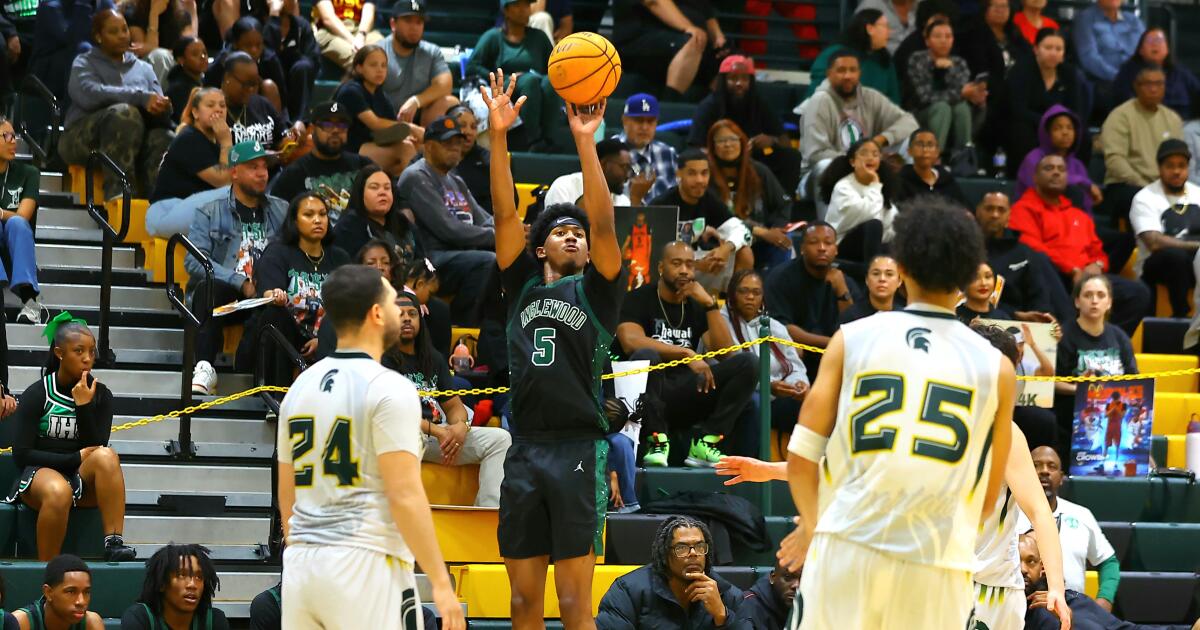
Inglewood guard Jason Crowe Jr. was selected the Gatorade state player of the year. . . .
Jon Palarz has resigned after 17 years as basketball coach at Calabasas. . . .
Former Granada Hills Kennedy football coach Dion Lambert is the new defensive coordinator at Simi Valley. . . .
Brandon Clifford has been named the basketball coach at Campbell Hall. He last coached in Greensboro, N.C. . ..
Derek Allen is the new boys water polo coach at Agoura. . . .
United Teachers Los Angeles has announced members would strike on April 14 if no deal is reached with the Los Angeles Unified School District. That would disrupt spring sports in the City Section, likely forcing games to be postponed or canceled based on previous strikes. Charter schools such as Birmingham and Granada Hills would not be affected since their teachers have separate contracts. . . .
Dylan O’Leary is the new football coach at San Dimas after being an assistant at South Hills. . . .
In 2021, JSerra pitcher Gage Jump delivers a pitch against Harvard-Westlake.
(Robert Gauthier/Los Angeles Times)
Former JSerra pitcher Gage Jump has become one of the top pitching prospects in the Oakland Athletics organization. The left-hander originally signed with UCLA before transferring to LSU. He was drafted No. 74 overall in 2024. He’s listed at 6-feet tall but throws with power.
From On3, a story on the controversy in Nevada, where public schools in Clark County are moving to independent status as protest against Bishop Gorman’s powerful football program.
Granada Hills Kennedy QB Diego Montes has been accepted to UCLA Henry Samueli School of Engineering and Applied Science with Civil Engineering. What an achievement. Ringer for intramural football team.
Incredibly, former Sherman Oaks Notre Dame pitcher Jack McDowell is not in the College Baseball Hall of Fame. He was an All-American at Stanford, a Cy Young Award winner with the White Sox. That needs to change. One of the greatest high school and college pitchers of the 1980s.
The new shortstop for Santa Margarita is sophomore Warren Wulfemeyer. His grandfather, Mark, is one of the best basketball players produced in Orange County. A look back at what grandpa did at Troy. https://t.co/CRXwYqZUPt
Have a question, comment or something you’d like to see in a future Prep Rally newsletter? Email me at eric.sondheimer@latimes.com, and follow me on Twitter at @latsondheimer.
Did you get this newsletter forwarded to you? To sign up and get it in your inbox, click here.
This is the April 21, 2021, edition of the Essential Politics newsletter. Like what you’re reading? Sign up to get it in your inbox three times a week.
Outgoing presidents often leave decisions for their successors to take on.
Over the last two decades, and four presidents, how to end America’s longest war — in Afghanistan — has been among the largest open questions. President Biden inherited it from President Trump, who inherited it from President Obama, who took it from President George W. Bush. Unpopular, seemingly unending and unwinnable, the war is a case study in how the choices of one administration echo into the next.
Last week, Biden formally announced a deadline of Sept. 11 — the 20th anniversary of the terrorist attacks that provoked the U.S. invasion of Afghanistan — to end military involvement in the country.
“War in Afghanistan was never meant to be a multigenerational undertaking,” he said.
The prospective exit also has been years in the works. Obama promised to scale back U.S. involvement, but first he sent a surge of troops. Trump vowed several times to withdraw all troops, making chaotic progress that stopped short of a full exit. Biden is now the third president to make a similar commitment.
Whether he will follow through remains to be seen. My colleagues David S. Cloud and Tracy Wilkinson have extensively covered the American involvement in Afghanistan, from Trump’s growing tensions with the Pentagon over withdrawal to the lives of Afghanistan’s youngest generation, which was born into U.S. occupation.
Taken together, their work over the last few years reveals the deep roots of Biden’s promise, and the complicated history that will color his path forward.
Get our L.A. Times Politics newsletter
The latest news, analysis and insights from our politics team.
By continuing, you agree to our Terms of Service, which include arbitration and a class action waiver. You agree that we and our third-party vendors may collect and use your information, including through cookies, pixels and similar technologies, for the purposes set forth in our Privacy Policy such as personalizing your experience and ads.
The long path to leaving
January 2017: A president who promised peace leaves office after eight years of war
During his first presidential campaign, Obama pledged to end the war in Afghanistan, as well as in Iraq. He ended his presidency as the first two-term president to see U.S. forces at war for all eight years.
Experts saw his legacy as mixed. He did reduce the number of troops in Afghanistan, cutting their ranks to 8,400, and his administration reduced American deaths — if not Afghanis’ — by relying on diplomacy and on drones to launch airstrikes. Yet intelligence officials said the U.S. faced more threats in more places than the country had seen since the Cold War. “We’re now wrapped up in all these different conflicts, at a low level and with no end in sight,” one expert told The Times.
August 2017:Trump presides over a stalemate and negotiated settlement
Trump the candidate ran as a tough-on-the-Taliban leader, promising a hard-fought and fast victory to end U.S. engagement. But Trump the president softened when it came time to reveal formal plans, Cloud and Wilkinson wrote with former Times reporter W.J. Hennigan. Fighting continued — to show U.S. forces could not be pushed out — while Trump promised that the 16-year war might end “some day” in a negotiated settlement. It was an acknowledgment that victory would elude a president who loved to win and refused to concede defeat.
“This entire effort is intended to put pressure on the Taliban, to have the Taliban understand you will not win a battlefield victory,” then-Secretary of State Rex Tillerson said. “We may not win one, but neither will you. So at some point, we have to come to the negotiating table and find a way to bring this to an end.”
By February 2018, the Trump administration proposed a defense budget that increased spending in Afghanistan by almost $2 billion, for a total of $48.9 billion in the next fiscal year.
December 2018:Trump presses for peace talks and announces a withdrawal of half of troops
That month, a series of announcements signaled Trump’s growing dissatisfaction with involvement in Afghanistan. Increased Taliban attacks had caused hundreds of Afghan civilian and military casualties a month, prompting Trump administration officials to press for a cease-fire agreement, but with dim prospects, Cloud wrote.
Less than two weeks later, administration officials announced a drastic plan: withdraw up to half of the 14,000 American troops serving in Afghanistan, potentially by summer. The backlash was swift from U.S. lawmakers, allies and even the Pentagon. Defense Secretary James N. Mattis was so furious that Trump would abandon allies in Syria and Afghanistan that he resigned in protest, as Cloud reported.
February-May 2020: A truce and a landmark agreement to withdraw
With 12,000 troops still in Afghanistan, the Trump administration brokered a temporary deal with the Taliban to reduce violence for a week in February, Wilkinson reported. The test was a success, and on Feb. 29, U.S. and Taliban officials signed an accord to end the war. The Taliban would prevent Al Qaeda and other terrorist groups from using Afghan territory to threaten the U.S., without renouncing its terrorist ties. In return, the U.S. would withdraw its troops within 14 months, setting a deadline of May 1, 2021.
The plan again drew backlash, from former Trump and Obama administration officials, who warned a complete withdrawal could backfire, Cloud, Wilkinson and Stefanie Glinksi reported. Even as conflict continued between the Taliban and the Afghan government into May, the Trump administration remained committed to removing troops.
November 2020: Hopes of exiting before the election dashed
Trump, hoping that a full exit in 2020 would boost his reelection prospects, made clear to advisors that he cared little about conditions in Afghanistan, Cloud and Wilkinson reported. He wanted out, period. By July, the number of troops on the ground had shrunk to 8,600.
But as the peace talks the U.S. hoped to broker struggled to get off the ground, administration officials said about 4,000 troops would have to remain into November. The Pentagon said too rapid a withdrawal would doom the talks, invite violence and cause American forces to have to abandon valuable equipment. Trump said he wanted a withdrawal by the end of his term in January, and in November — as he refused to concede his loss to Biden — he ordered troop levels reduced in Iraq and Afghanistan, to 2,500 in each country.
Trump’s relationship with Congress further deteriorated in December, in part over the bipartisan pushback to his withdrawal plans. It was among the reasons he cited in vetoing the annual National Defense Authorization Act, Cloud and Jennifer Haberkorn wrote.
April 2021: Biden says it’s “time to end the forever war.”
When Biden took the oath of office on Jan. 20, 2,500 troops remained in Afghanistan. But the new president faced the decision of whether to honor Trump’s May 1 deadline for withdrawing them — the final exit from the war, Cloud wrote. Once again, Defense Department officials pressured the president to delay a full withdrawal as the deadline the Trump administration negotiated with the Taliban approached.
On April 14, Biden made his decision public: The drawdown would proceed, but not so quickly. The U.S. would fully exit by Sept. 11, Cloud and David Lauter wrote.
“I am now the fourth United States president to preside over an American troop presence in Afghanistan. Two Republicans. Two Democrats,” Biden said. “I will not pass this responsibility onto a fifth.”
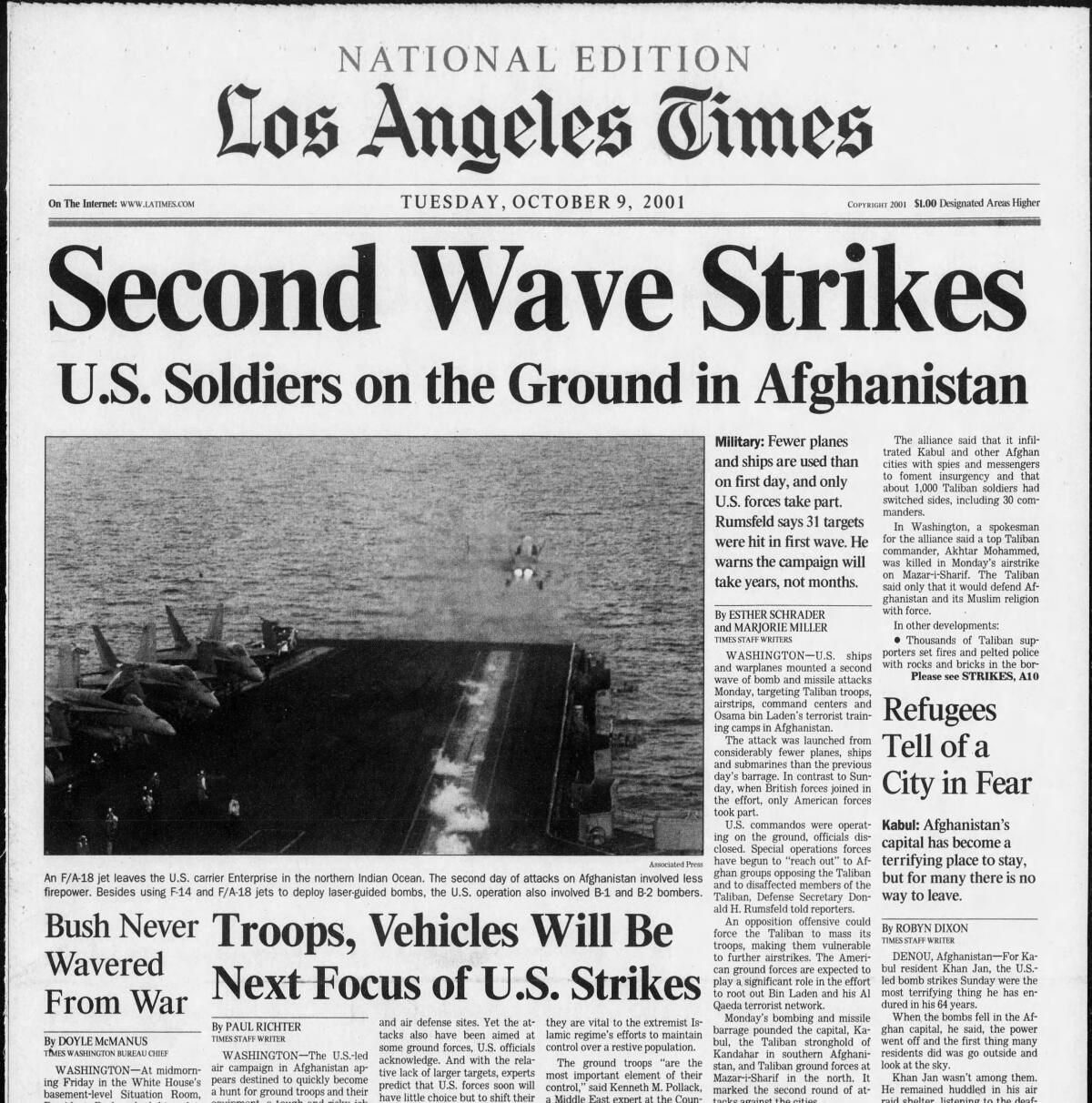
The top half of the front page of the Los Angeles Times on Oct. 9, 2001.
(Los Angeles Times)
Enjoying this newsletter? Consider subscribing to the Los Angeles Times
— The conviction of former Police Officer Derek Chauvin for the murder of George Floyd reenergized a push for sweeping criminal justice reform by President Biden and leading Democrats, who said Tuesday’s verdict was just the first step on the path to national healing, report Evan Halper, Eli Stokols and Sarah D. Wire.
— Anticipating an uproar, Facebook said it would crack down on violent content, hate speech and harassment ahead of the Chauvin verdict. But as Brian Contreras reports, critics are wondering why the platform doesn’t take those precautions all the time.
The latest on the environment
— China, Japan and South Korea are the world’s biggest funders of coal-fired power plants around the globe — and the Biden administration is looking to win their agreement to deep cuts in their greenhouse gas emissions by the end of the decade, write Anna M. Phillips and Wilkinson.
— Biden will convene leaders from around the world on Thursday and Friday as he marks the United States’ return to the global fight against climate change, Chris Megerian writes. Three people with knowledge of the White House plans say Biden will pledge to cut U.S. greenhouse gas emissions at least in half by 2030.
— Solar panels, wind turbines and electric cars will go far in helping California and the Biden administration meet their aggressive climate goals — but not far enough. As time runs short, scientists and government officials say the moment to break out the giant vacuums has arrived, Halper writes.
More from Washington
— Vice President Kamala Harris traveled to North Carolina on Monday to talk about economic opportunities and electric school buses as part of the Biden administration’s efforts to promote its roughly $2-trillion infrastructure, clean energy and jobs plan, Noah Bierman writes.
— The Supreme Court is weighing whether immigrants granted temporary protected status can get green cards — and if the Biden administration will make that decision, David G. Savage reports.
— The Justice Department has brought charges against hundreds of people who stormed the Capitol during the Jan. 6 riot, but one of its most pivotal potential cases involves a man who never set foot inside the building, writes Del Quentin Wilber.
— After Jan. 6, many of the nation’s largest corporations pledged that they would suspend donations to elected officials who opposed the certification of Joe Biden’s victory, hindered the peaceful transfer of power or incited violence. The vast majority kept their word, report Seema Mehta, Maloy Moore and Matt Stiles.
— What is there left to say about House Speaker Nancy Pelosi? Plenty, it turns out. In a new biography, Pelosi dishes on chiding Rep. Alexandria Ocasio-Cortez and using the nickname “Moscow Mitch,” writes Wire.
Neil Sedaka, the singer and songwriter whose signature hits include “Calendar Girl” and “Breaking Up Is Hard to Do,” died of atherosclerotic cardiovascular disease.
The condition is caused by the buildup of plaque — meaning fats, cholesterol and other substances — in and on the artery walls, which can lead to events such as heart attacks, strokes and aneurysms. According to the American Heart Assn., atherosclerotic cardiovascular disease is the leading cause of death worldwide.
The musician’s death certificate, published Wednesday by the New York Post, also listed kidney failure as a contributing factor.
Sedaka died Feb. 27 in Los Angeles at age 86. The songwriter’s family previously told The Times that his death was sudden.
“Our family is devastated by the sudden passing of our beloved husband, father and grandfather, Neil Sedaka,” their statement read. “A true rock and roll legend, an inspiration to millions, but most importantly, at least to those of us who were lucky enough to know him, an incredible human being who will be deeply missed.”
Born and raised in Brooklyn, N.Y., Sedaka was a Juilliard-trained classical pianist who translated his skill to pop stardom in the 1960s. His popularity as a performer waxed and waned over the years, but he maintained a steady career writing hits for other artists for decades, collaborating with lyricists such as Howard Greenfield.
“Songwriting is a difficult undertaking that gets harder and harder because you have to top your past work,” Sedaka told The Times in 1996. “You have to keep proving yourself. … It’s wonderful to sing ‘Calendar Girl’ and ‘Breaking Up Is Hard to Do,’ but you need more than that. You have to break new ground. As an artist, I have to choose what I feel is good and hope that the public will go along with it.”
Sedaka is survived by his wife Leba; children Dara and Marc; and three grandchildren.
Plus, every time you drive, you can see the escalating average cost for a gallon of gas throughout the state that ranges from $5.77 in Orange County, $5.78 in San Diego County, $5.80 in Los Angeles County and $5.86 in San Francisco County to the high of $6.57 in Mono County, according to AAA.
It can easily make anyone think having fun is unaffordable.
Fortunately, our Travel and Experiences team has put together a list of 75 fun things to do for under $20.
On warm days, it’s hard to beat a ride on the swan boats at Echo Park.
They’re powered by foot paddles, and the pedaling is easy because you’re in no hurry. Maybe you’ll want to do a circuit of the lake (really a man-made reservoir). Maybe you’ll sidle up to the towers of whitewater rising from the mid-lake fountain.
Maybe you’ll wait until after dark (because the swans light up).
(Christina House / Los Angeles Times)
Experience L.A.’s esoteric history at the Philosophical Research Society (Los Feliz)
Cost: Free to visit, workshops and lectures from $10 and up.
Located at the intersection of Los Feliz and Griffith Park boulevards, the Philosophical Research Society has long been a place of mystery, intrigue and, for some, apprehension.
The Mayan Revival campus painted in Southwestern shades of clay, cream and sage was built in 1935 by the celebrated author and esoteric lecturer Manly P. Hall.
Today, it hosts a dizzying array of events each week including poetry readings, death cafes, sound baths, a weekly class on Buddhism, tarot and astrology salons and musical performances — some of which have a suggested donation of just $10.
If you visit, make sure to make time to browse the excellently curated metaphysical bookstore.
(Gina Ferazzi / Los Angeles Times)
Find the perfect meditation spot at the Self-Realization Fellowship Lake Shrine (Pacific Palisades)
Cost: Free.
Whether or not you’re familiar with the work of Paramahansa Yogananda, who founded the Self-Realization Fellowship in 1920, if you live in Los Angeles you owe him a debt of gratitude for the smattering of lush, meditative gardens in Southern California that are still open to the public today.
Among those is Lake Shrine, a beautifully landscaped 10-acre property in the Pacific Palisades surrounding a spring-fed lake that is dotted with quiet meditation spots.
It is free to visit, but you will need to make a reservation online before you go. (Reservations open each Saturday at 10 a.m. for the week ahead, and they can fill up quickly.)
(Wally Skalij / Los Angeles Times)
Cozy up with a flick at the Paramount Drive-In Theater (Paramount)
Cost: $14 per adult, $7 per kid (ages 3-11).
For a night out that feels as cozy as a night in, head to the Paramount Drive-In Theater. In the comfort of your own car, you can spread out, munch popcorn and make all the commentary you want without getting looks from other moviegoers.
Tickets are purchased on arrival, and the parking lot is huge, so you’re bound to secure a good view of the big screen. There is a concession store on site with candy, chips and drinks, but you are free to bring all the snacks you want from home. Recline your seat all the way back, relax and enjoy the show.
You’re reading the Essential California newsletter
Sign up to start every day with California’s most important stories.
By continuing, you agree to our Terms of Service, which include arbitration and a class action waiver. You agree that we and our third-party vendors may collect and use your information, including through cookies, pixels and similar technologies, for the purposes set forth in our Privacy Policy such as personalizing your experience and ads.
The week’s biggest stories
(Irfan Khan / Los Angeles Times)
Heat wave and environmental news
Los Angeles mayor, city council news
Cesar Chavez fallout
California governor’s race
Crime, courts and policing
What else is going on
Must reads
Other meaty reads
For your downtime
(Illustrations by Lindsey Made This; photograph by Myung J. Chun / Los Angeles Times)
Going out
Staying in
L.A. Affairs
Get wrapped up in tantalizing stories about dating, relationships and marriage.
Have a great day, from the Essential California team
Jim Rainey, staff reporter Hugo Martín, assistant editor, fast break desk Kevinisha Walker, multiplatform editor Andrew J. Campa, weekend writer Karim Doumar, head of newsletters
The Los Angeles chapter of the Democratic Socialists of America will not endorse a candidate for mayor.
After City Councilmember Nithya Raman decided at the last minute to run against her former ally Mayor Karen Bass, the group called a vote on whether to reopen the endorsement process, which it had closed without supporting a candidate.
DSA-LA backed Raman’s two successful city council runs, but she has been at odds with the group on some issues.
Also in the mix was another mayoral candidate, community organizer Rae Huang, whose positions align more closely with those of the group.
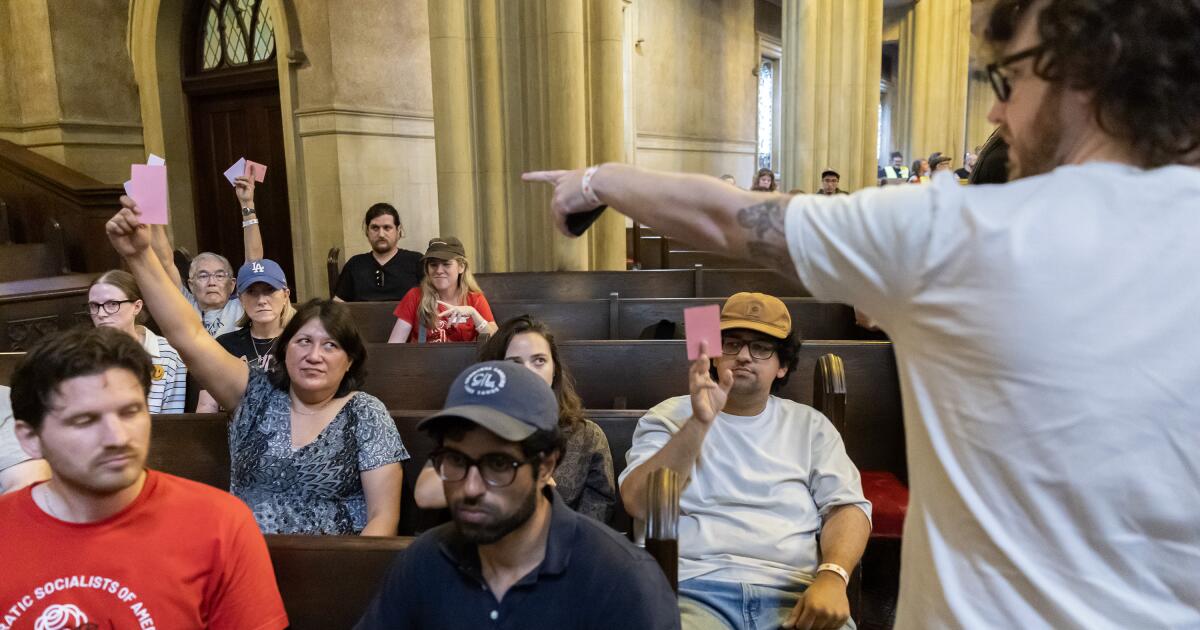
The two candidates were present for Saturday’s vote at Immanuel Presbyterian Church in Koreatown, though neither spoke.
The left-wing organization, which has about 5,000 members, is known for running strong ground game campaigns that include canvassing, door-knocking and phone banking. In addition to Raman, three other DSA-backed politicians now sit on the 15-member City Council.
Before the vote, DSA-LA members argued for and against reopening the endorsement process.
“The worst thing we can do right now for our movement is to say, ‘Well, actually, we’re not going to endorse Rae or Nithya. We’re going to do a third thing, which is to issue no endorsement.’ Who is the audience for this message?” said Leslie Chang, a co-chair of DSA-LA.
DSA-LA member Anna Gross argued that neither candidate was ideal, with Huang, who has little political experience, being a long shot and Raman hesitating to fully embrace the group.
“I do want a democratic socialist mayor, but as it stands, we have one candidate who is not going to win … and a candidate who will not openly identify as a democratic socialist,” Gross said.
Of the 488 members who voted Saturday, about 55% supported reopening the endorsement process, falling short of the required two-thirds majority.
If the process had been reopened, the group would have then voted on whether to endorse Raman, Huang or neither.
Huang’s earlier attempt to get the endorsement while the window was still open had failed because she did not obtain enough valid member signatures to qualify.
If the race is not decided in the June 2 primary, DSA-LA can still endorse a candidate in the runoff.
Besides Bass, Raman and Huang, the field of 14 candidates includes conservative reality TV star Spencer Pratt and tech entrepreneur Adam Miller.
Some members believed that a mayoral endorsement would take resources away from the slate of six local candidates they have already endorsed.
In city council races, DSA-LA is backing incumbents Hugo Soto-Martínez and Eunisses Hernandez; Faizah Malik, who is running against incumbent Traci Park on the Westside; and Estuardo Mazariegos for an open South L.A. seat.
The group is also backing Marissa Roy, who is challenging City Atty. Hydee Feldstein Soto, and Rocío Rivas, an incumbent L.A. Unified school board member.
A look at the Los Angeles Times’ All-Star boys’ basketball team for the 2025-26 season:
Brandon McCoy, Sierra Canyon, 6-5, Sr.: The Mission League co-MVP averaged 19.2 points and 7.4 rebounds while helping his team go 30-1 and win Open Divison championships in the Southern Section and state.
Jason Crowe Jr., Inglewood, 6-3, Sr.: The Missouri commit is the state’s all-time scoring leader with 4,718 points and averaged 43.6 points this season to become the first four-time All-Star selection.
Drew Anderson, Santa Margarita, 6-10, Sr.: The Oregon State commit was co-MVP of the Trinity League while averaging 20 points and 10 rebounds.
Joe Sterling, Harvard-Westlake, 6-4, Sr.: The Texas commit has been one of the state’s best three-point shooters, averaging 21.4 points and 5.8 rebounds for the Open Division finalists.
Maxi Adams, Sierra Canyon, 6-8, Sr.: The North Carolina commit averaged 16 points and 7.2 rebounds per game, including 26 points against Harvard-Westlake in the Open Division regional final.
Christian Collins, St. John Bosco, 6-9, Sr.: The McDonald’s All-American and USC commit averaged 25 points, 12 assists and four assists per game.
SJ Madison, Redondo Union, 6-5, Sr.: The Nevada commit and Bay League MVP led the Sea Hawks to a 27-5 record, averaging 18 points and 6.1 rebounds.
Maxwell Scott, Corona del Mar, 6-2, Jr.: The Sunset League MVP averaged 21.7 points after leading his team to a 27-1 regular-season record and averaged 24.5 points in three Open Division games.
Will Conroy Jr., Village Christian, 6-0, Fr.: He burst onto the scene as the best first-year freshman player in the state, averaging 26.7 points.
NaVorro Bowman Jr., Sherman Oaks Notre Dame, 6-3, Jr.: He shared Mission League MVP honors, averaging 22.5 points as one of the top juniors in the state.
Public murals are among the best ways to honor our heroes, which is why dozens of murals of civil rights icon Cesar Chavez dot California’s landscape. Those images are now deeply upsetting after shocking revelations published in a recent New York Times investigation that allege Chavez sexually abused girls as young as 12 and raped his fellow labor organizer Dolores Huerta.
According to the nonprofit Travel Santa Ana, the Chavez mural, created in 2008 to commemorate the launch day of the city’s KaBoom playground and Jerome Community Learning Garden, is “one of 30 murals around California that was commissioned by a project commemorating Cesar Chavez, initiated by Maria Shriver and former LA Mayor [Antonio] Villaraigosa.”
That’s 30 from a single project — the total number would be impossible to count. It’s hard to overstate the prominence of Chavez’s legacy in California, where his name and likeness are ubiquitous on the sides of bodegas, in parks, on street signs, on schools and memorialized in statues. He was considered a man of the people, which is why murals, created in unassuming local spaces, seemed especially fitting.
It’s now up to the public that revered him and is now grappling with the pain of his misdeeds to decide what should become of his painted image. California lawmakers announced their intention to rename the upcoming Cesar Chavez holiday “Farmworkers Day,” and that idea could be extended to murals of Chavez. These artworks could be remade to instead celebrate the achievements of the many people — especially the women and girls — who marched and fought for the labor movement.
I expect changes to these murals will come swiftly. A statue of Chavez at Fresno State has already been covered and will soon be removed. Maybe it can be melted down to create something new and uplifting. We can paint over the past, but we should never forget.
I’m Arts editor Jessica Gelt, looking forward to gazing at a mural of Huerta in the very near future.
You’re reading Essential Arts
Our critics and reporters guide you through events and happenings of L.A.
By continuing, you agree to our Terms of Service, which include arbitration and a class action waiver. You agree that we and our third-party vendors may collect and use your information, including through cookies, pixels and similar technologies, for the purposes set forth in our Privacy Policy such as personalizing your experience and ads.
The week ahead: A curated calendar
FRIDAY Brokentalkers Through music and dance, the Dublin-based theater company presents “Bellow,” the story of Irish accordionist Danny O’Mahony as he revisits key moments when mentorship, mastery of the craft and preservation of the art form influenced his path. 8 p.m. Friday and Saturday. UCLA Nimoy Theater, 1262 Westwood Blvd. cap.ucla.edu
Piano recital with Gilles Vonsattel, solo Camerata Pacifica presents the third program of “Beethoven 32,” a three-year Beethoven cycle in which principal pianist Vonsattel performs all 32 of the composer’s piano sonatas. 7 p.m. Friday. Academy of the West, 1070 Fairway Rd., Santa Barbara. 8 p.m. Sunday. The Colburn School, Zipper Hall, 200 S. Grand Ave., downtown L.A. cameratapacifica.org
Sex, Lies and Harold Pinter Two of the playwright’s darkly comic one-acts, “Party Time” and “The Lover,” are paired. 8 p.m. Fridays and Saturdays; 3 p.m. Sundays, through April 26. Odyssey Theatre, 2055 S. Sepulveda Blvd. odysseytheatre.com
SATURDAY And the Beat Goes On The Gay Men’s Chorus of Los Angeles performs American classics from R&B, Motown, gospel and musical theater with Emmy Award-winning host and GMCLA alum Melvin Robert and soprano Nicole Heaston. 8 p.m. Saturday; 3:30 p.m. Sunday. Saban Theatre, 8440 Wilshire Blvd, Beverly Hills. GMCLA.org
Cirque Kalabanté’s Afrique en Cirque A celebration of African culture featuring acrobatics accompanied live Afro Jazz, percussion and kora. 8 p.m. Saturday. Carpenter Performing Arts Center, CSULB, 6200 E. Atherton St., Long Beach. carpenterarts.org; 3 p.m. Sunday. The Soraya, 18111 Nordhoff Street, Northridge. thesoraya.org
Artist Todd Gray has a show at Perrotin.
(Kyungmi Shin)
Todd Gray A solo exhibition of the artist’s photosculptures, “Portals,” continues his interest in the effects of colonization, the built environment and the natural world. Gray will be in conversation with LACMA chief executive Michael Govan on Tuesday. Opening reception, 6 to 8 p.m. Saturday; conversation, 6:30 p.m. Tuesday; exhibition continues through May 30. Perrotin Los Angeles, 5036 W Pico Blvd. perrotin.com
Convergence: Contemporary Artists of Armenian Descent More than 20 artists, in work ranging from abstraction to conceptual installations, interrogate the complexities of their cultural identities. Through Aug. 9. Forest Lawn Museum, 1712 S. Glendale Ave., Glendale. museum.forestlawn.com
Esther Chung and Ins Choi in “Kim’s Convenience” at the Ahmanson.
(Dahlia Katz)
Kim’s Convenience Playwright Ins Choi stars in this production of his award-winning comedy drama, about a Korean family-run corner store in Toronto, that inspired the TV series. Directed by Weyni Mengesha. Through April 19. Ahmanson Theatre, 135 N. Grand Avenue, downtown L.A. centertheatregroup.org
‘KPop Demon Hunters’ singalong Bop to the beat of this year’s two-time Oscar-winner — animated feature and original song — at this special Academy screening. 11 a.m. Academy Museum, 6067 Wilshire Blvd. academymuseum.org
Miss Velma in the City of Angels In the “Religion and Ritual” section of the ongoing Art of the West exhibition, this new installation features a custom-made dress worn by the charismatic co-founder of the Universal World Church in Los Angeles. Opens Friday. The Autry, 4700 Western Heritage Way. Griffith Park. theautry.org
Ok, Olympia, Let’s Go! Apollo Dukakis wrote and performs the one-act play “You and Me” alongside Kandis Chappell in a multimedia celebration of his sister, the late Academy Award-winning actress Olympia Dukakis. Playwright and filmmaker Graham Barnard hosts with special invited guests. 8 p.m. Saturday. 3 p.m. Sunday. Odyssey Theatre, 2055 S. Sepulveda Blvd. odysseytheatre.com
Song Of The North Hamid Rahmanian created this multimedia production using shadow puppetry and projected animation to reimagine the Persian epic “Shahnameh” about a fierce heroine and her quest to save her beloved. 2 p.m. Saturday, Sunday and March 28 to 29; 7 p.m. Saturday and March 29. Pasadena Playhouse, 39 S. El Molino Ave. pasadenaplayhouse.org
The exhibition “Turner & Constable” at the Tate in London is featured in a new documentary on the two British painters.
Turner & Constable Laemmle’s “Culture Vulture” series presents this documentary on two of Britain’s finest artists — J.M.W. Turner and John Constable — their rivalry as very different landscape painters and the current exhibition at the Tate in London. Directed by David Bickerstaff. 10 a.m. Saturday and Sunday; 7 p.m. Monday. Laemmle Glendale, 207 N. Maryland Ave.; Laemmle Town Center 5, 17200 Ventura Blvd., Encino; Laemmle Monica Film Center, 1332 2nd St. laemmle.com
Vertigo in Concert Sarah Hicks conducts the Los Angeles Philharmonic performing the Bernard Herrmann score for Alfred Hitchcock’s classical psychological thriller live to screen. 8 p.m. Saturday. Walt Disney Concert Hall, 111 S. Grand Ave., downtown L.A. laphil.com
SUNDAY Network The American Cinematheque presents screenwriter Paddy Chayefsky’s prescient 1976 media satire for its 50th anniversary and in tribute to actor Robert Duvall. 7 p.m. Sunday. Egyptian Theatre, 6712 Hollywood Blvd. americancinematheque.com
Yefim Bronfman The pianist performs selections from Schumann, Brahms, Debussy and Beethoven. Rescheduled from Feb. 11. Walt Disney Concert Hall, 111 S. Grand Ave., downtown L.A. laphil.com
Geoff Elliott in “Death of a Salesman” at A Noise Within.
(Daniel Reichert)
Death of a Salesman A Noise Within co-artistic director Geoff Elliott steps into the shoes of Arthur Miller’s beleaguered working man. Through April 19. A Noise Within, 3352 E. Foothill Blvd., Pasadena. anoisewithin.org
Ebell + LA Festival: Powered by Women A free celebration of art, activism and community spirit featuring performances, classes and crafts. 11 a.m. to 4 p.m. The Ebell of Los Angeles, 741 S. Lucerne Blvd. ebellofla.org
Akinsanya Kambon: The Hero Avenges A conversation between the sculptor known for his work inspired by the Black diaspora, African histories and mythologies, and Hammer curator Pablo José Ramírez, plus the premiere of a new eponymous documentary directed by Gabriel Noguez and Sean Rowry and a book signing of the monograph “Akinsanya Kambon: The Hero Avenges.” 2 p.m. Sunday. UCLA Hammer Museum, 10899 Wilshire Blvd., Westwood. hammer.ucla.edu
MONDAY Lang Lang Plays Beethoven The piano virtuoso joins the Pacific Symphony for performances of Beethoven’s “Piano Concerto No. 3” and Egmont Overture, plus Dvořák’s Ninth Symphony, “From the New World.” 8 p.m. Monday. Segerstrom Center for the Arts, 600 Town Center Drive, Costa Mesa. pacificsymphony.org
TUESDAY Gerald Barry’s ‘Salome’ Thomas Adès conducts the L.A. Phil in the U.S. premiere of Barry’s new opera, based on the Oscar Wilde play. 8 p.m. Walt Disney Concert Hall, 111 S. Grand Ave., downtown L.A.laphil.com
WEDNESDAY Alvin Ailey American Dance Theater The illustrious troupe performs two alternating programs as part of its exclusive multiyear Southern California residency under the leadership of new Artist Director Alicia Graf Mack. 7:30 p.m. Wednesday to March 28; 2 p.m. March 28 to 29. Dorothy Chandler Pavilion, 135 N. Grand Ave., downtown L.A. musiccenter.org
THURSDAY Level Up! A trans tween feels like she can only be herself in her virtual world in the Latino Theater Company’s world premiere of a resonant, family-friendly play by Gabriel Rivas Gómez. Directed by Fidel Gómez. Previews through April 3. Opens April 4 and runs through May 3. Los Angeles Theatre Center, 514 S. Spring St., downtown L.A. latinotheaterco.org
Arts Anywhere
BroadwayHD Don’t get out to the theater as much as you’d like? This decade-old streaming service could be a viable supplement to your live theater habit. It offers a nice variety of shows from Broadway and the West End, off-Broadway, plays, musicals and virtually anything in between. BroadwayHD: $20 per month or $200 per year.
“Future Relic: Failures, Disasters, Detours, and How I Made a Career as an Artist” by Daniel Arsham.
(Simon & Schuster)
Future Relic: Failures, Disasters, Detours, and How I Made a Career as an Artist Part memoir, part how-to, contemporary artist Daniel Arsham’s new book shares pragmatic advice on things like how to get a gallery, why you need a great lawyer, how to run a creative business and the importance of building a network of successful people. Bursting onto the scene more than 20 years ago with a bold vision across multiple mediums and accruing an eclectic list of big-name collaborators, including Merce Cunningham, Pharrell Williams, Pokémon, Tiffany & Co. and Cleveland Cavaliers, he quickly found both critical and commercial success. In a 2014 review of the artist’s work, Times contributor Sharon Mizota wrote, “Daniel Arsham’s casts of everyday or recently obsolete objects in sand, volcanic ash or various kinds of rock are like premature fossils, or perhaps eerie premonitions of ruin to come.” At a time when everything in the world is starting to feel obsolete, including us, “Future Relic” could find a place on the bookshelves of many would-be creatives. (Think of it as a companion to Rick Rubin’s “The Creative Act: A Way of Being.”). Authors Equity: 320 pp. $30.
Out of Vienna The acclaimed Berlin-based chamber ensemble Leonkoro Quartet, formed in 2019, has released its stellar debut recording after winning a string of prestigious awards across Europe. An exploration of early 20th-century modernism in the Austrian capital, the album features compositions by Alban Berg, Anton Webern and Erwin Schulhoff. Alpha Classics: Available on CD ($19) or download ($9.25).
— Kevin Crust
Culture news and the SoCal scene
Spring is here, and with it many arts and culture entertainment choices.
McNulty has been extra busy lately and has delivered a series of reviews. Harry Potter fans will enjoy his take on Daniel Radcliffe in Broadway’s “Every Brilliant Thing,” which McNulty calls “an ingenious and touching solo performance piece written by Duncan Macmillan with Jonny Donahoe on the subject of suicide — or more precisely, on the ordinary joys that militate against such a drastic step.”
McNulty also dropped in on the Geffen Playhouse to catch “Dragon Mama,” the second installment in a trilogy written and performed by Sara Porkalob about her Filipina American family. “To be frank, I wasn’t sure I was up for a trilogy on Porkalob’s family history. But after ‘Dragon Mama,’ I can hardly wait for ‘Dragon Baby,’ the third and final segment,” McNulty writes.
Pierre Adeli and Adam J. Jefferis in “The Adding Machine.”
(Bob Turton Photography)
Finally, McNulty checks in with the Actors’ Gang, which is running a production of Elmer Rice’s 1923 expressionist satire, “The Adding Machine.” The story, about “an accountant drone aptly named Mr. Zero who, after losing his job to an adding machine, kills his boss and is sentenced to death,” shares uncomfortable modern-day parallels with the threat to workers currently posed by AI, McNulty writes.
Classical music critic Mark Swed got the scoop on the Los Angeles Philharmonic’s new season — its first without revered music director Gustavo Dudamel. “For the first time in 64 years, the L.A. Phil will be without a music director, and with no one in waiting in the wings. But you may barely notice. In little more than three months, Dudamel, although newly installed as music and artistic director of the New York Philharmonic, will be saying hello once again to his old band at Walt Disney Concert Hall for two weeks of Beethoven,” Swed writes.
Workers install the Francis Bacon 1969 “Three Studies of Lucian Freud” oil painting in the David Geffen Galleries at the Los Angeles County Museum of Art.
(Kayla Bartkowski / Los Angeles Times)
I got to watch workers hang a $142.5-million Francis Bacon triptych on the walls of LACMA’s new David Geffen Galleries. The paintings were gifted to the museum by its late trustee, Elaine Wynn. LACMA’s director, Michael Govan, said that part of her interest in supporting the new building was because she wanted the paintings to eventually belong to the public.
Dance writer Steven Vargas penned an interesting profile of choreographer Jacob Jonas and how his battle with Stage 4 lymphoma deepened his connection to his craft.
The news from the Kennedy Center does not stop coming. Late last week, we learned that President Trump had replaced Kennedy Center president Richard Grenell, who presided over the unfolding chaos at the center for a little over a year, with Matt Floca, the vice president of facilities operations at the center. This week, the Trump-appointed board voted to officially close the venue for two years. Trump had already announced his intentions, so the vote amounted to little more than a rubber stamp.
Enjoying this newsletter? Consider subscribing to the Los Angeles Times
Younes and Soraya Nazarian Center for the Performing Arts — better known as the Soraya — on the campus of Cal State Northridge.
(The Soraya)
The Soraya announced its 2026-27 season, which includes six major debuts: singer and actress Audra McDonald, the Grammy Award-winning Snarky Puppy ensemble, Emmet Cohen’s jazz trio, Dance Theatre of Harlem, the National Symphony Orchestra (which will be roving in the wake of the Kennedy Center closure) and the National Symphony Orchestra of Ukraine. Also arriving at the Soraya, according to a note from its publicist, “Domingo Hindoyan leads the LA Phil and soprano Sonya Yoncheva in the world premiere of a new, LA Phil-commissioned song cycle from Miguel Farias. Farias’ incandescent new work is paired with Barber’s ‘Medea’s Dance of Vengeance’ and Dvořák’s Ninth Symphony.”
The first-ever museum survey of the legendary Chicana artist Ofelia Esparza (“Ofelia Esparza: A Retropective “) at Vincent Price Art Museum has been extended through May — now you have no excuse to not get yourself out to see it.
Los Angeles County’s chief executive officer Fesia Davenport, who has been on medical leave since October, has announced that she will resign next month.
In a LinkedIn post, Davenport said she was leaving county service to “focus on my health and wellness.”
A notice to the Board of Supervisors provided to The Times Saturday said she had decided to step down April 16 “based primarily on hereditary and ongoing health issues initially uncovered late last year, the risks of which have become clearer based on more recent medical testing and consultation with my doctors.”
She said the “extraordinary amount of time and energy” required of the chief executive played into her decision.
“Although I originally assumed that I would be able to return to my post, I now know that I would be unable to do the job as it deserves to be done while also prioritizing my health,” she told the supervisors.
Supervisor Kathryn Barger issued a statement Saturday saying, “I’m disappointed by Fesia Davenport’s decision to step down. Her dedication and accomplishments over nearly three decades have left a lasting impact on Los Angeles County.”
Davenport, who was appointed to the county’s top job in 2021, received an undisclosed $2-million settlement last summer to compensate for damage to her “professional reputation” from Measure G, a voter-approved ballot measure that will soon eliminate her position.
In a July 8 letter, released by the county counsel in October through a public record request, Davenport said she sought $2 million in damages for “reputational harm, embarrassment, and physical, emotional and mental distress caused by the Measure G.”
Under Measure G, which voters approved in 2024, the county chief executive, who manages the county government and oversees its budget, will be elected by voters instead of appointed by the board. The elected county executive will be in place by 2028.
Measure G “has had, and will continue to have, an unprecedented impact on my professional reputation, health, career, income, and retirement,” Davenport wrote to county counsel Dawyn Harrison. She said it had “irrevocably changed my life, my professional career, economic outlook, and plans for the future.”
At the time the payout was disclosed, Davenport had begun a medical leave, saying at the time she expected to be back to work early this year.
A lengthy email to her staff, posted on LAist, which first disclosed her resignation, said the unspecified “health crisis” has affected three of her siblings and posed risks to her that “have become clearer based on more recent medical testing and consultation with my doctors.”
Her brother Raymond died in 2018 after “experiencing a sudden health crisis,” she said. Last year, two more of her sisters survived the same health crisis, but one will now require 24-hour care for the rest of her life, she said.
“Although I am not out of the woods yet, I am thankful to the Board for granting me the space to focus on my health and to arm myself with the knowledge I needed to make informed decisions,” she wrote.
The office of chief executive issued a statement Saturday saying chief operating officer Joe Nicchitta will continue serving as acting chief executive officer while Davenport remains on medical leave.
“We appreciate Fesia’s nearly three decades of service to Los Angeles County and all that she has accomplished on behalf of its residents and communities,” the statement said.
Davenport listed a number of accomplishments in her letter to the board, including setting up five new departments maintaining the county’s credit rating when other jurisdictions were being downgraded and “balancing the budget while developing a financing plan to compensate sexual assault victims — the largest settlement of its kind in American history.”
That payout has now come under scrutiny after a Times investigation found that some plaintiffs had been paid to join the class-action lawsuit.
Taylor, 35, hit .186 with a .256 on-base percentage, two homers, 12 RBIs and two steals in a combined 58 games with the Dodgers and Angels last season.
He batted .248 with a .327 on-base percentage, 110 homers and 443 RBIs during a 12-year career. Taylor made the NL All-Star team while playing for the Dodgers in 2021.
Strickland, 37, went 1-2 with a 3.27 ERA and one save in 19 relief appearances for the Angels last season. He has a 26-25 record with a 3.39 ERA and 30 saves in 499 career major league appearances, all in relief.
Good morning, and welcome to L.A. on the Record — our City Hall newsletter. It’s David Zahniser, with an assist from Libor Jany and Howard Blume, giving you the latest on city and county government.
It was a dramatic moment for City Hall: Council President Marqueece Harris-Dawson, appearing at a meeting about reining in certain traffic stops by police, revealed that he had been pulled over only two days earlier.
Harris-Dawson, who is Black, told his colleagues that police have stopped him four times since he took office in 2015. During the most recent incident, he said, an officer asked him a number of questions, including, “How do you have this vehicle?”
“It was as traumatic on Wednesday as it was when I was 16,” Harris-Dawson said at the March 6 committee meeting.
It wasn’t the Los Angeles Police Department that pulled over Harris-Dawson’s car, a Tesla Model Y with a government license plate. Instead, it was an officer from the L.A. Unified School District police, who began trailing him while he was heading to work on the freeway, Harris-Dawson said recently.
The district has provided minimal details, and its police union has not commented. But the union that represents nearly 8,700 LAPD officers, known for its bare knuckle politics, is now deeply involved.
Ricky Mendoza, president of the Los Angeles Police Protective League, urged Dist. Atty. Nathan Hochman on Thursday to investigate whether Harris-Dawson attempted to resist, delay or obstruct the officer who carried out the traffic stop, in violation of state law.
Mendoza pointed to a California Post story that accused Harris-Dawson of contacting an unnamed school board member during the incident “in an apparent effort to get out of the citation.”
You’re reading the L.A. on the Record newsletter
Sign up to make sense of the often unexplained world of L.A. politics.
By continuing, you agree to our Terms of Service, which include arbitration and a class action waiver. You agree that we and our third-party vendors may collect and use your information, including through cookies, pixels and similar technologies, for the purposes set forth in our Privacy Policy such as personalizing your experience and ads.
Tom Saggau, a police union spokesperson, said Harris-Dawson was caught driving “recklessly” in a school zone — and should have disclosed it during his remarks about the incident.
“Mr. Harris-Dawson’s testimony implied LAPD pulled him over because of his race, not his driving behavior,” Saggau said in an email. “That implication painted our minority-majority membership as racist, and we will always stand up for our membership and correct falsehoods and other tall tales.”
Harris-Dawson, for his part, told The Times he received the citation for attempting to enter a left turn lane too early — before it was actually marked as a turn lane. That maneuver did not pose a threat to anyone, he said.
Harris-Dawson said he did contact other people during the traffic stop, to ensure he had real-time witnesses. He would not provide their names.
“I called several people during that encounter so that there was a record of it besides myself,” he said.
The Times reached out to the school board about the police union’s claims. Four of the seven, either in person or through a representative, said they did not talk to Harris-Dawson about the stop.
The dispute comes as the council is weighing new limits on “pretextual stops,” where officers use a minor violation as justification to pull someone over and then investigate whether a more serious crime has occurred. The stops have disproportionately affected Black and Latino drivers, and the LAPD has scaled back their use over the past decade.
At the meeting where Harris-Dawson revealed he had been pulled over, two council committees were discussing next steps on the issue.
On Thursday, a Harris-Dawson aide hit back at the union, accusing the group of trying to divert the public’s attention away from that work.
“Just like pretextual traffic stops, the call for these pointless investigations violates the public trust, is wholly ineffective, and wastes precious resources that could be used to keep us safe,” said Harris-Dawson spokesperson Cerrina Tayag-Rivera in a statement this week.
Asked about his recent experience with the school police, Harris-Dawson said: “It’s not up to the driver to determine if a stop is pretextual, but it felt pretextual.”
School district officials have offered only minimal information about the incident.
“During our morning school drop-off, a Los Angeles School Police Department officer conducted a traffic stop based on an observed moving traffic violation in the vicinity of one of our high schools and issued the driver a citation,” the statement said.
Harris-Dawson told The Times that the encounter began the morning of March 4, during his drive from his South L.A. home to City Hall, when he noticed a white, unmarked car following him on the northbound 110 Freeway.
He took the Adams Boulevard offramp, turned right on Adams and headed toward Main Street, with the unmarked car following him through multiple intersections. When he turned left on Main, the officer turned on his lights and pulled him over, he said.
The officer walked up to the car with his hand on his gun and told him to roll down the windows, Harris-Dawson said.
“Because it was an unmarked car … I thought I was dealing with Immigration and Customs Enforcement,” he said.
Harris-Dawson said the officer told him that he had illegally crossed the double-yellow line in the center of the street, preparing to turn left before his car was actually in the marked left-turn lane.
The intersection is four blocks from Santee High School.
Harris-Dawson said the officer asked him how he came to possess the car. He informed the officer that it was a city vehicle and that he sits on the council. He handed the officer his driver’s license and, at a certain point, demanded it back.
The officer refused twice, Harris-Dawson said.
“He said, ‘Are you accusing me of taking your property?’” Harris-Dawson said. “I said, ‘That’s absolutely what I’m accusing you of.’”
Harris-Dawson said he was cited for violating the state vehicle code that prohibits motorists from driving the double-yellow lines.
“That stop was not about traffic safety,” he said, adding: “It was an investigative stop where the officer decided to give a citation, frankly, because I failed the attitude test.”
Harris-Dawson said through his spokesperson that he has paid the $238 citation. Asked if he is considering any legal action, he responded: “I’m weighing all my options.”
Meanwhile, Mendoza said he wants not just the D.A. but also City Atty. Hydee Feldstein Soto to investigate Harris-Dawson’s behavior during the stop, determining who he called, what he said, and whether the officer was contacted by a school board member.
The police union president said it’s “unethical and potentially illegal for a city leader to use their position of power to attempt to avoid accountability for their reckless driving in a school zone.”
The Police Protective League is well known for its heavy involvement in city politics, especially during election season. On the Westside, the union has already put nearly $500,000 into efforts to reelect Councilmember Traci Park.
The union has endorsed Mayor Karen Bass, a close ally of Harris-Dawson, but hasn’t been spending on her behalf.
Councilmember Hugo Soto-Martínez, who sits on the council’s public safety committee, said he believes the union is trying to “bully” Harris-Dawson, to ensure that others remain silent about pretextual stops.
“I think the council president is very courageously bringing up a reform on one of the most racist practices” in the LAPD, he said.
State of play
— DROPPING CHAVEZ: The bombshell New York Times report that found that labor organizer Cesar Chavez sexually abused minors left the state’s elected officials scrambling to rename streets, buildings and of course, the holiday itself. In L.A., Bass and several council members said they would rename the March 31 holiday “Farm Workers Day,” a move also backed at the county level by Supervisor Janice Hahn. Meanwhile, Raul Claros, running for an Eastside council seat, said Cesar Chavez Avenue should be renamed Dolores Huerta Avenue.
— DEMS WEIGH IN: The L.A. County Democratic Party threw its endorsement behind Bass and Councilmembers Eunisses Hernandez, Katy Yaroslavsky, Monica Rodriguez, Hugo Soto-Martínez and Tim McOsker. The group also backed several newcomers: Marissa Roy for city attorney, Zach Sokoloff for city controller and council candidates Barri Worth Girvan and Jose Ugarte.
— PLUS THE COUNTY: The Dems also threw their support behind four countywide candidates: Sheriff Robert Luna, Assessor Jeffrey Prang, Supervisor Lindsey Horvath and State Sen. Maria Elena Durazo, who is running to replace termed-out Supervisor Hilda Solis.
— SPEAKING OF WHICH: It’s been pretty clear from the past year that Horvath is not a fan of Bass, offering bracing critiques of the city’s approach to homelessness and other issues. But her four colleagues — Hahn, Solis, Kathryn Barger and Holly Mitchell — have all lined up behind the mayor’s reelection, according to a campaign announcement issued Friday.
— POLICE PAYOUT: A jury awarded $5.9 million to a former LAPD commander who claimed she was wrongfully fired over an alcohol-fueled incident in 2018. The commander, Nicole Mehringer, said she was held to a different standard than her male colleagues, losing her job after being arrested on a charge of public intoxication.
— MINDING MEASURE ULA: Councilmember Ysabel Jurado was named the chair of a new three-member ad hoc committee formed to take a fresh look at the impacts of Measure ULA, the 2022 tax on high-end property sales. She will be joined by Councilmembers John Lee and Imelda Padilla in examining the measure, which has been criticized by real estate leaders.
— HOLLYWOOD’S HOMELESS: Bass and Soto-Martínez celebrated the opening of a new homeless services hub on Hollywood Boulevard to help unhoused residents shower, find new clothes, obtain meals and receive help finding an apartment or a bed in an interim housing facility.
QUICK HITS
Where is Inside Safe? The mayor’s signature program to address homelessness went to South Los Angeles, focusing on the area around Broadway and 23rd Street, according to the mayor’s team.
On the docket next week: The council meets Tuesday to discuss its strategy for complying with Senate Bill 79, which seeks to add taller, denser apartments within a half mile of rail and dedicated bus stops.
Stay in touch
That’s it for this week! Send your questions, comments and gossip to LAontheRecord@latimes.com. Did a friend forward you this email? Sign up here to get it in your inbox every Saturday morning.
Nicholas Brendon, best known for portraying the loyal, wisecracking Xander Harris in “Buffy the Vampire Slayer,” died Friday from natural causes after dealing with a congenital heart defect and other health issues in recent years. He was 54.
His family shared news of his passing in a statement posted on the actor’s social media accounts. While it’s “no secret Nicholas had struggles in the past,” they said, he was on medication to manage his diagnosis and “optimistic about the future” at the time of his death.
His siblings and parents asked for privacy as they grieve the loss of “a man who lived with intensity, imagination, and heart.”
“He was passionate, sensitive, and endlessly driven to create,” the family stated. “Those who truly knew him understood that his art was one of the purest reflections of who he was.”
Brendon was born in Los Angeles in 1971 and began his acting career in the mid-’90s. He got his big break in 1997 when he was cast as Harris in “Buffy.” Over the show’s seven-season run, Brendon became a central figure, portraying the witty, insecure but dependable “everyman” in the gang’s battles against the forces of darkness.
He starred in his first feature film, “Psycho Beach Party,” in 2000, playing the love interest Starcat in the indie flick that’s now regarded as a cult classic.
After “Buffy” ended in 2003, Brendon continued working in television, making appearances on series such as “Without a Trace,” “Private Practice,” and “Kitchen Confidential.” He also played a recurring role as FBI technical analyst Kevin Lynch on “Criminal Minds.”
In 2022, his family shared that he had been rushed to the hospital because of tachycardia, a condition that makes the heart beat abnormally fast, and had been diagnosed with a congenital heart defect that is common in twins. Brendon has an identical twin brother named Kelly Donovan, who appeared as his stand-in and double in episodes of “Buffy.”
The “Criminal Minds” star also underwent multiple spinal surgeries to manage cauda equina syndrome, a rare condition in which nerve bundles in the lumbar or sacral spine are compressed or not functioning properly. His serious spinal injury was triggered by a fall in 2021, which required emergency surgery to prevent paralysis, his manager Theresa Fortier said in a statement at the time.
In recent years, he developed a love for painting and the arts and enjoyed sharing his emerging talent with family and friends, his family said.
Former Times staff writer Nardine Saad contributed to this report.
On a night when my family watched Austin Reaves pull off the miraculous intentional missed free throw put-back basket on the way to a thrilling Laker overtime win against the Denver Nuggets, we talked more about the newest Lakers super fan on the way home. Kudos to Bill Plaschke for recognizing and capturing the power of 6-year-old Jackson Tuyay’s passionate cheering that helped ignite the laid-back crowd and inspire the Lakers to a huge comeback win. As a lifelong Laker fan since the same age as Jackson it was so awesome to see such innocent and authentic passion for the Lakers. In an arena full of stars in the stands and on the court it was the voice of a 6-year-old that reminded us how awesome it is to be a Lakers fan for life!
Paul Stapleton Los Angeles
To quote Jackson Tuyay, “Yeaaaaah!” It looks like the Lakers can play some defense and beat the better teams after all.
Vaughn Hardenberg Westwood
The Los Angeles Times welcomes expressions of all views. Letters should be brief and become the property of The Times. They may be edited and republished in any format. Each must include a valid mailing address and telephone number. Pseudonyms will not be used.
California Atty. Gen. Rob Bonta is asking a judge to unravel Nexstar Media Group’s $6.2-billion acquisition of rival TV station owner Tegna — the latest in a flurry of merger twists.
The state officials sued to block the union of the station groups, alleging the new colossus would violate antitrust rules and a federal law limiting broadcast station ownership.
The lawsuit was filed in U.S. District Court in Sacramento.
Hours after that filing, the Federal Communications Commission’s Media Bureau in Washington approved Nexstar’s deal — clearing the way for the nation’s largest TV station group owner to swallow the third-largest station group.
The purchase gives Nexstar, which owns KTLA-TV Channel 5 in Los Angeles, 265 television stations.
On Friday, Bonta and the other attorneys general asked a judge for a temporary restraining order to freeze the takeover until a hearing on the matter.
“Nexstar/Tegna is not a done deal,” Bonta said Friday in a statement. “I will not let these corporate behemoths merge without a fight.”
It was not immediately clear when a judge might rule on the request for a restraining order.
Bonta appeared at a lawmakers’ hearing in Burbank on Friday to explore the impacts of another huge merger: Paramount Skydance’s proposed $111-billion takeover of Warner Bros. Discovery. Bonta’s office has opened an investigation into the Paramount-Warner merger, but Bonta said Friday that no decision has been made on whether he or other attorneys general will seek to block it.
For now, he is focused on derailing the Nexstar-Tegna deal.
“We filed a suit before that deal closed,” Bonta told The Times. “We think our case is extremely strong. There is no way this should be approved.”
At issue is whether the FCC had the power to grant a waiver that would allow Nexstar to control TV stations that reach nearly 80% of U.S. households. In 2003, Congress set the station ownership cap at 39% of the country.
The Department of Justice also gave its blessing to close the deal.
The three FCC commissioners did not vote on the matter — despite pleas from the lone Democrat on the panel who advocated for an open process.
“We need more competition against THE ENEMY, the Fake News National TV Networks,” Trump wrote in his social media post.
“Letting Good Deals get done like Nexstar – Tegna will help knock out the Fake News because there will be more competition, and at a higher and more sophisticated level,” Trump wrote. “GET THAT DEAL DONE!”
In a statement Thursday, Nexstar founder and chief executive Perry Sook thanked Trump and FCC Chairman Brendan Carr, saying Nexstar was “grateful” they recognized the “dynamic forces shaping the media landscape” and allowed the transaction to move forward.
Should Paramount Skydance prevail in its $111-billion takeover of Warner Bros. Discovery, the Larry Ellison family would control two historic Hollywood film studios, dozens of cable channels, HBO and two legendary newsrooms, CBS News and CNN.
Concerns about the potential loss of more Hollywood jobs, and questions about newsroom independence dominated a hearing Friday to address Los Angeles’ crisis of shrinking film and TV production jobs.
Paramount wants to wrap up its Warner merger by September — a rapid timetable. The takeover deal, which was struck last month after Netflix bowed out, would put HBO and CNN under the control of Larry Ellison and his son David, the chairman of Paramount, which includes CBS.
Both Ellisons maintain friendly relations with President Trump. Those bonds, along with challenges to legacy media and changes at CBS News in recent months, sparked handwringing during the hearing called by Sen. Adam Schiff (D-Burbank) and Rep. Laura Friedman (D-Glendale).
“The questions surrounding this merger go beyond jobs, contracts and consumers,” Schiff said. “They also go to editorial independence of two of America’s most significant news organizations, CNN and CBS News.”
Trump has long agitated for changes at CNN, and members of his cabinet, including War Secretary Pete Hegseth, have openly cheered for an Ellison takeover of CNN.
To pave the way for the Ellisons’ purchase of Paramount, the company paid $16 million to Trump last summer to settle his lawsuit over edits to a “60 Minutes” interview with Kamala Harris in October 2024. Most 1st Amendment experts had deemed Trump’s suit “frivolous.”
Since the Ellisons took the helm, there has been a change in direction at CBS News and a reduction in its size and scope. Staff members at CNN are bracing for similar changes, including to the tone of its newscasts.
In addition to the long-term health of Los Angeles’ film economy, the merger’s fate could determine “whether we have state sponsored media … or whether we have journalists who can truly follow the story,” Friedman said.
Paramount Chairman David Ellison has vowed to “build a stronger Hollywood,” by increasing the creative output of the two legendary movie studios — Paramount and Warner Bros. — to 30 theatrical releases a year. Warner Bros., which owns such prominent franchises as “The Matrix,” Batman, Harry Potter, “The Big Bang Theory,” and “Friends,” has long been one of Hollywood’s most prolific studios.
But Paramount has suffered from years of under-investment and Ellison and his team have been working to boost the film pipeline.
“HBO will continue to operate independently under our ownership, enabling it to create more of the world-class content it is renowened for,” Ellison wrote in the Feb. 28 letter to Schiff and Friedman, responding to their concerns about consolidation.
During Friday’s hearing, the lawmakers turned to former CNN anchor Jim Acosta, who famously jousted with Trump during his first term, for his reflections. He was asked whether any “guardrails” could protect against potential merger harms.
“If this merger goes through, the guard-rails are gone,” Acosta said bluntly. “If we continue to go down this road it will be lights-out for the news industry… We need media options that are not controlled by the wealthiest and most powerful people in the country.”
The hearing occurred the same day that CBS News imposed another sweeping round of layoffs and disbanded its CBS News radio network. It also came the same week as Trump’s Federal Communications Commission approved a massive television station merger, which will allow Texas-based Nexstar Media Group to control more than 250 stations, despite a legal challenge from state attorneys general.
The proposed Paramount-Warner merger would prompt at least $6 billion in cost savings, according to Paramount. Industry veterans warn that billions more in cuts may be necessary to make the deal math work.
A combined Paramount-Warner would carry nearly $80 billion in debt, a legacy of the proposed leveraged buyout and the mergers that came before it.
The hearing at Burbank City Hall —“Lights, Camera, Competition”: Promoting American Film Production,” — was wide-ranging. Award-winning actor Noah Wyle, the star and a producer of Warner Bros.’ “The Pitt,” discussed the need to bring more productions back to Los Angeles where thousands of out-of-work film professionals have been suffering. “The Pitt” is filmed in Burbank.
“Over the last six years, the aggregate effect of projects leaving the state in search of tax credits, the pandemic and last year’s fires has been a near cratering of our once thriving industry,” Wyle said. “We lost 42,000 film and TV jobs between 2022 and 2024.”
The hearing unfolded down the road from the massive Warner Bros. studio complex, and was held to explore ways to boost the Hollywood economy, including the potential for a national tax credit under consideration in Congress. The campaign is intended to keep film jobs in the U.S. amid an increased migration to Britain, where Warner Bros. maintains an expansive studio complex in London, and other countries that offer generous subsidies.
“Work in the entertainment industry is precarious,” said Matthew D. Loeb, International President of the International Alliance of Theatrical Stage Employees (IATSE). “Past studio mergers have meant fewer jobs.”