L.A. County certifies 2026 primary election ballots, including Los Angeles Mayor and Governor
Twenty-four days after the polls closed on election day, Los Angeles County officials have certified the results from the 2,227,461 ballots cast. Despite questions raised about the pace of the vote count, a Times analysis found ballots this June were tallied faster than in previous cycles.
California is known to have a slow vote count, partially because of the state’s grace period for mail-in ballots. This year, counties were required to report most of the ballots by June 15, with some exceptions, including for mail-in ballots received within seven days of election day and ballots requiring additional verification such as signature curing. The process has spurred baseless claims of fraud from President Trump and others, leading the U.S. Supreme Court to take up a case on whether mail-in ballots must be received by election day to count.
The state has reported 9.4 million processed ballots. Officials estimate about 5 ballots remain to be counted and 17,650 are waiting to cure a missing or mismatched signature.
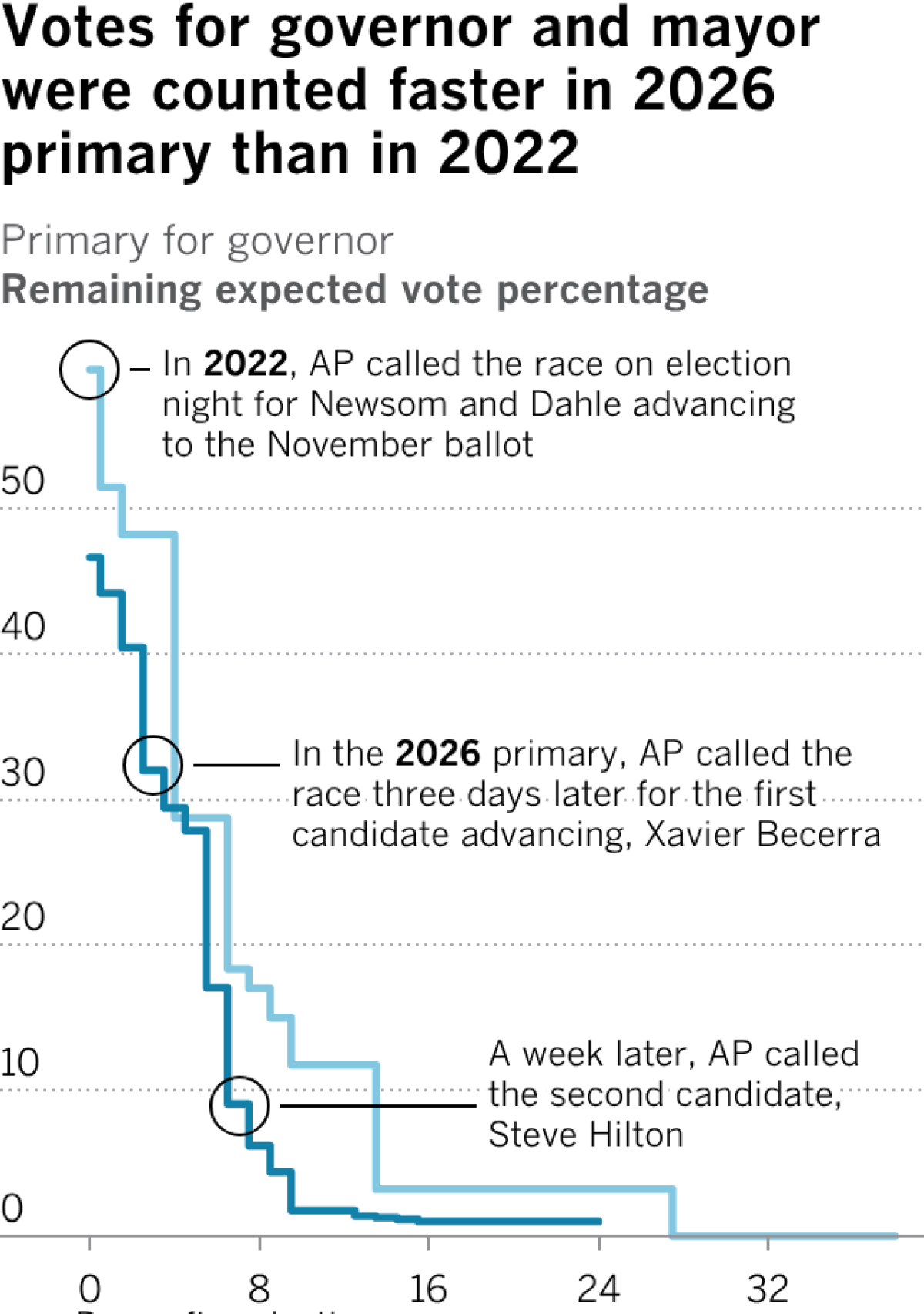
Compared with the last time both governor and Los Angeles mayor were on the ballot, county election officials counted more ballots, and tallied them faster than in 2022, The Times found.
In Los Angeles County, turnout jumped from 28% of eligible voters in the 2022 primary to 38% this June, according to the county registrar. Meanwhile, the share of vote-by-mail ballots dropped about 3 percentage points to 82%, indicating a rise in in-person voting.
Statewide, early results show 41% of registered voters turned up for the June election, up from 33% in 2022, according to the secretary of state. County elections officials must report their final results by July 3, giving state officials a week to certify all election results.
The Los Angeles Times reports election results from the county clerk as well as from the Associated Press. The AP provides ballot counts, a calculation of the expected vote and race calls for statewide and national races.
The expected vote percentage, or EEVP, is an estimate of the total number of votes that will eventually be certified. That number can be adjusted based on new information over time.
“Before counting begins in California, our estimates are primarily informed by turnout in past similar elections plus pre-election data on ballot returns, with projections based on what percentage of ballots had already been received at the same point in past elections,” AP director of election analytics Emily Swanson said in an email.
In the gubernatorial and mayoral races, more than half of the votes were counted by the end of election day, EEVP data show.


Swanson’s team also observed a faster vote count this year than in the 2022 and 2024 primaries.
In January 2024, L.A. County consolidated its election operations into a new ballot processing center in the City of Industry. Dean Logan, head of the L.A. County registrar-recorder/county clerk’s office, told The Times earlier this month that the facility, which is open to observers, is designed for transparency, security and efficiency.
“It doesn’t take long to count. The counting process is very fast,” Logan said ahead of election day. “What extends the time period is those options that are provided under California law for voters — to allow everyone the opportunity to vote up until election day, and then allowing us the time to process those with the same level of security and integrity that we did the ballots that were received two weeks before the election.”
Despite the faster count, the Associated Press took longer to call winners, suggesting these races were more competitive. The AP makes such declarations by determining whether there is an opportunity for a trailing candidate to catch up to the race leader. It has been calling races for nearly 180 years.
Both the gubernatorial and Los Angeles mayoral race saw a 30% increase in votes from 2022. The governor’s race received more than 9.2 million votes compared with 7 million in 2022. The Los Angeles mayor’s race received more than 850,000 votes, an increase from nearly 650,000 in 2022.


The vote counting process for California, Washington, Oregon, Nevada and Alaska may change for the November midterm election, depending on which way the U.S. Supreme Court rules.
Data and graphics assistant editor Sean Greene contributed to this report.