Dodgers Dugout: Remembering Davey Lopes
Hi, and welcome to another edition of Dodgers Dugout. My name is Houston Mitchell. Today, we remember a Dodgers icon.
Sad news in Dodgersland this week as Davey Lopes, member of the famed Garvey-Lopes-Russell-Cey infield, died at the age of 80.
“Even though Davey may have been the less visible of the famous long-running Dodger infield with Cey, Russell and Garvey, his impact on the team’s success was huge,” former Dodgers owner and president Peter O’Malley told The Times. “All Dodger fans will always remember the excitement he gave us on the basepaths and I admire his commitment to the game managing, coaching and instructing after his playing days.”
Lopes was born May 3, 1945, in East Providence, R.I. He did not remember his father, who died when Lopes was 2. His mother, Mary Rose, supported Lopes and his nine siblings on the meager salary she earned as a maid. Lopes found solace in baseball.
“If it hadn’t been for sports, there’s no telling what I’d be or where I’d be,” Lopes told former Times baseball columnist Ross Newhan in 1973. “I had one glove until I got to high school. I guess I can admit now that I confiscated more than a few bats and balls.”
Lopes found a mentor in baseball coach Michael Sarkesian, who usually coached the team Lopes was playing against while growing up. Sarkesian remembers Lopes, though, and brought him to Iowa Wesleyan when Sarkesian became the athletic director there.
“Whatever I missed by not really having had a father, Sarkesian provided,” Lopes told Newhan. “He could relate to my problems, my environment. The drive, the determination, not to give in to the ghetto, to make something of my life, stems from my relations with him.”
Lopes was an NAIA All-American at Wesleyan and then followed Sarkesian to Washburn University in Topeka, Kan. He hit .380 and was selected by the San Francisco Giants in the seventh round of the 1967 MLB draft. He turned them down, then signed with the Dodgers when they chose him in the second round of the secondary phase of the 1968 draft.
He played his first two seasons at Class A Daytona Beach, hitting .247 with 26 steals in 82 games in 1968, then hitting .280 with 32 steals in 72 games in 1969.

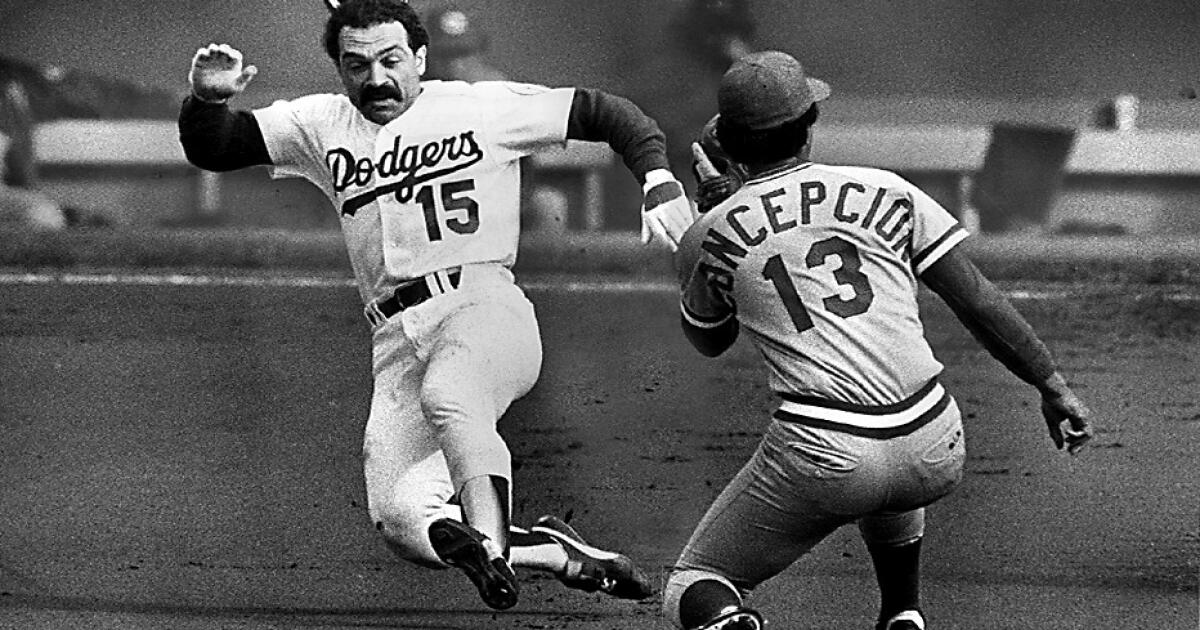
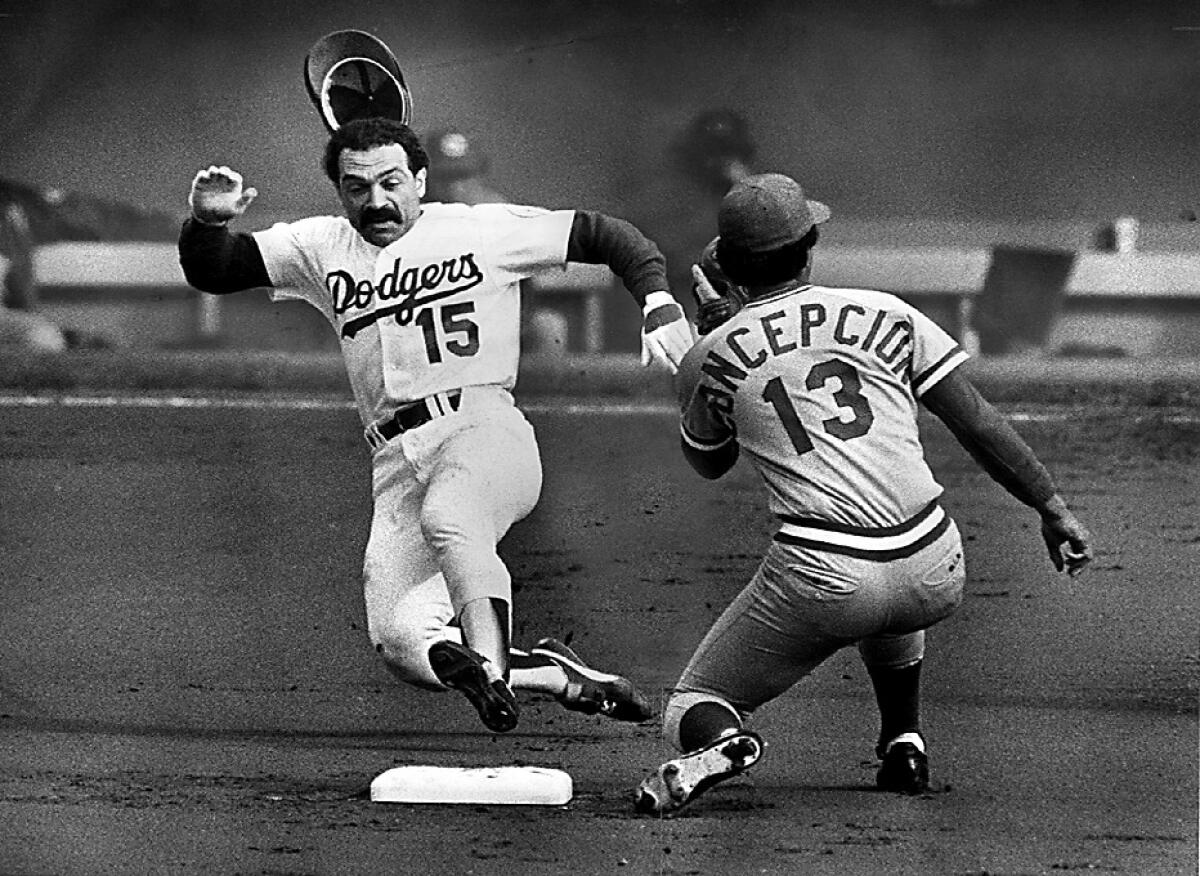
Davey Lopes steals second while Reds shortstop Davey Concepcion awaits the throw in a 1980 game.
(Joe Kennedy / Los Angeles Times)
Lopes was promoted to triple-A Spokane in 1970, and it was there that he met Tommy Lasorda, who was managing Spokane, and where the Dodgers converted Lopes from an outfielder to a second baseman under the tutelage of Monty Basgall. He was focused on learning a new position and stole only 11 bases, but rebounded in 1971 to hit .306 with 27 steals.
After another standout year in 1972, the Dodgers called him up to the majors for the first time for the final two weeks of the season. He stole four bases in four attempts.
At spring training in 1973, Lopes battled with Lee Lacy for the second base job and lost. But Lacy got off to a terrible start and Walter Alston made Lopes the starting second baseman on April 22. And he remained the starting second baseman until the 1982 season.
Eventually, Bill Russell, Ron Cey and Steve Garvey found their way into the starting lineup and on June 23, 1973, the foursome started together for the first time and stayed together for nine seasons, the longest-running infield in MLB history.
Lopes was the spark plug atop the lineup, becoming one of the best base stealers in the game. “I realize that when I’m running and stealing bases, I’m setting the momentum and getting the adrenaline going for the rest of the lineup,” Lopes told Newhan in 1974. “And until someone proves he can stop me, or the situation dictates I don’t run, I’m going to be stealing all the time.”
Hall of Fame catcher Johnny Bench once called Lopes the best base stealer in the game.
Beginning in 1975, Lopes racked up some impressive stolen base numbers:
1975*: 77 steals, 12 caught stealing, 86.5% success rate.
1976*: 63 steals, 10 caught stealing, 86.3%
1977: 47 steals, 12 caught stealing, 79.7%
1978: 45 steals, four caught stealing, 91.8%
1979: 44 steals, four caught stealing, 91.7%
*-Led league in steals.
In those five seasons, he stole 276 bases and was caught only 42 times, an amazing 86.8% success rate. He is the best base stealer in Dodger history. Maury Wills stole more often, but Lopes was more successful.
In 1975, Lopes stole 38 bases in a row from June 10 to August 24 to break Max Carey’s mark of 36 in a row set during the 1922-23 seasons. He was finally thrown out by Montreal’s Gary Carter in the 12th inning of a game.
In postseason play for the Dodgers, Lopes hit .241 with six home runs, 22 RBIs, 28 runs scored and 20 steals in 50 games, as the Dodgers lost in the World Series to Oakland (1974) and the Yankees twice (1977-78) before finally breaking through against the Yankees in 1981.
Lopes’ mentor with the Dodgers was Jim Gilliam. One day after the Dodgers won the 1978 NLCS, Gilliam died, leaving Lopes distraught. He channeled his emotions into an incredible Game 1 of the World Series, hitting two home runs and driving in five in an 11-5 rout. After his first homer, Lopes pointed to the sky to acknowledge Gilliam. A couple of years later, “The Bronx Zoo” by Yankees reliever Sparky Lyle was published. In it, he wrote about Lopes, saying, and I’m paraphrasing here, that it was bush league for Lopes to put up “We’re No. 1” while circling the bases, that the Dodgers had no class and that the Red Sox were better than the Dodgers. He had missed the point completely.
“They can do anything they want with us now,” Lopes said after the 1981 World Series victory. “I’ve got the ring. They can’t take that away from me.”

From left, Ron Cey, Bill Russell, Davey Lopes and Steve Garvey reunite in 2013.
(Los Angeles Times)
His comments contained a bit of foreshadowing. Lopes had his worst season in 1981, hitting .206 in 58 games of a strike-interrupted season (though he still stole 20 bases while being caught only twice). The Dodgers had prized prospect Steve Sax waiting in the wings. So, on Feb. 8, 1982, the Dodgers traded Lopes to Oakland for Lance Hudson. If you’ve never heard of Hudson, that’s OK, because he never made it to the majors. In essence, the Dodgers gave Lopes away for nothing.
Lopes was far from through, though. He hit .242 with the A’s in 1982 and .277 with 17 homers and 22 steals in 1983. Oakland sent him to the Chicago Cubs near the end of the 1984 season for pitcher Chuck Rainey. And in 1985, Lopes had a season for the ages, or at least, aged. At the age of 40, he stole 47 bases and was caught only four times while hitting .284/.383/.444 with 11 homers and 44 RBIs in 99 games. It is still the record for most stolen bases at age 40. Rickey Henderson is next with 37 in 1999.
Lopes finished his career with two seasons with the Astros, retiring after the 1987 season. He then began a long career as coach and manager, including a stint as first base coach for the Dodgers from 2011-15. Then GM Ned Colletti made it his mission to bring Lopes back as a coach.
Colletti had this to say after learning of Lopes’ death: “Davey Lopes transformed coaching at first base. His situational awareness and intricacy of coaching first base was the best I have ever watched. He changed a coaching position and how it was executed — base running, secondary leads, pitch tipping, cutting your steps from first to third.
“His contract has expired in Philadelphia [after the 2010 season] and I went and recruited him back. He helped players and, therefore, teams, get better. He could find any advantage and he was a great teacher. He was one of my favorite people.”
Former Dodgers reliever Tom Niedenfuer, who played with Lopes on the 1981 championship team, had this to say: “Davey was 15 years older than me and he was quiet with us new guys. But he treated us as equals and was helpful. It had to be tough seeing Sax come up and knowing his days were numbered.”
Among the 112 players with at least 350 stolen bases, Lopes is fifth in stolen base percentage:
1. Tim Raines, 808 steals, 146 caught, 84.7%
2. Willie Wilson, 668-134, 83.3%
3. Barry Larkin, 379-77, 83.11%
4. Tony Womack, 363-74, 83.07%
5. Davey Lopes, 557-114, 83%
6. Jimmy Rollins, 470-105, 81.7%
7. Carl Crawford, 480-109, 81.5%
8. Ichiro Suzuki, 509-117, 81.3%
9. Joe Morgan, 689-162, 81%
10. Vince Coleman, 752-177, 80.9%
Rickey Henderson is 11th with an 80.8% success rate. Maury Wills is 42nd at 73.8%. Steve Sax 49th at 71.4%. Ty Cobb 81st at 64.3%.
How was Lopes so successful? In an interview with Ross Porter, he said, “Well, it’s just not running by chance. I studied the pitchers. I tried to look for idiosyncrasies in their bodies that tell me when they go to first base compared to going home. Try to pick that up, react to it as quickly as I possibly can.”
He also told Porter his favorite moment of his career: “Actually, the first time I ran on the field. It was like I had reached a goal I set as a kid — to be a Dodger. I always wanted to be a Brooklyn Dodger, but for some reason, they left Brooklyn. We won’t get into that. But to do it as a Dodger — that meant everything. It was kind of like second best, but it was like I arrived.”
As a leadoff hitter, Lopes would often bat after the pitcher. I always enjoyed watching Lopes stall for time when the pitcher had to run hard during his at-bat. To give the pitcher ample time to rest in the dugout, especially if there were two out, Lopes had a variety of delay tactics before getting to the batter’s box. He’d give a couple of extra swings in the on-deck circle. He’d walk to the plate, then stop and go back to the on-deck circle to get some extra pine tar. He’d “have trouble” getting the weighted circle off his bat. He’d take the first pitch and then call time. It was a master class in looking at the big picture.
Our best wishes to Lopes’ family, friends and former teammates. He will be missed.
More sad news
Miguel Rojas was all set to play Tuesday against Toronto when he learned that his father had passed away in Venezuela.
“There’s nothing I could do being this far,” Rojas told reporters Wednesday. “Just support my family, and trying to understand a little bit of what’s going on. I found out that my dad, on the way to the hospital, passed away. He couldn’t live through the heart attack that he had. So it was suddenly that he passed away; he was feeling good. Really hard to understand. I’m still trying to process the whole thing.”
Micky Rojas’ funeral was Wednesday. “That’s how they do things in Venezuela,” Miguel Rojas said. “It happens quick because they have to. They don’t have many places to hold these funerals.”
Rojas played Wednesday and wanted to play Tuesday until a couple of Dodgers talked him out of it. He said later he was glad that Dave Roberts and Freddie Freeman took that decision out of his hands. But Rojas was adamant about playing Wednesday.
“It’s going to be emotional, yes, for me, I understand that,” Rojas said. “But I’ve been through moments like this before with my mom, my grandparents. I know what they want me to do is play baseball. They raised me up and they gave up everything in their life for me to be a baseball player. This is what they want me to do. They know how much pride I take in showing up every day, and not letting my teammates down.”
We send out best wishes to Rojas and his family. You can read more about the situation in this story by Maddie Lee.
What about the team?
We will discuss the team in detail starting next week. It has been a strange two weeks with Charley Steiner, Lopes and Rojas, and sometimes life is more important that baseball. I received over 500 emails about Steiner, and some of them will appear in a special edition of this newsletter in the next couple of weeks.
Up next
Friday: Texas (Kumar Rocker, 0-1, 3.60 ERA) at Dodgers (Tyler Glasnow, 1-0, 3.00 ERA), 7:10 p.m., Sportsnet LA, AM 570, KTNQ 1020
Saturday: Texas (Jack Leiter, 1-0, 2.45 ERA) at Dodgers (Emmet Sheehan, 1-0, 8.00 ERA), 6:10 p.m., Sportsnet LA, AM 570, KTNQ 1020
Sunday: Texas (Jacob deGrom, 0-0, 3.72 ERA) at Dodgers (Roki Sasaki, 0-1, 7.00 ERA), 1:10 p.m., Sportsnet LA, AM 570, KTNQ 1020
*-left-handed
In case you missed it
Tough day for Dodgers and Miguel Rojas following the death of his father
Davey Lopes, part of Dodgers’ historic infield and World Series winner, dies at age 80
These Canadian kids absolutely torched Freddie Freeman — and all for a good cause
Shohei Ohtani matches Ichiro’s on-base mark and adds to another impressive streak
Shaikin: Yoshinobu Yamamoto winning a Cy Young doesn’t mesh with a Dodgers three-peat
Shaikin: Dodgers continue to be the evil American mercenaries Toronto fans love to hate
Dodgers’ Andy Pages scorching start at the plate turning heads. ‘I really like his work’
Mookie Betts offers no specific timeline on when he’ll return from injury
And finally
Davey Lopes hits two home runs in Game 1 of the 1978 World Series. Watch and listen here.
Until next time….
Have a comment or something you’d like to see in a future Dodgers newsletter? Email me at houston.mitchell@latimes.com. To get this newsletter in your inbox, click here.