Judy Baca faces questions about ‘Great Wall,’ SPARC, Mellon grant
At more than 2,700 feet, “The Great Wall of Los Angeles” is one of the longest murals in the world and among the most important public artworks in the city. Created by artist Judy Baca between 1974 and 1984, the mural is a groundbreaking depiction of Southern California history from the viewpoint of women and minorities and a potent national symbol at the intersection of art and activism.
Baca’s leadership of the collaborative project made her a legend in the art world. She is the co-founder and artistic director of Social and Public Art Resource Center, or SPARC, a community mural nonprofit and has been hailed as one of the most influential figures of L.A.’s Chicano muralism. “The Great Wall” is on the National Register of Historic Places, and Baca is a National Medal of Arts recipient.
But now Baca, 79, has come under criticism from some of those who have worked most closely with her in recent years.
In interviews, 10 former SPARC employees — including two managers — accuse Baca of using her nonprofit to benefit her private, for-profit art practice, Judy Baca Inc. They allege Baca personally benefited from a $5-million Andrew W. Mellon Foundation grant to expand “The Great Wall,” sold the project’s archives to the Lucas Museum of Narrative Art at a large profit to herself, and has blurred the line between her nonprofit and for-profit endeavors.
Baca and SPARC’s board chair, Zojeila Flores, vigorously deny any impropriety or misuse of funds. In an interview, they said grant funds were used appropriately and that Baca maintains a mutually beneficial profit-sharing agreement with SPARC.
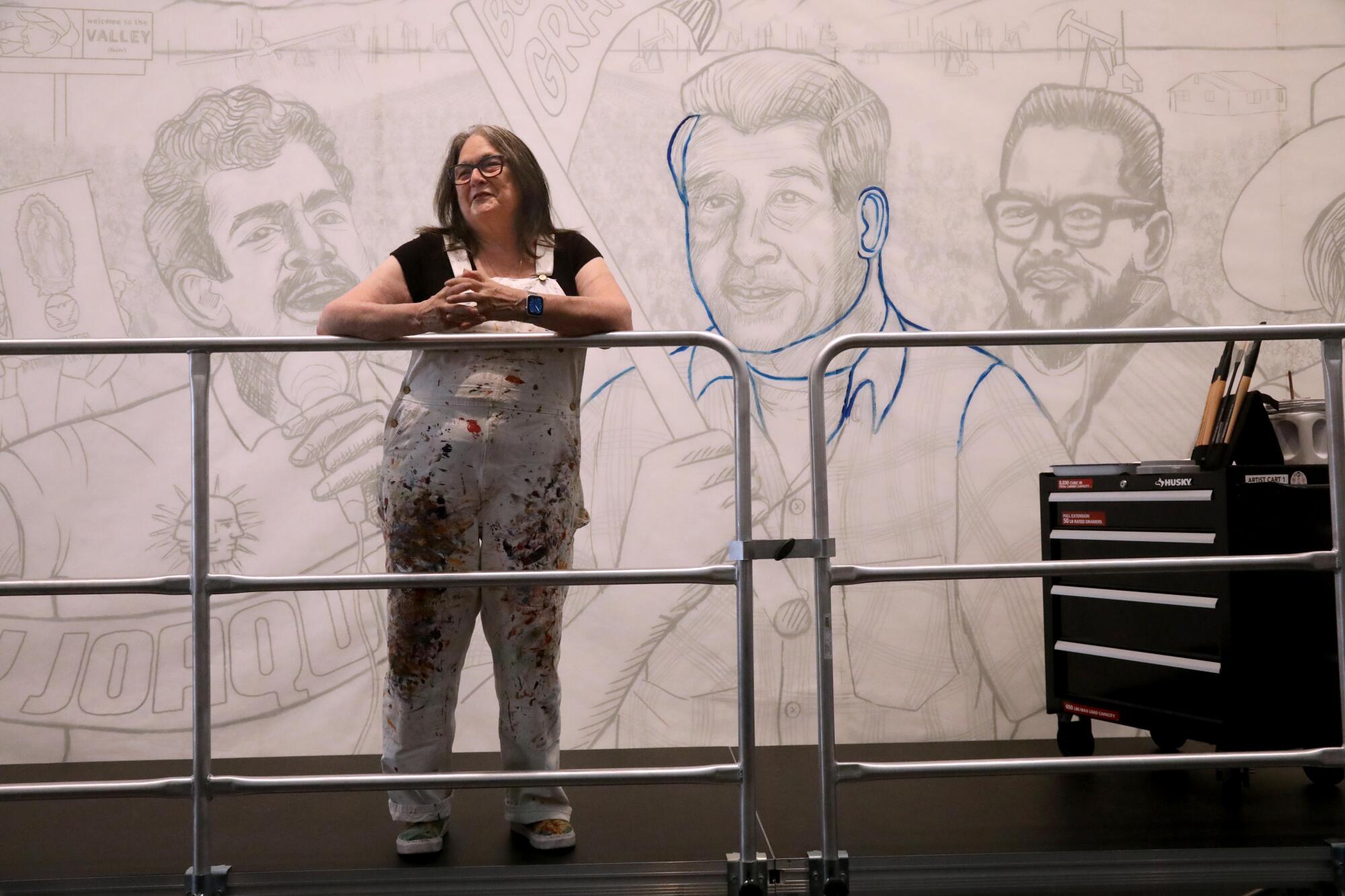
Baca ascribes the criticism to disgruntled former employees and hopes SPARC can finish its work on the mural “without more of this sort of rage and hostility and anger and hate.” It’s on schedule to be completed by 2028, she said, showing The Times sections of the mural in progress at a rented space at Bergamot Station Arts Center, an acclaimed, high-end gallery in Santa Monica.

Artist Judy Baca talks to the media after starting to paint a new section of “The Great Wall of Los Angeles” as part of a LACMA exhibition on Oct. 26, 2023.
(Genaro Molina / Los Angeles Times)
Baca supporters believe she is a visionary who has used the reputation she earned with “The Great Wall” to continue lifting underserved communities.
“I don’t know how to better serve a community than to represent them well,” said Kelly Watts, who, as a teen in the 1980s, participated in painting “The Great Wall” as a student artist. Watts now lives in Tennessee and said she isn’t familiar with the inner workings of SPARC but that what matters to her is Baca’s guidance over the years. “Judy has been a mentor of mine and has always been a really positive influence on me and my growth as an artist.”
The $5-million grant
At the root of the allegations is Baca’s 2017 announcement that she intended to expand “The Great Wall” to include hundreds of feet of new imagery, representing history from the 1960s up to the present day. The mural, which is in a floodwater channel that runs through the leafy Valley Glen neighborhood in the San Fernando Valley, originally concluded with depictions of two Olympic gold medalists, track star Wilma Rudolph and Native American runner Billy Mills. Baca also sought to add interpretive stations, illuminate the mural at night and build a pedestrian bridge over the Tujunga Wash flood control channel to provide a better view of the work.

Judy Baca painting “The Great Wall of Los Angeles” in 1983.
(SPARC Archives / SPARCinLA.org)
Baca’s goals were boosted in 2021 when the Mellon Foundation — one of the largest and most important nonprofit funders of art projects in the nation — supported “The Great Wall” plans with a $5-million grant to be paid over three years, ending in 2024. The grant was distributed through Mellon’s newly formed $250-million Monuments Project “to express, elevate, and preserve the stories of those who have often been denied historical recognition.” (Los Angeles County Museum of Art, the Emmett Till Interpretive Center in Mississippi and other noted institutions also received separate grants.)
Among those who question Baca’s stewardship of the grant are Pete Galindo, a former director of the Great Wall of Los Angeles Institute, which SPARC formed to oversee the mural expansion, and Carmen Garcia, who served as director of SPARC for six months ending in early 2023. Both alleged Baca required SPARC employees to also do work for Judy Baca Inc., Baca’s private business for her art.
Garcia resigned after repeatedly raising concerns about alleged misappropriation of Mellon grant funds, which Baca denied, and calling for the board to investigate Baca. She said she was “forcefully” led out of the building.
Galindo was fired in February 2022 after less than a year in his role. He alleges Baca terminated him in retaliation for questions he raised about how she was using the grant and objecting to her work assignments. Before his Great Wall Institute role, Galindo said he had known Baca for nearly 30 years, beginning as a UCLA student in 1996 and later working in various roles on a variety of SPARC initiatives, including as a community public art director.
According to documents reviewed by The Times, including Galindo’s offer letter and a spreadsheet with Mellon grant line items, Galindo’s $75,000 salary was paid through SPARC and the grant, which stipulates the money be used “to support the preservation, activation, and expansion of one of the country’s largest monuments to interracial harmony through civic engagement and muralist training.” But Galindo alleged Baca assigned him work outside SPARC and the Great Wall: to help sell her personal artwork, aid in fixing a termite infestation in her archives and help to manage the production of a mural titled “La Memoria de la Tierra: UCLA,” which was not related to “The Great Wall.”
The Times reviewed a series of text messages between Galindo and Baca in which Baca asked Galindo to help with jobs outside his Great Wall duties, including dealing with termites. The messages included a question to Baca from Galindo confirming she’d like the team to “print the UCLA mural at scale for review.” Baca replies that she will call momentarily. Another group chat between Galindo and two other SPARC employees is about meeting to move Baca’s belongings out of her office at UCLA in 2021.
Baca denied Galindo’s allegations, including that she asked Galindo to help manage the UCLA mural — a task outside of the Mellon grant’s purview. She said the project was brought to her personally and she referred the work to SPARC. The mural was completed on-site through a research and teaching facility known as the Digital/Mural Lab, she said. SPARC received money for the project, Baca wrote in a statement, although Baca got paid a commission — an “established practice” at SPARC for paying artists for their work.
In an interview, SPARC board chair Flores declined to say how much Baca earned from that project or Baca’s specific commission rate. However, on a hypothetical $200,000 project she said about $58,000 could go to SPARC for costs and fees. The remaining $142,000 could go to other vendors and Baca.
For decades, Baca brought in dozens of commissions to SPARC without being paid, SPARC said in a statement. The board voted to change that in recent years with a so-called “fiscal sponsorship arrangement,” which allows paid projects to piggyback on SPARC’s tax-exempt status. In this case, Baca earns a commission and SPARC receives funds for employee work on projects.
SPARC’S website currently lists nine board members. Baca and Flores are included, as is Mercedes Gertz, who rents an art studio in SPARC’s building. Baca’s cousin, Anthony Salcido, serves as the board’s finance chair. Bookkeeper Gloria Thompson is also Baca’s cousin.
“Mr. Salcido began working with SPARC only after consultation with legal counsel and Board approval, with Judy recused from the vote,” Flores wrote in an email. “Ms. Thompson began with SPARC as a volunteer and later became bookkeeper following formal consultation with legal.”
In 2022, after he was fired from SPARC, Galindo wrote a letter to Emil J. Kang, then the Mellon Foundation’s program director for arts and culture, to allege that Baca had misused the Mellon grant money by asking him to do work for her personal business.
“Throughout my time as the Great Wall of Los Angeles Institute Director, she focused my work on her personal exhibitions, sale of artworks, training her personal assistant, overseeing commissions, press and documentation,” Galindo wrote in the letter, concluding, “While Judy’s contribution to the field over the years cannot be denied, her treatment of employees, unequal pay scales and overall exploitation of staff and artists is anathema to the values and ideals of social justice movements and the monuments they inspire.”
Baca said she could not comment on personnel matters, but in a statement, SPARC said, “We strive to be fair and professional in all our personnel matters.”

Judy Baca poses in front of her artwork “La Salsera” at LA Plaza de Cultura y Artes in downtown Los Angeles in 2024.
(Christina House / Los Angeles Times)
Galindo said he did not receive a reply to his letter from Kang or the Mellon Foundation.
The Mellon Foundation issued a statement to The Times, confirming it had received Galindo’s letter, which “was handled in accordance with Mellon policy on third party complaints about our grantees.” The foundation added that it “does not comment on issues pertaining to internal matters of its grantees.” SPARC’s grant status never changed.
Garcia, who was hired as SPARC’s executive director after Galindo left the organization, remembered dealing with heightened inquiries from Mellon representatives, including culture program director Kang. Once, she said, the foundation asked SPARC for additional information on how grant money was being spent.
SPARC said in its response to The Times that such questions from funders were routine.
“Mellon consistently reviews all of its grantees’ performance, as is standard for nonprofit funders,” SPARC said.
Baca told The Times that she was unaware that Mellon had raised questions about how the grant was being used. However, in a text exchanged with Garcia in 2023 and reviewed by The Times, she indicated she had spoken to Kang at a National Medal of Arts event in Washington, D.C.
“They will ask us to improve some things but generally we had a long discussion and lots of laughs about me ‘hating the interrogation by a bunch of white me[n],’” Baca wrote. “He got a laugh out of it and knew they were a pain in the a—.”
When asked about the text she sent to Garcia, Baca said, “It was an informal conversation at a White House reception. We didn’t talk about the specifics of the grant itself. The conversation really was about the review process.”
Who should profit from ‘The Great Wall’?
Work on “The Great Wall of Los Angeles” began in 1974 and was completed over five summers by Baca with the help of many now well-known artists including Isabel Castro, Ulysses Jenkins, Judithe Hernández, Patssi Valdez, Margaret Garcia, Christina Schlesinger and Judy Chicago. More than 400 young people and their families — many from underserved neighborhoods — also contributed to the project, including 80 youths recruited from the juvenile justice system.
The collective effort made “The Great Wall” a work of social justice, and in 1976 led to the founding of Baca’s nonprofit, SPARC, with its stated mission of producing, preserving and promoting, “activist and socially relevant artwork,” and fostering “artistic collaborations that empower communities who face marginalization or discrimination.”

“The Great Wall of Los Angeles” on April 9, 2025.
(Carlin Stiehl / For The Times)
Some former SPARC employees feel that Baca has failed to honor the community that toiled to create “The Great Wall.” They have expressed concern that Baca has benefited unfairly from the project, and, in particular, the sale of work related to it.
Flores disagrees, writing, “For 50 years, SPARC has used art to empower communities facing marginalization and/or discrimination. This currently includes immigrant populations traumatized by ICE. Further, SPARC ensures that working artists can remain in Venice, a neighborhood with deep artistic and cultural roots.”
When “The Great Wall” was originally copyrighted in 1983, authorship of the work was attributed to both “Judith F. Baca” and the “Social Public Art Resource Center.” In 2011, however, after a restoration effort led by SPARC in which the mural was completely painted over, the project was again copyrighted, this time solely under Baca’s name. Former employees question the ethics of Baca’s profiting off a celebrated community effort, but Flores said Baca has always retained ownership of her work and that, “Owning a copyright is not the same as owning an artwork itself.” Baca, Flores said, evenly splits copyright licensing fees with SPARC.
Baca sold “The Great Wall” archives to the Lucas Museum in 2021. The sale included more than 350 objects and ephemera, including concept drawings, site plans, sketches and correspondence with community leaders, scholars, historians and collaborators.
A Lucas Museum representative declined to comment on how much the museum paid for the archive or whether or not the acquisition was made from Baca or SPARC.
Galindo said he was told by former SPARC executive director Carlos Rogel that it sold for $1.5 million. Rogel declined a request for comment. Another source close to SPARC, who asked to remain anonymous out of fear of retaliation, also said the sale was for $1.5 million.
Baca and Flores declined to say what the archives sold for. In an emailed response, Flores wrote that Baca was the owner of “The Great Wall” archive and was not paid by SPARC to produce that work.
“Nonetheless, following the sale, and although Judy was not required to do so, she generously donated $521,000 to SPARC,” Flores wrote.
Galindo and other former employees also expressed concern about Baca’s rising salary and believe it is out of proportion with SPARC’s mission of uplifting and aiding underserved communities and youth. In the two years prior to receiving the Mellon grant, Baca made $42,916 and $50,000, respectively. The year after SPARC received the grant, Baca’s salary rose to $215,000. In 2023, she made $236,149, and the following year, $211,004. The increase in Baca’s salary is discussed in an internal email and executive board meeting minutes reviewed by The Times, which state that SPARC’s board voted to set Baca’s annual compensation to be commensurate with what Baca was paid before she retired as a UCLA professor and that the additional money should come from the Mellon grant. Records of her 2025 and 2026 salaries were not currently available.

“The Great Wall of Los Angeles” depicts the history of California through the 1950s. An expansion to be completed in 2028 will add scenes from the 1960s to 1990s.
(Carlin Stiehl/For The Times)
SPARC said in a statement that Baca’s salary “is lower than the market rate for similar non-profit CEOs and lower than the market value commissioning rate for artist Judy Baca who is the author of The Great Wall Mural.”
Ongoing work on “The Great Wall” is currently done by a variety of people. For the new panels, which begin with the civil rights era of the 1960s, research is done by Baca and her team from the Great Wall Institute (there is currently no institute director, according to SPARC’s website). From there, Baca creates rough drawings, and drafts are made by artists from SPARC’s Digital/Mural Lab. Baca suggests edits and gives directions, and later she will add her own personal touches.
Eventually, colorations are submitted by various artists, and Baca does one final hand coloration of the entire piece. During The Times’ visit to see the mural expansion in progress, two artists were painting on sketches that had been fine-tuned by Baca and printed onto giant panels. These panels will eventually be attached to the wall of the flood water channel where “The Great Wall” resides, Flores said.
Former SPARC digital mural artist Toria Maldonado alleged it was not always clear if the work they were doing was for SPARC or for Judy Baca Inc. They were asked on occasion to work on assignments that appeared to be for the benefit of the latter, Maldonado said.
Maldonado said they and two other SPARC employees once redrew the 1960s segment of “The Great Wall” for a private collector. Baca, Maldonado said, “was selling a print, and wanted to refine it, and had us do that assignment.” Maldonado shared a checklist with The Times featuring notes about what work needed to be done on the segment, including shading Malcolm X’s hair.
In an email, Flores called Maldonado’s allegations, “factually inaccurate” and “misleading.”
“Judy was the owner of the segment referenced. It was hand-colored by Judy and assistants whom Judy paid personally, and this work was done in her personal studio,” Flores wrote. Baca’s studio is a Frank Gehry-designed space at her Venice home.
Maldonado said that they had never been to Baca’s personal studio and that their salary was always paid through SPARC.
From May through August 2023, segments of “The Great Wall” were exhibited at Jeffrey Deitch Gallery in L.A. Baca didn’t sell any works during that show, Flores wrote in an email, but in 2025, “a coloration by Judy’s hand of a segment presented in that show was sold. This work was created in Judy’s private studio and owned by her.” Baca declined to disclose how much the segment sold for. SPARC began showing more of “The Great Wall” expansion in February at Jeffrey Deitch Gallery. The original panels will not be for sale, but “if a work of Judy’s is sold at the show, she receives the proceeds as the owner of the work,” Flores wrote.
The room where art happens
Galindo and Garcia also alleged that SPARC inappropriately leases its premises to board member Gertz and others.
Since 1977, SPARC has been housed in a former Venice police station and jail, a 1920s Art Deco building owned by the city of Los Angeles. In 2000, the city signed a lease allowing SPARC to use the building for free until 2055. That agreement stipulates the property be used for “production, exhibition, promotion and distribution of and education about public art on a nonprofit basis.” SPARC can sublease portions of its building to those engaged in similar work with a city official’s approval. It must submit annual financial reports to the city with earnings from such deals.
The Times reviewed Instagram posts made by Gertz touting a 2023 exhibition of her personal art at SPARC, another in 2024 advertising a holiday sale, as well as one that shows her working in her studio inside the building. SPARC said Gertz pays market rate for her studio but declined to specify how much that is, only that it is, “equivalent to the rent paid by all the other artists who sublet space in the building.”

Judy Baca outside her Venice nonprofit, the Social and Public Art Resource Center, better known as SPARC, in 2021.
(Gary Coronado / Los Angeles Times)
According to documents obtained through a California Public Records Act request, the city only has one sublease on file for SPARC from 1991. When asked if the city had approved SPARC’s deal with Gertz, Amy Benson, the director of the city’s real estate services division, wrote in an email that she had no further information to provide.
Flores wrote in an email that she was unable to speak to the specifics of a question about whether or not SPARC submits annual financial reports, inclusive of its subleasing income, to the city but noted, “we will follow up to make sure that the City has the documents you mention.” According to the latest available tax filings, SPARC made $64,991 in “rental property income” in 2024 and $57,590 in 2023.
Asked if Gertz’s use of SPARC for her personal, for-profit art practice, violates SPARC’s understanding of the lease, Flores wrote, “Our understanding is that our lease allows any use of the premises that is reasonably consistent with our nonprofit mission… Ms. Gertz uses her studio to weave textiles and also to lead art workshops for immigrants in the community, an activity that we think is entirely in keeping with our mission.”
Baca has also sold her personal art for profit at SPARC. When Baca’s art is for sale she “is treated like all other artists” and receives 60% of profits, the nonprofit said in a statement.
According to SPARC’s website, of the eight exhibits presented by SPARC in Venice and at Bergamot Station since 2022, five showcased Baca’s work, including on “The Great Wall,” and one featured work by Gertz. The remaining two shows accounted for roughly five months of programming in more than three years.
“I’m certain there are hundreds of artists in Los Angeles making socially engaged work who would benefit from a solo exhibition at SPARC,” Galindo wrote in an email.