An airport has revealed an easy trick for a shorter wait at airport security
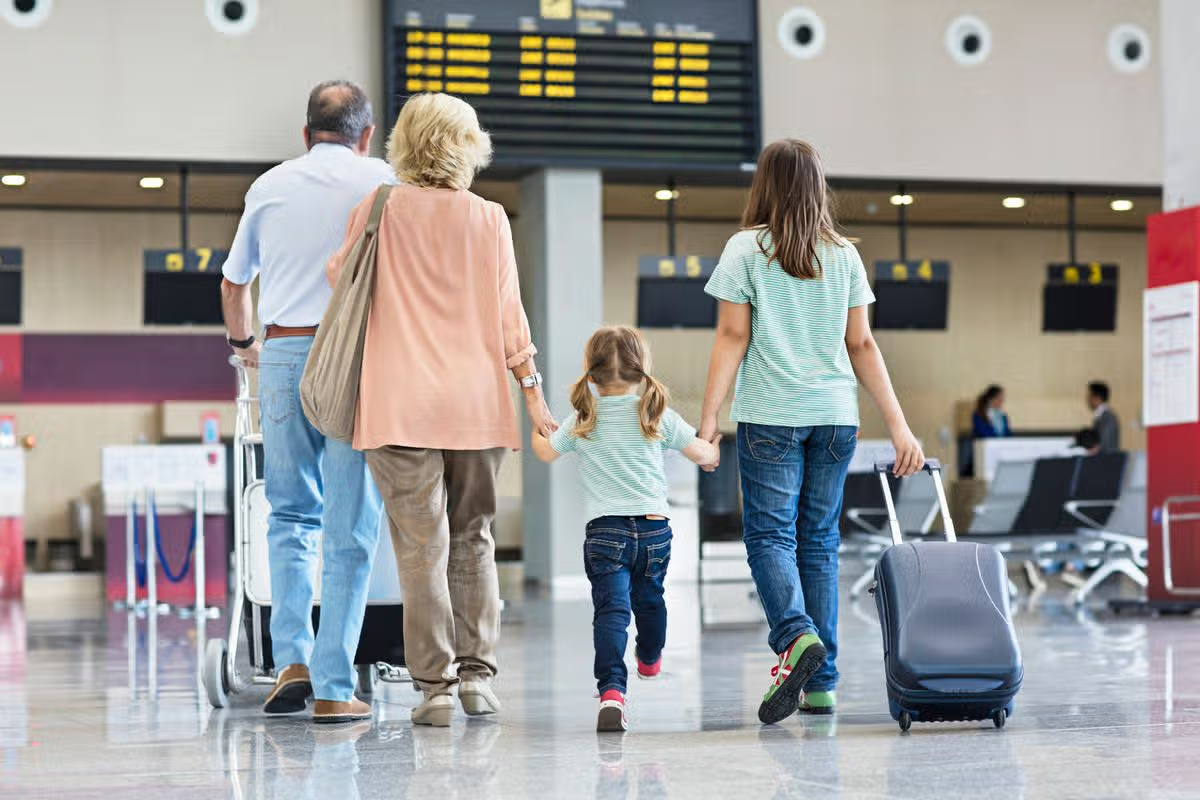
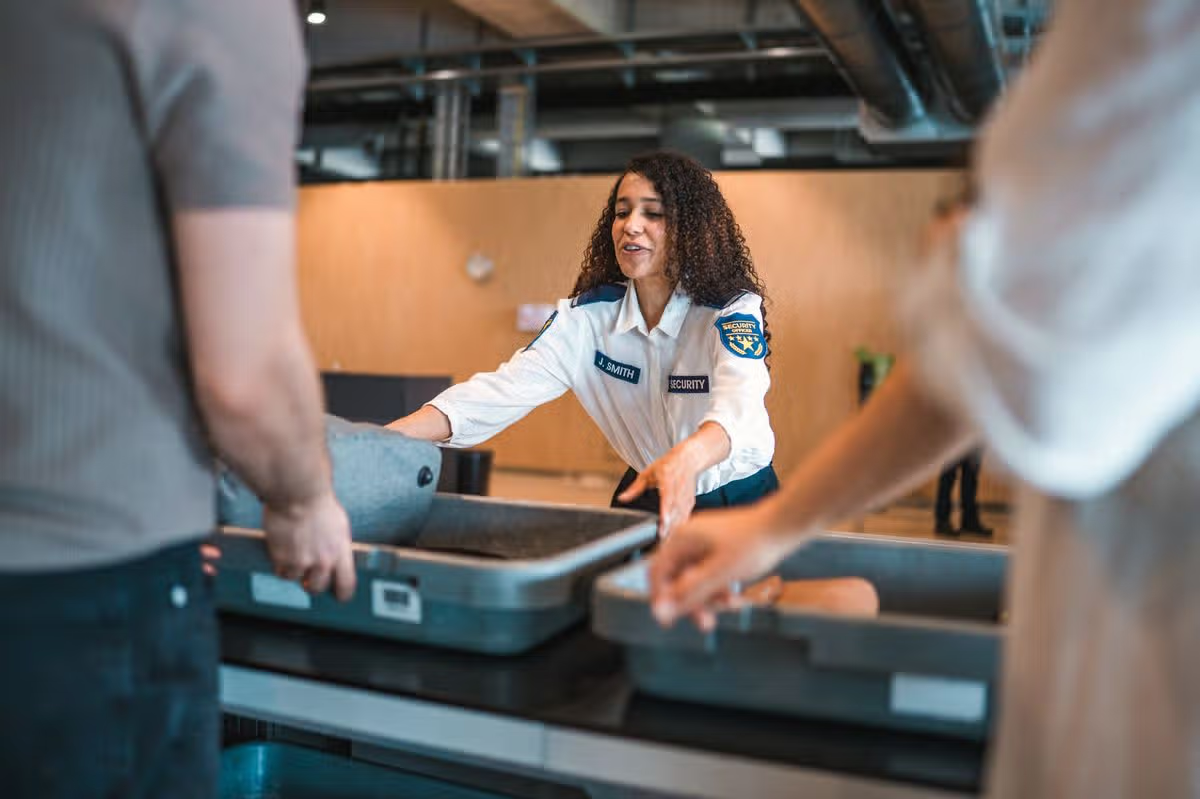
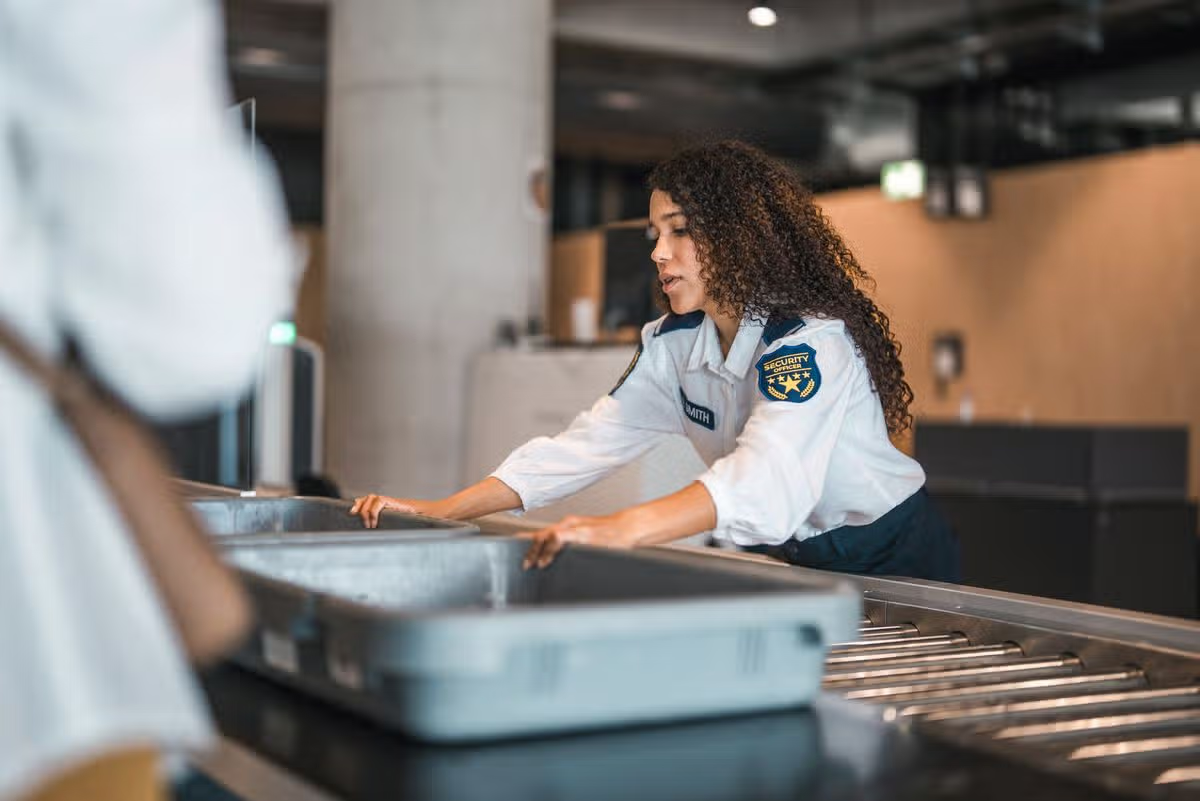
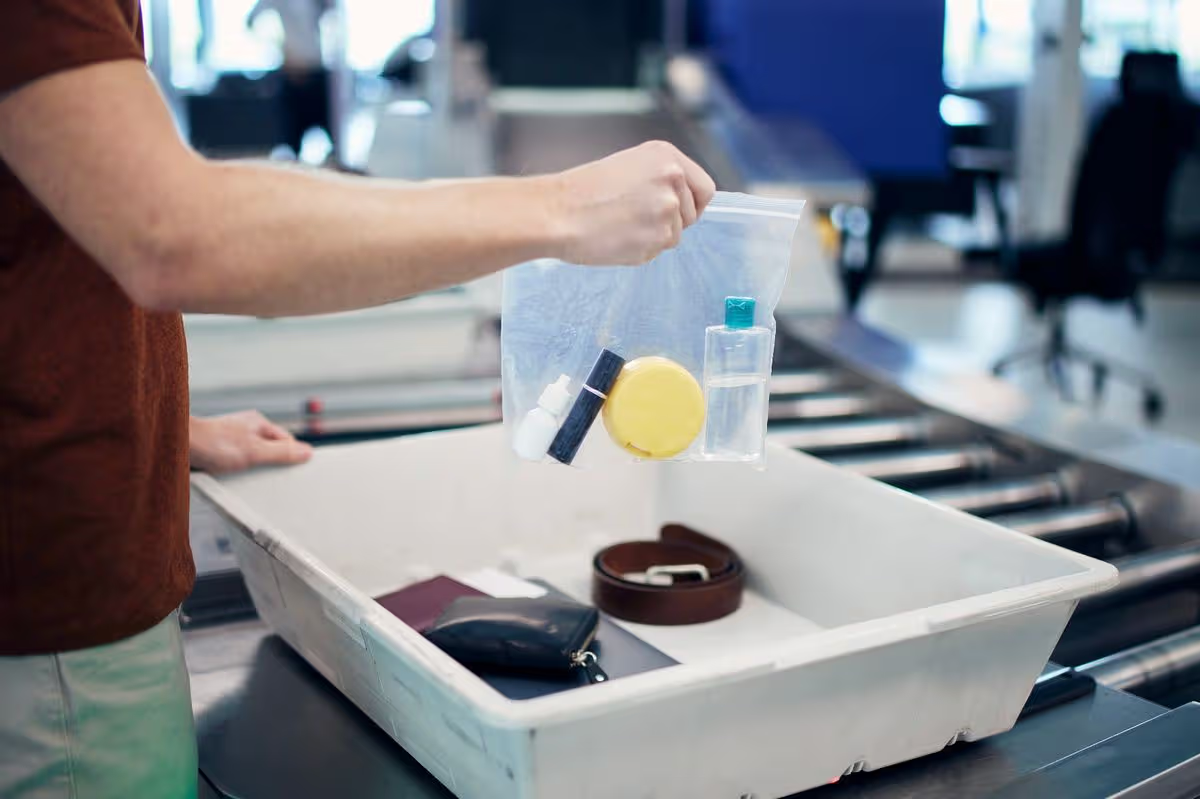
People could save time using the airport-approved tip (stock photo)(Image: Getty)
Holidaymakers can cut down the time they spend waiting at airport security using a little-known trick. The travel hack was shared by Manchester Airport, and it could be perfect for families ahead of the busy summer holidays.
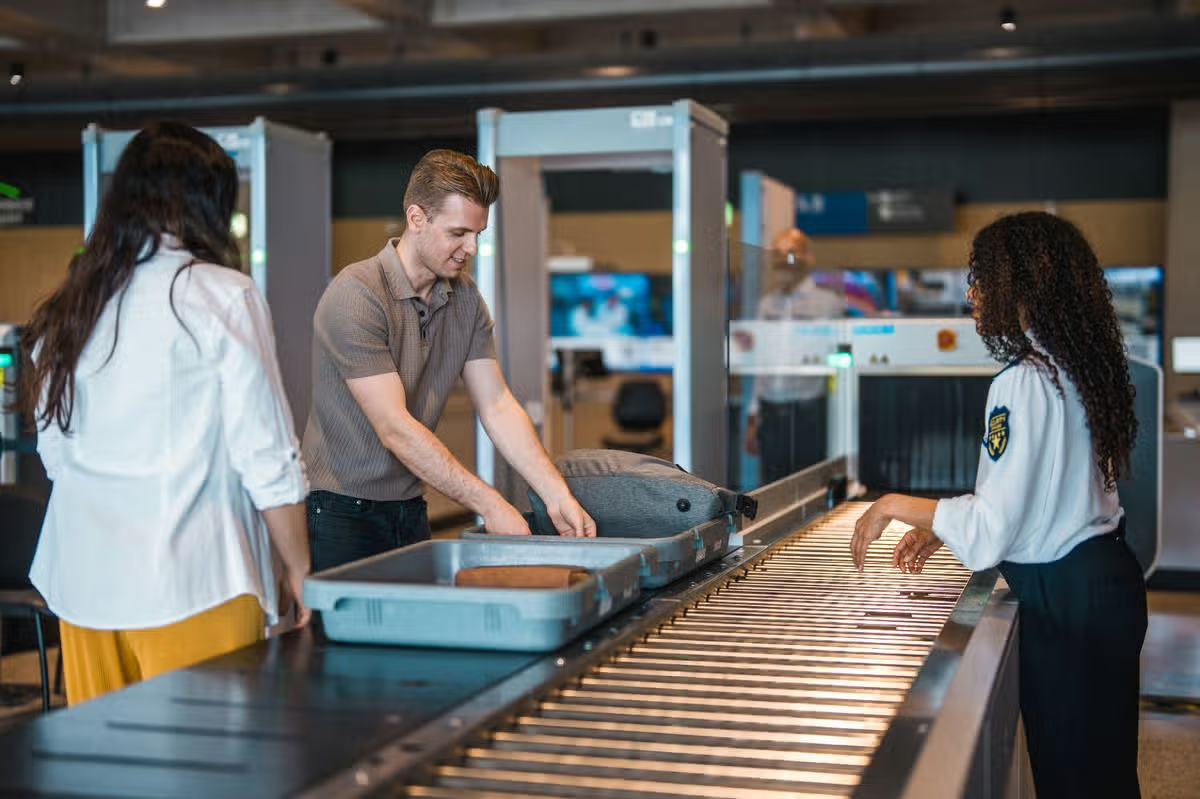
According to Manchester Airport, there’s an easy way to reduce your queue time if you’re allowed to choose which lane to wait in. Posting tips for passengers online, the travel hub shared an ‘Ultimate Airport Guide’ on its website. There are various tips, covering everything from the best shoes to wear and how to decorate suitcases for maximum visibility.
In the ‘at the airport’ section of the guide, there’s a hack that could help passengers fly through security using ‘reverse psychology.’ Manchester Airport said: “If given the choice of security lanes, pick the left. Most passengers are right handed and will subconsciously prefer the right, making the left a little quieter.”
The airport added that customers can also pay to upgrade to FastTrack for a faster experience. “For just a few pounds, you can purchase FastTrack tickets to use the priority lane and avoid the queues before Security on your way out and Passport Control on your way in.” Many airports offer a similar experience, allowing passengers to pay to use FastTrack.
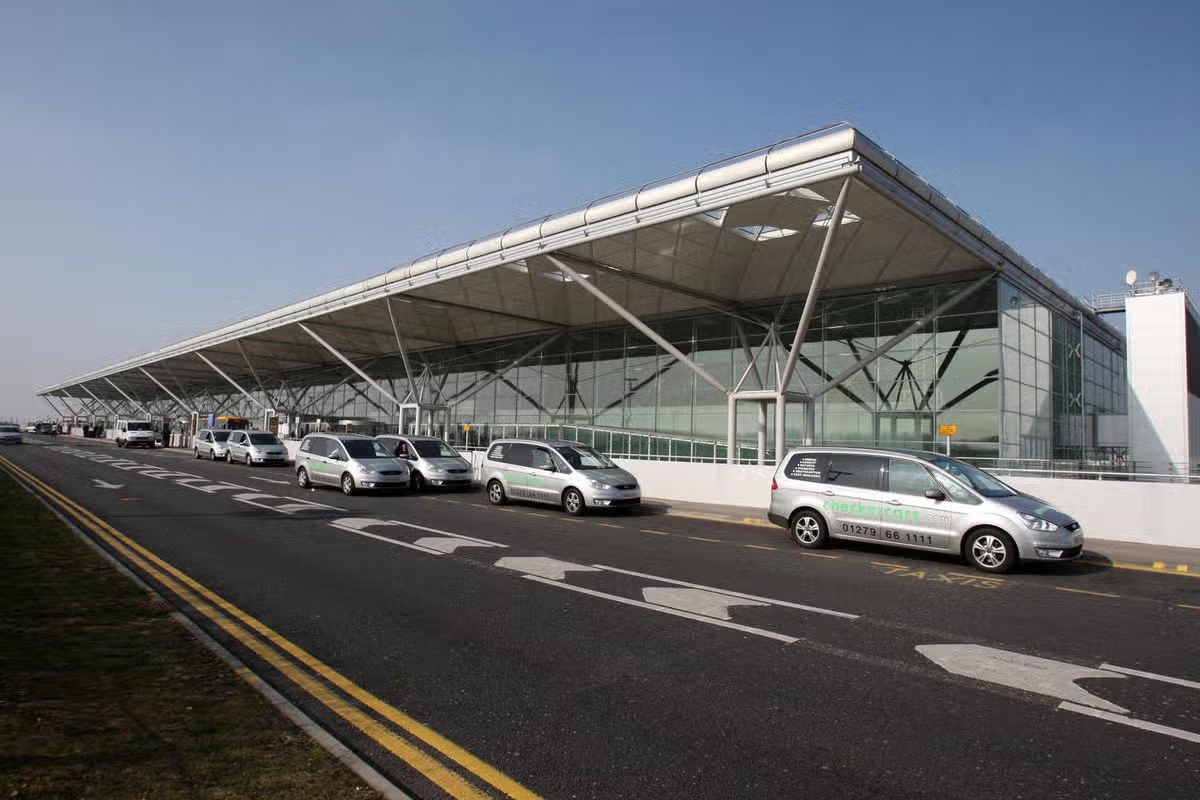
Elsewhere, London Stansted Airport offers the same security advice for passengers. The airport retierates: “If given the choice of security lanes, pick the left.”
The tip could be especially helpful when many passengers are travelling at the same time, such as during the school summer holidays. However, it’s worth noting that passengers don’t always get to choose their lane.
Nonetheless, they can help speed up the process by avoiding accessories that are difficult to remove. This makes the process faster for everyone.
Offering advice online, London Stansted Airport said: “To prepare your outfit for security, wear shoes that you can take off and put on easily. Avoid fiddley belts or fastenings in your clothes and excess jewellery. Try and keep your pockets empty of non-essentials.”
Despite this, passengers might still want to pack a few layers for later in their journey. The airport recommends packing items such as jumpers, which are easy to take on and off when the temperature changes.
The travel advice said: “Temperatures aboard flights can vary so wearing a few removable layers is advised. An extra jumper can always be used as a pillow if nothing else.”
Travel could be about to get faster for some families this summer at dozens of UK airports
15:30, 01 Jul 2026Updated 15:30, 01 Jul 2026
Families could see the change when they travel this summer(Image: Yau Ming Low via Getty Images)
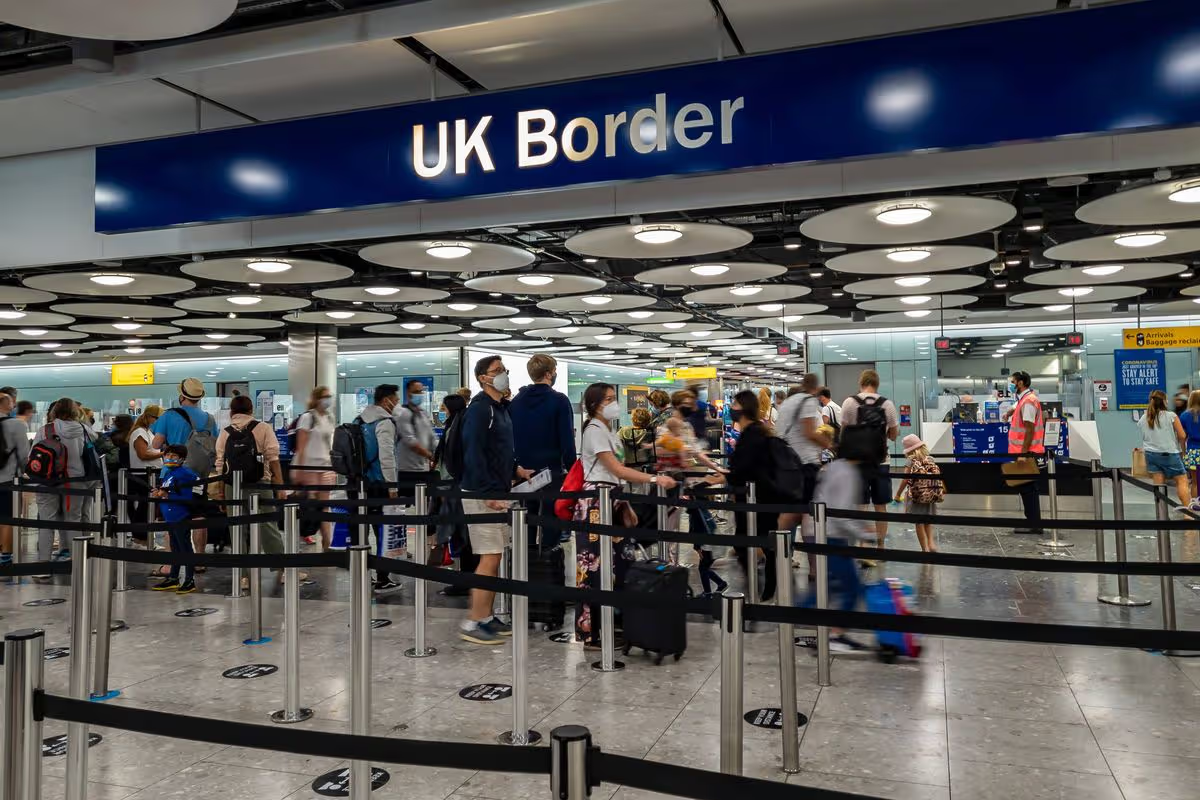
Families are being reminded that a major change to a key rule across more than a dozen UK airports will come into effect this summer. From next week, on July 8, a security rule will be eased for certain primary school-age children.
Back in May, the UK Government announced that up to 1.5 million more children would soon be able to use UK eGates, helping to speed up the process for them and their families during the summer holidays. Children aged eight and nine, who are at least 120cm (3ft 11in) tall and travelling with an adult, will become eligible under the new measures that come into force on Wednesday, July 8.
Officials say the change to the age threshold will be a welcome relief for families returning home from their holidays with young children in tow. The government claims that passing through an eGate typically takes just a matter of minutes.
With greater numbers of passengers making use of eGates, waiting times at passport control are also anticipated to fall. Prior to 8 July, eGates were generally available to those aged 10 and above, though children under 17 were required to (and must still be) accompanied by an adult, reports the Express.
Passengers are eligible to use an eGate if they have a biometric symbol on the front cover of their passport and are either:
a British citizen
a national of an EU country, Australia, Canada, Iceland, Japan, Liechtenstein, New Zealand, Norway, Singapore, South Korea, Switzerland or the USA
a member of the Registered Traveller Service
Content cannot be displayed without consent
Minister for Migration and Citizenship, Mike Tapp said: “Travel with young children can be stressful for parents. By expanding eGate access, more families can experience a swifter and smoother journey home – freeing up precious time this summer holiday season. We are delivering continued improvement to the passenger experience, while keeping our borders safe and secure.”
Border Force Director General, Phil Douglas said: “eGates are an essential part of keeping our border secure. Expanding access for families will deliver safe, smooth journeys whilst freeing up highly-skilled officers to focus on intercepting those who pose a threat to the UK.”
Karen Dee, Chief executive of AirportsUK, the trade body for UK airports, said: “This is a welcome development as it will give more families the ability to take advantage of this technology, speeding up the border process and reducing waiting times for many. Airports work very hard with border authorities to ensure the UK’s front door is both secure and welcoming, with those coming home and visiting enjoying a smooth experience.”
The UK first introduced ePassport gates at airports in 2008, with the very first gate going live at Manchester Airport. Initially, the automated gates were limited to UK, EU, and Swiss citizens but have since expanded to include eligible travellers from dozens of countries, including the US, Canada, Australia, and New Zealand.
Full list of UK airports with eGates (as of July 2026):
The airline has shared advice for passengers to help prevent delays during security checks
11:19, 01 Jul 2026Updated 11:19, 01 Jul 2026
The airline shared advice for passengers on its website (stock photo)(Image: Getty)
British Airways has advice to help passengers ‘avoid delays’ at the airport. The airline’s website shares the latest guidance and travel updates for customers. It also answers frequently asked questions to help passengers have the smoothest possible experience on travel days.
In the baggage FAQ section, the airline has offered a tip for anyone travelling with medication in their hand luggage. British Airways said it recommends that passengers carry a copy of their prescription for any medication they are carrying.
The advice said: “We recommend you carry a copy of the prescription for your medication to avoid delays at security or customs.” Passengers are advised to carry any essential medications in their hand luggage.
British Airways explained: “If you need to take regular medication, it’s important to pack enough essential medication for your personal use on board – and for the first few days of your journey – into your smaller under-seat item of hand baggage. This is in case your hold baggage is delayed for any reason.”
British Airways adds that this medication shouldn’t be packed in any larger cabin bags. “Avoid packing medication in your larger cabin bag as you may be asked to put it into the hold on busy flights.
“Additional medication for personal use at your destination can also be packed in your checked baggage, so long as you are carrying enough for a few days in your hand baggage in case of any eventuality.”
There are allowances for passengers who need to carry medicines exceeding 100ml. Gov.uk explains: “You’re allowed to carry the following in your hand luggage: essential medicines of more than 100ml, including liquid dietary foodstuffs and inhalers or medical equipment, if it’s essential for your journey.
“You’ll need to carry proof that the medication is prescribed to you (for example, a letter from your doctor or a copy of your prescription) if it’s both: in liquid form and in a container larger than 100ml. You do not need to show proof if the medication is either: in tablet form or liquid in a container that’s 100ml or smaller.”
Gov.uk also shares advice for any passengers travelling with medicine containing a controlled drug. The guidance states: “You must carry medicine containing a controlled drug with you in your hand luggage when entering or leaving the UK.
It may be taken away from you at the border if you cannot prove it was prescribed for you.”
As holiday prices go up, it’s always helpful to take on any advice you can to make it that little bit cheaper and as it turns out, that includes which day of the week you fly
This simple booking step could save your family £100s (Image: Getty)
Ahead of your last-minute summer trips or 2027 getaways, it’s best to be smart about your bookings, and a travel expert is here to tell you exactly why.
Flights are one of the most expensive aspects of any holiday, especially if you’re traveling further afield. If you’re not following these simple steps, you could be doing it all wrong.
To help holidaymakers navigate their bookings abroad with confidence, travel expert and head of aviation at Loveholidays, Gavin Brewer, has shared his expert advice for a stress-free getaway.
With three decades of experience in the aviation industry, he offers practical advice on securing cheap, last-minute deals and ensuring your trip is protected.
Something many people overlook when booking a holiday is the day they fly. While they often make sure to consider key dates, outside of school holidays for cheaper packages or outside of peak summer times altogether, they don’t stop to think about the difference flying on a Monday could have to flying on a Sunday, for example.
As it turns out, that difference could be quite a lot, especially if you’re booking for a family, where all those saved pounds soon add up.
Gavin suggests being super strategic with your departure date to ensure you’re saving money and getting the best flights for the best price. He explains that the start of the week is always the cheapest to depart, according to recent analysis of flights, meaning Sundays, Mondays and Tuesdays are the best days to begin your holiday.
“If you’re on a budget, be flexible with your departure date and look at holidays departing on either a Sunday, Monday or Tuesday. Our research shows you could save up to £24 per person on the flight element of your package holiday, and every little bit helps,” he said.
To ensure you have the safest, stress-free holiday, the expert advises booking your travel insurance at the same moment in time you book your holiday and avoiding putting it off. This means it protects you from the moment the trip is secured, making it “one of the smartest moves you can make”.
Getting to grips with your cover is just as important as picking your destination, because when the unexpected happens, the right policy can be the difference between spending big bucks and flying away without a care in the world.
If you want a little extra protection, package holidays are ideal. In the UK you get built-in protections you don’t get when booking separately. In the event of any disruption ahead of your travels, such as a cancelled flight with no suitable alternative, as a traveller you are fully protected, thanks to a set of consumer laws called the Package Travel Regulations. As a result of this, you are entitled to a full refund on your package holiday.
We’ve all got used to packing tiny shampoos and shower gels into our hand luggage when we fly, but new technology means some major airports are scrapping the 100ml rule making going through security so much easier
Many airports have upgraded their security systems(Image: Getty Images/iStockphoto)
It’s hard to believe that the airline liquid rules have been in place for nearly two decades. Since a terror plot was foiled in 2006, air passengers in the UK have been limited to taking containers of under 100ml on planes, and made to keep them in a clear, resealable 20cm x 20cm plastic bag.
Over the years, technology has improved, meaning restrictions have slowly been eased. In many airports, you no longer need to use a clear plastic bag for your liquids and can simply leave them in your hand luggage. However, in the majority of airports, the 100ml rule still stands all these years later.
A small number of airports have now scrapped the 100ml rule – allowing Brits to fly out with liquids in containers of up to two litres in volume. This means most standard-sized bottles of water, creams, gels, sprays, and aerosols can be taken through as hand luggage.
Whatever the allowed liquid size at your departure airport, holidaymakers should make sure they avoid using metal or double-walled bottles, such as a Thermos flask, when they carry liquids on board, as the scanners cannot penetrate the insulated layers.
Another thing travellers should keep in mind is that the rules at their return airport might be different. The vast majority of European airports still enforce the 100ml rule. So while you may be able to take a big bottle of suncream in your hand luggage going out, you may need to put it in your checked luggage coming back.
The GOV.UK website has a list of items considered liquids. Many travellers still get caught out by the 100ml rule as they don’t realise items such as semi-liquid foods such as soup, jam, honey, or syrups need to be within the restricted size.
Nut butters and soft cheeses also come under the category of liquids. In the USA, the Transportation Security Administration (TSA) use a rule that: if you can spill it, spread it, spray it, pump it, or pour it, it counts as a liquid. While this isn’t an official rule in the UK, it’s a good way to determine whether an item you’re taking onboard is going to need to follow liquid size rules.
Liquid rules at airports can be updated with little notice, so always check your departure airport’s official website before you fly.
Full list of airports still enforcing the 100ml rule
Manchester Airport (MAN)
London Stansted (STN)
London Luton (LTN)
Glasgow Airport (GLA)
Glasgow Prestwick Airport (PIK)
Liverpool John Lennon Airport (LPL)
Newcastle International Airport (NCL)
Leeds Bradford Airport (LBA)
East Midlands Airport (EMA)
London City Airport (LCY)
Aberdeen International Airport (ABZ)
Jersey Airport (JER)
Cardiff International Airport (CWL)
Southampton Airport (SOU)
Inverness Airport (INV)
Cornwall Airport Newquay (NQY)
Full list of airports that have scrapped 100ml rule
London Heathrow (LHR)
London Gatwick (LGW)
Edinburgh Airport (EDI)
Birmingham Airport (BHX)
Bristol Airport (BRS)
Belfast International Airport (BFS)
George Best Belfast City Airport (BHD)
Bournemouth Airport (BOH)
Have a story you want to share? Email us at webtravel@reachplc.com
Earlier on Monday evening, he Met Office announced a thunderstorm warning for several regions across the UK on Monday night, spanning from 5pm to 9pm.
While the weather alert has since expired, communities across south West England are still reeling in the wake of wild storms and flash flooding.
Who did the warning cover? The weather alert applied to parts of East of England, London and South East England, South West England.
What was the full alert? A Yellow weather warning is in effect, continuing until Monday 9pm. The forecast indicates frequent lightning strikes and heavy rain in the impacted regions.
A Met Office forecaster said, in a statement issued alongside the urgent weather alert earlier this evening (June 22): “An area of thunderstorms moving east across the area will bring a spell of frequent lightning, gusty winds, torrential rain, and a few places, hail.
The storms will be moving quickly reducing the potential for widespread large amounts of rain, but there is a few places could see 20-25 mm of rainfall in a short period in the most active storms, which could bring some brief flooding.
“The majority of impacts are likely to come from other hazards however, such as lightning striking buildings and causing power cuts, difficult driving conditions in heavy rain, and some localised damage to vulnerable structures by strong wind gusts or hail.”
Airport security stainless steel bottle ‘rule’ all UK travellers must know – The Mirror
Need to know
Some UK airports are relaxing the rules, with this one being the exception for all passengers
This could lead to delays at the security checkpoint(Image: Getty)
Airport security rules: How water bottles and playing cards could cause delays
Holidaymakers jetting off this summer need to be aware of some basic airport security rules that could catch them out at the scanners. Despite many UK airports scrapping the 100ml liquid rule thanks to cutting-edge scanners, there’s one crucial exception that could trip up travellers
Metal water bottles are allowed through, but must still be emptied before security. The new scanners can’t penetrate the double-layer insulation on stainless steel bottles and thermos flasks, meaning they need to go through empty for safety reasons.
The good news is that most airports offer free water refill stations after security. This way, travellers can top up their empty bottles after going through the scanners.
Major airports, including Heathrow, Gatwick, and Birmingham, have all introduced the relaxed liquid rules as of May 2026. Edinburgh Airport warned passengers: “If you are carrying metallic or double-walled containers (including vacuum flasks, thermos flasks and metallic water bottles), please ensure the container is empty prior to the security checkpoint.”
It’s not just water bottles causing delays at security – playing cards are also flagging up problems at security checkpoints. The innocent-looking deck can trigger additional screening because its stacked shape and density can give the impression that something’s hidden inside.
TSA expert Ian Cava advised airline passengers to remove cards from hand luggage and place them in the tray separately. “This helps speed up the process and reduces the likelihood of delays,” he said.
Families need to be aware of how this could impact their flights home
Ryanair bookings need to be accurate at the time people head on holiday – especially people born in these three years(Image: GordZam via Getty Images)
Certain young people going on holiday with Ryanair this year could find themselves in trouble if they are booked to fly with the wrong ticket type. It can happen to anyone born in 2010, 2014, or 2024. Ryanair divides its passengers into four categories when assigning seats on planes: adults, teens, children, and infants.
The airline is clear online about who qualifies for specific ticket types when they are travelling abroad with the budget carrier. Outlining the policy online, Ryanair says: “For the purpose of defining our passenger types, adults are over 16 years of age, teens are between 12 and 15 years of age, children are between two and 11 years of age, and infants are those under two years of age.”
This applies from the “date of flight departure”. If families are heading abroad and celebrate a birthday, they need to be aware of how this could impact their flights home. Anyone born in 2010, 2014, or 2024 must comply with the rules.
If a child turns two, 12 or 16 between leaving the UK and returning home, they cannot be booked onto Ryanair flights without potentially facing extra charges. It is important for parents to be aware of this before booking their next holiday – or act now if the plans are already in place.
Ryanair adds: “If an infant turns two years of age or a child turns 16 years of age during your trip, you should purchase two one-way flights rather than a return ticket. You may then connect the bookings by contacting us.”
In terms of pricing, teens (aged 12-15) are treated the same as adults for pricing. They may, however, lose any free seat selection that is offered to under-12s.
The airline has a section on its website for customers who have already made a booking and need to change their passenger type. Changing passenger types may incur fees, and it is generally better to update this to avoid issues at boarding.
Generally, swapping a child or teen ticket to an adult is free when done online, but child passengers will lose their free seat selection privileges and have to pay for a new seat when ageing out of the free under-12s seating offer. The cost of doing this varies, depending on the flight service and the newly selected seat.
The page claimed the airline has announced routes to Barcelona that are “cheaper than dinner”. After making a quick check, you’ll see that some flights from the UK are pretty reasonable.
Chris Harrington, managing director at travel transfer company hoppa, has outlined what to do to give yourself the best chance at recovering your valuables, or, at least, getting some compensation for the loss
There are seven essential steps to take if your luggage is mishandled(Image: Getty)
One of the most common travel nightmare scenarios tourists face is having their luggage go missing after a flight.
Mishandling checked-in bags costs airlines around £4.2 billion a year, according to aviation technology company SITA. If you’re one of the unlucky ones who ends up not finding your suitcase on the conveyor belt, here are the seven steps to take immediately, according to an expert.
Chris Harrington, managing director at travel transfer company hoppa, has outlined what to do to give yourself the best chance at recovering your valuables, or, at least, getting some compensation for the loss.
The most important thing, he says, is to act fast. He says: “Ultimately, the faster and more informed your response is, the better your chances of recovering your bag or at least getting clear updates on where it is.”
Chris advises heading straight to the airline’s service desk near baggage reclaim if you notice a missing bag – stressing that delays can reduce the chances of locating your bag quickly.
From then on, it’s important to have your baggage tag and flight details ready, as they will help staff begin tracking your suitcase straight away.
You should also be as specific as you can when describing the missing item. “Details matter. Think about the colour, size, brand, and any distinguishing features like stickers or tags. Even better, show photos if you have them,” Chris continued.
And once your case is all documented and reported, never forget to ask for a Property Irregularity Report, or PIR number, as it is “essential for tracking your luggage and for any future claims.”
In the meantime, most airlines try not to leave customers empty-handed. “Some carriers will provide an allowance for essentials like clothes and toiletries,” Chris notes. “If they don’t, keep every receipt, as you may be able to claim those costs back later.”
Another essential step is to contact insurance companies early on, since many policies include cover for delayed luggage after 12 to 24 hours, but the expert recommends being prepared and checking exactly what evidence they require. If, after several days, nothing is found, it’s crucial not to give up.
“You should be following up regularly,” Harrington advises, adding that “after 21 days, luggage is officially considered lost under international guidelines.”
Thats the stage in which travellers are encouraged to put forward a formal claim – according to the Montreal Convention, which sets out airline liability in such cases.
Chris highlights that passengers may then be entitled to compensation of up to around £1,300 if they provide the right documentation.
To claim that sum, “you’ll need proof of your luggage and what was inside it. The more evidence you have, the stronger your claim.”
Four UK airports have found themselves in the top 10 of the ‘worst for delays’ across Europe, with one securing the top spot following average delays of almost two hours
Four UK airports have been named among the ‘worst for delays’ across Europe(Image: Getty Images/Stock Image)
A UK airport has been named the ‘worst in Europe’ for delays, while three other UK airports also found themselves in the top 10.
New research from AirAdvisor ranked Manchester Airport as the worst airport in Europe for hour-long flight delays. The airline comparison experts analyzed data from 9,594,711 flights across 46 European airports in 2025 to reveal results based on the percentage of flights delayed by 60 minutes or more (weighted at 70 percent) and the average length of those delays (weighted at 30 percent).
This saw Manchester take the top spot, with 6.16 percent of its flights delayed by 60 minutes or more in 2025 and an average delay of 116.7 minutes, which amounts to almost 2 hours. AirAdvisor AirData found that the routes from Manchester most prone to delays were to Amsterdam Schiphol, Paris Charles de Gaulle, and Dublin.
A Manchester Airport spokesperson told The Mirror: “This analysis of the Civil Aviation Authority’s data is misleading as it ignores important context – context which is directly referenced by the CAA in the notes accompanying the research and in the research itself. Punctuality is affected by factors that are outside of an airport’s control. The two most significant factors contributing to delays in the last year have been industrial action affecting air traffic control in Europe, and the weather. These were exacerbated by airspace restrictions above conflict zones meaning airports with significant long-haul networks, like Manchester, were more significantly affected than others.
“As an industry we are working collectively to achieve the best possible on-time departure rates, while protecting flight schedules and avoiding the need for cancellations.”
But it wasn’t just Manchester that found itself named among the worst. Birmingham, London Gatwick, and London Stansted joined the airport, making the UK the most represented country in the top 10.
London Gatwick was ranked the sixth worst in Europe, with a 5.24 percent rate of hour-long delays and an average delay of 111.88 minutes. According to the data, AirAdvisor found that the most impacted routes from Gatwick were to three major holiday hotspots: Barcelona, Malaga, and Lisbon.
In tenth place was Birmingham Airport, after the experts found that it scored a 5.26 percent rate of hour-long delays and an average duration of 108.01 minutes. The most disrupted routes from Birmingham were said to be flying to the popular destinations of Amsterdam, Dublin, and Paris Charles de Gaulle.
A Birmingham Airport spokesperson said: “Flight delays can happen for several reasons including industrial action and bad weather, some of which are out of an airport’s control. This month over half of all aircraft left on time and we continue to work hard to improve punctuality. Our colleagues work tirelessly to provide brilliant passenger service, with the vast majority of people rating their experience as excellent.”
Meanwhile, London Stansted came in joint tenth with Birmingham, after data found that it had a 5.5 percent rate of hour-long delays and an average delay of 106.24 minutes. AirAdvisor said the most delayed routes from Stansted were to Dublin, Edinburgh, and Istanbul Sabiha Gokcen.
A London Stansted Airport spokesperson told the Mirror: “It’s very important to put this analysis into perspective. The data looks at 46 airports but there are more than 340 major airports across Europe, so this represents a small and self-selective sample. This type of analysis of the Civil Aviation Authority’s data is misleading as it ignores important context – context which is directly referenced by the CAA in the notes accompanying the research and in the research itself.
“It should also be noted this research has been produced by a flight compensation company and looks specifically at delays of more than 60 minutes, which are often driven by wider factors such as air traffic restrictions, industrial action, adverse weather impacts and airline operations, airline crew shortages or delays to inbound flights rather than airport performance.
“Like all major airports operating in busy European airspace, punctuality on certain routes can be affected by congestion elsewhere in the network. We continue to work closely with airlines, air traffic control and partners across the aviation system to reduce disruption and keep journeys running as smoothly as possible for passengers.”
London Gatwick has been contacted by The Mirror for a comment.
Top 10 worst airports in Europe for long delays
Manchester, UK
Palma de Mallorca, Spain
Kraków Balice, Poland
Nice Côte d’Azur, France
Bucharest Henri Coandă, Romania
London Gatwick, UK
Porto, Portugal
Marseille Provence, France
Birmingham, UK
London Stansted, UK
Birmingham, London Gatwick, and London Stansted were contacted for comment.
Do you have a travel story to share? Email webtravel@reachplc.com