
Load

‘The Weight’ review: Ethan Hawke gets his own ‘Sorcerer’

Somewhere in the overlap between William Friedkin’s 1977 action thriller “Sorcerer” and Kelly Reichardt’s 2020 Pacific Northwest pioneer indie “First Cow” lies Padraic McKinley’s directorial debut “The Weight.”

“Sorcerer” is about a group of fugitives driving a load of dynamite across the jungle; “The Weight” follows a group of Depression-era convicts transferring gold through the forest. “First Cow” is about the sweetness of friendship and French pastries in the wilds of Oregon during westward expansion; “The Weight” is about the corrupting forces of capitalism. McKinley’s movie marries the instincts of modern indie filmmaking with a New Hollywood ethos, while bringing an authenticity to the details of the period.

We follow the story of Murphy (Ethan Hawke), a World War I vet and single father in Eugene, Ore., struggling to provide for his daughter, Penny (Avy Berry), three years into the Great Depression. After an unfortunate run-in with the law, Murphy finds himself in a prison labor camp, building a road and trying to shorten his sentence so he can get out before his daughter is adopted by a new family.

Opportunity presents itself in Murphy’s foreman, Clancy (Russell Crowe), who takes a shine to him after he fixes his car and devises an ingenious way to remove boulders without dynamite. Cuddly but dangerous, Clancy makes a seemingly simple offer to Murphy: He and three friends can earn their freedom if they hike a load of gold out of a mining camp on the eve of President Franklin D. Roosevelt confiscation of all gold stockpiles.

The how and why details aren’t that important; the story is merely that the prisoners have to get from point A to point B through a rugged forested terrain, under the watch of two intimidating chaperones, Amis (Sam Hazeldine) and Letender (George Burgess). A mining camp servant, Anna (Julia Jones), joins their group as a runaway and while it seems a straightforward task, the arduous and brutal journey is one that is liable to turn these convicts into runaways.

Murphy’s gang weren’t really outlaws to begin with — he was imprisoned for defending his daughter from some undercover cops, while Singh (Avi Nash) was arrested for his associations with socialism. Olson (Lucas Lynggaard Tønnesen) was part of a group going after a judge for seizing Scandinavian farms, while the most hardened criminal among them is Rankin (Austin Amelio), who grew up in juvie. But in order to survive the woods, Murphy will have to dig deep into his wartime past and rely on his own skills and smarts to make out it out intact.

McKinley pours his craft into authentically representing the era, from the perfectly worn denim of the costumes to the refreshingly real and craggy faces of the cast (and thank goodness Hawke and Crowe are respectably aging into their character-actor looks). The Bavarian forest beautifully stands in for 1930s Oregon and cinematographer Matteo Cocco balances ’70s-inspired slow zooms with composed, high-contrast images that hark to early 20th century styles of photography. A score by Latham and Shelby Gaines balances discordant, atonal tones with suspense-driven sound design that captures the creaking noises of the forest and the concealed dangers it holds.

McKinley stages a few bullet-sweating sequences of peril, including a particularly brutal transport of gold bars across a crumbling rope bridge and an underwater accident exacerbated by floating logs. Both are nail-biters but you can’t help but think he could have pushed it even further. Tonally, the film is torn between wanting to be brutally bleak and offering some kind of hope for Murphy and his precocious, adorable daughter.

When “The Weight” leans into its nasty, mean and grim moments, it gets at something that seems closer to truth than the saccharine resolution we fear is coming. It seems like McKinley wants to deliver a crushing blow, but then feints at the last minute, opting for a more optimistic kind of fantasy.

Politically and culturally, what “The Weight” speaks to is as ugly as the violence that occurs in the mud and fog of the forest. But it ends on an oddly cheery note that doesn’t square with what we’ve seen. It’s a cutesy ’70s nod that feels more “Smokey and the Bandit” than “Sorcerer.” The bolder choice would have been to commit to expressing the despairing lessons of this world. We want to see these characters changed by what they’ve experienced, even if it’s dark. We want to see them actually carry the weight.

Katie Walsh is a Tribune News Service film critic.

‘The Weight’

Rated: R, for language and some violence/bloody images

Running time: 1 hour, 55 minutes

Playing: Opens Friday, Sept. 18 in wide release
Source link

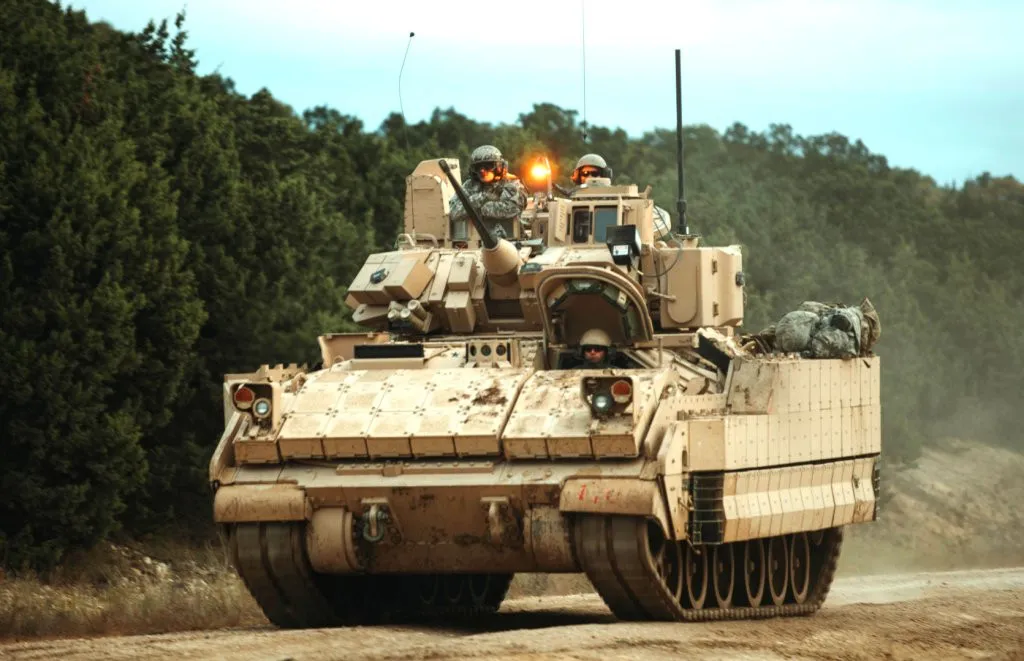
Bradley Fighting Vehicle Lugging Load Of Swarming Ground Drones Is A Sign Of What’s To Come

U.S. Army soldiers used a Bradley Fighting Vehicle as a carrier for FireAnt uncrewed ground vehicles (UGV) during a recent test exercise. The small 4×4 UGVs can be configured as one-way attack munitions, as well as for electronic warfare, surveillance and reconnaissance, and other missions. Bradleys acting as transports and controllers for swarms of UGVs like the FireAnt could open up important new operational possibilities.

Swarmbotics AI, the developer of the FireAnt, shared a video on its LinkedIn page yesterday showing the Bradley with five of the UGVs attached to its side. The post says the footage was taken during Pegasus Charge 3, the third iteration of a 1st Cavalry Division-led test exercise series. The division is one of the operational formations supporting the Army’s larger Transformation In Contact (TIC) modernization initiative. Units assigned to the 1st Cavalry have been testing and evaluating various new weapon systems and other capabilities through Pegasus Charge events and other exercises.

“The US Army has picked Swarmbotics AI (SBAI) to build swarming, attritable, small unmanned ground vehicles (sUGVs) to advance Transformation in Contact (TiC) with the 1st Cavalry Division,” the company announced in a press release back in February. “The award results from successful participation at last year’s xTech Overwatch competition.”

xTech is an in-house Army technology accelerator that regularly hosts “innovation challenges” to support new developments that could be of interest to the service.

“During xTech Overwatch evaluations, soldiers from the 1st Cavalry Division assessed several contractor’s autonomous capabilities that spanned from ground, airborne, payload, and mission planning,” Swarmbotics AI’s release added. “This competitive assessment, facilitated by T2COM [the Army’s Transformation and Training Command] and key stakeholders, aimed to accelerate the adoption of autonomous systems in line with the Chief of Staff of the Army’s directive.”

From what is seen in the video from Swarmbotics AI, it is not immediately clear whether or not the FireAnts can be released remotely from within the Bradley, or if personnel have to unload them manually. Where the UGVs are seen stowed on the side is space that is often taken up by explosive reactive armor (ERA) blocks. A Bradley could carry additional FireAnts internally and deploy them via the rear ramp.

A stock picture of a current-generation US Army M2A4 Bradley Infantry Fighting Vehicle with explosive reactive armor (ERA) blocks fitted on the side, as well as on the front of the hull. US Army

How the roughly 70-pound FireAnts were controlled and otherwise employed during Pegasus Charge 3 is also unclear. Swarmbotics AI has said in the past that human operators are responsible for directing groups of the UGVs. In its press release in February, the company said a squad-sized Army unit had operated 10 FireAnts during the xTech Overwatch competition.

Swarmbotics AI has also said that FireAnt has a significant degree of artificial intelligence (AI) driven autonomy to carry out assigned tasks. When networked together in a swarm, the UGVs are capable of “coordinated behavior across mixed teams and missions,” the company said previously, according to a story from Interesting Engineering.

TWZ has reached out for more information.

As already mentioned, FireAnt is designed to be readily reconfigurable for different missions using modular payloads. The anti-armor configuration, which arms the UGV with an explosively formed penetrator (EFP) warhead, has received the most attention to date. In this role, FireAnt has to get close to its target to be effective. Swarming capability would be very beneficial here for overwhelming defenders, as well as just launching attacks on large groups of tanks and other armored vehicles across a broader area.

FireAnt UGVs armed with explosively formed penetrator (EFP) warheads. Swarmbotics AI
Screen captures from a previous Swarmbotics AI video showing a FireAnt launching a kamikaze attack on a test target. Swarmbotics AI captures

With sensor and electronic warfare payloads, FireAnts could also help scout ahead, provide added general situational awareness, and even launch non-kinetic attacks. Swarmbotics AI has also raised the possibility of a counter-drone role for its UGVs. FireAnts could also conceivably act as signal relay nodes, which would also be especially useful when employing the UGVs in semi-autonomous swarms and/or for pushing them further forward of the main body of a friendly force.

“Mass is our objective, by employing swarms of heterogeneous small sUGVs [small UGVs] we create multiple dilemmas for our adversaries at fractions of the cost of exquisite platforms,” Stephen Houghton, Swarmbotics AI’s CEO, said in a statement accompanying the company’s February release.

It is worth noting here that the Army has previously demonstrated the ability of the Bradley to serve as a forward control node for UGVs. Bradleys could also bring groups of FireAnts or similarly-sized designs to the front lines and hand off control to other nodes.

Previous Army-sponsored testing has also involved FireAnts deployed from larger UGVs, as seen in the video below. This demonstrates an additional layer of crewed-uncrewed teaming capability that could push the entire chain further forward on the battlefield. This, in turn, would help keep human personnel even further removed from potential threats.

U.S. Army Tests New Robotic ‘Tank Killer’ Swarm Vehicles thumbnail

U.S. Army Tests New Robotic ‘Tank Killer’ Swarm Vehicles


UGVs have already become a notable fixture in the ongoing conflict in Ukraine. This includes types in the same general size category as FireAnt configured for kamikaze attacks, as well as large ones armed with various anti-tank guided missiles, automatic grenade launchers, and machine guns. Various UGVs and other uncrewed capabilities were the centerpieces of the annual Independence Day parade in the Ukrainian capital Kyiv just on Monday, as seen in the video below.

On the battlefields of Ukraine, UGVs are generally being employed via links with an operator, either in first-person direct or a third-person semi-autonomous mode, with the help of cameras on the vehicle. In that conflict, uncrewed ground systems face the same electronic warfare threats as their aerial counterparts, and designs with hard-wired fiber-optic control links have been developed in response. TWZ has also previously highlighted the impacts, in general, that the continued development and proliferation of AI-enabled automated target recognition capabilities and new autonomous technologies are already having on aerial one-way-attack drones. This applies, in broad terms, to uncrewed platforms on the ground, as well.

“The key takeaway is that robot swarms are here to stay,” Drew Watson, Swarmbotics AI’s CTO, said in a statement in the February press release. “Working with 1st Cav in 2026 we’ll baseline concepts for hundreds of robots deployed on the X and at the breach.”

It is still to be seen how FireAnt, specifically, may slot into the Army’s future force structure, overall. That being said, the image of the Bradley at Pegasus Charge 3 carrying a load of the UGVs does look to be a sign of things to come.

Special thanks to user @lfx160219 on X for bringing Swarmbotics AI‘s video from Pegasus Charge 3 to our attention.

Contact the author: joe@twz.com

Joseph is TWZ’s Deputy Editor, helping to oversee the site’s highly experienced and dedicated team, while also writing informative and impactful defense and national security content. He lives right in the thick of it in the Washington, D.C. area.


Source link