Littoral Combat Force Takes Up Station In Caribbean Under Navy’s New Deployment Concept
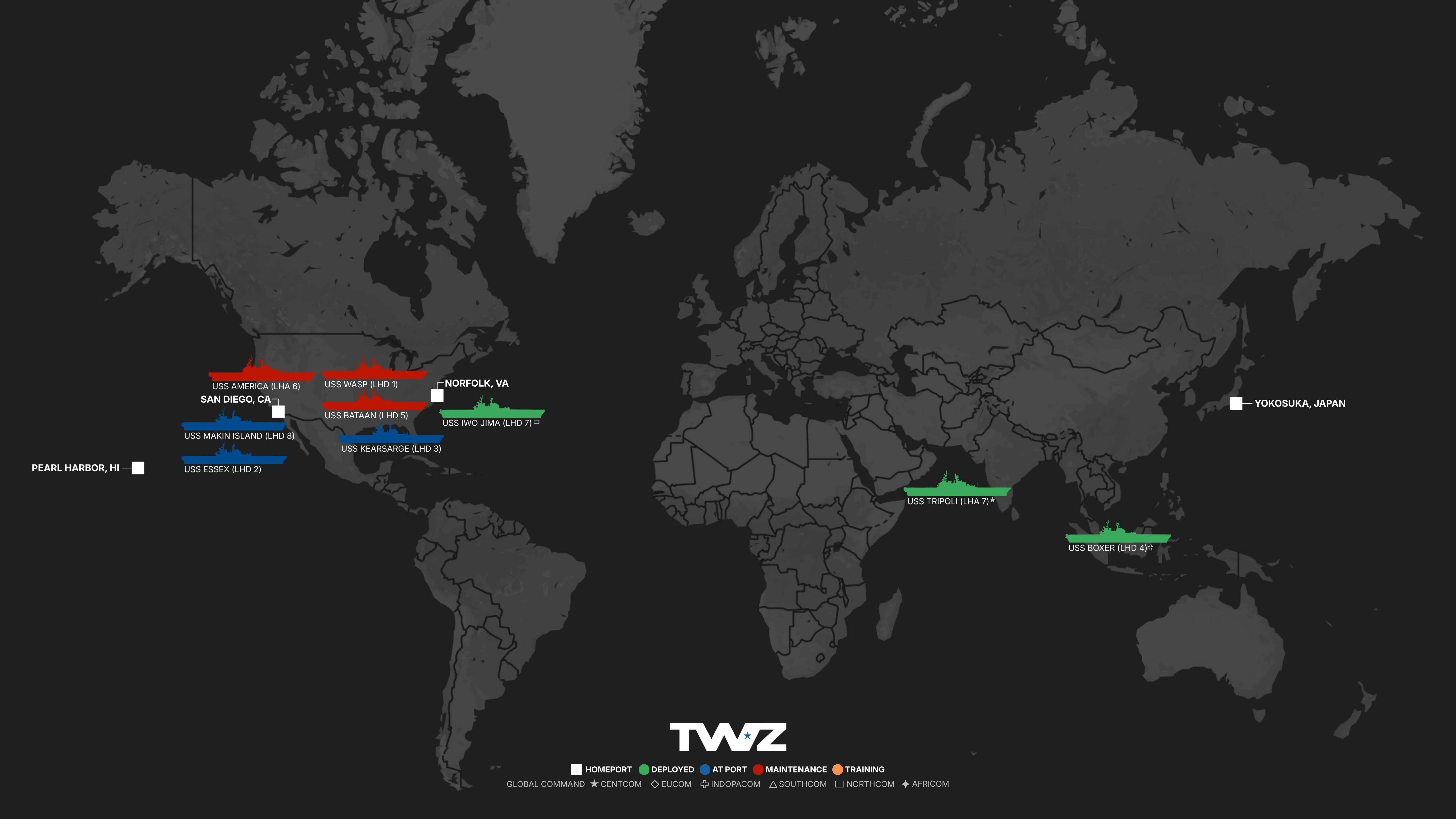
Here’s TWZ’s weekly carrier tracker monitoring America’s flattop fleet, including Carrier Strike Groups (CSG) and Amphibious Ready Groups (ARG), using publicly available open-source information. Given the carrier picture is largely unchanged compared to last week, this week’s tracker highlights the big-deck amphibious fleet.
Much of America’s fleet of nine amphibious assault ships is hard at work as the U.S. opts to replace the Iwo Jima ARG in Southern Command (SOUTHCOM) with a “sub-optimized” Littoral Combat Force (LCF). The LCF appears to be the first deployment that embodies the Navy’s new more flexible deployment strategy, which could have wider impacts across the fleet in the future. “It’s the way to have force multiplication, to punch bigger than yourself, and that’s done through tailored offsets,” Chief of Naval Operations Adm. Daryl Caudle said at SNA earlier this year about the new tailored deployments concept. “That whole thing builds a way to present forces to allow me to do more with less.”

The 24th MEU, operating under the designation LCF-24, deployed to SOUTHCOM and replaced the Iwo Jima ARG. “Distinct from a standard Amphibious Ready Group/MEU deployment, LCF-24 is a purpose-built MAGTF engineered for distributed operations,” SOUTHCOM explained in a statement. The Marine Air-Ground Task Force, with more than 1,300 Marines and Sailors, will operate from both shore-based nodes and aboard Fort Lauderdale, and is certified to “execute a wide array of mission essential tasks, including but not limited to Quick Reaction Force operations such as embassy reinforcement and the tactical recovery of aircraft [and] personnel, while standing ready to support disaster relief activities.”
Amphibious assault ship USS Boxer departed Singapore on May 30 after spending 12 days in port. “USS Boxer (LHD 4) pulled into Sembawang, Singapore, May 19, for maintenance and resupply,” a U.S. Navy spokesperson told TWZ. Notably, the nearly two-week stop coincided with a visit from Sec. Hegseth, who spoke at the Shangri-La Dialogue over the weekend. Boxer transited the Singapore Strait eastbound and entered the South China Sea, according to ship spotters and public AIS data.
The three-ship Boxer ARG disaggregated despite initial reports the group was headed to the Middle East to join the war. Dock landing ship USS Comstock is operating in the U.S. Central Command (CENTCOM) area of responsibility (AOR), alongside the three-ship Tripoli ARG, enforcing the ongoing blockade of Iranian ports. Amphibious transport dock USS Portland was last spotted training in the U.S. Indo-Pacific Command (INDOPACOM) AOR.
USS Iwo Jima and the embarked 22nd Marine Expeditionary Unit (MEU) are heading home after an almost 10-month deployment in the SOUTHCOM AOR, and were spotted today off Topsail Beach, North Carolina. USS San Antonio returned to Norfolk in late April, while USS Fort Lauderdale remains in the Caribbean to support the recently announced Littoral Combat Force-24 (LCF-24) and Operation Southern Spear.
Back stateside, USS Kearsarge is in New Orleans for Sail 250, a “global gathering of tall ships and military ships to celebrate the 250th Anniversary of the founding of the U.S.” After completing landing deck certifications earlier this year, Kearsarge has been working up off the east coast and participating in public events. USS Makin Island is training in preparation for an upcoming deployment and completed Surface Warfare Advanced Training (SWATT) on May 28. USS Essex returned to homeport in San Diego after a week-long visit for L.A. Fleet Week. USS America, USS Bataan, and USS Wasp are, or have recently been, in maintenance.
Note: Positions are general approximations.
Contact the author: ian.ellis-jones@teamrecurrent.io