

As BBC marks what would have been Queen Elizabeth II’s 100th birthday, Peter Phillips says that his grandmother stunned them all in 2012

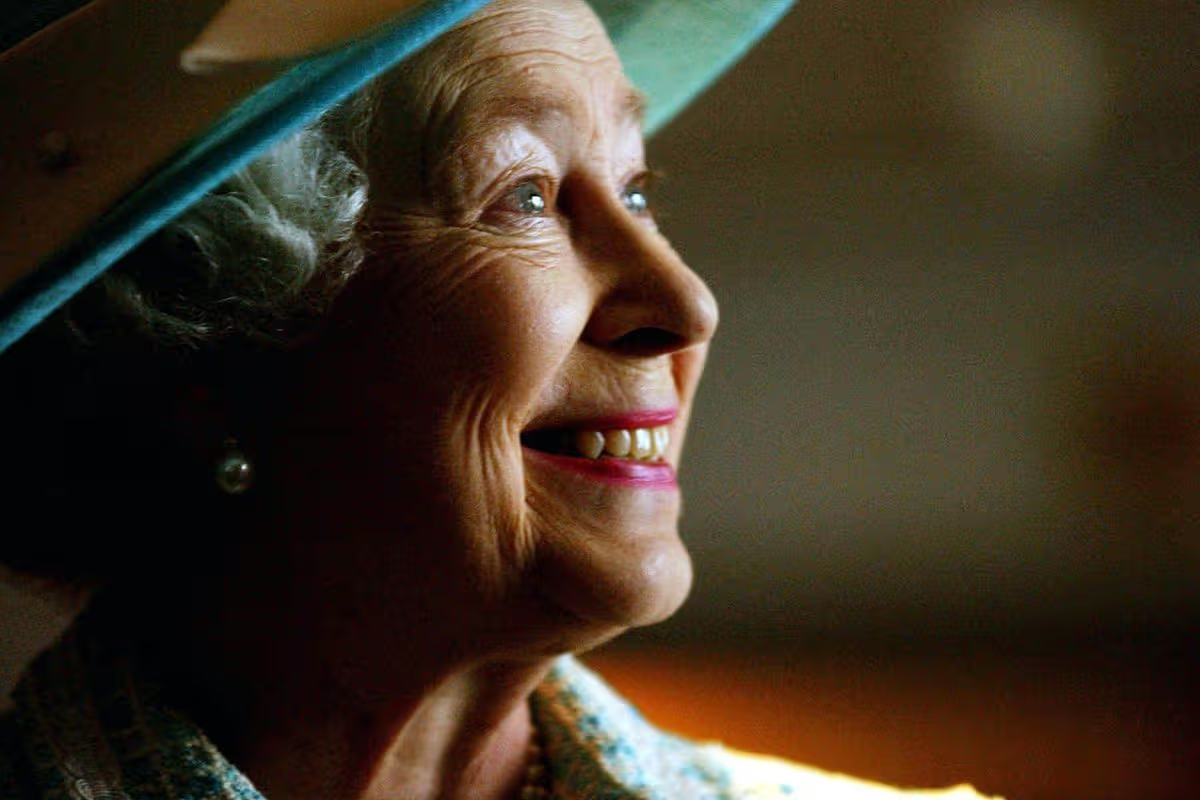
Queen Elizabeth II had a great sense of fun when it came to marking big events(Image: CREDIT LINE:BBC Studios/Camera Press/ROTA)
As the nation remembers Queen Elizabeth II on what would have been her 100th birthday next week, one grandson has given fresh insight into the subterfuge that went into her astonishing James Bond moment from the 2012 Olympics.
Peter Phillips was gripped by the scenes, along with the rest of the nation, in which the monarch comes face to face with Daniel Craig’s 007, before they seemingly parachute into the stadium from a helicopter.
But speaking in a new BBC documentary, Peter says even the family were kept totally in the dark about the extraordinary stunt. “When the clip first started we were like, ‘I wonder who they’ve got playing the Queen?’ And then she turned around. And we were like ‘wow’. It was sheer amazement. That was one of the best-kept secrets, because literally nobody knew.”
READ MORE: ITV reveals last ever outing for cast of 7 Up this year – but some faces will be missingREAD MORE: Iconic 90s TV show returning to Channel 4 for first time since 2015
The tribute film, which airs tomorrow, takes viewers through all the key moments of her reign, with insights provided by leaders, celebrities, experts and loved ones.
Queen Camilla speaks of her deep admiration for her late mother-in-law. Looking back at how she came the first female member of the royal family to join the army full time, when she joined the Auxiliary Territorial Service during the war, Camilla says: “I think duty has over-ridden everything. I don’t think I’ve ever seen anybody have a sense of duty like she had.”
Ex-US president Barack Obama agreed, commending the late Queen’s “combination of a sense of duty, with a very human quality of kindness and consideration and a sense of humour”. He adds: “I think that’s what made her so beloved, not just in Great Britain but around the world.”
Former Labour Prime Minister Tony Blair also had deep respect for Elizabeth II. “She was not a queen, but the queen,” he says. “I don’t think we’ll see her like again.”
Camilla recalls that celebrating the Queen’s platinum jubilee in February 2022, just as the Covid pandemic finally came to a close, was particularly joyous coming, as it would turn out, just a few months before the Queen’s death.
“I remember there were thousands and thousands of people lining the streets and lining The Mall – we were all looking for something to cheer us all up,” she says. “People hadn’t been out, they’d been stuck in their houses so it was an incredible jubilee. She was very much centre stage, I’ve never seen anything like it. Everybody was in a good mood.”
Helen Mirren, who put in as Oscar-winning performance as Elizabeth II in The Queen, agrees that the monarch’s profound sense of duty came naturally to her and says her death in 2022 left many feeling bereft. “She’d become such an intrinsic part of the tapestry of our life, it was as if you were going to pull a thread and the whole thing was going to fall apart.”
To research the role for the 2006 movie, Helen studied hours of footage, including plenty of when the monarch was a child. She laughs when shown an archive reel of a three-year-old Elizabeth. “I’ve never seen this before, so young! And her hair is almost the same as when she died. That’s incredible.”
Another clip shows Elizabeth aged around 10. “When I played the Queen I watched a particular piece of film over and over again of her getting out of a big black car,” the actress explains. “You see how she steps forwards and does what she knows she’s supposed to do, which is shake hands. She naturally had a sense of self control and duty.”
That innate sense of how to behave was again in evidence when Elizabeth’s father, George VI, died suddenly while she and her new husband Prince Philip were just six days in to a tour of the Commonwealth in 1951. Returning swiftly to Britain, she was filmed smiling and shaking hands with the many top-hatted, male politicians who were on the tarmac to greet her.
“She’s only just been told that her beloved, beloved father has died without her being there,” Helen 80, says. “I think that would have been so devastating to her, that she never had the chance to say goodbye.What you see happening is the duty stepping in, she does exactly what she’s supposed to do.”
Camilla is also astonished to see how calm and composed the young queen looks in this challenging moment, when she is dealing with her own grief. “It must have been so difficult being surrounded by much older men. There weren’t women prime ministers or women presidents, she was the only one. So I think she carved her own role.”
Over the course of her life Elizabeth faced plenty of difficult times, including the marriages of three of her children ending in the same year and the loss of many loved ones.
When her husband of 73 years, the Duke of Edinburgh, died during the pandemic, the Queen refused to break the rules governing the nation and instead broke hearts as she sat at his funeral all alone. Watching the sad clip of his isolated grandmother, Peter Phillips says all he wanted to do at the time was “give her a hug”.
But there were also times when the Queen came in for criticism rather than sympathy, never moreso than after the death of Princess Diana in 1997, when she opted to remain at Balmoral for more than a week rather than return to London.
BBC royal presenter Kirsty Young remembers: “There was tangible anger. Whether it was the flag being brought down to half mast or the Queen making a statement, these things were not happening. There was radio silence. There was a sense in which people might almost storm the gates of the palace.”
But the Queen then turned public opinion around with her heartfelt TV broadcast to the nation. Describing the former monarch as “quietly radical”, Kirsty adds: “I think the address by the Queen after the death of Diana illustrated beautifully that she had an ear to the public and that she was willing to do things that had never been done before.”
Blair agrees it was one of the Queen’s most challenging moments. “We had a series of really intense conversations where the Queen was having to balance the impact on her family, on her grandchildren, with the need to respond to what was a national mood at the time. Her genius was, in a way, to steer the monarchy through all of that whilst not really changing much herself.”
For her part, actress Helen believes the Queen was absolutely right to stay with her grandsons after the devastating loss of their mother. “I think she was right to stay in Balmoral with the children and then when she came out and did the very difficult walk with the flowers and everything, that was the right thing to do.”
Born just a couple of weeks after the Queen, Sir David Attenborough was running the BBC at one point in the late 1960s when it was decided the royals needed to become more relatable. This led to the BBC documentary Royal Family, an early example of reality TV, where they let the cameras in. “There was a feeling that the royal family was getting a bit remote and I remember the discussions we had in the BBC, that the image of the family should be softened in some way,” Sir David explains. It was huge hit with more than 30million UK viewers tuning in – but afterwards the Queen regretted her decision to display their private lives. The series has not been shown since the 1970s, with Elizabeth ordering it was locked away in the royal archives.
But tonight viewers can see rare clips from the series, showing a relaxed Philip cooking sausages and the queen laughing and joking with her children.
– Queen Elizabeth II: Her Story, Our Century, BBC1, 9pm, Sunday