DAMASCUS: Syria’s Culture Ministry is stepping up efforts to combat illiteracy and expand access to adult education as the country grapples with the legacy of years of war and displacement that has left about one in five Syrians unable to read or write.
The ministry highlighted the scale of the challenge at an event marking International Literacy Day, where officials outlined plans to expand literacy programs, introduce new teaching methods and use digital technology to reach people who have been excluded from education.
Ministry data presented at the event showed that around 4 million people in Syria are illiterate, equivalent to about 20% of the population, while an estimated 2.5 million children have dropped out of education.
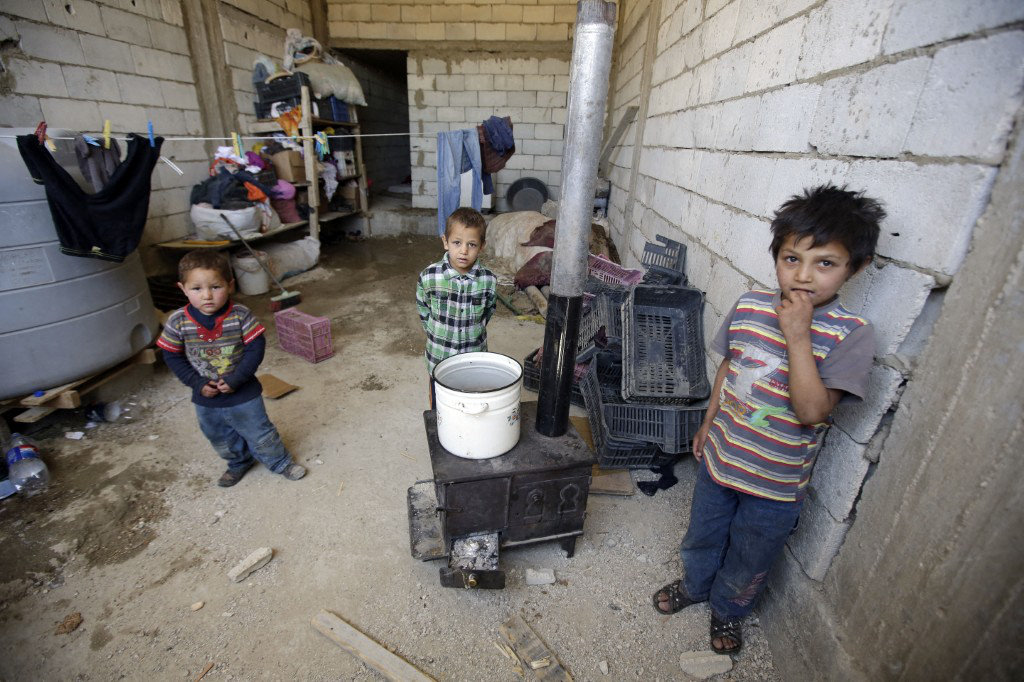
Syrian refugee children whose mother was killed while fleeing recent violence in Qussayr pose in the place they live with their father on June 14, 2013 in Arsal in the Lebanese Bekaa valley.
Officials said years of war, displacement and deteriorating economic and social conditions had contributed to the high numbers, making literacy not only an educational issue but also a challenge for the country’s broader recovery and development.
Targeting single-digit illiteracy rate
Mohammad al-Asha, director of the Cultural Development and Adult Education Department at the ministry, said authorities were pursuing two parallel approaches to address the problem.
More than 400 literacy courses have been launched since the beginning of the year as part of an immediate response, while the ministry is also developing a national plan aimed at reducing the illiteracy rate to single digits within three years.
Syrian-Kurdish children refugee play outside tents at the Domiz refugee camp, 20 km southeast of the northern Iraqi city of Dohuk, on June 19, 2013.
New curricula are expected to go beyond basic reading and writing skills to include digital and legal literacy, critical thinking and Syrian cultural identity, as well as awareness aimed at preventing extremism, addiction and behavioral problems.
Deputy Culture Minister Ahmad al-Sawwaf said literacy was closely linked to human dignity, development and citizenship, describing reading and writing as essential tools for people to understand their rights and responsibilities and participate in rebuilding their communities.
Children walk back from school past building rubble in the devastated Hajar al-Aswad area near the Yarmuk camp for Palestinian refugees on the southern outskirts of Damascus on December 23, 2024.
Digital tools to broaden access
The event also focused on using digital technology and artificial intelligence to expand adult education at a time when limited resources and staffing pose additional challenges.
Engineer Ramez al-Sammak said digital tools could be used to assess learners’ abilities and tailor educational content to individual needs, helping move literacy programs beyond traditional classroom-based teaching.
Such technology could also help programs reach more people and address difficulties including low motivation and the challenge of attending lengthy courses, participants at a specialized seminar on digital literacy education said.
The event honored 18 people who had benefited from adult education programs, including some who went on to complete secondary education and others who used their newly acquired skills to start income-generating projects in food production, handicrafts, woodworking and crochet.
The event honored 18 people who had benefited from adult education programs.
People with disabilities who continued their education despite difficult circumstances were also honored.
The Culture Ministry said tackling illiteracy required a broad national effort to help vulnerable groups regain access to education and overcome economic, social and psychological barriers.
Through its Adult Education Directorate, the ministry implements Syria’s national literacy policy and develops programs aimed at providing sustainable learning opportunities and helping people excluded from formal education participate more fully in social and cultural life.
“Everywhere I go, the kids call me ‘the book lady.’”
Dolly Parton wore the moniker like a badge of honor, and she earned it too. Through her Imagination Library program, launched by the Dollywood Foundation in 1995, she put more than 330 million books into the hands of children across America, Canada, the U.K., Australia and the Republic of Ireland.
The program is rooted in a childhood of poverty and illiteracy — roots that those who knew Parton said she never denied or abandoned.
Parton, 80, died Tuesday after a brief battle with cancer. And although the country western superstar collected accolades — including 10 Grammy Awards, a National Medal of the Arts and two Academy Award nominations — across her storied career, Parton said her contributions to children’s literacy were most precious to her.
In 2023, the American Library Assn. awarded the singer-songwriter, book lady and philanthropist its highest honor — lifetime membership — to recognize her lasting impact on literacy and inspiring a love of reading in children.
“Dolly Parton represented the very best of America,” ALA President Maria McCauley told The Times on Tuesday, adding that, like people all over the world, she’s been playing Parton’s music since news of her death broke, particularly the song “I Can See the Light of a Clear Blue Morning.”
“That song has so much resonance right now,” she said, noting its lyrics capture a theme of resilience and faith in overcoming dark times.
“We want to make sure that Dolly’s vision, that reading is for everyone, becomes a reality. That’s something that we can all carry forward in memory of Dolly.”
Parton’s Imagination Library gifts a book a month to children signed up for the program from the time they are born until they are 5 years old. Parton described the program best when speaking with librarian Carla Hayden in 2018. “We send the book in the mail with their name on it. It’s not in the care of Mom and Dad — it’s got their little name on it, and they love to think, ‘This is mine.’ They wait at the mailbox. They get their little books, and to them, it’s personal.”
Parton understood the novelty of owning your very own book. Growing up in the Great Smoky Mountains town of Sevierville in east Tennessee, Parton was the fourth of 12 kids. Her father, a tobacco sharecropper, couldn’t read or write, and the family lived in a one-room cabin with no electricity. There were no books in the home, aside from the Bible.
The singer’s upbringing, particularly her father’s illiteracy and his shame around what he considered a shortcoming, was what inspired her to launch the Imagination Library. With the help of her dad, they set out to foster a love of reading in the kids of Sevier County. Reading, she believed, was the gateway to dreaming, and dreaming, the first step in the path toward success.
By 2000, the program had expanded beyond the Smoky Mountains and into a nationwide movement. By 2003, the Imagination Library had mailed 1 million books to budding readers. After the United States, the gifting initiative launched in Canada in 2006, then the U.K. in 2007, Australia in 2013 and the Republic of Ireland in 2019.
The program operates on a shared funding model split between the Dollywood Foundation — which manages the central overhead, administration, and global book-selection strategy of the Imagination Library — and local community partners including businesses, school districts, small or large organizations, or individuals who share in the mission.
Selina Brown, a U.K. author whose book “My Rice Is Best” was selected by the Imagination Library this year, said that 14,000 copies had been distributed across the U.K. to children in underprivileged areas. “To know that my book has gone into the hands of young children across the U.K. is absolutely incredible,” she told The Times.
Brown said that public figures often make shallow promises and vanity moves, but “with Dolly Parton, you can actually see her work manifest, and it really makes an impact. In the U.K. alone, there are children who do not have books in their house, and because of Dolly Parton, they now have their own library.”
Canadian author Melanie Florence, who penned “Sarabeth’s Garage” — another of Imagination Library’s picks — also grew up in a small town, with no bookstore, during a time with no online retailers. “If that had existed when I was a kid, being gifted a book that you get to keep, it’s a big thing, especially for a kid like I was, who just lived to read,” Florence told The Times.
“I think that’s such a beautiful legacy,” Florence said, “her music and this spirit of generosity.”
But it’s also a working legacy that Parton built to last, according to Dollywood Foundation’s president, Jeff Conyers.
“Dolly’s legacy was never meant to be something we simply preserve or look back upon,” Conyers said. “She built things that could keep doing good in the world.”
Conyers said the foundation was set to “make certain the love at the heart of her work continues reaching children, families and communities long into the future.”
Although the foundation is heartbroken after Parton’s death, he said, “the mission she gave us is as clear today as it has ever been, and we will carry it forward for generations to come.”
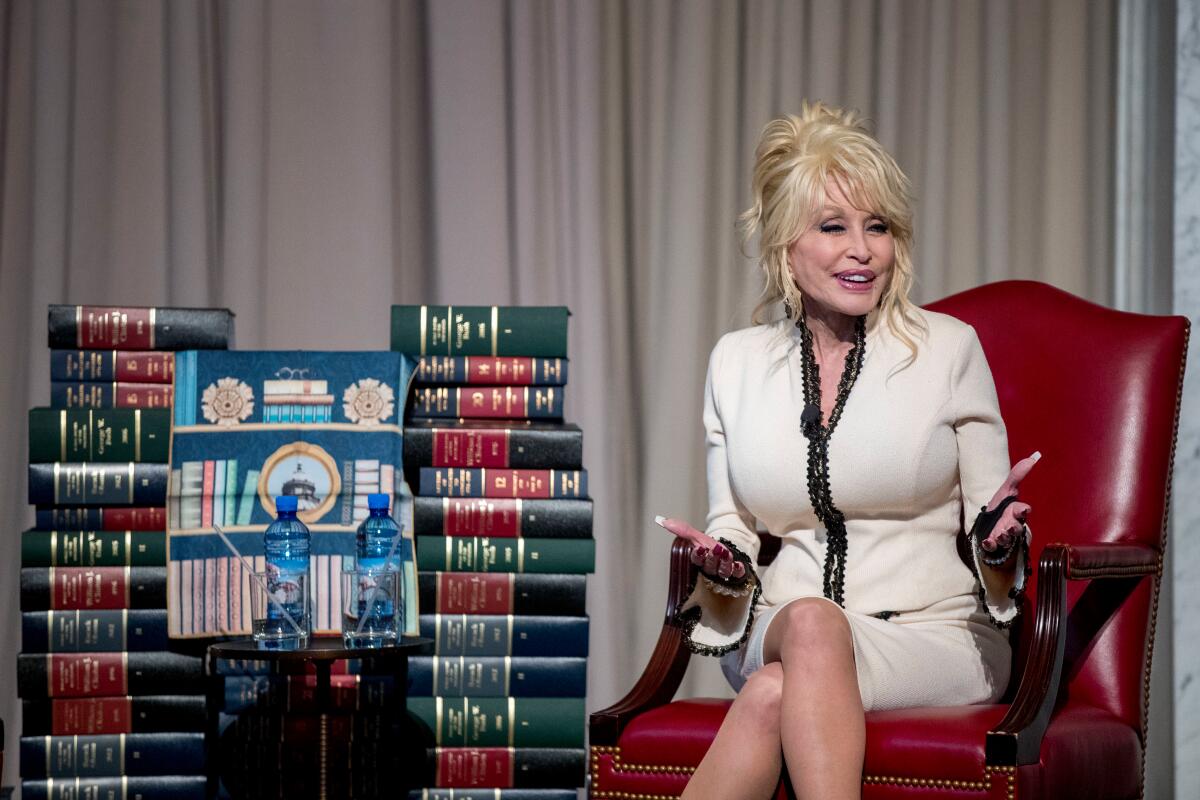
Dolly Parton marks the 100 millionth book donation by her Imagination Library to the Library of Congress collection in 2018.
(Andrew Harnik / Associated Press)
Washington, D.C., Councilmember Charles Allen said he was visiting family in east Tennessee more than decade ago when his 2-year-old niece went tottering off toward the mailbox. When her parents brought her back in, she was holding a book with her name on it. Allen said his brother had signed her up for Parton’s Imagination Library at the hospital just after she was born — “right then and there.”
Allen said he was inspired by “the joy on my own niece’s face when she opened up a book with her name on it” to write a D.C. law called “Books From Birth.”
“We basically borrowed that program and then partnered with them,” he said. “And now every child in D.C. from the time they’re born ’til they’re 5 years old gets a free book delivered.”
Allen said that the program is now 10 years old, and 4 million books have been distributed to about 100,000 kids: “It’s made a big impact.”
Allen met with Parton years ago and said she never forgot her roots.
“Watching her own parents struggle with literacy and kind of hiding it, she realized very quickly the power that she had as this just massive cultural and musical star,” he said, adding that she was going to use that power for something that would outlast her. “It’ll outlast me. It’ll outlast everybody.”
Children of D.C. “they know Dolly Parton,” he added. “They know she’s the lady that delivered the books. I have all the confidence in the world that she is smiling somewhere, knowing that so many people think of her as the book lady. That she was going to battle illiteracy, one kid, one family, one household at a time.”
In 2018, Parton donated her 100 millionth book to the Library of Congress.
During the ceremony Hayden, the librarian, asked the country star if she ever thought she’d be known so widely as “the book lady.”
Parton responded with her signature self-deprecating wit and wisdom: “I never thought about being the book lady — the painted lady, yes. The overexaggerated, overdressed lady — yes. But that just goes to show you that you can’t judge a book by looking at the cover, right? Or even a 100 millionth book by looking at the cover.”
In September, 336,004,951 books will have been distributed through Imagination Library. More than 3.6 million families have been registered globally.