Lincoln

Times of Troy: It’s time for Lincoln Riley to finally beat Oregon

Welcome back to the Times of Troy newsletter, where we’ve reached a critical fork in the road for the Lincoln Riley era.

The soft part of the schedule is behind USC. Oregon awaits next Saturday. The time is now for Riley and USC, just like the billboards around L.A. have been insisting for months.

That this moment arrives after Saturday’s uninspiring escape from Rutgers only amplifies the pressure on USC’s coach. Against arguably the worst team in the Big Ten, the Trojans were once again plagued by many of the same road woes that Riley has failed for four years to solve. USC’s defense, now on its third coordinator under Riley, was largely a disaster. Even the offense, with another Heisman Trophy candidate at quarterback, looked clunky and out of sync.

Fight on! Are you a true Trojans fan?

Get our Times of Troy newsletter for USC insights, news and much more — exclusive to L.A. Times subscribers. Free Members receive a partial preview of each edition.

Now, Riley is out of time to iron out these issues. Because there is no more important game for USC this season than next Saturday. Outside of the 2022 Pac-12 title game, which went quite poorly for him, I’d argue it’s the most important game of Riley’s entire tenure to date.

Riley has yet to beat Oregon as USC’s coach, while Dan Lanning and the Ducks have run circles around the Trojans, on and off the field, during the four-plus years they’ve both been coaching out West. Oregon may have never won a national title, but has been to the College Football Playoff in three out of those four years. USC has never been to the Playoff. The two teams have become legitimate rivals over that time. But in two meetings with Oregon under Riley, there’s never been any doubt about who’s the better team.

For a brief moment, early in this season, it seemed like that might be shifting. Oregon was stunned by Oklahoma State, just two weeks ago, leading to real questions about whether the Ducks are the Playoff contender they were made out to be.

That loss, though, actually ratcheted up the importance for Riley. With Oregon appearing this vulnerable, there are no excuses for USC or its coach if they don’t win this game. No matter the situation that Riley inherited, the Trojans should have what it takes, by Year 5, to compete with Oregon. Full stop.

That’s the standard that USC was expecting in shelling out over $11 million per year to its football coach. But in four-plus seasons under Riley, the Trojans have just six wins against ranked opponents and have consistently blown their biggest games.

Think, for a moment, of Riley’s biggest win at USC. Are you having a hard time conjuring it? That’s because of the six ranked teams that USC has beaten under Riley, all of them finished with four losses that season.

Clay Helton had three top-five wins at USC through his first 18 games as head coach. Meanwhile, in almost five years and 57 games, I’d argue Riley still doesn’t have a single great win.

He can change that Saturday. But if Riley can’t lead USC past Oregon now, after all this time, who’s to say he ever will?

“House of Troy”: Chapter 1 drops Sept. 22

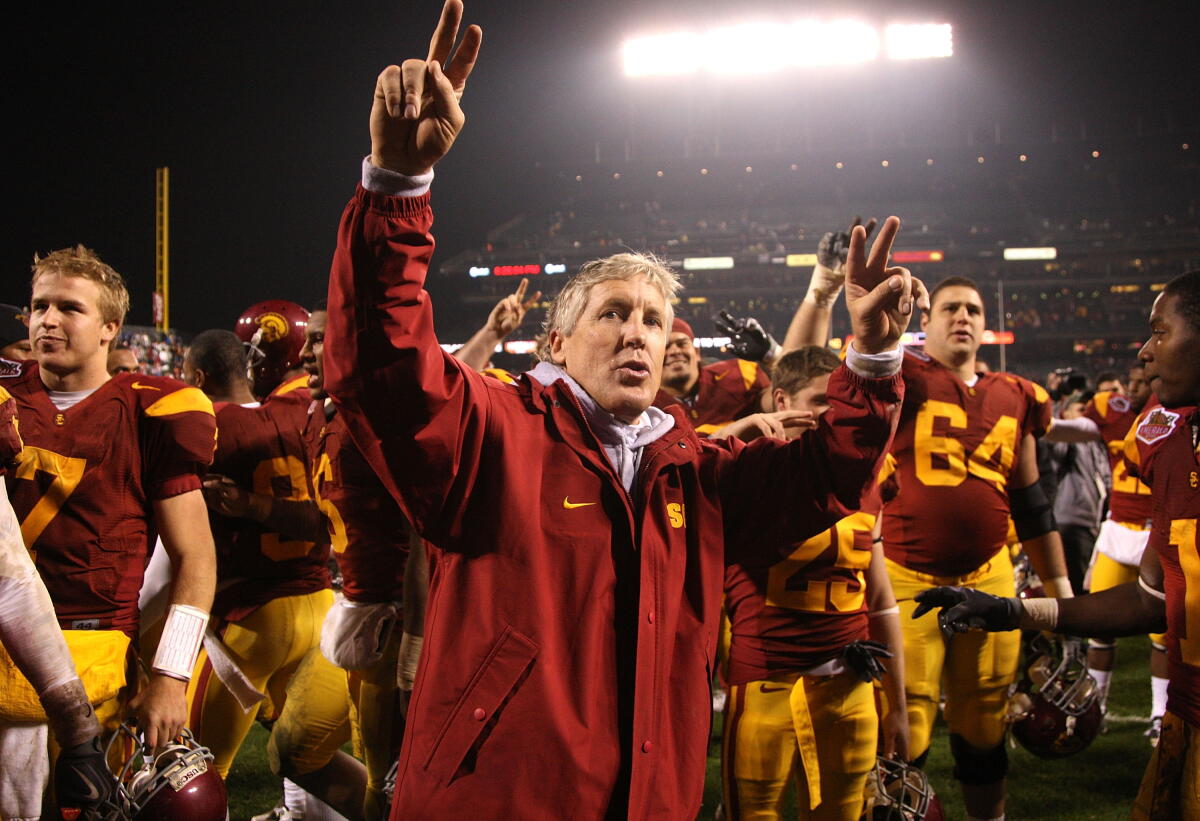
USC coach Pete Carroll celebrates after defeating the Boston College Eagles during the 2009 Emerald Bowl

Pete Carroll when he was coaching USC.

(Getty Images)

Twenty five years ago, USC’s football program was in a bad spot.

The Trojans hadn’t been relevant in over a decade, and Paul Hackett had just been fired as head coach. USC needed a new direction. But its search for Hackett’s replacement was going poorly. Two coaches — from Oregon and Oregon State, no less — had already turned them down. That’s when Daryl Gross, the USC official in charge of the search, turned his attention to a twice-failed NFL coach.

Pete Carroll.

His hire would turn out to be a seminal moment in the history of Trojan football. But that was not how folks saw it at the time.

“There’s legendary stories of fax machines just blowing up and paper after paper coming through,” said Rocky Seto, who was a grad assistant at the time. “People weren’t happy.”

Bill Plaschke, The Times columnist, wrote a column at the time ripping the hire. Carroll himself called Plaschke after that, begging for a shot.

“All he kept saying,” Plaschke said, “was just gimme a chance.”

Well, it turned out OK for Carroll and the Trojans. They won back-to-back national titles and nearly won a third during his tenure as coach.

It’s what came after that, as USC tried to cling on to the Carroll era, that’s the subject of a new narrative podcast series from LA Times and LA Times Studios, House of Troy. Starting with Carroll’s hire a quarter-century ago, we’ll walk you through how USC rose to college football prominence and how it all came crashing down once Carroll left.

The first chapter of House of Troy drops on Sept. 22, with new episodes coming every week after that. Before then, be sure to subscribe wherever you get your podcasts.

King Miller runs past Rutgers defensive lineman Farell Gnago in the first half.

King Miller runs past Rutgers defensive lineman Farell Gnago in the first half.

(Adam Hunger / AP)

—King Miller is the clear RB1 at the moment. USC may view Miller and Waymond Jordan as starting running backs, but there’s no doubting who has taken the reins at the top of that rotation. Both are averaging over five yards per carry. But Miller has at least 15 carries in all four games, while Jordan hasn’t eclipsed 11. Personally, I’m a bit surprised by that divide given how great Jordan looked before his injury last season. It makes me wonder if he’s all the way back from his ankle surgeries.

—The receiver rotation is still up in the air right now. With Trent Mosley out indefinitely, USC opened the game with Kayden Dixon-Wyatt, Corey Simms and Zacharyus Williams as its top three wideouts. Dixon-Wyatt is deservedly locked in that spot, while Simms balled it in his 20 snaps, catching four passes for 72 yards despite missing some time during the game due to injury. Hines ended up playing more snaps, but had a key drop on third down that we’d be talking much more about if USC hadn’t gone for it and converted on fourth. Williams played in the slot, but had just one catch. The real mystery here is Terrell Anderson, who was dressed and not on the injury report, but didn’t play a single snap on offense. Anderson was viewed, at one point, as a key contributor, so it’s not clear what happened.

—Kaylon Miller replaced Hayden Treter as the starting left guard. The move was a bit unexpected, given how Treter played through three games. Treter still played 28 snaps to Miller’s 40 against Rutgers, but with a very good Oregon defensive line on tap, the offensive line will be tested next week unlike it has all season. Miller has always had the respect of offensive line coach Zach Hanson. We’ll know at the start of the game next week whom he trusts the most in that spot.

—USC isn’t built to withstand injuries in the secondary. No unit on the entire roster has more doubts about its depth, and against Rutgers, USC had to test that depth more than it would like. Top corner Jontez Williams only played 22 snaps, while slot corner Alex Graham only played 15. Kennedy Urlacher and Rock Hill took their places, and while they did a fine job, the ripple effects of one injury on the position could be significant. Behind those players are a lot of question marks. So USC better hope that they’re all healthy heading into Oregon.

—USC men’s hoops will play four Big Ten road games in 10 days to start 2027. Which, on its face, seems patently insane. But after a screwy start to the Big Ten schedule a year ago, coach Eric Musselman actually asked for a slate exactly like this. The reason? His team doesn’t have to travel back and forth twice to the East Coast. In this case, they will have to travel from Bloomington, Ind. to College Park, Md. But that’s much more doable than an extra 10 hours of flying.

This week, in 2006 …

After hosting College Gameday and beating No. 19 Nebraska at home, USC opens its Pac-10 season on the road with a dominant defensive performance at Arizona, winning 20-3.

Led by new inside linebacker Rey Maualuga, the Trojans didn’t allow a single point until the fourth quarter. The offense, meanwhile, finally found a running back to lean on. With Reggie Bush and LenDale White both off to the NFL and USC still waiting for someone to step up in their place, Emmanuel Moody heeded the call. He rushed for 130 yards and a score as the Trojans stood pat at No. 3 in the AP poll.

Polling the people

We asked, “After three comfortable wins in the non-conference schedule, do you feel better about the Trojans’ trajectory than you did at the start of the season?”

After 1,523 votes:

Nothing has changed, 47.4%
Yes, I feel better, 45.8%
No, I feel worse, 6.8%

Olympic sports spotlight

A brutal start to the season isn’t getting much better in Big Ten play for USC’s women’s soccer team. After starting the conference slate by being shut out, 5-0, by Michigan State, USC was shut out again by Purdue, 2-0, and then managed a tie against Oregon, 1-1.

The Trojans have scored one or fewer goals in seven of their nine matches this season and are 0-5-2 in those scenarios. They need to produce more offense — and stat.

What I’m watching this week

Domhnall Gleeson as Ned in "The Paper."

Domhnall Gleeson as Ned in “The Paper.”

(Aaron Epstein/Peacock)

It tends to take at least a season for a sitcom to really find its rhythm, and so far, that’s been the case for “The Paper,” the spinoff of The Office which dropped its second season on Peacock recently. The first season got the journalism right, but the narrative was a bit clunky, as it sorted out who of its characters should be leading the way.

Fortunately, it seems like they’ve figured it out. Especially in the case of Domnhall Gleeson’s lead editor character, Ned Sampson, who I find far more likable in Season 2.

In case you missed it

No. 12 USC defeats Rutgers in Big Ten opener, but defensive woes detract from win

USC freshman star Luke Wafle’s football roots date back nearly a century

USC freshman star receiver Trent Mosley to miss Rutgers game

Chad Baker-Mazara sues USC, accuses Eric Musselman of ‘racially charged’ tirade

Until next time …

That concludes today’s newsletter. If you have any feedback, ideas for improvement or things you’d like to see, email me at ryan.kartje@latimes.com, and follow me on X at @Ryan_Kartje. To get this newsletter in your inbox, click here.
Source link

USS Abraham Lincoln Looks Like It’s Been Through Hell After 286 Days At Sea

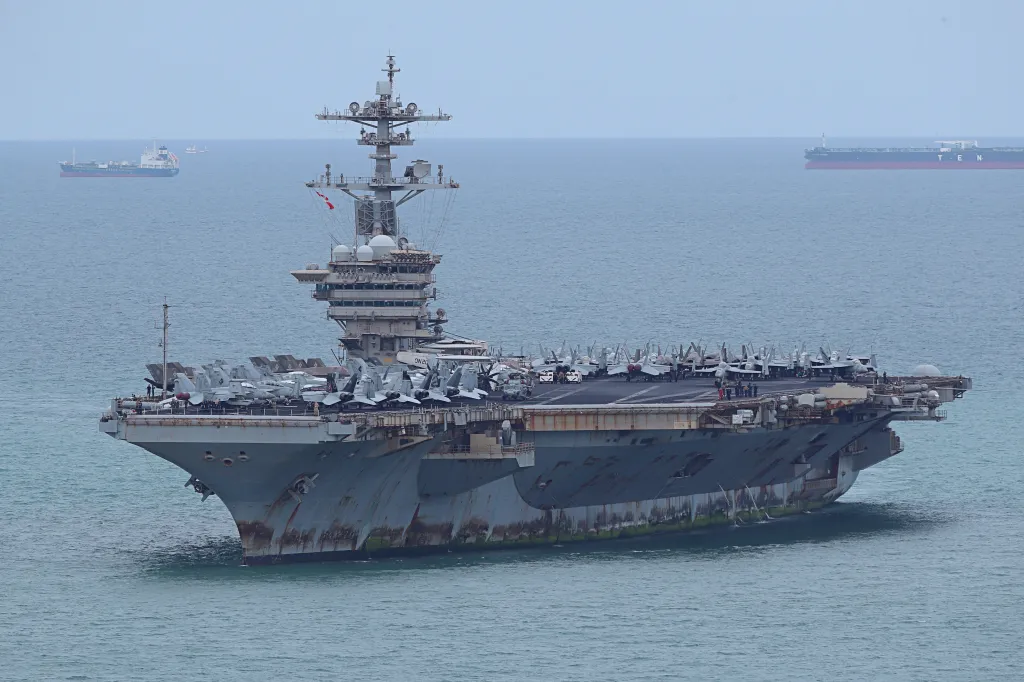
The U.S. Navy’s supercarrier USS Abraham Lincoln is now in Thailand for a much-deserved and highly publicized liberty port call. The carrier had gone 286 days without making such a stop, with much of that time spent executing grueling combat operations against Iran. The ship has been run very hard, relying on at times a rickety conveyor of sea replenishments to continue operating for months on end, and it has the scars to show for it. The Lincoln looks very much worse for wear, with so-called “running rust” and algae caked all along the sides of the hull, as well as around the edges of the flight deck and sponsons on either side. It’s something of a startling appearance for one of the most powerful ships on the planet and a major symbol of U.S. power projection, but it is also a reminder of what the vessel and its crew have endured for months on end.

The Lincoln arrived in the Thai port of Laem Chabang earlier today. The carrier did make a stop in Guam in December 2025 and reportedly made another one somewhere in the Middle East in July. However, in both cases, these have been characterized as brief logistical stopovers that did not offer any real opportunity for personnel onboard to disembark. Thai media reports say the carrier is expected to remain in Laem Chabang through the end of the weekend.

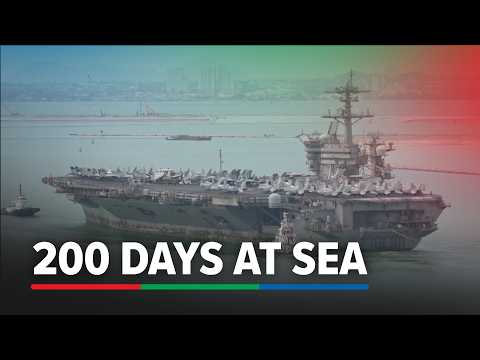
After over 200 days at sea, U.S. aircraft carrier arrives in Thailand | ABS-CBN News thumbnail

After over 200 days at sea, U.S. aircraft carrier arrives in Thailand | ABS-CBN News


“Our arrival in Laem Chabang provides a well-deserved opportunity for our Sailors and Marines to rest and recharge. It also underscores the strong and enduring partnership and alliance between the United States and Thailand,” Rear Adm. Robert E. Loughran, commander of Carrier Strike Group 3 (CSG-3), said in a statement in a press release today. “What this strike group has accomplished is truly historic. I could not be prouder of the exceptional professionalism and expertise demonstrated by every member of this team during our operations in the U.S. Central Command area of responsibility.”

An official picture the US Navy has released of the USS Abraham Lincoln arriving in Thailand today. USN

Lincoln and its strike group had left port in San Diego in November 2025 for what was originally expected to be a routine cruise in the Pacific. The carrier, its air wing, and escorts were subsequently directed to the Middle East and arrived in that region in January 2026.

CSG-3 took part in the opening salvo of strikes on Iran on February 28 as part of what the U.S. military dubbed Operation Epic Fury. Lincoln and the rest of the strike group continued to support Epic Fury and subsequent operations against Iran for months thereafter. The decision was finally made to rotate the carrier out of the region last month following a raft of reports of severely flagging morale and mental health among the crew, which we will come back to later.

Two of the Arleigh Burke class destroyers assigned to CSG-3, the USS Michael Murphy and the USS Spruance, are still understood to be operating in the Western end of the Indian Ocean. A third destroyer in the strike group, the USS Frank E. Petersen Jr., accompanied the Lincoln to Thailand and is now docked in a separate port in Sriracha, near Laem Chabang. The Ticonderoga class cruiser USS Robert Smalls also helped escort the carrier, and that warship “also arrived in Map Ta Phut, Thailand for their own scheduled port visit,” according to the Navy.

As mentioned, Lincoln definitely looks like it’s been at sea more or less continuously for the last nine and a half months or so. Pictures and videos of the ship in Laem Chabang seen throughout this story plainly show big dark rust stains all around the hull and other similar signs of wear elsewhere. There is also a bright green ring of algae layered on the hull at the waterline. While carriers have very large crews and usually keep the ship’s appearance up relatively well while on cruise, there is only so much that can be done out of port on particularly long deployments, where all resources are focused on sustained high-tempo combat operations.

USS Abraham Lincoln seen arriving in Laem Chabang, Thailand, today. Thananuwat Srirasant/Getty Images
Another look at the Lincoln arriving in Thailand today. ANTHONY WALLACE / AFP via Getty Images
A closer look at the side of Lincoln‘s hull, with ‘running rust’ and algae plainly visible. ANTHONY WALLACE / AFP via Getty Images

Running rust on U.S. Navy ships has been something of a lightning rod for criticism in recent years, including from President Donald Trump. This is in part due to the negative optics of such visible wear and tear on American naval vessels, especially during calls in foreign ports.

“It’s terrible. I think they should be ashamed,” John Phelan told members of Congress at a hearing last year after being shown pictures of a very worn-looking Arleigh Burke class destroyer, the USS Dewey, during a stopover in Singapore. “Would you want to go on that ship?”

Phelan was testifying at the time regarding his nomination to be Secretary of the Navy. At the time, he said that President Trump had already been texting him in the middle of the night regarding the issue. Phelan was subsequently confirmed and served as the Navy’s top civilian until he was unexpectedly fired in April, reportedly over disagreements regarding the new Trump class battleships and other more general friction within the administration,

A picture of the USS Dewey covered in “running rust” during a recent port visit in Singapore is shown at the confirmation hearing for Secretary of the Navy nominee John Phelan on January 27, 2025. Senate Armed Services Committee capture

Lincoln‘s current condition is, of course, an extreme case that is the result of very specific operational circumstances. The carrier has already been in the news for weeks now due to the aforementioned morale issues, which family members of those onboard have been very vocally calling attention to through the media. One sailor had to be rescued last month after deliberately jumping overboard. There were reports that at least one other individual onboard had attempted to do the same. President Donald Trump and Secretary Pete Hegseth, among others, have pushed back on concerns about mental health and other issues on the ship. In a statement shared on social media on August 16, Navy Adm. Brad Cooper, head of U.S. Central Command (CENTCOM), acknowledged, but still downplayed, the seriousness of the mental health situation, in particular.

At the same time, the carrier’s marathon deployment is indicative of larger shipbuilding, readiness, and other issues that the Navy continues to struggle with. Strains on the service carrier fleets in particular have been steadily building for years and are now becoming a low-level crisis. The USS Gerald R. Ford wrapped up a historic 326-day-long deployment in May. The Navy has publicly said that the USS Theodore Roosevelt, which is set to begin its latest cruise soon, could be away from home for at least eight months. The longer the ships remain deployed, the longer they typically have to spend in port afterward, further compounding the situation with each passing day during months-long extensions. This all has very worrisome cascading impacts on even routine maintenance cycles, let alone deep overhauls and upgrade efforts, as well as personnel management matters, as we have explored in detail in the past.

USS Abraham Lincoln in Guam in December 2025. USN

“It’s my earnest attempt to really try to keep those [deployments] at seven months,” Chief of Naval Operations Adm. Daryl Caudle, the Navy’s top officer, said during a question-and-answer session at Fort Meade, Maryland, Monday, which was livestreamed. He also said he wanted a Navy “that can sustain a seven-month deployment and still give our combatant commanders the amount of naval force they need to accomplish their missions, solve their key operational problems, and make sure they have all the naval force necessary to do what they need to do.”

Caudle had notably acknowledged concerns about strains on the Ford while speaking to TWZ and other outlets at the Surface Navy Association’s annual symposium back in January.

The Lincoln‘s visibly worn state certainly draws new attention to the stress on America’s carrier fleets as personnel onboard are now finally getting a much-earned reprieve in Laem Chabang.

Contact the author: joe@twz.com

Joseph is TWZ’s Deputy Editor, helping to oversee the site’s highly experienced and dedicated team, while also writing informative and impactful defense and national security content. He lives right in the thick of it in the Washington, D.C. area.


Source link

USS Abraham Lincoln Is Getting A Badly Needed Scrubbing While In Thailand

After pulling into Thailand looking very much like it just spent 286 days at sea, the U.S. Navy’s supercarrier USS Abraham Lincoln is now getting much-needed TLC. When the Lincoln arrived in the Thai port of Laem Chabang on Sept. 2, it had so-called “running rust” and algae caked all along the sides of the hull. Other parts of the ship, especially around the edges of the flight deck and sponsons on either side, also looked rough. The ship’s condition was a stark, visible reminder of the hardships endured by the carrier and its crew during a long deployment that included a key role in the war against Iran.

Video emerged on social media of local workers cleaning the carrier. Two of them can be seen on a scaffolding platform, dressed in silver-colored protective clothing, yellow helmets, face shields and black boots, spraying the side of the big ship. You can see that most of the rust, as well as all of the green swath of algae, was removed from the section where they are working.

The camera also pans across the ship, showing the extent of the work still needed. 

It is unclear whether this work had already been scheduled as part of routine maintenance or whether it had been ordered after images of the ship emerged showing its rough condition. The ship was a huge focus of attention even before it got to Thailand.

Lincoln and Carrier Strike Group 3 took part in the opening salvo of strikes on Iran on February 28 as part of what the U.S. military dubbed Operation Epic Fury. Lincoln and the rest of the strike group continued to support Epic Fury and subsequent operations against Iran for months thereafter. The decision was finally made to rotate the carrier out of the region last month following a raft of reports of severely flagging morale and mental health among the crew. One sailor had to be rescued last month after deliberately jumping overboard. There were reports that at least one other individual onboard had attempted to do the same. President Donald Trump and Defense Secretary Pete Hegseth, among others, have pushed back on concerns about mental health and other issues on the ship.

Interest in the Lincoln flared up anew after it arrived in Thailand due to its condition, as well as intense curiosity about how the crew would fare in a Thai port call after being at sea for so long.

SI RACHA, THAILAND - SEPTEMBER 02: The USS Abraham Lincoln (CVN-72) aircraft carrier arrives at Laem Chabang Port on September 02, 2026 in Si Racha, Thailand. The U.S. aircraft carrier is making a port visit to Thailand following an extended deployment in the Middle East. Nearly 5,000 sailors and Marines are aboard the carrier, with personnel expected to take shore leave in nearby Pattaya. (Photo by Thananuwat Srirasant/Getty Images)
The USS Abraham Lincoln (CVN-72) aircraft carrier arrives at Laem Chabang Port on Sept. 2, 2026 in Si Racha, Thailand. (Photo by Thananuwat Srirasant/Getty Images) Thananuwat Srirasant

As we noted in our initial story about the Lincoln’s arrival in Thailand, running rust on U.S. Navy ships has sparked criticism over the years, including from President Donald Trump. This is in part due to the negative optics of such visible wear and tear on American naval vessels, especially during calls in foreign ports.

“It’s terrible. I think they should be ashamed,” John Phelan told members of Congress at a hearing last year after being shown pictures of a very worn-looking Arleigh Burke class destroyer, the USS Dewey, during a stopover in Singapore. “Would you want to go on that ship?”

One driving factor in the condition of ships like Lincoln is the operational tempo of deployments, a Navy official noted earlier this year.

“We know what to do, but we choose not to do it,” Mark Lattner, director of the Navy’s Ship Integrity and Performance Engineering, Naval Systems Engineering Directorate, said in January during a panel at the Surface Navy Association’s annual symposium that TWZ attended. “And we choose not to do it because there’s always some other problem I’ve got to fix. I don’t have time. Our corrosion can wait. And so we don’t implement the fixes.”

Finding a solution to the Navy’s rust problem became one of Lattner’s main missions in the wake of the fallout from Trump’s late-night texts to Navy officials demanding answers about the condition of the Arleigh Burke class guided missile destroyer USS Dewey after he saw pictures of it covered in running rust as it pulled into Singapore last year.

President Donald Trump, through his pick to be the next Secretary of the Navy, has thrust long-running criticisms of what is commonly called "running rust" on American warships back into the mainstream limelight.
A picture of the USS Dewey covered in ‘running rust’ during a recent port visit in Singapore is shown at the confirmation hearing for Secretary of the Navy nominee John Phelan on January 27, 2025. (Senate Armed Services Committee screen capture) Senate Armed Services Committee capture

Port calls offer critical time to fix long-standing issues and resupply the ship of pretty much everything you can think of, from jet fuel to food. So it’s no surprise that the Lincoln would be swarmed with support personnel and supplies while much of her crew enjoys being on land once again for a few days.

It’s unclear how long the clean-up work on the Lincoln will last or how much of it will be finished by the time the ship and crew leave port. Either way, from what we have seen so far, it will look much better leaving Thailand than when it arrived.

Contact the author: howard@twz.com

Howard is a Senior Staff Writer for TWZ. He writes frequently about conflict, focusing heavily on the Middle East and Ukraine, and interviews with military and intelligence officials and industry leaders from around the globe. He lives near Tampa, Florida, home of U.S. Central Command, U.S. Special Operations Command.


Source link

USS Abraham Lincoln docks in Thailand for shore leave

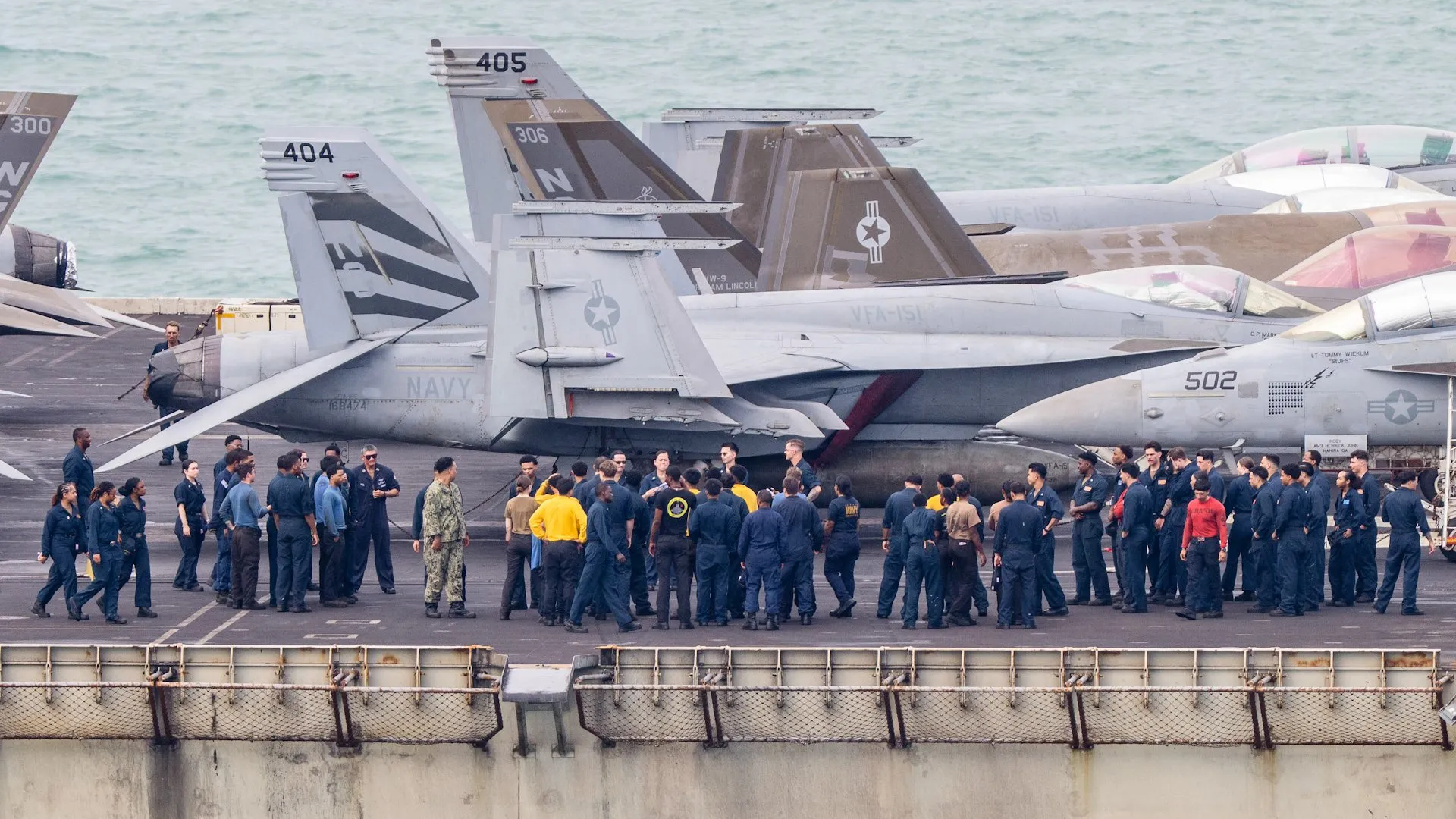
A U.S. Navy helicopter lands on the nuclear-powered aircraft carrier USS Abraham Lincoln (CVN-72) while the ship sails to dock at the deep-sea port in Laem Chabang, Chonburi province, Thailand, Wednesday. The Nimitz-class nuclear-powered aircraft carrier with roughly 5,000 sailors and Marines aboard and other vessels from its Carrier Strike Group, is docked with personnel to come ashore in Thailand to rest and recuperate while the warship replenishes supplies after an extended deployment. Photo by Rungroj Yongrit/EPA

Sept. 2 (UPI) — The USS Abraham Lincoln docked in Thailand Wednesday morning, the first break for the sailors aboard since before Thanksgiving.

The 5,000 crew members aboard the nuclear-powered aircraft carrier stepped on land and headed to the beach town of Pattaya, Thailand, to begin their first significant shore leave in nine months.

The ship, based in San Diego, has spent more than 250 consecutive days supporting actions in Venezuela and Iran. The crew has faced issues with morale, plumbing and food supplies. At least one sailor aboard the ship has attempted suicide, and there have been reports of more.

During the Lincoln’s deployment in the Middle East, the U.S. naval base in Bahrain was mostly destroyed at the beginning of the war, making restocking and repairs more challenging.

After public outcry, the Navy replaced the Lincoln with the USS George Washington, allowing the Lincoln to head home.

The Lincoln docked Wednesday at Laem Chabang, north of Pattaya, and crew members traveled by bus into the beach town. Many of them booked hotels for their shore leave, said Pattaya Mayor Poramet Ngampichet.

“It is a well-deserved break for all of the crew, and we really look forward to our time here,” said Capt. Daniel J. Keeler, commanding officer of the Lincoln, The New York Times reported.

“It’s good to have you here,” the mayor said, shaking hands with the Captain.

The mayor and other local dignitaries greeted the first arriving sailors at the Hard Rock Hotel in Pattaya. They handed the crew members gifts and welcomed them to the area.

“Our arrival in Laem Chabang provides a well-deserved opportunity for our sailors and Marines to rest and recharge. It also underscores the strong and enduring partnership and alliance between the United States and Thailand,” Rear Adm. Robert E. Loughran, commander of Carrier Strike Group 3, which includes the Lincoln, said in a statement. “What this strike group has accomplished is truly historic. I could not be prouder of the exceptional professionalism and expertise demonstrated by every member of this team during our operations in the U.S. Central Command area of responsibility.”

The statement pointed out that Thailand has been a partner of the United States since the 1833 Treaty of Amity and Commerce, and it’s the only treaty ally in mainland southeast Asia.

Pattaya is just north of U-Tapao, where an airbase hosted U.S. B-52 bombers during the Vietnam War. It also provided a rest and relaxation spot for U.S. servicemembers during the war and since. For this shore leave, local authorities said the military has restricted certain activities, including consuming marijuana, parasailing and jet skiing.

After the weekend in Thailand, the Lincoln is scheduled to leave for San Diego Sunday.

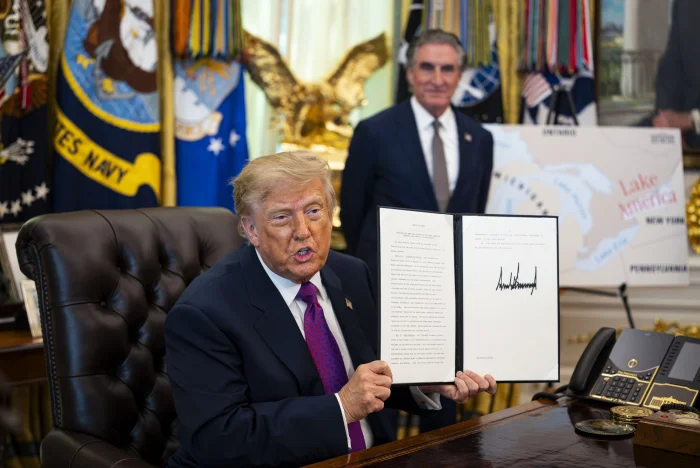
President Donald Trump signs an executive order to rename Lake Ontario as Lake America in the Oval Office of the White House on Thursday. Photo by Al Drago/UPI | License Photo

Source link

5,000 US sailors descend on Thailand as USS Abraham Lincoln docks | US-Israel war on Iran News

Thailand’s Pattaya is expecting a business boost as 5,000 US sailors arrive after spending nine months at sea aboard the USS Abraham Lincoln. The carrier supported the US war on Iran, while its record deployment was marked by deteriorating conditions on board.

Source link

Where Are The Aircraft Carriers?: USS Abraham Lincoln Escorted To Thailand As The Middle East Heats Up

Under heavy escort, the USS Abraham Lincoln transited the Strait of Malacca and Singapore Strait over the weekend, en route to Thailand for a highly publicized and much-needed liberty port call. Guided-missile cruiser USS Robert Smalls led the three-ship column, with guided-missile destroyer USS Frank E. Petersen Jr. following astern of the supercarrier as she entered the South China Sea. Multiple Thai officials have confirmed the upcoming port visit since it was first reported by USA Today last week, with the flattop expected to pull into port at Laem Chabang in the coming days. Meanwhile, America’s other two deployed carrier groups are in the Middle East enforcing the ongoing blockade as the U.S. and Iran exchange fire for the first time since July.

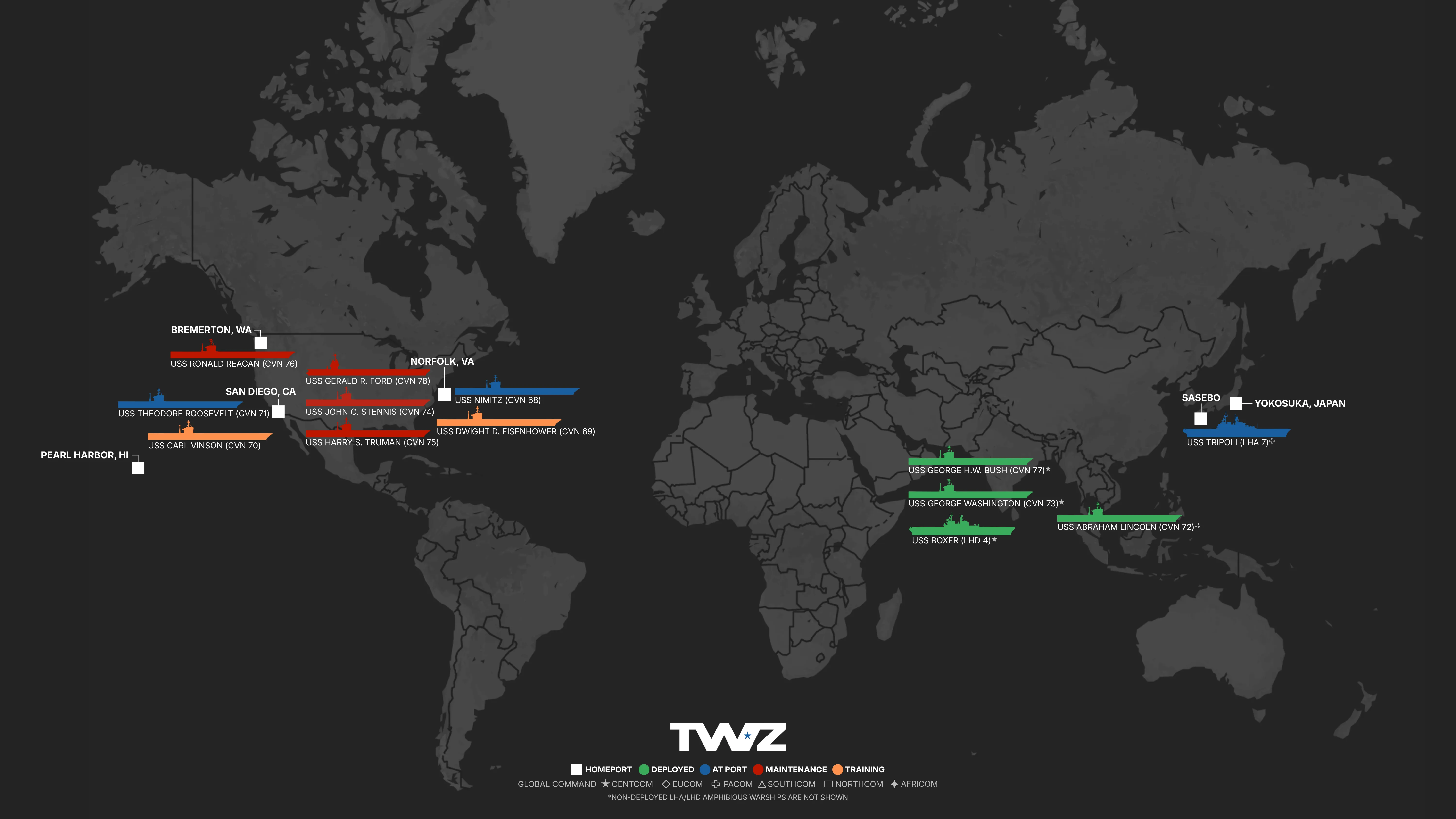
Here’s TWZ’s weekly carrier tracker monitoring America’s flattop fleet, including deployed Carrier Strike Groups (CSG) and Amphibious Ready Groups (ARG), using publicly available open-source information. Check out last week’s report here.

A detailed review of America's deployed carrier strike groups and CONUS-based flattops.
TWZ/IAN ELLIS-JONES (HIGH RESOLUTION)

Lincoln Enters The South China Sea, Again, En Route To Thailand For Liberty

Abraham Lincoln flipped her Automatic Identification System (AIS) transponder on ahead of the transit, broadcasting the flattop’s position publicly for the first time since January 28, 2026, when the CSG made the transit in the opposite direction prior to Operation Epic Fury. Lincoln has now been deployed for 285 days without a liberty call, but that streak is set to end this week.

For friends and family, we anticipate an arrival back home in late September or early October, depending on how long the crew stays in Thailand and whether any other stops are made along the way. When all is said and done, Abraham Lincoln’s deployment will likely become the second-longest in the modern carrier era behind the historic 326 days logged by the USS Gerald R. Ford earlier this year.

While the composition of the Abraham Lincoln CSG has shifted over the nine-plus-month deployment, Frank E. Petersen Jr., a Flight IIA Technology Insertion (TI) Arleigh Burke class destroyer and one of the newest in the fleet, embarked the commander of Integrated Air and Missile Defense (IAMD) throughout the six months of almost nonstop combat operations against Iran. The IAMD commander is responsible for coordinating the detection, response, and interception of inbound aerial threats, and Petersen Jr. is equipped with the world’s foremost integrated naval combat system – the Aegis Combat System Baseline 9 – which delivers quick reaction times, concentrated and networked firepower, and advanced electronic countermeasure capabilities for anti-air warfare.

The unannounced addition of Ticonderoga class cruiser USS Robert Smalls, which has historically served as the IAMD commander for the carriers forward-deployed out of Yokosuka, Japan, adds 122 Vertical Launch System (VLS) cells packed with missiles for protection and firepower. The rationale for the additional Tico cruiser, an iconic class that will be completely retired over the coming years without a comparable replacement, is unclear. TWZ has not received an on-the-record response from the U.S. Central Command (CENTCOM) or U.S. Naval Forces Central Command (NAVCENT) public affairs explaining the redirection.

Robert Smalls was part of the George Washington CSG as recently as August 18, making the northwest-bound Malacca Strait transit with the strike group the week prior, before peeling off to escort the Abraham Lincoln back through.

U.S. Launches Another Round of Strikes Against Iran Today As Tensions Escalate

Ahead of publication on Tuesday, CENTCOM announced a fresh round of strikes against targets in Iran that began at noon Eastern Time. “The strikes follow recent attempted attacks by the IRGC against commercial shipping in the Strait of Hormuz and against American service members deployed to the region,” the command posted in a statement on social media.

George Washington, which is currently accompanied by a single destroyer, USS Shoup, relieved the Abraham Lincoln in the Middle East earlier this month. Other U.S. 5th Fleet ships are reportedly moving in and out of the CSG, but the situation is fluid and TWZ cannot confirm the current, complete composition of the group. It’s unknown which warship, if any, is currently serving as IAMD commander for the CSG, which chopped into the CENTCOM area of responsibility (AOR) on or around August 19.

Also operating in the Middle East, the four-ship George H.W. Bush CSG is underway at an undisclosed location in the Arabian Sea. Alongside USS George H.W. Bush is Tico cruiser USS Princeton, the IAMD commander, and two Burke destroyers, USS Ross and USS Donald Cook.

The carriers are enforcing the ongoing blockade of Iran – and presumably participating in the latest round of airstrikes – although they are both officially on station to “support maritime security and stability in the Middle East,” according to DVIDS, the military’s content-sharing platform. CENTCOM forces have redirected 84 commercial vessels, disabled three using kinetic force, and boarded another two since the blockade resumed, as of September 1.

Over the weekend, the United States and Iran traded blows for the first time in over a month. CENTCOM opened the tit-for-tat exchange on Sunday by targeting rocket systems on Larak Island, located in the Strait of Hormuz on the Iranian side of the northern corridor, that are fitted to launch naval mines, after the Islamic Revolutionary Guard Corps (IRGC) was observed making preparations to fire into the contested waterway.

“I can confirm that earlier today U.S. forces struck two Iranian launchers on Larak Island,” Navy Capt. Tim Hawkins, CENTCOM’s spokesman, told TWZ. “Islamic Revolutionary Guard Corps forces were observed preparing to launch rockets with sea mines into the Strait of Hormuz,” he added. The IRGC retaliated by launching a salvo of ballistic missiles at Muwaffaq Salti Air Base, a Jordanian installation the U.S. military operates from. Jordan’s military said it successfully intercepted eight missiles.

The preemptive strikes to prevent Iran from deploying additional mines came just days after CENTCOM commander Adm. Brad Cooper said U.S. forces “successfully cleared” Iranian sea mines from international shipping lanes in the Strait of Hormuz. Commercial traffic through the strait is slowly recovering but still well below pre-war levels.

Ongoing Maintenance Delays Stateside Impact Fleet Readiness

On the other side of the world, in the United States, three carriers are active: two are underway training while one is in homeport getting ready for an upcoming deployment. USS Dwight D. Eisenhower, which left Norfolk on August 21, transited south in the Atlantic Ocean and was last operating approximately 70 nautical miles off the coast of Florida, well into East Coast Fleet Replacement Squadron (FRS) and Training Command (TRACOM) Carrier Qualifications (CQ). After departing San Diego on August 10, USS Carl Vinson was spotted on satellite imagery off the California coast by ship-tracker MT Anderson, in the process of completing Tailored Ship’s Training Availability (TSTA) and Final Evaluation Period (FEP) training.

USS Theodore Roosevelt, the next carrier slated to deploy from the continental U.S., is pierside at Naval Air Station North Island in San Diego, based on commercial satellite imagery. Speculation is rampant about where Theodore Roosevelt will deploy, but as the Navy has told us many times, “we do not discuss future operations or timelines.”

The balance of America’s carriers (excluding USS Nimitz, which will begin deactivation in 2027) is either in maintenance or scheduled to begin an availability in the future.

The next flattop that will re-enter service, USS Ronald Reagan, is expected to finish a roughly 17-month Docking Planned Incremental Availability (DPIA) soon. “The docking planned incremental availability for Ronald Reagan is on track for its scheduled completion at the end of August 2026,” Catherine Norton, the Public Affairs Officer (PAO) for Puget Sound Naval Shipyard and Intermediate Maintenance Facility, told Stars and Stripes earlier this month. However, the ship has not gotten underway as of publication, even though yesterday was the end of the month, and it appears the DPIA will stretch into September. TWZ reached out to Puget Sound’s PAO but has not received a response yet. For the latest status of the other three carriers in current or upcoming maintenance, marked in red on the map above, check out our recent deep-dive here.

USS Ronald Reagan pierside at Puget Sounds undergoing Docking Planned Incremental Availability (DPIA). Her return to service is expected soon.
USS Ronald Reagan in Bremerton, Washington, as of August 29, 2026. Source: @BulletOneOneTwo via @WarshipCam on X

Current Big Deck Force Posture At A Glance

Overall carrier force posture is unchanged compared to our previous report on August 24. Three U.S. carriers are deployed (although one is on the tail end of her deployment and heading home to San Diego), one is preparing to deploy in the near term, two are working up in various states of readiness, four are in maintenance, and another, the USS Nimitz, is being used primarily for training before deactivating next year. One amphibious ready group is deployed, one is forward-deployed and at homeport, four are working up or in port, and three are in maintenance.

Note: Positions are general approximations. Non-deployed LHA/LHD amphibious warships are not shown.

Contact the author: ian.ellis-jones@recurrent.io

Ian executes TWZ’s full-spectrum social media strategy, brings his interpretive graphics skills to our editorial team as an OSINT analyst and researcher, and maintains the weekly carrier tracker and newsletter.


Source link

Lincoln Riley defends USC amid criticism of season opener crowd

After sparse attendance during USC’s season-opening win over San José State turned the Trojans into a national punchline during the weekend, USC coach Lincoln Riley responded Tuesday, dismissing what he called a “false narrative” being spread about the program in recent days.

“I think that comes from a lot of people who don’t follow our program, most of those who have never stepped foot in the Coliseum,” Riley said. “The reality is, during my years here, attendance has gone up every single year. As has our play in the Coliseum, including running the table last year in front of a lot of epic atmospheres. And I expect that to happen again this year.”

Average attendance for USC football games at the Coliseum actually dropped from the 2024 to the 2025 season, from an average of 71,571 to 67,783. But the 2025 season also featured fewer marquee home matchups, plus one game soaked by heavy rain (Iowa), and it was still the second-best average attendance of Riley’s four seasons as coach.

Saturday, though, marked the smallest home crowd at USC since late in the 2018 season, when the Trojans had their worst finish for the program in a quarter century, under former coach Clay Helton.

Much of that was due to the scorching heat throughout the Southland, which reached a heat index about 100 at the Coliseum on Saturday. It was so hot and humid that Lee Feaster, a native Texas and the father of freshman wideout Boobie Feaster, said on Tuesday that his wife passed out during the game and still had blisters.

But the attendance announced by USC — 51,144 — admittedly felt generous.

Attendance was that low just once under Helton, for a 38-35 loss to Arizona State, the weekend before Halloween in 2018. But average attendance plummeted after the 2017 season as fan sentiment turned on Helton. For the rest of Helton’s tenure, from 2018 to the start of 2021, USC reached the 60,000-fan mark just four times.

Empty swaths of Coliseum bleachers hadn’t been as much of a concern for Riley, who had never fallen below the 60,000-fan mark at home until Saturday. But as photos of the poor attendance circulated on social media during the weekend, USC chose to release a statement responding to the online derision.

“We understand the factors that impacted Saturday’s attendance,” the statement read. “We have high expectations and a premier home schedule this season, and we know the competitive advantage an electric Coliseum atmosphere can provide our program. We thank our fans who showed up Saturday and look forward to seeing increased attendance the rest of the season.”

The response, though, only poured gasoline on a viral fire.

By Monday, the conversation had crossed over from critical posts on social media to Riley’s coaching peers roasting USC, starting with his alma mater.

“Not to take any shots because I have a lot of respect for USC and Lincoln Riley, but man it’s really awesome to be playing Lubbock, Texas, in front of 60,000,” Texas Tech coach Joey McGuire said. “And it’s going to be warm. It’s going to be every bit as warm as it was Saturday. The great thing is we’ve got some really tough people in West Texas that love their football. They’re gonna show up no matter what the weather’s like. There’s not going to be any excuses of why they’re not here for us.”

A fan covers takes cover under a poster during USC's season opener against San José State Saturday at the Coliseum.

A fan covers takes cover under a poster during USC’s season opener against San José State Saturday at the Coliseum.

(Ronaldo Bolanos/Los Angeles Times)

New California coach Tosh Lupoi piled on some more Tuesday.

“To turn on the TV, to see that environment in Los Angeles, that’s disheartening to see,” Lupoi said in Berkeley. “I can guarantee you, that’s a completely different environment here.”

USC should have a much more temperate environment to play on Friday, when it kicks off against Fresno State at 6 p.m. at the Coliseum. And Riley knows the world will be watching closely, to see how many seats are filled for the Trojans’ second game.

“This is USC, right?” Riley said. “People are going to pay attention. People are going to have an opinion. It’s part of being a blueblood school.”

Source link

National Park Service backs Trump’s arch, despite its impact on Washington’s sightline

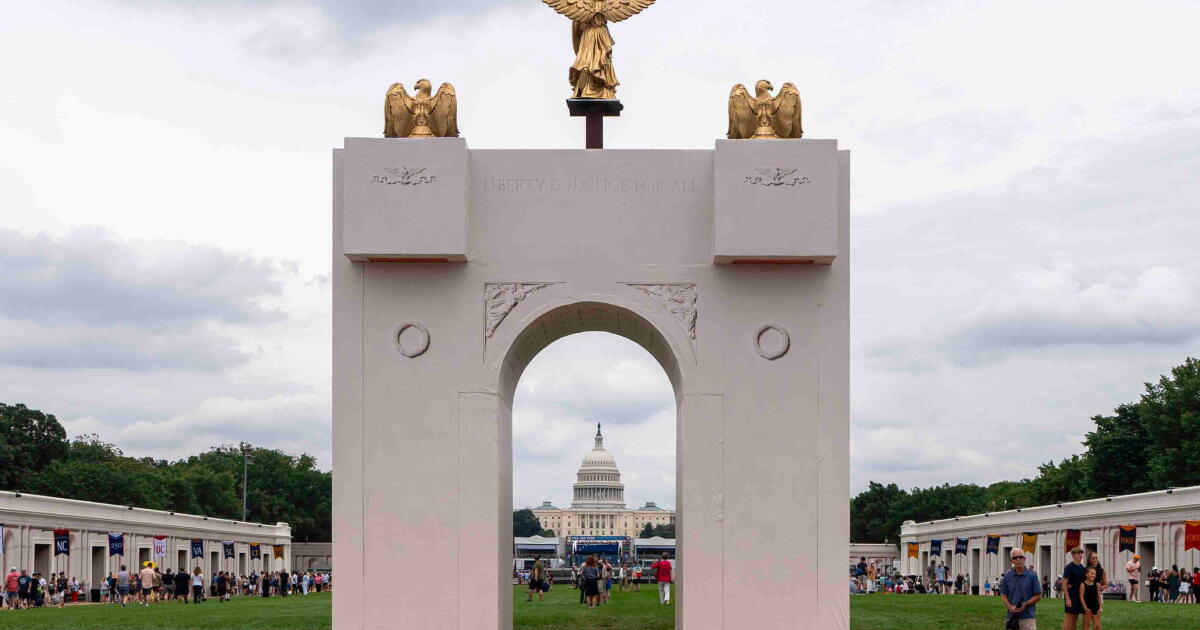
A new National Park Service report backs President Trump’s proposed arch, despite what it says are adverse effects to the sightline between a host of landmarks in Washington, including the Washington Monument and Lincoln and Jefferson memorials.

The report released Friday says the 250-foot-tall arch is likely to disrupt the historically significant layout of dozens of sites near its planned location adjacent to Memorial Bridge.

Many of Washington’s monuments, buildings and sites have been carefully planned over decades to reflect significant moments in the nation’s history and to evoke symbolism through sightlines that connect them to other sites. The arch will disturb the sightline between more landmarks than anticipated, the report said.

But the Park Service report says “the same characteristics that make Memorial Circle sensitive from a preservation perspective are also the characteristics that make it the historically appropriate location for the undertaking.”

The project’s effects cannot be “fully avoided without either relocating the Arch away from the historically identified site or eliminating the principal commemorative feature, both of which would fail to meet the undertaking’s purpose and need,” the report said.

“For this reason, alternative locations outside Memorial Circle are not reasonable avoidance alternatives,” the report said.

The 133-page report by the Park Service supports Trump’s plans for the controversial arch and could play an important role in bolstering the administration’s case in its fight against a legal challenge filed by three veterans and a group of historians.

The proposed towering arch, which last month received initial approval from a key federal commission, would impact the “integrity” of dozens of historic properties because it would change “character-defining visual and spatial relationships” between them.

One of the most obvious elements the report cited is that the arch would break alignment between the Lincoln Memorial, Memorial Bridge and Arlington House that was formerly Confederate Gen. Robert E. Lee’s home. That alignment was “intended to physically and symbolically unite North and South through a coordinated monumental composition extending across the Potomac River,” the report said.

The Lincoln Memorial Arlington House connection was one of dozens of historic sites and structures listed as being impacted directly by the proposed structure. It added that the National Mall, the U.S. Capitol, Washington Monument, Jefferson Memorial, Georgetown Historic District, Old Naval Observatory, Key Bridge, National Cathedral and other sites also would be affected.

Nicolas Sansone, an attorney with Public Citizen Litigation Group representing the plaintiffs, said the report again “confirms what we’ve been saying all along: the project will have an enormous impact and transform that National Mall.”

The report underscores the legal challengers’ claim that a project of this size and importance “is a decision for Congress to make” and should not be rushed through by executive decree, Sansone said.

Daly writes for the Associated Press.

Source link

Why USC’s Lincoln Riley is ready for a breakthrough fifth season

From behind his new desk, on the top floor of USC’s shining, new Bloom Football Performance Center, Lincoln Riley can gaze out upon a stunning view of the downtown L.A. skyline. It’s a nice perk when rounding out a $200-million facility.

And especially welcomed given that three-quarters of USC’s previous football home, the John McKay Center, could be classified as “subterranean.” But as Riley considers how far he’s come these past five years and how far USC has come in the meantime, the metaphor is just as meaningful to USC’s coach as the cityscape.

This view, this office, this program, really — it was all just a hypothetical when Riley accepted the USC job in November 2021. The wunderkind coach knew he was inheriting a football program in a years-long slump. What he couldn’t grasp was how far it actually fell. And what it would take to drag it back. He’d never even been on USC’s campus.

He admits he didn’t understand quite what USC needed then, in the beginning. Not like he does now, on the doorstep of his fifth season as the Trojans coach.

“There’s no other job like this, not in our sport,” Riley said Thursday. “There are some unique things that make this place really special, but also you have to understand how it works and how to harness it and how to use it, and I think that has probably been the biggest thing.”

“I know what direction we’re heading now. I know so much more about this place and how it works, and that’s been more helpful than just starting over at kind of your normal run-of-the-mill job in college football. … This one is just so unique and different. That’s what attracted me to it. And that’s what’s going to help make it great again.”

Riley certainly knows USC well enough now to understand his time to deliver on that promise is running out. The Trojans are 35-18 through four seasons under Riley, precisely the same record they were under his predecessor, Clay Helton, through 53 games. In that time, USC has yet to reach the College Football Playoff and only once played for a conference title, in Riley’s first season. And it hasn’t beat a ranked team in a true road game outside of L.A.

Meanwhile, the school has gone to great lengths to close the gap that existed between USC and its blueblood counterparts, revamping the whole front-office operation, hiring a Hall of Famer in Gary Patterson to coordinate the defense and investing millions in NIL in the nation’s top recruiting class in 2026.

Riley said multiple times this summer that he is now more “well-equipped” to win. And around USC, everyone seems inclined to agree. Meaning any excuse for why the Trojans aren’t breaking through will no longer suffice.

“It’s black and white,” USC general manager Chad Bowden said after last season. “You’re either in the Playoff or you’re not. You either win a championship or you don’t. … I’m sick to my stomach, you know, for people that might be unhappy with winning nine games. They should be unhappy, right?”

Whether nine wins in 2026 would be enough to ensure Riley sees a sixth season at USC in 2027 remains to be seen. Though, just getting back to that mark, with a schedule that includes Oregon and Ohio State at home and Indiana and Penn State on the road, might be more of an uphill climb than it was a season ago.

It would also probably mean falling short of the Playoff. When asked if Riley needed a Playoff berth this season, athletic director Jennifer Cohen told The Times in May she “tries not to think in hypotheticals” but added:

“The expectation has always been the same. I mean, that’s the thing, that’s the reason why I came here, is that the standard is high, that we do expect to make the Playoff. We do expect to have a championship run. We do expect to be competing for championships every single year.

“The expectation, I mean, we haven’t been shy about that. We expect to win, and I feel confident that we’re going to.”

So confident, in fact, that USC pasted its season mantra on billboards across the Southland, each of them not-so-subtly declaring that the “THE TIME IS : NOW”.

The message feels, in many ways, meant for Riley. And he isn’t shying away from it.

“Hell, that’s why I came here,” Riley told The Times this summer. “It’s progressively gotten better and better, I think to a point where everybody should be excited and the expectations should be through the roof.”

It’s hard to argue with the positive signs so far. The No. 1 recruiting class is already making a major impression, with five true freshmen earning starting spots and over a dozen appearing on the initial two-deep. With a top returning quarterback in Jayden Maiava, real depth along the offensive line and one of the Big Ten’s best backfield tandems in Waymond Jordan and King Miller, USC should once again have one of the nation’s top offenses.

The questions, as always, are on the other side of the ball. But in Patterson, Riley appears so far to have found someone he considers an equal on defense, the yin to his yang.

“You feel his presence in terms of the mentality of the group and how he pushes and pushes and pushes,” Riley said. “He’s very aggressive, and you never have to wonder about how he’s feeling or where he stands. For a little bit, I think it took our players some getting used to. It was a little different of an approach than what they had out of that position. But I think they’ve come to understand and respect the intensity that he brings every day and the demand for greatness. There’s no question on the practice field that you feel that from him.”

Riley, meanwhile, has not seemed like a head coach who’s feeling the heat heading into a make-or-break season at USC. In fact, with everything hanging on this season, he seems more at ease than ever.

“It’s taken a lot to come from where it was four years ago to now, a lot of people,” Riley said. “And so, I don’t want us to be bashful about it now. We’ve gotta go do it. And that’s the fun part of this. And it’s fun feeling like that you got the opportunity to do anything and everything that you want to do.

“I think this year will be the start of a run where USC football, we’re gonna feel like that for a while. That’s what we came here to do.”

Source link

Immigration officials arrest father of USS Abraham Lincoln sailor

Aug. 24 (UPI) — Immigration officials arrested the father of a sailor on board the USS Abraham Lincoln, an aircraft carrier that’s come under scrutiny for conditions on board.

In a Facebook post Sunday, sailor Joshua Aviles said his father, Luis Manuel Aviles Roa of Nicaragua was arrested Saturday.

Department of Homeland Security officials told CBS News the arrest happened during a traffic stop in Key West, Fla. Luis Manuel Aviles Roa was in the custody of Immigration and Customs Enforcement officials and faced deportation proceedings.

“I just got a call that my dad was taken by ICE,” Joshua Aviles wrote. “If you know my dad, you know he is a hardworking, humble man who is always willing to help anyone if he can.

“This is heartbreaking for me. I don’t know how I can mentally continue working 12+ hour days knowing that my dad is somewhere, possibly being treated like a criminal.”

The USS Abraham Lincoln has been under an extended deployment to the Middle East and was en route back to the United States. The journey could take several weeks.

Luis Manuel Aviles Roa’s stepdaughter, Katty Delgado, told NBC News that he had been living in the United States for about two decades. She said she had no knowledge of any criminal history for her stepfather and that he had a pending immigration application seeking legal status.

“He’s doing everything the right way,” she told the outlet.

DHS did not deny that Luis Manuel Aviles Roa lacks a criminal record. Officials said that having “a family member in the military is not a free pass to violate our nation’s laws.”

“We are simply enforcing the laws passed by Congress,” the DHS statement said. “This administration does not pick and choose which laws to enforce.”

NTT IndyCar Series Drivers Scott Dixon (R) and Graham Rahal (L) pose with first lady Melania Trump during an event in the Rose Garden of the White House on Thursday. The first lady announced that a $2 million donation from IndyCar and Fox Corporation will fund Fostering the Future scholarships at Indiana University and Purdue University to expand academic opportunities for individuals transitioning from foster care. Photo by Bonnie Cash/UPI | License Photo

Source link