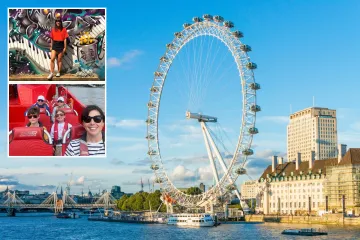
NOTHING says Christmas quite like streets filled with twinkling lights – especially the spectacular displays put up in London.
This year you can score 20% off the magical Christmas Lights London Bus tour AND even get a free Thames cruise.
The Original Tour’s London Christmas Lights Tour is now 20% off when you use code FESTIVELONDONCredit: The Original Tour
Save 20% on The Original Tour’s Christmas Lights London Bus Tour + claim a FREE Thames sightseeing cruise. Use code: FESTIVELONDON
The tour usually costs £36 for adults and £22 for kids, but you’ll get tickets for £28.80 and £17.60, respectively, using our discount code.
The tour starts on Coventry Street, where you’ll climb aboard one of London’s famous double-decker buses and get cosy on your guaranteed upper deck seat.
Sign up for the Travel newsletter
Thank you!
The Christmas-themed bus will then take you through London‘s best-decorated spots, alongside festive facts and jokes from a live tour guide.
Along the route you’ll tick off famous spots such as Leicester Square, Trafalgar Square, Hyde Park, Oxford Street, Piccadilly Circus and more.
Make sure to snap some pictures of the world-famous, glittering Trafalgar Square Christmas tree, gifted to the UK all the way from Norway.
And in a brand new route for 2026, you’ll now also cruise down Regent Street, known for its giant glimmering angels with golden wings spread high overhead.
Oxford Street sees a canopy of sparkling hanging stars, while posh Bond Street goes all out with fancy displays illuminating the high-end shops and hotels.
Picadilly Circus acts like the grand junction of all these fantastic displays, with its giant screens running festive takeovers and the glowing spillover of surrounding streets in the distance.
Whether you’re visiting London with the kids, ticking off the sights with friends or wanting a romantic date beneath the stars, the tour is suitable for all ages and occasions.
The best way to make the most of the tour? Grab a hot chocolate before boarding, wrap up in your cosiest hat and scarf, and make sure to pose for pictures as you cruise right under the impressive displays.
The tour lasts up to 90 minutes, running from November 14 and January 3,.
You have lots of options too with the first bus departing at 4:30pm and the last at 9pm.
Travel through London’s most beautifully-decorated festive streetsCredit: The Original Tour
Save 20% on The Original Tour’s Christmas Lights London Bus Tour + claim a FREE Thames sightseeing cruise. Use code: FESTIVELONDON
Tots under two travel free, and there’s space on every bus to pop your pram and buggy.
That’s not all, however. If you purchase the Christmas Lights London Bus Tour, you also get a daytime Thames River cruise thrown in completely for free.
That means you can experience a full-on sightseeing day in London, taking in the sights from the water in the daylight on the river cruise, before taking in the city by night on your bus tour.
On the Thames River cruise you’ll tick off top landmarks like Big Ben, the London Eye and more, so by the end of your big day in London you’ll have taken in the very best the city has to offer.
Cruises start from Westminster Pier, Tower Pier, Greenwich Pier, or the London Eye Pier, giving you flexibility in how you plan your day.
As well as a free river cruise, you’ll also get SIX free self-guided walking tours thrown in.
So when you’re not aboard the boat or open-top bus, you’ll have plenty of guidance on which sights are best to see by foot.
The audio tours include the Wizard’s Walk (a Harry Potter-themed tour) as well as a spooky Jack the Ripper tour, and you can listen to them on The Original Tour’s partner app.
With three ways to explore the city bundled into one, it’s hard to find a better value way to experience London at Christmas.
You’ll also get a free Thames river cruise and six walking tours included in the priceCredit: The Original Tour
Save 20% on The Original Tour’s Christmas Lights London Bus Tour + claim a FREE Thames sightseeing cruise. Use code: FESTIVELONDON
The Original Christmas Lights Tour: what you get
What’s included in The Original Christmas Lights Tour offer?
The Original London Christmas Lights Bus Tour Adults tickets: £36 £28.80 Children’s tickets: £22 £17.60
Take in all the best of London’s Christmas lights displays on one dazzling bus tour.
Free Thames River cruise
Soak up famous London sights like Big Ben and the London Eye from the water, learning all about London’s history with guided commentary.
Six self-guided audio tours of London
Buying a Christmas bus tour ticket will also give you access to six audio walking tours, which you can listen to on The Original Tour app.
Begin at any of the listed stop points – these clever tours are GPS-triggered, and the tour will activate when you’re close to a point of interest.
Best of London – The essential London experience, hitting all the landmarks you simply cannot miss.
The Wizard’s Walk – A tour through the real London locations that brought the world of Harry Potter to life.
Towers and Bridges – From the Tower of London to The Shard, a walk through the city’s most striking skyline.
Jack the Ripper – A walk through Whitechapel, retracing the story of London’s most infamous unsolved case.
Parks and Palaces – Royal parks, grand residences, and open spaces at the heart of the city.
Kensington Gardens – A peaceful walk through one of London’s most elegant and historic green spaces.
Terms and Conditions: Code FESTIVELONDON expires on January 3, 2027 at 11:59pm BST. The offer is available from 12 October 2026 until 3 January 2027, with tours running daily from 14 November 2026 to 3 January 2027, excluding Christmas Eve, Christmas Day, New Year’s Eve and New Year’s Day. The discount applies to adult and child tickets only, excludes family tickets and cannot be combined with other offers. Blackout dates apply and are from 21 December 2026 to 30 December 2026. Blackout dates are dates in which promotional offers cannot be used.Full T&Cs can be found on The Original Tour’s website at theoriginaltour.com
A woman holds a sign that reads in Spanish, “Corruption has left us in the dark,” during a protest against power cuts in Valencia, Venezuela, on Oct. 2, 2026. (Graphic by Truthdig; images by AP Photo, Adobe Stock)
The “biggest oil deal in history” was announced almost simultaneously by acting Venezuelan President Delcy Rodríguez and U.S. PresidentDonald Trump on Aug. 28. However, many Venezuelans didn’t find out until the next day because massive blackouts — up to 16 hours a day and partly caused by increased oil production — kept them from scrolling the news.
At the United Nations a month later, Trump bragged that he had taken Venezuela’s “spoils,” while Rodríguez said the deal with the U.S. would contribute to resolving the energy needs of “the hemisphere and the international economy.” Venezuelans then asked: What about our energy needs and economy?
The oil deal, the legal and operational details of which are still unknown, covers the exploitation of 17 fields and 65 billion barrels, which equates to 20% of Venezuela’s total reserves — the world’s largest, at an estimated 303 billion barrels. U.S. companies will invest $100 billion in exploiting the fields, a figure which — according to Venezuelan government projections — would translate into more than $209 billion in tax revenue for Venezuela over the years of the contract.
The announcement sparked questions and criticism from different sectors of the country, with concerns about the lack of information and the impact on sovereignty. In response, Rodríguez tried to explain the deal’s benefits in a nationally televised address, noting, “How much does Venezuela receive? Based on a barrel price of $65 … revenue would reach $209.3 billion for the state. In concrete terms, this means that for every barrel produced and sold, about $19 goes to [Venezuela].”
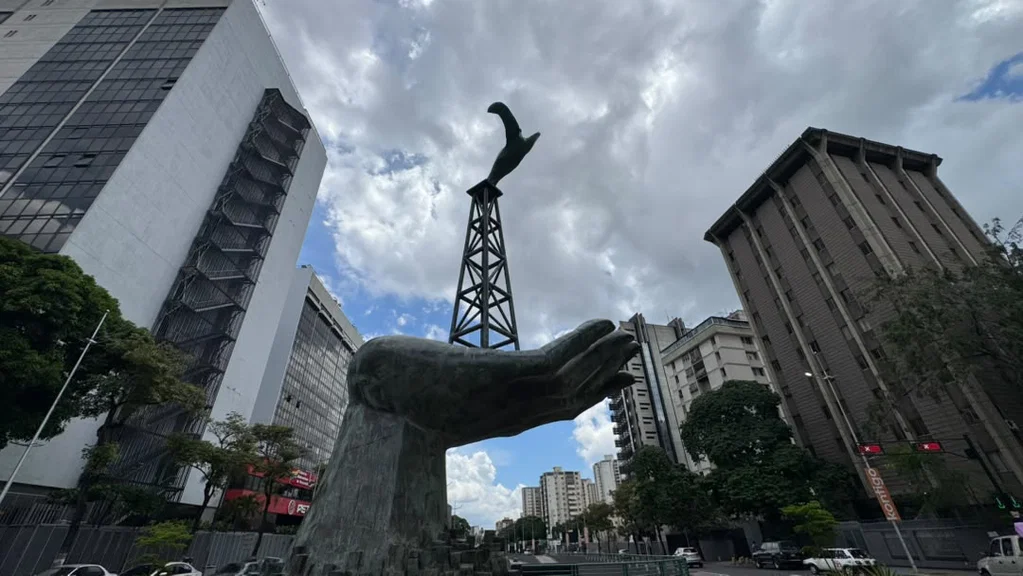
Paúl del Río’s Monument to Peace, erected in 2003, honors the recovery of the Venezuelan oil industry after the government increased state control in 2001, and after the opposition strike ended. (Jessica Dos Santos Jardim)
Oil drives the Venezuelan economy. Currently, it accounts for 71% of the nation’s total exports, but now much of that revenue goes to the U.S. In the first quarter of this year, out of a total of $7.76 billion in exports, $5.5 billion came from oil activity. As the acting president’s address went on, many of us only had more doubts.
A few hours later, Venezuelan economist Francisco Rodríguez summed up some of the nation’s concerns: “Do the projected tax revenues … correspond to nominal amounts, inflation-adjusted amounts, or net present values? A nominal amount of $19 per barrel in 2051, the project’s final year, would correspond to a real value of about $9 today.”
“The $209 billion equates, over 25 years, to about $8.4 billion annually, a relatively low amount compared with the tax revenue Venezuela has collected in the past at similar production levels. The amount would be even lower if it corresponds to a nominal total.” According to Central Bank of Venezuela data, Venezuela took in a record $82.8 billion in 2008 alone from oil sales.
Contradictions
Trump later contradicted Delcy Rodríguez’s 25-year timeline, saying the deal would involve a century of concessions. Francisco Rodríguez, the economist, noted that extracting 65 billion barrels in 25 years would be impossible, due to lack of infrastructure.
“What rights does the U.S. acquire over these resources after 25 years? Can a future Venezuelan government decide to withdraw from this deal if it doesn’t like it?” he asked.
And why wouldn’t they like it? Trump said on Truth Social that Venezuela will begin supplying the U.S. strategic oil reserve immediately through “a gift.” Nobody knows what that means exactly, but since the military intervention on Jan. 3, the revenue generated by the sale of Venezuelan oil — we don’t know how much that is either — is already “in the custody” of the U.S. Treasury.
“It doesn’t look like Venezuela will benefit broadly in the long term. It’s like being on floor minus-18 and going up to minus-10,” Venezuelan researcher Blas Regnault, who specializes in energy policy and oil governance, told Truthdig from The Hague, Netherlands.
“There could be an indirect reactivation of the economy because of the indirect jobs that may emerge in some regions. But let’s also keep in mind that the country has been 100% blockaded, suffocated, so any door that opens will bring some benefits, but this is not the benefit one would expect for a sovereign country,” he said.
“That’s the other problem: There’s no sovereignty of any kind over the resource itself, over what’s being sold. On top of that, there’s a lot of opacity — you’re analyzing blind.”
This “opacity” is also illegal. Articles 150 and Article 187, Paragraph 9, of Venezuela’s Constitution state that contracts of national public interest with foreign states or entities require approval from the National Assembly. However, although the Assembly endorsed the announcement of the deal on Sept. 1, its president, Jorge Rodríguez, said it had not yet been “submitted” to the legislature. Then, a month later he said that “according to some legal experts, it doesn’t need to be reviewed.”
It’s clear that Venezuela is once again, as it was for much of the 20th century, a kind of “U.S. oil province,” Regnault says, “Recovering sovereignty won’t be easy because Venezuela is strategic to U.S. interests.”
“On top of that, the other side of the coin is that China has become a key player [globally]. Today the Chinese do what Saudi Arabia used to do when it cut production and pushed prices up. With this Strait of Hormuz crisis, after the naval blockade of Iran, it was discovered that China had more reserves than previously thought, and that kept the crisis from being bigger and the price from reaching $150.”
That is precisely why U.S. Secretary of State Marco Rubio celebrated the fact that several of the oil fields included in the deal were once “dominated by China and Russia and Iran.” At the same time, the U.S. government has decided to maintain sanctions against Venezuela, thereby preventing any new economic players. In fact, the U.S. Treasury Department, through its Office of Foreign Assets Control, updated its oil licensing policy for Venezuela in late September through Orders 46E, 48D and 49B, which benefit U.S. businesses but maintain an absolute ban on Russia, Iran, Cuba, North Korea and China.
“The [Venezuelan] government has already amended the Hydrocarbons Law to try to create more favorable conditions for investors in the oil and gas sector, but … the [U.S.’] problem isn’t domestic supply. They need to monopolize the world’s energy reserves, markets and prices in order to prevail in the rest of their economic activities,” oil expert David Paravisini explains to Truthdig from Caracas, referring to a legal reform that was passed on Jan. 29 and created the possibility of technical and operational management and direct commercialization by private companies. He believes that for Venezuela, the deal is a diplomatic “quest” to survive.
People block a street during a protest against power cuts in Valencia, Venezuela, on Oct. 2, 2026. (AP Photo/Jacinto Oliveros)
Trump is also maintaining some of his domestic support by presenting Venezuela as the great economic and geopolitical victory of his administration, especially after the war against Iran — which was supposed to last “only a couple of weeks” — reached the six-month mark and cost more than $37.5 billion through the end of July. In fact, Trump has claimed again and again that this oil deal will lower fuel costs inside the U.S. and come “at no cost whatsoever to the American taxpayer.””
Does this mean the $100 billion investment will come from private companies? The deal also aims to exploit eight greenfield blocks, areas where crude has been identified but which have not yet been developed. But what happens if that investment does not materialize? Since Jan. 9, Trump has been trying, without success, to persuade U.S. oil companies to invest in Venezuela.
Corruption is fine if the U.S. profits
So far, the only company we’ve heard about is North American Blue Energy Partners (NABEP), which was selected on Aug. 31 by the Trump administration to lead oil extraction projects in the 17 Venezuelan fields.
According to the White House, the Department of Defense will hold a 35% equity stake in NABEP and, in addition, the Barbados-registered company will grant Washington the right to buy 20% of the oil it produces at the cost of production.
NABEP, which has only operated in Venezuela for two years, was awarded the deal without a prior bidding process. The company belongs to Venezuelan businessperson Alejandro Betancourt, who was under investigation by federal prosecutors in Florida until January 2026 for allegedly laundering more than $1 billion from the state-owned Petróleos de Venezuela (PDVSA). The case was then closed suddenly under the orders of U.S. Deputy Attorney General Todd Blanche (now the attorney general), after a decade-long investigation. He is still the subject of open investigations in Switzerland and Spain.
Betancourt comes from a middle-class family but studied at the private religious school Instituto Cumbres de Caracas, where he befriended Javier Alvarado Pardi, son of Javier Alvarado Ochoa, who later became president of Electricidad de Caracas, deputy energy minister and a PDVSA executive.
Back in 2009, Alvarado Ochoa presented Betancourt and his engineering firm, Derwick Associates, as the best solution to Venezuela’s power generation crisis. Betancourt went on to receive 12 government contracts, awarded without competitive bidding, worth a total of $5 billion, which were either never completed or were implemented improperly, according to Transparency Venezuela and the Organized Crime and Corruption Reporting Project (which is funded by the U.S. government, among other countries).
So why Betancourt? Rubio said that he is no longer under investigation by the U.S., has supported the Venezuelan opposition and he has demonstrated his ability to produce oil. In that vein, NABEP claims it produces 200,000 barrels of crude a day, just behind Chevron.
However, Victor Hugo Majano, a Venezuelan investigative journalist and director of the well-known outlet La Tabla, told Truthdig that Betancourt overbilled the Venezuelan state by billions of dollars for power plants that never worked. He cited information from Thor Halvorssen, an anti-Chavista activist and cousin of Venezuelan opposition leader Leopoldo López. With that money, Betancourt bought a Dassault Falcon private jet and the historic Alamíin Castle in Spain.
Halvorssen also says Betancourt, who is also linked to 50 companies spread across 15 countries, paid former New York prosecutor Adam S. Kaufmann to halt prosecutions; former Wall Street Journal reporters to discredit whistleblowers; and former New York City Mayor Rudy Giuliani to bring the U.S. Justice Department over to his side.
“Despite this, the U.S. still doesn’t attack Venezuelan corruption. They want to protect the dollar and the U.S. financial system. They are only worried about securing capital flow, money that is not controlled by the state, the [Venezuelan] government,” Majano said.
More oil for the U.S., less electricity for Venezuela
Meanwhile, Venezuelans are paying the price for both Betancourt’s alleged corruption and the oil deal. So far this year, oil production has increased by 29.9%, going from 924,000 barrels per day (bpd) in January to an average of 1.2 million bpd. The increase has been driven by the need to deliver oil to U.S. companies, and it has directly worsened the nation’s electricity crisis.
Authorities acknowledge this; Venezuela’s interior minister, Diosdado Cabello, said in May the country is seeing higher electricity demand due to the growth in oil production, which “is a very serious problem.” The Ministry of Electrical Energy also noted that demand has reached 15,625 megawatts (MW), “the highest energy consumption figure in the last eight years, an increase of 3.6% compared with the peak reported in 2025.”
However, this statement omits that Venezuela actually has a nominal installed capacity of approximately 35,000 MW, double the country’s peak demand, but stable real generation barely reaches 11,000 MW. This shortfall is a result of both U.S. sanctions and domestic corruption, which together have led to disinvestment, lack of maintenance, fuel shortages (plants designed to run on natural gas have been forced to use low-quality diesel) and transmission problems.
Where does oil production come in? Víctor Poleo, an electrical engineer and former vice minister of Energy and Mines from 1999 to 2001, told Truthdig that “the national oil industry uses up about 1,500 MW, of which about 250 MW is self-generated, but another 1,250 MW is taken from the national interconnected system. This draw is 24/7 and must be continuous in order to carry out crude extraction, transport, pumps and compressors and refining.”
High-voltage transmission lines cross the Waraira Repano mountain range overlooking Caracas, Venezuela. (Jessica Dos Santos Jardim)
Poleo, who bases his analysis on studies by fellow electrical engineer Nelson Hernández, says light, medium and heavy crudes are estimated to require between 9 kilowatt-hours and 15 kilowatt-hours per barrel to produce. For extra-heavy Orinoco crudes, the estimate is 24 kilowatt-hours per barrel. “As a result, citizens lose their quality of life so that oil can be produced.”
This deterioration is particularly notable in Zulia state, Venezuela’s so-called oil cradle, where production has risen to between 350,000 and 370,000 barrels per day of light and medium crude — far below the historic peak of 1.5 million bpd in 2004, but a figure that, for its residents, has translated into daily blackouts exceeding 12 hours.
From the Isla Dorada residential complex in northern Maracaibo, capital of Zulia, José Javier León tells Truthdig that power failures “have worsened dramatically.” In his area, outages used to last four hours but now exceed seven.
“In many places there are double rounds, meaning the power goes out in the morning and at night, or at night and then before dawn. All the problems have gotten worse, and we don’t know the real reasons. In the suburb of Cuatricentenario, one of the most working-class areas and where the government had the most electoral support, the cuts are the worst,” he says.
León complains that residents are not alerted when the outages will happen. There is nothing like the electricity rationing schedules of the past, which would at least let them plan better. “In my area, there is no domestic gas, so we have electric stoves. Also, these are apartment buildings, where we have to turn on pumps to get water.” To make matters worse, the temperature in Zulia often reaches 39 degrees Celsius (102 Fahrenheit) because of the humidity.
In the Andes, outages add up to as many as 12 hours a day, and 16 hours in rural or border areas. From La Hechicera, an urban neighborhood in the city of Mérida, Silvana Solano tells Truthdig that the power used to go out for seven to eight hours, once a day, “but for the past two months, it goes out twice a day, the first time for seven hours and the other for around five hours, and we can’t predict the schedule. This also affects phone signals, which keeps us from communicating, making payments, etc.”
Some government institutions, including the Mérida mayor’s office, are open only from 8 a.m. to noon. Solano says she is worried that public schools, which operate until 3 p.m., will also adopt this schedule, in turn affecting parents’ working hours. Throughout September, residents of the towns of Caja Seca (Zulia state) and Nueva Bolivia (Mérida state) blocked the Pan-American Highway to protest the power outages.
To Venezuela’s north, on the famous Margarita Island, Alejandro Pérez tells Truthdig there are areas that have gone seven to eight months without water service. “Here we pay for water trucks, $50 for 10,000 liters of water, sometimes with $60 we get 13,000 liters, but you have to pay in foreign cash or at the parallel rate because the Central Bank of Venezuela exchange rate isn’t accepted here.” The black market or informal exchange rate is worth more, for those with foreign currency, than the official exchange rate.
Unlike other Caribbean islands, Margarita doesn’t have significant natural sources of fresh water. Some 90% of the area’s water comes from the mainland, crossing the sea through underwater pipelines that require gigantic pumping stations.
The contradictory rhetoric and the endless problems we face daily mean that, according to the latest AtlasIntel poll conducted for Bloomberg News, only 10% of Venezuelans believe the country will benefit from the oil pact with the U.S. — data that also aligns with the most recent study by the firm Meganálisis, the same one that after Jan. 3 said 92.2% of Venezuelans loved Trump. Emotions change, social problems persist, and without electricity, no economic improvement will be possible.
The views expressed in this article are the author’s own and do not necessarily reflect those of the Venezuelanalysis editorial staff.
Hit Northern Irish police series, Blue Lights, aired its second episode on Tuesday night with the series also available to watch in full on BBC iPlayer
22:43, 06 Oct 2026Updated 22:43, 06 Oct 2026
Blue Lights recently returned with series four(Image: BBC/Two Cities Television)
Blue Lights recently returned with series four.
The hit Northern Irish police series is back with its fourth season, which is available to watch in full on BBC iPlayer now, and Tuesday night saw episode two air.
A teaser for series four reads: “Three years into their jobs as response officers, Constables Grace Ellis, Tommy Foster, and Annie Conlon are operating at their limit, facing a new threat on the streets that the police can barely control.
“Meanwhile, the murder trial of Gerry Cliff exposes a dangerous and long-buried secret that leads to chaos both inside the police and across the criminal underworld.
“As they grapple with big decisions about their future, Grace, Tommy and Annie must find the courage to face the greatest threat they have ever encountered: the truth.”
Meanwhile, a synopsis for episode two saw: “In the wake of the attack on Amira, Grace’s determination puts her in danger, while Mo spirals further with violent consequences.”
Many fans have already binged series four, taking to Twitter, now X, to share their thoughts one person said: “Such a brilliant show. Season 4 binged over 2 days. Not sure where it goes from here, would love more. I grew up with Cagney & Lacey, that really made me smile #BlueLights.”
Another viewer wrote: “@BBC thank you for another brilliant series of #bluelights, hopefully they’ll find a way to come back for a fifth season.”
A different account put: “Just finished episode two of #BlueLights it’s brilliant! No spoilers!” while another person added: “Two episodes into #BlueLights S4, @sgfmann you were indeed correct, it’s great – gripping & so pertinent.”
Elsewhere, another show watcher praised: “Just finished S4 of #BlueLights, surely one the best cop dramas ever produced, the writing, acting and filming are all top notch.
“Edge of my seat every episode. If that was the last, then what a way to go out! Deserves every award coming it’s way!”
While a different account added: “Finished watching #bluelights series 4 . I hope the BBC plan on doing more it’s probably one of the best shows I’ve watched on the beeb in recent years .. not sure how exactly most storylines seemed to be wrapped up!”
Blue Lights is available to watch on BBC One and BBC iPlayer
Venezuela’s electrical grid was hard hit by US sanctions. (Venezuelanalysis)
Friday morning. The electric fluctuations were so frequent that I decided to go to the gym and work out for a bit. Though I was tempted to get angry with my work being interrupted, I remembered that Caracas is a bubble when it comes to electricity. In other parts of the country, blackouts happen sometimes twice a day, sometimes lasting for 16 hours in total.
In their anguish, people have taken to the streets, burning tires and blocking highways. Without fans or air conditioning it is hard to survive the Super El Niño phenomenon, which recently joined our catalog of misfortunes by raising temperatures across the board. Children who can’t sleep at night end up falling asleep in school the next day.
Not only that, these blackouts and power surges damage appliances and put water pumping stations offline, leaving communities without water supply. What makes everything worse is that authorities do not publish rationing schedules, making it impossible for families and businesses to undertake any minimal planning.
To “explain” things, the acting Delcy Rodríguez government celebrated the fact that national electricity demand exceeded 16,424 megawatts (MW) on September 22, calling it a “historic milestone” and highlighting a 9% increase compared to the peak demand in 2025.
What officials failed to mention is that in 2013 Venezuela recorded a demand of 18,700 MW, far, far higher than the figure announced this month, without any blackouts.
Furthermore, the supposed economic improvement is that oil production rose to 1.23 million barrels per day, but it appears that the United States is the only one benefiting from the additional revenue. The vast majority of the Venezuelan population is seeing absolutely no economic benefit, neither before nor after the twin earthquakes. Between shady business deals and power outages, we are truly in the dark.
Meanwhile, Interior Minister Diosdado Cabello assured that he “wouldn’t sugarcoat things for the people” and admitted that the electricity crisis “is a serious problem.” However, his solution was to ask mayors and governors to request that private companies with power plants generate their own electricity. We will then surely see a “record high” diesel demand, which will leave the agricultural sector without fuel.
The truth is that the blackouts are causing massive paralysis, costing the industrial sector up to 44% of its productive hours. In a country that has advocated “economic diversification” for years, the little energy that is available is prioritized to keep oil production going in the oil-producing regions – lest Trump and the corporations get upset – and to try and mitigate the impact on the country’s capital.
What is rarely mentioned is that although Venezuela has a nominal installed capacity of approximately 35,000 MW, a figure that doubles the national peak demand, actual stable generation barely reaches 12,000 MW. This operational deficit is what causes the constant blackouts the population is currently enduring. The 1,300 MW that the authorities promise to bring back online in the coming months will only slightly alleviate the issue.
The deterioration of the National Electric System (SEN) is structural and affects both transmission and distribution. The transmission grid exceeds its technical safety limits almost daily by transmitting more power than allowed, causing voltage fluctuations. At the same time, the distribution system has been deteriorating for years. There is a shortage of basic spare parts, transformers, and distribution cables resulting from years of US sanctions.
To add to the paradox, what is the proposed solution? Privatization! At a time when service is at its worst, the National Assembly has preliminarily approved reform of the Organic Law of the National Electricity System and Service to open up generation, transmission, distribution, and commercialization to private operators. The incentive is a new tariff structure designed to reflect “the real costs” of the service and generate “reasonable returns” for investors.
Truth be told, if we were to pay “the real costs” of the current service, we would have to be compensated day after day. Perhaps people will go from having no electricity due to the condition of the power grid to having no electricity because they cannot afford the bill.
Even in a country where we’ve grown accustomed to hearing extravagant promises – ranging from millions of barrels of daily crude output to imminent economic prosperity – the outlook for electricity is far from encouraging. Preliminary assessments from experts suggest that a complete overhaul to prevent blackouts and modernize the grid in the medium and long term could cost up to $40 billion.
Maybe the US would be willing to “lend” us some of our own money to do this? Even if it did, we would obviously have to do it through US corporations, because if there’s one thing Washington knows how to do, it’s paying itself and keeping the change.
The best example is the recent oil deal, “the biggest in history” according to Trump. From what has been reported, Venezuela is going to hand over 17 prime oil fields, some producing extra-heavy crude in the vast Orinoco Belt and others producing light crude in Lake Maracaibo, to a company that seems straight out of a lazy Hollywood movie script.
The company in question is NABEP, owned by Alejandro Betancourt – who deserves a column all to himself – and which will now be under the control of the Pentagon. The US will have preferential access to the oil produced, including 20% at cost. The most screwed-over country in the hemisphere, handing over subsidized oil to the superpower that kept it under a vicious blockade for more than a decade.
Which brings us back to the electricity problem. From the oil deal to the state of the electrical grid, propagandists want us to believe that once the US is satisfied, once the transnational corporations and their local allies are making enough money, things will improve for the Venezuelan people. We have seen that movie before and it turns out differently. Let the last one out turn off the lights.
Jessica Dos Santos is a Venezuelan university professor, journalist and writer whose work has appeared in outlets such as RT, Épale CCS magazine and Investig’Action. She is the author of the book “Caracas en Alpargatas” (2018). She’s won the Aníbal Nazoa Journalism Prize in 2014 and received honorable mentions in the Simón Bolívar National Journalism prize in 2016 and 2018.
The views expressed in this article are the author’s own and do not necessarily reflect those of the Venezuelanalysis editorial staff.
Tries: Du Preez, Cokanasiga, Carreras, Frost, Richards Cons: Russell 4
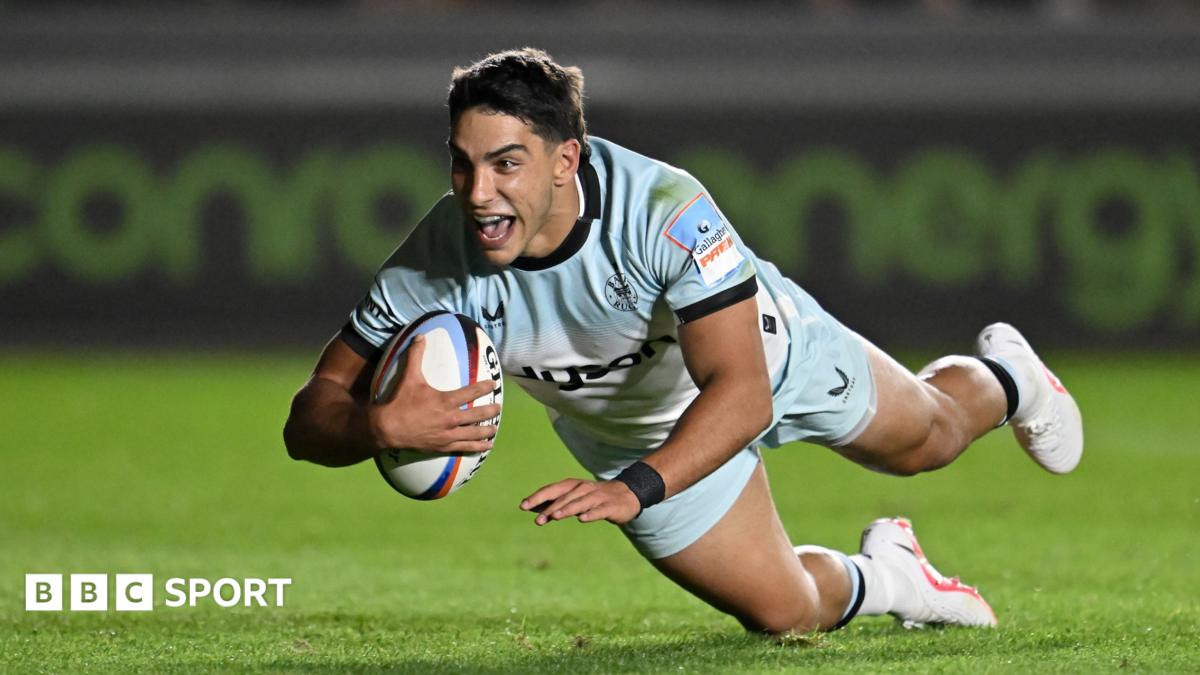
A terrific try from full-back Santiago Carreras was the highlight of Bath’s opening night 33-17 bonus-point victory over Harlequins.
The Argentina international intercepted a Tyrone Green pass with his boot, kicking the ball into the air before collecting it one-handed before it went out of play and smoothly accelerating away to score under the posts in a real moment of magic.
Dan du Preez, Joe Cokanasiga and Dan Frost added first-half tries for Bath who led 28-10 at the break, with Will Porter and Chandler Cunningham-South replying for Quins.
Pedro Delgado reduced the gap to 11 points early in the second half but Ewan Richards’ late try ensured it would be Bath who started the new season with a win.