
Licences

Libya issues rare oil exploration licences to foreign firms | Energy News

Winning bidders include Chevron, Eni, QatarEnergy and Aiteo.

Libya has assigned new oil and gas exploration rights to foreign firms, aiming to revamp the sector after years of civil strife.

The country’s National Oil Corporation (NOC) announced the results of its first licensing round since 2007 on Wednesday. Winners included US oil giant Chevron and Africa’s largest privately-owned energy company, Nigeria’s Aiteo.

Recommended Stories

list of 3 itemsend of list

Other winning bidders were consortia: Spain’s Repsol with British Petroleum, Eni North Africa with QatarEnergy, and Repsol with Hungary’s MOLGroup and Turkiye Petrolleri.

The licensing awards signal some renewed interest in Libya’s oil sector, which foreign investors had long been wary of after the country erupted into conflict in 2011 with the overthrow of longtime ruler Muammar Gaddafi. But experts said the response was smaller than expected.

“It is likely that lingering uncertainty over Libya’s political dysfunction and insecurity in the areas around the blocks on offer were factors in the underwhelming response,” Hamish Kinnear, an analyst with UK-based risk consultancy Verisk Maplecroft, told the AFP news agency.

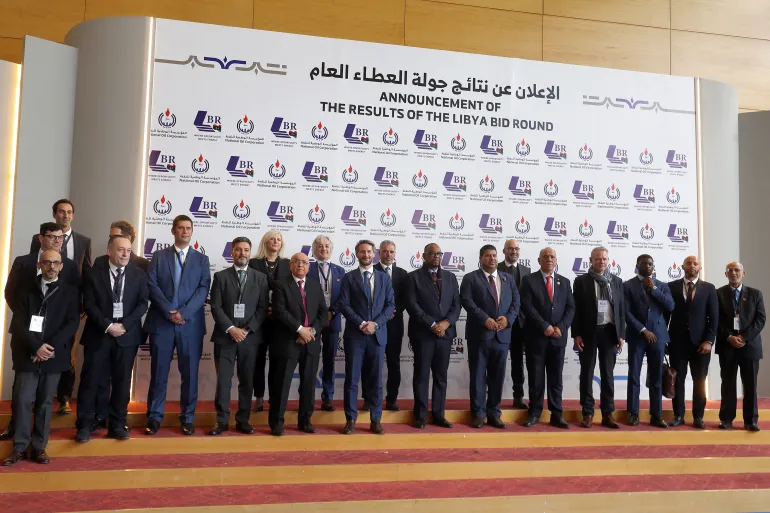
Masoud Suleiman Musa, acting chairman of Libya's National Oil Corporation (NOC), and other corporate represntatives pose for a family photo during a conference announcing the first new grants of oil exploration and production licences in 17 years, in Libya's capital Tripoli on February 11, 2026. The hydrocarbon-rich country is seeking to draw major global energy companies back, while boosting daily oil production by 850,000 barrels over the next 25 years. The winners of the latest bidding round included US oil giant Chevron and Nigeria's Aiteo. (Photo by Mahmud Turkia / AFP)
Masoud Suleiman Musa, acting chairman of Libya’s National Oil Corporation, and other corporate representatives attend a conference announcing grants of oil exploration and production licences, in Tripoli, Libya, February 11 [Mahmud Turkia/AFP]

Libya remains politically divided between rival administrations in the east and west, and disputes over the central ‌bank and oil revenues often disrupt production at key oil fields.

‘Return of trust’

The licensing round, in which five of 20 blocks on offer were awarded, follows a $20bn deal last month with France’s TotalEnergies and ConocoPhillips to boost oil production over 25 years.

Prime Minister Abdelhamid Dbeibah, who announced the deal, said the goal was to increase daily oil production by 850,000 barrels within that timeframe. Libya currently produces approximately 1.4 million bpd.

The round used a new, more investor-friendly contract model to replace the rigid terms that previously deterred investment.

NOC chief Masoud Suleman said a committee will be created to further “improve the terms” of the bidding system and negotiate with candidates to grant unallocated blocks.

Speaking at the bid’s announcement ceremony, he said “a return of trust and resuming institutional work in one of the country’s most important sectors after a long period of pause and challenges.”

“They are part of a broader national path that aims for prosperity, growth, the return of normalcy,” he added.

Source link

£349 TV Licences required for certain UK households – who has to pay

The TV Licence fee rose to £174.50 in April 2025, but some people may need to pay twice

Many households faced a rise in the TV Licence fee last year, with the Government pushing the price up to £174.50 in April 2025. This yearly payment is generally required for homes and businesses watching live television, including broadcasts on services such as Netflix and YouTube, as well as BBC iPlayer content.

Whilst just one licence covers each household, the situation is different for people with a second home or a caravan. Sometimes, you might need to get another TV Licence for that property, which could see the total bill jump to £349.

Additional TV Licences are particularly necessary if you intend to view TV channels on any service, live broadcasts on streaming services, and BBC iPlayer from a second property. According to official TV Licensing online guidance, this covers any device in a house, flat, bungalow, or cottage.

The only exception is if you exclusively use devices running on their own batteries, so they’re not linked to an aerial or connected to the mains electricity. In those circumstances, your main residence’s TV Licence will suffice.

Yet completely separate rules apply to those living in a touring caravan, static caravan, boat, mobile home, or moveable chalet. Official guidance confirms that your main home’s TV Licence should cover you, provided nobody is watching live programmes or accessing BBC iPlayer at the same time at your main licensed address.

In this case, you’ll be required to complete a declaration form, which ought to take just a few minutes. The forms can be accessed in both English and Welsh.

Official TV licensing guidance adds: “You could be prosecuted if we find that you have been watching, recording or downloading programmes illegally. The maximum penalty is a £1,000 fine plus any legal costs and/or compensation you may be ordered to pay.

“A standard TV Licence costs £174.50 and a black and white licence costs £58.50.” For more information, click here.

Why has the licence fee gone up?

The Secretary of State approved a 2.9% hike in the licence fee for 2024, coming into force from April 1, 2025, aligned with annual CPI inflation. This represents a daily increase of just over 1p and is only the second fee rise since April 1, 2021.

The adjustment has raised the annual colour licence fee to £174.50, while the black-and-white licence now costs £58.50 annually. Moving forward, licence fee rises will track CPI inflation for the following four years, ending in 2027.

What does a TV Licence include?

Your payment encompasses four main elements. According to the Express, these include:

  • All TV channels – like BBC, ITV, Channel 4, U&Dave and international channels
  • Pay TV services – like Sky, Virgin Media and EE TV
  • Live TV on streaming services – like YouTube, Netflix, and Amazon Prime Video
  • Everything on BBC iPlayer

This covers watching, recording, and downloading on any device.

Source link