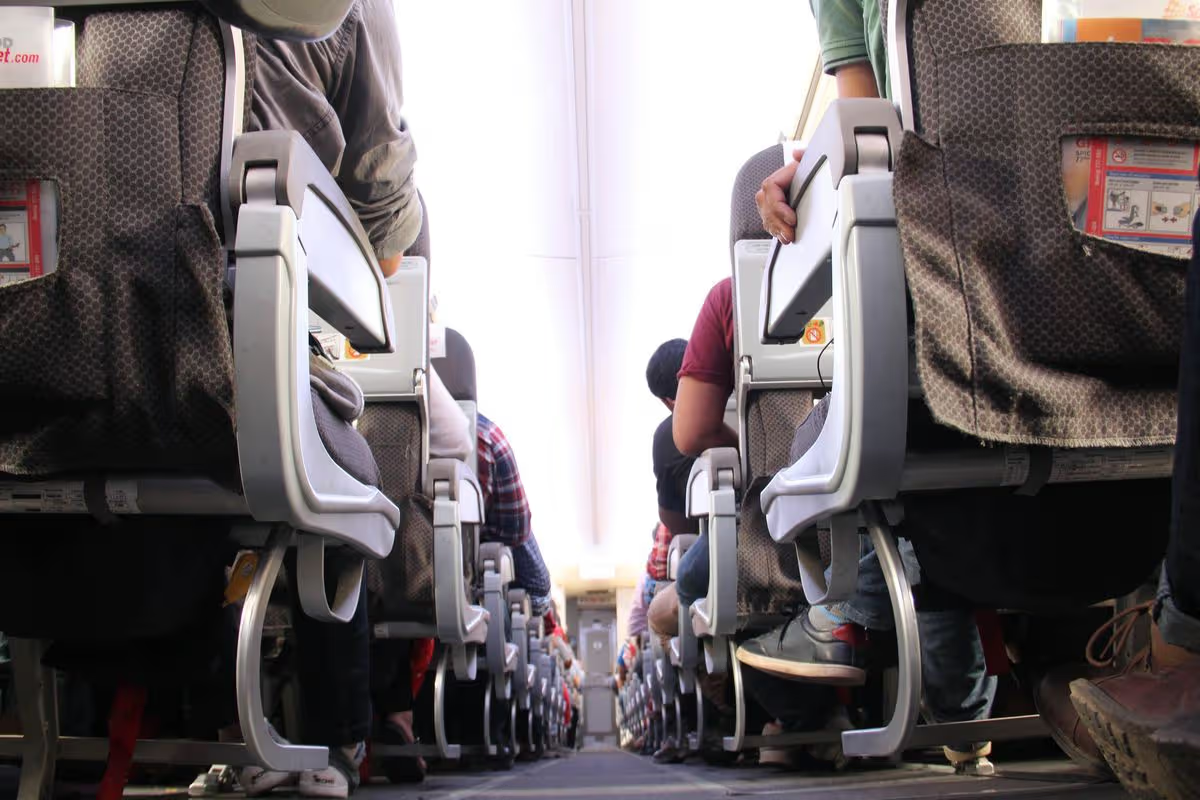
legroom

‘I’m cabin crew – there’s a major downside to seats with extra legroom’

According to a flight attendant for a major UK airline, there’s a big difference between the seats you choose on the plane, and the extra legroom might not always be worth it

Securing extra legroom on a flight is often seen as a major perk, but a flight attendant has revealed that it can have a major downside.

Adam Hodge, 35, originally from Newcastle, has worked as Wizz Air cabin crew for eight years, and during that time he’s travelled to around 30 countries. He loves nothing more than providing the best service to his passengers, and knows the cabin like the back of his hand.

So much so that Adam, who is based at Luton Airport, knows exactly where the best seats are on a plane, the seat he’d recommend for nervous flyers, along with the seats that are the least desirable. And while most travellers long for extra legroom so they can stretch out, he said it’s actually more “restrictive”.

READ MORE: Ryanair names unlikely item that should never be placed in hand luggageREAD MORE: I went to a fairytale hidden gem Greek island – it’s foodie heaven

Speaking exclusively to the Mirror, Adam explained: “It’s all great having the extra leg room at the emergency exit, but the problem is, you can’t have your bags on the floor for take-off and landing, and you can’t have your headphones on. They’re great as you do have a bit more space, but they are more restrictive.

“For me, I like to have my bag under the seat so I can get stuff in and out of my bag when needed, change my headphones, or get a book out. So it’s good to have more freedom and flexibility.”

There’s one desirable spot Adam suggests securing on the plane, but it has to be within specific rows. “I always recommend a window seat.”

On his own seat preference, Adam, who is also a representative on Wizz Air’s Cabin Crew People’s Council, added: “I don’t like to be at the very front, but I don’t like to be at the very back. I like to be in the middle.” Therefore, he recommends that passengers choose a window seat between rows 5 and 10 or 25 and 30.

“It’s the middle, but it’s not right at the back or right at the front,” he added. “You still have easy access to the toilet, or you’re not having to wait long for the trolley service to pass by.”

In reference to securing a window seat, the flight attendant noted: “For me, I like to see what’s going on, take some photos, especially if we’re flying over the Alps, for example.

“The aisle is great too if you like a little bit more access to get in and out, but not the middle aisle. I call it the friendship seat. I’ve made some very good friendships over the years sitting in the middle seat, but I definitely prefer a window.”

Having spent almost 10 years flying to various destinations, Adam has been able to explore some of the lesser-known holiday spots, with Wizz Air operating more than 750 routes across Europe, Africa and the Middle East. One capital he couldn’t recommend more highly is Tiranë, Albania.

“Not only does it have the city, but it also has the beach and coastal areas as well. It has the best of both worlds. If you want to do a city break, or visit the beaches along the coast, and towards the top are the European destinations similar to the Maldives,” he said.

“Tiranë has everything, and it’s very good value for money.”

For more information about Wizz Air flights or to book your next trip, visit their website.

Do you have a travel story to share? Email webtravel@reachplc.com

Source link

Flight misery over for tall passengers as easyJet shares new seats with extra legroom

The new seat will be installed from 2028 on hundreds of easyJet’s new aircraft, providing an extra two inches of improved knee and shin clearance

As budget airlines attempt to cram more and more passengers onto flights, it can feel as if the seat in front edges slightly closer each time you board a plane.

However, a “next generation” economy seat is on the horizon, which its creators claim will provide travellers with additional legroom without compromising space for airlines.

The Kestrel seat from Mirus Aircraft Seating, a British manufacturer, will be fitted from 2028 on hundreds of easyJet’s new aircraft, delivering an extra two inches of “improved knee and shin clearance” for passengers. It will enable easyJet to provide more legroom than most of its short-haul budget rivals.

READ MORE: Britain’s biggest car park operator to close 22 sites within days – full listREAD MORE: Warning as tourist is detained for going on a walk in holiday hotspot

The seat reshapes a passenger’s back, enabling their hips and spine to sit further back on the cushion so their knees and legs gain additional space at the front.

The back is constructed from carbon fibre rather than the traditional moulded plastic, producing a slimmer seat that provides crucial extra inches for the person behind.

A “fixed recline” of 22 degrees naturally shifts the passenger to the most efficient position in the seat, Mirus claims. Customers cannot manually recline the seat to annoy the passenger behind them.

A standard easyJet seat typically provides between 28 and 29 inches of room, meaning anyone who is six foot or taller will touch the seat in front with their knees. Some airlines on longer haul economy flights offer up to 34 inches of space.

“We’ve always had very comfortable leg room in easyJet,” said Kenton Jarvis, the airline’s chief executive. “This product is exceptionally comfortable, exceptionally light and allows a configuration that creates more space for the customer in the cabin.”

He explained easyJet wouldn’t be retrofitting any of its estimated 350 aircraft, stating: “There’s an expense to ripping off perfectly good seats and putting in and buying new ones.” The seats will instead appear in new orders of the Airbus A320neo and A321neo from 2028.

Research conducted this year by consumer group Which identified the short-haul carriers offering the tightest economy-class seat layout, or pitch, as Jet2, KLM, Lufthansa, Ryanair, SAS, TAP Air Portugal, Vueling and Wizz Air. All featured at least some seats with a 28-inch pitch.

The group noted that seat comfort also hinged on quality factors such as padding. By that measure, easyJet’s current seats achieved two out of five.

David Morgan, easyJet’s chief operating officer, commented: “We are delighted to be introducing the Mirus Kestrel seat across our future fleet.

“On top of the sustainability benefits, the additional legroom and enhanced comfort these seats will provide will also deliver an improved onboard experience for our customers, which we know they’ll love.”

READ MORE: ‘Text four letters to five-digit code’ this week if you have a mobile phone

Source link

EasyJet to launch new seats with even more legroom for economy passengers

NEW economy seats being rolled out on easyJet flights will give passengers even more legroom, in a rare move.

More than ever, budget airlines are trying to squeeze in more passengers in an attempt to keep costs down.

New easyJet seats will be giving you more legroomCredit: EasyJet
The slimline seats will add up to two inches of legroomCredit: EasyJet

But easyJet has reveals the “next generation” seats which will actually give you more space.

Designed by Mirus Aircraft Seating, the new Kestrel seats are much slimmer then standard seats as they’re made from carbon fibre rather than plastic.

They also weigh less, coming in at just under 7kg per seat which is 20 per cent lighter than current seats.

And the slimmer seats mean passengers will get an extra two inches legroom too.

FLAKES ON A PLANE!

easyJet serves FREE Greggs sausage rolls on some flights for first time


NOT SO EASY

EasyJet warns Brits to book summer holidays NOW to avoid more price hikes

EasyJet currently offers around 28-29 inches of legroom, so the additional two inches will take it up to 31 inches.

Hate passengers who recline? The seats have a fixed 22 degree recline that don’t move or go back.

The Mirus website states: “Designed for airlines operating short to medium-range flights of around 5 hours in standard specification, but available in ‘Enhanced Comfort’ specification to comfortably open up longer routes — the Kestrel transforms travel for passengers through unbeatable levels of legroom.”

They’re set to be rolled out across the Airbus A320neo and A321neo fleet in 2028.

David Morgan, chief operating officer, said: “The additional legroom and enhanced comfort these seats will provide will also deliver an improved onboard experience for our customers which we know they’ll love.”

EasyJet isn’t the only airline making the economy experience better.

Air New Zealand is launching bunk beds which economy passengers can rent for up to four hours to get some sleep.

Last year, Thai Airways announced they would be launching lie-flat beds in premium economy.

Emirates is rolling out “gamechanger” new cheap seats, although little else has been revealed.

And a new economy seat design called the Skynook has been compared to business class, with a private sliding door

The new seats will be rolled out from 2028Credit: Alamy

Source link