Legislature

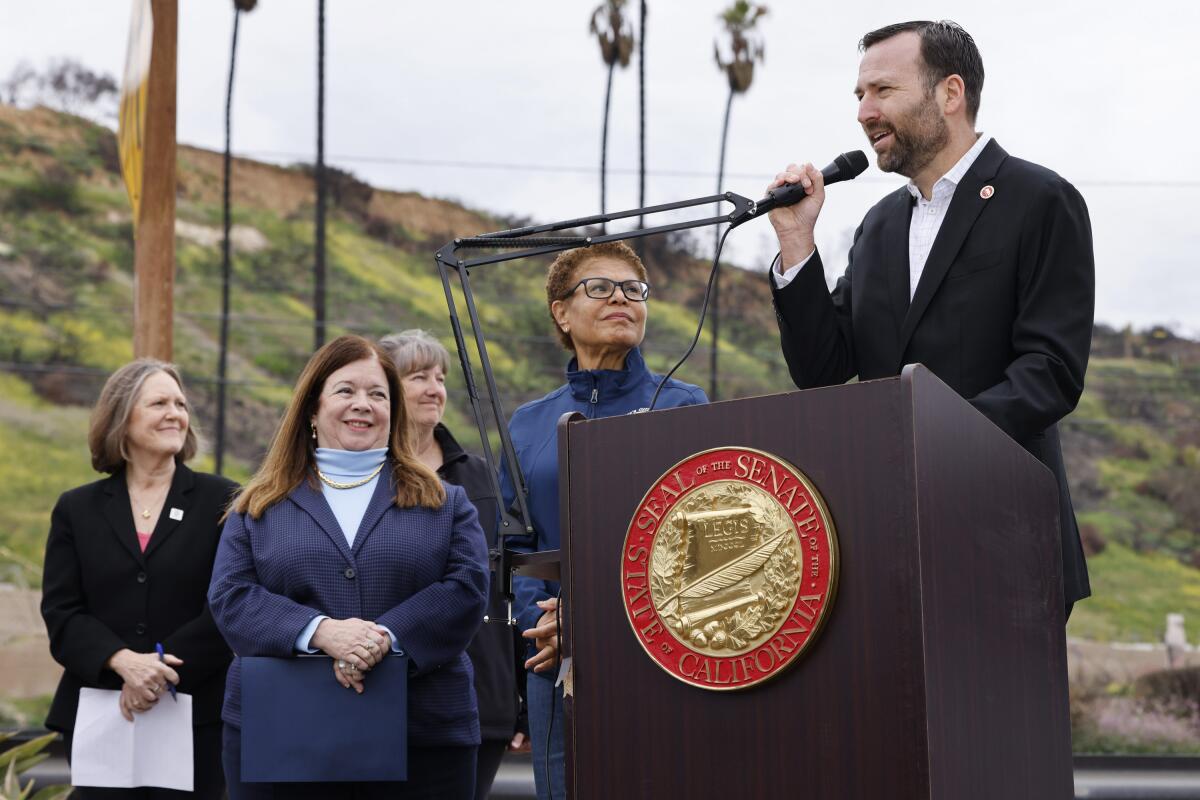
Legislature OKs cuts to state prisons

Lawmakers on Friday gave final approval to a plan to cut the state’s giant prisons budget, passing a hard-fought measure that would reduce the inmate population by thousands but stop far short of solving the overcrowding crisis.

It would also leave California’s budget with $200 million in red ink. Administration officials said Gov. Arnold Schwarzenegger intends to sign the measure nonetheless.

But as the lawmaking calendar drew to a close, the only other major legislation heading toward the governor was in danger of a veto. The measure, hailed by environmentalists as one of the most important in the country, would substantially boost the amount of energy that utilities must derive from solar, wind, geothermal and other renewable resources.

Lawmakers sidelined plans to ease construction of a stadium in the Los Angeles area that could bring NFL football back to town. Ambitious proposals to ban potentially toxic chemicals in baby bottles, cut down on plastic grocery bag use and require more pets to be sterilized were scuttled.

The prisons measure, SBX3 18 by Sen. Denise Moreno Ducheny (D-San Diego), would reduce supervision of low-level offenders on parole so they could not be sent back for violating the terms of their release. It would allow some offenders to earn shorter terms by completing rehabilitation programs.

Legislative officials estimated that under the measure, the prison population would fall by 20,000 to 25,000 over two years.

But the bill no longer contains provisions passed by the Senate that would have moved thousands of inmates to home detention and created a commission with the power to change state sentencing laws. Sen. Gloria Romero (D-Los Angeles), called the final bill “prison lite,” although she voted for it, and declared: “What’s not in the bill is a resolution and solution to this prison crisis.”

The vote was the culmination of weeks of controversy and dispute over how to safely cut the population of the state’s overcrowded prisons to ease budgetary pressure and satisfy a federal court order to reduce the number of inmates.

The Senate, despite fierce opposition from law enforcement, had approved a broader package of cuts earlier in the summer to reduce the number of inmates by 37,000 over two years, nearly the amount federal judges have demanded.

That package would have cut $525 million from the $1.2 billion in prison cuts they authorized in July’s budget deal. The governor planned to make up the difference with administrative actions.

The package sent to the governor’s desk Friday evening, however, is estimated to be more than $200 million short. It is not clear how that money will be made up. As the hours ticked by Friday, action in the Capitol was mostly dominated by bickering, scheming, and disappointment.

Top lawmakers shuttled between closed-door meetings with one another and powerful interest groups. There was so much activity in the governor’s courtyard smoking tent, where Schwarzenegger and his staff conduct negotiations and fine cigars are passed around, that legislative staff in offices above raised a sign reading, “Bitte nicht Rauchen” (German for “Please do not smoke”).

By late night, Democratic leaders abandoned efforts to push another major bill through before the clock ran out: a big water bond and policy package that had support from some long-dueling industry and environmental groups, though not enough lawmakers.

The Senate did manage to pass the energy bill, which would raise to 33% the amount of energy the utilities must get from renewable sources. Final approval by the Assembly of some minor amendments was expected.

However, a high-ranking administration official said late Friday that the governor planned to veto the bill, AB 64 by Paul Krekorian (D-Burbank), and a companion measure, SB 14 by Sen. Joe Simitian (D-Palo Alto), unless Democrats redrafted the proposals to discard provisions limiting the amount of energy that can come from outside California. The official spoke on condition of anonymity because the bills were not yet on the governor’s desk.

Lawmakers throughout the day also expressed frustration with what has been one of the more unproductive years in Sacramento. Disgruntled GOP lawmakers began withholding their votes on nearly every measure that came up, to show their anger at Senate leader Darrell Steinberg (D-Sacramento) over what they said were broken promises

Among them, GOP staffers said, was a chance for Republicans to kill a state program popular with taxpayers that allows state authorities to fill out their tax forms. The tax preparation firm Intuit, which sells TurboTax, has been trying to abolish the program for years.

Meanwhile, facing stiff resistance from environmentalists, Steinberg opted to put the brakes on the stadium bill, ABX3 81 by Isadore Hall (D-Compton), which would have waived environmental laws that proponents say stand in the way of a 75,000-seat stadium proposed by billionaire Ed Roski.

Steinberg said he wants to try, in coming weeks, to mediate an agreement that addresses the environmental impact of the stadium plan.

“Because I see the obvious merit in the proposed stadium development in the City of Industry — the creation of up to 18,000 jobs, the economic development for the area, and the tax revenue for the local and state governments — I am willing to . . . commence negotiations,” Steinberg wrote to his colleagues.

If negotiations fail, Steinberg said, he would allow the bill, which passed the Assembly on Thursday, to be heard in a special legislative session before the end of this month.

Several bills that failed to win enough votes were put off until next year. One was SB 250, by Sen. Dean Florez (D-Shafter), which would have required many dogs and cats to be sterilized unless the owners obtained an unaltered animal license.

Another measure would have banned the chemical BPA (bisphenol A) from feeding products designed for children younger than 3. “It’s a shame that we have failed to protect our most vulnerable citizens,” said Sen. Fran Pavley (D-Agoura Hills), author of SB 797.

The Senate was struggling Friday over a proposal by Schwarzenegger to create a 4.8% surcharge on all new or renewed commercial and residential fire insurance policies to raise funds for emergency and fire protection services. Democrats championing the bill, AB 196 by the Assembly Budget Committee, cited ongoing wildfires. But Republicans were balking, saying another tax would hurt the economy and taxpayers.

The water package that legislative leaders scrambled unsuccessfully to pass late Friday included nearly $12 billion in bonds and the implementation of five policy proposals addressing a broad range of issues. Examples: urban water conservation, water rights and creation of a council to oversee projects in the Sacramento-San Joaquin River Delta.

Assembly Speaker Karen Bass (D-Los Angeles) said legislative leaders hope to revive the package in a special session before the end of the year.

[email protected]

[email protected]

Times staff writer Bettina Boxall contributed to this report.

Source link

Legislature OKs casinos’ growth – Los Angeles Times

Deals to add up to 17,000 slot machines at four Southern California tribal casinos passed the Legislature on Thursday, setting the stage for giant casinos with twice as many slots as the biggest in Las Vegas.

Within minutes, union leaders raised the possibility of mounting a repeal campaign.

The Assembly passed compacts that Gov. Arnold Schwarzenegger struck last year with four wealthy tribes, along with a side agreement addressing child support, gambling addiction, workers’ compensation, accounting and arbitration issues.

Under the deals, which Schwarzenegger has signed, the state will get between 15% and 25% of the revenue from the additional machines, possibly bringing in half a billion dollars a year.

Organized labor had unsuccessfully sought to include requirements that tribes not punish or harass workers for trying to organize. Unions had also sought language allowing a union to bargain for workers if more than 50% of employees signed authorization cards.

Jack Gribbon, California political director for Unite Here, a union that organizes casino and hotel workers, said he and other union leaders are considering asking voters to undo the agreements. To qualify a repeal measure for next February’s presidential primary ballot would probably require gathering 400,000 signatures in 90 days, he said.

“The discussions are very serious,” Gribbon said.

Assembly Speaker Fabian Nunez (D-Los Angeles), a former labor organizer, said unions placed an “undue burden” on him with the provisions they sought.

“I did not negotiate the compacts,” he said. “The governor negotiated the compacts.”

Tribes given the right to expand are the Agua Caliente Band of Cahuilla Indians, which owns casinos in Palm Springs and Rancho Mirage; the Pechanga Band of Luiseno Indians in Temecula; the Sycuan Band of the Kumeyaay Nation in San Diego County; and the Morongo Band of Mission Indians in Cabazon.

A compact between the governor and the San Manuel Band of Mission Indians of San Bernardino County did not pass the Legislature. Nunez’s office said that was because the tribe refused to sign the side agreement insisted upon by the speaker.

The Assembly also gave final approval Thursday to a compact allowing the Yurok tribe of Northern California to install 99 slot machines. The tribe is among the state’s largest, and one of the poorest.

[email protected]

Source link

Abortion is illegal again in North Dakota, state Supreme Court rules

Abortion is again illegal in North Dakota after the state’s Supreme Court on Friday couldn’t muster the required majority to uphold a judge’s ruling that struck down the state’s ban last year.

The law makes it a felony crime for anyone to perform an abortion, though it specifically protects patients from prosecution. Doctors could be prosecuted and penalized by as much as five years in prison and a $10,000 fine.

Three justices agreed that the ban is unconstitutionally vague. The other two justices said the law is not unconstitutional.

The North Dakota Constitution requires at least four of the five justices to agree for a law to be found unconstitutional, a high bar. Not enough members of the court joined together to affirm the lower court ruling.

In his opinion, Justice Jerod Tufte said the natural rights guaranteed by the state constitution in 1889 do not extend to abortion rights. He also said the law “provides adequate and fair warning to those attempting to comply.”

North Dakota Republican Atty. Gen. Drew Wrigley welcomed the ruling, saying, “The Supreme Court has upheld this important pro-life legislation, enacted by the people’s Legislature. The attorney general’s office has the solemn responsibility of defending the laws of North Dakota, and today those laws have been upheld.”

Republican state Sen. Janne Myrdal, who introduced the 2023 legislation that became the law banning abortion, said she was “thrilled and grateful that two justices that are highly respected saw the truth of the matter, that this is fully constitutional for the mother and for the unborn child and thereafter for that sake.”

The challengers called the decision “a devastating loss for pregnant North Dakotans.”

“As a majority of the Court found, this cruel and confusing ban is incomprehensible to physicians. The ban forces doctors to choose between providing care and going to prison,” Center for Reproductive Rights senior staff attorney Meetra Mehdizadeh said. “Abortion is healthcare, and North Dakotans deserve to be able to access this care without delay caused by confusion about what the law allows.”

The ruling means access to abortion in North Dakota will be outlawed. Even after a judge had struck down the ban last year, the only scenarios for a patient to obtain an abortion in North Dakota had been for life- or health-preserving reasons in a hospital.

The state’s only abortion provider relocated in 2022 from Fargo to nearby Moorhead, Minn.

Justice Daniel Crothers, one of the three judges to vote against the ban, wrote that the district court decision wasn’t wrong.

“The vagueness in the law relates to when an abortion can be performed to preserve the life and health of the mother,” Crothers wrote. “After striking this invalid provision, the remaining portions of the law would be inoperable.”

North Dakota’s newly confirmed ban prohibits the performance of an abortion and declares it a felony. The only exceptions are for rape or incest for an abortion in the first six weeks of pregnancy — before many women know they are pregnant — and to prevent the woman’s death or a “serious health risk” to her.

North Dakota joins 12 other states enforcing bans on abortion at all stages of pregnancy. Four others bar it at or around six weeks of gestational age.

Judge Bruce Romanick had struck down the ban the GOP-led Legislature passed in 2023, less than a year after the U.S. Supreme Court overturned Roe vs. Wade and opened the door to the state-level bans, largely turning the abortion battle to state courts and legislatures.

The Red River Women’s Clinic — the formerly sole abortion clinic in North Dakota — and several physicians challenged the law. The state appealed the 2024 ruling that overturned the ban.

The judge and the Supreme Court each denied requests by the state to keep the abortion ban in effect during the appeal. Those decisions allowed patients with pregnancy complications to seek care without fear of delay because of the law, Mehdizadeh previously said.

Dura writes for the Associated Press.

Source link

Judge adopts Utah congressional map creating a Democratic-leaning district for 2026

A Utah judge on Monday rejected a new congressional map drawn by Republican lawmakers, adopting an alternate proposal creating a Democratic-leaning district ahead of the 2026 midterm elections.

Republicans hold all four of Utah’s U.S. House seats and had advanced a map poised to protect them.

Judge Dianna Gibson ruled just before a midnight deadline that the Legislature’s new map “unduly favors Republicans and disfavors Democrats.”

She had ordered lawmakers to draw a map that complies with standards established by voters to ensure districts don’t deliberately favor a party, a practice known as gerrymandering. If they failed, Gibson warned she may consider other maps submitted by plaintiffs in the lawsuit that led her to throw out Utah’s existing map.

Gibson ultimately selected a map drawn by plaintiffs, the League of Women Voters of Utah and Mormon Women for Ethical Government. It keeps Salt Lake County almost entirely within one district, instead of dividing the heavily Democratic population center among all four districts, as was the case previously.

The judge’s ruling throws a curveball for Republicans in a state where they expected a clean sweep as they’re working to add winnable seats elsewhere. Nationally, Democrats need to net three U.S. House seats next year to wrest control of the chamber from the GOP, which is trying to buck a historic pattern of the president’s party losing seats in the midterms.

The newly approved map gives Democrats a much stronger chance to flip a seat in a state that has not had a Democrat in Congress since early 2021.

“This is a win for every Utahn,” said state House and Senate Democrats in a joint statement. “We took an oath to serve the people of Utah, and fair representation is the truest measure of that promise.”

In August, Gibson struck down the Utah congressional map adopted after the 2020 census because the Legislature had circumvented anti-gerrymandering standards passed by voters.

The ruling thrust Utah into a national redistricting battle as President Trump urged other Republican-led states to take up mid-decade redistricting to try to help the GOP retain control of the House in 2026. Some Democratic states are considering new maps of their own, with California voters approving a map last week that gives Democrats a shot at winning five more seats. Republicans are still ahead in the redistricting fight.

Redistricting typically occurs once a decade after a census. There are no federal restrictions to redrawing districts mid-decade, but some states — more led by Democrats than Republicans — set their own limitations. The Utah ruling gives an unexpected boost to Democrats, who have fewer opportunities to gain seats through redistricting.

If Gibson had instead approved the map drawn by lawmakers, all four districts would still lean Republican but two would have become slightly competitive for Democrats. Their proposal gambled on Republicans’ ability to protect all four seats under much slimmer margins rather than create a single-left leaning district.

The ruling came minutes before midnight on the day the state’s top election official said was the latest possible date to enact a new congressional map so county clerks would have enough time to prepare for candidate filings for the 2026 midterms.

Republicans have argued Gibson does not have legal authority to enact a map that wasn’t approved by the Legislature. State Rep. Matt MacPherson called the ruling a “gross abuse of power” and said he has opened a bill to pursue impeachment against Gibson.

Gibson said in her ruling she has an obligation to ensure a lawful map is in place by the deadline.

Schoenbaum writes for the Associated Press.

Source link