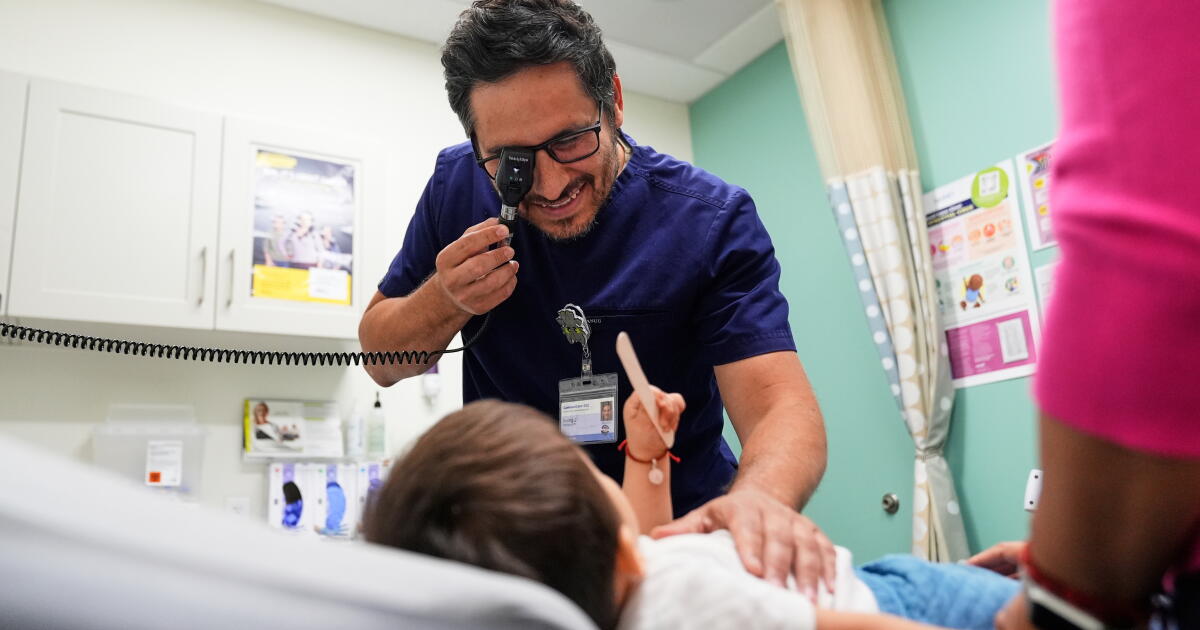
New restrictions have stripped Medicaid coverage from certain legal immigrants, including refugees and victims of human trafficking, as part of broader federal changes to the health insurance program that are expected to force millions off their coverage.
The change effective Oct. 1 cut from Medicaid what is estimated to be hundreds of thousands of people who legally immigrated to the United States, many of whom work and pay taxes, in the latest Trump administration policy to target foreigners.
The move is part of sweeping changes to Medicaid under President Donald Trump’s 2025 tax cut and policy law, with many set to take effect early next year. The Medicaid changes are projected to result in 7.5 million fewer people with health insurance, according to the Congressional Budget Office’s 2025 estimate.
Advocates say that without Medicaid, people will not be able to afford private insurance and will either delay care or end up in emergency rooms, adding pressure to a strained health system. For immigrants, the cuts could be felt more acutely, compounding the effects of other administration efforts to restrict their access to public assistance as part of a broader immigration crackdown.
“This is about telling every immigrant in the United States that they are not welcome here and that they should leave,” said Ben D’Avanzo, a senior strategist at the National Immigration Law Center, which has pursued litigation against the Republican administration over its immigration agenda.
Refugees, asylum seekers, victims of human trafficking and domestic violence are among those who have lost coverage. Green-card holders were not impacted.
Lauren Bis, a White House spokesperson, said in a statement that “immigrants must be able to support themselves without taking from overburdened benefits programs paid for by hard-working American taxpayers.”
D’Avanzo said many people who have lost coverage will likely only realize when they need medical care. But for some, the change has been felt immediately.
Dwindling supplies of lifesaving medication
In Tucson, Arizona, María Chacon has been caring for her son Jesus for almost five years since a car accident at 17 left him unable to breathe on his own. He requires a ventilator, a feeding tube and daily medication, and must be turned once every two hours to stop sores from forming. Chacon said he sometimes opens his eyes.
The family is originally from Mexico and entered the U.S. on a T visa, offered to victims of human trafficking, in 2018.
Chacon said Medicaid has helped cover almost $25,000 per month of care for her son, which includes a small stipend for her and her husband as compensation for being long-term caregivers. She said doctors have explained that even if they both worked 24 hours a day, they would not be able to cover the cost of his care.
“Since that day I haven’t been able to sleep. We haven’t been able to eat or anything. We’re wondering what we’re going to do?” Chacon said.
Jesus takes medication that Chacon estimates costs $7,000 a month. The supply runs out in mid-October. Without coverage, she does not know how her son is going to survive.
Chacon found out just days before the cuts that she was losing care. She called the state’s Medicaid offices to appeal. Although she is in the process of obtaining a green card, Medicaid coverage would only kick in five years after she is approved.
Steven Camarota, research director for the Center for Immigration Studies, a right-leaning think tank that seeks less immigration, said the administration “is trying to nibble around the edges” with the Oct. 1 cuts, finding piecemeal ways to curb immigration into the U.S.
Camarota believes the government should screen legal immigrants for income potential and education, reducing the number who might rely on public benefits once they cross the border.
“You need immigrants who are unlikely to need welfare,” he said, or those with high educational attainment.
The administration recently revived a federal rule that could deny green cards to immigrants who use public benefits that could include food stamps, Medicaid, housing vouchers and others.
Chacon believes the cuts to Medicaid coverage are part of the administration’s clampdown on immigrants. She said her son is in no condition to travel.
“I know that’s what he’s doing, but, as my son is, I couldn’t go to Mexico,” Chacon said.
Millions more will be dropped from Medicaid
Medicaid, jointly funded by states and the federal government, has become a political focal point during Trump’s second term. The president has pushed to root out what he describes as fraud in the program. In July, the administration deferred over $1 billion in Medicaid payments to California and Minnesota, claiming there was suspected fraud; critics argued the move targeted Democratic-led states.
As more people are cut from Medicaid, the federal government is predicted to reduce program spending by $911 billion, according to healthcare research nonprofit KFF.
In Arizona, officials said 29,000 legal immigrants were cut from Medicaid rolls on Oct. 1. In Florida, estimates are closer to 177,000. Overall, more than 281,000 immigrants from nine states and the District of Columbia are estimated to lose Medicaid coverage, according to KFF.
As more states implement various restrictions to coverage, 7.5 million people are expected to lose coverage by 2034, according to analysis by the Congressional Budget Office.
Without coverage, people will turn to emergency rooms for care. When people delay seeing a doctor, conditions can worsen and become even more expensive to treat.
“At the end of the day, it does raise the cost for the states because once you get these people in for something that could have been prevented, they could not go to the doctor because they were uninsured; they most likely will end up at a hospital in an emergency room,” said Carmen Feliciano, the vice president of policy and advocacy at UnidosUS, a Latino civil rights organization.
UnidosUS partners with community organizations to help provide medical care, but Feliciano said they already are overwhelmed and would not be able to support the number of people who are going to lose medical coverage in the coming months.
“We are not going to have the capacity to serve all the people who need it,” Feliciano said.
Schuettler and Hussein write for the Associated Press.