LeBron

Gold Phoenix chasing history in Del Mar Handicap as an 8-year-old

Gary Fenton and Billy Koch have been sports fans long enough to know the cliché about Father Time being undefeated.

“I can say that about me for sure,” joked Koch, who is 56.

But the two men also know some individuals can delay the inevitable for years far beyond the norm. Someone like Kareem Abdul-Jabbar. Or Tom Brady. Or LeBron James. Or Gold Phoenix.

Wait, who?

Gold Phoenix is an 8-year-old gelding Fenton and Koch — managing partners of the Little Red Feather Racing Stable — purchased five years ago in his native Ireland. Since making his U.S. debut in January 2022, he has won a dozen races, all but one in a graded stakes, and earned more than $2.5 million. All of which puts him in great, though not exclusive company.

At about 6:40 p.m. Saturday, however, Gold Phoenix has a chance to separate himself from all but one other thoroughbred who has competed in North America. Should he win the $300,000 Del Mar Handicap, Gold Phoenix will join the legendary Kelso as the only horses to win the same major stakes race on this continent in five straight years. (Kelso, a five-time Horse of the Year, won the Jockey Club Gold Cup from 1960-64 at Aqueduct.)

“I got the chills when you said it,” Koch said. “To be even mentioned in the same breath as a horse like Kelso … that’s something that only happens once in a lifetime.”

Gold Phoenix is the 5-2 morning-line favorite, but the Grade 2 race is hardly a walkover. There are multiple stakes winners in the field, led by Test Score, the early second choice at 3-1. The 4-year-old is trained by Graham Motion, who has his own impressive streak: Seven straight summer stakes wins at Del Mar dating to 2022 — which is also the year Gold Phoenix won this 1 3/8-mile race for the first time.

Another victory would be the gelding’s seventh stakes win here, extending the record he set last month in the Eddie Read Stakes, which Koch and Fenton, in separate interviews, ranked among their favorite performances. At 1 1/8 miles, the race was shorter than Gold Phoenix prefers, and he had to beat a field that included another Del Mar specialist, Formidable Man.

“To see him come charging home just brought out all the emotions of what we’ve seen, not just from him [anywhere], but on this racetrack here at Del Mar that he absolutely loves,” Fenton said.

The victory was a close one, but that’s typical for Gold Phoenix, who has seven wins by a nose, head or neck and only one by more than 1¼ lengths. His competitiveness is apparent at any distance and under any jockey: He’s won races as short as 7 furlongs and as long as 1¾ miles, and all seven men to ride him earned at least one victory (his current rider, Hector Berrios, is four for five).

“He’s just such a cool horse,” Koch said, noting the gelding is known around the barn as “Clifford the Big Red Dog” because of his chestnut coat and a temperament Fenton describes as “sweet.”

But other horses like that, or those that are completely the opposite, don’t have Gold Phoenix’s success rate or longevity. That’s where Fenton made a human comparison.

“I’m going to say he’s like LeBron,” Fenton said, “in that as he’s been able to age, his body, his athleticism, have maintained at a very, very top level with very [few] issues. He’s been relatively sound all this time.”

Fenton and Koch are quick to credit trainer Phil D’Amato and his barn staff for their overall management, spacing out his races and giving Gold Phoenix time off each year after the Breeders’ Cup. He had a shorter break this winter — just three months until his first start of 2026 — because, Fenton said, “I think [D’Amato] just thought being at that age, to give him a break and then try to ramp him up, might be a little bit too much. So I think he rolled the dice and kept him in training for as long as he could. And, I mean, here we still are.”

For how much longer? There’s no reason to stop yet. Gold Phoenix already has three victories in 2026, matching his high for any year. And he hasn’t even run in the race he always wins.

“I just want to watch him and see him thrive at this level,” Fenton said, “and the moment he’s not at this level is where it’ll probably be time to wrap it up. But he’s showing no signs of it.”

Said Koch: “People always say, ‘Why are you still running? He’s 8.’ I’m like, what are we supposed to do? The horse might be better now than he was at 7 or he was at 6.”

Koch noted that in his role as board president for CARMA, a nonprofit that provides funding and care of retired California racehorses, he hears from many facilities offering to house Gold Phoenix.

“I tell them he’s not ready,” Koch said. “He’ll tell us. They keep asking, [but] somehow he’s managed to dodge Father Time. I don’t know how, but he has.

“We’ll figure it out. He’s going to go to a very special home. I promise you that he is going to have a great life. He deserves it.”

Source link

LeBron James borrowed $300 million from insurers arranged by Guggenheim

When LeBron James signed up to lead the Los Angeles Lakers to NBA glory with a $154 million contract in 2018, it wasn’t the biggest deal he did that year.

Just months before he joined, a limited liability company he controls borrowed almost $300 million from a pair of Midwestern life insurers advised by an arm of Guggenheim Partners, according to insurance industry records reviewed by Bloomberg.

The previously unreported bonds, which are due in 2049, were structured to provide immediate cash to James and backed by a stream of future revenue tied to his earnings outside basketball such as a lifetime Nike Inc. sponsorship, people with knowledge of the matter said.

The burst of lending began before Guggenheim leader Mark Walter started acquiring the storied basketball team. In an abrupt turn this month, the billionaire mogul agreed to sell the Lakers amid a federal probe into parts of his business empire. There’s no indication that the loans to James have anything to do with those inquiries.

Athletes and artists are increasingly using future earnings like royalties and licensing deals to structure deals that help them unlock immediate capital. David Bowie was famously the first recording artist to go to Wall Street to tap the future earnings of his music, paving the way for a thriving market for esoteric securities.

But James’ deal offers another look at how Walter and fellow Wall Street money managers have tectonically shifted the once-boring business of life insurance, steering policyholder premiums into more unusual investments. Guggenheim has moved insurers’ money deeper into private credit, sports franchises and — with James — financing for a star player. That’s far outside the industry’s traditional focus on plain-vanilla assets to reliably pay out future claims.

The two insurers — North American Company for Life and Health Insurance and Midland National Life Insurance Co. — are both owned by Sammons Financial Group. During a call with investors this week, Sammons said Guggenheim was the sole manager in charge of picking assets for the firm’s portfolios until 2021, according to people who heard the remarks and, like others in this story, asked not to be identified describing confidential dealings.

Sammons has been distancing itself from Guggenheim recently. Walter’s firm had long counted Sammons’ parent company among its biggest investors. During the call, though, Sammons’ representatives said it has been selling down that stake, the people said.

The “transactions were a securitization done by Mr. James with his personal, non-NBA salary, assets and income which is a very common financial structure for an individual with this level of earnings and assets,” a spokesperson for James said.

Spokespeople for Sammons and Guggenheim declined to comment.

The scrutiny of Walter’s empire by the Justice Department and Securities and Exchange Commission has turned up the spotlight on the intermingling of asset managers and insurers.

Wall Street power players have used insurance balance sheets to pursue their quest for higher returns, steering the savings of everyday Americans into more opaque and complex investments. The approach lets asset managers originate and structure deals, and then find uncomplaining buyers by parking such investments on the balance sheets of insurers they influence.

King James Funding

James’ borrowing from the two Midwestern insurers — structured as sales of asset-backed bonds — began when he was at the Cleveland Cavaliers and his career was poised for new heights.

The two companies bought almost $300 million bonds issued by an LLC he controlled called King James Funding, the records show. Within a few years, the LLC paid down some of that debt, then sold more bonds to the insurers, leaving them with about $245 million on their books by the end of last year, the records show.

The initial bonds from 2018 had a 4.8% interest rate and aren’t due until late 2049, the industry filings show. Terms are otherwise scant in the records reviewed by Bloomberg.

A few months after the deal, James started looking for another team as a free agent, ultimately picking the Lakers. In an oft-retold moment, he received a visit at home from Walter’s longtime business partner Magic Johnson, then a top executive for the Lakers. James ultimately signed a four-year contract.

Then in mid-August 2022, James signed a $97 million contract extension with the Lakers. Around that same time, the same Midwestern insurers provided his LLC with more cash, buying almost $60 million of 34-year bonds with a 5.75% interest rate, the insurers’ records show.

“Both transactions were independently credit rated by a third party and the 2022 transaction was fully approved by NBA,” James’ spokesperson said, noting the athlete had no affiliation with Guggenheim, Sammons, North American Co. or Midland National beyond their participation in the transactions.

Guggenheim also got involved in some of James’ other personal ventures. As the Covid pandemic took hold in 2020, he and his childhood friend and business partner, Maverick Carter, announced that they had raised $100 million for their media venture called SpringHill Co. Guggenheim was listed among investors in that company.

Leaving the Lakers

For more than a decade, Walter has mixed money from insurers with investments in sports. His 2012 acquisition of the Los Angeles Dodgers with business partners including Johnson relied heavily on the insurance industry.

Afterward, the new team’s owners ramped up spending on players to turn the franchise into a jewel of professional baseball, appearing in five of the past nine World Series. But that playbook isn’t as feasible in the NBA, which has stricter caps on team salaries.

Walter’s acquisition of the Lakers began in 2021 when he purchased a minority stake, granting him rights that paved the way for him to take a majority stake last year.

The sale of the team came as Walter has been reshaping his empire to unwind more than $20 billion of loans on his insurers’ books that should have been marked as funding affiliated businesses, but weren’t. While regulations allow insurers to lend money to such parties, they require that the dealings be disclosed.

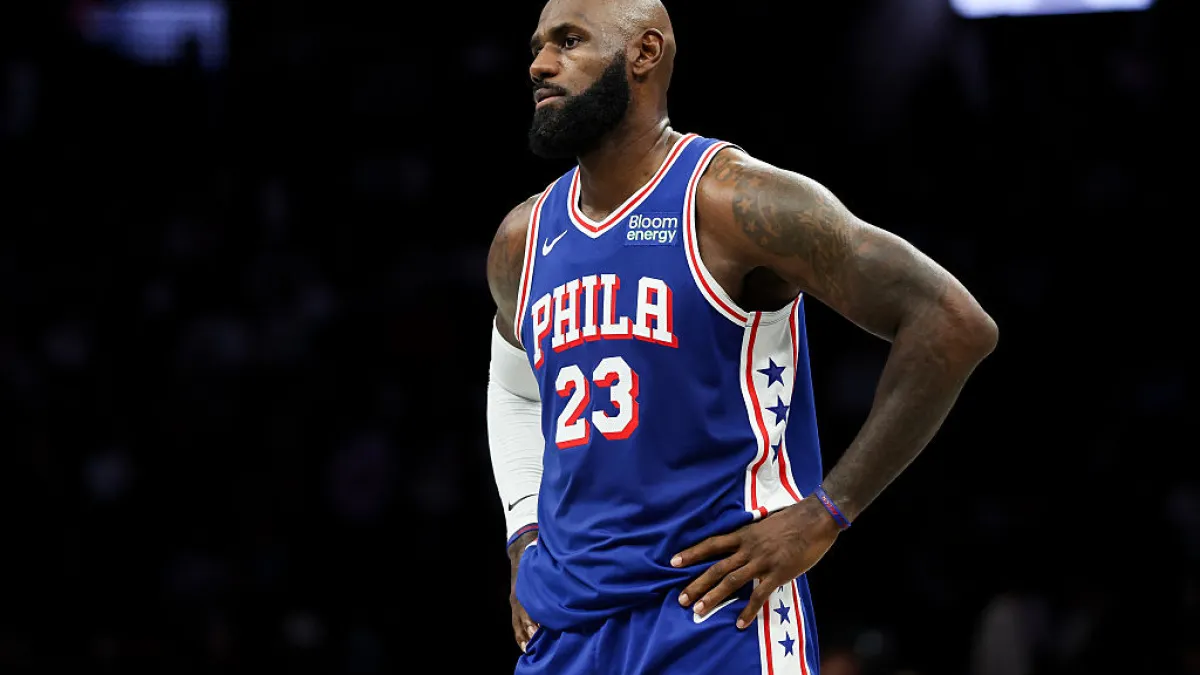
James, meanwhile, announced that he’s leaving the Lakers and he signed a two-year deal with the Philadelphia 76ers. His new team is co-owned by Josh Harris, whose 26North Partners invests across middle-market private equity, credit and insurance.

Li, Sridhar Natarajan and Rajbhandari write for Bloomberg.

Source link