Lebanons

Lebanon’s ban on Hezbollah ‘activities’: bold but difficult to implement | Israel attacks Lebanon

Beirut, Lebanon – Hezbollah raised the stakes for the Lebanese government on Tuesday, when it launched an attack on Israel’s Ramat Airbase and a barrage of rockets another military facility in the Israeli-occupied Golan Heights, a day after Prime Minister Nawaf Salam’s cabinet announced a ban on Hezbollah’s military and security activities.

Analysts said that the Lebanese government’s decision, while difficult to implement, might have a decisive impact on the future of Lebanon. Some say it was a necessary step to bring decisions related to security and defence under the central government’s control, while others argue it raises the spectre of internal strife.

Imad Salamey, a political scientist at the Lebanese American University, said that implementation of the government’s decision to disarm Hezbollah was “more plausible today than in previous years because the decision reflects unusually broad national backing, including from within the Shia political sphere”.

“Amal’s vote in favour signals that support for consolidating arms under state authority is no longer framed purely as a sectarian or anti-resistance demand, but increasingly as a state-stabilisation necessity – especially amid economic collapse and regional escalation,” he said, referring to the other Lebanese Shia Muslim group headed by Parliament Speaker Nabih Berri.

But Michael Young, a Lebanon expert at the Carnegie Middle East Center, said the decision was easier said than done.

“Implementation is going to he much more complicated. The army is not enthusiastic to enter into a fight with Hezbollah,” Young told Al Jazeera.

“It’s good that the state has taken this decision, but it is not good that the army seems very reluctant to implement this decision,” he added.

The Iran-backed Hezbollah effectively joined the war that the United States and Israel started against Iran on Saturday when it launched a barrage of rockets and drones towards northern Israel on Monday, saying it was acting to avenge the killing of Iran’s Supreme Leader Ayatollah Ali Khamenei in Tehran and Israel’s near-daily attacks on Lebanon.

Israel responded by hitting Beirut’s southern suburbs with loud attacks that woke many of the city’s residents up, and issued evacuation warnings for more than 50 towns, displacing tens of thousands of people from their homes.


Hezbollah’s military actions banned

As this unfolded, Salam’s cabinet met and debated the events before the prime minister called an emergency news conference.

“We announce a ban on Hezbollah’s military activities and restrict its role to the political sphere,” Salam said in a news conference on Monday after the meeting.

“We declare our rejection of any military or security operations launched from Lebanese territory outside the framework of legitimate institutions.”

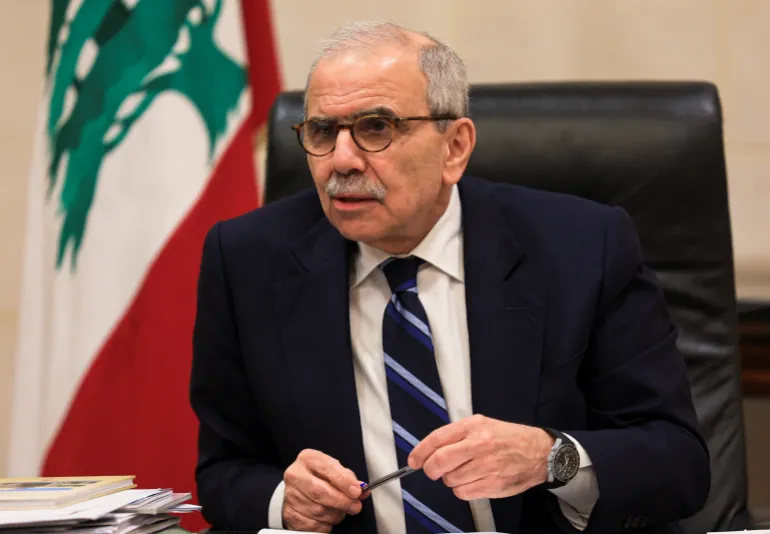
Lebanese Prime Minister Nawaf Salam speaks to journalists at the government headquarters in Beirut, Lebanon, December 3, 2025. REUTERS/Mohamed Azakir
Lebanese Prime Minister Nawaf Salam speaks to journalists at the government headquarters in Beirut, Lebanon, December 3, 2025 [Mohamed Azakir/Reuters]

He added that all of Hezbollah’s military or security activities are “illegal” and said security forces would “prevent any attacks originating from Lebanese territory” against Israel or other states.

“We declare our commitment to the cessation of hostilities and the resumption of negotiations,” he said.

The statement was the strongest stance against Hezbollah to date and even gained the support of Parliament Speaker, and longtime staunch Hezbollah ally, Nabih Berri, who leads the Amal Movement.

Justice Minister Adel Nassar, meanwhile, ordered the arrest of the people who ordered the attack.

A ‘landmark’ decision

Hezbollah has been Lebanon’s strongest political and military force for decades. But the 2023-2024 war with Israel devastated the group. Hezbollah lost the majority of its military leadership, including longtime Secretary-General Hassan Nasrallah.

Since the end of that war, a debate over Hezbollah’s weapons and role has ensued. Salam’s government has promised to disarm Hezbollah, while the group itself only accepted giving up its arms south of the Litani River that cuts across southern Lebanon.

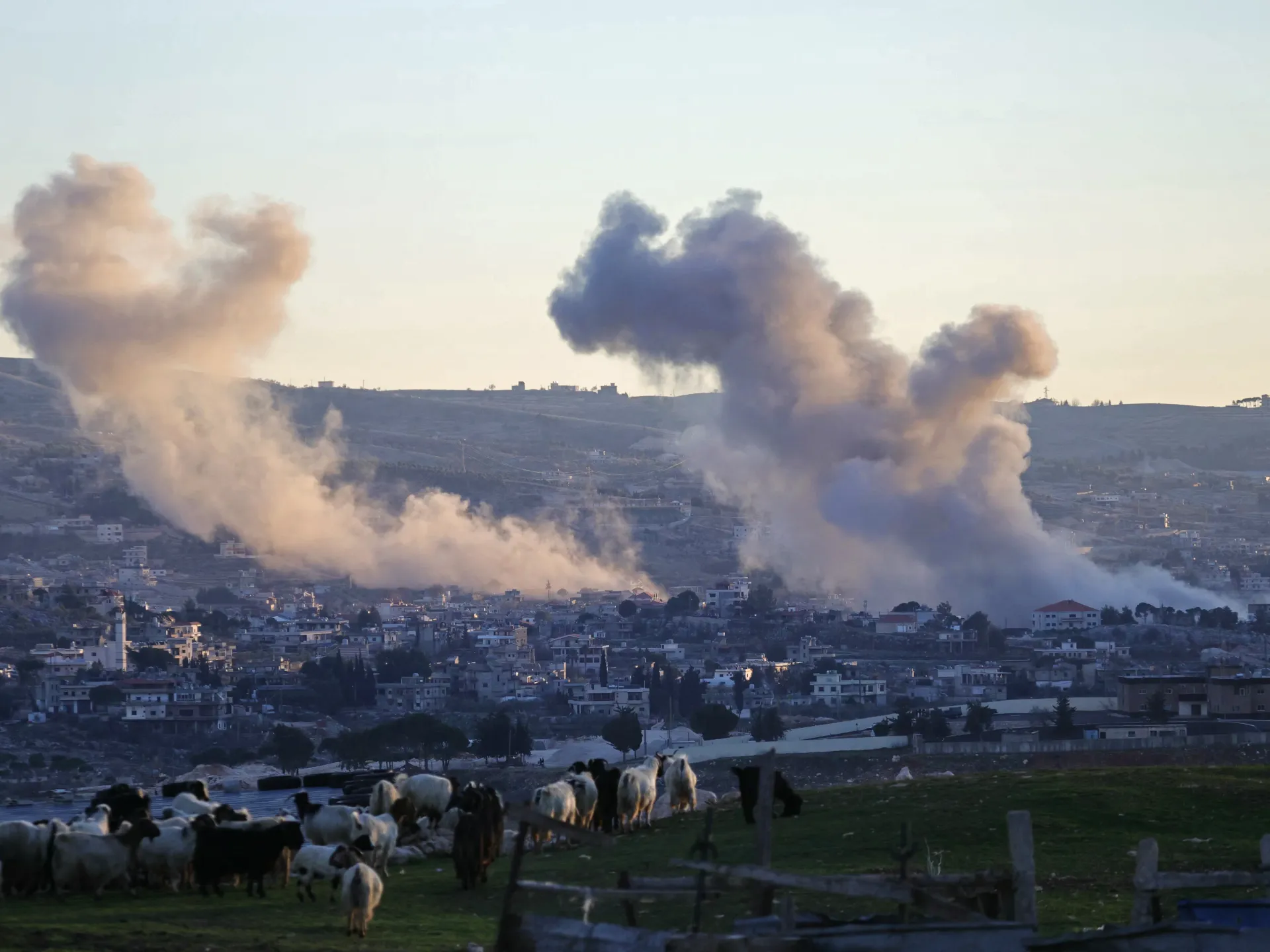
Despite a November 2024 ceasefire agreement, Israel continued to attack south and east Lebanon almost daily. But since Hezbollah’s retaliation, Israel has started bombing Beirut’s suburbs again. On Monday alone, Israel killed more than 52 people, wounded more than 150 others, struck targets all over Lebanon, and gave evacuation orders for more than 50 Lebanese towns.

While Hezbollah’s first attack on Israel in over a year took many by surprise, Israel’s violent response did not.

Critics of Hezbollah pointed out that the group had acted recklessly and gave Israel an excuse to unleash its fury on Lebanon. Israel has also spoken about a potential ground invasion.

For analysts, the Lebanese government’s decision was a clear indication of how far the group has fallen since 2024.

“The government’s decision to officially ban all Hezbollah activities represents a landmark shift in the position of the government toward disarming Hezbollah,” Dania Arayssi, a senior analyst at New Lines Institute for Strategy and Policy, told Al Jazeera. “This is a further reaffirmation that Hezbollah has lost a lot, if not all, its political power and influence in the Lebanese government.”

Arayssi said Hezbollah’s diminished status since 2024 also meant that the likelihood of a clash between the group and the Lebanese Armed Forces (LAF) was minimal.

“I don’t think there is a possibility of this leading to internal strife,” she said.

Hezbollah challenges Salam’s government

Hezbollah did not welcome the announcement.

The head of Hezbollah’s Parliamentary Bloc, Mohammad Raad, dispelled rumours of his assassination on Monday evening when he released a statement dismissing the government’s decision.

“We see no justification for Prime Minister Salam and his government to take bombastic decisions against Lebanese citizens who reject the occupation and accuse them of violating the peace that the enemy itself has denied and refused to uphold for a year and four months,” Raad said in a statement. “[Israel] has imposed a state of daily war on the Lebanese people.”

“The Lebanese were expecting a decision to ban aggression, but instead they are faced with a decision to ban the rejection of aggression,” Raad added.

Jawad Salhab, a political researcher and analyst, called the government’s move “a grave betrayal of the Lebanese people and a grave betrayal of the Lebanese state, whose sovereignty has been violated for 15 months.”

“Fifteen months of strategic patience have cost us more than 500 martyrs, while this Zionist enemy has persisted in its aggression against Lebanon and its sovereignty by air, land, and sea,” he said.

Overnight on Monday, leading into Tuesday, Israel struck targets around Lebanon, including the southern suburbs of the capital Beirut. In one strike, Israel targeted al-Manar, Hezbollah’s television station.

Then, on Tuesday morning, Hezbollah attacked Israel again, in what will be interpreted as a clear challenge to Salam’s announcement.

The Lebanese army had been tasked with an earlier government decision to disarm Hezbollah and said in January that it completed the first phase south of the Litani River. But Hezbollah has refused to move along with phase two, set to take place between the Litani and the Awali River, which is near the city of Sidon.

Nicholas Blanford, a nonresident senior fellow with the US-based Atlantic Council, told Al Jazeera that the government’s move was a “bold step” but one that might be difficult to enforce.

“How can they implement the decision?” Blanford asked, adding that it increased the potential for internal conflict.
Source link

Analysis: Lebanon’s May elections in limbo despite Hezbollah’s decline

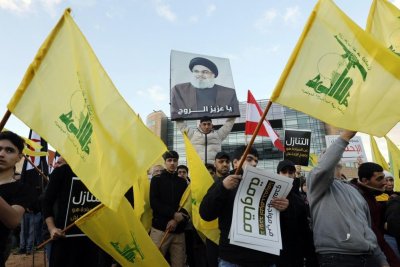
Supporters of Hezbollah and allied parties carry flags of Hezbollah and a picture of former Hezbollah leader Hassan Nasrallah (C) during a protest organized by Hezbollah under the slogan “The entire country is resistance” outside the United Nations Economic and Social Commission for Western Asia headquarters in Beirut, Lebanon, on February 4. Photo by Wael Hamzeh/EPA

BEIRUT, Lebanon, Feb. 28 (UPI) — Lebanon’s parliamentary elections, scheduled for May and widely seen as a new test for the country’s main political players, remain in limbo amid uncertainty over whether they will be held on time or postponed – and whether they will bring about any meaningful change.

While it will be the first election since Iran-backed Hezbollah was significantly weakened during the recent war with Israel, it is unlikely to alter the current balance of power.

Officially, Lebanon says it is ready to proceed on schedule. Most political parties have publicly committed to the vote, with the number of declared candidates for the 128-member parliament rising to 44 as of Friday.

However, as with many other issues in the country, Lebanese are divided over the electoral law and proposed changes concerning expatriate voting and the establishment of mega-centers allowing voters to cast ballots outside their home districts.

Parliament Speaker Nabih Berri, Hezbollah’s main ally and leader of the Shiite Amal Movement, has refused to bring the proposed amendments put forward by his and Hezbollah’s political opponents to a vote.

The current law is largely inapplicable and requires one or two amendments — specifically, whether to allow or bar Lebanese expatriates from voting in embassies abroad for all 128 parliamentary candidates instead of just six — before it can be fully implemented, according to elections expert Nazih Darwish.

“In any case, it would require a parliamentary vote and cannot be implemented automatically,” Darwish told UPI.

The dispute over diaspora voting essentially revolves around equal political rights and the strategic calculations of political parties aiming to protect or increase their leverage.

Delaying the elections by a few months or postponing them for one or two years has emerged as a likely scenario, with each party trying to safeguard or extend its power.

At the heart of the matter is Hezbollah’s reduced influence, both militarily and politically.

If the delay is purely technical — such as moving the elections from May to July — it would not significantly affect the outcome, with one key exception: More members of the diaspora could participate, as many spend the summer in Lebanon, according to Karim Bitar, a lecturer at Saint Joseph University of Beirut and Sciences Po Paris.

Hezbollah, Bitar said, argues that diaspora voting could tilt the balance against it, as it cannot campaign effectively in many European and Western countries, where it is designated a terrorist organization and large Lebanese expatriate communities reside.

“Hezbollah remains a significant force. Even though it was severely weakened militarily, strong support for Amal and Hezbollah persists among their constituencies,” Bitar told UPI. “Supporters feel they must stick together and continue voting for the two parties to prevent rivals from exploiting their political and military setbacks.”

Although many of Hezbollah’s supporters acknowledge that the group was defeated in the war and should admit it, they still pledged to vote for its candidates.

“That’s because no serious political alternatives have emerged so far for Lebanon’s Shiite community,” David Wood, a senior Lebanon analyst at the International Crisis Group, told UPI.

The challenge is that while Hezbollah retains significant backing, not all Shiites in Lebanon support the group, and the existing Shiite opposition lacks a popular base and relies on backing from other groups.

Darwish argued that the balance of power in the country would remain unchanged as long as Hezbollah — which might lose at most two seats if the elections proceed as scheduled — is not fully disarmed.

“That could change if Hezbollah were to relinquish its weapons completely, but not before four to five years, when a genuine Shiite opposition is likely to emerge and succeed in convincing the Shiite base,” he said.

Postponing the elections would thus benefit the country’s main parties: Hezbollah would maintain its current parliamentary representation, while its opponents could wait for regional developments to shift further against Hezbollah and hasten its full disarmament.

“So, the logic would be that a postponement would actually suit Hezbollah’s opponents, because the group’s situation — both inside Lebanon and in the region — will only get weaker.” Wood noted.

What could accelerate the process is either the conflict between the United States and Iran — Hezbollah’s patron — or a deal affecting Iran’s proxies and regional role.

Other political parties, notably the Christian Lebanese Forces — Hezbollah’s main rival — were gearing up for the elections.

Jade Dimien, the Lebanese Forces deputy secretary-general in charge of elections, said the vote could bring change, provided the Lebanese people want it and are ready to make it happen.

Dimien said this year’s general elections would be shaped by major events of the past three years, including the Israel-Hezbollah war, the election of a new president, the government’s firm stance on Hezbollah’s disarmament and the fall of Syrian President Bashar Assad‘s regime.

“There will be some big changes, but whether they will cause a major shift in the balance of power now, I don’t know,” he told UPI, noting the accelerated developments in the region and fearing “compromises” at the expense of Lebanon.

Separately, campaign financing emerges as another major challenge, with some parties favoring wealthy businessmen who can fund their own campaigns amid limited foreign funding.

While not new in Lebanese parliamentary elections, especially after the 1975-90 civil war, such financing has become increasingly visible today, fueled by the 2019 financial collapse.

“Foreign funding has been reduced … even Iran might not be willing under its current conditions to spend as much money supporting Hezbollah,” Bitar said.

The fear remains that wealthy candidates could buy their way into parliament — by paying for votes or providing clientelist services — thereby boosting the seat count of the most powerful parties.

Bitar warned of an even more alarming issue concerning the redistribution of losses following the collapse of the financial system in 2019.

“Major bank shareholders are trying to sway the vote by electing MPs who could block any IMF deal requiring them to cover their share of the losses,” he said.

Source link

Israeli attacks on Lebanon’s Bekaa Valley kill Syrian teenager | News

One killed and 29 others wounded in latest Israeli attack in violation of ceasefire.

Israeli strikes on Lebanon’s Bekaa Valley have killed one person and wounded 29 others, the latest in a series of ceasefire violations.

Lebanon’s Ministry of Health announced that a “16-year-old Syrian boy was killed”, the National News Agency (NNA) reported on Thursday. He was named as Hussein Mohsen al-Khalaf and was killed in a strike on Kfar Dan near Baalbek, the L’Orient news outlet reported.

Recommended Stories

list of 3 itemsend of list

At least 13 air strikes were recorded, four in Shmestar, five in Boudai, two in Harbata and two in the Hermel and Nabi Chit mountains, according to NNA. Several shops were damaged in the Baalbek Souk in Tallet al-Ajami.

The Israeli military said it targeted eight camps belonging to Hezbollah’s special operations unit, the Radwan Force. It said weapons and missiles were stored there and training was conducted “as part of preparations for emergency situations, and to plan and execute terrorist plots”. It said this activity was a “violation of the understandings between Israel and Lebanon”.

Ceasefire violations

Israel’s military has continued to carry out attacks in Lebanon, despite a November 2024 ceasefire with the Lebanese armed group Hezbollah that sought to bring an end to more than a year of fighting. More than 300 people have been killed since then, including 127 civilians, according to the United Nations.

Last week, at least 12 people were killed in Israeli strikes on the Bekaa Valley and the Ein el-Hilweh Palestinian refugee camp near the city of Sidon. Israel said it was targeting Hezbollah and Hamas command centres.

Lebanon filed a complaint with the UN in January, detailing a total of 2,036 Israeli violations between October and December 2025 alone. It called on the UN Security Council to compel Israel to end these actions and to fully withdraw from its borders.

Israel continues to occupy parts of Lebanon, blocking the reconstruction of border villages and preventing people from returning to their homes.

Lebanon’s government has said it has almost completed its ceasefire commitment to disarm Hezbollah south of the Litani River. It said it will need four months to complete the second phase.

However, Hezbollah has rejected this, saying it believes the disarmament in the ceasefire agreement only applies to areas south of the river.

Source link

Lebanon’s tax hikes draw anger from economically frustrated public | Features News

Beirut, Lebanon – Anger in Lebanon is growing after the government of Prime Minister Nawaf Salam announced increases in petrol taxes and value-added taxes (VATs) last week.

The rises in what economists and analysts have called “regressive” taxes led to two protests on February 17 and an array of criticism against the government, including from media and voices that had previously been friendly to Salam’s reformist administration.

Recommended Stories

list of 3 itemsend of list

“The government lost its mind,” Megaphone News, an independent, progressive news outlet published on a social media account in response to Salam’s government announcing a 300,000 Lebanese pound ($3.35) price increase on 20 litres (about 5.3 gallons) of petrol or gasoline and a one percent increase from 11 to 12 percent on VAT – a consumption tax charged on goods and services at each stage of production.

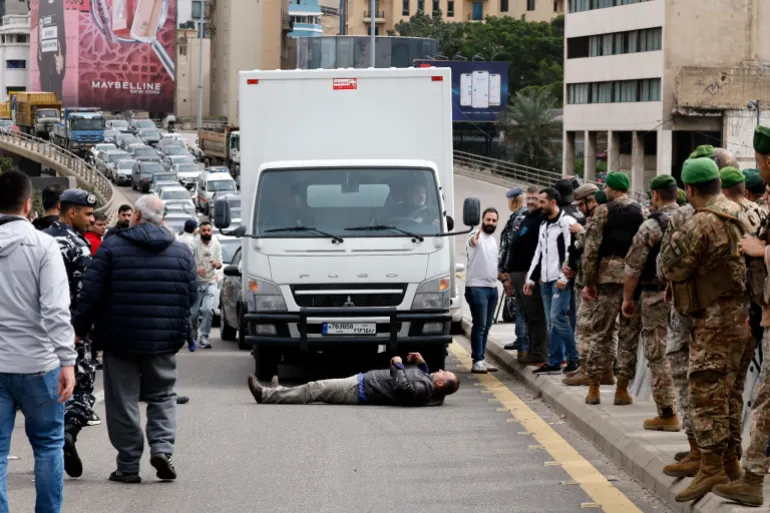
epa12749352 A taxi driver lies on the ground in front of a truck as taxi drivers block a main road with their vehicles during a protest in Beirut, Lebanon, on 17 February 2026. Taxi drivers blocked the Ring Highway with their vehicles to protest against the increased taxes and gasoline prices approved by the Cabinet during its meeting on 16 February. EPA/WAEL HAMZEH
A taxi driver lies on the ground in front of a truck as taxi drivers block a main road with their vehicles during a protest in Beirut, Lebanon, on February 17, 2026 [File: Wael Hamzeh/EPA]

On the morning of February 17, a handful of taxi drivers blocked the Ring Bridge in downtown Beirut to protest the rise in taxes. Later that evening, in Riad al-Solh Square, around 50 or so protesters gathered to express their discontent with the government’s decision.

“You have no housing, you have no loans, you have no safety, I mean, you live here in a prison, brother,” one angry protester told Lebanese television station Al Jadeed from the Ring Bridge protest.

His comments represent the frustration felt by many Lebanese – that the tax increases are yet another indignity the population must live through, including near-daily Israeli attacks and violations of the 2024 ceasefire, collapsing buildings in the north, and an ongoing economic crisis since 2019.

Salam doubles down

The last time a tax spike sent Lebanese people to the streets was in 2019. Anger in Lebanon had boiled after decades of economic and political mismanagement by the government. Then, as the country’s economy started collapsing, the government tried to implement a series of taxes, including on WhatsApp calls.

The response was widespread protests that collapsed the government, led at the time by then-Prime Minister Saad al-Hariri. But they failed to dislodge the wider sectarian system that many activists and experts say plagues Lebanon and prevents reform.

Last week’s protests were on a far smaller scale than 2019, however.

Then, protesters forced the government to walk back the taxes. But Salam, the prime minister, defended the tax hike on Friday. The government’s argument is that the taxes are necessary to pay salaries and pensions for state employees and retirees.

“We had to find a quick source to fund the raises,” he said. “These are exceptional measures… but the government wants to reform the tax system, not just impose new taxes.”

Salam also said that his government inherited a “very difficult” financial situation and promised that he would rebuild trust between the state and the people by working to establish a fair tax system.

Lebanon’s Finance Minister Yassine Jaber said the fuel price increase would take effect immediately, but that VAT increases would need parliament’s approval.

“More than 50 per cent of the budget today is allocated to salaries, and it was necessary to take steps to secure the funds,” he said.

VAT is a regressive tax

But not everyone agreed with the decision, including some ministers themselves. The right-wing Lebanese Forces bloc – which is part of the government coalition – voiced objection to the tax increase, calling for a study of the impacts.

Analysts, meanwhile, were heavily critical of the tax increase. They said that the rise of petrol prices and VAT would punish the country’s most vulnerable and would further widen the gap between rich and poor in Lebanon.

“The people who are most affected by value-added taxes are usually the poorest of the poor and the most vulnerable, given the type of their consumption, which is mostly filled of the goods and the services that are affected by taxation, and whereby the proportion of the taxation is significant,” Farah al-Shami, senior fellow and programme director for Social Protection at the Arab Reform Initiative, told Al Jazeera. “VAT is by nature the most regressive type of taxation. Studies have shown that it affects the full supply chain, meaning everything that goes into the production, for example, of a certain good is affected.”

A price increase at every step of the supply chain means that prices compound to end up being more expensive for consumers.

In 2019, decades of government mismanagement of the economy ended in the collapse of the banking sector and the depreciation of the Lebanese pound by over 90 percent. Before 2019, $1 was equivalent to 1,500 Lebanese pounds, whereas now $1 is valued at nearly 89,500 Lebanese pounds.

Many lost their life savings with the currency freefall. Banks quickly shut their doors and limited withdrawals. More than six years later, many Lebanese have not recovered, nor has the economy.

Scandalous undertaxing

The high cost of living is a regular talking point among Lebanese, particularly in the capital, Beirut. Many are struggling to make ends meet and rely on the $5.8bn in remittances from family or contacts abroad (these are 2024 figures).

With so many struggling, a tax increase that impacts the entire population is a recipe for anger. And analysts said that if the government is in need of tax revenue, there are plenty of undertaxed sources to draw from.

“Property in Lebanon remains scandalously undertaxed,” Dania Arayssi, a senior analyst at New Lines Institute for Strategy and Policy Luxury, told Al Jazeera. “Real estate in Beirut — some of the most expensive per square metre in the region — generates a fraction of the public revenue it could and should. Capital gains on property are minimal. Wealth held in land and assets is effectively sheltered. Similarly, luxury goods face no meaningful additional burden.”

Fouad Debs, a lawyer and member of the Depositors Union, a group founded after the 2019 banking crisis to protect the rights of depositors, said the decision went against the government’s stated goals of reform.

“All of this is to keep the [current] system intact and save the banks, instead of having them also pay the taxes that they should pay,” Debs said.

Source link

Deadly tower collapse has locals in Lebanon’s Tripoli asking: Are we next? | Infrastructure

Tripoli, Lebanon – Hossam Hazrouni points underneath a concrete staircase to the exposed foundation of the building where he lives.

“Inside, there, look,” the 65-year-old says. “The interior pillars are all broken. It’s covered in water. Everything inside is wet.”

Recommended Stories

list of 3 itemsend of list

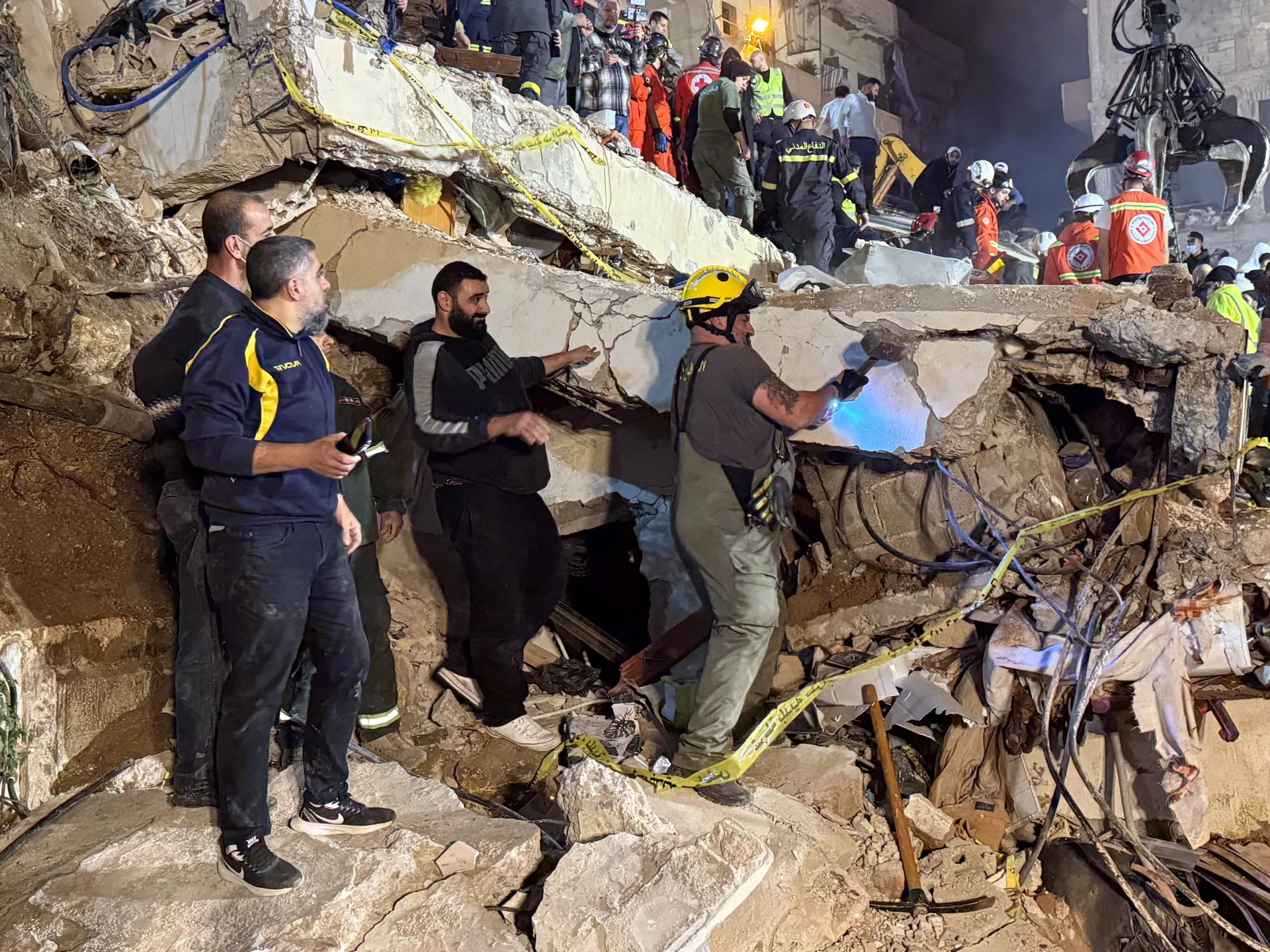
A few metres away lies a pile of smashed concrete blocks and twisted metal. It is the rubble of a building that collapsed on February 8, killing at least 15 people.

In Tripoli, collapsed buildings are fast becoming common. This is the fourth building to collapse this winter alone. Today, hundreds of buildings are at risk of collapse due to a lethal combination of ageing infrastructure, unregulated construction, Lebanon’s 2019 economic crisis, the 2023 earthquake that fractured much of the local infrastructure’s foundation, and a relatively heavy rain season.

Locals like Hazrouni are afraid their buildings will be next.

“They told us that you should evacuate and you shouldn’t stay, but how are we supposed to leave when we are in a bad situation?” he asked, raising his palms to the sky. “Where are we supposed to go?”

Collapsing structures

In the 1950s, Tripoli, Lebanon’s second-largest city and the largest in the country’s north, was a hub for trade and shipping in the region. But in the intervening years, its status has fallen to become one of the poorest cities on the Mediterranean Sea.

It is also a city of massive disparity. Multiple billionaires live in Tripoli, including the former Prime Minister Najib Mikati and former Minister of Finance Mohammad Safadi, while about 45 percent of the city’s population lives in poverty, according to a 2024 World Bank report.

Over the years, most of Tripoli’s middle- and upper-class residents have moved to the southern edge of the city, leaving behind its impoverished classes to inhabit the decaying old city. Many of the poor know their concrete buildings are ageing and in poor condition, but have little means to fix them.

“The first problem is that the structures are old,” Fayssal al-Baccar, an engineer, told Al Jazeera from a restaurant in southern Tripoli. Al-Baccar is also the founder of the Tripoli Emergency Fund, a private initiative started in response to the collapsing building issue that has been fundraising to help the city.

“The lifespan of concrete is between 50 to 80 years,” al-Baccar explained, and in many of the buildings in central Tripoli, that lifespan is coming to an end. On a sheet of white paper with a blue pen, he drew a model of a building’s foundation.

“Through time, the pH [level] of the concrete will become more and more acidic,” he said, sketching lines around the base of his drawn wall. “Then it will corrode the steel – the steel will self-destruct – and the building will collapse.”

The issue has been exacerbated by a few incidents in particular. When a 2023 earthquake devastated northern Syria and southern Turkiye, it was widely felt in Tripoli as well. Local officials say that it damaged much of the infrastructural foundations of older buildings, many of which have had irregular or unregulated floors added to them, making them weaker. The area has also suffered from neglect and a lack of infrastructure for years, even before the 2019 economic and banking crisis.

Lastly, there is the issue of water damage. This year, Lebanon has received more rainfall than in the last couple of years. And in the days leading up to the collapsed building on February 8, it rained multiple times. “Water is infiltrating into the concrete and is also making the steel worse,” al-Baccar said.

That is why al-Baccar has recruited whom he described as some of the city’s “best and most successful” to help fill governmental gaps.

One of those people is Sarah al-Charif, the Tripoli Emergency Fund’s spokesperson and fundraising committee member. She is also the Lebanon director for Ruwwad Al Tanmeya, a nonprofit focused on youth and disenfranchised communities, and was appointed vice president of Tripoli’s Port Authority last year.

“You’re talking about areas where most, if not all, of the buildings are old and dilapidated, some of which are actually on the verge of collapse,” al-Charif said from her office at Ruwwad Al Tanmeya’s office in Bab al-Tabbaneh, less than a kilometre (0.62 miles) away from where the building collapsed on February 8.

“The fact that the problem is so big reflects decades of accumulated neglect by a state that hasn’t fulfilled its obligations towards this city,” she said.

Al-Charif said she doesn’t hold the current government – which took office a year ago – responsible, but that historically, “people who were in positions of power didn’t do anything, they weren’t fulfilling their duties”.

“There’s also a part that falls on the landlord, a part that falls on the tenant, and a part that falls on the merchants who are the builders. Maybe they’re using substandard materials,” she said. “So everyone has to take their share of the responsibility.”

Historical neglect

Standing on the street, Wissam Kafrouni, 70, points to the top floor of a building just a few doors down from the structure that collapsed on February 8. A crack runs zig-zagging down the building’s side, in the pattern of descending stairs. His nephew rents the top-floor apartment, he says, but the landlord is claiming that repairs are the responsibility of the tenant.

Locals in this neighbourhood say that many officials have visited the site in recent days, including Prime Minister Nawaf Salam. They also say that they’ve been told for years that the local municipality has plans to fix the infrastructure, but that little has come about from it.

The local government has known about the issue for years, but until now, little has been done. Deputy Mayor Khaled Kabbara is part of a new municipal government elected in 2025.

“The issue of cracked buildings is a very old issue in the city of Tripoli, and unfortunately, it has not been dealt with in previous periods,” he told Al Jazeera from Tripoli’s municipality headquarters. But this new municipal government that was elected in 2025, he said, has “raised its voice”.

Kabbara also said that Tripoli has been historically ignored by Beirut “since independence” in the 1940s, but that the current government was working with the local government to find solutions.

“Honestly, this is the first time that we feel that someone is listening and there is someone who is working with us,” he said.

A group of engineers are currently inspecting buildings around the city to decide if damaged buildings can be repaired or must be evacuated and demolished. Evacuation warnings have been issued for 114 buildings, though that number is expected to rise substantially.

Families that evacuate should receive a one-year shelter allowance to secure alternative housing. Religious institutions have opened their doors to evacuees, while Turkiye has also promised to donate about 100 prefabricated houses.

A call centre has also been set up for residents to report suspected issues with their buildings. The hotline has so far received reports on approximately 650 different buildings, Kabbara said.

One of the buildings previously reported to the call centre was the building that collapsed on February 8. Locals had heard a creaking sound coming from the building.

Kabbara acknowledged that the report was received and that the residents were afraid. However, he said, the engineers had not inspected it before it collapsed because nothing in the report indicated it needed an urgent inspection.

What comes next?

Back in Bab al-Tabbaneh, numerous locals expressed frustration and fear. They said many officials and associations have visited the site, but few have delivered on promises to help them.

“We’ve been told there is a plan to fix the infrastructure since the Siniora government,” Samir Rajab, 56, said, referring to Fouad Siniora, the prime minister of Lebanon from 2005 to 2009. “But nothing happens.”

Next to the destroyed building site, Mustapha al-Abed, 54, repaired a broken washing machine out of a small workshop. He said his work was not very fruitful lately, as poverty forced many in this area with broken appliances to wash their laundry by hand.

He looked over at the site where the building had gone down just days earlier. “The problem is not here any more. These people are already dead,” he said. He then pointed across the street to a bustling neighbourhood, where people were doing their Ramadan shopping.

“The problem is all the other buildings.”


Source link